Introduction
Aedes aegypti (Linnaeus) (Diptera: Culicidae) is the main vector of dengue viruses (serotypes 1–4), responsible for dengue fever, dengue shock syndrome, and dengue haemorrhagic fever, which are endemic diseases throughout tropical and subtropical countries. An estimated 2.5 billion people live in areas where they are at risk of becoming infected with dengue virus. Dengue virus transmission accounts for ∼100 million new infections and 20 000 deaths per year (World Health Organization 2009). There are no vaccines or antiviral treatments available for dengue, and disease control is based on reducing insect bites and vector populations (Mackenzie et al. Reference Mackenzie, Gubler and Petersen2004). Despite extensive vector control efforts, disease incidence continues to increase due to the concurrent presence of multiple virus serotypes circulating in many geographical regions (World Health Organization 2009). It is imperative to explore alternative strategies to decrease the transmission of this disease. Advances in molecular techniques such as genome sequencing and genetic manipulation open new routes to improve disease transmission control.
Vector competence (VC) is the intrinsic permissiveness of an arthropod vector to infection, replication, and transmission of a virus (Hardy Reference Hardy1988; Woodring et al. Reference Woodring, Higgs and Beaty1996). VC is controlled by genetic and environmental factors. Low VC, or refractoriness, is associated with different barriers that inhibit viral replication or dissemination (Black et al. Reference Black, Bennett, Gorrochotegui-Escalante, Barillas-Mury, Fernandez-Salas and de Lourdes Munoz2002). An inability of the virus to enter or replicate in the midgut is referred to as a midgut infection barrier (MIB), while an ability to infect the midgut but not move subsequently into other regions of the vector is known as a midgut escape barrier (MEB). If the virus escapes the midgut it must breach the salivary gland barrier and enter the salivary glands for transmission (Woodring et al. Reference Woodring, Higgs and Beaty1996). Understanding the genetic factors associated with VC and those factors that regulate the barriers to viral development will allow us to identify new strategies to decrease transmission based on genetic manipulation, or may identify DENv-specific molecules that may become targets for new drugs or vaccines (Beerntsen et al. Reference Beerntsen, James and Christensen2000; Alphey et al. Reference Alphey, Beard, Billingsley, Coetzee, Crisanti and Curtis2002). In A. aegypti, the genetic components of VC have been studied through selections of strains with different susceptibilities to dengue virus (Gubler et al. Reference Gubler, Nalim, Tan, Saipan and Sulianti Saroso1979; Miller and Mitchell Reference Miller and Mitchell1991; Bennett et al. Reference Bennett, Olson, Munoz Mde, Fernandez-Salas, Farfan-Ale and Higgs2002, Reference Bennett, Flick, Fleming, Jochim, Beaty and Black2005). Methodologies such as random amplified polymorphic DNA-polymerase chain reaction (RAPD-PCR) markers and quantitative trait loci (QTL) have identified biological markers associated with VC (Gubler et al. Reference Gubler, Nalim, Tan, Saipan and Sulianti Saroso1979; Bosio et al. Reference Bosio, Fulton, Salasek, Beaty and Black2000; Black et al. Reference Black, Bennett, Gorrochotegui-Escalante, Barillas-Mury, Fernandez-Salas and de Lourdes Munoz2002) but have not identified specific genes that determine VC. Once specific genes are identified these must be evaluated in strains of A. aegypti that demonstrate different levels of susceptibility and well-known and characterised infection barriers. It is unknown whether the same genetic regulation of VC is conserved across geographic strains of a vector species or sympatric vectors of different species. Comparing the VC of strains from different geographical origins might yield different models to evaluate and validate general antiviral control mechanisms.
Previous studies carried out in A. aegypti collected from Cali, Colombia, demonstrated a high variation in VC depending on the time and location of collection (Ocampo and Wesson Reference Ocampo and Wesson2004), and we have observed the presence of different anatomical barriers. Based on these studies, we began to select strains with different susceptibilities to Dengue-2 virus (DENv-2) using the isofemale selection methodology (families obtained from a mother with a specific phenotype) (Tardieux et al. Reference Tardieux, Poupel, Lapchin and Rodhain1991) starting with field collected mosquitoes, to allow us to study genetic components associated with VC in these A. aegypti populations. The objectives of this research were to select for higher levels of specific phenotypes (resistance or susceptibility to DENv) and to measure the effects of this selection on fitness parameters.
Materials and methods
Mosquitoes
Laboratory colonies were established from field collected larvae and pupae from artificial larval habitats in five locations at least 10 km apart in the city of Cali, Colombia. The mosquitoes were maintained under standard laboratory conditions: 26 ± 2 °C, 70% relative humidity, and a 12:12 hour light:dark cycle. Larvae were maintained in plastic containers at a density of 300 larvae/2 L of water and were fed daily with 2 mL of a stock solution (8 g/400 mL) of beef liver (DIFCO, Becton, Dickinson and Company, Franklin Lakes, New Jersey, United States of America). Adults were fed with a 10% sugar solution. Blood feeding was done through an artificial membrane feeder using a pig intestine membrane and defibrinated rabbit's blood. The Filial 1 (F1) eggs were stored and used to begin the selection process.
Virus strain
DENv-2 New Guinea C strain, freshly grown in C6/36 HT (Aedes albopictus [Skuse] cells), was used in oral challenges. Infected cells were incubated for 14 days at 32 °C in L15 medium supplemented with 2% heat-inactivated foetal bovine serum, 1% penicillin/streptomycin, and 1% l-glutamine (Higgs et al. Reference Higgs, Traul, Davis, Kamrud, Wilcox and Beaty1996). Virus and cells were harvested and collected in a 15-mL conical centrifuge tube. Aliquots of the infected cell suspension and the mixture of blood and virus before and after the infection process were titered as described by Bennett et al. (Reference Bennett, Olson, Munoz Mde, Fernandez-Salas, Farfan-Ale and Higgs2002). Titres in the cell suspensions ranged from 108 to 108.5 TCID50/mL in all oral challenges. The viral suspension was used in experimental infections and also to microinject the virus intrathoracically into mosquitoes, to serve as positive controls for indirect immunofluorescence (IFI) studies.
Mosquito infection and virus titration
Five-day-old female A. aegypti (F1) that had been starved for 12 hours were exposed for 2 hours to an infectious bloodmeal consisting of a 1:1 mixture of defibrinated rabbit blood and the dengue virus suspension via a membrane feeder described above. Subsequently, engorged females were maintained individually in plastic (2 cm × 4 cm) containers and given access to moist cotton and a piece of moist filter paper for oviposition.
The presence and concentration of virus to which the females were exposed was determined in: (a) uninfected rabbit blood, (b) virus suspension, and (c) the mixture of blood and virus at the beginning and end of the exposure period as described by Bennett et al. (Reference Bennett, Olson, Munoz Mde, Fernandez-Salas, Farfan-Ale and Higgs2002).
Indirect IFI was used to determine the percentage of infections in the head and midgut of each female as described by Wallis et al. (Reference Wallis, Aitken, Beaty, Lorenz, Amato and Tabachnick1985). Fourteen days post exposure, the barriers to virus dissemination were determined as described previously (Bennett et al. Reference Bennett, Olson, Munoz Mde, Fernandez-Salas, Farfan-Ale and Higgs2002; Black et al. Reference Black, Bennett, Gorrochotegui-Escalante, Barillas-Mury, Fernandez-Salas and de Lourdes Munoz2002). A murine IgG polyclonal antibody bound to FITC (Dengue FITC conjugate + 2% BSA; obtained from the Center for Disease Control, Puerto Rico, United States of America), in a 1:200 dilution, was used in the IFI.
Selection of Susceptible (S), refractory-midgut infection barrier (R-MIB), or refractory-midgut escape barrier (R-MEB) strains
We determined the phenotype of the mothers using IFI to begin the selection process. Heads of females that were positive with IFI indicated susceptible mothers with no midgut barriers (Cali-S). We assumed that this population had no barriers to virus dissemination. The midgut of mothers whose heads were negative to IFI were dissected to determine anatomical barriers associated with virus infection. Positive IFI analysis of the midgut indicated a MEB, and these females and their descendents were classified as refractory MEB (Cali-MEB). Negative midgut IFI analysis indicated a MIB and these females and their offspring were classified as refractory MIB (Cali-MIB).
The selection by phenotype after exposure to DENv-2 was not done in every generation. The strains were exposed to blood free of dengue virus every second generation to allow them to recover from any fitness limitations. This protocol was initiated after the F1 generation and continued throughout the selection process. The offspring of females that demonstrated the same phenotype in each selection process were grouped with the aim of increasing genetic variability and increasing the numbers of each strain.
Survival analysis
The effects of the infection and initial selection on the fitness of these selected strains were evaluated using Kaplan–Meier survival analyses for the first seven generations. This technique estimates the survival over the stages of egg hatching, larvae, pupae, and adult emergence. Survival was therefore measured in terms of the stage achieved, rather than time in days. The Kaplan–Meier survival probabilities are applicable because they depend only on the ordering of the stages, not their duration in days. The final point of the survival curve is the proportion of eggs surviving to emergent adults. Using Greenwood standard errors, these proportions were analysed by contrasts, in terms of trends over generations (1–7), and differences between strains (Cali-S, Cali-MIB, and Cali-MEB) (Armitage et al. Reference Armitage, Berry and Matthews2001). The average number of eggs laid per female in generations exposed to DENv was evaluated using the nonparametric Kruskal–Wallis test (K–W). The proportion of eggs that hatched was evaluated among strains and generations using a χ 2-test for multiple comparisons. A negative binomial analysis was used to compare differences in the percentage of mortality per developmental stage between our strains and also to compare these parameters between the parental generation and subsequent virus-exposed generations. The reported effect measure is the incidence rate ratio (IRR) with the 95% confidence intervals (95% CI).
Results
Strain selection
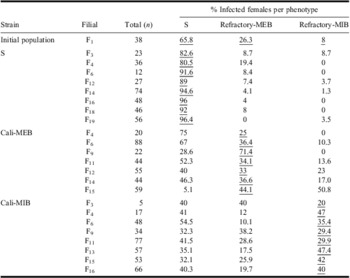
In offspring of Cali-S females, the percentage of susceptibility (positive head infections) increased from 65.8% (F1) to 96.4% (F19) through the selection process. Any inherent midgut barriers were reduced over the 19 generations (Table 1). In offspring of mosquitoes with the Cali-MIB phenotype, refractoriness (absence of infection) increased from 8% (F1) to 40% (F16). During the selection process we observed variability in the frequency of individuals with MEB phenotype (Table 1). The Cali-MEB strain first increased from 26.3% (F1) to 71.4% in generation 9, then fell to 34.1% (F11) and increased again to 44.1% in generation 15 (Table 1). The titre of the DENv-2 preparation used was monitored throughout all selections and ranged from 108 to 108.5 TCID50/mL (50% tissue culture infective doses/mL) at the beginning of virus exposure and from 107.2 to 107.4 TCID50/mL at the end of the exposure period. All rabbit blood was free of infection.
Effect of selection on the percentage of females from different selected strains that are susceptible to infection with DENv-2.

Notes: The selected phenotype is underlined.
DENv-2, dengue-2 virus; S, susceptible strain; MEB, midgut escape barrier; MIB, midgut infection barrier; Cali-MEB, refractory with midgut escape barrier strain; Cali-MIB, refractory with midgut infection barrier strain.
Effects of DENv-2 infection on the survival of eggs to emergent adults of the selected strains
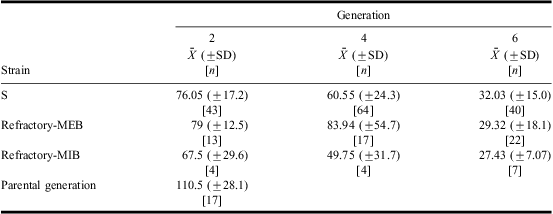
The average number of eggs laid per female diminished during the selection process, from 110 eggs/female in the Parental (F1) generation to <40 in the F6 generation in all selected strains (Table 2). There were significant differences in the overall number of eggs laid between the parental and the subsequent generations (K–W χ 2 = 58.339, df = 4, P < 0.001) and among the generations (Cali-S: K–W χ 2 = 63.91, df = 2, P < 0.001; Cali-MEB: K–W χ 2 = 27.79, df = 2, P < 0.001; Cali-MIB: K–W χ 2 = 4.33, df = 2, P < 0.001).
Average number of eggs laid per female of Cali-S, Cali-MEB, and Cali-MIB Aedes aegypti strains at different generations of selection against DENv-2.
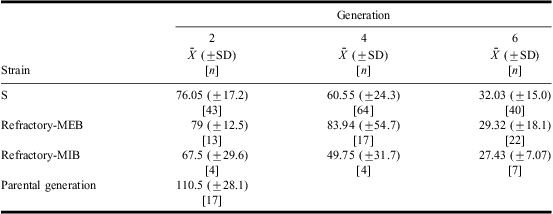
Notes: The sample sizes are indicated in [ ].
Cali-S, susceptible strain; Cali-MEB, refractory through a midgut escape barrier strain; Cali-MIB, refractory through a midgut infection barrier strain; MEB, midgut escape barrier; MIB, midgut infection barrier; DENv-2, dengue-2 virus.
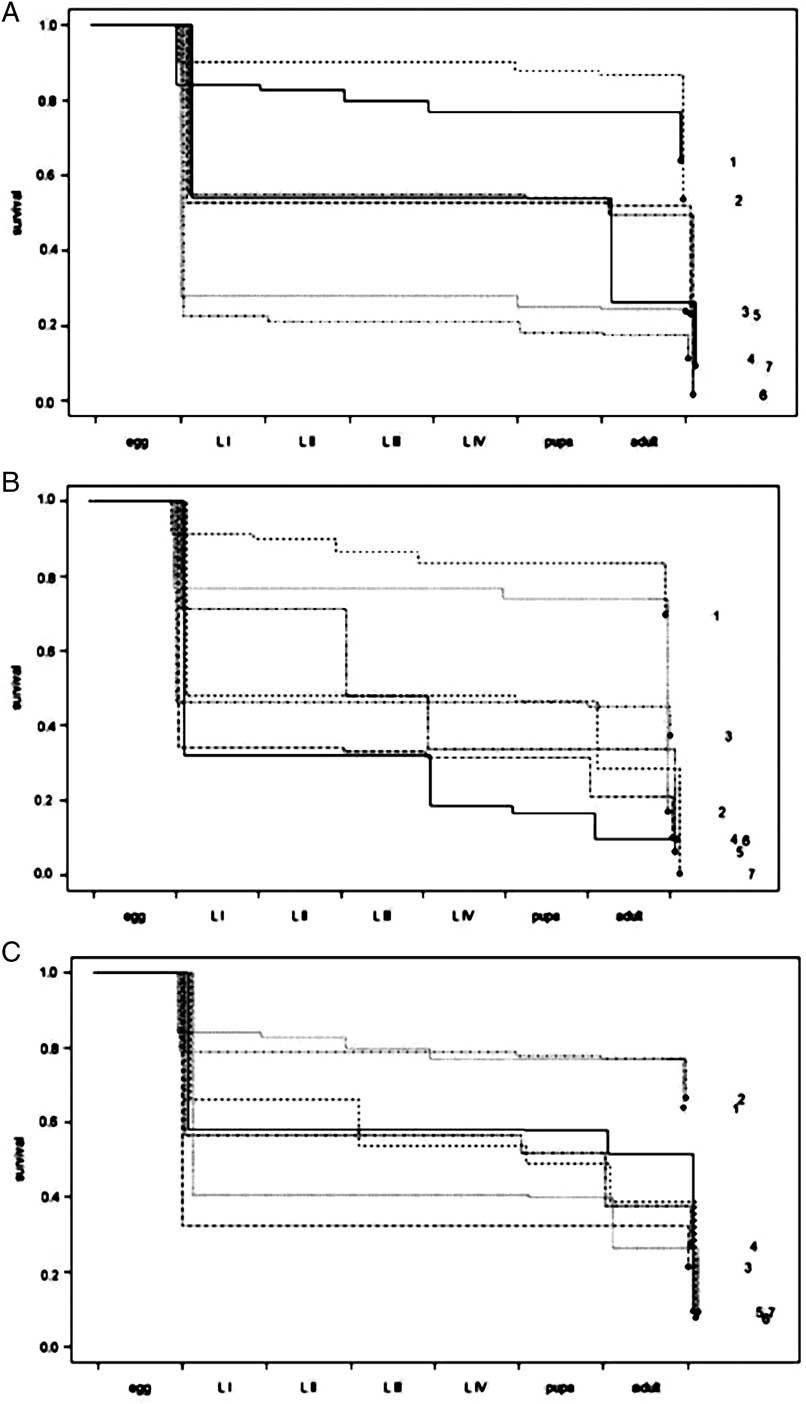
The survival curves for the three strains are shown in Figure 1. Of all the eggs laid, there was a trend for the proportion of eggs hatching and surviving to adults to be reduced over the generations (P < 0.001). On average over the seven first generations, the proportion of eggs surviving to adults fell to 29.4% for the S strain, 26.7% for the Cali-MEB strain, and 21.5% for the Cali-MIB strain (P < 0.001), relative to the F1 strain.
Kaplan–Meier analysis of the survival of three selected strains of Aedes aegypti in response to exposure to Dengue-2 virus over seven generations. (A) Refractory through a midgut escape barrier (Cali-MEB); (B) Refractory through a midgut infection barrier (Cali-MIB); (C) Susceptible strain (Cali-S).
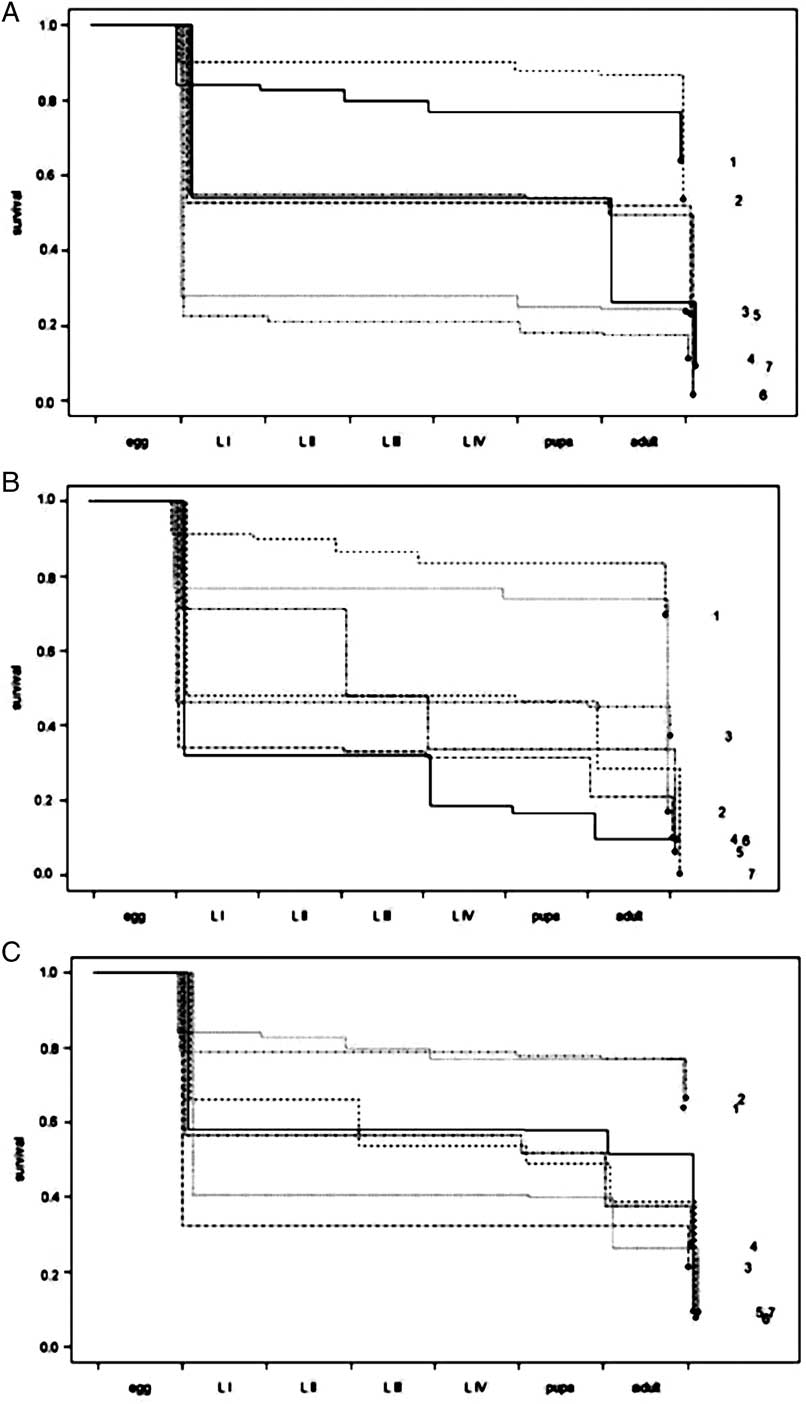
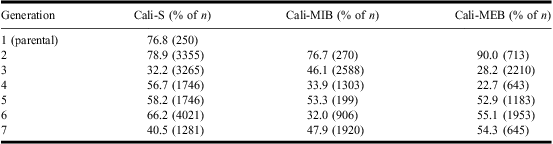
Most of these differences can be attributed to the percentage of eggs that hatched. Mortality was observed mainly in the first day during the egg hatching period (Fig. 1). In the Cali-S strain the percentage of eggs that hatched to produce viable larvae was reduced from 78.9% to 40.5% between generations 2 and 7 (Table 3). Similarly, between generations 2 and 7, the hatching rates of eggs in the Cali-MIB strain were reduced from 76.7% to 47.9%, and in the Cali-MEB strain from 90% to 54.3% (Table 3).
Effect of infection with DENv-2 on the egg hatching rates over different generations in the selected strains of Aedes aegypti.
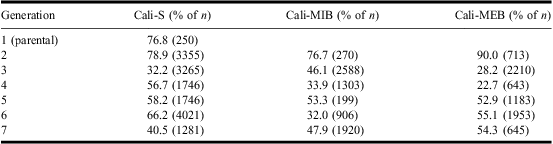
Notes: Generation 1 is the parental strain brought into the laboratory as field collected pupae.
Strains are Cali-S, Cali-MIB, and Cali-MEB.
Numbers represent % of eggs that hatched from (n) eggs.
DENv-2, dengue-2 virus; Cali-S, susceptible strain; Cali-MIB, refractory through a midgut infection barrier strain; Cali-MEB, refractory through a midgut escape barrier strain.
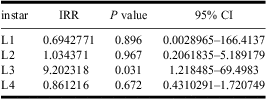
Of the first instars that did hatch, there were no significant differences in the survival of L1–L4 larvae in any of the strains (negative binomial regression, P > 0.05; Table 4). Similarly, there were no differences in the survival of larvae once they hatched between generations within a strain (negative binomial regression, P > 0.05). In the Cali-MEB strain there were significantly more losses at the pupal stage over generations of selection. Within the other strains there were no significant differences in pupal survival over the six generations.
Parameters of the negative binomial regression analysis of larval mortality among the three strains of Aedes aegypti: Cali-S, Cali-MIB, and Cali-MEB.
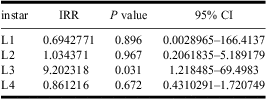
Cali-S, susceptible strain; Cali-MIB, refractory through a midgut infection barrier strain; Cali-MEB, refractory through a midgut escape barrier strain; IRR, incidence rate ratio; CI, confidence ratio.
Initially all selected strains spent more time as 4th instar and pupae than established laboratory colonies, and emerging females were receptive to a bloodmeal at later periods (5–8 days post emergence) than established laboratory colonies (3–4 days post emergence).
Discussion
Selection in nonconsecutive generations yielded survival and allowed maintenance of significant populations of these strains through >15 generations. Previously, when all generations were exposed consecutively to selection pressure, we were able to maintain the strains for only three generations.
The selection-free generations allowed the mosquitoes to recuperate from the stress and to ensure maximum survival of all selected strains. The decrease in survival, due to a decrease in hatching, observed in the first three generations of constant or alternate generation selection, may have resulted from recessive deleterious alleles being expressed due to the high degree of relatedness (Bennett et al. Reference Bennett, Flick, Fleming, Jochim, Beaty and Black2005). Dengue, and other horizontally transmitted arboviruses, has been reported to have negative effects on A. aegypti including a reduced fitness of the arthropod hosts (Lambrechts and Scott Reference Lambrechts and Scott2009; Maciel-de-Freitas et al. Reference Maciel-de-Freitas, Koella and Lourenco-de-Oliveira2011). In addition, other linked alleles that were deleterious or “side effects” caused by the alleles that conferred resistance, also may have contributed to the reduced fitness we observed.
The selection of Cali-S, Cali-MEB, and Cali-MIB strains, whose phenotypes are defined in relation to infection with DENv-2, confirms the heritable component of these characteristics (Hardy Reference Hardy1988). Although we did not achieve 100% susceptible or refractory phenotypes in these selections, we did increase the values compared with the original field collected mosquitoes. We do not know, nor could we control for, the phenotype of the male, and similar results were reported in Culex tarsalis Coquillett (Hardy et al. Reference Hardy, Apperson, Asman and Reeves1978).
In this study, we experimentally infected A. aegypti with titres of DENv-2 ranging from 107 to 108 TCID50/mL; similar levels to which they would be exposed when biting a human suffering from dengue fever. Studies of the variation in susceptibility to dengue virus infection suggest that a constant virus titre must be used in each experiment because this quantitative factor can affect the determination of the VC (Gubler et al. Reference Gubler, Nalim, Tan, Saipan and Sulianti Saroso1979). Additionally, larval density, food availability, and temperature conditions were controlled for all the selected lines, which produced homogenous populations. We did not evaluate other variables such as viral dose, mosquito size, the specific combination of vector and virus genotypes, or changes in temperatures found in the field that are known to affect virus susceptibility (Gubler et al. Reference Gubler, Nalim, Tan, Saipan and Sulianti Saroso1979; Lambrechts Reference Lambrechts2011; Lambrechts et al. Reference Lambrechts, Paaijmans, Fansiri, Carrington, Kramer and Thomas2011).
The exact mode of inheritance of the susceptible or refractory phenotypes was not determined in this study. However, the susceptible strain was dominant in all three selection schemes (Table 1). In the S strain the proportion of individuals with this phenotype increased progressively with generations of selection. In contrast, there was greater variation in the selection results for refractory strains (Table 1). Although there was an initial increase towards refractory phenotypes (Cali-MEB and Cali-MIB) under selection, this did not continue consistently, suggesting that there are adverse effects or fitness costs associated with the selection. The relatively easy selection of the susceptible phenotype differs from previous reports that suggested that the DENv-2 resistant phenotype in A. aegypti was dominant over the susceptible phenotype (Gubler and Rosen Reference Gubler and Rosen1976). Instead, our results agree with Hardy et al. (Reference Hardy, Apperson, Asman and Reeves1978) who reported that in C. tarsalis there was a complete or partial dominance of the susceptible over the resistant phenotype in response to infection with equine encephalitis virus. The results of this study suggest that VC is associated with multiple genes that have some additive effects on susceptibility, as suggested previously (Bosio et al. Reference Bosio, Beaty and Black1998).
Other studies on the genetics of VC for flavivirus infections in A. aegypti also have used strain selection by isolines. Wallis et al. (Reference Wallis, Aitken, Beaty, Lorenz, Amato and Tabachnick1985) selected lines of A. aegypti susceptible and refractory to infection with the yellow fever virus. Similarly, Tardieux et al. (Reference Tardieux, Poupel, Lapchin and Rodhain1991) selected lines of A. aegypti from a French Polynesian colony using isofemale lines, and concluded that the variation in susceptibility to DENv-2 was partially controlled by genetic factors. Bennett et al. (Reference Bennett, Flick, Fleming, Jochim, Beaty and Black2005) selected two strains of A. aegypti on the basis of isofamilies that differed in their susceptibility to infection with DENv-2 and Miller and Mitchell (Reference Miller and Mitchell1991) selected A. aegypti strains that were completely refractory or highly susceptible to the yellow fever virus.
Recent advances in molecular biology, genetics, and statistics have allowed us to map QTL in relation to parasite or pathogen infection (Severson et al. Reference Severson, Mori, Zhang and Christensen1994a, Reference Severson, Mori, Zhang and Christensen1994b; Bosio et al. Reference Bosio, Beaty and Black1998, Reference Bosio, Fulton, Salasek, Beaty and Black2000; Bennett et al. Reference Bennett, Flick, Fleming, Jochim, Beaty and Black2005). These studies have confirmed that the genetic component of VC is a product of multiple genes acting additively or in a dominant manner. These results suggest that A. aegypti is an excellent model for the study of selection processes that will allow an evaluation of the genetic complexities of specific aspects of VC.
The mortality levels in the selected strains may be attributed to a differential tolerance of infection or to an adaptation of strains to laboratory conditions and/or the selection process used. It is known that infection by pathogens may cause pathological effects in mosquitoes, subsequently reducing survival and fecundity of the vector (Kershaw et al. Reference Kershaw, Crewe and Beesley1954; Javadian and Macdonald Reference Javadian and Macdonald1974; Courtney et al. Reference Courtney, Christensen and Goodman1985; Lambrechts and Scott Reference Lambrechts and Scott2009; Lambrechts Reference Lambrechts2011; Lambrechts et al. Reference Lambrechts, Paaijmans, Fansiri, Carrington, Kramer and Thomas2011). Whether these differences were caused directly by the virus (Lambrechts and Scott Reference Lambrechts and Scott2009), a result of the innate immune response towards the virus (Maciel-de-Freitas et al. Reference Maciel-de-Freitas, Koella and Lourenco-de-Oliveira2011), or a result of the selection process itself was not addressed in this study.
The present study supports the concept that we can select for strains with different VC although there is variability. These results could allow us to use more quantitative techniques such as QTL, to further identify the genetic components of VC. The strains generated in this study were used in suppressive subtraction hybridisation studies that identified differentially expressed genes likely involved in determining the susceptibility of A. aegypti to infection with DENv-2 (Barón et al. Reference Barón, Ursic Bedoya, Lowenberger and Ocampo2010) and will be used for larger deep sequencing and microarray analyses to delve further into the mechanisms that determine phenotype. These strains also will serve as a natural model of A. aegypti: dengue virus to study specific innate immune mechanisms related to DENv infection, and to expand current in vivo studies on the effects of knocking down specific genes using RNA interference to evaluate their role in determining the refractory phenotype.
Acknowledgements
The authors thank Luis Ernesto Ramirez for technical support at the Centro Internacional de Entrenamiento e Investigaciones Medicas (CIDEIM). This research was funded in part by the Departamento Administrativo de Ciencia, Tecnología e Innovación (COLCIENCIAS) contract 349-2004 to C.B.O., by the Tropical Disease Research contract TDA30848a to C.B.O., the young investigator award by COLCIENCIAS contract 159-2008 to O.L.B. and grant 261940 from the Natural Sciences and Engineering Research Council of Canada to C.L., and by the Canada Research Chairs program to C.L.