Introduction
As part of a more comprehensive research project on interaction among Norwegian paramedics and cancer patients and their relatives, this study focuses on a fundamental ethical dilemma in prehospital emergency services: should patients who are seriously ill with cancer always be resuscitated when they have cardiac arrest?
Decisions about resuscitation are influenced by many factors. In some countries, “do-not-resuscitate” (DNR) forms provide formal guidelines. Do-not-resuscitate forms are not used in Norway, but sometimes a “resus minus” (R-minus) clause, referring to the medical decision that the patient should not be resuscitated, is added to a patient’s record. This clause always should be accompanied by a written justification for the decision, and an explanation of how the decision was reached on the basis of autonomous wishes and informed consent expressed by the patient and/or relatives. The R-minus clause and the underlying justification can play an important role in prehospital work, but in acute situations, it can be difficult to access all of the relevant information. In cases of uncertainty, the overall principle is that standard procedures for resuscitation should be followed. As discussed below, this principle corresponds to paramedics’ own ethical judgments.
In Norway, there are no official statistics on the number of cancer patients treated by paramedics. Seventy-two percent of all patients transported by the national ambulance services are ≥67 years of age,1 and people ≥85 years of age have been diagnosed with an average of four diseases.Reference Kristjansson and Wyller2 The aging of the population suggests that paramedics are treating an increasing number of patients who have serious, prolonged, and life-threatening cancer.
Cancer has become more common among younger patients as well,Reference Arnesen3 and the number of critical care situations involving this patient group will increase in the future. These cases can be challenging for paramedics, both mentally and emotionally. As one of the study participants said, “Encounters with small children who are critically ill due to prolonged cancer are simply devastating. These situations really have a heavy personal impact.”
During interviews for the more comprehensive research project mentioned above, it became evident that many paramedics had experienced ethical dilemmas related to resuscitation of cancer patients with cardiac arrest, and found these situations to be very difficult. “Sometimes one part of me desperately wants me to stop,” one study participant said. “What is the meaning of it all? But I put on a show. I know that I have my back covered if I continue, and I do not risk being accused by relatives of not having done everything possible.”
One paramedic said that when he had successfully resuscitated a very weak, elderly cancer patient, and delivered him at the hospital, staff there said “Why did you do this? Why did you not let him die in peace?”
The question of resuscitation for cancer patients with short life expectancies and expectations of low quality of life and severe negative illness experiences only can be answered adequately on the basis of individual and general values. The question involves life and death issues that have fundamental ethical dimensions.Reference Naess, Steen and Steen4–Reference Brock, Kuhse and Singer6 Decisions about what is ethically “right” and “wrong” are made within moral frameworks, and are not simply a matter of following formal procedures.Reference Naess, Steen and Steen4,Reference Ashcroft, Lucassen, Parker, Verkerk and Widdershoven7–Reference Gutmann, Frey and Wellman9
There is a great deal of general literature on the ethical dimensions of patient treatment.Reference Kuhse and Singer10–Reference Davis, Arosker, Liaschenko and Drought13 In institutional or hospital contexts, including Emergency Departments, there are many resources for ethical deliberation and communication with patients and their families.Reference Chaitin, Wood and Arnold14–Reference Silverman, Kurtz and Draper17 Although some conceptual tools for solving ethical dilemmas in emergency services have been developed,Reference Van Vleet18–Reference Sanders20 the resources available in a hospital setting are not available in the prehospital emergency setting, and little research has been conducted in this area.
Paramedics must make resuscitation decisions quickly. Contact with medical specialists and other health personnel is limited, and the communication typically happens through a narrow interactive communication channel.Reference Sanders20–Reference Nordby22 It can be difficult for medical supervisors to give good advice when they have limited knowledge of the patient, and cannot observe situations directly. Therefore, it is important that paramedics have an ethical competence that is as autonomous as realistically possible.Reference Naess, Steen and Steen4,Reference Van Vleet18,Reference Bamonti, Heilicser and Stotts19
The existing educational course literature on emergency work is of limited value. Prehospital research and paramedic textbooks typically have focused on medical issues in a narrow, somatic sense.Reference Sanders20,Reference Henry and Stapleton21 It is easy to forget that paramedics are involved in interpersonal, critical care relations, and that they often must make ethical health care choices that are not based on straightforward medical procedures.
The main aim of this study is to show that reflection on ethical dilemmas should have an important place in education and training, and that the issue of ethical deliberation in prehospital work should receive more attention in theoretical and empirical research.
Methods
During the autumn of 2009, researchers from the University of Oslo and Lillehammer University College initiated a comprehensive research project designed to understand how paramedics experience transports of patients with prolonged cancer. Paramedics from the ambulance services in Norway were recruited and interviewed to shed light on ethical issues and communicative challenges in these “quiet” but difficult transports.
Analyses of ethical dilemmas experienced by health workers must be derived from a proper understanding of their thoughts and beliefs.Reference Dahlberg, Drew and Nyström23,Reference Pope and Mays24 In this study, therefore, it was logical to employ a research method that involved direct dialogues and in-depth interviews.Reference Pope and Mays24,Reference Miller, Glassner and Silverman25 It is not always easy to talk about ethical issues and personal beliefs. For interviewers, expressing attitudes like trust, honesty, interest, neutrality, and openness is essential.Reference Pope and Mays24,Reference Gubriu and Holstein26 It also is important to remember that informants’ ethical beliefs are based on emotions, preferences, and personal values. It is necessary to understand their horizons, and to realize how their beliefs and actions are grounded in their subjective perspectives.Reference Miller, Glassner and Silverman25
This qualitative study was conducted using a cognitive-emotional perspective.Reference Miller, Glassner and Silverman25,Reference Gubriu and Holstein26 The central idea is that verbal utterances usually express cognitive states, e.g., beliefs and thoughts, and that informers normally use language to express mental concepts that literally are expressed by the expressions they use (naturalistic interpretation).Reference Gubriu and Holstein26,Reference Bernstein27 The naturalistic perspective recognizes that sometimes language must be interpreted as a guide to inner feelings and emotional experiences that are not directly expressed in speech.Reference Flick28,Reference Bleicher29 Therefore, in interviews about emotional work, it is necessary to stimulate contextual reflection and create an atmosphere in which informers feel comfortable about expressing inner feelings, conveying private beliefs and talking about challenges that have a heavy personal impact.Reference Dahlberg, Drew and Nyström23,Reference Pope and Mays24
A core aim in the cognitive-emotional perspective is that informers should communicate what they really mean. Achieving this aim is equivalent to meeting fundamental communication conditions in human dialogue. Thus, senders and audiences in communicative processes must have a platform of shared concepts, and senders need to reach the attention of audiences when they use language.Reference Nordby22 Because the cognitive-emotional perspective implies that interpretation and analyses of language expressions should be as theory-neutral as possible,Reference Gubriu and Holstein26 this study did not involve theoretical frameworks for analysis. Therefore, direct quotes and the “voices” of participants are central to the presentation of the findings.
Study participants were randomly selected from a larger group of paramedics who already had been interviewed about transport of weak and sometimes dying cancer patients. Invitations to participate in the study were published in a journal for paramedics working in the national ambulance services in Norway, and on several web sites used by health personnel in prehospital services. More than 100 phone calls and e-mails were received from paramedics who wanted to participate.
From this group, 15 paramedics were randomly selected. It was not required that the paramedics had been in situations involving cancer patients with cardiac arrest. In-depth individual interviews about cardiac arrest patients were conducted in accordance with a semi-structured interview plan. Research questions about resuscitation were general, and concerned the paramedics’ thoughts and feelings. It could not be ruled out a priori that those who had encountered this patient group many times had beliefs that were strikingly different from those who had less experience, but this was not confirmed in the current study. No differences could be traced to the extent of actual experience.
All participants read and signed a form that explained the nature of the research. They also signed a statement that explained the aims and scope of the interviews, and that their participation was voluntary and based on informed consent. Each interview lasted from 30 to 45 minutes; all were recorded and burned on compact discs. The interviews were transcribed and systematized; statements that were conceived to be especially important for the study questions were underlined. The written material then was analyzed in light of the cognitive-emotional perspective explained above.
Results
The 15 interviews focused on four questions: (1) What were the main perceived challenges related to decisions about resuscitation? (the ethical dilemma); (2) What did the paramedics believe to be ethically “right” and “wrong”? (moral beliefs); (3) How were these beliefs grounded in medical expert advice? (the role of doctors); and (4) How did the paramedics act in the light of their moral beliefs? (actions). The results can be categorized along four dimensions corresponding to these questions.
The Ethical Dilemma
All participants believed that decisions about whether to resuscitate cancer patients sometimes involved deep ethical dilemmas. “We know the procedures for seeking medical expert advice and how to use our equipment,” one participant said. “In these cases, the fundamental dilemma we sometimes confront and discuss with physicians is how long we should use the equipment—if we should use it at all.”
This dilemma was perceived to concern the human relation to the patient, and sometimes also the communication with relatives. “When we can solve problems simply by following instructions and standard procedures, then it is easier,” one paramedic said. “Difficult problems of resuscitation are not merely medical problems,” noted another. Situations involving cancer patients with cardiac arrest often were perceived to involve ethical challenges, and none of the paramedics thought it was easy to meet these challenges successfully. The following statement was typical:
Once the relevant issues are clarified, we often find it hard to determine how to proceed—to judge what is ethically correct. I have encountered many cases of uncertainty, cases in which it is far from obvious what to do, and where doctors wish to consult with me.
All paramedics interviewed thought that knowledge of relevant ethical background theory could be helpful. “I wish I was capable of understanding these situations better, so that I could make better decisions,” said one. There was, in particular, concern about grey ethical cases, where “it is not obvious what to do.” Twelve out of the 15 paramedics interviewed said that they encountered grey ethical cases in their practices often, and that they felt they had a personal and professional moral responsibility to “do the right thing.”
Moral Beliefs
All participants believed that it can be ethically correct not to perform resuscitation if the cancer patient is expected to survive only for a short time, with severe negative illness experiences, and a very low quality of life. This belief was formed on the basis of ethical reflection and dialogues with medical doctors that took place after the situation was identified as involving an ethical dilemma. The belief was thought to be justified in different ways, but it could always be traced to statements such as “it is better for the patient to die” and “this would be in the patient’s best interests.”
Ten paramedics talked explicitly about “very weak and old patients” and encounters with terminal cancer patients in ambulance transports. A typical statement was:
I have seen many cancer patients who really suffer. Many are old and weak and in great pain. Several patients have actually told me “I wish this would be over soon.” I remember one patient who actually said it very directly: “If my heart stops beating, please let me die in peace. I have had so much pain now. I have cancer everywhere.”
All participants emphasized that decisions about resuscitation should be based on a thorough understanding of the patient’s condition. This was thought to be especially important when questions about continuing resuscitation became pressing. A representative statement was: “If you stop, you have to have very good knowledge of the patient’s condition. This decision must be grounded in medical judgments medical experts should make.” One paramedic said “It is better to drive one trip too many than one too few.” This simple statement sums up the general opinion among the paramedics in an illuminating way.
Confronted with the crucial role played by uncertainty and lack of knowledge of the patient’s condition, the paramedics referred to different aspects of the ethical dilemmas. Five referred to lack of personal expertise; seven mentioned lack of clarity about the situation. One paramedic had been in a situation in which there was contextual pressure (from relatives) to stop, but he later learned that the patient’s disease condition was not “as bad as they said.”
Although pressure from relatives was described as sometimes significant, all participants thought that challenges in interaction with relatives could normally be solved by good communication. “After a while, you learn to talk to them and understand,” one informant said. It was, in a more fundamental sense, the paramedics’ own uncertainties and perceived lack of knowledge that made these situations difficult.
In most cases, the patients’ medical records provided adequate information about their diseases, but five participants had dealt with incomplete records. They had learned, as one said, that “when information has life and death consequences, you should be on the safe side unless the information is bulletproof.” One paramedic told this story:
There was a “resus minus” in this cancer patient’s journal [record]. Apparently, it meant that the patient was so weak that he should not be resuscitated. But I hesitated, the patient’s condition did not look that poor, so I started resuscitation. It turned out later that the “resus minus” information was very old, and that it concerned an earlier bout with cancer. The patient had survived this disease against all odds, and now he had cancer again, but not as serious this time. Someone had forgotten to remove the resus minus clause from the patient’s journal! The patient survived, but he would have died if I had not thought carefully about the situation and made my own clinical judgments.
The Role of Doctors
It is a fundamental principle that health workers should consult more knowledgeable health personnel when it is relevant and possible to do so. Therefore, it was logical to ask the paramedics about the role of supervising doctors. A significant finding of this study is that the paramedics had experienced a wide variety of arrangements. Some were accustomed to working side by side with doctors; others were left more to themselves.
Many of these differences were experienced as being system-related in the sense that the protocols for communication with supervisors and physicians were part of standard procedures. The system-related variations were confirmed by the 10 study participants who had worked in different places. However, there was agreement among the more experienced paramedics that “it is better now than in the old days,” as one paramedic said. “We normally get very good advice, and the cooperation is usually good,” said another.
Even when doctors were present at the scene or able to give advice, the process did not always go smoothly. Thirteen informants had experienced poor cooperation on more than one occasion. In some of these cases, the paramedics did not get direct guidance from medical doctors due to practical limitations. For example, a paramedic referred to a situation in which he and a doctor resuscitated a patient. “There were several relatives around us,” he said. “We both wished we could communicate more directly, but it was difficult. We could not ask them to leave the room.” Seven other paramedics had experienced similar communication challenges. One of them noted that “the best communication with colleagues takes place afterwards. This can help us to prepare for similar situations in the future.” Even when doctors and paramedics were able to communicate more directly, this did not always lead to a good solution. A very experienced paramedic said:
I remember a young and inexperienced intern. He found it difficult to decide what to do. I have encountered a great many situations like this. After a while it was my determinate impression that it was best to stop. But I did not get the support I needed, so we continued.
Six other paramedics reported similar experiences. Four of them had been working in the services for many years, but even the two with less experience thought that doctors and interns sometimes failed to give good guidance.
When the paramedics were given instructions, the ethical dilemmas remained. All 15 paramedics interviewed emphasized that it was important for them to form their own ethical beliefs. “I often know what to do in the sense that I know what I am told to do,” one said. “But this is not necessarily a view I have formed myself.” Fundamentally, all the paramedics conceived of the need to engage in personal ethical deliberation as part of their duty and professional competence.
Actions
One might think that the paramedics’ actions always correspond to their beliefs, but this is not straightforward. Twelve study participants had been in situations in which they continued to resuscitate, even though each had a clear conviction that it was wrong to do so. This discrepancy between belief and action was fundamentally related to uncertainty about the patient’s condition. “In general, if there is just a little bit of uncertainty, then you must be on the safe side,” one said. Another said “Sometimes I get an overwhelming feeling that it is wrong to resuscitate very old patients, but I do not act in accordance with this feeling unless I am absolutely certain about their illnesses.” The paramedics interviewed emphasized that if resuscitation should be stopped (or not started), the decision must be grounded in sound knowledge. Ten said explicitly that actions demanded more certainty than a strong personal conviction. “You can have a strong, intense feeling that it is best to stop. But it takes something extra to actually do it,” one said.
Decisions about continuing resuscitation were not always grounded in uncertainty about the patient’s condition. Five paramedics mentioned pressure from relatives as a reason for continuing. “Sometimes we do it for them, even though it is hopeless,” an informant said. “They want us to continue, and sometimes we do that.” This was conceived of as justified, insofar as it “does not make a difference for the patient.” But it also was important to “not overdo this,” and to “inform relatives about the reality of the situation.” This can be especially challenging when relatives had different expectations. “In these cases, it is important to explain as well as possible, often in a separate room if we have personnel to do it,” one paramedic said. This communication with relatives was thought of as “very important.”
In addition to the external pressure from relatives, 10 paramedics mentioned internal system-related pressures to continue. “There is a fundamental ideology in the services that we should save lives no matter what,” one informant explained. Five paramedics had experienced conflicts between their own moral beliefs and the negative consequences of acting in accordance with these beliefs: As one paramedic noted:
We cannot disregard [these consequences]. We can lose our jobs if we do not have our backs covered. You can easily end up on the front pages of the newspapers nowadays. We have a life to live, a family to support, and houses and cars that are mortgaged.
Three paramedics told of situations in which they actually thought that it was best not to resuscitate, but chose to do so because they were afraid of negative consequences that could occur if they did not “resuscitate all the way to the hospital.” One put it very bluntly: “[in these situations] we can choose the safe solution or be left with the glory over our heads, at least as we judge the situation.” Ten paramedics said that they often felt this dilemma, and that there was no easy way out of it. “If you really believe that it is correct to do one thing, then you cannot escape the problem simply by deciding that something else is the best thing to do,” one said. All 10 of these paramedics emphasized that revisions of ethical beliefs should be based on good reasons, and that it was insufficient to be told what to do.
Discussion
Ethical Concepts
All participants believed that resuscitation of cancer patients often involves ethical dilemmas. The reasons they gave correspond to a basic assumption in ethical theory: that ethical dilemmas involve difficult interpersonal problems that cannot be solved in a straightforward, factual way.Reference Ashcroft, Lucassen, Parker, Verkerk and Widdershoven7,Reference Gutmann, Frey and Wellman9,Reference Harris11
The paramedics’ reflections displayed a strong, implicit awareness of ethical concepts. When explaining why they thought it was sometimes wrong to continue resuscitation, they used expressions like “quality of life.” Quality of life is a central concept in many bioethical discussions.Reference Harris11,Reference Kuhse and Singer12 The paramedics also said that sometimes it was in the patient’s “best interests” not to be resuscitated. This relates to ethical theory in an even more subtle sense.Reference Naess, Steen and Steen4 According to Kantian duty ethics, health workers have a fundamental obligation to respect patients’ wishes.Reference Kuhse and Singer10 However, it generally is recognized that these wishes must be autonomous; the patient must be able to think rationally and have sufficient self-knowledge, as well as knowledge of himself, his situation and the consequences of relevant action alternatives.Reference Kuhse and Singer10–Reference Kuhse and Singer12 Thus, the focus on the patient’s “best interests” reflects the belief that not resuscitating can be ethically correct only when it corresponds to what the patient’s own wishes would be.
The paramedics’ words about the importance of continuing resuscitation in the face of uncertainty also is consistent with the ethical duty approach. The problem for paramedics is that it is difficult to determine issues of autonomous patient choices in an intense prehospital context.Reference Naess, Steen and Steen4 If a decision to stop (or not start) is made, it is absolutely imperative that the decision is made on the basis of a firm understanding of the patient’s condition. It appears that many paramedics had an implicit understanding of this when they said things like “it is better to make one trip too many than one too few.”
When the paramedics explained their beliefs and actions, they generally did not use theoretical ethical vocabulary. However, their explanations corresponded well with relevant theoretical concepts. Therefore, ethical theory is clearly useful as a way of making paramedics more conscious of crucial distinctions, and as a starting point for relevant theoretical reflection in education and training.
Double Pressure Situations
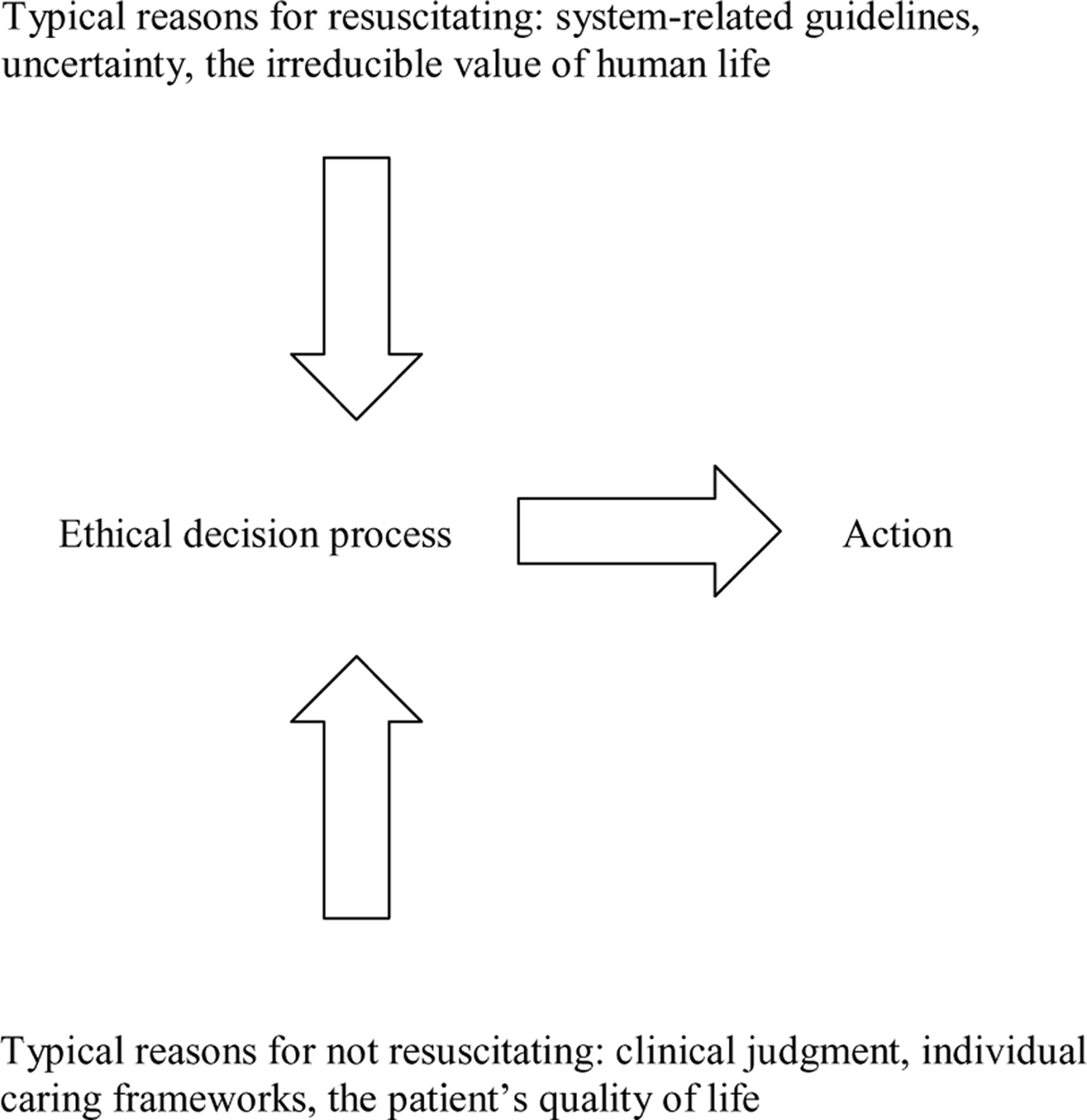
The paramedics did not always act in accordance with their ethical convictions. The main reason was that their personal beliefs did not always match internal or external procedures. The concept of a double pressure situation is useful in understanding this tension (Figure 1).
Double pressure situations as experienced by paramedics
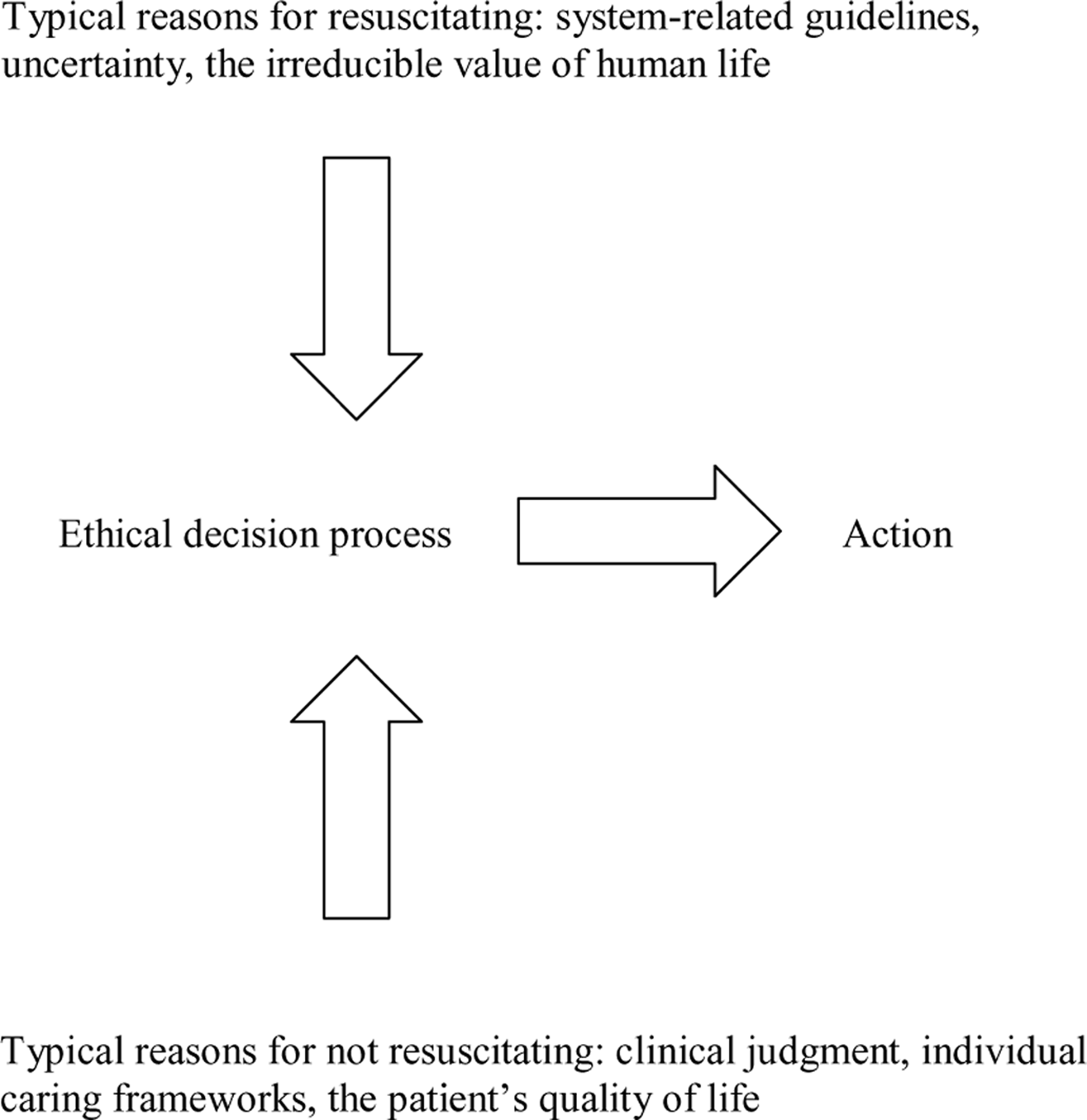
In organizational theory, this concept is defined as a situation in which there are conflicting vertical pressures to perform an action.Reference Freidson30,Reference Johnson31 The pressure from above is grounded in various management levels, and in the idea that health workers are ambassadors for the values, norms and principles on which their organization is founded.Reference Buchbinder and Shanks32 The pressure from below is grounded in professional ideals and direct observations.Reference Freidson33,Reference Parsons and Stanford34 It has its source in the direct and close experience of the suffering patient, the will and need to help the patient as much as possible, expressed wishes from relatives, and beliefs about what it is correct to do then and there.Reference Ashcroft, Lucassen, Parker, Verkerk and Widdershoven7,Reference Davis, Arosker, Liaschenko and Drought13,Reference Parsons and Stanford34,Reference Steen, Naess and Steen35
The concept of a double pressure situation is a general theoretical concept that can be analyzed and applied in various ways.Reference Freidson30,Reference Freidson33 Using the concept as a framework for discussing dilemmas of resuscitation, there are two crucial points. First, there should be general procedures for how the dilemmas should be addressed. In many of the paramedics’ workplaces, guidelines for solving ethical problems were lacking. Protocol for cooperation with doctors also varied widely, and sometimes the cooperation did not work very well. A fundamental question related to this cooperation is how autonomous paramedics should be in making decisions. This question needs to be addressed in the light of relevant, existing competence, and future competence needs. There should be reasonably uniform practices, and this research indicates that there is a potential for improvement in this area.
Second, the concept of a double pressure situation can have an important role in education and training. Dilemmas of resuscitation always can be understood as involving opposing pressures. Insofar as a situation is experienced as a genuine dilemma, there must be an experienced, conflicting pressure from reasons that underlie (at least) two alternative actions. Thus, the concept of a double pressure situation can be used to shed light on why a situation is experienced as an ethical dilemma. Understanding this concept is a matter of identifying the reasons that weigh in favor of each alternative. A good solution to an ethical dilemma should be based on a proper analysis of these reasons.
Beliefs vs. Actions
The concept of a double pressure situation also is relevant for understanding the links between beliefs and actions. Many of the paramedics said that “having one’s back covered” was important, and argued that although they sometimes thought it was ethically “correct” to not resuscitate, they continued due to external pressure.
This experienced discrepancy between beliefs and actions raises deep philosophical questions,Reference Dancy36,Reference Knobe and Nichols37 and thus theories from the philosophy of mind and action can shed light on prehospital dilemmas of resuscitation. However, facts about paramedics’ experiences of ethical dilemmas also should stimulate theoretical discussions in the sense that such discussions should be based on real-life experiences. According to experimental philosophy, particular judgments made by health professionals are relevant for abstract philosophical thinking about that area.Reference Knobe and Nichols37
Double pressure situations ideally should be eliminated from first-line services. An important goal in all health organizations should be to minimize experienced conflicts between economic and administrative values and the personal beliefs that are formed in patient interaction. Current measures of quality in the health sector tend to focus on objective facts, budgets, and economic consequences.Reference Hunink and Glasziou38 Interpersonal values, professional interactions and experienced, subjective consequences often are not included in evaluations of how public sector organizations perform.Reference Freidson33,Reference Seibold, Shea, Jablin and Putnam39
One of the study participants made an illuminating statement: “Our mental rucksacks are gradually filled up with negative experiences, and one day they overflow.” It is well documented that there is a large degree of burnout and long-term disability leave in ambulance services.Reference Smith and Roberts40,Reference Siriwardena, Donohoe and Stephenson41 All the paramedics interviewed during this study thought that double pressure situations were difficult, had a huge negative personal impact, and contributed towards making their jobs very challenging.
Such personal experiences may affect performance, even when performance is measured in straightforward economical or administrative ways. When many negative experiences lead to burnout and permanent job loss, costs rise. It is an important economic and psychosocial principle that health workers should have sufficient strength and capacity to meet work-related challenges,Reference Rose, Bisson, Churchill and Wessely42 and it takes time and resources to train new personnel. Loss of strength and reduced motivation to deal with difficult patient encounters also may lead to patient dissatisfaction and negative consequences from wider community perspectives. In order to understand how Emergency Medical Services should be organized, it is necessary to take these wider consequences into consideration.
Limitations
Qualitative findings are not necessarily representative of all members of a target group;Reference Flick28 quantitative concepts of generalization do not apply within qualitative research.Reference Pope and Mays24,Reference Gubriu and Holstein26 Nevertheless, exploratory qualitative research can provide a good indication of how members of a group tend to experience a phenomenon.Reference Gubriu and Holstein26,Reference Flick28 In-depth interviews make it possible to achieve a substantial understanding of participants’ beliefs, emotions, and experiences. It often is difficult to achieve this aim in comprehensive, quantitative investigations where standardized forms and electronic resources are employed to communicate with participants. In such narrow and time-limited interactive communication, a good understanding of each individual participant is limited by the lack of direct two-way “authentic” dialogue and other contextual factors.Reference Nordby22,Reference Dahlberg, Drew and Nyström23 In contrast, what often is labeled the “closeness dimension” of qualitative interviews makes it possible to discover and interpret health workers’ subjective horizons (their overall beliefs and thoughts about themselves, their professional roles, and their relations to patients).Reference Dahlberg, Drew and Nyström23
The naturalistic interview guide and the cognitive-emotional interpretative approach imply that interpretation of participants’ words should be as theory-neutral as possible. Thus, the presentation of this study’s findings relies on quotes and literal interpretations.Reference Gubriu and Holstein26,Reference Flick28 It clearly is possible to engage in more structured analyses of this material, and to interpret the empirical findings in more detail from specific theoretical perspectives in psychology and moral philosophy. This further analysis is outside the scope of the current study, but could form the basis for further research.
Conclusions
In this qualitative study, paramedics’ experiences of the dilemmas of resuscitating cancer patients corresponded to deep distinctions in ethical theory, and paramedics formed clear ethical beliefs about “good” actions. However, when these beliefs conflicted with general rules or procedures, they did not always act in accordance with the beliefs. The fact that all informants in this study experienced such double pressure situations as fundamental problems strongly suggests that this is a widespread phenomenon. The pressure situations can be understood and solved in different ways on individual and system levels, but all such situations should ideally be eliminated from first-line emergency services. More research is needed to shed light on how ethical dilemmas arise in prehospital work.
Acknowledgment
The authors thank this journal for very helpful referee comments.
Abbreviations:
DNR = do-not-resuscitate
R-minus = resus minus