INTRODUCTION
Cognitive impairment is prominent and recognized as a rate-limiting factor for functional recovery in schizophrenia. The neuropsychological profile of schizophrenia is commonly characterized by reductions across cognitive domains on the order of one to two standard deviations below normative levels (Nuechterlein et al., Reference Nuechterlein, Barch, Gold, Goldberg, Green and Heaton2004). Cognitive impairment is detectable early in development, typically preceding emergence of psychotic symptoms (Seidman et al., Reference Seidman, Cherkerzian, Goldstein, Agnew-Blais, Tsuang and Buka2013), and is considered a better predictor of disability status and vocational functioning than psychotic symptom severity (Shamsi et al., Reference Shamsi, Lau, Lencz, Burdick, DeRosse, Brenner, Lindenmayer and Malhotra2011; Tsang, Leung, Chung, Bell, & Cheung, Reference Tsang, Leung, Chung, Bell and Cheung2010). Alongside pharmacologic efforts to address cognitive impairment associated with schizophrenia (Buchanan, Freedman, Javitt, Abi-Dargham, & Lieberman, Reference Buchanan, Freedman, Javitt, Abi-Dargham and Lieberman2007; D’Souza et al., Reference D’Souza, Carson, Driesen, Johannesen, Ranganathan, Krystal, Ahn, Bielen, Carbuto, Deaso, Naganawa and Pittman2018), innovative behavioral interventions have emerged in recent years as complements to routine psychiatric rehabilitation services (McGurk & Mueser, Reference McGurk and Mueser2017).
Cognitive remediation (CR) refers broadly to interventions aimed at improving memory, attention, processing speed, executive functions, and other aspects of cognition. Interventions range from “top-down” approaches, such as skills training and coaching on problem-solving strategies to drill-and-practice exercises including “bottom-up” training targeting early stages of information processing (Best & Bowie, Reference Best and Bowie2017). Meta-analyses conclude that CR for individuals with schizophrenia can improve performance across test domains with effect sizes for measures of global cognitive function in the range of d = .41−.45 (Grynszpan et al., Reference Grynszpan, Perbal, Pelissolo, Fossati, Jouvent, Dubal and Perez-Diaz2011; McGurk, Twamley, Sitzer, McHugo, & Mueser, Reference McGurk, Twamley, Sitzer, McHugo and Mueser2007; Wykes, Huddy, Cellard, McGurk, & Czobor, Reference Wykes, Huddy, Cellard, McGurk and Czobor2011). However, although CR may appear effective when evaluated at the sample level, inspection of individual data reveals variable responses, with substantial improvement for some but no change from baseline in others (e.g., Medalia & Richardson, Reference Medalia and Richardson2005; Murthy et al., Reference Murthy, Mahncke, Wexler, Maruff, Inamdar, Zucchetto, Lund, Shabbir, Shergill, Keshavan, Kapur, Laruelle and Alexander2012). While there is evidence to support the efficacy of CR in schizophrenia broadly, effective clinical application may require further integration of individual approaches to, and capacity for, learning. The understanding of individual characteristics mediating CR efficacy is a developing area with significant room for growth.
Preliminary advances have been made in the area of predicting CR outcomes. Early work by Medalia and Richardson (Reference Medalia and Richardson2005) reported an analysis of three databases examining predictors of response to CR, finding that regularity of training attendance, intensity, and work habits positively influenced outcome. More recently, Lindenmayer et al. (Reference Lindenmayer, Ozog, Khan, Ljuri, Fregenti and McGurk2017) found that positive response to computerized CR was associated with baseline demographic features, including younger age, higher level of education, shorter time since initiation of treatment at current tertiary care center, and lower level of negative and disorganized symptoms. Cognitive features, including overall cognition, faster processing speed, better working memory, and better attention/vigilance were associated with positive CR outcome. However, in contrast to these findings, an analysis of five randomized controlled trials including a total of 300 participants with severe mental illness concluded that better response to a CR program that combined drill-and-practice and compensatory top-down approaches was predicted by lower baseline cognitive functioning (DeTore, Mueser, Byrd, & McGurk, Reference DeTore, Mueser, Byrd and McGurk2019). Other work has evaluated intermediate predictors, reflecting proximal effects of learning during intervention. For example, in a study of computer-based cognitive training in young people with recent onset schizophrenia, early gains in auditory processing speed predicted improvements on cognitive testing at the conclusion of the intervention (Fisher et al., Reference Fisher, Loewy, Carter, Lee, Ragland, Niendam, Schlosser, Pham, Miskovich and Vinogradov2015). Still, little is known about mechanisms of learning during CR and how interventions should be tailored to accommodate the heterogeneous nature of schizophrenia. The investigation of neural mechanisms supporting differential benefit of CR has gained traction with recent studies. Electrophysiology may be especially informative. Perez and colleagues (Reference Perez, Tarasenko, Miyakoshi, Pianka, Makeig, Braff, Swerdlow and Light2017) showed that, although all participants improved on an auditory training task after an hour of training, larger mismatch negativity amplitudes before and after training were associated with larger improvements. Pre–post change in mismatch negativity and another event-related potential component (P3a) were later shown to predict verbal learning improvements in a randomized clinical trial of auditory-based targeted cognitive training for patients with schizophrenia spectrum disorders (Hochberger et al., Reference Hochberger, Joshi, Thomas, Zhang, Bismark, Treichler, Tarasenko, Nungaray, Sprock, Cardoso, Swerdlow and Light2018). Developments in putative biomarkers of CR response complement attempts to understand the behavioral components of the learning process that leads to positive outcomes.
Learning is a multifaceted process determined by individual factors (e.g., intelligence, motivation), the content and context of training, and opportunity for practice leading to consolidation of new skill. In addition, the capacity to modify and improve performance through training, or learning potential, is recognized as an important mediator of an individual’s response to rehabilitation (Green, Kern, Braff, & Mintz, Reference Green, Kern, Braff and Mintz2000). Evaluated in schizophrenia, learning potential appears a better indicator of readiness for psychosocial rehabilitation (Fiszdon et al., Reference Fiszdon, McClough, Silverstein, Bell, Jaramillo and Smith2006), and predictor of skill acquisition during vocational rehabilitation (Watzke, Brieger, Kuss, Schoettke, & Wiedl, Reference Watzke, Brieger, Kuss, Schoettke and Wiedl2008) and CR training (Davidson, Johannesen, & Fiszdon, Reference Davidson, Johannesen and Fiszdon2016; Wiedl & Wienobst, Reference Wiedl and Wienobst1999), than static cognitive ability. These findings support the validity of learning potential as a predictor of “near” learning. Near learning is the acquisition of skill as demonstrated on tasks similar to training tasks, or skills expressed in context of training. The relationship of learning potential and near learning to broader treatment goals of CR is less established, but the availability of online near learning metrics collected as a component of CR protocols facilitates further exploration. For example, Tarasenko et al. (Reference Tarasenko, Perez, Pianka, Vinogradov, Braff, Swerdlow and Light2016) found that early training progress in CR, conceptualized as a metric of “plasticity potential,” may reflect capacity for experience-dependent change critical to learning. However, studies of basic perceptual learning suggest that skill generalization unfolds over a longer timescale than near learning (Wright, Wilson, & Sabin, Reference Wright, Wilson and Sabin2010) raising the possibility that behavioral change evidenced during training may not be a sufficient condition for consolidation and transfer of new skill. An unanswered question relevant to this issue is: do “learners,” those showing performance gains in training, actually become “responders” when evaluated on treatment outcome at completion of intervention?
A retrospective analysis was undertaken in a trial of computer-based, drill-and-practice training for schizophrenia to examine predictors of response to CR. Responders and non-responders were classified according to change in global cognitive function following 4 weeks of training and compared on metrics of learning derived from CR training exercises along with pre-training clinical, cognitive, and electroencephalographic (EEG) measures. Clinical measures included chlorpromazine equivalent doses, given the extensive literature on negative cognitive effects of antipsychotic medications (Hill, Bishop, Palumbo, & Sweeney, Reference Hill, Bishop, Palumbo and Sweeney2010). The EEG measure included in this study, individual alpha frequency (IAF), also has an established relationship with cognitive capacity (Doppelmayr et al., Reference Doppelmayr, Klimesch, Sauseng, Hödlmoser, Stadler and Hanslmayr2005; Grandy et al., Reference Grandy, Werkle-Bergner, Chicherio, Lövdén, Schmiedek and Lindenberger2013). The principle aim of this study was to evaluate the predictive utility of near learning, reflecting proximal effects of CR training, on CR outcome. In addition, exploratory analyses were undertaken to identify individual factors distinguishing CR responders and non-responders and to ascertain whether these factors interact with near learning to explain outcome.
METHODS
Participants
Forty individuals meeting DSM-IV-TR criteria for schizophrenia (SZ) were enrolled in a registered clinical trial (identifier: NCT00923078, https://clinicaltrials.gov). The study was conducted under oversight of VA Connecticut Healthcare System (VACHS) Human Studies Subcommittee (HHS protocol # 01245) and Yale University Human Investigation Committee (HIC protocol #1003006388) institutional review boards. All participants provided written informed consent prior to initiating any study procedures.
Inclusion was restricted to native English-speaking individuals aged 18–70 with stable housing for minimum of 30 days. In addition, participants had minimum of 30 days since discharge from last hospitalization, 30 days since last change in psychiatric medications, and were receiving mental health treatment through local outpatient clinics. Excluded were individuals with current (past 30 days) diagnosis of alcohol or substance abuse disorders, history of brain trauma or neurologic disease, intellectual disability or premorbid intelligence ≤ 70, and uncorrected impairment in auditory or visual acuity.
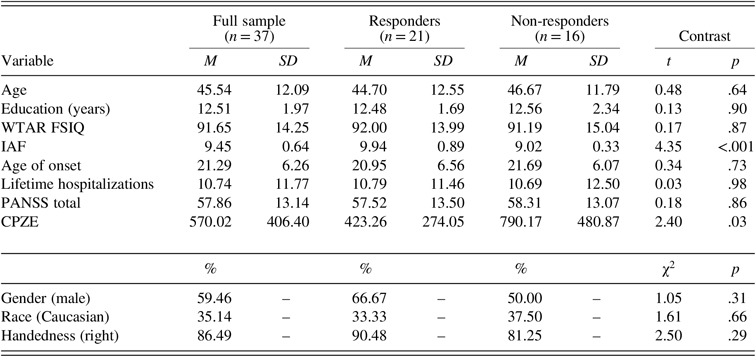
Of the enrolled sample of N = 40, 37 completed all aspects of the study and were included in analyses. Two non-completers terminated training early due to factors unrelated to the study: childcare and motor vehicle accident with subsequent participation in physical therapy. A third participant was excluded from analysis due to insufficient participation in cognitive training. Sample descriptive statistics for the final sample are presented in Table 1. Participants were on average middle-aged with a high-school-level education and had initial psychiatric treatment in their early 20s.
Sample descriptive statistics

WTAR = Wechsler Test of Adult Reading; IAF = Individual Alpha Frequency; PANSS = Positive and Negative Syndrome Scale; CPZE = Chlorpromazine Equivalence (mg/day).
Clinical Assessment
All participants underwent a clinical interview to obtain treatment, substance use, medical, legal, employment, and psychosocial background information. Diagnosis of participants was confirmed using the Structured Clinical Interview for DSM-IV-TR (SCID-I/P; First, Spitzer, Gibbon, & Williams, Reference First, Spitzer, Gibbon and Williams2002), administered by a licensed clinical psychologist. The Wechsler Test of Adult Reading (WTAR; Wechsler, Reference Wechsler2001) was administered to obtain an estimate of premorbid intellectual endowment, and the MATRICS Consensus Cognitive Battery (MCCB; Nuechterlein et al., Reference Nuechterlein, Green, Kern, Baade, Barch, Cohen, Essock, Fenton, Frese, Gold, Goldberg, Heaton, Keefe, Kraemer, Mesholam-Gately, Seidman, Stover, Weinberger, Young, Zalcman and Marder2008) was used to test current cognitive ability referenced to normative standards for age and gender. Response to cognitive training intervention was determined based on change in global cognitive function, assessed by a composite score comprising eight subtests: Trail Making Test Part A, Hopkins Verbal Learning Test—Revised, Wechsler Memory Scale Third Edition Spatial Span, Letter Number Span, Neuropsychological Assessment Battery Mazes, Brief Visuospatial Memory Test—Revised, Category Fluency (Animal Naming) Test, and Continuous Performance Test—Identical Pairs.
Electroencephalography
The parent study included data collection of several experimental tasks during electroencephalography (EEG) recording. For purposes of the present analysis, we focused on a single measure extracted from resting EEG, IAF. IAF is considered a trait-like feature of the EEG, representing a measure of global brain function rather than a specific cognitive ability (Grandy et al., Reference Grandy, Werkle-Bergner, Chicherio, Lövdén, Schmiedek and Lindenberger2013), and is therefore reasoned to be reflective of general capacity for learning.
Resting EEG was recorded at the beginning of each EEG test session prior to administration of behavioral experiments (not reported in current analysis) using a 64-channel BioSemi ActiveTwo (BioSemi B.V., Amsterdam, The Netherlands) bio-amplifier and electrode system with sensors located according to the 10–20 system. Additional electrodes were placed bilaterally at mastoids (reference), the outer canthi of both eyes (horizontal electrooculogram), and above and below the right orbit (vertical electrooculogram). Continuous EEG was monitored online in ActiView V6.05 and acquired at a 1024 Hz sampling rate with a bandpass filter setting of 0.16–100 Hz. Resting EEG was recorded in 1-min segments alternating twice between eyes-open (REO) and eyes-closed (REC) with transition timing and event marking controlled in NBS Presentation software (Neurobehavioral Systems, Inc., Albany, CA, USA).
Signal processing was conducted using Brain Vision Analyzer v2.1. (Brain Products, GmbH, Gilching, Germany). EEG data were first examined using an automated routine to mark channels based on criteria for excessive EMG, continuous low voltage, and large voltage shifts. Data were inspected, re-referenced offline to the common average, broadband filtered from 1 to 100 Hz (12 dB/oct) with a notch filter at 60 Hz, and corrected for ocular artifact (Gratton, Coles, & Donchin, Reference Gratton, Coles and Donchin1983). EEG was then segmented in 1 s epochs and submitted to fast Fourier transform using a 10% Hanning window (resolution 0.5 Hz), averaged separately for REO and REC conditions, with mean alpha power extracted from each average from 8 to 12 Hz. IAF, representing the average peak of alpha frequency over time, was identified in the REC condition using the VIGALL 2.0 routine for Brain Vision Analyzer (Hegerl et al., Reference Hegerl, Sander, Ulke, Böttger, Hensch, Huang, Mauche and Olbrich2016). VIGALL was designed and validated as an automated EEG-vigilance stage classification method. For this purpose, periods of resting eyes closed EEG of 15 min or greater are recommended. Furthermore, VIGALL has been validated in non-pathological samples and the authors caution that interpretation of arousal states can be obscured in psychiatric samples due to pharmacologic and neuropathologic influences on EEG. VIGALL was applied in the current study as an automated routine for extraction of IAF only with no further interpretation of vigilance classification metrics.
CR Intervention
Participants completed 4 weeks of computer-based, drill-and-practice cognitive training using a visually mediated program (InSight by Posit Science Corporation, San Francisco, CA, USA). Training was completed in context of a larger crossover study that also included 4 weeks of training using an auditory-based platform (Brain Fitness, Posit Science), with all participants completing both training conditions following one of two training orders (i.e., visual first or auditory first). Subgroups assigned to each training order were statistically equivalent on baseline characteristics (age, gender, race, ethnicity, handedness, education, estimated IQ, illness duration, age of onset, age of first hospitalization, MCCB cognitive composite, and PANSS symptomatology). For the current analysis, the sample was collapsed by training order and outcome was assessed relative to true baseline (study intake), or to pre-visual training condition (post auditory training), depending on training order. Training consisted of five 10-min long exercises (Bird Safari, Jewel Diver, Master Gardener, Road Tour, and Sweep Seeker) designed to engage visual acuity, useful field of view, visual processing speed, and visual memory, with four exercises administered each training session. The first session of each exercise provided calibration of difficulty level to the individual user’s ability, with difficulty level increased automatically by standard increments according to manufacturer’s algorithm. Training schedule consisted of four 40-min long sessions plus one 50-min session for calibration assessment on all five exercises each week. Training was conducted in a dedicated computer laboratory monitored by a facilitator. The facilitator assisted with scheduling training times, logged participants in to computers, addressed technical questions, and tracked progress, but did not provide coaching on how to complete training beyond ensuring that standard instructions were comprehended.
Statistical Analyses
To assess cognitive target engagement, relationships between baseline cognitive performance and initial training calibration assessment were examined using Pearson correlation. Correlation strength was compared (Steiger, Reference Steiger1980) between individual tests and a global measure of cognition (MCCB composite) to determine the most sensitive measure(s) of training-related outcome. Near learning scores were computed to reflect change from baseline-to-peak (best performance of all training weeks) and baseline-to-final (training week 4) performance on training calibration tests for each training exercise. These scores were adjusted to individual baseline by regressing assessment performance at endpoints on initial calibration score, with residual values re-expressed as standardized (z) scores and directionally corrected to align positive values with higher learning. For each exercise, learners were classified as those participants with positive standardized residuals (z > 0), and non-learners as those with negative standardized residuals (z ≤ 0). Response to intervention was quantified similarly by regressing post-training cognitive test scores on pre-training scores, standardizing the regression residuals, and classifying individuals based on sign of the residuals. Chi-square analysis was used to assess whether responder status differed between subjects first assigned to visual training and those who participated in visual training following the auditory training condition.
Difference in cognitive performance by responder status was tested statically in a group (responder vs. non-responder) by time (pre vs. post-training) repeated measures ANOVA. Linear relationships between learner and responder status were examined by Pearson correlation, followed by non-parametric comparison of learner and responder classifications using chi-square. Baseline comparison of clinical features in responders and non-responders was performed using t tests, with significant variables entered into logistic regression as predictors of responder status. Finally, these classifiers were tested as moderators of the relationship between near learning metrics and cognitive outcome using Model 1 of the SPSS Process macro (Hayes, Reference Hayes2013).
All data were inspected for assumptions of normality, completeness, and statistical outliers prior to analyses. One study completer reported an exceedingly high number of hospitalizations (150) and was excluded from analyses involving lifetime hospitalizations. Medication dosing information was not obtained for seven subjects, reducing the analysis of this variable to N = 30. A reliable IAF value could not be obtained from EEG of one subject. In addition, analysis of age (n = 2), age of illness onset (n = 2), and hospitalizations (n = 1) excluded specific cases for which data were missing.
RESULTS
Cognitive Training Intervention
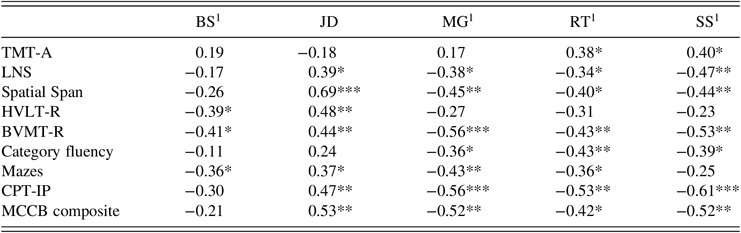
Out of a maximum 14 hr of CR training scheduled over 4 weeks, participants completed an average of 12.98 (SD = 2.65). Correlations between baseline training calibration and cognitive test performance were statistically significant with highest values for each individual exercise ranging from r = .41 to .69 (Table 2), and suggested primary engagement of visual recall, working memory, attention, and planning/organization. The highest correlations between training calibration scores and individual cognitive tests did not differ statistically (Steiger, Reference Steiger1980) from those obtained for MCCB composite score. Therefore, the MCCB composite score was selected as a single, global measure of response to cognitive training. Pre–post training change in MCCB composite score was statistically significant with an overall treatment effect size of .41 (Cohen’s d); pre-training M = 34.97, SD = 12.53; post-training M = 36.86, SD = 12.73; t(36) = 2.51, p = .02.
Bivariate correlations of baseline training performance and cognition

TMT-A = Trail Making Test Part A; LNS = Letter Number Span; HVLT-R = Hopkins Verbal Learning Test—Revised; BVMT-R = Brief Visuospatial Memory Test—Revised; CPT-IP = Continuous Performance Test—Identical Pairs; BS = Bird Safari; JD = Jewel Diver; MG = Master Gardener; RT = Road Tour; SS = Sweep Seeker.
1 Lower score reflects better performance.*p < .05; **p < .01; ***p < .001 (two-tailed).
Response to CR
In order to quantify response to cognitive training at the individual level, baseline-adjusted change in MCCB composite score was modeled using linear regression, R 2 = .87, β = .93, p < .0001. From this model, 21 trainees were identified as responders, with positive regression residuals (M = 0.69, SD = 0.48) relative to the sample mean, and 16 as non-responders with negative residuals (M = −0.91, SD = 0.68). These residual scores represented average improvement in MCCB composite score of 5.05 points for responders as compared to reduction of 2.25 points for non-responders, t(35) = 8.37, p < .0001, d = 2.78. Although some responders improved only minimally, with one improving by only 1 T-score point and two by 2 T-score points, overall change for responders was appreciable (range +1 to +10 T-score points) when compared to non-responders (range −10 to +2 T-score points). Responders and non-responders were equivalent in proportions of participants who completed visual training before and after auditory training (χ 2 = 1.40, p = .24); therefore, training order was not considered in subsequent analyses. Evaluation of pre–post training change by responder status produced a main effect of time (pre-training, post-training), F(1,35) = 9.02, p = .005, partial η 2 = .21, and group*time interaction, F(1,35) = 61.34, p < .0001, partial η 2 = .64. This analysis confirms that while pre–post measures of MCCB composite score did improve significantly at the sample level, improvement was not uniform across subjects. Taken together with results of the regression-based classification, statistically significant improvement in cognitive performance at the sample level was explained by only approximately 57% of participants.
Responders and non-responders did not differ on MCCB composite score at baseline [M = 35.81, SD = 12.17 vs. M = 33.88, SD = 13.31; t(35) = 0.46, p = 0.65, d = .15] and, together, were characterized by mildly impaired performance according to normative conventions. At post-training follow-up, responders had improved by about half a standard deviation with central tendency reflecting low-average performance range (M = 40.86, SD = 11.50), while non-responders showed slight decline from baseline score and remained in the mildly impaired range (M = 31.63, SD = 12.70).
Near Learning
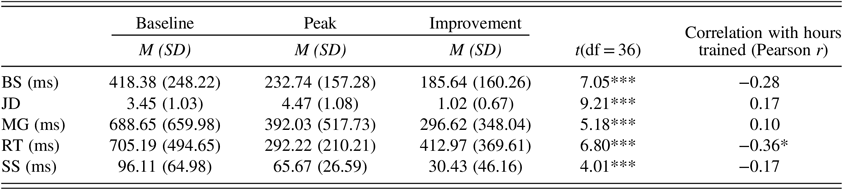
Comparison of performance metrics of learning indicated that peak performance was achieved prior to final assessment in the majority (51–75%) of trainees across training exercises. While training performance improved significantly from baseline to peak assessment on all five training exercises, relationships between performance and number of hours trained were non-significant with exception of one exercise (Table 3). These findings favored use of the peak performance over final score as the primary metric for analyses of near learning, taken to reflect upper limit of capacity.
Cognitive exercise performance metrics and relationships to training time

BS = Bird Safari; JD = Jewel Diver; MG = Master Gardener; RT = Road Tour; SS = Sweep Seeker.
Improvement is depicted as change from baseline assessment to peak performance across assessments conducted at weeks 2, 3, and 4 of intervention. JD score reflects the number of items presented in a visuospatial working memory display, with higher values indicating improvement. Scores for all other exercises reflect stimulus display or inter-stimulus interval time (milliseconds), with lower values indicating improvement in performance.
*p < .05; **p < .01; ***p < .001 (two-tailed).
Association of Near Learning and Response to CR
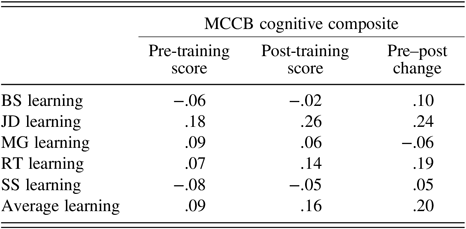
Correlations between continuous measures of near learning and MCCB composite score, both pre- and post-training, were small and below statistical significance (Table 4). Moreover, pre–post change in MCCB composite score was unrelated to learning across individual training exercises.
Relationship of near learning to cognitive performance (Pearson correlations)

BS = Bird Safari; JD = Jewel Diver; MG = Master Gardener; RT = Road Tour; SS = Sweep Seeker. Learning scores are computed as the residual difference between baseline-predicted post-training score and obtained peak performance.
In order to examine proportional differences in learning across exercises, participants were classified as learners or non-learners according to baseline-adjusted gain in calibration assessment performance. Across exercises, 41–73% of trainees were classified as learners. Using this categorical classification of learner status, we examined whether learning on each training task increased probability of also meeting responder criteria for CR intervention. For all five training tasks, learners were no more likely than chance to also be responders (Table 5). Kappa values further suggest low agreement between learner and responder classifications.
Relationship between learner and responder classification rate

Responder status as it relates to learner status, depicted as raw counts of non-learners and learners with chi-square (χ 2, p values) and kappa (κ). NL = non-learner; L = learner; BS = Bird Safari; JD = Jewel Diver; MG = Master Gardener; RT = Road Tour; SS = Sweep Seeker.
Responder Analysis
Although significant improvement in exercise performance and in cognitive test performance occurred over the course of training, no direct relationship between learning and outcome was confirmed. Consequently, exploratory analyses were undertaken to assess whether response to CR intervention was associated with clinical features independent of training. Of the features examined (Table 1), responders differed from non-responders in two ways: higher IAF, t(30.07) = 4.80, p < .001, d = 1.51, and lower antipsychotic (CPZE) dosing, t(15.80) = 2.40, p = .03, d = 0.99. When combined in multiple regression, these two features explained 41% of the variance in MCCB composite change across the sample, R 2 = .41, F(2,26) = 6.34, p = .001.
Logistic regression of IAF predicting treatment responder status achieved 78% overall classification accuracy (sensitivity = 80%, specificity = 75%), with 50% (Nagelkerke R 2) of variance explained. An examination of the logistic regression equation found the intercept at IAF of 9.29 Hz, with values above associated with greater than 50% probability of positive response to intervention. IAF of 8.95 Hz was associated with a 25% probability of response, and IAF of 9.64 Hz was associated with a 75% probability of response.
With CPZE entered as the predictor, responder status was classified at 70% accuracy (sensitivity = 83%, specificity = 50%), while explaining 26% (Nagelkerke R 2) of the variance in outcome. The logistic regression equation had an intercept at CPZE of 671 mg/day with values below associated with greater than 50% probability of positive response. At 1035 mg/day, the probability was 25%, and at 300 mg/day, the probability was 75%.
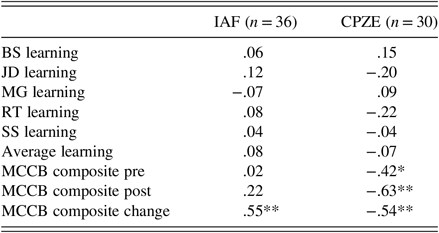
Although both IAF and CPZE effectively distinguished subgroups on the basis of response to cognitive training, and showed moderately sized correlations with measurement of cognitive change, neither feature correlated significantly with metrics of near learning (Table 6). CPZE, but not IAF, also correlated with pre- and post-training scores taken independently.
Correlations between near learning, cognitive performance, and moderator variables

BS = Bird Safari; JD = Jewel Diver; MG = Master Gardener; RT = Road Tour; SS = Sweep Seeker. Learning scores are computed as the residual difference between baseline-predicted post-training score and obtained peak performance.
*p < .05; **p < .01.
Moderation of Effects of Learning on Cognitive Gain
Following direct effects of IAF and CPZE on CR outcome, a final set of analyses examined how these variables influence the relationship between learning and outcome. The effect of learning was tested using a single learning composite score, computed as the average of directionally corrected regression residuals across training tasks. Evaluation of constituent baseline and peak average scores found performance of treatment responders to be superior to non-responders in both cases, t(35) = 2.45, p = .02 and t(35) = 2.21, p = .03, respectively. Effects of IAF and CPZE were tested as dichotomous moderator variables at levels determined by logistic cut-points, IAF </> 9.29 Hz and CPZE </>671.
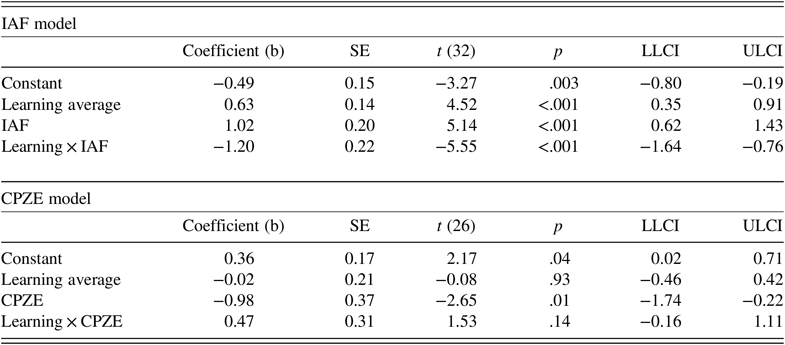
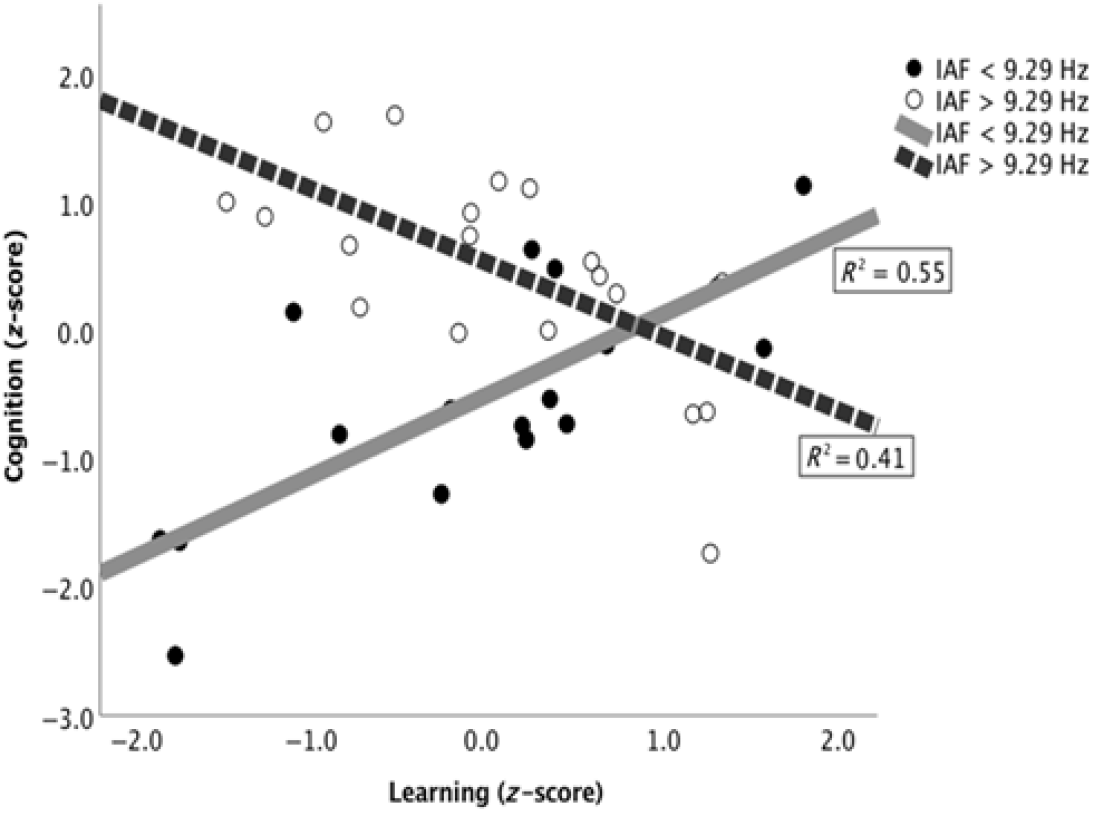
Entry of IAF as a moderator variable resulted in a significant overall model explaining CR outcome, F(3,32) = 19.95, p < .001, R 2 = .62. Main effects of learning, IAF, and their interaction were statistically significant (Table 7). Interpretation of the interaction by simple slopes suggested that for IAF < 9.29 Hz, a unit increase in learning produced a .63 unit increase in cognitive outcome, b = .63, t(32) = 4.51, p < .001.Footnote 1 While a significant relationship was also observed at IAF ≥ 9.29, smaller gains in cognitive outcome were predicted at higher levels of learning, b = −.57, t(32) = −3.46, p < .01. These results are illustrated in Figure 1.
Models describing relationship of learning to intervention outcome moderated by IAF and CPZE

Moderation model parameters. IAF = Individual Alpha Frequency (Hz); CPZE = Chlorpromazine Equivalence (mg/day).
Scatterplot of the relationship between learning and intervention outcome by IAF level.

When considering CPZE as a moderator, 38% of the variance in cognitive outcome was explained by the total model, F(3,26) = 5.40, p = .005, R 2 = .38. This effect was attributed to direct effects of CPZE with neither learning nor the interaction reaching significance (Table 7).
DISCUSSION
The current study aimed to understand factors accounting for variable responses to CR in schizophrenia. Specifically, it was postulated that “near learning,” reflecting gains in training progress, would provide a useful proxy for predicting later response to intervention when assessed outside of training context. Indeed, this principle has been previously proposed in studies of schizophrenia focused on early changes in bottom-up auditory processes (Fisher et al., Reference Fisher, Loewy, Carter, Lee, Ragland, Niendam, Schlosser, Pham, Miskovich and Vinogradov2015; Tarasenko et al., Reference Tarasenko, Perez, Pianka, Vinogradov, Braff, Swerdlow and Light2016). However, current findings suggest that gains in cognitive test performance following drill-and-practice intervention, reflecting “far” transfer of learning, are not sufficiently explained by cognitive training progress alone. Moreover, we find that individual factors unrelated to intervention appear to influence individual responses to CR. Although responders and non-responders were statistically equivalent on most baseline characteristics, including estimated intelligence, cognitive test performance, symptom severity, and age, responders differed prominently in two important ways: higher peak frequency of resting alpha EEG (IAF) and lower antipsychotic dosing (CPZE). Taken together, these features combined to explain 41% of the variance in change in cognitive test performance following intervention. Contrary to expectation, although training exercise performance did correlate with cognitive ability at baseline and improved significantly with practice, derived metrics of near learning proved to be poor predictors of cognitive outcome. Those showing high-learning progress during training were no more likely to respond to intervention than those with low learning. Accordingly, tests of a direct relationship failed to support the hypothesis that near learning predicts response to CR.
Significant improvement was observed both on training tasks and on the MCCB composite score over the course of training; however, the magnitude of change was not correlated between these variables. Of note, these change indices were computed in a manner that adjusted for baseline performance and were arguably psychometrically advantageous to simple gain scores (Fiszdon & Johannesen, Reference Fiszdon and Johannesen2010). Given reasonable skepticism about the ability of cognitive training to produce generalizable gains, this finding calls for explanation (Simons et al., Reference Simons, Boot, Charness, Gathercole, Chabris, Hambrick and Stine-Morrow2016). In the current study, training did produce generalized gains with a medium overall effect size (d = .41). Importantly, for responders, improvement in cognitive test performance also reflected a clinically meaningful transition from mildly impaired to low-average levels. Still, it is striking that those classified as responders were no more likely to be classified as learners on any of the training exercises. One clue to interpreting this finding comes from moderation analyses.
The finding that IAF and CPZE influenced response to CR offered the intriguing possibility that biologically based features could interact with learning to either facilitate, or rate-limit, cognitive gains. Examined using moderated regression analysis, 60% of variance in cognitive outcome was explained when accounting for IAF. Higher IAF was directly associated with better cognitive outcome, but unrelated to metrics of learning derived from training tasks (Table 6). Interestingly, the relationship between learning and outcome differed according to IAF; below 9.29 Hz, gains in cognitive outcome increased with higher levels of learning, but above 9.29 Hz, an inverse relationship between learning and outcome was suggested (Figure 1). Considering that higher IAF predicted positive training outcome, this finding would seem contradictory. One plausible explanation is that learning, as defined by increases in task difficulty over training, is constrained by a ceiling effect that limits progression of initially high performers. In support of this interpretation, responders were found to have higher baseline training performance, from which point level increases would occur in quantitatively smaller units of change. Importantly, when accounting for IAF, learning became a statistically significant and positive predictor of cognitive outcome. This result differed from analysis of moderation by CPZE dosage, in which case outcome was predicted by CPZE alone. Therefore, while the hypothesis that response to CR is predicted by learning was unsupported when examined directly, partial support for this hypothesis was found when individual differences in brain function (i.e., IAF) were considered.
The individual level factors that differentiated CR responders from non-responders in this study were few among a comprehensive set of demographic, clinical, and cognitive features examined. Although findings regarding IAF and CPZE may be regarded as exploratory, and do not permit firm conclusions about mechanisms, they can be interpreted in context of a larger evidence base supporting relevance to cognitive function. IAF represents the dominant frequency within the alpha band measured over a period of resting EEG during eye closure, causing an augmentation of alpha power most prominently observed over the occipital region. This increase in alpha band activity is thought to reflect neural functions important to inhibitory control, serving to suppress communication within and between sensory systems that are not immediately required for information processing (Foxe & Snyder, Reference Foxe and Snyder2011). In this way, alpha activity is considered critical to the efficiency of neural networks, with higher peak frequency associated with greater information processing capacity (Doppelmayr et al., Reference Doppelmayr, Klimesch, Sauseng, Hödlmoser, Stadler and Hanslmayr2005; Grandy et al., Reference Grandy, Werkle-Bergner, Chicherio, Lövdén, Schmiedek and Lindenberger2013). In relation to memory function, a 1 Hz increase in IAF equates to a .21 increase in reverse digit span (Clark et al., Reference Clark, Veltmeyer, Hamilton, Simms, Paul, Hermens and Gordon2004), and has been reported to be 1.25 Hz higher in “good” compared to “bad” performers of a memory task (Klimesch, Schimke, & Pfurtscheller, Reference Klimesch, Schimke and Pfurtscheller1993). IAF is considered a developmentally sensitive and trait-like feature of the EEG, showing strong heritability (Smit, Wright, Hansell, Geffen, & Martin, Reference Smit, Wright, Hansell, Geffen and Martin2006) and stability over the course of interventions that produce improvement in cognitive performance (Grandy et al., Reference Grandy, Werkle-Bergner, Chicherio, Schmiedek, Lövdén and Lindenberger2013). Grandy et al. (Reference Grandy, Werkle-Bergner, Chicherio, Lövdén, Schmiedek and Lindenberger2013) also found IAF to be correlated with general intelligence (but see Anokhin & Vogel, Reference Anokhin and Vogel1996). Importantly, individuals with schizophrenia tend to have lower IAF (Karson, Coppola, & Daniel, Reference Karson, Coppola and Daniel1988), with values of 9 Hz on average in comparison to 11 Hz for healthy subjects (Giannitrapani & Kayton, Reference Giannitrapani and Kayton1974; Harris, Melkonian, Williams, & Gordon, Reference Harris, Melkonian, Williams and Gordon2006). In the current study, an empirically derived cut-point of 9.29 Hz differentiated CR responders from non-responders with 78% accuracy. We conclude, as others have suggested (Grandy et al., Reference Grandy, Werkle-Bergner, Chicherio, Lövdén, Schmiedek and Lindenberger2013), that IAF represents a latent cognitive capacity, which may be expressed in context of new learning. However, whether higher IAF facilitates transfer of learning as reflected by gains in post-training cognitive performance or, alternatively, that IAF below a certain level impedes effective transfer of near learning, remains a question for further study. In either case, a plausible mechanism of action may involve suppression of irrelevant information during training, thus enhancing opportunity for gains.
Moving from consideration of a potentially less modifiable to a more modifiable predictor, non-responders in the current study had higher doses of antipsychotic drugs. Previous investigations have identified worse cognitive performance in individuals prescribed high dosage and polypharmacy (Élie et al., Reference Élie, Poirier, Chianetta, Durand, Grégoire and Grignon2010; Hori et al., Reference Hori, Noguchi, Hashimoto, Nakabayashi, Omori, Takahashi, Tsukue, Anami, Hirabayashi, Harada, Saitoh and Kunugi2006). Hori and colleagues (Reference Hori, Noguchi, Hashimoto, Nakabayashi, Omori, Takahashi, Tsukue, Anami, Hirabayashi, Harada, Saitoh and Kunugi2006) suggest that greater cognitive impairment relates to higher clinical severity and higher doses needed to achieve therapeutic benefit, but also consider a direct link between antipsychotic dosage and cognitive impairment given that symptom severity did not differ between high and regular dose groups. Ours is not the first CR study to identify a negative effect of antipsychotic dosage, with Vita and colleagues (Reference Vita, Deste, De Peri, Barlati, Poli, Cesana and Sacchetti2013) also reporting that participants on higher antipsychotic dosage were less likely to benefit from training. A recent CR study by Joshi et al. (Reference Joshi, Thomas, Hochberger, Bismark, Treichler, Molina, Nungaray, Cardoso, Sprock, Swerdlow and Light2019) found that decreases in verbal learning scores in a treatment as usual group were associated with increases in anticholinergic burden, primarily driven by antipsychotic medication. This relationship was not observed in the CR group, suggesting that some types of CR may offer a protective effect against cognitive decline typically associated with increased anticholinergic burden. Again, although not possible to differentiate effects of higher antipsychotic dose from aspects of illness on which these prescriptions are based, it is possible that changes in cerebral architecture associated with long-term antipsychotic use (Ho, Andreasen, Ziebell, Pierson, & Magnotta, Reference Ho, Andreasen, Ziebell, Pierson and Magnotta2011) could interfere with consolidation of new learning.
The current study is notable for strengths in sample characterization, integration of electrophysiological metrics, CR training adherence, and the tracking of online training exercise improvements as proximal outcomes. However, we acknowledge several limitations and anticipate that future studies will assist in clarifying our results. First, the study lacks a control group of schizophrenia participants who did not participate in cognitive training, which may help disambiguate the effects of training on cognitive outcome measurement from practice effects. Fortunately, the sizes of the responder group and non-responder group were sufficiently equivalent for comparison and provided an implicit experimental control for practice effects, with nearly half the sample showing no improvement on post-training assessment. Additionally, the MCCB psychometric evaluation found practice effects to be negligible over a 4-week retest interval (Nuechterlein et al., Reference Nuechterlein, Green, Kern, Baade, Barch, Cohen, Essock, Fenton, Frese, Gold, Goldberg, Heaton, Keefe, Kraemer, Mesholam-Gately, Seidman, Stover, Weinberger, Young, Zalcman and Marder2008). We do, however, acknowledge that without a control group, we cannot completely rule out the possibility that individuals with high IAF and low CPZE might demonstrate cognitive improvement at the time of retest without having had CR. Second, antipsychotic dosage data were obtained by self-report and unavailable for three responders and four non-responders, which reduced the sample in models examining combined effects of CPZE and IAF. Therefore, results of this analysis may not generalize to the full sample on which other analyses are based. However, a prior study also concluded that higher antipsychotic dosing impeded response to CR in schizophrenia (Vita et al., Reference Vita, Deste, De Peri, Barlati, Poli, Cesana and Sacchetti2013), suggesting this finding is generalizable. Third, it is important to consider the fact that approximately half the sample already received 4 weeks of auditory training prior to the intervention evaluated in our analyses, which may have obfuscated a pure response to the visual training arm examined in this analysis.
ACKNOWLEDGEMENTS
We thank the faculty and staff of the VA and Yale Learning Based Recovery Center who contributed time and laboratory resources in support of the study. We also thank the veterans and community participants who contributed their personal time and effort. This work was supported by a VA Rehabilitation Research and Development Career Development Award (D7008W) to J.K.J. The sponsor had no role in the study design, collection, analysis, or interpretation of data, or in the contents of this manuscript. No author has any possible financial gain for the findings presented here.
CONFLICT OF INTEREST
There are no conflicts of interest for any of the authors of this paper.