Implications
Previous studies have shown that supplementation of grazing heifers can improve growth rate. This paper looks at the effect of feed supplementation for grazing Belgian Blue double-muscled replacement heifers younger than 1 year of age. Extra protein besides an energy supplement improved their performance and may be cost-effective. Soybean meal (SBM) can be replaced by ruminally protected SBM, but its use can reduce blood urea nitrogen concentration. Dried distillers grains and solubles are a good alternative for SBM. Maize silage can replace beet pulp as energy supplement.
Introduction
Several experiments indicated that first calving of beef heifers at 2 years of age results in a higher calf production during cow lifetime (Núñez-Dominguez et al., Reference Núñez-Dominguez, Cundiff, Dickerson, Gregory and Koch1991; Patterson et al., Reference Patterson, Perry, Kiracofe, Bellows, Staigmiller and Corah1992). The management of replacement heifers is an investment in the future. Reducing age at first calving may increase financial return and output of a beef–cow herd. Belgian Blue double-muscled (BBDM) heifers need an appropriate management when calving first at 2 years of age. It is desirable to realize a high daily growth rate of at least 0.75 kg or more, so that body weight (BW) before calving is close to 600 kg (Fiems and De Brabander, Reference Fiems and De Brabander2009). This growth rate was not realized when grazing heifers aged between 6 and 11 months did not receive an energy supplement (Fiems et al., Reference Fiems, Boucqué and Buysse1979).
Efficiently managed grazed grass can be the cheapest feedstuff in temperate climates in comparison with other feed crops (Peyraud and Delaby, Reference Peyraud and Delaby2001; Finneran et al., Reference Finneran, Crosson, O'Kiely, Shalloo, Forristal and Wallace2010). Nevertheless, Vendramini et al. (Reference Vendramini, Sollenberger, Dubeu, Interrante, Stewart and Arthington2006) suggested that a supplementation is desirable to maximize the efficiency of utilization of grass by young growing cattle. However, previous work with growing BBDM animals showed that performances were low, even when an energy supplement was fed (Fiems et al., Reference Fiems, De Campeneere, De Boever and Vanacker2002b). This is mainly a consequence of the reduced feed intake capacity of double-muscled animals (Fiems et al., Reference Fiems, Cottyn, Boucqué, Bogaerts, Van Eenaeme and Vanacker1997). The high moisture content of grass may contribute to the bulk of the diet because of the intracellular water (Forbes, Reference Forbes1995). This may be an additional disadvantage for double-muscled animals. Typical for the BBDM breed is that calves are mostly reared by bucket feeding. They are turned out to pasture after the rearing period, which is in contradiction to calves of other beef breeds, where beef cows mainly calve in late-winter to early-spring and offspring are weaned in October/November at the end of the grazing season (McGee, Reference McGee2012).
Previous results showed that grass was partly replaced when beet pulp (BP) was supplemented. This resulted in a decreased dietary protein content (Fiems et al., Reference Fiems, De Boever, De Campeneere and Vanacker2002a), which may exert a negative effect on animal performance. Therefore, it can be expected that an extra protein supplement can be an alternative to overcome this problem. The aim of the present experiments was to investigate the effect of an energy supplement, or a combination of energy and protein feeds on performance of young grazing BBDM replacement heifers.
Material and methods
Animals and management
Six subsequent experiments were conducted between 2000 and 2011, always using purebred BBDM heifers born out of the beef cow herd of the institute (autumn calvings). The objectives of the later experiments were based on the results and the lack of knowledge from previous trials. Initial age at the start of the experiments was 190 ± 52 days. The grazing season started mostly in May and ended in the course of October, depending on the weather conditions and grass supply towards the end of the grazing period. As a consequence, and also because some late-born females were introduced into the experiment up to the end of June, the duration of the grazing period was variable. Heifers were artificially reared from birth to 5 months of age and subsequently switched over to a maize silage (MS) diet as previously described (Fiems et al., Reference Fiems, De Boever, Vanacker, De Campeneere and De Brabander2012). They were weighed on 2 subsequent days at the start and the end of the grazing period with interim weighings at 8-week intervals. Animals were preventively treated against gastrointestinal parasites by the application of avermectins at 3 and 8 weeks following turn-out. Rotational grazing on monoculture of perennial ryegrass was practiced. Pastures were located in an area with a Cfb climate according to the Köppen climate classification: Melle, Belgium; 51°00′N and 03°44′E; altitude: 10 m above sea level, sandy soil, mean annual precipitation and temperature: 726 mm and 9.5°C, respectively. Grassland management was similar for all experiments. The use of fertilizer was in accordance with a decree of the Flemish government: maximum 370 and 350 kg/ha total N, and 95 and 90 kg/ha total P2O5, when grass was only mowed or mowed in combination with grazing, respectively. Excess of grass in spring and early summer was mowed for hay making or ensiling, as mentioned by Dillon (Reference Dillon2006), to assure the availability of grass all over the grazing season, meaning that stocking rate was not constant. Parcels were equipped with one automatic water fountain per 0.25 ha.
Experimental design
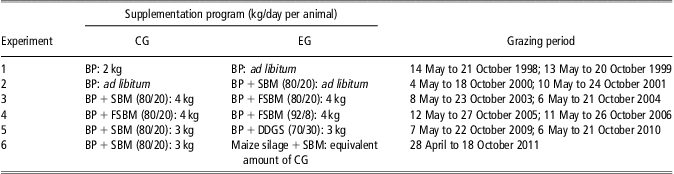
Each experiment was conducted to compare the effect of two feed supplements on animal performance. Females were divided into two comparable groups without dietary adaptation period, on the basis of initial BW, age at the start and growth rate from birth to start. To prevent that heavier animals would consume most of the supplement allowance, to the detriment of the lighter animals, they were split up in two subgroups within each supplementation treatment at the start of the grazing period, according to their initial BW (more or <250 kg, with unequal number of heifers per subgroup). Parcels were subsequently grazed by each of the subgroups to eliminate possible effects of grass composition on performance. Subgroups moved independently to a new parcel on the basis of a target post-grazing sward stubble height of 6 to 8 cm. The supplementation program is shown in Table 1. Supplements were fed once daily at ∼0930 h in portable cribs with 0.5 m or more of crib space per heifer.
Experiments and supplementation programme besides ad libitum grazed grass

CG = control group; EG = experimental group; BP = beet pulp; SBM = soybean meal; FSBM = formaldehyde-treated SBM; DDGS = dried distillers grains and solubles.
In Exp. 1, BP intake was restricted at 2 kg/day and per animal or freely available. The experimental design was comparable with previous experiments involving dual-purpose heifers (Fiems et al., Reference Fiems, Boucqué and Buysse1979). BP was chosen as energy supplement because its nutritive characteristics (low protein content, ready-fermentable carbohydrates) are complementary with those of grass (Bohnert et al., Reference Bohnert, Schauer and DelCurto2001; Van Vuuren and Van Den Pol-Van Dasselaar, Reference Van Vuuren and Van Den Pol-Van Dasselaar2006). It has been frequently used as an energy supplement for animals on pasture (Bargo et al., Reference Bargo, Muller, Kolver and Delahoy2003) and it is easy to handle and to store. Extra protein from soybean meal (SBM) or formaldehyde-treated SBM (FSBM) was fed in Exp. 2 and Exp. 3, respectively. Supplements were fed ad libitum in Exp. 2 because of the moderate performance in Exp. 1. The choice for a mixture of BP/SBM ratio of 80/20 (fresh weight (FW) basis; Exp.2) was based on the evaluation of the protein intake from a previous study, using BBDM bulls supplemented with 2 kg BP daily (Fiems et al., Reference Fiems, De Boever, De Campeneere and Vanacker2002a) and Exp. 1. Relying on the findings of Exp. 3, we tried to reduce the amount of SBM by the use of FSBM in Exp. 4. The BP/SBM ratio of 80/20 was reduced to a BP/FSBM ratio of 92/8 (FW basis) to obtain a similar content of truly digested and absorbed protein in the small intestine in both supplements (DVE; Tamminga et al., Reference Tamminga, Van Straalen, Subnel, Meijer, Steg, Wever and Blok1994). The supplement level was restricted to a maximum of 4 kg per animal and per day in Exp. 3 and Exp. 4, taking the relatively high intake into account of the heifers supplemented with extra protein in Exp. 2. Dried distillers grains and solubles (DDGS) was studied in Exp. 5. DDGS can be used as an alternative protein source for SBM (Segers et al., Reference Segers, Stelzleni, Pringle, Froetschel, Ross and Stewart2013). It was derived from a wheat/maize blend with at least 50% wheat. The supplements consisted of 80/20 BP/SBM and 70/30 BP/DDGS (FW basis). In Exp. 6, MS combined with SBM were compared with 80/20 BP/SBM. The ratio of MS and SBM was calculated to yield a similar DVE concentration in the dry matter (DM) as in the 80/20 BP/SBM supplement. MS/SBM was fed at a similar amount of DM as BP/SBM. To make the highest benefit from grass, and because animals did not always consume a daily amount of 4 kg supplement in Exp. 3 and Exp. 4, the supplement level was restricted to a maximum of 3 kg as such per animal and per day in Exp. 5 and Exp. 6, or the equivalent amount when MS was fed. Feed efficiency was always calculated as partial feed conversion (kg supplement DM/kg BW gain).
Sample collection and analyses
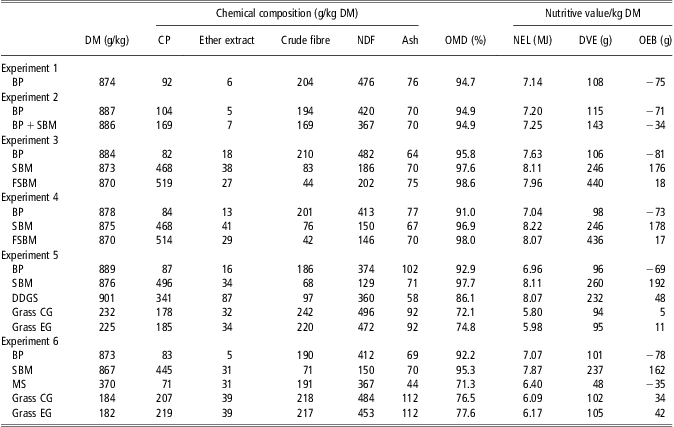
Feed supplement samples were collected on a monthly basis. In Exp. 2, the mixture of BP and SBM was sampled and analysed, whereas supplement ingredients were individually sampled and analysed in the other experiments. In Exp. 5 and Exp. 6, grass samples were collected fortnightly from the plots that were currently grazed by the animals. They were hand plucked at 6 to 8 cm above the soil surface from 10 to 15 random sites of the grazed parcels. Chemical composition of the composited feed samples was determined according to the Weende scheme, using European reference methods for ash (Anonymous, 1971a), moisture (Anonymous, 1971b) and protein (Anonymous, 1972) and fat (Anonymous, 1998). NDF was analysed with the addition of α-amylase, and sodium sulphite and was expressed on an ash-free base (Van Soest et al., Reference Van Soest, Robertson and Lewis1991). In vitro organic matter digestibility and net energy lactation value were predicted as described by De Boever et al. (Reference De Boever, Cottyn, De Brabander, Vanacker and Boucqué1999). The chemical composition and the nutritive value of the supplements are shown in Table 2. In Exp. 5, calcium and phosphorus were determined according to ISO standards (ISO, 1985 and 1998). Calcium and phosphorus contents amounted to 11.8 and 0.8, 4.5 and 7.2, 1.4 and 9.6, and 5.4 and 3.3 g/kg DM, for BP, SBM, DDGS and grass, respectively. In all experiments, supplement refusals were weighed back on a weekly basis and sampled for chemical analysis.
Chemical composition and the nutritive value of the supplements
DM = dry matter; OMD = in vitro organic matter digestibility using cellulase; NEL = net energy lactation; DVE = truly digested and absorbed protein in the small intestine; OEB = rumen degradable protein balance; BP = beet pulp; SBM = soybean meal; FSBM = formaldehyde-treated SBM; DDGS = dried distillers grains and solubles; MS = maize silage; Grass CG = grass grazed by heifers of the control group; Grass EG = grass grazed by heifers of the experimental group.
Blood samples were taken from heifers in Exp. 3 and Exp. 4 in the course of the 2nd week of July, when the youngest heifers were at least 2 weeks on pasture, to determine urea concentration according to the Berthelot method (Anonymous, 1992).
Statistical analysis
Data of each experiment were statistically analyzed using the GLM of Statistica software (StatSoft, 2009). Analyses were based on individual data for BW, duration of the grazing period and growth rate. Subgroup means were used as the unit for statistical analysis of feed intake. Because of the diverging age at start of the grazing period, age was used as covariate. Year effect on BW gain was investigated using an analysis of variance for the results of Exp. 3 to Exp. 6. The effect of feeding 4 (control groups of Exp. 3 and Exp. 4) or 3 kg daily of the BP/SBM supplement (control groups of Exp. 5 and Exp. 6) was compared, using initial age as covariate and year as dummy variable, because experiments were not conducted simultaneously. Regression analysis was used to investigate the effect of initial age and BW on BW gain, based on the results of Exp. 3 to Exp. 6 and the BP/SBM treatment of Exp. 2. Treatment effects were presented as significant when P ⩽ 0.05 and trends were identified at P ⩽ 0.10.
Results
Experiment 1
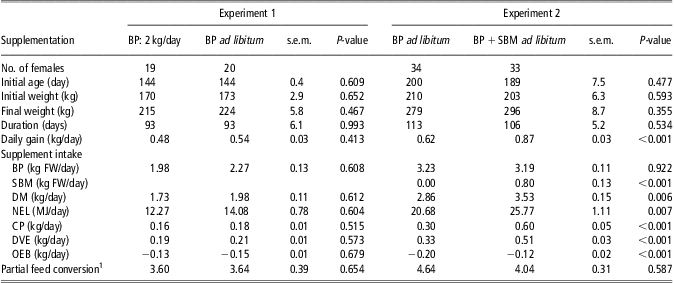
Supplementing heifers with 2 kg BP daily resulted in a moderate growth rate of 0.48 kg (Table 3). Ad libitum supplementation did not increase daily gain (P = 0.413), although the supplement intake was increased by 15% (P = 0.608). The partial feed conversion (kg DM/kg BW gain) was similar for both groups and averaged 3.62 kg.
Effect of supplementation on animal performance in Experiments 1 and 2
BP = beet pulp; SBM = soybean meal; FW = fresh weight; DM = dry matter; NEL = net energy lactation; DVE = truly digested and absorbed protein in the small intestine; OEB = rumen degradable protein balance.
1kg supplement DM intake/kg BW gain.
Experiment 2
Supplementing heifers with 80/20 BP/SBM increased growth rate by 40% (P < 0.001) compared with BP. Daily supplement DM, energy and protein intake (P < 0.01) were higher when extra protein was provided, but the partial feed conversion was not affected (Table 3).
Experiment 3
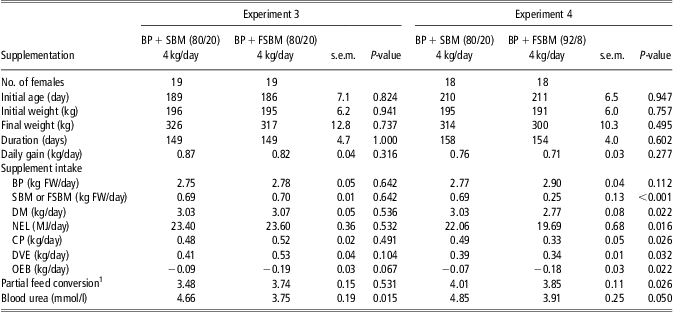
The replacement of SBM by FSBM on a FW basis did not affect daily gain (P = 0.316; Table 4). The maximum supplement intake of 4 kg FW/day was not achieved, meaning that intake was close to ad libitum during the initial weeks. There was a tendency for a higher DVE supply (29%; P = 0.104) when SBM was replaced by FSBM, but the lack of rumen degradable protein (OEB) was doubled (P = 0.067). The amount of soluble protein decreased because of the use of FSBM, where the OEB content was reduced from −31 in BP/SBM to −62 g/kg DM in BP/SFBM (based on the analytical data of Table 2). Partial feed conversion was not different between treatments (P = 0.531). FSBM resulted in a lower blood urea concentration (P = 0.015).
Effect of supplementation on animal performance in Experiments 3 and 4
BP = beet pulp; SBM = soybean meal; FSBM = formaldehyde-treated SBM; FW = fresh weight; DM = dry matter; NEL = net energy lactation; DVE = truly digested and absorbed protein in the small intestine; OEB = rumen degradable protein balance.
1kg supplement DM intake/kg BW gain.
Experiment 4
The reduction of the FSBM incorporation in the supplement from 80/20 in Exp. 3 to 92/8 in the current experiment did not affect growth rate (P = 0.277; Table 4). Daily intake of DM, net energy and protein from the supplement was lower (P < 0.05) for FSBM. The maximum supplement intake of 4 kg FW/day was neither achieved in this experiment. The lack of rumen degradable protein (OEB) was more than doubled (P = 0.022). The amount of soluble protein decreased because of the incorporation of FSBM, where the OEB content was reduced from −23 in BP/SBM to −65 g/kg DM in BP/FSBM. The lower OEB value of the supplement containing FSBM resulted in lower blood urea concentrations (P = 0.050). Partial feed conversion was improved by FSBM (P = 0.026).
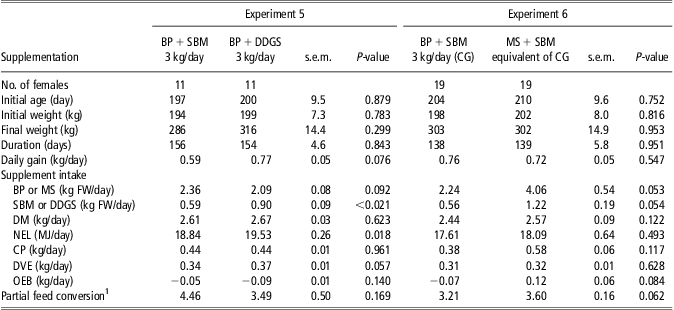
Experiment 5
The use of 70/30 BP/DDGS (FW basis) tended to increase the growth rate by 30% (P = 0.076) compared with 80/20 BP/SBM. Although daily supplement DM intake was similar, net energy intake was increased (P = 0.018) and daily DVE intake tended to increase (P = 0.057). Partial feed conversion was slightly improved by 13% (Table 5; P = 0.169). The calcium : phosphorus ratio in the supplement was decreased from 4.9 to 2.4 when SBM was replaced by DDGS.
Effect of supplementation programme on animal performance in Experiments 5 and 6
BP = beet pulp; SBM = soybean meal; DDGS = dried distillers grains and solubles; CG = control group; MS = maize silage; FW = fresh weight; DM = dry matter; NEL = net energy lactation; DVE = truly digested and absorbed protein in the small intestine; OEB = rumen degradable protein balance.
1kg supplement DM intake/kg BW gain.
Experiment 6
The use of MS as an energy supplement besides SBM did not affect growth rate in comparison with BP. There was a tendency for a higher soluble protein (OEB) intake when MS was fed (Table 5; P = 0.084). Partial feed conversion was 12% higher when MS was used (P = 0.062).
Effect of year, supplementation level and initial BW and age
Data of Exp. 3 to Exp. 6 showed a significant year effect on BW gain, ranging from 0.55 to 0.86 kg/day (P = 0.001).
Increasing the maximum daily supplementation with 80/20 BP/SBM from 3 to 4 kg resulted in a daily average DM intake of 2.51 and 3.03 kg (P = 0.141), respectively, corresponding to 1.02% and 1.18% of the mean BW. These results indicate that the maximum supplement allowance was not consumed. Supplement intake was lower than intended, especially during the initial weeks of the grazing period. We observed a small tendency for an increased daily gain from 0.69 to 0.81 kg (P = 0.121). Partial feed conversion was not affected by supplementation level (3.63 v. 3.72 kg DM/kg BW gain, respectively; P = 0.674).
Data of Exp. 3 to Exp. 6 and the BP/SBM treatment of Exp. 2 showed a significant effect of initial age or initial BW on BW gain:
 $$ { {\rm{BW}}\,{\rm{gain}}\,{\rm{(kg/day,}}\, \pm \,{\rm{SE)}}\, = \, - \,{\rm{0}}{\rm{.459}}\,{\rm{(0}}{\rm{.285)}}\hfill\, \cr \quad+ \,{\rm{0}}{\rm{.0096}}\,{\rm{age}}\,{\rm{(0}}{\rm{.0027)}}\, - \,{\rm{0}}{\rm{.00002}}\,{\rm{(0}}{\rm{.00001)}}\hfill \\ \quad\,{\rm{ag}}{{{\rm{e}}}^{\rm{2}}} {\rm{;}}\,P{\rm{\ & \lt \,0}}{\rm{.001;}}\,{{R}^{\rm{2}}} \, = \,{\rm{0}}{\rm{.223;}}\,{\rm{SE}}\, = \,{\rm{0}}{\rm{.220}} \\ {\rm{BW}}\,{\rm{gain}}\,{\rm{(kg/day,}}\, \pm \,{\rm{SE)}}\, = \,{\rm{0}}{\rm{.189}}\,{\rm{(0}}{\rm{.403)}}\, \cr \quad+ \,{\rm{0}}{\rm{.0125}}\,{\rm{BW}}\,{\rm{(0}}{\rm{.0038)}}\, - \,{\rm{0}}{\rm{.00002}}\,{\rm{(0}}{\rm{.00001)}} \\ \quad\,{\rm{B}}{{{\rm{W}}}^{\rm{2}}} {\rm{;}}\,P{\rm{\ & \lt }}{\rm{0.001;}}\,{{R}^{\rm{2}}} \, = \,{\rm{0}}{\rm{.199;}}\,{\rm{SE}}\, = \,{\rm{0}}{\rm{.223}}<! \\ >$$
Discussion
Animal performance of grazing BBDM heifers in Exp. 1 (0.48 to 0.54 kg/day) was considerably lower than that of heifers from other breeds. We previously reported a daily gain of 0.55 and 0.65 kg for Belgian White–Red heifers grazing in similar conditions and supplemented with BP fed at 1 kg daily or ad libitum, respectively (Fiems et al., Reference Fiems, Boucqué and Buysse1979). Mean BW of ad libitum-supplemented BBDM and Belgian White–Red heifers was similar, but intake per kg BW0.75 of BBDM heifers was 5.4% lower. This result confirms the lower intake capacity of double-muscled animals compared with normal-muscled animals, as reported previously (Fiems et al., Reference Fiems, Cottyn, Boucqué, Bogaerts, Van Eenaeme and Vanacker1997). Furthermore, it is assumed that the increased protein requirement of BBDM heifers is not met, as shown previously for BBDM bulls (Fiems et al., Reference Fiems, De Boever, De Campeneere and Vanacker2002a). Feeding 1.41 kg corn DM daily (0.5% of BW) to Simmental crossbred steers and heifers, weighing initially 272 and 240 kg, respectively, resulted in a mean average daily gain of 0.69 kg (Goetsch et al., Reference Goetsch, Murphy, Grant, Forster, Galloway, West and Johnson1991). Gadberry et al. (Reference Gadberry, Beck and Gunter2004) reported a daily gain of 0.83 kg for crossbred heifers, weighing initially 189 kg, grazing winter-annual pasture and supplemented at 1% of BW. BBDM bulls, weighing initially 255 kg, grazing at a stocking rate of 6 or 10 animals/ha and supplemented with ± 1 kg of a mixture of dried BP and barley (50/50), gained 1.10 and 0.52 kg/day, respectively (Hornick et al., Reference Hornick, Raskin, Clinquart, Dufrasne, Van Eenaeme and Istasse1998). The initial BW in our experiments was lower than in most other experiments, except in the experiment by Gadberry et al. (Reference Gadberry, Beck and Gunter2004). This may be important with regard to the lower growth rate. Data not only suggest a breed × diet interaction but also a breed × diet × BW interaction or a breed × diet × age interaction. We previously found a close relationship between BW and DM intake in grass-fed growing BBDM bulls (Fiems et al., Reference Fiems, De Boever, De Campeneere and Vanacker2002a) on the one hand, and between BW and daily gain of grazing animals (Fiems et al., Reference Fiems, De Campeneere, De Boever and Vanacker2002b), on the other hand. The relationship between initial BW and daily gain is confirmed by the current results. Furthermore, a considerable year effect on daily BW gain was observed. This is not unexpected as Hopkins et al. (Reference Hopkins, Murray, Bowling, Rook and Johnson1995) reported a variation of 45% in DM yield of perennial ryegrass between years because of seasonal differences in weather.
A compensatory growth potential after a grazing period can be expected, as shown by Hornick et al. (Reference Hornick, Raskin, Clinquart, Dufrasne, Van Eenaeme and Istasse1998). However, a compensatory gain can be realized in case of a compensatory feed intake. In contradiction with bulls, heifers becoming pregnant may be restricted in their compensatory growth potential. Pregnancy may affect feed intake by competing with the digestive organs for space within the abdomen (Forbes, Reference Forbes1987). We previously reported a BW loss during the last months of gestation in BBDM heifers (Fiems and De Brabander, Reference Fiems and De Brabander2009), which can be a consequence of an insufficient feed intake because of the competition for abdominal space. This phenomenon may be more important in double-muscled than in normal-muscled animals because of the reduced organ size of double-muscled animals (Fiems, Reference Fiems2012).
The high supplementation level in our experiments may compromise rumen fermentation (Mould and Ørskov, Reference Mould and Ørskov1984; Van Vuuren and Van Den Pol-Van Dasselaar, Reference Van Vuuren and Van Den Pol-Van Dasselaar2006), resulting in a reduced feed digestion, and consequently a lower performance. On the basis of the physical structure evaluation as proposed by De Brabander et al. (Reference De Brabander, Vancker, De Boever and Geerts2002), and the physical structure requirement of 0.6/kg DM for BBDM growing bulls (De Campeneere et al., Reference De Campeneere, Fiems and De Brabander2004), there was no lack of fibrousness in the dietary DM. This is confirmed by the fact that the increased dietary structural value in Exp. 6, owing to MS, did not improve animal performance.
Results by Vendramini et al. (Reference Vendramini, Sollenberger, Dubeu, Interrante, Stewart and Arthington2006) showed a linear increase in growth rate when the supplement level increased from 1% to 2% of BW, which is not confirmed by the results of Exp. 1. Supplement level in Exp. 1 amounted to 0.9% and 1% of BW, respectively. Bohnert et al. (Reference Bohnert, Schauer and DelCurto2001) found no effect on growth rate, averaging 1.08 kg/day, when 0, 0.25, 0.5 or 0.75 kg dried BP was fed daily to Hereford × Angus heifers in an 84-day lasting experiment. This study confirms the lack of an effect of BP level on heifer performance observed in Exp. 1. However, daily BW gain reported by Bohnert et al. (Reference Bohnert, Schauer and DelCurto2001) was considerably higher. Several factors can contribute to this difference. Grass quality can be variable. CP content averaged 168 g/kg DM in the study by Bohnert et al. (Reference Bohnert, Schauer and DelCurto2001). CP content of the grass was not analysed in our experiment. On the basis of the analyses of Exp. 5 and Exp. 6, we can assume that protein content may be higher in Exp. 1 than in the study by Bohnert et al. (Reference Bohnert, Schauer and DelCurto2001), so that this parameter can hardly explain the different animal performance. On the contrary, a higher protein content may be beneficial for growth (Fiems et al., Reference Fiems, De Boever, De Campeneere and Vanacker2002a). As aforementioned, the different breeds involved can exert a diverging effect on intake and performance. A third reason that may help to explain the different effect of the supplementation is BW. Bohnert et al. (Reference Bohnert, Schauer and DelCurto2001) mentioned an initial BW of 287 kg, which is higher than in Exp. 1. We previously reported that daily BW gain in young bulls was dependent on BW of the animals (Fiems et al., Reference Fiems, De Campeneere, De Boever and Vanacker2002b). A similar effect of BW on growth rate of early weaned calves has been reported by Vendramini et al. (Reference Vendramini, Sollenberger, Dubeu, Interrante, Stewart and Arthington2006).
Despite the high nutritive value of grass in Western Europe (Table 2, Exp. 5 and Exp. 6; Van Vuuren and Van Den Pol-Van Dasselaar, Reference Van Vuuren and Van Den Pol-Van Dasselaar2006), and because of a similar grassland management in all experiments, we observed a positive effect of extra protein in Exp. 2. However, a positive effect of a protein supplement was not always reported. Supplementing Simmental crossbred heifers and steers grazing bermudagrass with a mixture of 60.6% feather meal, 28.3% corn gluten meal and 11.1% blood meal (0.063% of BW) in addition to supplemental corn (0.437% of BW) only nominally (P > 0.05) enhanced daily gain up to 0.75 kg compared with 0.69 kg for corn supplemented (0.437% of BW) animals (Goetsch et al., Reference Goetsch, Murphy, Grant, Forster, Galloway, West and Johnson1991). Similar results from the same authors were reported when only crossbred steers were involved in another experiment. Supplementation with a mixture of 50% feather meal, 25% corn gluten meal, 15% blood meal and 10% SBM (0.098% of BW) in addition to supplemental corn (0.402% of BW) non-significantly increased daily gain from 0.56 kg for corn-supplemented animals to 0.68 kg for corn- and protein meal-supplemented animals. The supplement composition in the last experiment (80.4% corn and 19.6% protein meals) was similar to the supplement fed to the experimental group in our Exp. 2. The significant effect of the protein supplement in our experiment is in contradiction with the results of Goetsch et al. (Reference Goetsch, Murphy, Grant, Forster, Galloway, West and Johnson1991), but can be explained by the higher protein requirement of double-muscled animals (Fiems et al., Reference Fiems, Cottyn, De Campeneere and Boucqué1998). Consequently, there was a greater response to the extra protein in our experiment.
The replacement of SBM by rumen bypass protein (FSBM) did not affect growth rate in Exp. 3 and Exp. 4. Hafley et al. (Reference Hafley, Anderson and Klopfenstein1993) found that the combination of ruminally degraded (corn steep liquor) and bypass protein (SBM and feather meal) increased growth rate (P < 0.10) of steers (1.08 kg/day) above the energy supplemented control group (0.95 kg/day) and also numerically increased gain above that, resulting from the ruminally degraded and bypass protein supplement (0.94 and 0.97 kg/day, respectively, P < 0.10). However, Karges et al. (Reference Karges, Klopfenstein, Wilkerson and Clanton1992) found no response of extra degradable protein in grazing steers fed iso-energetic supplements at 0.88 kg/day. Escape protein in addition to rumen degradable protein resulted in a linear (P < 0.01) increase in average daily gain. Besides the use of 85 kg heavier animals in the experiment by Karges et al. (Reference Karges, Klopfenstein, Wilkerson and Clanton1992), and applying a different supplementation level, grass protein content was also higher than reported by Hafley et al. (Reference Hafley, Anderson and Klopfenstein1993). Vendramini et al. (Reference Vendramini, Arthington, Sollenberger and Saraiva2011) fed early weaned calves grazing annual ryegrass with soybean hulls (0.85% of BW) complemented with SBM, heat-treated SBM, or a 50/50 mixture of heated and non-heated SBM (0.15% of BW). Increasing the rumen undegradable protein content of the supplement did not affect daily gain. These literature data, together with the lower blood urea concentrations found in Exp. 3 and Exp. 4, suggest that extra soluble protein in the supplement may be desirable. Assuming previously reported equations to estimate the intake of grass-fed BBDM animals (Fiems et al. (Reference Fiems, De Boever, De Campeneere and Vanacker2002a) showed a lack of soluble protein (OEB), resulting in a negative rumen degradable protein balance. A negative rumen degradable protein balance may impair microbial protein synthesis and is therefore not recommended (Tamminga et al., Reference Tamminga, Van Straalen, Subnel, Meijer, Steg, Wever and Blok1994). On the other hand, a positive OEB value may result in nitrogen losses. We expected a benefit from the escape protein in the supplement (negative OEB value) in combination with the rumen degradable protein in the grass (positive OEB value; see Table 2), so that dietary nitrogen losses could be restricted without negative effect on animal performance. Although neither total energy nor protein intake were known in our experiments, the reduced blood urea concentrations give an indication of the decreased ruminal protein: energy ratio when FSBM was fed. Blood urea concentrations of 3.75 (Exp. 3) and 3.91 (Exp. 4) mmol/l were at the lower limit of the blood urea nitrogen range of 11.1 to 15.2 mg/100 ml mentioned by Byers and Moxon (Reference Byers and Moxon1980) for a maximum growth rate of growing steers. Supplementing 18 to 24-month-old grazing crossbred beef heifers with 0 or 3 kg molassed BP daily resulted in blood urea levels of 5.07 and 4.37 mmol/l (Kenny et al., Reference Kenny, Boland, Diskin and Sreenan2001), which is higher than in our experimental groups of Exp. 3 and Exp. 4. Because heifers were older in the experiment by Kenny et al. (Reference Kenny, Boland, Diskin and Sreenan2001), total DM intake may be higher. Furthermore, owing to the lower supplementation level, grass intake containing a relatively high amount of rumen degradable protein may be more important than in our experiments. It is also known that double-muscled animals may have a lower blood urea concentration than non-double-muscled ones (Holmes et al., Reference Holmes, Ashmore and Robinson1973).
Wheat DDGS is as good as SBM as protein supplement for young grazing cattle. However, growth rate of the SBM-supplemented heifers was low compared with other experiments. We have no explanation for this lower growth rate. Performance of DDGS-supplemented heifers was comparable with the performance obtained by SBM-supplemented heifers in Exp. 6. Supplementation of grazing steers, weighing 260 kg initially, with 0.9 kg maize DDGS daily increased (P < 0.05) daily gain by 26% to 1 kg/day in comparison with 0.79 kg/day for non-supplemented steers. However, increasing supplemental feed from 0.9 to 1.8 kg DDGS resulted in a non-significant increase in growth rate (Gadberry et al., Reference Gadberry, Beck, Morgan, Hubbell, Butterbaugh and Rudolph2010). Greenquist et al. (Reference Greenquist, Klopfenstein, Schacht, Erickson, Vander Pol, Luebbe, Brink, Schwarz and Baleseng2009) fed steers with an initial weight of 330 kg with 2.3 kg maize DDGS daily. Daily gain increased from 0.68 kg for non-supplemented animals to 0.92 kg for DDGS-fed animals (P < 0.01). McMurphy et al. (Reference McMurphy, Sharman, Cox, Payton, Horn and Lalman2011) fed a protein supplement (33% CP) three times a week and delivered at 0.95 kg DM per crossbred steer. Supplements contained cottonseed meal or DDGS as protein sources and were fed from day 49 of the grazing period onwards until the end of the experiment. DDGS improved BW gain by 0.05 kg/day (P < 0.05) compared with cottonseed meal. Partial feed conversion amounted to 2.67 and 3.78 kg per kg of additional BW gain, respectively, compared with non-supplemented steers. The faster growth rate and the improved partial feed conversion for the DDGS-supplemented animals (Exp. 5) were confirmed by these authors. The results of Exp. 5 confirm that DDGS can be used as an alternative for SBM in BBDM animals, which is in accordance with the results by Segers et al. (Reference Segers, Stelzleni, Pringle, Froetschel, Ross and Stewart2013). The combination of BP and DDGS is complementary with regard to the supply of calcium and phosphorus. BP has high calcium content and low phosphorus content, whereas the reverse is true for DDGS. Estimating total DM intake using equations previously reported for BBDM growing animals (Fiems et al., Reference Fiems, De Boever, De Campeneere and Vanacker2002a), and taking the calcium and phosphorus contents into account that were determined in Exp. 5, we can calculate a calcium : phosphorus ratio in the dietary DM of 3.1 and 2.1 for the SBM- and DDGS-supplemented heifers. Combining DDGS with barley instead of BP and assuming the same intake of the supplement can lead to a calcium : phosphorus ratio in the dietary DM of 0.65. A low calcium : phosphorus ratio can be a risk for obstructive urolithiasis (Ewoldt et al., Reference Ewoldt, Jones and Miesner2008). Especially male calves are predisposed for the development of urolithiasis. Double-muscled animals are even more susceptible because of their reduced weight of the kidneys, the reduced number of urinary tubes and the reduced diameter of the Bowman's capsules (Fiems, Reference Fiems2012).
The use of MS may have a negative effect on feed intake because dietary moisture can exert a replacement effect on DM intake. Cabrera Estrada et al. (Reference Cabrera Estrada, Delagarde, Faverdin and Peyraud2004) showed that voluntary DM intake of dairy cows increases as the internal water content of roughages decreases. This phenomenon may even be more important in double-muscled animals because of their reduced feed intake capacity (Fiems, Reference Fiems2012). Furthermore, we found that dietary DM content is one of the most important feed characteristics influencing intake of growing double-muscled bulls (Fiems et al., Reference Fiems, De Boever, De Campeneere and Vanacker2002a). However, growth rate was not affected by feeding MS as energy supplement in comparison with BP, and supplement DM intake was even slightly higher (P = 0.122). This slightly higher supplement DM intake along with a similar growth rate suggests an increased substitution of grass by MS compared with BP/SBM. Higher substitution rates were reported for forage than for concentrate supplementation because of higher forage fill value (Dillon, Reference Dillon2006). This effect is also confirmed by the tendency for a higher partial feed conversion for heifers fed MS. Abdelhadi et al. (Reference Abdelhadi, Santini and Gagliostro2005) investigated the effect of an MS supplementation at 0% or 1% of BW on crossbred beef heifers grazing fresh temperate pasture. Initial BW and DM intake of the supplement (% of BW) were similar to BW and supplement intake in Exp. 6. Abdelhadi et al. (Reference Abdelhadi, Santini and Gagliostro2005) found no effect of MS on daily gain, and total DM intake was slightly but not significantly lower for the supplemented animals. The effect of MS on grass intake in Exp. 6 may be slightly reduced, because of the nominally lower growth rate. DM intake amounted to 3.03% and 2.87% of mean BW for the respective groups in the experiment of Abdelhadi et al. (Reference Abdelhadi, Santini and Gagliostro2005). Data for the intake of BBDM heifers are not known, but intake data obtained from BBDM bulls fed grass and supplemented with 2 kg BP daily (Fiems et al., Reference Fiems, De Boever, De Campeneere and Vanacker2002a) showed a maximum total DM intake of 1.9% of BW.
Previous research conducted by Vendramini et al. (Reference Vendramini, Sollenberger, Dubeu, Interrante, Stewart and Arthington2006) showed that supplementation of early weaned beef calves grazing annual pastures at 1% of BW is necessary to have a satisfactory performance. Increasing supplementation levels above 1% of BW increased performance, but this management practice was not cost-effective. The effect of supplementation level may be different in double-muscled animals because of their reduced feed intake capacity. The highest growth rate was obtained when a supplement was fed at 4 kg daily, corresponding to an average supplement DM intake of ±1.2% of BW. The desired level of supplementation of grazing animals is dependent on several factors such as the amount of available forage, the quality of the grass and it also depends on the limits of feed intake. Assuming the aforementioned maximum DM intake of 1.9% of BW for double-muscled animals means that more than 60% from the total DM intake comes from the supplement. It is questionable whether a permanent indoor feeding during the 1st year of life would be a better alternative for these animals. A large supplementation level, solely based on energy and protein supplement, can provoke nutritional imbalances during the grazing period, owing to a lack of some minerals and vitamins.
Previous studies involving heifers of a dual-purpose breed showed that feed costs were lowest when BP was supplemented at 1 kg/day in comparison with no or an ad libitum supplementation (Fiems et al., Reference Fiems, Boucqué and Buysse1979). Because grass intake and stocking rate were not known in the present experiments, it is difficult to estimate feed costs. Furthermore, the extra protein requirement of double-muscled animals makes the simulation even more complicated. An attempt was made for Exp. 2, using unit prices for fresh grass, BP and SBM of 0.120, 0.290 and 0.535 €/kg DM, respectively, and taking the performances mentioned in Table 2 into account. A total daily DM intake of 1.9% of BW was assumed, based on previous experiments with grass-fed BBDM animals (Fiems et al., Reference Fiems, De Boever, De Campeneere and Vanacker2002a), or fed MS or pressed BP-based diets supplemented with concentrate at 0.25 of total DM intake (unpublished data). Feed costs averaged 1.04 and 1.34 €/day, or 1.68 and 1.54 €/kg BW gain, respectively. The faster daily BW gain of BP/SBM supplemented heifers will advance first calving, resulting in lower feed costs for maintenance. However, this effect is not yet discounted in the feed cost estimation. Because daily supplement DM intake was highest for the BP/SBM-supplemented heifers (ad libitum supplementation) at the expense of grass intake, a lower supplementation rate may even be more cost-effective.
It can be concluded that grazing double-muscled replacement heifers of <1year of age necessitate extra protein besides an energy supplement on pasture. A mixture of 80% BP and 20% SBM offers a good balance of energy and protein. Increasing the rumen bypass protein in the supplement did not improve performances and may provoke a lack of rumen fermentable protein. Wheat DDGS can replace SBM, whereas MS is an alternative energy source, despite the higher moisture content than in BP. The use of FSBM and DDGS without negative effects on animal performance can be an alternative to reduce the import of SBM in Europe. Increasing the supplementation level from 3 to 4 kg/day, corresponding to an average DM supplementation of 1.02% and 1.18% of the mean BW, respectively, tends to increase growth rate without effect on partial feed conversion. A significant effect of year on growth rate was observed.
Acknowledgments
The authors greatly acknowledge Martine Martens, Piet Van Laere and Dirk Langerock for their skilled technical assistance.