BACKGROUND
Informal caregivers of palliative patients are close friends, relatives, and partners who have a significant relationship with and provide assistance to a patient with a life-threatening, incurable illness (Applebaum & Breitbart, Reference Applebaum and Breitbart2013). Informal caregivers experience intense emotional burdens: self-ratings and standardized interviews show that about 30 to 50% suffer from psychological distress (Pitceathly & Maguire, Reference Pitceathly and Maguire2003). Increased levels of depression and anxiety have also been reported (Chentsova-Dutton et al., Reference Chentsova-Dutton, Shucter and Hutchin2002; Pitceathly & Maguire, Reference Pitceathly and Maguire2003).
The authors of a Cochrane review observed that only a few interventions for informal caregivers have been developed, and they are often without a solid theoretical background and do not show long-term intervention effects (Candy et al., Reference Candy, Jones, Drake, Leurent and King2011). A more recent systematic review found that the number of interventions is increasing but that evaluation of their methodology is still lacking (Applebaum & Breitbart, Reference Applebaum and Breitbart2013).
Existential behavioral therapy (EBT) was developed in order to address these issues. It is based on cognitive behavioral and existential psychology. This novel intervention has been evaluated in a randomized controlled trial, where improvements in both quality of life and depressive symptoms were observed up to one year after completion of EBT (Fegg et al., Reference Fegg, Brandstätter and Kögler2013).
Questions about values, mindfulness, and acceptance have been integrated into the “third wave” of cognitive behavioral therapy (Hayes, Reference Hayes2004). In addition to these essential improvements, EBT includes an existential perspective to meet the needs of informal caregivers in their confrontation with death, hopelessness, questions of meaning, and reorientation toward life (Yalom, Reference Yalom1980).
After developing a treatment manual and conducting a pilot study, EBT treatment effects were evaluated in a randomized controlled trial assessing the quality of life and psychological distress of informal caregivers. The intervention comprised six sessions (22 hours total) (Fegg et al., Reference Fegg, Brandstätter and Kögler2013):
-
• First meeting: becoming acquainted and introduction to mindfulness.
-
• Second meeting: death, bereavement, and mindfulness.
-
• Third meeting: activating resources and finding meaning.
-
• Fourth meeting: self-care and stress managememt.
-
• Fifth meeting: personal values for (re-)orientation.
-
• Sixth meeting: saying goodbye and new steps.
The details of this intervention are described elsewhere (Fegg et al., Reference Fegg, Brandstätter and Kögler2013).
Existential behavioral therapy was designed to support relatives continuously through the processes of caring to grieving (Benkel et al., Reference Benkel, Wijk and Molander2009; Field et al., Reference Field, Payne and Relf2007). Because almost half of the patients died during their stay at the palliative care unit (average treatment period: 10 days), the majority of relatives (77.4%) were already grieving when the intervention began. Comparable to previous studies, the rate of EBT enrollment was low, with only 13.6% of approached relatives taking part (range of enrollment in the literature: 2.4–30%) (Cherlin et al., Reference Cherlin, Barry and Prigerson2007; Harding et al., Reference Harding, Higginson and Leam2004; Bergman et al., Reference Bergman, Haley and Small2010).
This highlights the fact that further studies are needed to investigate the factors that influence utilization of mental health prevention and treatment programs in palliative care (Wills & Gibbons, Reference Wills and Gibbons2009). Their findings may provide ideas for better design and implementation of interventions that would lead to improved acceptance (Harding et al., Reference Harding, Higginson and Leam2004).
There are two main perspectives in research on mental healthcare service utilization to explain help seeking and to analyze the “complex array of psychological, social, and demographic factors” influencing a distressed individual's decision to utilize services (Henshaw & Freedman-Doan, Reference Henshaw and Freedman-Doan2009, p. 420).
The health belief model (Rosenstock, Reference Rosenstock1966), a sociocognitive approach, explains preventive health behavior as a result of a rational decision-making process. This model proposes two groups of variables influencing utilization of healthcare services: (1) readiness to act and (2) belief regarding the relative beneficial value of an available action/intervention. Readiness to act is defined by an individual's perceived vulnerability to a particular health problem and the perceived seriousness of this problem. Beliefs regarding the relative beneficial value of utilizing healthcare services are based on a cost/benefit analysis. The model proposes that people are most likely to utilize healthcare services when they: (1) believe they are at high risk (perceived susceptibility), (2) believe that it is a serious problem with severe consequences (perceived seriousness), (3) believe that the intervention will be effective (perceived benefits), and (4) perceive few barriers to service utilization (perceived barriers). All variables are thought to be influenced by such sociodemographic characteristics as age, gender, and education (Henshaw & Freedman-Doan, Reference Henshaw and Freedman-Doan2009).
Andersen's behavioral model of healthcare service utilization, based on a structural approach, was developed to analyze factors associated with utilization of healthcare services (including inpatient care, physician visits, and psychological support) (Andersen, Reference Andersen1995; deBoer et al., Reference deBoer, Wijker and deHaes1997; Phillips et al., Reference Phillips, Morrison and Andersen1998). According to this conceptual model, use is determined by individual characteristics, environmental influences, and the interaction between internal and external factors (Andersen, Reference Andersen1995). The model postulates three factors representing individual determinants of utilization:
Predisposing factors (e.g., age, gender, race, health beliefs, sociocultural environment) define a person's willingness to seek help. Female gender, younger age, and higher education, for example, seem to be associated with a higher level of psychological help seeking (Toseland et al., Reference Toseland, McCallion and Gerber2002; Cherlin et al., Reference Cherlin, Barry and Prigerson2007; Dhingra et al., Reference Dhingra, Zack and Strine2010).
Enabling factors (e.g., family support, social support, access to health insurance, one's community) describe aspects that may facilitate access to services. For example, informal support from one's social network or familiarity with professional support systems may enhance the likelihood of utilizing psychosocial support (Toseland et al., Reference Toseland, McCallion and Gerber2002).
Need factors (individually perceived and actual need for healthcare service): higher distress or impairments are often associated with higher levels of service use (deBoer et al., Reference deBoer, Wijker and deHaes1997; Cherlin et al., Reference Cherlin, Barry and Prigerson2007; Bergman et al., Reference Bergman, Haley and Small2010; Reference Bergman, Haley and Small2011). Need variables are considered to be the most immediate determinants for utilization of support (Andersen, Reference Andersen1995; deBoer et al., Reference deBoer, Wijker and deHaes1997; Bergman et al., Reference Bergman, Haley and Small2010).
We chose Andersen's model as a theoretical framework for our study due to several reasons. First, the behavioral model of healthcare service use is more commonly applied in a wide range of research (Andersen, Reference Andersen2008) and has been employed to explain and predict health behavior and help seeking in bereavement (Bergman et al., Reference Bergman, Haley and Small2010; Reference Bergman, Haley and Small2011), caregivers for dementia patients (Toseland et al., Reference Toseland, McCallion and Gerber2002), chronic illness (deBoer et al., Reference deBoer, Wijker and deHaes1997), and treatment of mental problems (Dhingra et al., Reference Dhingra, Zack and Strine2010). Moreover, the behavioral model was specifically developed for analyzing factors associated with utilization of healthcare services and can be used to integrate a wide range of individual as well as contextual variables (e.g., access to informal support sources or provider-related variables) associated with decisions to seek help.
Aim
Our study aimed to (1) identify the characteristics of EBT utilization with respect to the behavioral model of healthcare service use, (2) explore individually given reasons for declining support during the EBT trial, and (3) analyze whether participants and decliners differ in their long-term (12-month) psychological distress and quality of life (QoL).
METHODS
Design and Participants
Our study had a prospective longitudinal design with two assessments (baseline and 12-month follow-up). Inclusion criteria comprised being a relative of a palliative care patient (life expectancy ≤6 months according to the patient's physician), being at least 21 years of age, and having a sufficient knowledge of German. The exclusion criterion was a severe mental illness that would adversely affect the ability to give informed consent (e.g., dementia, delirium, acute psychosis). Two palliative care units and a radiation oncology department in Munich took part. The EBT sessions were held at one palliative care ward. Informal caregivers were approached as soon as possible after their ill relative was admitted to the palliative inpatient facility either by phone or in person to inform them about the EBT trial. They were given written and oral information by a member of our research group on the format (group format, led by a psychotherapist) and duration (six sessions) of the intervention, as well as about the content of each session. They were informed that the intervention was new and being currently evaluated. Caregivers were informed that if they were interested in participating they would be randomly assigned to either the intervention or control group, and in either case would be asked to complete several questionnaires. Care was taken to make this clear from the onset. In addition, help was offered to find alternative support, if desired. During a four-month period (April to June of 2010), all caregivers who declined participation in the EBT trial were asked to take part in the current study. Their data were compared to all relatives who were enrolled in the EBT trial and were randomly assigned to either the intervention or standard-care control group (Fegg et al., Reference Fegg, Brandstätter and Kögler2013). The ethics committee of the Ludwig–Maximilians–University Munich approved our study.
Questionnaires
Caregivers received a self-administered questionnaire assessing their sociodemographic information, their relationship to the patient, how often they received support (from family, friends, doctors, nurses, psychologists) during the prior four weeks (number of talks to a provider), the time spent providing care per day (in hours), and how intense they rated the pain of the patient (range 0–10). As pain is one of the most distressing physical symptoms at the end of life, we decided to focus on this core physical symptom (Oechsle et al., Reference Oechsle, Goerth and Bokemeyer2013). Data on patients' age, gender, and time of death were also collected. The distance from the home address of the caregiver to the EBT venue was calculated using Google maps.
The Brief Symptom Inventory (BSI) was employed to assess depression, anxiety, and hostility (Derogatis & Melisaratos, Reference Derogatis and Melisaratos1983). Previous studies showed that caregivers scored particularly high on these subscales (Chentsova-Dutton et al., Reference Chentsova-Dutton, Shucter and Hutchin2002). Raw scores were transformed into gender-specific t values (t ≥ 60 being clinically relevant). Quality of life was recorded using the Satisfaction with Life Scale (SWLS) (Diener et al., Reference Diener, Emmons and Larsen1985) and a numeric rating scale (QoL–NRS, range 0–10 on “How is your quality of life at the moment?”).
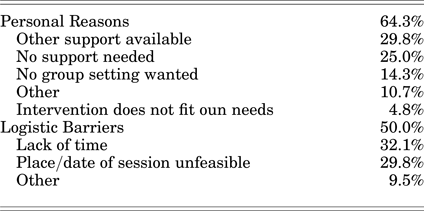
The reasons for declining were collected with open-ended questions and coded a posteriori into six categories (see Table 1). The categories were derived from two studies examining the reasons for not using bereavement services or support groups for caregivers (Cherlin et al., Reference Cherlin, Barry and Prigerson2007; Gage & Kinney, Reference Gage and Kinney1995).
Reasons for not using EBT (n = 84)

Note. Multiple responses were possible.
Statistical Analyses
Statistical analyses were carried out employing PASW Statistics 18.0 for Windows. The (two-tailed) significance level was set at α = 0.05.
Student's t and χ2 tests were utilized to examine group differences (RCT participants: intervention and controls vs. decliners). A hierarchical binary-logistic regression based on the behavioral model of healthcare service use was applied to test utilization or decline of support. The predictors were categorized into three groups (predisposing, enabling, and need factors), which were entered consecutively into the analysis. Multiple regression models (adjusted for baseline values, age, gender, relation to the patient, time of death, and use of other support) were applied to examine the long-term effects on psychological distress and QoL in the three groups (EBT, control, and decliners).
RESULTS
Sample Description
Some 190 caregivers declined to participate in the EBT trial during the study period, while 94 decliners agreed to participate in the utilization study (inclusion rate, 49.5%; see Figure 1); 78 of these caregivers also completed the 12-month follow-up (dropout rate, 17.0%). The decliners were compared to all EBT trial participants (n = 160; intervention: n = 81, controls: n = 79).
Flowchart displaying the recruitment process of study participants (decliners and EBT trial participants).

Reasons for Decline
The reasons for declining are summarized in Table 1.
Differences Between Participants and Decliners at the Time of Decision
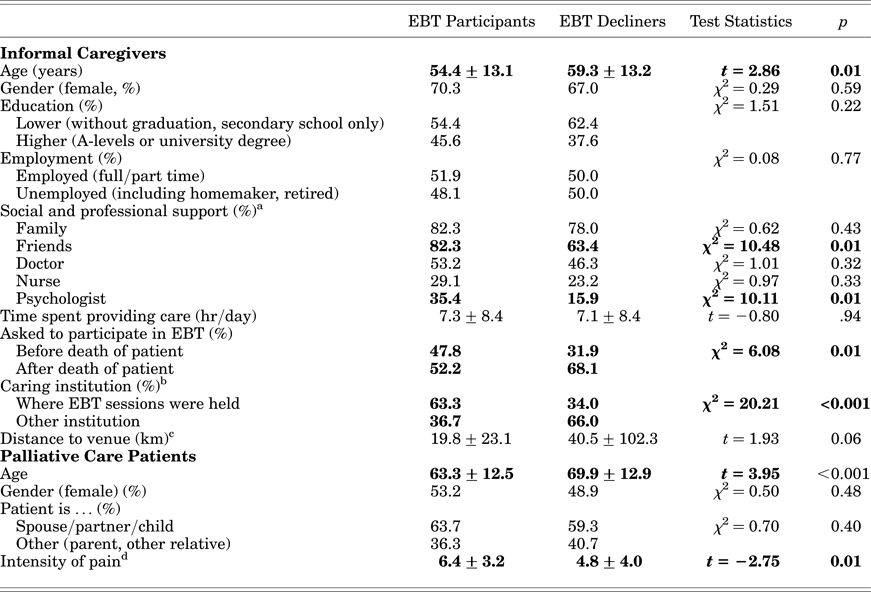
Participating caregivers were about five years younger than decliners; this corresponded to the age of the patient (Table 2). No differences were found regarding gender, education, employment, or relationship to the patient. EBT participants were more likely to be caregivers, and EBT decliners were more likely to be recently bereaved. Caregivers who felt that the patient suffered from greater pain were more likely to participate. No differences were found in terms of time spent providing care per day. A trend was observed indicating that decliners were living further away from the EBT venue compared to participants. Furthermore, relatives of patients being treated at the palliative care ward where the EBT sessions were held were also more likely to participate. EBT participants sought support more often from friends and psychologists during the previous four weeks.
Sample characteristics of EBT participants (n = 160) and decliners (n = 94)

Note. Bold = significant results.
aSupport used at least once during the previous four weeks.
bPalliative care department that held the EBT sessions vs. other institutions (another palliative care ward, a radiation oncology department; all in the same city).
cDistance from caregiver's home to EBT venue.
dCaregiver assessment range: 0 (no pain) to 10 (most intense pain).
Psychological Distress and Well-Being
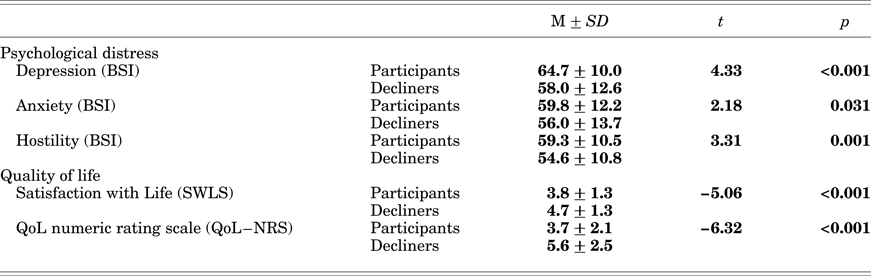
Table 3 shows that EBT participants (intervention and controls) were significantly more distressed (BSI) and reported lower QoL at baseline compared to decliners.
Psychological distress and quality of life of EBT participants (n = 160) and decliners (n = 94) at baseline

Note. Bold = significant results.
Behavioral Model of Healthcare Service Use
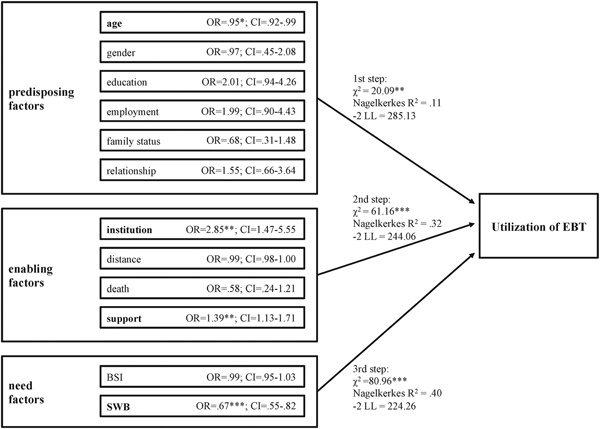
Figure 2 depicts the results of the binary-logistic regression for utilization predictors, which explain 40.1% of the overall variance. The regression steps are all significant, indicating that the predictors (predisposing, enabling, need factors) sufficiently discriminate between participants and decliners. The model correctly identifies 75.7% of caregivers as participants or decliners.
Behavioral model of healthcare service use: hierarchical binary-logistic regression model. OR = odds ratio; CI = confidence interval. Outcome: utilization of EBT (0 = decliner, 1 = participant). Predictors: gender (0 = female, 1 = male); education (0 = lower level, 1 = higher level); family status (0 = without relationship, 1 = in a relationship/married); occupation (0 = unemployed, 1 = employed); relation to patient (0 = other relation, 1 = patient is partner/child); institution (0 = patient treated at other institution, 1 = patient treated at EBT venue department); distance = between caregiver's home and EBT venue (km); death (0 = patient deceased before EBT recruitment, 1 = patient deceased after EBT recruitment); support = number of sources of social and/or professional support used during the last four weeks; BSI = psychological distress (composite score of the BSI subscales); SWB = subjective well-being (composite score of QoL–NRS and SWLS). *p < 0.05, **p < 0.01. ***p < 0.001.

Caregivers who were younger, had a lower QoL, used more sources of social and/or professional support, or whose patient was treated at the palliative care unit where the EBT sessions were held were more likely to participate in the EBT trial.
Longitudinal Analysis
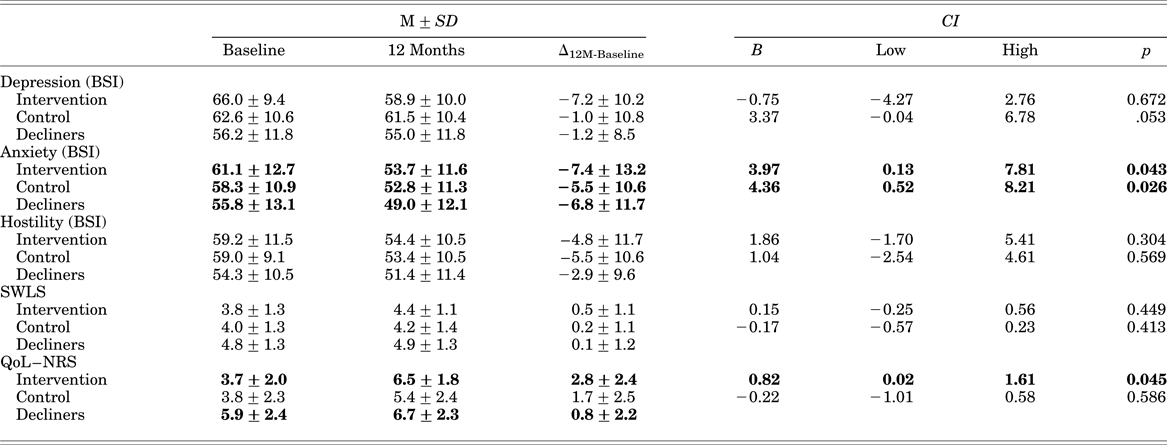
Table 3 indicates that decliners were less distressed at baseline than the EBT intervention and control group. Comparing changes between baseline and 12-month follow-up (adjusted for baseline values and other confounders; see Table 4), anxiety was 3.97 and 4.36 points more reduced in decliners (compared to intervention and controls, respectively). With regard to QoL–NRS, the intervention group improved by 0.82 points more than decliners. Decliners showed stronger improvements in anxiety compared to the intervention and control group. We did not find any interaction effects between group (decliners, intervention and control group) and bereavement status.
Linear regression analyses of long-term changes in psychological distress and quality of life (n = 187): EBT participants compared to EBT decliners (intervention vs. decliners // control vs. decliners).

Note. Bold = significant results. Univariate comparisons between EBT participants (intervention, controls) and decliners controlled for age, gender, relation to patient (partner/child vs. parent/other), time after death of patient (before EBT intervention vs. after EBT intervention).
B = regression coefficient, with positive values indicating higher, negative values indicating lower scores for the EBT participants (intervention vs. controls) compared to EBT decliners.
CI = 95% confidence interval for B.
DISCUSSION
Despite experiencing intense emotional and psychological burdens, only some informal caregivers of palliative patients access mental healthcare services. This may lead to “chronification” of existing distress (Pitceathly & Maguire, Reference Pitceathly and Maguire2003; Vanderwerker et al., Reference Vanderwerker, Laff and Kadan-Lottick2005; McNamara & Rosenwax, Reference McNamara and Rosenwax2010). Other factors contributing to chronification may include the experience of additional stressors/life events, multiple losses, or insufficient coping strategies and preexisting psychological disorders. Ambivalence regarding support and time-organizational barriers may also hamper service utilization (Harding & Higginson, Reference Harding and Higginson2001; Payne, Reference Payne2010).
The behavioral model of healthcare service use provided the framework for identifying barriers and promoters of EBT utilization. Younger age was a predisposing factor, enabling factors included social and professional support already being received as well as familiarity with the caregiving institution, while the need factors were QoL impairments.
Although no significant gender differences were found in utilization behavior, the majority of participants were female. This corresponds with other studies on psychological support utilization (Addis & Mahalik, Reference Addis and Mahalik2003; Galdas et al., Reference Galdas, Cheater and Marshall2005). Also consistent with previous research, younger caregivers were more likely to participate (Cherlin et al., Reference Cherlin, Barry and Prigerson2007), while older adults might have more negative attitudes toward seeking help for emotional problems (Segal et al., Reference Segal, Coolidge and Mincic2005). Participants were in their mid-fifties, with almost two thirds being the spouse/partner of a palliative care patient. Employment status (including retirement) did not influence these results. Another study offering support groups in the afternoons reported enrollment differences for employed and unemployed caregivers (Harding et al., Reference Harding, Higginson and Leam2004). EBT sessions, however, were held in the evenings to enable employed caregivers to take part.
EBT groups were conducted at one palliative care department, with informal caregivers being recruited from two other institutions in the same city; familiarity with the venue as well as distance from the caregiver's home were further predictors of EBT utilization.
Compared to decliners, EBT participants (intervention and controls) had significantly higher levels of psychological distress (BSI depression, anxiety, hostility) and significantly lower QoL (SWLS, QoL–NRS) at the time of enrollment decision. Due to their increased distress, participants might search for more help from social and professional sources. Seeking help often starts with friends and family; if this turns out to be insufficient, professional support is requested (Barker & Pistrang, Reference Barker and Pistrang2001).
At the 12-month follow-up, decliners were again less psychologically distressed and experienced better QoL compared to EBT participants. Changes during the one-year period pointed to the fact that caregivers receiving EBT treatment showed the strongest improvement. In the longitudinal analysis, the intervention group reported higher QoL improvements than decliners at follow-up. Decliners showed stronger improvements in anxiety compared to the intervention and control group. Bereavement status did not influence these anxiety improvements. Though the differences were statistically significant, distress levels for both decliners and EBT intervention participants fell within a normal range (i.e., not pathologically elevated) 12 months later (t < 60). Untreated controls, however, still had clinically relevant depressive symptoms. Again, this shows their increased distress and support needs.
In summary, it is notable that caregivers who did not want to utilize EBT were still well adjusted at follow-up. These findings imply that utilization behavior might be a self-selection process in which distressed relatives are more likely to seek support and benefit, particularly from psychological interventions (Kissane et al., Reference Kissane, McKenzie and Bloch2006; Toseland et al., Reference Toseland, McCallion and Gerber2002). It may be helpful to screen informal caregivers for psychological distress and quality-of-life impairments. In addition to the instruments used in our study, the Hospital Anxiety and Depression Scale (Zigmond & Snaith, Reference Zigmond and Snaith1983) and the Distress Thermometer (Weiss & Holland, Reference Weiss and Holland2007) have been successfully applied in other contexts. Following the screening, psychological support could be targeted at particularly burdened relatives.
Our study has several limitations. Due to logistical barriers, we did not investigate all caregivers who declined to take part during the full length of the EBT trial. Furthermore, the generalizability of our results is limited because only a specific support group was investigated. About 5% of decliners indicated that the offered intervention did not fit their needs, and about 15% stated that they did not want to participate in a group setting. Thus, it seems important to offer diverse forms of support, especially both the group and one-on-one support options. At the time of recruitment, a short description of the intervention contents was provided to each caregiver. It is unclear, however, what associations these descriptions elicited in caregivers. This may depend to a large extent on their personal experiences and attitudes. An intervention targeting existential topics potentially attracts a different subgroup of caregivers than an intervention targeting information needs or practical support. Additionally, with six meetings (22 hours in total), EBT is a rather extensive support service compared to intervention doses calculated in a review (mean 7.5 hours; range 1.7–18 hours) (Northouse et al., Reference Northouse, Katapodi and Sing2010). More than 30% of decliners stated that lack of time was one reason they did not use EBT. The enrollment rates for other support services indicate that shorter and/or more flexible interventions (e.g., home visits, phone calls) may be more accessible for relatives of palliative patients, especially for those who provide care for a dying relative (Applebaum & Breitbart, Reference Applebaum and Breitbart2013; Harding et al., Reference Harding, Higginson and Leam2004). Utilization of EBT may also be confounded by reservations about participating in a randomized controlled trial (i.e., only a 50% chance to participate, repeated questionnaires), although none of the decliners in this study indicated this as a reason for declining.
Future research could also address the underlying sociocognitive processes (appraisal, attitudes) that affect the decision to utilize or decline support. In addition, attitudinal barriers may inhibit utilization of accessible support despite being required.
To enable distressed caregivers to use support, they need information and knowledge about where to turn for help (Toseland et al., Reference Toseland, McCallion and Gerber2002). Thus, palliative care providers should set as a high priority implementing services for caregivers as well as improving the availability and accessibility of support. Familiarity with the service providers is a core promoter of support utilization. Group support may not always be feasible in a palliative care setting. Though cost effective, it might be necessary to initiate support quickly in a one-to-one setting; if the patient is in his or her last days of life, waiting for the start of the next group might be inappropriate. Bereaved caregivers were also less likely to take part in EBT groups, though no negative effects were reported from a “mixed composition” of caring and bereaved relatives (Fegg et al., Reference Fegg, Brandstätter and Kögler2013; Kögler et al., Reference Kögler, Brandl and Brandstätter2013). In summary, interventions for caregivers should be embedded into routine care in hospices and palliative care units at an early stage. Furthermore, early integration of palliative care in treatment of advanced cancer (Greer et al., Reference Greer, Jackson and Meier2013) may be useful in identifying and targeting distressed patients and their families in need of psychological support services early on.
FUNDING AND CONFLICTS OF INTEREST
This work was supported by Deutsche Krebshilfe e.V. (No. 107433). The funder had no role in the study design, data collection, analysis or interpretation, decision to publish, or preparation of the manuscript. The authors state that they have no conflicts of interest to declare.