1. Introduction
The Digermulen Peninsula (Fig. 1) in Arctic Norway includes one of the most complete successions of Cryogenian–Lower Ordovician strata in the world with an important record of diverse organic-walled microfossils (Vidal, Reference Vidal1981; Welsch, Reference Welsch1986; Högström et al. Reference Högström, Jensen, Palacios and Ebbestad2013; Palacios et al. Reference Palacios, Högström, Ebbestad, Jensen, Høyberget, Meinhold, Taylor, Mangerud, Lopes, Vecoli and Wicander2015, Reference Palacios, Ou, Agić, Högström, Jensen, Høyberget, Meinhold, Taylor, Ebbestad and McIlroy2017b) well suited for establishing a high-resolution Cambrian chronostratigraphy. Acritarchs represent a polyphyletic group of form-taxa, most of which represent organic-walled cysts. These fossils are essential for Cambrian biochronology as they were generally cosmopolitan in distribution and can often be extracted in great numbers from fine-grained siliciclastic rocks deposited under marine conditions.
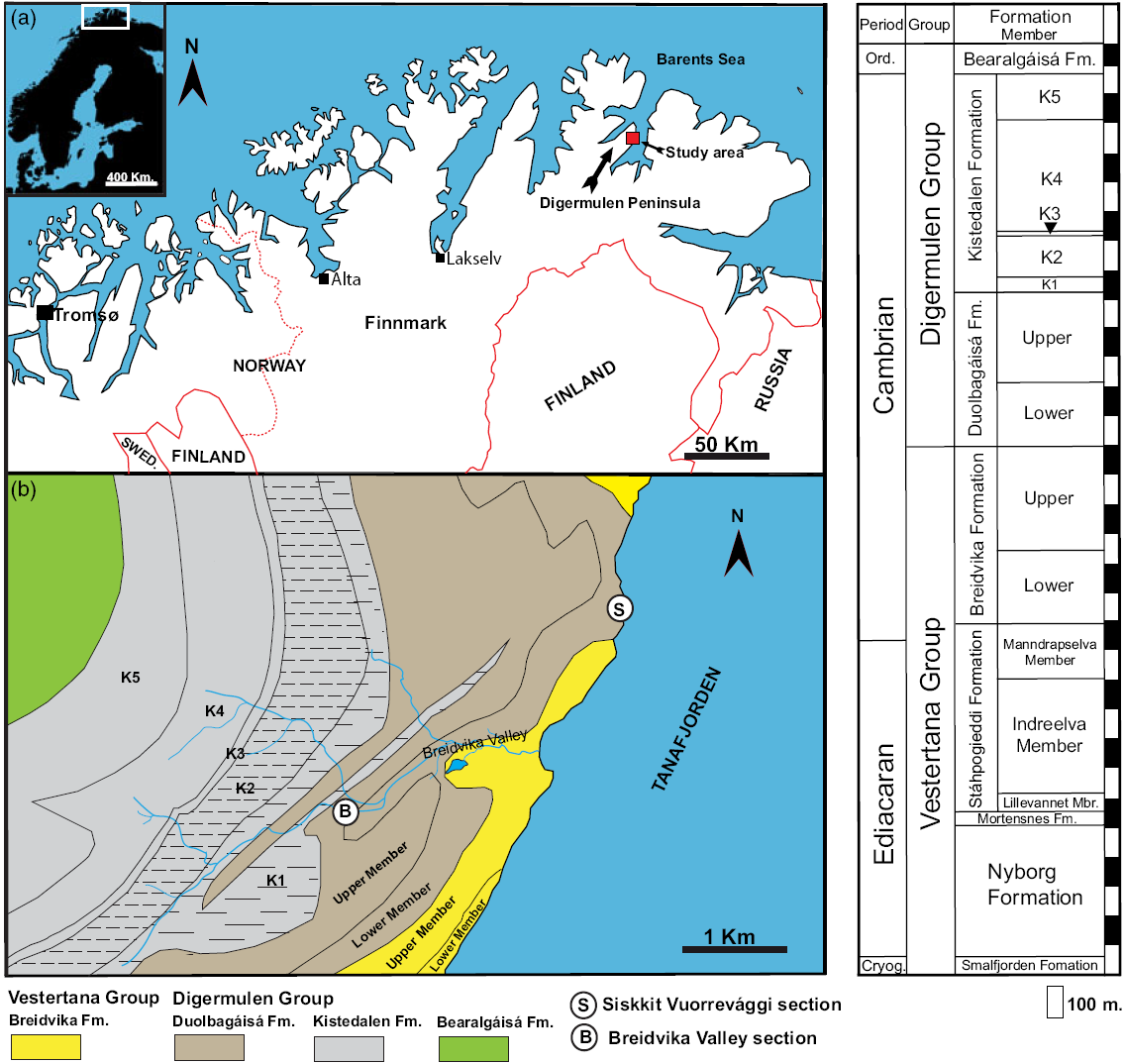
Location and geological setting of study area on the Digermulen Peninsula, Arctic Norway. (a) Geographical location of the Digermulen Peninsula. (b) Geology of the Breidvika Valley area with location of the Duolbagáisá Formation sections of this study. See the column for key to the geological units.

Cambrian acritarch zonations were first established in the western part of the East European Platform (western Russia, the Baltic States, Ukraine, Belarus and Poland). The stratigraphical distribution was recognized within ‘horizons’ of the lower Cambrian comprising in stratigraphically ascending order the Rovno, Lontova, Talsy, Vergale and Rausve horizons (Volkova et al. Reference Volkova, Kirjanov, Piscun, Paškevičienė, Jankauskas, Urbanek and Yu Rozanov1983). A comparable formal zonation based on studies of numerous drillcores was established in southeastern Poland (Moczydłowska, Reference Moczydłowska1991), comprising in stratigraphically ascending order the Asteridium tornatum–Comasphaeridium velvetum, Skiagia ornata–Fimbriaglomerella membranacea, Heliosphaeridium dissimilare–Skiagia ciliosa and Volkovia dentifera–Liepaina plana Assemblage zones (in the following given in abbreviated form). The Asteridium–Comasphaeridium Zone and the Rovno and Lontova horizons have been correlated with the Terreneuvian Series, with an approximate duration of 20 Ma (Cohen et al. Reference Cohen, Finney, Gibbard and Fan2013). The Rovno horizon is approximately equivalent to the Fortunian Stage, and is characterized by morphologically simple acritarchs (leiosphaerids) and filamentous sheaths. The Lontova Horizon, equivalent to the Asteridium–Comasphaeridium Zone, corresponds to the Fortunian and Stage 2 in part. However, the correlation of these zones outside their original source areas is sometimes problematic. On the Digermulen Peninsula, as well as in sections on Newfoundland and in New Brunswick, Canada, the name-bearing taxa of the Asteridium–Comasphaeridium Zone are absent from basal Fortunian strata, which instead are characterized by acritarchs lacking processes (Leiosphaeridia spp., Granomarginata squamacea and G. prima) (Palacios et al. Reference Palacios, Jensen, White and Barr2011, Reference Palacios, Ou, Agić, Högström, Jensen, Høyberget, Meinhold, Taylor, Ebbestad and McIlroy2017b, Reference Palacios, Jensen, Barr, White and Myrow2018; Högström et al. Reference Högström, Jensen, Palacios and Ebbestad2013). The first assemblages in well-exposed successions with a good record of organic-walled microfossils, including those diagnostic of the Asteridium–Comasphaeridium Zone, have been located in New Brunswick at levels dated to 531 Ma (Palacios et al. Reference Palacios, Jensen, White and Barr2011) and on Newfoundland at levels above the Watsonella crosbyi Zone (Palacios et al. Reference Palacios, Jensen, Barr, White and Myrow2018). Following Palacios et al. (Reference Palacios, Jensen, Barr, White and Myrow2018) and herein we therefore identify the Asteridium–Comasphaeridium Zone only when the index taxa are present. Low-diversity Fortunian assemblages dominated by Granomarginata, which were previously included in this zone (i.e. Moczydłowska, Reference Moczydłowska1991), are instead included in an assemblage that encompass the Granomarginata Zone (Palacios et al. Reference Palacios, Jensen, Barr, White and Myrow2018) and a lower assemblage dominated by leiosphaerids. The succeeding acritarch zones, the Skiagia–Fimbriaglomerella, Heliosphaeridium–Skiagia and Volkovia–Liepaina zones, allow a more detailed division of the Cambrian Series 2 (approximate duration of 12 Ma; Cohen et al. Reference Cohen, Finney, Gibbard and Fan2013) compared to that of the Terreneuvian (approximate duration of 20 Ma; Cohen et al. Reference Cohen, Finney, Gibbard and Fan2013). On Baltica the base of the Skiagia–Fimbriaglomerella Zone approximates the position of the earliest trilobites of the Schmidtiellus Zone (Moczydłowska, Reference Moczydłowska1991). More broadly, Skiagia has been suggested to have a global first appearance close to the appearance of trilobites and to the base of the yet-undefined Cambrian Series 2 (Moczydłowska & Zang, Reference Moczydłowska and Zang2006). The appearance of Skiagia coincides with a substantial increase in the diversity of phytoplankton that signals the onset of the Cambrian phytoplankton radiation (e.g. Vidal & Moczydłowska-Vidal, Reference Vidal and Moczydłowska-Vidal1997; Moczydłowska, Reference Moczydłowska2011; Palacios et al. Reference Palacios, Jensen, Barr, White and Myrow2018).
In the present paper, the first data on acritarchs from the Duolbagáisá Formation on the Digermulen Peninsula is presented, establishing for the first time an acritarch-based chronostratigraphic framework for this part of Baltica. A critical analysis of current acritarch zonations and their potential for chronostratigraphy of the Cambrian Series 2 is made.
2. Geological setting
The Digermulen Peninsula, Arctic Norway (Fig. 1a), includes a thick parautochthonous succession of Cryogenian–Lower Ordovician strata (Føyn, Reference Føyn1937; Banks et al. Reference Banks, Edwards, Geddes, Hobday and Reading1971) divided into the Cryogenian–Terreneuvian Vestertana Group and the Cambrian Series 2 – Lower Ordovician Digermulen Group (Reading, Reference Reading1965) (Fig. 1b). The basal formations of the Vestertana Group include, in ascending order, the Cryogenian glaciogenic diamictites of the Smalfjorden Formation, the Nyborg Formation and the Ediacaran diamictite of the Mortensnes Formation correlated with the Gaskiers glaciation of Newfoundland (Rice et al. Reference Rice, Edwards, Hansen, Arnaud, Halverson, Arnaud, Halverson and Shields-Zhou2011; c. 580 Ma, Pu et al. Reference Pu, Bowring, Ramezani, Myrow, Raub and Landing2016). The Nyborg and Mortensnes formations contain organic-walled microfossil assemblages of low diversity (Vidal, Reference Vidal1981), with the Nyborg Formation notable for an organically preserved multicellular eukaryote (Agić et al. Reference Agić, Högström, Moczydłowska, Jensen, Palacios, Meinhold, Ebbestad, Taylor and Høyberget2019). The presence of Doushantou–Pertataka-type acritarchs in the Nyborg Formation points to an Ediacaran age and corroborates other lines of evidence for a Gaskiers-equivalent age for the Mortensnes glacial deposits (Agić et al. Reference Agić, Högström, Jensen, Ebbestad, Meinhold, Palacios, Taylor and Høyberget2018). The succeeding Stáhpogieddi Formation comprises lower quartzitic sandstones (Lillevannet Member), blue-green and red-violet mudrock (Indreelva Member) and the Manndrapselva Member (Banks et al. Reference Banks, Edwards, Geddes, Hobday and Reading1971), the latter with a basal quartzitic sandstone followed by two coarsening-upward successions of greywacke sandstone and mudstone and sandstone. The Ediacaran–Cambrian transition is recognized within the Manndrapselva Member on the basis of ichnofossils (i.e. Treptichnus pedum) and organic-walled microfossils (Högström et al. Reference Högström, Jensen, Palacios and Ebbestad2013; Palacios et al. Reference Palacios, Ou, Agić, Högström, Jensen, Høyberget, Meinhold, Taylor, Ebbestad and McIlroy2017b; Jensen et al. Reference Jensen, Högström, Almond, Taylor, Meinhold, Høyberget, Ebbestad, Agić and Palacios2018). The lower part of the Breidvika Formation, the uppermost unit of the Vestertana Group, yields Platysolenites antiquissimus and Rusophycus sp., and acritarchs diagnostic of the Asteridium–Comasphaeridium Zone (Vidal, Reference Vidal1981; Högström et al. Reference Högström, Jensen, Palacios and Ebbestad2013; Palacios et al. Reference Palacios, Ou, Agić, Högström, Jensen, Høyberget, Meinhold, Taylor, Ebbestad and McIlroy2017b). Banks (Reference Banks, Crimes and Harper1970) reported Platysolenites antiquissimus from the lower part of the formation, but McIlroy et al. (Reference McIlroy, Green and Brasier2001) documented specimens only from the upper part. The Digermulen Group is made up of three formations. At the base, the Duolbagáisá Formation (Reading, Reference Reading1965; Banks et al. Reference Banks, Edwards, Geddes, Hobday and Reading1971) includes two members. The Lower Member is well exposed along the coast to the northeast of Breidvika Valley, in the Siskkit Vuorrevággi section (Fig. 1b), where it consists of 256 m of siltstone, mudstone and quartzitic sandstone (Fig. 2). This member contains abundant trace fossils (Banks, Reference Banks, Crimes and Harper1970; McIlroy & Brasier, Reference McIlroy, Brasier, Brasier, McIlroy and McLoughlin2017), an unidentified trilobite (Ebbestad et al. Reference Ebbestad, Högström, Palacios, Jensen, Meinhold, Høyberget, Agić and Taylor2018) and, near the base of the member, the enigmatic agglutinated tube-shaped fossil Volborthella tenuis (Crimes & McIlroy, Reference Crimes and McIlroy1999; McIlroy & Brasier, Reference McIlroy, Brasier, Brasier, McIlroy and McLoughlin2017), which is taken to mark a point at around the base of the Cambrian Series 2 (McIlroy & Brasier, Reference McIlroy, Brasier, Brasier, McIlroy and McLoughlin2017). The Upper Member of the Duolbagáisá Formation is well exposed in the Breidvika Valley (Figs 1, 3). Here it consists of 382 m of quartzitic sandstone with minor intercalations of fine-grained sandstone, siltstone and mudstone that have their maximum thickness in the middle part, where trilobites occur, including Kjerulfia n. sp., Elliptocephala n. sp. and rare ellipsocephalids (Nikolaisen & Henningsmoen, Reference Nikolaisen and Henningsmoen1990; Ebbestad et al. Reference Ebbestad, Høyberget, Högström, Palacios, Jensen, Taylor, Meinhold and Pärnaste2017, Reference Ebbestad, Högström, Palacios, Jensen, Meinhold, Høyberget, Agić and Taylor2018). The overlying Kistedalen Formation contains trilobites and acritarchs of Miaolingian–Furongian age (Nikolaisen & Henningsmoen, Reference Nikolaisen and Henningsmoen1985, Reference Nikolaisen and Henningsmoen1990; Welsch, Reference Welsch1986; Palacios et al. Reference Palacios, Högström, Ebbestad, Jensen, Høyberget, Meinhold, Taylor, Mangerud, Lopes, Vecoli and Wicander2015). The boundary between the Duolbagáisá and Kistedalen formations has been suggested to approximate the Cambrian Series 2–Miaolingian boundary (Nielsen & Schovsbo Reference Nielsen and Schovsbo2015; but see below). Nielsen & Schovsbo (Reference Nielsen and Schovsbo2015) considered the possibility that the upper sandstone-dominated part of the Duolbagáisá Formation represents lowstand deposits related to the Hawke Bay regression, which is concurred herein. The Kistedalen Formation is divided into five members, K1–K5. The lower member, consisting of sandstone with interbedded mudstone and siltstone (K1), yields Miaolingian trilobites near the base (Eccaparadoxides cf. pusillus, Ellipsocephalus cf. hoffi, Hydrocephalus cf. carens), of uncertain zonal assignment, but Nikolaisen & Henningsmoen, (Reference Nikolaisen and Henningsmoen1990, p. 77) suggested the Eccaparadoxides insularis Zone. The K2 member consists of mudstone intercalated with dark grey to black sandstone at the top, and yields abundant acritarchs (Welsch, Reference Welsch1986; Palacios et al. Reference Palacios, Högström, Ebbestad, Jensen, Høyberget, Meinhold, Taylor, Mangerud, Lopes, Vecoli and Wicander2015). The K3 ‘black quartzite member’ and the K4 (black shale) member yield Furongian acritarchs (Welsch, Reference Welsch1986). The formation culminates with a massive sandstone (K5). The Digermulen Group terminates with the Bearalgáisá Formation, consisting mainly of shale and sandstone in the lower part and sandstone and minor shale in the upper part, and yields Tremadocian trilobites and acritarchs (Nikolaisen & Henningsmoen, Reference Nikolaisen and Henningsmoen1985; Welsch, Reference Welsch1986).
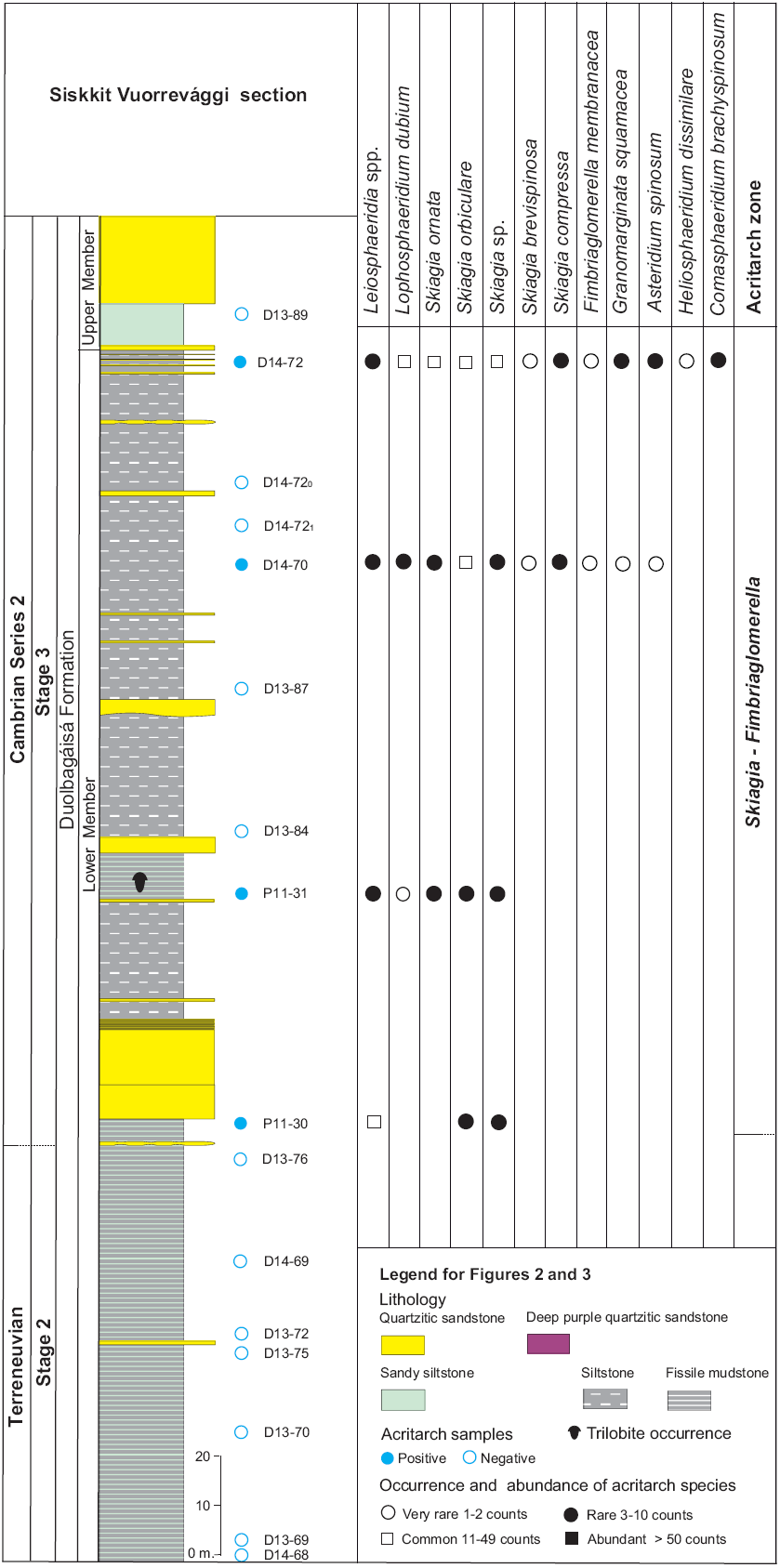
Lithostratigraphic column of Siskkit Vuorrevággi coastal section north of Breidvika Valley (Lower Member of the Duolbagáisá Formation) showing location of samples and their sample number, occurrence and abundance of acritarch species in each slide.

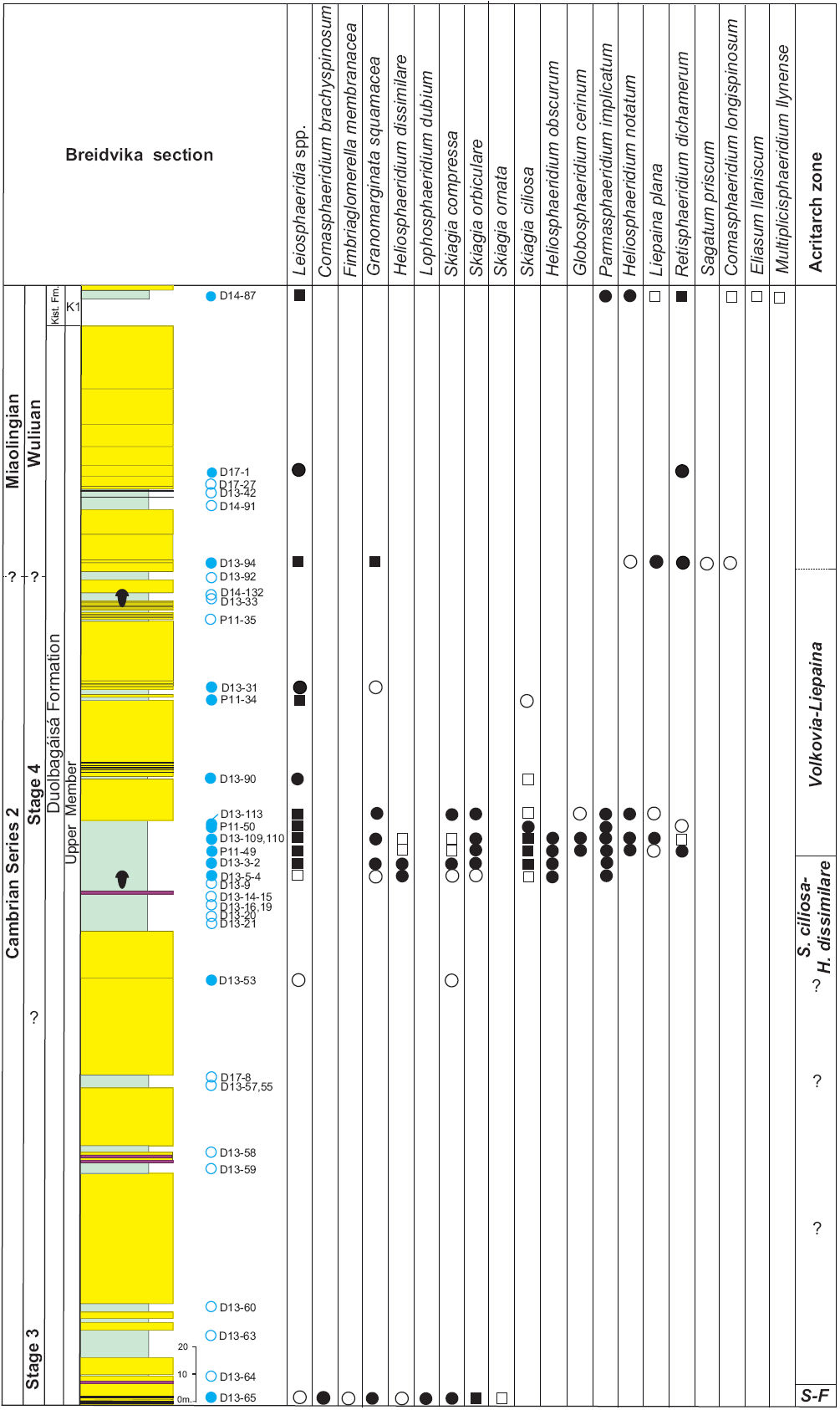
Lithostratigraphic column of the Breidvika Valley section (Upper Member of the Duolbagáisá Formation) showing location of samples and their sample number, occurrence and abundance of acritarch species. See Figure 2 for legend.

3. Material and methods
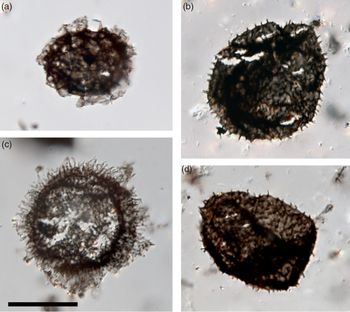
This study is based on shale and siltstone samples from the Duolbagáisá Formation collected by the authors between 2011 and 2017. A total of 55 samples (Figs 2, 3) have been processed, mainly of shales with colours ranging from green and light grey to olive green and dark grey. Stratigraphic levels and quantitative distribution of the identified acritarch species in positive samples are shown in Figures 2 and 3. Samples of c. 50 g were treated with standard palynological methods, mounted on glass slides with Petropoxy 154 resin and studied under transmitted light with a Zeiss Axio Imaginer M1 microscope with a computerized AxioCam HRc microscope camera. The positive samples contain relatively well-preserved (brown to dark brown, TAI 3–4 sensu Hayes et al. Reference Hayes, Kaplan, Wedeking and Schopf1983) acritarchs. Studied and illustrated material (Figs 4–7, 9, 10) is stored with the palaeontological collection of the Arctic University Museum of Norway, prefix TSGf, with the exception of comparable material from the Hanford Brook Formation, New Brunswick, Brigus Formation, Newfoundland and Láncara and Vallehondo formations, Spain (Fig. 8), which is reposited in the collections of Área de Paleontología of the Universidad de Extremadura, Badajoz. Museum numbers are referred to in the figure captions, which also provide sample numbers and England finder coordinates.
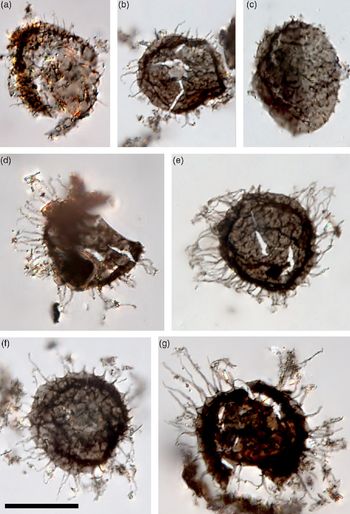
Acritarchs from the Duolbagáisá Formation (Lower Member), Siskkit Vuorrevággi section. Given in this and the following figures are the sample number, museum number and England finder coordinates. Scale bar = 20 μm. (a, b) Skiagia orbiculare (Volkova) Downie: (a) P11-30, TSGf 18435, Q-33; (b) D14-72, TSGf 18438a, T-26-2. (c) Skiagia brevispinosa Downie, D14-70, TSGf 18437a O-29. (d, e) Skiagia ornata (Volkova) Downie: (d) P11-31, TSGf 18436, K-33-3; (e) D14-72, TSGf 18438b, M-44-4. (f, g) Skiagia compressa (Volkova) Downie: (f) D14-72, TSGf 18438c, E-26-1-3; (g) D14-72, TSGf 18438d, C-38-3.

Acritarchs from the Duolbagáisá Formation. Scale bar = 20 μm. (a, b) Lower Member, Siskkit Vuorrevággi section. (c, d) Upper Member, Breidvika Valley section. (a) Fimbriaglomerella membranacea (Kirjanov) Moczydłowska & Vidal, D14-72, TSGf 18438e, L-18-2. (b) Comasphaeridium brachyspinosum (Kirjanov) Moczydłowska & Vidal, D14-70, TSGf 18437b, W-17-1. (c, d) Lophosphaeridium dubium (Volkova) Moczydłowska: (c) D13-65, TSGf 18439a, D-17; (d) D13-65, TSGf 18439b, R-14-1-3.

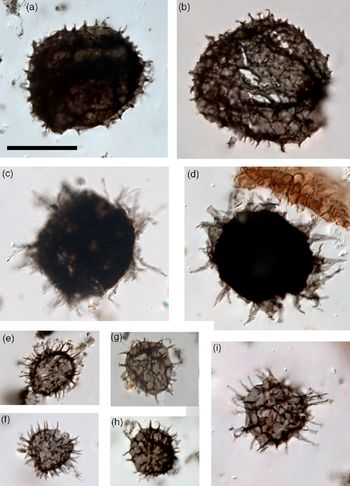
Acritarchs from the Duolbagáisá Formation (Upper Member), Breidvika Valley section. Scale bar = 20 μm. (a, b) Globosphaeridium cerinum (Volkova) Moczydłowska: (a) D13-110, TSGf 18441a, C-38-4; (b) D13-109, TSGf 18440a, E-25-1. (c, d) Parmasphaeridium implicatum (Fridrichsone) Jachowicz-Zdanowska: (c) P11-49, TSGf 18443a, B-18-1-2; (d) D13-113, TSGf 18444a, R-40-4. (e, f) Heliosphaeridium dissimilare (Volkova) Moczydłowska: (e) D13-110, TSGf 18442a, E-45; (f) P11-49, TSGf 18443b, Q-22-2. (g, h) Heliosphaeridium obscurum (Volkova) Moczydłowska: (g) D13-110, TSGf 18442b, A-19-2; (h) D13-110, TSGf 18441b, A-26-2. (i) Heliosphaeridium notatum (Volkova) Moczydłowska, D13-113, TSGf 18444b, C-17-1.

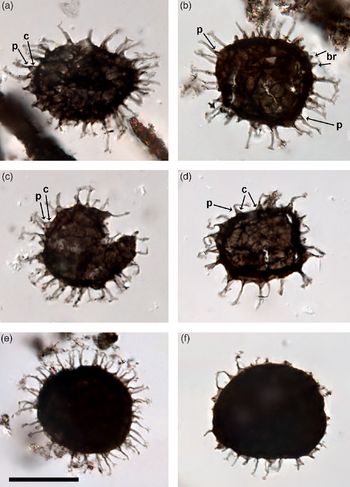
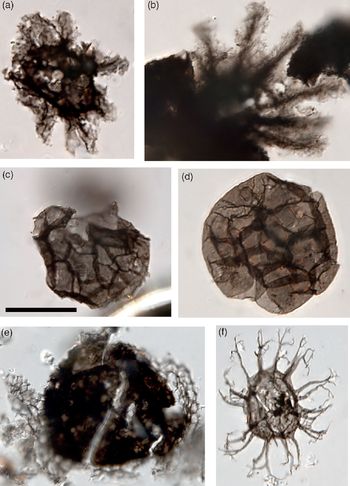
Acritarchs from the Duolbagáisá Formation (Upper Member), Breidvika Valley section. Scale bar = 20 μm. (a–f) Skiagia ciliosa (Volkova) Downie. In Figures 7 and 8, the arrows show the clear and distinctive plug (p), conical base (c) and some broken (br) processes. (a) D13-109, TSGf 18440b, L-38-1. (b) D13-113, TSGf 18444c, U-37-4. (c) D13-109, TSGf 18440c, B-33-4. (d) D13-109, TSGf 18440d, D-34-1-2. (e) Specimen with a dark internal body (a possible endocyst) D13-110, TSGf 18441c, E-20-2. (f) Specimen with dark internal body D13-3, TSGf 18445, H-17-2-4

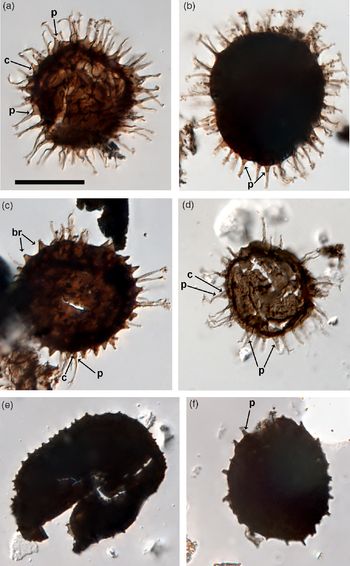
Skiagia ciliosa from Avalonia. Scale bar = 20 μm. (a–c) New Brunswick, St Martins Member, Hanford Brook Formation. (e) Newfoundland, Brigus Formation, Dantzig Cove section. (d, f) Iberian Peninsula: (d) Cantabrian Zone, Lower Member, Láncara Formation; (f) Ossa-Morena Zone, Lower Member, Vallehondo Formation. (a) Hanf09-3, slide 2, B-24. (b) Specimen with dark internal body, Hanf09-3, slide 2, H-27-2. (c) Specimen with broken processes, Hanf09-3, slide 2, B-46-2. (d) BL14-1, slide 1, C-20. (e) Specimen with broken processes, DC17-12, slide 2, T-16-3. (f) Specimen with broken processes, CA06-4, slide 1, C-44-1.

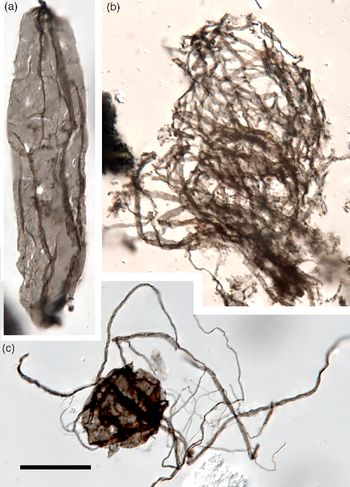
Acritarchs from the Upper Member of the Duolbagáisá Formation (a, c, e) and K1 Member of the Kistedalen Formation (b, d, f), all Breidvika Valley section. (a, b) Liepaina plana Jankauskas & Volkova: (a) D13-109, TSGf 18440e, L-42; (b) D14-87, TSGf 18447a, E-16-3. (c, d) Retisphaeridium dichamerum Staplin, Jansonius & Pocock: (c) D13-109, TSGf 18440f, D-24-3-4; (d) D14-87, TSGf 18447b, D-32-3. (e) Sagatum priscum (Kirjanov & Volkova) Vavrdová & Bek, D13-94, TSGf 18446a, B-22-4. (f) Multiplicisphaeridium llynense (Martin) Jachowicz-Zdanowska, D14-87, TSGf 18447c, N-28. Scale bar = 20 μm.

Acritarchs from the Upper Member of the Duolbagáisá Formation (b), and K1 Member of the Kistedalen Formation (a, c), all Breidvika Valley section. (a) Eliasum llaniscum Fombella, D14-87, TSGf 18447d, Q-45-1. (b, c) Comasphaeridium longispinosum Hagenfeldt: (b) D13-94, TSGf 18446b, J-46-1; (c) D14-87, TSGf 18447e, M-34. Scale bar = 20 μm.

4. Acritarch assemblages from the Duolbagáisá Formation
The distribution of fossiliferous samples through the Duolbagáisá Formation has allowed recognition of the three Cambrian Series 2 acritarch assemblage zones: the Skiagia–Fimbriaglomerella Zone (Stage 3), Heliosphaeridium–Skiagia Zone (Stages 3–4) and Volkovia–Liepaina Zone (Stage 4). Comasphaeridium longispinosum, Eliasum llaniscum and Multiplicisphaeridium llynense at the transition between the Duolbagáisá and Kistedalen formations indicate the beginning of the Wuliuan Stage. In the following section, we present a critical analysis of these assemblages and their chronostratigraphic implications.
4.a. Skiagia ornata–Fimbriaglomerella membranacea Zone
The first diagnostic acritarchs, Skiagia orbiculare (Fig. 4a) and Skiagia sp., occur in the lower part of the Lower Member of the Duolbagáisá Formation (Fig. 2). Acritarchs in the middle-upper part of the Lower Member are more diverse and abundant, including Skiagia ornata (Fig. 4d, e), S. orbiculare (Fig. 4b), S. compressa (Fig. 4f, g), S. brevispinosa (Fig. 4c), Fimbriaglomerella membranacea (Fig. 5a), Comasphaeridium brachyspinosum (Fig. 5b) and Lophosphaeridium dubium (Fig. 5c, d). Additionally, there are very scarce Heliosphaeridium dissimilare (Fig. 6e, f) in levels transitional between the Lower and Upper members (Fig. 2).
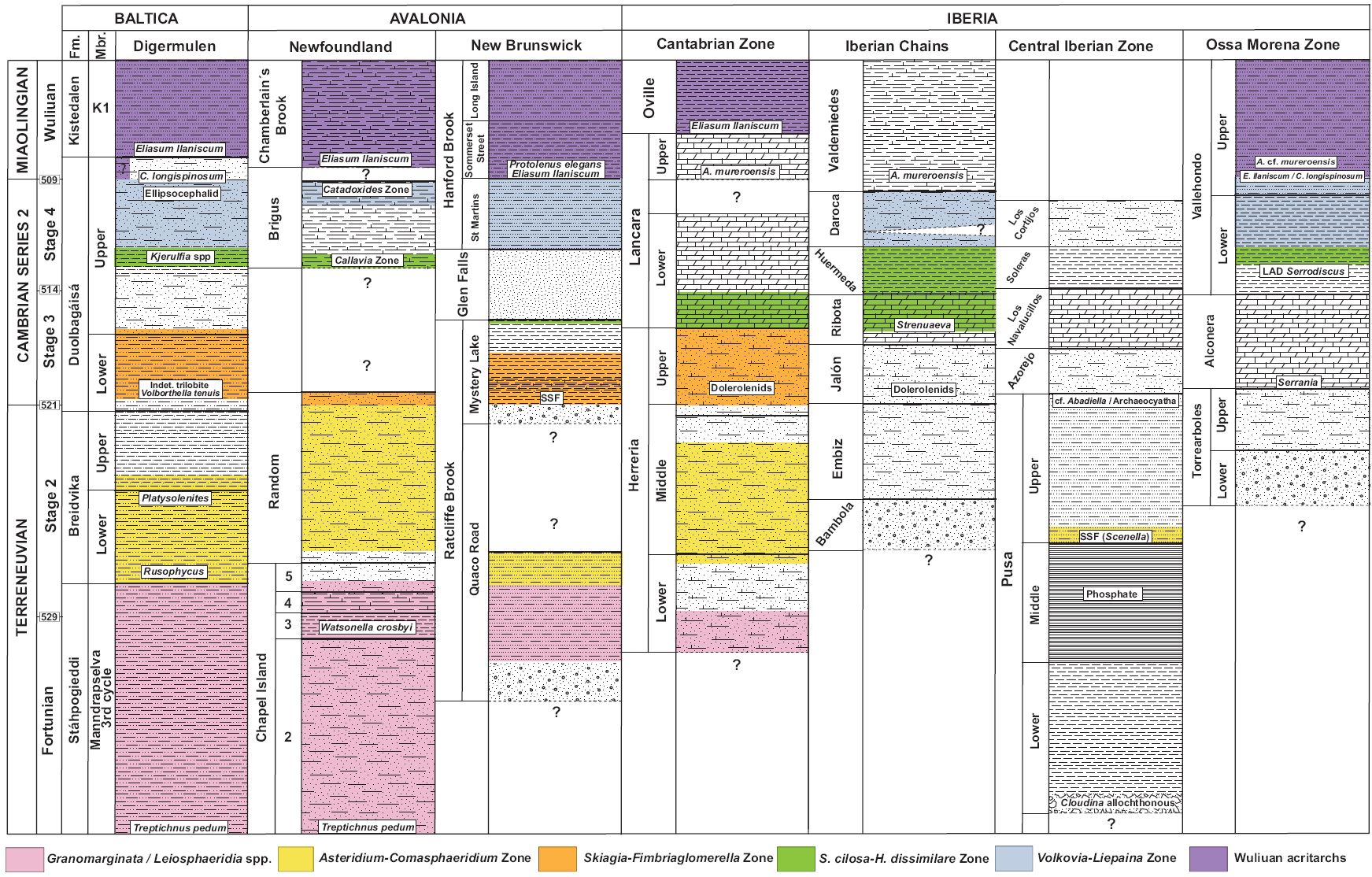
All identified acritarch species have their first appearances in the Skiagia–Fimbriaglomerella Zone (Moczydłowska, Reference Moczydłowska1991, fig. 5) except for H. dissimilare, which together with S. ciliosa defines the Heliosphaeridium–Skiagia Zone (Moczydłowska, Reference Moczydłowska1991). However, H. dissimilare is a species with poor diagnostic characters and it has been reported both from the Terreneuvian (lower Cordubian) in Iberia (Central Iberian Zone; Díez Balda & Fournier Vinas, Reference Díez Balda and Fournier Vinas1981; Vidal et al. Reference Vidal, Palacios, Díez Balda, Gámez Vintaned and Grant1994) and Series 2 (Ovetian) in the Skiagia–Fimbriaglomerella Zone (Palacios & Vidal, Reference Palacios and Vidal1992) in the Cantabrian Zone, much lower than the first appearance of S. ciliosa and the first trilobite record (Fig. 11). In Tarim and South China, the Asteridium–Heliosphaeridium–Comasphaeridium acritarch assemblage has a comparable stratigraphic position to the Asteridium–Comasphaeridium Zone (Ahn & Zhu, Reference Ahn and Zhu2017). This indicates that regionally H. dissimilare occurs much earlier than S. ciliosa, and that the latter is the more diagnostic zonal fossil. Although a few Heliosphaeridium species were present already in the Cambrian Age 2, significant diversification of the genus occurred later, around the Cambrian Age 3.
Acritarch-based correlation chart of the Cambrian Terreneuvian–Miaolingian (Wuliuan) of the Digermulen Peninsula, Avalonia (New Brunswick and Newfoundland) and Iberia. Sources: New Brunswick – Palacios et al. (Reference Palacios, Jensen, White and Barr2011, Reference Palacios, Jensen, White, Barr and Miller2017a); Newfoundland – Palacios et al. (Reference Palacios, Jensen, White and Barr2016, Reference Palacios, Jensen, Barr, White and Myrow2018) for Chapel Island, Random and Brigus (lower part) formations and Martin & Dean (Reference Martin and Dean1983) for the upper part of the Brigus and Chamberlain Brooks formations; Cantabrian Zone, northern Spain – Palacios (Reference Palacios2015), Palacios & Vidal (Reference Palacios and Vidal1992), Palacios et al. (Reference Palacios, Jensen, Cortijo Sánchez and Martí Mus2014) and T. Palacios unpub. data; Iberian Chains, northern Spain – Palacios & Moczydłowska (Reference Palacios and Moczydłowska1998); Central Iberian Zone, central Spain – Jensen et al. (Reference Jensen, Palacios and Martí Mus2010); Ossa-Morena Zone, southern Spain – Palacios et al. (Reference Palacios, Jensen, Apalategui and Fernández-Martínez2006) and T. Palacios unpub. data.

The Skiagia–Fimbriaglomerella Zone represents globally the greatest increase in diversity of Cambrian acritarchs (Vidal & Moczydłowska-Vidal, Reference Vidal and Moczydłowska-Vidal1997) and the beginning of the Palaeozoic phytoplankton radiation (Palacios et al. Reference Palacios, Jensen, Barr, White and Myrow2018) close to the first appearance of trilobites. This event, well documented in the fossil record, has been proposed to define the base of the Cambrian Series 2 (Moczydłowska & Zang, Reference Moczydłowska and Zang2006) and has been used as such by several authors (Moczydłowska, Reference Moczydłowska2011; Rushton & Molyneux, Reference Rushton, Molyneux, Rushton, Brück, Molyneux, Williams and Woodcock2011; Palacios et al. Reference Palacios, Jensen, White and Barr2011, Reference Palacios, Jensen, Barr, White and Myrow2018). Landing et al. (Reference Landing, Geyer, Brasier and Bowring2013, fig. 4) and Zhang et al. (Reference Zhang, Ahlberg, Babcock, Choi, Geyer, Gozalo, Stewart, Hollingsworth, Li, Naimark, Pegel, Steiner, Wotte and Zhang2017, fig. 3) considered this zone diachronic, with an appearance in Avalonia that pre-dates trilobites (Stage 2). This argument was based on a reinterpretation of the data on organic-walled microfossils that Palacios et al. (Reference Palacios, Jensen, White and Barr2011) presented from sections in New Brunswick. Landing et al. (Reference Landing, Geyer, Brasier and Bowring2013) assigned the 530 Ma ash layer from the Somerset Street section to the Skiagia–Fimbriaglomerella Zone in the Hanford Brook section, where it is associated with a shelly fauna that Landing and colleagues attributed to the sub-trilobitic Watsonella crosbyi Zone. However, Palacios et al. (Reference Palacios, Jensen, White and Barr2011, fig. 7), based on the succession of acritarchs in these two sections, advocated a different correlation between these two sections, in which the 530 Ma ash pre-dates the Skiagia–Fimbriaglomerella Zone acritarchs. The same succession of acritarch assemblages that was recognized in New Brunswick (Asteridium–Comasphaeridium; Skiagia–Fimbriaglomerella) is recognized also in Newfoundland (Palacios et al. Reference Palacios, Jensen, Barr, White and Myrow2018), where the sub-trilobitic Watsonella crosbyi Zone pre-dates both the Asteridium–Comasphaeridium (sensu Palacios et al. Reference Palacios, Jensen, Barr, White and Myrow2018) and Skiagia–Fimbriaglomerella zones.
Acritarch data from the Terreneuvian–Cambrian Series 2 on the Digermulen Peninsula show a similar succession, with acritarchs of the Asteridium–Comasphaeridium Zone in the Lower Breidvika Member (Fig. 11) (Högström et al. Reference Högström, Jensen, Palacios and Ebbestad2013). The absence of acritarch data from the Upper Breidvika Member and lowermost part of the Duolbagáisá Formation does not exclude a lower range of the Skiagia–Fimbriaglomerella Zone.
In Iberia (Fig. 11), acritarchs diagnostic of the Skiagia–Fimbriaglomerella Zone appear in the Herrería Formation with Ovetian (Cambrian Series 2) trilobites (Jensen et al. Reference Jensen, Palacios and Martí Mus2010; Liñán et al. Reference Liñán, Gámez Vintaned and Gozalo2015). In central Iberia (Central Iberian Zone), the first trilobites are located in the upper part of the Pusa Formation, overlying levels that contain a Scenella-like mollusc and acritarchs of the Asteridium–Comasphaeridium Zone (Fig. 11). There are no data indicating that the appearance of Skiagia–Fimbriaglomerella Zone acritarchs occurs much earlier than the first appearance of trilobites. On the other hand, if it is accepted that the first appearance of trilobites is diachronic and strongly facies dependent (Zhang et al. Reference Zhang, Ahlberg, Babcock, Choi, Geyer, Gozalo, Stewart, Hollingsworth, Li, Naimark, Pegel, Steiner, Wotte and Zhang2017), it is inconsistent to use them as calibration of the Skiagia–Fimbriaglomerella Zone; we need an independent means of calibration in successions with good stratigraphic control. A clear example of this situation is given in Spain (Central Iberian Zone) where controversy arose from finding trilobites and archaeocyathids in the Pusa Formation (Jensen et al. Reference Jensen, Palacios and Martí Mus2010) at levels that had been classically attributed to the lower Cordubian correlated with the Fortunian (Liñán et al. Reference Liñán, Gozalo, Palacios, Gámez Vintaned, Ugidos, Mayoral, Gibbons and Moreno2002).
The first appearances of trilobites and Skiagia assemblages may not coincide (Zhang et al. Reference Zhang, Ahlberg, Babcock, Choi, Geyer, Gozalo, Stewart, Hollingsworth, Li, Naimark, Pegel, Steiner, Wotte and Zhang2017); however the latter, being cosmopolitan and less facies dependent, is more likely to represent an isochronous event, which we consider a solid candidate to define the base of the Cambrian Series 2 (cf. Moczydłowska & Zang, Reference Moczydłowska and Zang2006).
4.b. Heliosphaeridium dissimilare–Skiagia ciliosa Zone
The middle part of the Upper Member of the Duolbagáisá Formation includes a thick mudstone/siltstone interval with a good record of acritarchs in its upper half (Fig. 3). The first levels include the first appearance of very abundant Skiagia ciliosa (Fig. 7a–f), while rare Globosphaeridium cerinum (Fig. 6a, b), Parmasphaeridium implicatum (Fig. 6c, d) and Heliosphaeridium obscurum (Fig. 6g, h) appear close to levels with the olenelloid trilobites Kjerulfia n. sp. and Elliptocephalus n. sp. (Ebbestad et al. Reference Ebbestad, Høyberget, Högström, Palacios, Jensen, Taylor, Meinhold and Pärnaste2017, Reference Ebbestad, Högström, Palacios, Jensen, Meinhold, Høyberget, Agić and Taylor2018).
Moczydłowska (Reference Moczydłowska1991) defined the H. dissimilare–S. ciliosa Zone by the First Appearance Datum (FAD) of both species. However, given the occurrence of H. dissimilare at much lower stratigraphic levels than the first appearance of S. ciliosa (discussed earlier) we consider Skiagia ciliosa to be the more diagnostic form. Other cosmopolitan and highly diagnostic species such as Parmasphaeridium implicatum (Fridrichsone) Jachowicz-Zdanowska, Reference Jachowicz-Zdanowska2013 (Fig. 6c, d) and Globosphaeridium cerinum have their first appearances in this zone (Moczydłowska, Reference Moczydłowska1991).
Skiagia ciliosa shows diagnostic morphological features that allow easy identification, although it also has the highest morphological variability among species of Skiagia. The original diagnosis of Baltisphaeridium ciliosum given by Volkova (Reference Volkova, Yu Rozanov, Missarzhevsky, Volkova, Voronova, Krylov, Keller, Korolyuk, Lenzion, Michniak, Pykhova and Sidorov1969, p. 260) included ‘central body is dark, compact, translucent’, morphological features also listed by Downie (Reference Downie1982, table 1). Later revisions by Moczydłowska (Reference Moczydłowska1991, p. 66, plate 7a, b, d, f) included new characters: ‘bases of the processes are conical’ and ‘separated from the central body cavity by a plug’. In well-preserved material from New Brunswick (Palacios et al. Reference Palacios, Jensen, White, Barr and Miller2017a, figs 5a–c, 8a–d) and in specimens studied here (Fig. 7a–f), the conical base of the process (Fig. 7a–d) is seen to have a thick and resistant wall, whereas the tubular part of the process (Figs 7a, b, 8a–c), separated by the plug, is thinner and more delicate. The transition to the plug is an area of weakness where the process regularly breaks (Figs 7b, 8c, e, f). This variability in preservation is a result of the development of the dark internal body and the thickening of the wall, which favours a preservation of the vesicle with the conical bases and the loss of the tubular part of the delicate processes (Fig. 8c, e, f). The tubular part of the processes exhibits a certain variability (Moczydłowska, Reference Moczydłowska1991) and does not constitute the most diagnostic character of S. ciliosa. The Skiagia-plexus concept of Moczydłowska (Reference Moczydłowska2010) has introduced a certain confusion (Zhang et al. Reference Zhang, Ahlberg, Babcock, Choi, Geyer, Gozalo, Stewart, Hollingsworth, Li, Naimark, Pegel, Steiner, Wotte and Zhang2017, p. 135) into the identification of morphospecies of Skiagia, especially in S. ciliosa, by extending a very specific morphological feature of this species (the dark internal body: a suggested endocyst) to all species of the plexus as part of a life cycle of the cyst. The presence of a dark internal body in Skiagia has been clearly identified in species that appear in the Heliosphaeridium–Skiagia Zone. Species that have their FAD in the Skiagia–Fimbriaglomerella Zone, such as S. orbiculare, S. compressa and S. ornata, lack the internal body. Moczydłowska (Reference Moczydłowska2010, p. 132) placed Baltisphaeridium bimacerium, a species with a dark nucleus that appears in the Heliosphaeridium–Skiagia Zone (Zang et al. Reference Zang, Moczydłowska, Jago, Laurie, Paterson and Jago2007, fig. 8), in synonymy with S. ornata, suggesting that it was ‘a mature stage’ while S. ornata was considered ‘an -immature cyst’. If this is correct it would be necessary to justify the absence of the mature stage in the abundant and diverse associations of Skiagia, older than S. ciliosa, described in numerous assemblages. We do not think the interpretation by Moczydłowska (Reference Moczydłowska2010) is tenable, and therefore consider Skiagia species to be morphospecies that have been recorded in well-exposed sections with good stratigraphic control. Using this criterion, we have established the correlations shown in Figure 11 with areas of Avalonia and Iberia in which there is a good control on the first appearances of the S. ciliosa morphospecies. Some species attributed to S. ciliosa, such as those from the middle-upper Tommotian to lower Atdabanian stages of Siberia (Vidal et al. Reference Vidal, Moczydłowska and Rudavskaya1995, fig. 7, 3, 4; see Grazhdankin et al. Reference Grazhdankin, Marusin, Izokh, Karlova, Kochnev, Markov, Nagovitsin, Sarsembaev, Peek, Cui and Kaufman2020 for discussion on age) do not show the diagnostic features of S. ciliosa discussed above, and their assignment should be reviewed.
4.c. Volkovia dentifera–Liepaina plana Zone
The upper portion of the siltstone-rich interval in the upper part of the Upper Member of the Duolbagáisá Formation records the first appearance of Liepaina plana (Fig. 9a), Heliosphaeridium notatum (Fig. 6i) and Retisphaeridium dichamerum (Fig. 9c) a few metres above the trilobite occurrences (Fig. 3).
Liepaina plana and H. notatum have a cosmopolitan distribution, and their first appearances indicate the Volkovia–Liepaina Zone. However, L. plana is a very rare species in Cambrian Stage 4 rocks in Baltica, and its maximum abundance is recorded in the Miaolingian, equivalent to the Acadoparadoxides oelandicus Superzone (Volkova et al. Reference Volkova, Kirjanov, Piscun, Paškevičienė, Jankauskas, Urbanek and Yu Rozanov1983). A similar situation occurs in New Brunswick (Palacios et al. Reference Palacios, Jensen, White, Barr and Miller2017a), and is also observed in the study area, with maximum abundance of L. plana in the lower part of the Kistedalen Formation (Figs 3, 9b). Heliosphaeridium notatum, a diagnostic species of the Volkovia–Liepaina Zone, is more abundant than L. plana and has a global distribution, and is therefore more useful for correlation. For a detailed discussion on the distribution of L. plana and H. notatum we refer to Palacios et al. (Reference Palacios, Jensen, White, Barr and Miller2017a). R. dichamerum, first found in the Miaolingian Albertella Zone of Alberta, Canada (Staplin et al. Reference Staplin, Jansonius and Pocock1965), has a cosmopolitan distribution with reports from Laurentia, Baltica, Gondwana and the peri-Gondwanan terrains of Avalonia, Ganderia and Iberia (Downie, Reference Downie1982; Martin & Dean, Reference Martin and Dean1988; Vidal & Peel, Reference Vidal and Peel1993; Molyneux et al. Reference Molyneux, Le Hérissé, Wicander, Jansonius and McGregor1996; Rushton & Molyneux, Reference Rushton, Molyneux, Rushton, Brück, Molyneux, Williams and Woodcock2011; Palacios et al. Reference Palacios, Jensen, White and Barr2012, Reference Palacios, Jensen, White, Barr and Miller2017a; Palacios, Reference Palacios2015). Identification of R. dichamerum can be difficult as flattened specimens may be confused with Cymatiosphaera or flattened Leiosphaeridia, because the diagnostic character that allows its easy identification is the rupture of the vesicle into plates (Downie, Reference Downie1982, fig. 11p; Palacios, Reference Palacios2015; Palacios et al. Reference Palacios, Jensen, White, Barr and Miller2017a). The rupture into plates is a morphological feature of Miaolingian acritarchs similar to some modern dinoflagellates, and it marks the important evolutionary innovation of ‘placoid acritarchs’. These include some of the most diagnostic genera of the Miaolingian and Furongian, such as Eliasum, Cristallinium, Timofeevia, Vulcanisphaera and Stelliferidium (Palacios et al. Reference Palacios, Jensen, Barr and White2009, Reference Palacios, Jensen, White, Barr and Miller2017a; Palacios, Reference Palacios2015). Retisphaeridium dichamerum has been reported from the Heliosphaeridium–Skiagia Zone (Eklund, Reference Eklund1990; Hagenfeldt, Reference Hagenfeldt1989; Vidal & Peel, Reference Vidal and Peel1993), and is clearly present at higher levels (upper Series 2) in Scotland (Downie, Reference Downie1982, fig. 11p) and Newfoundland. In Newfoundland, R. dichamerum is abundant in the highest Cambrian Series 2, Brigus Formation (Catadoxides Zone of Howell, Reference Howell1925) and the Triplagnostus gibbus Zone of the lowest part of the Chamberlains Brook Formation (Martin & Dean, Reference Martin and Dean1983, Reference Martin and Dean1984, Reference Martin and Dean1988).
In our opinion, R. dichamerum is a diagnostic species whose first appearance is close to that of the species defining the base of the Volkovia–Liepaina Zone. As with L. plana, the maximum abundance of R. dichamerum is in the Wuliuan Stage. This trend is clearly observed on the Digermulen Peninsula (Fig. 3). Proposed correlations of the Volkovia–Liepaina Zone are shown in Figure 11.
5. Cambrian Series 2–Miaolingian transition assemblages and the Hawke Bay regression
The upper levels of the Upper Member of the Duolbagáisá Formation, dominated by quartzitic sandstone with scarce siltstone, record the last occurrence of Skiagia (Fig. 3). At this level, there is a low-diversity assemblage dominated by abundant Leiosphaeridia spp. and rare acritarchs indicative of the Volkovia–Liepaina Zone. The transition between the Cambrian Stage 4 and the Wuliuan Stage marks a significant decrease in the diversity of acritarchs, well documented in continuous sections without a significant hiatus. The disappearance of Skiagia species in the upper Cambrian Stage 4 has been verified in different continuous and well-exposed sections of Avalonia (Palacios et al. Reference Palacios, Jensen, White, Barr and Miller2017a), Iberia (Palacios et al. Reference Palacios, Jensen, Apalategui and Fernández-Martínez2006) and in the Brunovistulicum terrain (Jachowicz-Zdanowska, Reference Jachowicz-Zdanowska2013), while possible redeposition in the oelandicus beds of Baltica has been suggested (Jachowicz-Zdanowska, Reference Jachowicz-Zdanowska2013, p. 15). A possible explanation for the presence of Skiagia in Miaolingian deposits may be reworking of Cambrian Series 2 acritarchs including the Skiagia assemblages dominated by S. ciliosa during the Hawke Bay regression at the Cambrian Stage 4–Wuliuan transition. Palynomorphs, such as acritarchs, commonly occur in great abundance and are especially sensitive to reworking because of their small size. Reworking may involve material of very different ages and result in well-preserved acritarchs, such as the reworked Ordovician acritarchs of the Barrancos Formation (Portugal) in Carboniferous continental strata that contain abundant spores (Lopes et al. Reference Lopes, Pereira, Fernandes, Wicander, Matos, Rosa and Oliveira2014). In this case, the reworking is evidenced from known stratigraphical ranges, not from state of preservation. However, in material with a similar diagenetic or metamorphic history and deposited in similar environments, recognition may be problematic. Different studies show the presence of reworked palynomorphs in regressive series (Habib et al. Reference Habib, Eshet, van Pelt and Traverse1994, p. 331; Stover et al. Reference Stover, Brinkhuis, Damassa, de Verteuil, Helby, Monteil, Partridge, Powell, Riding, Smelror, Williams, Jansonius and McGregor1996, p. 706), and also show concentrations in the basal sequence of the new transgressive event above the boundary unconformity (Stover et al. Reference Stover, Brinkhuis, Damassa, de Verteuil, Helby, Monteil, Partridge, Powell, Riding, Smelror, Williams, Jansonius and McGregor1996, p. 706). This model is applied in our hypothesis.
The Cambrian in Baltica includes a highly condensed series of poorly lithified sediments in several areas, which under lowstand sea level conditions would be easily remobilized. The pattern observed in sections with a good record of organic-walled microfossils in Baltica is (1) a great abundance of Skiagia (mainly S. ciliosa) in Holmia beds (S. ciliosa–H. dissimilare Zone, Moczydłowska, Reference Moczydłowska1991), (2) a disappearance (Eklund, Reference Eklund1990) or a major decrease of Skiagia in the regressive series corresponding to the Volkovia–Liepaina Zone (Moczydłowska, Reference Moczydłowska1991, Radzyn IG-1 and Łopiennik boreholes; Jankauskas, Reference Jankauskas2002, Kibartai-22 borehole), and (3) a reappearance of Skiagia (mainly S. ciliosa) in the generally discordant transgressive series of oelandicus beds (Volkova et al. Reference Volkova, Kirjanov, Piscun, Paškevičienė, Jankauskas, Urbanek and Yu Rozanov1983; Hagenfeldt, Reference Hagenfeldt1989; Eklund, Reference Eklund1990; Moczydłowska, Reference Moczydłowska1991; Jankauskas, Reference Jankauskas2002). In our opinion, the most abundant forms having more resistant walls, such as S. ciliosa, will be the most prone to being remobilized and incorporated into Wuliuan sediments of the oelandicus Superzone (Moczydłowska, Reference Moczydłowska1991, Reference Moczydłowska1998), where they become mixed with typical Miaolingian assemblages, increasing the overall biodiversity. Another hypothesis to explain this trend is the reappearance of Skiagia in Miaolingian strata. However, the observations of our study do not support this, and reworking is the most plausible hypothesis for the observed pattern. The presence of Skiagia in oelandicus beds therefore artificially modifies patterns of biodiversity (cf. Vidal & Moczydłowska-Vidal, Reference Vidal and Moczydłowska-Vidal1997; Nowak et al. Reference Nowak, Servais, Monnet, Molyneux and Vandenbroucke2015) Thus, the important extinction signal at the Cambrian Series 2–Miaolingian transition, marked by the disappearance of typical assemblages of the Cambrian Series 2 dominated by Skiagia and the diversification of the ‘placoid acritarchs’ that dominate the Miaolingian, becomes distorted. Sections with a good record of acritarchs in Baltica support this notion. Eklund (Reference Eklund1990) described assemblages dominated by Skiagia in the Mickwitzia Sandstone Member (Assemblage B) of southern Sweden, followed by their disappearance in the Lingulid Sandstone Member in levels that contain Volkovia dentifera (Assemblage C), and their reappearance in the ‘Glauconite sandstone’ and oelandicus mudstone (Assemblage D), which are contemporary with the Wuliuan (Kibartai Stage). A similar situation occurs in northern Spain with the disappearance of Skiagia at the top of Huérmeda Formation and the reappearance of reworked Skiagia in the regressive Daroca Formation (Palacios & Moczydłowska, Reference Palacios and Moczydłowska1998). In comparison with material in the Huérmeda Formation, Skiagia in the Daroca Formation are more poorly preserved and have broken processes.
It therefore appears probable that the presence or absence of reworked Skiagia in Miaolingian strata serves as an indicator of the intensity of the regressive events at the Stage 4–Wuliuan transition. It follows that the absence of Skiagia in the upper Duolbagáisá and Kistedalen formations indicates limited reworking. This is also consistent with the sedimentology and ichnology of these units. Marine conditions are indicated by the presence of trace fossils throughout the Duolbagáisá Formation with forms typical of the Skolithos and Cruziana ichnofacies (Banks, Reference Banks1973), and by acritarchs in fine-grained interbeds. Deposition of thick sandstone beds in the Upper Member of the Duolbagáisá Formation was dominated by strong tidal currents in a shoreface to offshore setting (cf. Banks, Reference Banks1973; Crimes & McIlroy, Reference Crimes and McIlroy1999). The lower member of the Kistedalen Formation similarly yields trace fossils and acritarchs. The Hawke Bay regression on the Digermulen Peninsula therefore is represented by shallow marine facies without evidence for an unconformity, which is consistent with an originally distal position of the area compared to units formed upon the craton (cf. Nielsen & Schovsbo, Reference Nielsen and Schovsbo2015, figs 12–15).
The appearance of a single specimen of Comasphaeridium longispinosum (Fig. 10b), an acritarch so far known only from the Miaolingian (Jachowicz-Zdanowska, Reference Jachowicz-Zdanowska2013; Palacios et al. Reference Palacios, Jensen, White, Barr and Miller2017a), at the top of the Duolbagáisá Formation suggests that the Cambrian Series 2–Miaolingian boundary is located close to the top of this unit (Fig. 3). The first siltstone levels of the K1 Member of the Kistedalen Formation yield a more diverse assemblage with abundant Retisphaeridium dichamerum (Fig. 9d), C. longispinosum (Fig. 10c) and Liepaina plana (Fig. 9b), and the first appearance of Multiplicisphaeridium llynense (Fig. 9f; see revision of Jachowicz-Zdanowska, Reference Jachowicz-Zdanowska2013) and Eliasum llaniscum (Fig. 10a), clearly diagnostic of the Miaolingian.
6. Conclusions
The Duolbagáisá Formation contains one of the more complete successions of acritarch assemblages of the Cambrian Series 2. The Cambrian Series 2–Miaolingian acritarch associations indicate an essentially transitional record across this boundary.
Skiagia assemblages are limited to Cambrian Series 2 strata, following the same trends observed in the peri-Gondwanan terrains of Avalonia and Iberia, confirming the existence of an important acritarch extinction at the end of the Cambrian Series 2.
Occurrences of Skiagia in Miaolingian strata of Baltica are interpreted as reworked material related to the Hawke Bay unconformity at the Cambrian Series 2–Miaolingian transition. The absence of reworked Skiagia in the Kistedalen Formation indicates that the Hawke Bay regression did not result in an unconformity in this area.
The base of the Wuliuan Stage is located in the uppermost part of the Duolbagáisá Formation, whereas the acritarch association from the lowermost part of K1 Member of the Kistedalen Formation contains taxa attributable to the Miaolingian Series.
Acknowledgements
The Digermulen Early Life Research Group acknowledges funding (through AESH) from the Norwegian Research Council (NRC, project number 231103). T. P. & S. J. acknowledge funding from ‘Ministerio de Economía. Industria y Competitividad’ grant CGL 2017-87631-P. We thank Małgorzata Moczydłowska for robust comments on an earlier manuscript version. Comments from two anonymous reviewers improved the manuscript considerably.