

Introduction
We present a case of anterior spinal artery infarction following major head and neck surgery. This syndrome is very rare, and to the best of our knowledge has not previously been reported in the English Language literature. Head and neck cancer patients often have significant co-morbidity, increasing the risk of complications. Awareness of anterior spinal artery syndrome is important in view of its drastic consequences.
Case report
A 64-year-old man underwent total laryngectomy with bilateral neck dissection for post-radiotherapy, recurrent carcinoma of the larynx (graded as tumour 2, node 2b, metastasis 0). The surgical procedure and initial recovery were uneventful.
Five days post-operatively, the patient developed an acute haemorrhage from the neck wound. The estimated blood loss was around 500 ml. His vital parameters were stable apart from tachycardia. The wound was immediately explored under general anaesthesia; bleeding originating from the right internal jugular vein was identified and the bleeding point ligated, securing haemostasis. Further examination revealed a small dehiscence in the neopharynx, far away from the internal jugular veins. This was repaired primarily and a sternomastoid muscle cover secured over it. Intra-operatively, the patient's systolic blood pressure was stable at 90–100 mm Hg.
Post-operatively the patient complained of weakness in both lower limbs. The neurologists were consulted, who noted that power, touch and pain sensation in both the lower limbs had been lost but that vibratory sensation was preserved. In addition, the patient had lost bowel and bladder control.
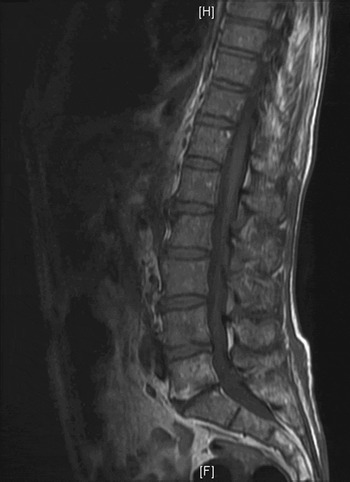
An urgent magnetic resonance imaging (MRI) scan of the spinal cord showed abnormal intrinsic signal change within the distal thoracic cord and conus extending from T11 to L1. This predominantly involved the anterior aspect of the spinal cord and was consistent with an acute cord infarction (Figure 1).
Sagittal magnetic resonance imaging scan of the spinal cord, showing abnormal intrinsic signal change within the distal thoracic cord and conus extending from T11 to L1. This predominantly involves the anterior aspect of the cord, consistent with acute spinal cord infarction. H = Prevertebral area; F = Pelvic area.

Post-operatively, the patient had a salivary leak which was closed with a pectoralis major myocutaneous flap. He recovered fully from the neck surgery.
At the time of writing, the patient's paraparesis had not improved further, and he was undergoing spinal rehabilitation. He was also being followed up for his primary cancer.
Discussion
Anterior spinal artery syndrome comprises ischaemia or infarction of the spinal cord in the distribution of the anterior spinal artery, which supplies the ventral two-thirds of the spinal cord. This condition is usually associated with atherosclerosis of the aorta, and may result from dissection of an aortic aneurysm or, rarely, from dissection of the anterior spinal artery. Acute spinal cord ischaemia can also be due to arterial or venous infarction and global ischaemia resulting from cardiac arrest or severe hypotension. Clinical features include weakness and loss of pain and temperature sensation below the level of the injury, with relative sparing of position and vibratory sensation.Reference Raymond, Adams and Ropper1 Other rare causes of anterior spinal artery syndrome include sepsis, coronary artery bypass, epidural analgesia, protein S deficiency, infrarenal aortic aneurysm surgery and lower limb angiography.Reference Pantet, Frischknecht and Croquelois2–Reference Bozkurt, Aydingöz, Yüceyar and Tanriverdi7
Anterior spinal artery syndrome is diagnosed by clinical examination and MRI.
The blood supply of the spinal cord is derived from three to 10 intercostal and lumbar arteries, which coalesce to form the anterior spinal artery and the two posterior spinal arteries. The anterior spinal artery extends the length of the spinal cord. The artery of Adamkiewicz, which usually originates between the sixth intercostal and the second lumbar artery, is the principal arterial supply of the anterior spinal artery at the lower thoracic and lumbar levels.Reference Zhao, Logan, Schraedley and Rubin8–Reference Wan, Angelini, Bryan, Ryder and Underwood11 Seventy-five per cent of the spinal cord blood supply comes from the anterior spinal artery.Reference Wan, Angelini, Bryan, Ryder and Underwood11
The natural course of anterior spinal artery syndrome is variable; the outcome is dependent on the aetiology.
• This paper describes a case of anterior spinal artery infarction following major head and neck surgery
• Anterior spinal artery syndrome comprises ischaemia or infarction of the spinal cord in the distribution of the anterior spinal artery
• Clinical features include weakness and loss of pain and temperature sensation below the level of the injury, with relative sparing of position and vibratory sensation
• The natural course of anterior spinal artery syndrome is variable; outcome is dependent on aetiology
For purposes of standardisation, the American Spinal Injury Association has classified the impairment resulting from anterior spinal artery syndrome into five grades: A = complete (no motor or sensory function is preserved in sacral segments S4–S5); B = incomplete (sensory but not motor function is preserved below the neurological level and includes the sacral segments S4–S5); C = incomplete (motor function is preserved below the neurological level, and more than half of the key muscles below the neurological level have a muscle grade of less than 3; D = incomplete (motor function is preserved below the neurological level, and at least half of the key muscles below the neurological level have a muscle grade of 3 or more; and E = normal (motor and sensory function is normal).
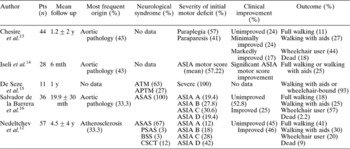
Table I describes the reported outcomes of spinal cord ischaemia in various studies.Reference Nedeltchev, Loher, Stepper, Arnold, Schroth and Mattle12
Clinical characteristics and outcome of spinal cord ischaemia in different studies

Published with permission.Reference Nedeltchev, Loher, Stepper, Arnold, Schroth and Mattle12 Pts = patients; y = years; mth = months; ASIA = American Spinal Injury Association grade; ATM = acute transverse myelopathy; APTM = acute partial transverse myelopathy; ASAS = anterior spinal artery syndrome; PSAS = posterior spinal artery syndrome; BSS = Brown-Séquard syndrome; CSCT = complete spinal cord transsection
A comprehensive search of the English Language literature found no reports of paraparesis occurring as a complication of major head and neck surgery.
Awareness of this syndrome is very important in view of its major associated disability, which may be preventable. In our patient, the aetiology may have been multifactorial, involving for example atherosclerosis, radiotherapy effects and sudden blood loss. Immediate suspicion of anterior spinal artery syndrome, on clinical examination and MRI scanning, helped to exclude other causes. Early rehabilitation and a multidisciplinary team approach are very important in facilitating a safe and effective recovery. In patients undergoing head and neck cancer primary surgery who develop anterior spinal artery syndrome, management of the syndrome should be as aggressive as that of the primary cancer.