Introduction
Depression has been extensively studied in older adults. Although this population shows prevalence rates for depression somewhat lower than those of other age groups (Blazer, Reference Blazer2003), depression does constitute a significant public health issue (Fiske et al., Reference Fiske, Wetherell and Gatz2009; Solhaug et al., Reference Solhaug, Romuld, Romild and Stordal2012). More specifically, some studies reveal a prevalence rate of around 15% for clinically significant depressive disorders in older adults (Conner et al., Reference Conner2010). As Blazer (Reference Blazer2003) notes, depression can be considered the most common cause of emotional distress among elderly people, contributing to reduction in their quality of life.
The study of the mechanisms involved in the origin and maintenance of depression in older adults, and in the development of intervention strategies for reducing its prevalence, is of great scientific and social relevance. Several studies have provided empirical evidence on the association between depression and functional impairment, not only in population-based research but also in cross-sectional and follow-up studies in older adults (e.g. Brenes et al., Reference Brenes2005). The World Health Organization (2002) already considers this disorder as the main cause of disability among elderly people. Furthermore, other research has shown how, in the elderly people, depression is especially related to chronic medical illness, cognitive impairment, family disruption, and increased mortality (Alexopoulos et al., Reference Alexopoulos2011).
Relationship between frequency of leisure activities and depressive symptomatology
One of the main psychological models for explaining depression is that of Lewinsohn (Reference Lewinsohn, Calhoun, Adams and Mitchell1974), who considered this disorder as the result of a reduction of person's activity levels, implying a reduction or loss of positive reinforcers. This model has received substantial empirical support in the general population (Manos et al., Reference Manos, Kanter and Busch2010). Focusing on older adults, the aging process is associated with several contextual (e.g. retirement) and internal (e.g. biological) changes in the person, which undoubtedly affect their patterns of activity and their access to reinforcers. For example, for elderly people, the loss of mobility may represent an important precedent of psychological distress, given that it involves a significant reduction in their social and leisure/free-time activities (Teychenne et al., Reference Teychenne, Ball and Salmon2008). Barcelos-Ferreira et al. (Reference Barcelos-Ferreira, Yoshio Nakano, Steffens and Bottino2013) found in a sample of community elderly persons significant and negative associations between depression diagnosis and physical activity and going to cinema. In turn, deficits in behavioral activation and lack of involvement in leisure activities may be considered both as associated factors involved in the development of depressive disorders in older adults and as components of depressive disorder, which facilitate its maintenance (Manos et al., Reference Manos, Kanter and Busch2010). For this reason, activity takes on special importance in old age, as highlighted in the main models of aging, whose hypotheses were developed with a focus on this issue. One of the most significant proposals in this area was the Activity Theory (Havighurst, Reference Havighurst, Williams, Tibbitts and Donohue1963), according to which the social interaction associated with involvement in leisure activities significantly increases the quality of life of elderly people. For example, the study conducted by Dimidjian et al. (Reference Dimidjian2006) pointed out the effectiveness of an intervention program based on behavioral activation rather than just a pharmacological and cognitive one (Dimidjian et al., Reference Dimidjian2006). Moreover, longitudinal studies have provided substantial empirical support for the benefits of leisure activities for both well-being and cognitive functioning in elderly people (Leung et al., Reference Leung2010).
Influence of rumination on the relationship between frequency of leisure activities and depressive symptomatology
Cognitive models for explaining depression (e.g. Beck et al., Reference Beck, Rush, Shaw and Emery1979) focus on cognitive vulnerability, which consists in the presence of dysfunctional cognitive schemata, activated in response to stressors related to specific deficits in the individual, and which lead to distortions in information processing (e.g. negative interpretation of ambiguous information, and focusing the attention on negative aspects). A range of studies have found significant relationships between the presence of cognitive distortions and higher levels of psychological maladjustment (Millan et al., Reference Millan2012) in the general population. Furthermore, these cognitive distortions can contribute to increasing and maintaining depressive mood, promoting depressive behaviors (inactivity or passivity, avoidance of situations, etc.). From a cognitive perspective, it is assumed that a change in the behavioral component in a patient of depression can be simply achieved through changing the dysfunctional cognitive schemata that are at the basis of such behavior (Beck et al., Reference Beck, Rush, Shaw and Emery1979). One of the mechanisms explored in this approach, as a potential factor involved in the duration of depression, is rumination.
Rumination is defined as the tendency to focus attention on one's own depressive symptoms and to have repetitive thoughts about the causes of such symptoms and/or the situation or event that generated them, as well as about the negative consequences of that situation or event and of the symptoms themselves (Abramson et al., Reference Abramson, Metalsky and Alloy1989). Likewise, rumination has been also understood as an emotion regulation strategy displayed by the person as a response to the normal emotion of sadness (Nolen-Hoeksema et al., Reference Nolen-Hoeksema, Wisco and Lyubomirsky2008). Rumination appears to have a key influence on the intensity and duration of depressive symptoms: People who present a ruminative style feel such symptoms more intensely and for longer periods than those who employ other strategies (e.g. distraction), in both general and elderly population groups (Aldao et al., Reference Aldao, Nolen-Hoeksema and Schweizer2010). Thus, the tendency to ruminate predicts the onset, duration, and severity of depression (Nolen-Hoeksema et al., Reference Nolen-Hoeksema, Wisco and Lyubomirsky2008), rumination also being one of the most common symptoms found in depressive states in elderly people, and one of the factors that triggers depressive episodes (Nolen-Hoeksema et al., Reference Nolen-Hoeksema, Wisco and Lyubomirsky2008). The harmful psychological effects of rumination have been analyzed in several studies, in longitudinal and experimental research in both the general population (Nolen-Hoeksema et al., Reference Nolen-Hoeksema, Wisco and Lyubomirsky2008) and the dementia caregiving population (Romero-Moreno et al., Reference Romero-Moreno, Márquez-González, Losada and López2011), as well as (although less frequently) in elderly people (Nolen-Hoeksema and Aldao, Reference Nolen-Hoeksema and Aldao2011). Specifically, the cross-sectional study carried out by Nolen-Hoeksema and Aldao (Reference Nolen-Hoeksema and Aldao2011) found that even when the frequency of rumination is lower in older adults than in younger ones, this strategy shows a negative correlation in both populations. In the general population, the ruminative style increases despair about the future as well as negative and global attributions through greater negativity based on the interpretation of negative events. Furthermore, it facilitates the emergence of thoughts about negative events and memories, reduces effectiveness in problem-solving, and increases vulnerability to the development of anxiety symptoms (Nolen-Hoeksema et al., Reference Nolen-Hoeksema, Wisco and Lyubomirsky2008).
A recent cross-sectional study with younger adults (Genet and Siemer, Reference Genet and Siemer2012) has found that rumination moderates the relationship between unpleasant daily events and negative mood in such a way that unpleasant daily events were significantly associated with higher levels of negative mood only in individuals with high levels of rumination and not in individuals with low levels of rumination.
Taking into account these findings, it is theoretically possible that people's tendency to ruminate might also moderate the intensity of the relationship between involvement in leisure activities and depressive symptomatology.
Some of the studies mentioned in the above paragraphs may suggest the hypothesis that rumination plays a moderator role in this relationship insofar as it interferes with the emotional benefits derived from leisure activities. For example, Romero-Moreno et al. (in press) have recently pointed out how guilt (as a cognitive variable) has a moderating role between pleasant activities and depressive symptoms in caregivers of relatives with dementia (Romero-Moreno et al., in press). Hence, due to its persistent focus on negative emotions (Nolen-Hoeksema and Aldao, Reference Nolen-Hoeksema and Aldao2011), which may represent a substantial obstacle to obtaining gratification or a positive reward from pleasant activities, people with a tendency to ruminate might benefit less from their involvement in such pleasant activities.
However, recent studies suggest that pleasant activities are subjectively associated with improved mood states and reduced ruminative thinking, reflecting an inverse relationship between involvement in pleasant activities and rumination (Takano et al., in press). Taking these findings into account, an alternative hypothesis on the specific moderator role of rumination may be that the beneficial effects of engagement in pleasant leisure activities are particularly important for people with a tendency to ruminate, as such involvement may help them to reduce the frequency of their negative thinking and depressive symptomatology.
Identifying which variables moderate the impact of cognitive and behavioral therapy on depressive symptoms seems to be a useful strategy for increasing our knowledge about the profiles of older adults that benefit most from engagement in leisure activities and respond best to interventions (Dimidjian et al., Reference Dimidjian, Barrera, Martell, Muñoz and Lewinsohn2011). Given the importance of participation in pleasant activities for older adults’ well-being and quality of life, and assuming the clinical relevance of depressive disorders in this population, we decided to explore previously described hypotheses in this age group. Therefore, this study is aimed at exploring the potential role of rumination as a moderator in the relationship between participation in leisure activities and level of depressive symptomatology in older adults aged 60 years and over. In addition to testing the moderator role of rumination in this relationship, we were also interested in exploring which of the two specific hypotheses in the direction of moderation best fits the data: (a) the “rumination as interference” hypothesis, according to which the relationship between involvement in leisure activities and depression will be lower for older adults with high levels of rumination; or (b) the hypothesis that involvement in leisure activities will have a significant and stronger association with depressive symptomatology in older adults with a tendency to ruminate, as opposed to those with low levels of rumination.
Methods
Participants
Participants were 312 people aged over 60 years, non-institutionalized, and recruited at the Red Cross Reina Sofía Cultural Centre in Madrid, where they took advantage of the educational and cultural activities it offers.
Measures
In addition to the socio-demographic characteristics of the sample (age, sex, and educational level), we assessed the following variables.
depressive symptomatology
For the assessment of depressive symptomatology we used the Center for Epidemiologic Studies Depression Scale (CES-D; Radloff, Reference Radloff1977), a 20-item scale (e.g. “I felt sad”) that rates the frequency of appearance of depressive symptoms in the previous week by means of a four-option Likert-type response format (from 0 = rarely or none of the time, to 3 = most or all of the time). The cut-off point established in this scale to detect clinical depression is a score of 16. This scale has good psychometric properties, with an internal consistency index (Cronbach's α) of 0.89 (Losada et al., Reference Losada, Márquez-González, García-Ortíz, Gómez-Marcos, Fernández-Fernández and Rodríguez-Sánchez2012). In the present study, the α-value was 0.86.
rumination
This variable was measured with a brief version of the Response Styles Questionnaire, the Ruminative Responses Scale (RRS-Brief Version; Jackson and Nolen-Hoeksema, Reference Jackson and Nolen-Hoeksema1998), which assesses the frequency of appearance of ruminative thoughts in situations in which the person is experiencing feelings of sadness or melancholy. This scale consists of 10 items (e.g. “I think about how sad I feel”), with Likert-type response format and four options (from 0 = never, to 3 = always). This scale showed good psychometric properties in previous studies, with an internal consistency of 0.85 for general population and of 0.91 in elderly people (Márquez-González et al., Reference Márquez-González, Losada, Fernández-Fernández and Pachana2012). In this work the α-value was 0.89.
frequency of leisure/free-time activities
This variable was assessed through the adaptation of the leisure time satisfaction (LTS) measure (Stevens et al., Reference Stevens2004). This instrument evaluates, through six items (e.g. “Eating out or other social activities”), how often the person performed different leisure activities in the previous month, with item scores ranging from 0 (not at all) to 4 (a lot). This scale showed acceptable psychometric properties in previous studies, with an internal consistency index of 0.73 (Losada et al., Reference Losada, Márquez-González, Peñacoba and Romero-Moreno2010). The α-value obtained here with this instrument was 0.73.
Procedure
Participants were contacted at a cultural center (Red Cross Centre Reina Sofía) in Madrid, where they were attending a range of courses (literature, drawing, computing, etc.). Posters and pamphlets provided information about the study and invited voluntary participation. Those who wished to participate were required, after providing written informed consent, to fill an assessment protocol, aimed at screening the mental health of the center's users. A requirement for participation was basic literacy. Two specially trained psychologists were present during the assessments, and answered the participants’ questions about how to respond to the items. Time taken for the assessments was approximately 30–40 minutes.
Data analysis
We first carried out an analysis of the univariate or multivariate atypical cases. For the description of the sample we carried out descriptive and frequency analyses. With the aim of minimizing the effects of multi-collinearity, we carried out all the regression analyses with the standardized independent variables centered. Furthermore, we examined the variance inflation factor (VIF) and the tolerance indices. The relationship between the variables assessed was measured by means of bivariate Pearson's correlations analyses.
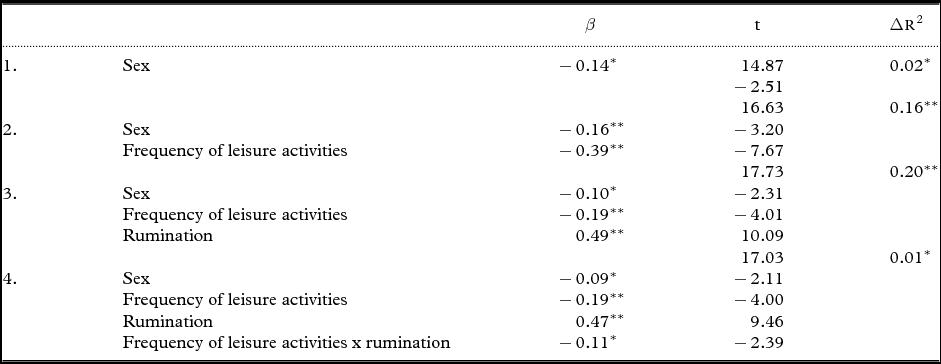
We carried out hierarchical regression analyses to determine, on the one hand, the main effects of the frequency of leisure activities and rumination variables on the dependent variable (depressive symptomatology), and, on the other hand, the moderation effect of rumination on the relationship between the frequency of leisure activities and depressive symptomatology. Following Baron and Kenny's (Reference Baron and Kenny1986) criteria, there is a moderation effect when the product of the predictor variable (frequency of leisure activities) by the moderator (rumination) is significant in the explanation of the criterion variable (depressive symptomatology) after controlling the main effects of the two variables. In the first step of the hierarchical regression analysis, sex was entered, the frequency of leisure activities being entered in the second step. The third step saw the entry of rumination, and finally, the interaction “frequency of leisure activities by rumination” was entered in the fourth step.
Likewise, to determine the nature of the relationship between the frequency of leisure activities and depressive symptomatology, we carried out a post hoc analysis following the procedure described by Holmbeck (Reference Holmbeck2002), according to which the moderation effect is confirmed through the different levels of the moderator variable (high levels of rumination [+1 SD] vs. low levels [–1 SD]) in the relation between the frequency of leisure activities and depressive symptomatology.
Lastly, following the procedure described by Preacher et al. (Reference Preacher, Curran and Bauer2006), we calculated the specific values of the significant regions of rumination in which the regression of the frequency of leisure activities on depressive symptomatology moves from being non-significant to significant.
Results
Description of the sample
The analysis of univariate and multivariate atypical cases revealed the presence of a univariate atypical case, and no multivariate atypical cases were found. Thus, the final sample of 311 participants was obtained. Mean age of participants in the sample was 71.27 years (SD = 6.9; range 60–90 years), with 71.7% women. Mean of number of years of formal education was 10.96 (SD = 6.45).
The moderation role of rumination between leisure activities and depressive symptomatology
Table 1 shows score results for the variables studied. The correlation analyses carried out suggest that both frequency of leisure activities and rumination are significantly associated with depressive symptomatology (Table 1). Likewise, we found a significant negative relationship between the frequency of activities and rumination.
Matrix correlation and descriptive data

Note: *p ≤ 0.01.
The final regression model explains 39.3% of the variance of depressive symptomatology. The results of this analysis are shown in Table 2. Significant main effects on depressive symptomatology in the final model were found for sex, frequency of leisure activities, and rumination. Furthermore, there was a significant interaction effect of frequency of leisure activities and rumination.
Analysis of main effects and interaction effects

Note: ΔR2: Increase in the percentage of explained variance; x: product; **p < 0.01; *p < 0.05; 0 = female; 1 = male.
These results suggest that rumination has a moderating effect on the relationship between the frequency of leisure activities and depressive symptomatology; in other words, the relationship between leisure activities and depressive symptomatology is moderated by the level of rumination in elderly people.
The post hoc analyses carried out on the interactive effect of rumination on the relationship between the frequency of leisure activities and depressive symptomatology (see Figure 1) reveal that this relationship varies in accordance with high levels (+1 SD) or low levels (−1 SD) of the moderator variable. The results show that when rumination was high, the relationship between the frequency of leisure activities and depressive symptomatology was significant (β = −0.29; t = −4.55; p = 0.000). Specifically, when the frequency of leisure activities was low, the average for depressive symptomatology was 22.68, compared with 18.05 when the frequency of leisure activities was high. However, when rumination was low, the relationship between the frequency of leisure activities and depressive symptomatology was not significant (β = −0.08; t = −1.21; p = 0.22). The score range for depressive symptomatology was from an average of 13.26 when the frequency of leisure activities was low to 12.05 when it was high.
Estimation of the relation between the frequency of leisure activities and depressive symptomatology in participants with high (+1 SD) and low (−1 SD) levels of rumination.
The results obtained after calculation of the region of significance of rumination indicate that the frequency of leisure activities significantly predicts depressive symptomatology when elderly people obtain scores of 5.90 or more on the rumination scale.
Discussion
The object of this study was to explore the potential moderator role of rumination in the relationship between the frequency of leisure activities and depressive symptomatology in people aged over 60 years. Specifically, two alternative moderation hypotheses suggesting different directions of moderation were compared.
The results of the study support the role of rumination as a moderating variable of the relationship between the frequency of leisure activities and depressive symptomatology among elderly people. Specifically, we found evidence to support the hypothesis that the relationship between involvement in leisure activities and depression is significant only for older adults with high levels of rumination (hypothesis (b)). The results suggest that the psychological correlates (depressive symptomatology) of leisure activities are especially important for older adults with a tendency to ruminate, as only in this group the frequency (high or low) of leisure activities is significantly associated with different emotional correlates: a higher frequency of leisure activities is associated with lower levels of depressive symptomatology, and scarce involvement in such activities is linked to higher levels of depression. Although low involvement in leisure activities is associated with higher levels of depressive symptomatology in all participants, low frequency of leisure activities is more strongly related to depressive symptomatology in elderly people who tend to use rumination as an emotional regulation strategy. It should be noted that the relationship between leisure activities and depression is not significant in the presence of low levels of rumination. This finding suggests that elderly people who perform fewer leisure activities and have a tendency to ruminate may represent a particularly vulnerable group with higher risk of depressive symptoms.
As regards psychological intervention in elderly people with depressive symptomatology, our findings suggest the importance of considering behavioral (leisure activities) and cognitive variables (rumination) jointly in order to explain, prevent, and/or treat depressive symptomatology in older adults.
The results of the study support a significant inverse relationship between the performance of leisure activities and depressive symptomatology in elderly people as previously found in research with the general population (Lewinsohn, Reference Lewinsohn, Calhoun, Adams and Mitchell1974; Manos et al., Reference Manos, Kanter and Busch2010). This finding highlights the importance of the involvement of older adults in leisure activities for their emotional well-being. In line with the findings of Sütterlin et al. (2012) in elderly people, our results also support the association between rumination and depressive symptomatology, which demonstrates the relevance of this emotional regulation variable in the explanation of depressive symptomatology for this population (Nolen-Hoeksema and Aldao, Reference Nolen-Hoeksema and Aldao2011).
Even though both leisure activities and rumination have been considered in previous studies as involved in the development and maintenance of depressive disorders in older adults, to our knowledge this is the first study to show a moderator role for rumination in the relationship between leisure activities and depression. As our results suggest, rumination is not only a variable associated with distress in elderly people but may also reinforce the detrimental effect of scarce involvement in leisure activities in this population.
The present results are of great relevance for the understanding of depressive symptomatology in older people, as they highlight the importance of taking into consideration both behavioral (involvement in leisure activities) and cognitive (rumination) variables in order to gain a deeper understanding of the depression phenomenon in elderly people. As shown by our data regarding the percentage of variance in depressive symptomatology, both factors seem to be relevant in explaining this variable (15.7% involvement in leisure activities and 20.5% in rumination).
These results must be considered with caution, given the correlational nature of this study, which precludes us from drawing conclusions about possible causal relations between rumination, frequency of leisure activities, and depressive symptomatology. Thus, there is a need for longitudinal and experimental studies that will allow us to test hypotheses of a causal nature. The study has some additional limitations. First, the participants were recruited at a cultural center, which undoubtedly affects the representativeness of the sample. Moreover, despite presenting adequate psychometric properties, the scale employed in this study for assessing leisure activities does not cover the broad spectrum of gratifying activities; nor was it designed specifically for older adults.
Also, important variables, such as marital status or educational level, have not been controlled in this study, even though they may play a significant role in the explanation of depression in older adults. Future studies should include these and other relevant variables in order to control their potential influence for the variables of interest.
In spite of the above, the finding that the relationship between the level of involvement in leisure activities and depressive symptomatology is influenced by a key cognitive–emotional variable, such as rumination, has clear implications for clinical practice. First of all, it seems reasonable to think that rumination should be considered in the clinical assessment of elderly people as a potential factor of psychological vulnerability, as previous studies have suggested (Genet and Siemer, Reference Genet and Siemer2012; Takano et al., in press). Specifically, the results suggest that such vulnerability may be especially significant in those cases where the scores on rumination are above 5.9, the specific cut-off point for a rumination score after which the frequency of leisure activities is significantly related to depressive symptomatology. These results are more relevant in older people, considering that rumination is regarded as one of the most damaging elements in adaptation to emotional losses (Nolen-Hoeksema and Davis, Reference Nolen-Hoeksema, Davis, Snyder and López2005), which are highly frequent as part of the aging process.
From the prevailing paradigm of active aging, originally proposed by Rowe and Khan (Reference Rowe and Khan1987), numerous policies have been launched aimed at the promotion of well-being and quality of life in elderly people by encouraging participation in pleasant social activities (World Health Organization, 2002). The results of this study highlight the importance of analyzing psychological variables, including rumination, in the process and design of such active aging interventions. Specifically, our results suggest that this type of intervention may be particularly helpful and necessary for older adults with high levels of rumination.
The results also highlight the need to develop effective psychological interventions in order to reduce rumination in older adults, since it is a factor that, in contrast to pleasurable activities, has been scarcely taken into account in assessments and clinical intervention with this population. The results presented here reveal the need to continue exploring the relationships and interactions between the diverse cognitive, emotional, and behavioral processes involved in depressive symptomatology, with the aim of bringing together different levels of analysis and gaining a more integrated and comprehensive understanding of the development and duration of depression in this age group.
Conflict of interests
None.
Description of authors’ roles
All the authors collaborated in the design and implementation of the study, the data analysis, and the writing of the paper.
Acknowledgments
This work would not have been possible without the cooperation of the Cruz Roja Española, Centro de Mayores Reina Sofía (Spanish Red Cross, Reina Sofia Day Centre for Senior Citizens). The study was funded within the framework of Project PSI2009-08132 from the Ministry of Science and Innovation, and Project PSI2012-31293 from the Ministry of Economic and Competitiveness.