“What is the chief end of man?” asks the first question of the Westminster Shorter Catechism. This historic teaching tool of the Presbyterian Church, the denomination with which Princeton had close ties, had for generations shaped how the prominent college's presidents and faculty conveyed to students their moral duties. Specifically, Princeton's leadership communicated a moral framework that reflected the catechism's answer: “Man's chief end is to glorify God, and to enjoy him forever.” In other words, the chief moral duty was to relate rightly to God. All other moral duties incumbent on those privileged enough to receive a college education would flow naturally from this one. The Westminster divines had meant “man” in the generic sense of “human,” but social and intellectual changes in the late nineteenth century led Princeton's leaders to consider more carefully how they might communicate to students the chief end of “man” specifically.Footnote 1
Prominent among these changes was the widespread entrance of women into American higher education. Before the Civil War, very few colleges accepted women, but by 1870 women constituted 21 percent of the collegiate population, and over 47 percent by 1920. In this environment, Princeton's New England competitor had sought to raise its national profile by emphasizing that Harvard would not admit the new stream of students. In the words of Harvard president Charles William Eliot, “It is not the chief happiness or the chief end of woman, as a whole, to enter … new occupations, to pursue them through life. … [It is rather] to make family life more intelligent, more enjoyable, happier, more productive.” Why then should the nation's most elite colleges expend resources on women? If Princeton likewise were to focus solely on men—particularly the elite white ones deemed fit to guide national affairs—it could thereby lay claim to a mission of greater national significance than institutions that admitted women. And a new religious orientation, one that emphasized the divinely ordained social duties of each sex more than all humans’ common duties to God, could help it do so. Historians have overlooked this aspect of the religious shift taking place within American colleges and universities of this era, but Princeton's decision to alter its spiritual approach reveals how collegiate religion helped instill gender ideals in the Progressive Era American elite.Footnote 2
Much excellent scholarship has examined the changing role of religion in American higher education during the decades around 1900. Historians of this phenomenon have demonstrated how a wide range of concurrent changes, such as the increasing prestige of science, the rise of the research university, and the growth of “modernist” theological liberalism, led prominent colleges and universities to reduce the role of traditional religious means in how they sought to produce ethical graduates. With the decline of required chapel and courses in Protestant doctrine, these institutions cast about for alternative approaches. Even though the resulting debates corresponded exactly with the wide-scale advent of an entirely new type of student—women—gender ideals rarely merit even a mention in this scholarship. Yet the prominent male college and university presidents and professors who dominated these discussions had to include in their deliberations whether their institutions would benefit society more if they were single-sex or coeducational.Footnote 3
Changes in American higher education during this era mattered more broadly because they corresponded with increasing influence by colleges and universities on national politics, economics, and culture. In 1870, less than 2 percent of the American population between the ages of 18 and 21 attended college. By 1900, that number had more than doubled to 4 percent, and it would double again to 8 percent by the 1920s. Yet even this rapid growth does not tell the whole story: college graduates during this time period came to hold national leadership positions in government, business, education, and Progressive reform movements quite out of proportion to their numbers in the wider population. Male and female college students tended to separate into broadly male and female professions, with male graduates dominating politics, business, and the traditional professions of law, medicine, and ministry, while female graduates dominated the new female professions of teaching, nursing, and, increasingly, social work. Drawing a straight line from students’ college environments to their behavior after graduation is notoriously difficult—and professional incentives and historical barriers certainly played a role in men's and women's career choices—but available evidence indicates that, both before and after graduation, ethically minded undergraduates generally participated in the types of moral service toward which their leaders encouraged them.Footnote 4
This article explores how a shift in religious ideals interacted with a shift in gender ideals to shape the moral messages male college leaders proclaimed and male college students internalized. It does so through the lens of developments at Princeton. First, by drawing on the writings of Princeton presidents, the article analyzes the college's changing approaches to student moral formation as it overhauled its institutional identity from the 1860s to the 1910s—while choosing to remain single-sex. The article then draws on the records of the college's most prominent student religious organization, the Philadelphian Society, to demonstrate that many Princeton students from this era appear to have absorbed the perspective of their elders and taken it with them to posts of wide influence.
Princeton serves as a powerful lens on these changes because its history speaks to the experience of both colleges and universities: In 1896, in a bid for national prominence, the College of New Jersey—a quintessential denominational college of the type that dominated the antebellum educational landscape—declared itself to be instead Princeton University, a research institution with an ambitious graduate as well as undergraduate program. The declaration was a bit premature, but Princeton would soon make convincing headway on the transition under its most famous president, Woodrow Wilson (1902–1910).Footnote 5
Because Princeton was one of the few turn-of-the-century founders of the Association of American Universities to have previously been instead a standard nineteenth-century denominational college, its records have proved useful for reconstructing the massive changes undergone by both types of institutions during the decades around 1900. For example, Princeton serves as a major source for both George Marsden's and Julie Reuben's classic treatments of the changing role of religion in American higher education, a change driven by the growing importance of research universities. Indeed, P. C. Kemeny treats Princeton as the ultimate exemplar of these religious developments in higher education by devoting an entire book to changes there. Meanwhile, as Princeton's graduate program remained largely separate (even physically) from its undergraduate program, Princeton also serves as one of the four schools that Bruce Leslie uses to demonstrate how colleges, as distinct from universities, remade themselves in the Gilded Age and Progressive Era into institutions that could retain a unique niche in American culture.Footnote 6
Scholarship on the sea change in American higher education during the decades around 1900 convincingly establishes not only the decline in traditional religious components of college education but also the rise of a new undergraduate culture dominated by the symbols of middle-class manhood, particularly athletics and clubs. As Leslie demonstrated, both changes were driven in part by young alumni hoping to make their alma maters more respected within the elite urban world of the Gilded Age and Progressive Era. Daniel Clark subsequently analyzed how the new image of the college man in middle-class magazines helped American business leaders come to endorse higher education. Brian Ingrassia revealed how, in turn, college leaders sought, ultimately unsuccessfully, to use the most popular aspect of this new image—football—to pass on Progressive ideals to the American public.Footnote 7
This article argues that what we have missed in this overall picture is that in the new context of competing men's, women's, and coeducational institutions, these shifts in religious ideals and gender ideals proved mutually reinforcing such that the sex of students an institution served became central to its new sense of ethical purpose—even at a men's college that was simply continuing a tradition of educating only men. Gender ideals in turn became central to the moral vision that educational leaders sought to communicate to male students. Whether at men's colleges or at coeducational universities that often patterned male students’ experiences after them, men were not simply socialized into elite male norms outside the classroom. Rather, college leaders also articulated to them an explicit moral vision that newly drew on elite gender ideals to lay out how these students should use their education to serve their future communities. College men, in turn, broadly acted in accordance with this vision. Thus in an era when women for the first time could access an education truly comparable to men's, educated men nevertheless continued to see themselves as uniquely suited for public leadership roles by virtue of their sex.Footnote 8
PRINCETON AT THE CROSSROADS OF CHANGE IN AMERICAN HIGHER EDUCATION
Changes at Princeton during this era allow us to perceive with particular clarity how religious and gender ideals interacted. As the institution shifted its identity from an evangelical Presbyterian college to a more liberal Pan-Protestant research university, it newly made much of the fact that it was an institution only for men. (It would remain so until 1969.) Previously all colleges were men's colleges, but in an era of expanding women's higher education, emphasizing this status gave Princeton a way to articulate a clear moral purpose as it moved away from its previous religious identity: Princeton would form the minds and morals of those destined for positions of the greatest influence both locally and nationally, positions it assumed were reserved for men.
One major engine behind this newly gendered moral vision at Princeton was the push for a more national constituency among leading institutions of higher education. As a typical nineteenth-century denominational college, Princeton had long sought to serve the public good by turning out graduates morally and intellectually fit to serve in leadership positions in public affairs in the realms of both church and state, positions limited at the time to (white) men. Yet for most of the first 150 years after its 1746 founding, Princeton's administration and faculty had sought to form graduates morally equipped for such positions by inculcating the type of Christian conversion and character development believed to apply equally to both sexes. In keeping with patriarchal norms of the time, it simply went without saying that only men would apply this ethical training to prominent public posts. After the Civil War, however, the new wide-scale entrance of women into higher education cast some doubt on this assumption, while the rise of research universities induced jostling for eminence among diverse types of higher educational institutions.Footnote 9
Those at the head of Princeton then made a bid for truly national prominence by emphasizing the college's history of service to the state over its history of service to the church—thus also appealing to rich donors in the secular sphere who could fund the necessary improvements. In the gender-focused culture of the Progressive Era—when Theodore Roosevelt urged men toward the “strenuous life” and decried the “race suicide” brought on by educated women who refused to have children—this bid involved playing up the institution's status as an all-male holdout in the midst of new women's colleges and coeducational universities. Princeton would continue to focus on training those it argued were best-equipped to wield the most influence on a national scale.Footnote 10
Indeed, Princeton's leaders made much of the growing influence of college graduates in the leading male-dominated secular professions. Arguing for the significance of a college education, Dean Andrew West observed during this era that college graduates made up 30 percent of the House of Representatives, 40 percent of the national Senate, almost half of the Cabinet officers, half the U.S. presidents, and almost all of the Supreme Court justices. Ivy League men's colleges had a special influence: the three Progressive Era presidents respectively graduated from Harvard (Roosevelt), Yale (Taft), and Princeton (Wilson). Historically, college graduates had also supplied many of the nation's doctors, lawyers, and ministers. During this era, that percentage grew even larger as more and more professional schools required a B.A. for admission, a reform for which Princeton professor and later president Woodrow Wilson would advocate in 1893. As Daniel Clark has observed, during the Gilded Age, college did not routinely serve as the path to leadership in business, but during the Progressive Era, college leaders succeeded in winning over much of the business community to the value of college for the socialization and habits of thought that led to commercial success. Princeton was one of the institutions at the helm of this movement; the number of its graduates entering the business field had mushroomed to 50 percent by 1900, the year Princeton President Francis Patton defended this shift in a widely read Saturday Evening Post article “Should a Businessman Have a College Education?” Princeton graduates and men with similar educations thus found themselves in a panoply of positions from which they could disseminate their ideals widely.Footnote 11
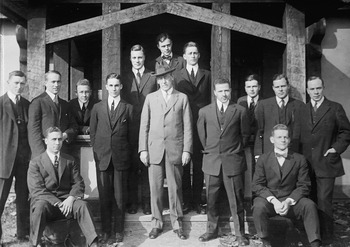
Merely three years after serving as the university's president, newly elected U.S. President Woodrow Wilson poses with Princeton students in 1913. Harris & Ewing Collection, Library of Congress Prints and Photographs Division, Washington, D.C.

A new understanding of religion among the institution's leaders dovetailed with this new sense of institutional identity to midwife an increased emphasis on gendered duties in Princeton's approach to student moral formation. Scholarship has typically described the shift from evangelical to “modernist” Protestantism at leading educational institutions as a shift in emphasis from facts to values or from belief to action, and hence away from formal religious indoctrination. Such descriptions have merit but have obscured how spirituality is always relational—toward God and others—and hence helps form people's sense of self, including their gender identity. So a more helpful approach to talking about this theological shift might be to say that for much of the nineteenth century, most American college leaders adhered to an evangelical Protestantism that asserted that what we could call the “vertical” relationship between humans and God ultimately grounded both individual and social flourishing. It therefore deserved more emphasis in moral formation than the “horizontal” relationships among humans. But toward the end of the century, leaders of higher education increasingly identified as more theologically liberal modernist Protestants who believed that right relationships among people made them right with God, rather than the reverse. Hence it was often modernists—though not exclusively so—who constituted the prominent leadership of the concurrent “social gospel” movement that focused religious energy on restructuring society along Christian principles. Modernism both shaped and bolstered educators’ new goals as it affirmed that serving the state was a primary means of serving the church, not the other way around. This approach to Protestantism also involved a less elaborate theology about the nature of God and salvation—it did not require a conversion experience—and so seemed less parochial. Institutions that adopted it could more easily argue that they prepared cosmopolitan graduates fit for national influence.Footnote 12
On the flip side, however, increased focus on how people should rightly relate to one another meant increased focus on gender roles, less relevant to the question of how all humans should relate to God. Over the course of the Gilded Age and Progressive Era, as Princeton's presidents gradually shifted focus from serving the church to serving the state, they also shifted focus from vertical to horizontal spirituality. Thus the religious aspects of student moral formation came to reinforce the gendered moral commitments emphasized by college leaders. Princeton not only downplayed urging conversion; it also played up inculcating gendered attributes and attitudes.
The voluntary religious and service activities of Princeton students and graduates over this time suggest that on the whole they imbibed the gendered ethics of the institution's leadership and carried it with them after graduation. Inasmuch as Princeton was in many ways a representative men's college, its experience suggests that the religious changes undergone by American institutions of higher education contributed to enshrining a commitment to separate vocational spheres for men and women among the educated elite in an era when the widespread entrance of women into higher education might otherwise have produced more egalitarian convictions.
EVANGELICAL REFORMERS AS PRESIDENTS, 1868–1902
In 1868, educational reformer James McCosh, famed Scottish theologian and philosopher, took over the presidency of Princeton from fellow Presbyterian minister John Maclean. The wider intellectual environment in which McCosh would serve looked quite different from the one his predecessor had known. McCosh took the reins as agitation began to brew for reform in American higher education. Many colleges and universities were beginning to update their curriculum and organizational structure with two aims in view: first, to place some emphasis on research; and, second, to provide more types of preprofessional training. Two pressures, somewhat at odds, accounted for the change: the example of German higher education and public demand for education more relevant to the American economic and social structure. Students’ demands for more determination of their own collegiate experience manifested not only in an altered curriculum, but also in the expansion of extracurricular activities, including the rising importance of college athletics. Additionally, arguments that higher education also ought to prepare women for their roles, particularly as teachers of the next generation, led to opening women's liberal arts colleges and expanding traditionally male state universities into coeducation.Footnote 13
In view of all these changes, McCosh sought to preserve the essence of Princeton's heritage by carefully adapting some of the new measures while defending what he perceived to be the core of the inherited tradition. Princeton's new president rearticulated the value of the traditional required curriculum—heavy on classical languages, mathematics, and philosophy. He believed it taught students how to think and thus prepared them for any future work to which God might later lead them. Yet he also allowed upperclassmen to elect a few classes in an area of specialty. Similarly, McCosh embraced but sought to moderate the new emphasis on extracurricular life and athletics among students. He also retained a strong commitment to scholarships for poor students, but actively recruited richer ones in a campaign to extend Princeton's national reach. Since the Civil War deprived the institution of its previously strong southern support while making others suspicious of its loyalty, Princeton's draw had shrunk to the mid-Atlantic region. Over the course of McCosh's twenty-year presidency, he sought to return the school to national prominence by expanding and improving Princeton's dormitory accommodations and then canvassing elite preparatory schools for students who might otherwise go to Harvard. Finally, at the very end of his term, McCosh would even nod to women's education, permitting the establishment of Evelyn College half a mile from campus. Like Radcliffe, this “coordinate” college allowed a small group of women to take many of the same classes as Princeton students from professors who retaught them to the women on a separate campus for additional pay.Footnote 14
But religious as well as intellectual winds were also shifting in the world of higher education. For example, Harvard president Charles William Eliot exemplified not only the trend away from a required curriculum but also the trend to drop mandatory doctrinal instruction and chapel attendance. A combination of new intellectual developments and a growing pluralism undergirded this move. Historical biblical criticism and Darwinian evolution led many educators to reject the evangelical Protestantism that affirmed an eternal truth handed down by God once for all and embrace a modernist Protestantism that preached the development of doctrine over time in light of new human discoveries. Accordingly, they emphasized God's immanence within human culture rather than divine transcendence over it, and likewise the gradual process of growing into spiritual maturity rather than a sudden, divinely initiated change of heart in a specific conversion experience. Finally came an emphasis on Christ as teacher rather than on Christ as the one who made atonement for sin. Taken together, this new approach to Protestant Christianity shifted the center of importance from the individual's direct relationship with God to his or her social role in the community.
Modernists, like evangelicals, transmitted their beliefs to students through chapel and courses that touched on Christianity, but these means were not as essential to modernist goals as they were to evangelical ones. Additionally, deemphasizing these aspects of the college experience would make more space for Catholics, Jews, and nonbelievers, and thus gave an institution greater claim to speak for and to the nation as a whole. Modernists thus often relied on the humanities to inspire students with notions of the true, the good, and the beautiful; on the sciences to inspire selfless pursuit of truth; and on student social life to expose students to a range of different people so as to foster democratic sensibilities.Footnote 15
Yet here McCosh would not compromise; he continued to affirm both the primacy of the divine-human relationship and the traditional means of facilitating it. McCosh rejected much of the new biblical criticism and defanged Darwinism by declaring it compatible with historic Christian doctrine. He continued to urge students to convert to evangelical Christianity both because he believed their eternal souls were at stake and because he believed morality would not survive if not grounded in what he believed to be true religion. The ethics of Princeton graduates especially mattered because their likely public prominence would make them beacons of right morals.Footnote 16
McCosh clearly thought in the gendered terms of his day—assuming men and women would fill different social roles—but, unlike future Princeton presidents, these terms did not define for him the essence of religious and moral formation at Princeton. McCosh spoke frequently of his hope that students would grow into “cultured gentlemen” or “educated gentlemen,” but not so much in distinction from women as in distinction from the “coarse” men whom he believed an overemphasis on athletics sometimes produced. He enjoined students to exert “manliness” in the sense of courage of convictions, but then turned around and applied the same exhortation elsewhere to young women. Strikingly, McCosh ended one of his baccalaureate sermons to graduating seniors with the metaphor that as they left college depending on God for guidance, they would “have much the same feeling as the daughter has when she has to leave her mother's house to enter into a house of her own, with one she can trust.” McCosh clearly took seriously the dominant biblical interpretation of his era that husbands led and wives followed because marriage symbolized the relationship between Christ and the church: men could and should metaphorically place themselves in the position of women when relating to God. In McCosh's mind, the same basic traits—“masculine” courage and “feminine” trusting submission—constituted religious and moral maturity in both men and women.Footnote 17
McCosh's successor, Francis Patton, also continued to hold the evangelical line, but he made more accommodations to the new intellectual, social, and religious environment of the late nineteenth century. On the one hand, Patton sustained McCosh's style of religious commitment throughout his 1888–1902 presidency. Patton, too, was a Presbyterian minister and philosopher; he, too, believed a Presbyterian college should actively defend what he believed to be the historic Christian faith. He thus articulated many of the same arguments as McCosh about the value of religious training for the individual's personal relationship with God.Footnote 18
On the other hand, Patton swung the pendulum toward greater emphasis on Princeton's value to the state than on its value to the church, and thus from vertical toward horizontal spirituality. McCosh had specifically urged graduates to consider the ministry, but at Princeton's 1896 sesquicentennial, Patton argued that religion at Princeton did not so much serve to form ministers as to form “men of moral courage and religious convictions, public spirited, patriotic, and possessed of clear, balanced, and discriminating judgment in regard to public opinions.” The president flagged not only Princeton graduates’ leadership in the professions, but especially their involvement in affairs of state; he noted that the university had produced more of the statesmen that helped found the nation than any other institution.Footnote 19
In the context of the late nineteenth century, a swing toward emphasizing Princeton's contributions to the highest halls of worldly power meant a swing toward sex-specific character formation. Princeton had ambitions to raise its academic quality to the level of a true research university, and doing so required soliciting donations from alumni and prominent Presbyterian businessmen. To accomplish this goal, the president presented Princeton's historic religious identity as an aid to its historic mission to serve the state. In this way he sought to appeal to the growing concerns of elite native-born white men within the Protestant church.
Toward the turn of the century, such men felt threatened by the growing political power of immigrant men, by the possibility that their stronger working-class bodies might violently overthrow the halls of capital, by the entrance of “New Women” into higher education and traditionally male occupations, and by the decreasing ability of even upper-middle-class men to advance above clerical positions in the new industrial economy. These anxieties led to an obsession among middle-class men for asserting traits associated with masculine power—strong and active bodies, tough-mindedness, and physical and moral courage, among others. Potential avenues of expression for this middle-class masculinity ranged from athletics, to the Spanish-American War, to Progressive reform movements, to conceptualizing business competition in martial terms.
These obsessions held sway not only in the physical, economic, and political spheres, but also in the religious one. Concern grew about the low ratio of men to women in the church—although it was actually no lower than usual. Advocates of “muscular Christianity” argued that middle-class Protestant men needed to take intentional action to improve both the church and the world or risk losing their virility. Muscular Christianity thus emphasized working hard at interpersonal ethics more than relying on God to transform individuals. Likewise, it emphasized active volunteer work in the community more than passive reflection on a sermon in church. Both emphases dovetailed with the overall shift from vertical to horizontal spirituality among many Christian intellectuals.Footnote 20
Patton hitched Princeton's wagon to the new approach by marketing the university as an institution that formed this new type of Christian man. In so doing, Princeton shut its gates against the tide of women entering higher education. Moreover, under Patton, Princeton's leadership opposed the fundraising efforts of Princeton's coordinate women's college when they threatened what he believed to be Princeton's more important fundraiser designed to help it achieve true university status. Thus, even though Patton had served on the board of Evelyn during his Princeton presidency, he let the women's college fold for lack of funds in 1897 in order to strengthen the mission of the men's institution.Footnote 21
As part of Princeton's new orientation, Patton sought to convince students of the merits of evangelical religion by appealing to their concern to be the type of men who had what it took to merit society's positions of power. The president concurred that a masculinity crisis existed within the American Protestant church: “It is intrinsically harder for men to be religious than women,” he told the students, because of “the special temptations to which men are subject” and “the irreligious atmospheres into which they are thrown.” Yet he argued that it was even more important for young college men to be trained in the faith than for their sisters because it would be these young men “who for good or ill will shape the history of the next generation.” In this way, Patton appealed to student pride in their social privilege as men in order to secure their buy-in to evangelical faith. Even more directly addressing students’ potential associations of religion with women, Patton asserted, “There is no reason why a man should forfeit his manliness by being a Christian.” Drawing on the martial metaphors of muscular Christianity, he argued for mounting a “manly” defense of the Christian faith, and chided students for too often treating their faith in an “effeminate” manner. He elaborated that “instead of being a shield which protects us from assaults; instead of being a stout club with which we knock temptation on the head; instead of being a sword wherewith we slay our spiritual enemies, it is regarded rather as a very weak companion that we must nurse tenderly and that cannot go out at night.” It is difficult to envision Patton following McCosh in enjoining students to see themselves as Christ's submissive wife.Footnote 22
But focusing on masculine character development also meant shifting focus away from the explicitly religious aspects of moral formation. Patton's preference for male-oriented morality led him to play up the moral power of student fraternities and athletics, at least when speaking to alumni and donors who valued these activities' masculine image and their ability to instill the normative social behavior that would equip men to gain public influence. In contrast, McCosh had taken a more nuanced view. The former president had been less concerned with fostering male moral traits and more concerned with fostering general ones. This different calculus had led to a different evaluation of Princeton's extracurricular life. McCosh had believed that the growing student Greek life could “foster pleasant social feelings” and “create a taste for oratory”—both traits historically necessary for success in the male-dominated public sphere. Nevertheless, he claimed they often did more harm than good: student societies maneuvered to win prominent prizes and positions for their members and sought to subvert college discipline. These outcomes led to the gender-neutral vices of pride, deceit, and rebellion. Likewise, McCosh had appreciated the role of Princeton athletics in training the body, but feared they could distract from other, more important aspects of college education, such as development of the mind or heart.Footnote 23
For Patton, however, the ability of fraternities and athletics to instill the masculine traits now perceived necessary for worldly success trumped other concerns. Patton praised students’ honor culture and the initiative they showed in forming organizations as expressions of their “manliness.” He retained some behavioral rules against which students bucked, but he argued that their purpose was to provide an environment conducive to students learning to take hold of their “manly independence” in a responsible way. Accordingly, he challenged students to reform their own culture—by abolishing abuses such as hazing—to decrease the need for regulations they saw as an affront to their manhood. Students responded; in 1893, student self-government at Princeton took a major leap forward with the adoption of the honor code. Meanwhile, Patton acknowledged that athletics could distract students from their studies, but he emphasized that sports taught discipline, courage, exertion, and cooperation in the service of a common goal, what Patton called “the lessons of manliness.” He therefore affirmed that athletics served as “agent[s] of moral reform” and, when speaking to alumni, loudly praised their role in college life.Footnote 24
Thus religious education under Patton retained some of its former emphases while also departing in new, more gendered directions. Like McCosh, Patton preached a Christianity oriented first and foremost toward fostering an individual's relationship with God. Patton believed individual change came from conversion—which required the same things of all people—but he believed social change came not primarily from the church, but from the public leadership of (hopefully converted) prominent men. To attract such men and their dollars to Princeton, he spoke of a conversion-oriented faith in a language tailored to them rather than accessible to all. Patton continued to support the traditional location of spiritual and moral formation at Princeton with required chapel and Christian instruction in the classroom. Patton, however, proved more willing than McCosh to subsume other areas of the college experience into his overarching goal of forming a certain type of male Christian. He therefore touted student clubs and athletics for their ability to foster specifically masculine moral traits. Patton thus held nongendered and gendered aspects of moral formation in tension: the conversion required of men and women, rich and poor alike, and the development of the positive characteristics required for success by elite men specifically.
PRESBYTERIAN MODERNISTS AS PRESIDENTS: WILSON AND HIBBEN, 1902–1917
Princeton's early twentieth-century presidents would swing the institution's identity and its type of moral formation even further in a sex-specific direction. Woodrow Wilson took over as president of Princeton in 1902 and served in that capacity until 1910. Unlike all previous Princeton presidents, Wilson was a layman, albeit a devout Presbyterian layman and the son of a Presbyterian preacher. Wilson did not just differ from McCosh and Patton in vocation, however; he also differed in the content of his faith. A Protestant modernist rather than an evangelical, Wilson defined the essence of Christian faith more in terms of the service to others that faith in God motivated, rather than in terms of the relationship with God that it facilitated. Furthermore, Wilson believed the essence of Princeton to be serving the state rather than the church. Although Patton had shifted the balance toward the former, he had retained a significant component of the latter. Wilson's predecessor had argued that Princeton ought to instruct students in religious belief both to fit them for a personal relationship with God and to fit them for service to the nation. Wilson spoke solely of this second aspect of undergraduate religion: instruction at Princeton must be informed by the spirit of “the religion of Christ” and animated by “the energy of a positive faith” to provide students with the ethical road map and sense of duty to serve the national good. In turn, he believed the national good to be best served by forming graduates equipped to fill top posts of public influence.Footnote 25
This constellation of beliefs led Wilson to reduce mandatory chapel attendance and eliminate the course requirements in Bible and Christian apologetics. These features of the collegiate experience had been essential for cultivating an evangelical-style relationship with God, but were not as essential for cultivating an inclination toward service. Meanwhile, they could be potentially divisive—or, worse yet, overly Presbyterian—in a manner that might endanger the institution's national standing, and hence its national influence. Accordingly, Wilson considered most of students’ moral formation to come from Princeton's liberal arts curriculum and from voluntary activities beyond the classroom. He believed that the liberal arts provided a broad knowledge of human affairs past and present; this grounding imparted wisdom. Specifically, it imparted the type of wisdom necessary for steering the nation through the choppy social and political seas of the day. Additional wisdom came from interaction outside the classroom with other social classes.Footnote 26
The moral responsibility for which Princeton thus prepared students was only for men, and select ones at that. Wilson articulated an elitist view of the role of a private undergraduate liberal arts education. He argued that the common schools ought to provide young men the basic training needed to be responsible voters. From there, most would then undergo technical training in preparation for their careers. University education should not be all things to all people as many state universities attempted. Rather, university education should train the nation's leaders in government, business, science, and academia. As author of the university's famous motto, “Princeton in the nation's service,” Wilson asserted that any university that did not do so would “lack its national title” and merely serve more proximate goals. By contrast, such leaders as Princeton produced charted the course, good or ill, along which the rest of the nation would sail. They constituted those who “stand at the front” and “offer themselves as guides.” Wilson carefully argued that such a conception was not undemocratic; it was instead meritocratic. Thus, under Wilson, Princeton continued to make provision for some boys of modest means—although, tellingly, Wilson stopped earmarking any such scholarships for ministerial candidates. Wilson could therefore claim that all men with talent and inclination could rise up to lead the nation through pursuing a Princeton education. In classic Progressive form, Wilson added that this division of labor produced the “efficiency” necessary to the nation's success.Footnote 27
Wilson's envisioned meritocracy had no room for women. He believed division of labor included division between the sexes. In true nineteenth-century—and southern—style, Wilson thought (white) men and women had different gifts; men's fitted them for the public realm and women's fitted them for the private sphere. Wilson believed that children became Christians primarily through home influences, so he did not exhibit the same paranoia about women's influence in the church as many muscular Christians of his day. Likewise, Wilson sometimes spoke about religion or morality in the language of “manliness,” in the sense of a specifically male ideal, but not nearly so frequently as Patton or other advocates of muscular Christianity. What he lacked in language, he made up in emphasis.
Wilson consciously oriented Princeton's education toward a specifically male ideal of Christian public action. He appreciated learned women, but believed they should do their learning in separate institutions geared toward their separate social roles so as not to “vulgarize” relations between the sexes. As to the Princeton men Wilson trained, he believed their service to the national good constituted an essentially spiritual act because it took them away from the material concerns of their specific profession or of providing income for their family. He expected those privileged to receive a liberal arts education to invest themselves, without remuneration, in wider concerns beyond their profession for the betterment of society. Wilson's conception of such service as something rendered not only through graduates’ professions but also above and beyond them logically undercut his male paradigm. Many women at that time worked primarily in the home but then volunteered various social services to their communities. A liberal arts education would theoretically have benefited them as well, inasmuch as Wilson believed it to furnish the knowledge of human nature and history needed for informed decisions on current social problems. Wilson, however, considered Princeton graduates to be the nation's “leaders” who would have a vocal public presence, a role he thought not fit for women.Footnote 28
Wilson's ambitious goals for Princeton to lead the nation in and through its undergraduate program provoked internal dissension. While cold to the educational desires of women (and African Americans), Wilson in other respects sought to implement his meritocratic ideals in radical and sometimes unpopular ways. He wanted Princeton to be a “city on a hill,” a democratic model for other institutions of higher education, and, ultimately, for the nation at large. Wilson found Princeton's campus life far too elitist to accomplish this goal. He therefore proposed that Princeton's socially exclusive eating clubs be merged with the dormitories into a British quadrangle system in which students from various social classes would live and eat together. The alumni refused to underwrite this plan. Wilson also wanted to locate Princeton's new graduate college in the center of campus, a scholarly example to the undergraduates. The location would have a second benefit: it would check the plans of Dean Andrew West to make the graduate college into an opulent enclave conveniently located right off a golf course—“a great big upper class Club,” in the words of one concerned trustee. After losing the ensuing power struggle with various trustees, faculty members, and alumni, Wilson resigned to seek election as governor of New Jersey.Footnote 29
Wilson's successor, John Grier Hibben, professor of logic at Princeton, set out in 1912 to restore peace with the university's elite constituency by dialing back Wilson's moral intensity while maintaining continuity with his educational ideals about how best to train the nation's male leadership. Hibben did so by expanding Princeton's service ideal beyond that rendered by the best and the brightest, and by no longer portraying the university itself as a city on a hill. Thus Princeton need not focus so much on admitting the talented poor or on curbing the social aspirations of recipients of a “gentleman's C.” Hibben agreed with Wilson that a liberal arts education obligated its recipients to use their privilege to better human conditions, but the new president quickly clarified that “naturally, we cannot expect our students generally to attain to the highest offices of public trust in our country.” Princeton “also [had] a responsibility of ministering to the needs of the average man” who would go on to play his part in “the great social organism of humanity.” Indeed, Hibben declared that unleashing the powers of all its students constituted Princeton's greatest contribution to the nation. In this way he maintained Wilson's emphasis on national service, but broadened that ideal to include the smaller-scale service rendered by men of more nearly average abilities—such as the sons of many of his wealthy donors. Effectively, Hibben sought to subsume all careers in the public sphere into Wilson's ideal that Princeton define itself by its ability to train the elite men who would shape the nation. As under Patton, “elite” could once again mean wealth and social position more than ability. Ironically, however, Hibben thereby reopened space in the institutional mission that in theory could have allowed training students outside the white male elite for whom national leadership positions were reserved.Footnote 30
How Hibben grounded moral formation in the religious aspects of education had this same dual effect. A modernist like Wilson, Hibben continued to emphasize the social aspects of spirituality and to identify a sense of duty to the country as the essence of early twentieth-century Princeton's religious identity. Wilson, however, had almost totally conflated Princeton's religious commitment with national service. Hibben—an ordained Presbyterian minister rather than a political scientist—brought back, albeit in muted tones, a parallel role for religion at Princeton in fostering students’ direct relationship with God. This move complemented how he de-emphasized Wilson's ideal of training top national leaders. When Hibben assumed Princeton's presidency, he shared with alumni that “it is a part of the Princeton tradition to believe in a power in the world that is greater than ourselves, greater than the institution which we love, greater than the nation to which we ever delight to pledge our loyal devotion, greater than the mighty army of humanity which has moved across the centuries in its onward march of progress—a power, moreover, which we feel constrained to recognize as a person and to worship as our God.” It is difficult to envision Wilson calling attention to a potential distinction between the divine will and national progress. Though pacifying elite male donors likely played a prominent part among Hibben's motivations, reintroducing this distinction—like reorienting Princeton's service to the nation—also created space in Princeton's identity where it could potentially have trained women along with others ineligible for top national leadership positions.Footnote 31
But the adjustment was slight to the course already set; Princeton did not expand its constituency. After all, coeducation would likely have offended the elite businessmen Hibben sought to pacify. Besides, the trend was by then away from rather than toward coeducation, as other elite eastern colleges and universities sought to position themselves nationally by the same technique of marketing single-sex status. Some, like Harvard, had solidified the coordinate college system as a means of holding off the demand for admitting women. At others, the earlier move toward coeducation not only slowed, but reversed. Middlebury, Colby, and Tufts changed from coeducation to coordinate education in the first decade of the twentieth century. Wesleyan, the one eastern men's college to have shifted to coeducation despite healthy enrollment, earned another distinction when in 1909 it became the first coeducational college to change its previous policy and stop admitting women altogether, without even establishing a coordinate college.Footnote 32
Furthermore, evidence from additional colleges and universities suggests that interpreting an institution's social contribution in a gendered manner had become a widespread phenomenon. For example, Benjamin Ide Wheeler, the early twentieth-century president of a university—California at Berkeley—that was already coeducational, nevertheless envisioned higher education serving men and women quite differently. Women should use their education “for the preparation of marriage and motherhood” so they could be “the great conservative and establishing influence in society,” while men were to prepare themselves “to take risks and to pursue the irregular and the extraordinary,” to “drive at the shifting goals of the day.” Like the majority of prominent higher educational leaders of the Progressive Era, California's president shared Wilson's and Hibben's modernist religious outlook.Footnote 33
Though not as narrow in their vision as Wheeler, many female educators also believed women ought to direct their education toward different ends than men. Vita Dutton Scudder, also a Protestant modernist, spoke for the Progressive Era faculty of all-female Wellesley when she drew on the pioneering work of Jane Addams and others in the settlement house movement to argue that college-educated women ought to pursue careers in social service because they were uniquely suited for work combining heart and head. Their education refined the “emotional intuition” of women by causing it to be “balanced and restrained by greater executive power, by broader interests, by wider and truer knowledge of the world.” By contrast, Wellesley's earlier evangelical founder, Henry Fowle Durant, had asserted that through the advent of women's collegiate education, God was “calling womanhood to come up higher, to prepare itself for great conflicts, for vast reforms in social life, for noblest usefulness,” but did not specify further which types of public service female graduates should engage in. Scudder's perspective also proved popular at coeducational institutions: like the Wellesley professor, and in slight distinction from President Wheeler, California's dean of women, Lucy Sprague, sought to channel her charges into professional social work. Other educators, though—most famously President M. Carey Thomas of Bryn Mawr—argued that college education qualified women for the full range of professional positions, including those Princeton presidents believed were reserved for men.Footnote 34
STUDENT RELIGIOUS LIFE
Ethically minded Princeton students generally fell in line with their leaders’ increasingly gendered vision for the moral service they could render the nation. A sense of these students’ priorities can be most easily discerned by considering the activities and writings of Princeton's Philadelphian Society, a chapter of the national collegiate Young Men's Christian Association (YMCA). The collegiate YMCA was a popular Pan-Protestant voluntary student religious society with chapters on most major college campuses—20 percent of male collegians at state universities belonged—and university administrators often transferred religious functions to it as they divested them. At Princeton, the Philadelphian Society constituted the umbrella organization for students who made religious and moral concerns a priority.Footnote 35
By the 1890s the Philadelphian Society was the second most popular extracurricular activity on campus—only Princeton's two debating societies combined involved more students. In part, this popularity sprang from a new approach the Philadelphian Society shared with other collegiate YMCAs: it instituted freshman orientation services at a time when college administrations had not yet taken responsibility for them. By 1910, around 60 percent of the student body belonged and that majority would hold throughout much of the next decade.Footnote 36
The extent to which students in the Philadelphian Society embraced a horizontal spirituality that emphasized moral formation for male social roles largely paralleled the transition by Princeton's leaders. For one thing, a shift from evangelical to modernist Protestant teaching within the Philadelphian Society corresponded to the shift in emphasis from vertical to horizontal spirituality over the presidencies of McCosh, Patton, Wilson, and Hibben. During McCosh's time in office from 1868 to 1888, speakers invited by the Philadelphian Society generally reflected his evangelical theology. Throughout Patton's 1888–1902 presidency, speakers secured by the organization increasingly represented doctrinal positions ranging from traditionally evangelical to modernist. Though Patton remained staunchly evangelical, his emphasis on developing moral traits specifically geared toward graduates’ future social roles dovetailed with modernist speakers who focused more often on the social implications of Christianity. Then, in keeping with Wilson's and Hibben's modernism, in the first decade of the 1900s the number of modernist speakers addressing the organization grew, and by the middle of the 1910s they dominated the roster.Footnote 37
The same rate of gradual change was evident in other aspects of the Philadelphian Society. Its voluntary Bible study courses shifted focus from personal piety toward social ethics at roughly the same pace. So did the style of foreign missions the organization supported: in 1909 a modernist Princeton graduate joined two evangelical Princeton graduates at a Chinese mission supported by the Philadelphian Society. They actually worked well together by dividing up the work according to their respective interests in evangelism and social reform. In 1914, the society became more firmly modernist by removing testimony of a conversion experience from the list of membership requirements. A revised purpose statement indicated no vertical component to students’ spiritual formation: the Philadelphian Society sought to develop students’ Christian character, to train them for work in the church, and “to further the advance of the Kingdom of God in Princeton University, the United States of America, and throughout the world.”Footnote 38
Over the course of these changes, both evangelical-leaning and modernist-leaning students embraced the horizontal spirituality shared by Patton, Wilson, and Hibben. This spiritual approach emphasized preparing students to take the lead as men in making the nation a better place. For example, by the 1910s the Philadelphian Society was offering classes on “College Men and Civic Leadership,” “Choice of a Profession,” and “Social Values in Athletics,” all clearly designed to cater to the self-conception of men on the make and inject an ethical perspective into their outlook. In contrast, earlier classes had focused on Christian doctrine and the life and teachings of Christ and the apostles.Footnote 39
Additionally, starting during Patton's presidency, members of the Philadelphian Society began to participate in a panoply of service activities. At the turn of the century, male reformers often argued that social service constituted a perfect expression of muscular Christianity while female reformers considered it an extension of women's nurturing role. Princeton students incorporated their service into their understanding of themselves as men by confining it largely within the male world. They offered classes for Italian immigrants and members of the dining hall staff, led Boy Scout troops and boys clubs, and ran a summer camp for poor boys from the surrounding area. Members of the Philadelphian Society also served their social peers: they helped at their local churches and participated in “deputations” to nearby college preparatory academies. Deputations involved sending a small group from the Philadelphian Society to talk with high school boys about the importance of Christianity so as to stimulate their spiritual life and inspire those who were likely Princeton-bound to join the Philadelphian Society when they arrived.Footnote 40
Throughout the Progressive Era, the Philadelphian Society justified its religious approach by pointing out how closely its members conformed to the elite male ideal. Specifically, it made much of the “prominent” men on campus who affiliated with the organization. Such men fell into roughly three groups: sports stars, heads of student government, and heads of student publications. The association gave its sports stars the most press, and they were always included on deputations. Thus students adopted the style of argument pioneered by President Patton.Footnote 41
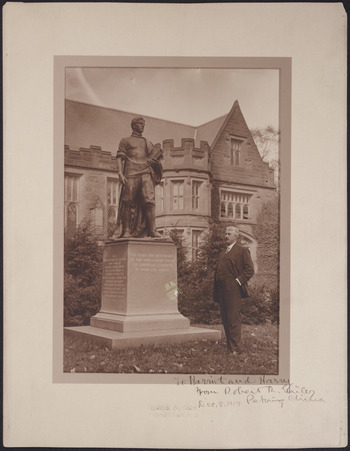
Former Princeton football star and missionary Robert Reed Gailey poses in 1914 next to the campus statue colloquially known as “The Christian Student,” dedicated the previous year. In reference to the intercollegiate YMCA, a portion of the statue base reads: “TO MARK THE BIRTH-PLACE OF THE WORLD-WIDE UNION OF CHRISTIAN STUDENTS IN WORK FOR CHRIST FOR A NOBLER STRONGER MANHOOD IN BODY SOUL AND MIND FOR THE BETTER SERVICE OF MANKIND AND THE COMING OF GOD'S KINGDOM.” The statue bears the likeness of an earlier football star who was president of the Philadelphian Society: W. Earl Dodge, Class of 1879. Princeton University Library. Department of Rare Books and Special Collections. Seeley G. Mudd Manuscript Library.

As Patton had hoped, focusing on religion's power to produce the qualities of an ideal man temporarily served to legitimate evangelical convictions among more cosmopolitan circles. For example, in the 1902 annual report of the Philadelphian Society, the organization sought to justify supporting a foreign missionary who focused more on evangelism than social service, while acknowledging that a difference of opinion on this point existed among students. The report claimed that the evangelical Robert Reed Gailey was “fit to be the representative of Princeton and to be supported by men so various in type and religious preference” because “he was one of her most prominent and noted football players of his day, being the center rush on the famous team of 1896.” Gailey's conformity to the ideals of success within this all-male community served to validate his (and the society leadership's) preferred approach to the religious life.Footnote 42
In the long run, however, justifying Princeton's evangelical religious approach by reference to its effects on male social roles facilitated a shift toward a more modernist religion that placed greater comparative emphasis on those roles. When the Philadelphian Society brought the prominent liberal theologian Albert Fitch to campus for a widely attended series of talks in 1915, he spoke on “the fundamental meaning of Christianity, dwelling upon its appeal and call to educated men.” Likewise, publicizing the presence of sports stars in the association simply served to legitimate the new religious orientation as it had the old. Thus, starting under Patton, the message students would take from their experience with the Philadelphian Society increasingly shaded away from those aspects of the faith that addressed all people equally and toward those aspects that fit their self-conception as elite men.Footnote 43
With growing emphasis among undergraduates on moral formation for specific social roles came an attempt to negotiate a space of postgraduate civic engagement in that vein. In 1912, Princeton students formed a Committee on Social Service under the aegis of the intercollegiate YMCA to stimulate Princeton graduates to continue the types of service in which they had participated as undergraduates. Similar associations formed at Yale, Columbia, Cornell, Williams, and Michigan. Yet the committee made no effort to channel Princeton graduates into full-time vocational social service, but rather to inspire graduates working in predominately business careers in New York City to volunteer some of their time outside the job to improving the city's conditions. This emphasis is significant in light of undergraduates’ service activities. Two of them—the boys club and the lessons for immigrants—operated under settlement house-style organizations run by educated single women. Clearly the expectation was that graduates for the most part would not elect full-time vocations within this space contested between the sexes. Rather, they would pursue careers earmarked for men, specifically men with an elite college education.
Even many of the avocational service activities recommended by the Committee on Social Service had a male focus. The committee's Social Service Bulletin urged graduates to volunteer at local boys clubs so as to socialize those boys into the graduate's line of work. It also primarily touted areas of civic engagement either exclusively for men or dominated by men: the honest ballot committee, legal aid, and medical relief. Accordingly, the types of service activities the Y encouraged after graduation were those that connected the gender-contested sphere of social work to the more gender-established sphere of professions dominated by men.Footnote 44
CONCLUSION
In the decades around 1900, colleges and universities that sought, like Princeton, to distinguish themselves from among their peers did so by laying claim to serving truly national interests. Princeton—in many ways a stereotypical nineteenth-century denominational college—successfully achieved national prominence as a newly minted university by downplaying aspects of its identity increasingly seen as parochial, namely, its affiliation with a specific denomination and the type of spirituality associated with its evangelical heritage. Instead, the institution reframed the moral aspects of its education in terms designed to appeal to the aspiring elite. Unlike new women's colleges and coeducational universities, Princeton would educate only men, eligible to be society's leaders. Thus, rather than pursuing spiritual formation that applied equally to all evangelicals, its ethical training would focus on forming in students the moral traits specifically associated with elite men and their unique social roles in the community, be they national political leaders or influential local businessmen. Every indication exists that students embraced this message.
Princeton's ambitions both contributed to and were aided by the shift in its approach to the religious aspects of its education. Emphasis on personal piety and doctrinal particulars—common in an evangelical religious system whose chief goal was to help the individual relate rightly to God—did not fly well in the cosmopolitan New York business environment. So Princeton's leaders downplayed these elements of spirituality and instead played up those that focused on ethical social interactions. Both evangelical and liberal religious systems endorsed the importance of this type of spirituality, but liberal “modernism” placed comparatively more emphasis on it. This shift under President Patton thus made for a more congenial environment for future modernists in the administration and in the Philadelphian Society. These new leaders among the administration and students would in turn only reinforce a moral training geared toward spelling out the appropriate social role for students. In the cultural environment of the Progressive Era, doing so meant seeking to create in students the attitudes and commitments associated specifically with elite men. And this was a type of religious life that very much enhanced Princeton's reputation in the halls of power.
Princeton's experience thus points toward a new emphasis on inculcating gendered traits among the premier men's colleges and universities at the turn of the century—and by extension at the many coeducational universities who modeled college life for male students after their peers at long-standing men's colleges. The entrance of women into higher education, the need to attract funding within a new type of higher educational market, and shifts in the dominant type of religiosity among American intellectuals all combined to create this change. The result was that the first generation of educated men to have equally educated sisters—the generation who earned their degree just as college graduates came to have a more significant influence on American politics, economics, and culture—nevertheless embraced the belief that it was not education per se that qualified someone for cultural leadership, but educated manhood.