Acute rheumatic fever, rheumatic cardiac disease, and neuropsychiatric movement disorders associated with group A beta haemolytic streptococcal infections remain major public health problems in South Africa.Reference Clur1, Reference Walker, Lawrenson and Wilmshurst2 Rheumatic fever occurs in susceptible individuals and is more prevalent in poor socio-economic conditions.Reference Carapetis, Steer, Mulholland and Weber3, 4 In resource equipped countries, representing 20% of the world's population, the incidence of rheumatic fever has fallen markedly.Reference Carapetis, McDonald and Wilson5 This decrease is a result of the introduction of antibiotics and is also a reflection of improved health and socio-economic standards.Reference Carapetis, McDonald and Wilson5 Many South Africans live in abject poverty and are thus exposed to rheumatogenic group A streptococci, but only some subsequently develop rheumatic fever.Reference Carapetis, McDonald and Wilson5, Reference Di Sciascio and Taranta6 The prevalence of rheumatic cardiac disease in sub-Saharan Africa is still among the highest in the world, 5–7 per 1000 compared to 0.5 per 1000 in developed countries.Reference Carapetis, McDonald and Wilson5 A significant number of children suffer from cardiac and neurological complications as a result of this enigmatic disease.Reference Walker, Lawrenson and Wilmshurst2, Reference Carapetis, McDonald and Wilson5, Reference Carapetis7 The ability to identify the subgroup of individuals at increased risk of rheumatic fever could help to direct primary prevention programmes and allow early intervention for affected children to minimise their morbidity.Reference Bryant, Robins-Browne, Carapetis and Curtis8
There are genetic components to the susceptibility to acute rheumatic fever.Reference Carapetis, McDonald and Wilson5, Reference Carapetis7–Reference Swedo, Leornard and Mittelman9 Various potential markers are described, including blood groups and human leucocyte antigen subtypes.Reference Bryant, Robins-Browne, Carapetis and Curtis8–Reference Weidebach, Goldberg and Chiarella10 The D8/17 marker is a B-cell surface allo-antigen.Reference Zabriskie, Lavenchy and Williams11, Reference Patarroyo, Winchester and Vejerano12 Zabriskie et al developed monoclonal antibodies to this surface allo-antigen, which have been used to identify rheumatic fever patients, rheumatic chorea, and obsessive compulsive disorder.Reference Zabriskie, Lavenchy and Williams11, Reference Chapman, Visvanathan, Carreno-Manjarrez and Zabriskie13 Monoclonal antibody D8/17 is a mouse monoclonal immunoglobulin M antibody originally prepared from fusion of murine spleen cells repeatedly immunised with isolated B-cells obtained from patients with rheumatic fever and or rheumatic cardiac disease.Reference Chapman, Visvanathan, Carreno-Manjarrez and Zabriskie13 The method for testing for the presence of the D8/17 marker consists of staining washed cells with monoclonal anti-D8/17 antibody and fluoresceinated anti-mouse immunoglobulin M and then counting by cytometry.Reference Chapman, Visvanathan, Carreno-Manjarrez and Zabriskie13 Flow cytometric assay allows for 10,000 cells to be counted. The results can be expressed as the percentage of patients who express positive cells as determined by a threshold cut-off or by the percentage of positive cells among the 10,000 cells counted.Reference Chapman, Visvanathan, Carreno-Manjarrez and Zabriskie13 The threshold cut-off varies in different centres between 10% and 22%.Reference Chapman, Visvanathan, Carreno-Manjarrez and Zabriskie13–Reference Harrington, Visvanathan, Skinner, Curtis, Currie and Carapetis16 With both methods, a clear difference is shown in the expression of this antigen between rheumatic cardiac disease and control patients.Reference Bryant, Robins-Browne, Carapetis and Curtis8 We used flow cytometry and counted the positive cells which were expressed as a percentage of the B-cells identified. In addition, we also stained separate samples of washed cells with an isotypic control antibody.
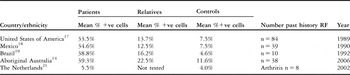
The D8/17 marker has been shown to be both highly specific, with 5–15% of healthy volunteers D8/17 positive and highly sensitive in individuals with rheumatic fever, and with 90–100% D8/17 positive regardless of their disease status.Reference Swedo, Leornard and Mittelman9 However, the findings are inconsistent. D8/17 was found to be a highly sensitive marker for rheumatic fever in the United States, Mexico, Russia, Chile, Israel, and AustraliaReference Bryant, Robins-Browne, Carapetis and Curtis8 (Table 1). In North India, it was less sensitive, with only 62–66% of a group of rheumatic fever and rheumatic cardiac disease patients expressing positive cells above a threshold cut-off compared to 100% in New York and New Mexico.Reference Kaur, Kumar and Grover14 The D8/17 non-human leucocyte B-cell antigen has not been studied in South Africa, where the prevalence of rheumatic fever, rheumatic cardiac disease, and post-streptococcal neuropsychiatric movement disorders is unacceptably high.Reference Walker, Lawrenson and Wilmshurst2, Reference Carapetis, McDonald and Wilson5, Reference Carapetis7
Results of D8/17 studies in people with past RF in different countries.Reference Bryant, Robins-Browne, Carapetis and Curtis8

RF = rheumatic fever
% +ve = percentage positive
We undertook to study the expression of the D8/17 marker in South Africans with a past history of rheumatic fever or rheumatic cardiac disease, their relatives, and controls with no history of rheumatic fever.
Methods
Individuals with a history of rheumatic fever (including Sydenham's chorea) or rheumatic cardiac disease, their first-degree relatives, and controls with no history of rheumatic fever were recruited. This selection of patients was based on the Harrington study in Australia.Reference Harrington, Visvanathan, Skinner, Curtis, Currie and Carapetis16
Index cases and first-degree relatives were enrolled from a dedicated rheumatic fever clinic. Controls were recruited from outpatient clinics at the time of venesection for other indications. Controls were not specifically age and gender matched but reflected the same population and age group attending the rheumatic fever clinic. Ethical and practical considerations directed this decision.
The diagnosis of previous rheumatic fever was confirmed from previous hospital records. In most cases, the Jones criteria were supplemented with an echocardiogram report, consistent with rheumatic cardiac disease or histology confirming rheumatic fever and/or rheumatic cardiac disease on excised valves.
Relatives accompanying children to the rheumatic fever clinic were interviewed; in addition, consent and family history pertaining to rheumatic fever were obtained.
In South Africa, there are a range of social and environmental determinants affecting child health. Poverty and inequality may affect access to basic sanitation, adequate housing, health care, and other essential services such as education. Such unhealthy living conditions can increase children's exposure to infection by streptococci. (Living Standards Measure www.saarf.co.za) Retrospective data concerning such levels of living, family history, and course of disease were collected. History of rheumatic fever in relatives was documented by the interviewer. Interpreters were used to obtain exact histories in those patients whose first language was not the same as that of the investigator.
Assays for D8/17 expression required testing of fresh whole blood within 1–2 hours of sample collection. Fresh blood (1–2 millilitres) was collected in a tube anti-coagulated with ethylene diamine tetra-acetic acid and was coded. Technologists from the research laboratory collected the coded specimens and these were processed between 30 and 120 minutes after sample collection. A flow cytometry assay for D8/17 as described by Harrington et alReference Harrington, Visvanathan, Skinner, Curtis, Currie and Carapetis16 was used. Either 20 microlitres of mouse anti-D8/17 monoclonal antibody (generously provided by Professor J Zabriskie, Rockefeller University, New York, United States of America) or 5 microlitres of isotypic control (Sigma) were added to 300 microlitres of whole blood. After 40 minutes’ incubation at 4 degrees Celsius, the samples were washed with phosphate-buffered saline. Fluorescein-5-isothiocyanate labelled anti-mouse immunoglobulin M antibody (Caltag, Burlingame, California, United States of America) and phycoerythrin-labelled anti-CD 19 (Becton Dickinson, San Jose, California, United States of America) were added. The CD 19 antibody identifies the B-cells. After 20 minutes’ incubation at room temperature, red cells were lysed with ammonium chloride lysis solution for 15 minutes. Cells were centrifuged and washed with phosphate-buffered saline before re-suspension in phosphate-buffered saline for analysis on a FacsCalibur flow cytometer (Becton Dickinson, South Africa). Lymphocytes were gated according to their forward and side scatter profile. To eliminate background fluorescence, values were set for the quadrants by defining the isotypic control samples (no D8/17 antibody) as 99% negative. Further analysis of CD19-positive cells was performed using FlowJo software (Tree Star, San Carlos, California, United States of America).
Statistical analysis
The mean and standard deviation of the percentage of B-cells positive for D8/17 were calculated for the samples from patients in each category: index cases (being those with a history of rheumatic fever), first-degree relatives, and controls. The differences between the means of each of the categories and the 95% confidence interval of these differences were calculated. Group comparisons were made with analysis of variance and post hoc Tukey tests.
Ethics and consent
Ethics approval was obtained from the Research Ethics Committee of the University of Cape Town. Informed consent was obtained and, where necessary, mother tongue used to educate and inform participants. Ethics approval reference number RECREF: 011/2006.
Results
A total of 107 people were enrolled; 40 were index cases, 20 were first-degree relatives of the index cases, and 47 were controls. Results of 23 of the 47 controls were analysed. The remaining 24 control results were lost when the laboratory computer was stolen from the high security laboratory.
The 40 index cases (16 males:24 females) consisted of 26 people of indigenous African ancestry and 14 of mixed ancestries. Mixed ancestry refers to people descended from an admixture of Caucasian, Khoisan, Malay, (Javanese Sumatran), and black African ancestries.
Social demographics identified that 26 out of 40 (65%) index cases lived in absolute poverty, 19 out of 40 (47.5%) required valve surgery, 22 out of 40 (55%) had their activities of daily living adversely affected, and 24 out of 40 (60%) gave a history of throat infections, thus highlighting the burden of disease in this community and the need for a means of detecting patients at risk for rheumatic fever.
Mean positives of blood samples, isotypic controls, and D8/17 monoclonal antibody tests are shown in Table 2. The mean percentage positive D8/17 of index cases was 0.5%, of relatives 0.47%, and of controls 0.27%. Analysis of variance comparing means of index to controls p = 0.030 (Table 3).
Percentage of D8/17-positive B-cells in three groups of participants.

% +ve = percentage positive
Differences of the mean % +ve D8/17 by category.

% +ve = percentage positive
Tukey test
Our method included adding isotypic control and D8/17 monoclonal antibody in two separate samples and only B-cells were stained. The uptake of the isotypic control compared to the D8/17 antibody is compared in Table 2. In all three groups, the uptake of the isotypic control was greater than that of the D8/17 monoclonal antibody, but percentage uptake was very low in both groups and it was not possible to find a cut-off that would classify individuals as either positive or negative.
Pure chorea cases had a percentage range of uptake of 0.04–0.85 compared to cases with other combinations of major and minor Jones’ criteria of 0.04–1.53. The range of uptake in those of African ancestry was 0.14–1.53% and in those of mixed ancestry the range was 0.04–0.97%. As all percentage uptakes were so small, statistical analysis between groups was not done.
Discussion
There was a significant difference in the uptake of the monoclonal antibody between index cases and controls (p = 0.03); however, all mean percentages of uptake were less than 1.5% (extreme outlier). Despite this difference following the trends of other studies, as the percentages of D8/17 positive B-cells in all three groups of participants were very low, these differences do not mean much!Reference Bryant, Robins-Browne, Carapetis and Curtis8 Furthermore, the uptake of the isotypic control was greater in all three groups (Table 2). The percentage range of uptake of the D8/17 antibody in a study from Australia was 11.6%–39.3%, 7.5%–33.5% in the United States, 7.5%–34.6% in Mexico, and 4.6%–38.8% in BrazilReference Harrington, Visvanathan, Skinner, Curtis, Currie and Carapetis16–Reference Herdy, Zabriskie, Chapman, Khanna and Swedo19 (Table 1).
The authors of the study of an Australian population recommended that 22.1% of cells positive for D8/17 was the most accurate break point to distinguish between affected patients and healthy controls.Reference Harrington, Visvanathan, Skinner, Curtis, Currie and Carapetis16
Kaur et alReference Kaur, Kumar and Grover14 in North India demonstrated that the discriminatory power of a monoclonal antibody against D8/17 was relatively low among patients with rheumatic fever/rheumatic cardiac disease. They considered as positive those samples having more than 10% stained cells and only 62–66% of their sample fell into this category compared to 93% of rheumatic cardiac disease patients who had more than 10% of stained cells in response to a locally produced antibody. They hypothesised that for the maximal ability to detect susceptibility, the monoclonal antibodies must be produced using lymphocytes from the homologous population.Reference Kaur, Kumar and Grover14 In the Netherlands, Jansen et alReference Jansen, Hoekstra, Buzet, Limburg and Griep20 found that only 29% of their patients with post- group A beta haemolytic streptococcal arthritis had an elevation of D8/17 positive lymphocytes greater than 8%. Morer et al studied 27 patients with neuropsychiatric disorders in a Spanish cohort. In the sample studied, the average percentage of B-cells expressing D8/17 was 4.8% and the D8/17 positive proportion of B-lymphocytes was above 11% in only 2 of the 27 cases. The great majority of their patients were negative for the D8/17 marker. They postulated that the molecular characterisation of D8/17 would be a major step forward in clarifying its implication in such conditions.Reference Morer, Vinas, Lazaro, Bosch, Toro and Castro21
None of our patients expressed more than 2% positive B-cells.
Inconsistencies in the results between D8/17 studies could be attributed to the variability and instability of the monoclonal antibody, technical difficulties with the laboratory procedure, or population differences in B-cell alloantigen expression.Reference Bryant, Robins-Browne, Carapetis and Curtis8
The authors are unaware of any commercial preparation of the antibody, which can only be sourced from one centre. The mouse anti-D8/17 monoclonal antibody used in this study had no batch number and no specifications regarding age and quality control. In the study of Aboriginal Australians, the antibody was again sourced from the same laboratory without data of batch concurrency. Variability and instability of the antibody could be a possible cause for the inconsistency of the results and for our low percentages. It was impracticable to repeat the tests with a different batch of antibody. In no studies were batch numbers of the antibody specified.Reference Bryant, Robins-Browne, Carapetis and Curtis8, Reference Harrington, Visvanathan, Skinner, Curtis, Currie and Carapetis16
The technique used for selecting B-cells was consistent with that used in other centres and was based on the Australian study.Reference Harrington, Visvanathan, Skinner, Curtis, Currie and Carapetis16 The method used in North India, the Netherlands, Australia, and in our study included using an isotypic control antibody, which may have affected the scatter profile and ultimately the total number of B-cells staining positive.Reference Kaur, Kumar and Grover14, Reference Harrington, Visvanathan, Skinner, Curtis, Currie and Carapetis16, Reference Jansen, Hoekstra, Buzet, Limburg and Griep20 In all three groups in the South African cohort, the isotypic control had higher percentage uptakes.
Ethnic differences in the expression of the B-cell antigens may serve as an explanation.Reference Chapman, Visvanathan, Carreno-Manjarrez and Zabriskie13, Reference Eisen, Leonard and Swedo15 In India, different monoclonal antibodies (PG-12A, PG-13A, and PG-20A) raised against B-cells from Indian patients with rheumatic cardiac disease were better than D8/17 at distinguishing those with acute rheumatic fever or rheumatic cardiac disease from controls.Reference Kaur, Kumar and Grover14, Reference Kumar, Kaur and Grover22
In summary, factors affecting our results may have included an old D8/17 antibody, including the use of an isotypic control in our method and the monoclonal antibody not being sensitive to a South African population.
In 34 of our index cases, there was evidence of unequivocal past diagnosis of rheumatic fever. If D8/17 is specific and sensitive in South African individuals, then this population should have demonstrated the same findings.
The clinical and social demographic data of the 40 index cases highlight the significant burden of disease from rheumatic fever in South Africa. It remains unknown why only a proportion of children infected with rheumatogenic group A streptococci develop an abnormal immune response that leads to rheumatic fever. This study aimed to study evidence of host susceptibility, which could be used to promote new treatments. Despite the expression of the D8/17 marker in people with a history of rheumatic fever compared to that in controls being statistically significant, the percentage of positive cells was very low and the results are therefore meaningless. A monoclonal antibody produced from our indigenous population may be better able to detect susceptibility.Reference Kaur, Kumar and Grover14
The D8/17 antibody would be impractical in South Africa as a tool to identify children at risk of rheumatic fever. There is no commercial source of antibody and no locally produced antibody. Blood samples need to be processed within 2 hours of sample collection and sophisticated laboratories are required for flow cytometry, which are unlikely to be found in rural areas of South Africa where rheumatic fever is common. For clinical applicability, a test to determine susceptibility must be readily available and cost effective.
Conclusion
The World Health Organization recognises an urgent need to develop new strategies to control rheumatic fever.23 This study highlights that the B-cell antigen D8/17 is not robust as a marker of susceptibility to acute rheumatic fever, and hence rheumatic cardiac disease, in South Africa. Its use to determine susceptibility at a primary health level is impracticable.
Acknowledgements
We thank Professor John Zabriskie for providing the D8/17 antibody, Professor David Beatty for support, and Dr Motasim Badri (MSc, MscMed, PhD) from the Department of Medicine, University of Cape Town for help with statistics. This study was funded by the research grant from the School of Child and Adolescent Health at the University of Cape Town.