Introduction
The calls came in without pause on the morning of September 11, 2001; more than 3,000 of them in the first ten minutes. Throughout the day, more than 55,000 calls would come in. Before the towers of the World Trade Center (WTC; New York City, New York USA) collapsed, emergency service call-takers and dispatchers from fire, Emergency Medical Services (EMS), and police in New York City would answer 130 calls from people inside the buildings.Reference Dwyer1 For many in the towers, the voices of the call-takers and the dispatchers would be the last thing they would hear.
Operating in office buildings far from the chaos, the call-takers and dispatchers didn’t have the visual aids that the rest of the world had. They couldn’t physically see what was happening at the WTC. All they had were the voices at the other end of the phone. Often-times scared, always pleading for help. Then there were the voices of the hundreds of firefighters, paramedics, emergency medical technicians (EMTs), and police officers that they dispatched into the mouth of hell.
Despite the considerable emotional trauma inflicted on these call-takers and dispatchers, there has been little recognition of what they suffered. In the beginning, they were largely forgotten. As civilian employees, they couldn’t access support through the Fire Department New York (FDNY) medical office. The union eventually convinced the FDNY to provide them access to the same trauma specialists designated for firefighters.
In the years following the September 11, 2001 terrorist attacks, call-takers and dispatchers experienced trouble sleeping, headaches, restlessness, and nightmares. Some turned to alcohol or substance abuse. Some experienced difficulty focusing on tasks. Some took it out on their families.Reference Baker2 Their collective experiences were a stark reminder that call-takers and dispatchers are routinely exposed to duty-related trauma, defined as an indirect exposure to someone else’s traumatic experience. Duty-related trauma can place call-takers and dispatchers at increased risk for developing mental health challenges like anxiety, depression, and posttraumatic stress disorder (PTSD). Along with the mental health challenges associated with being on the receiving end of difficult calls, call-takers and dispatchers also deal with the pressure and demand of following protocol, despite variability in situations.Reference Pierce and Lilly3
The unique working environment of call-takers and dispatchers can also place them at increased risk of physical health issues. Obesity levels are high, with research suggesting that approximately 83% of call-takers and dispatchers were obese or overweight, which was much higher than the comparison general population which had an obesity percentage around 30%.Reference Pierce and Lilly3 In addition to obesity, call-takers and dispatchers may suffer from work exposure-related headaches, backaches, insomnia, heartburn, and general malaise.Reference Lilly, London and Mercer4 Publications documenting the physical and mental health challenges associated with working as an emergency service call-taker or dispatcher provide important lessons regarding protective mechanisms for both physical and mental health and well-being. The objective of this review of the literature was to identify the existing evidence-base documenting these physical and mental health challenges.
Methodology
A systematic review of the literature was undertaken using the following databases: MEDLINE (US National Library of Medicine, National Institutes of Health; Bethesda, Maryland USA); PubMed (National Center for Biotechnology Information, National Institutes of Health; Bethesda, Maryland USA); CINAHL (EBSCO Information Services; Ipswich, Massachusetts USA); and PsychInfo (American Psychological Association; Washington DC, USA). All databases were searched until September 17, 2018 using a combination of the following search terms: emergency medical dispatcher [EMD]; EMD; dispatcher; call taker; call-taker; emergency communications; emergency operator; 911; 9-1-1; 000; and 999. Appropriate truncation symbols and Boolean combination functions were used in each database. Search results from each of the four databases were combined and duplicate results were removed.
Two independent reviewers reviewed all records initially retrieved by the search strategies, by title and abstract, to identify potentially relevant publications. Two independent reviewers then conducted a full-text review of all potentially relevant records in order to identify publications that met the inclusion criteria for the review. Inclusion criteria were any publication that reported on either the physical or mental health (symptoms or conditions) of EMDs. The reference lists of all relevant publications were reviewed in order to identify additional publications, and authors known to publish in the field were contacted to determine if any publications were “In Press” or had been missed by the search strategies.
A data extraction form developed for this research project was utilized by two independent reviewers. Data extracted included: journal of publication; year of publication; type of EMD (firefighter, police, paramedic/EMT, nurse/other); and the specific type of health challenge addressed.
Cohen’s Kappa Value was calculated for the inter-rater reliability between the two researchers in identifying relevant publications. The Kappa Value is generally thought to be a more robust measure than simple percent agreement calculation, since κ takes into account the possibility of the agreement occurring by chance.
Results
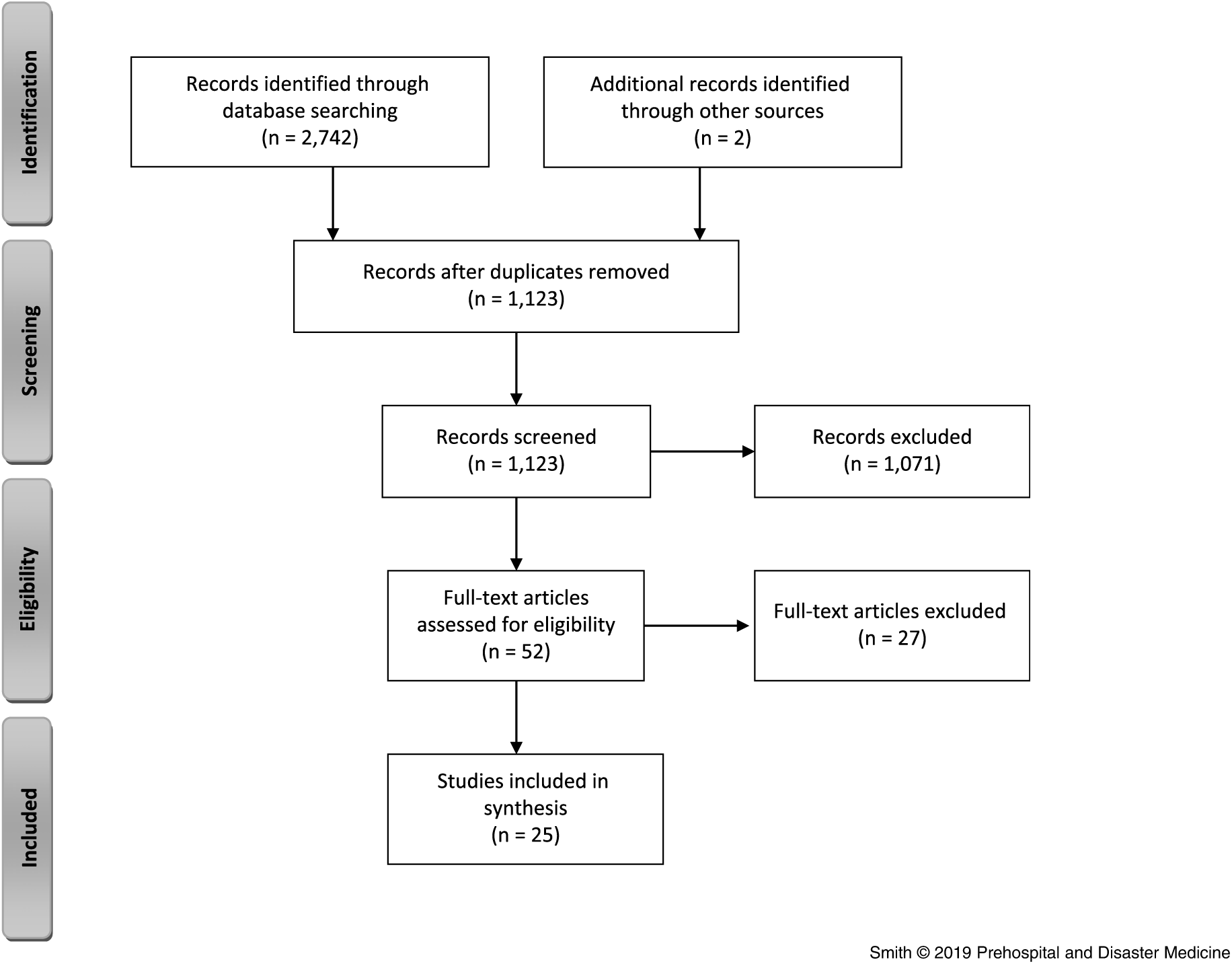
The combined search strategies yielded 2,742 individual records. After duplicates and obvious irrelevant publications were removed, there were 1,123. Initial title review of these records identified 52 potentially relevant records. Subsequent abstract review refined the number of potentially relevant records to 31. Full-text review of these records identified 23 publications that met the inclusion criteria for this study. Reviewing references lists and contacting authors known to publish in the field identified an additional two publications. These 25 publications informed the results of this literature review. These details are summarized in Figure 1.
PRISMA Flow Diagram of the Breakdown of Results of Search Strategies.

The publications predominantly reported a quantitative research methodology (52%), while nine (36%) reported the use of a qualitative research methodology. One study reported a mixed-methods methodology, one reported an evaluability assessment with semi-structured interviews, one reported on a case study, and one was a systematic review with a narrative synthesis.
Populations studied included call-takers and dispatchers across different emergency services; seven studied police,Reference Pierce and Lilly3,Reference Doerner5–Reference Ksionzky and Mehrabian10 one studied fire,Reference Palmer11 nine studied ambulance,Reference James and Wright12–Reference Gurevich, Halpern and Brazeau20 and two studied emergency nurse services.Reference Allan, Farquharson, Johnston, Jones, Choudhary and Johnston21,Reference Farquharson, Allan, Johnston, Johnston, Choudhary and Jones22 In one study, call-takers and dispatchers managed calls for both fire and ambulance,Reference Jenkins23 and in two studies, they managed calls for fire, police, and ambulance.Reference Forslund, Kihlgren and Kihlgren24,Reference Dagenais, Plouffe, Gagné, Toulouse, Breault and Dupont25 The type of call-taker or dispatcher was not disclosed in two of the studies,Reference Bedini, Braun, Weibel, Aussedat, Pereira and Dutheil26,Reference Lilly and Allen27 and one was a literature review.Reference Golding, Horsfield and Davies28
The kappa value for inter-rater reliability was 0.95, which indicated excellent agreement between reviewers in determining whether the records retrieved by the search strategy documented the physical and mental health challenges associated with emergency service call-taking or dispatching.
Discussion
The physical and mental health of first responders is a significant issue internationally.Reference Fong, Taylor and MacFarlane29 Safe-Work Australia (Canberra, Australian Capital Territory, Australia) indicates that the occupation of paramedicine has one of the highest rates of claims for mental disorders,30 and existing evidence suggests that emergency service personnel such as firefighters, police officers, and paramedics have a higher prevalence of mental health disorders associated with trauma and stress.Reference Bentley, Crawford, Wilkins, Fernandez and Studnek31–Reference Buzga, Zdenek and Buzgova35 Several studies suggest that paramedics are at a higher risk of being overweight, obese, and physically unfit compared to the general population,Reference Tsismenakis, Christophi, Burress, Kinney, Kim and Kales36,Reference Gamble, Stevens, McBrien, Black, Cran and Boreham37 and this challenge was identified as early as 1991.Reference Pierce and Lilly3,Reference Batt, Kent and Mason38 Paramedics are also more likely to smoke, have higher blood pressure, and higher cholesterol than the general population.Reference Tsismenakis, Christophi, Burress, Kinney, Kim and Kales36–Reference Batt, Kent and Mason38 The role of emergency service call-takers and dispatchers is positioned as more peripheral to that of the first responders, however, which is reflected in both the sparse research on this population and the narrow scope of this work.Reference Burke, Sullivan and Simonetti39
Narrow as it is, the existing literature identified by this review does highlight some significant health challenges for emergency service call-takers and dispatchers, both physical and mental.
Physical Health Challenges
The role of emergency service call-takers and dispatchers is critical to the outcome of patient’s health and well-being. Life and death hangs on the very actions taken at this first point of entry for all emergency responses. As such, call-takers and dispatchers are required to answer, analyze, and transmit complex information in making determinations about emergency status; location; level of patient acuity of illness, and appropriate level of response; and need for multi-agency emergency service personnel (for example, does the call require simultaneous response from police, fire, and EMS personnel?).Reference Burke, Sullivan and Simonetti39,Reference Burke, Sullivan and Simonetti40 As conduits between the distressed public and emergency service personnel, call-takers and dispatchers navigate a minefield of anguish, panic, and uncertainty with simultaneous demands for precise information. And all of this must be done nearly instantaneously, using manual or computer-aided dispatch.Reference Harrington41
In a study of 9-1-1 emergency services dispatchers in the United States in 2001, dispatchers described routinely suppressing fear, anger, sadness, and reported a sense of helplessness. The research identified three types of physical problems that resulted, at least in part, from these challenges: sleep disorders, chronic pain, and migraines.Reference Shuler and Sypher7 The sedentary nature of the occupation also provides fewer opportunities for physical activity and release of stress, which can potentially exacerbate these problems. Compounding the sedentary aspect is the shift-work element of emergency service call-taking and dispatching, which has been linked to increased health risks across a range of professions, including increased rates of cancer, obesity, cardiovascular disease, blood pressure, poorer sleep quality, burnout, depression, and anxiety.Reference Harrington41–Reference Proper, Van de Langenberg and Rodenburg45
In a study on biological correlates of stress in EMDs, cortisol measures in eight EMDs were compared to those of matched controls during leisure activities.Reference Weibel, Gabrion, Aussedat and Kreutz14 Cortisol is a hormone released by the body when it is under stress. The EMDs exhibited significantly increased cortisol levels throughout the day when measured every two hours over a ten-hour period, with an average elevation of almost 23% compared to controls. The subjective reports of distress by EMDs were strongly positively correlated with objective cortisol concentrations. High noise levels and poor lighting, in particular, were cited as the most problematic, and such evaluations were correlated with higher cortisol levels.
Obesity was reported to be incredibly high in one US-based study of 911 dispatchers, with 83% of telecommunicators in the study reported as being obese or overweight; 53% alone fell into the obese category.Reference Lilly, London and Mercer4 On average, there were 17 different health complaints with an occurrence at least once a month, all the way up to once a week. In addition to obesity, the most common complaints were headaches, backaches, insomnia, heartburn, and upset stomach. Cortisol dysregulation may be a major factor in some of these symptoms, as may the shift-work schedule, which can have a significant impact on physical health. Shift-work interferes with sleep, specifically impacting metabolism and the hormone ghrelin that is released when the body does not get enough sleep. Ghrelin prompts hunger signals. So stress, poor sleep patterns, dysregulated cortisol, and the sedentary nature of the job can all impact the health of the emergency service call-takers and dispatcher.
Mental Health Challenges
Studies dating back to the early 1980’s have documented the stress associated with the role of an emergency service call-taker or dispatcher. Focusing mostly on police dispatchers, the studies identified greater levels of stress among this group than the general population.Reference Doerner5,Reference Ksionzky and Mehrabian10,Reference McCammon, Durham, Allison and Williamson46 In 1997, a study examined stress among fire and police dispatchers, where operators were assessed for three days, two and one-half months following Hurricane Andrew (1992). The dispatchers reported rates of traumatic stress that were analogous to those of emergency personnel on the scene of a major air crash and relocated.Reference Jenkins23 However, like with 9/11, this occurred in the context of a major disaster as opposed to routine emergency dispatching, resulting in call-takers and dispatchers facing stress in both their occupational and personal lives; this made it difficult to disentangle the distress attributable to their roles as victims versus rescue workers.Reference Gurevich, Halpern and Brazeau20
Thematic analysis for potential triggers associated with mental health challenges for emergency service call-takers and dispatchers identified traumatic and abusive calls in several studies.Reference Pierce and Lilly3,Reference Tracy and Tracy6,Reference James and Wright12,Reference Shakespeare-Finch, Rees and Armstrong17 Despite not being physically exposed to the emergency situation, call-takers and dispatchers experienced the trauma vicariously, experiencing fear, helplessness, or horror in reaction to calls about children, suicide, or domestic violence.Reference Pierce and Lilly3 Calls relating to vehicle accidents, incidents involving children or vulnerable adults, domestic violence, and suicides were commonly cited as the most distressing types of call.Reference Pierce and Lilly3,Reference Tracy and Tracy6,Reference Shuler and Sypher7,Reference James and Wright12,Reference Gallagher and McGilloway16,Reference Forslund, Kihlgren and Kihlgren24 Police dispatchers reported concern about handling fluid situations, such as robberies-in-progress or suicidal callers, in case they did not make the correct decisions.Reference Tracy and Tracy6
Emergency service call-takers and dispatchers reported higher levels of traumatic distress compared to police officers, and this level of distress experienced during and immediately after a traumatic call positively correlated with PTSD symptoms and burnout.Reference Pierce and Lilly3 Veteran dispatchers had the highest rate of PTSD,Reference Lilly and Allen27 and exposure to traumatic calls resulted in difficulties sleeping, nightmares, flashbacks, and increases in alcohol consumption.Reference Gallagher and McGilloway16,Reference Adams, Shakespeare-Finch and Armstrong18
Managing traumatic and abusive calls was also associated with a higher desire to leave the occupation and greater levels of emotional exhaustion.Reference Sprigg, Armitage and Hollis15 Call-takers and dispatchers dealt with abuse from callers,Reference Tracy and Tracy6,Reference James and Wright12,Reference Sprigg, Armitage and Hollis15 as well as from fellow professionals.Reference Sprigg, Armitage and Hollis15,Reference Gallagher and McGilloway16 While managing these calls, emergency call-takers and dispatchers are required to exhibit emotional neutrality,Reference Shuler and Sypher7 which serves to convey “dispassionate authority”Reference Morris and Feldman47 and control under pressure. They have to suppress their emotional reactions when dealing with these callers.Reference Tracy and Tracy6 Emergency Medical Service call-takers and dispatchers who received abusive calls were higher in emotional exhaustion, de-personalization, and anxiety and had a higher intention to quit their job.Reference Sprigg, Armitage and Hollis15
A lack of high-quality training was identified by some emergency service call-takers and dispatchers as contributing to stress levels,Reference Doerner5,Reference Palmer11,Reference Gallagher and McGilloway16,Reference Adams, Shakespeare-Finch and Armstrong18,Reference Coxon, Cropley, Schofield, Start, Horsfield and Quinn19 and made prioritizing and managing emergency calls more challenging, which in itself appears to be stressful.Reference Forslund, Kihlgren and Kihlgren24 Call-takers and dispatchers made reference to a divide that exists between themselves and emergency services personnel in the field,Reference Adams, Shakespeare-Finch and Armstrong18,Reference Coxon, Cropley, Schofield, Start, Horsfield and Quinn19 and discussed the perceived invisible nature of their role.Reference Gallagher and McGilloway16 Bullying and a toxic working culture were reported in the literature, and study participants highlighted that inappropriate behavior by colleagues was not properly addressed by management, causing an additional strain and further mental health challenges for already stressed call-takers and dispatchers.Reference Gallagher and McGilloway16
Informal and formal peer-support programs were commonly regarded as necessary to reduce the emotional burden of the work of emergency service call-takers and dispatchers.Reference Tracy and Tracy6,Reference Shuler and Sypher7,Reference Palmer11,Reference Shakespeare-Finch, Rees and Armstrong17–Reference Coxon, Cropley, Schofield, Start, Horsfield and Quinn19 Engaging in storytelling, sharing anecdotes, and the use of black humor allowed call-takers and dispatchers to open-up, vent, and debrief, and were important tools for preventing mental health challenges.Reference Tracy and Tracy6,Reference Shuler and Sypher7,Reference Adams, Shakespeare-Finch and Armstrong18 Work-life balance was considered a vital protective mental health measure, as was support from family and friends,Reference Palmer11,Reference Shakespeare-Finch, Rees and Armstrong17,Reference Adams, Shakespeare-Finch and Armstrong18 with call-takers and dispatchers who reported less-social support experiencing greater psychological distress following exposure to a hurricane.Reference Jenkins23
Implications
Although emergency service call-takers and dispatchers may not experience emergencies first hand, they can experience vicarious trauma on a daily basis as a result of the job they do. Research exploring the effects of job-related trauma exposure in paramedics and emergency department personnel suggests that such exposure can have negative impacts on health and well-being and may contribute to burnout and compassion fatigue.Reference Fjeldheim, Nöthling and Pretorius48–Reference Van Mol, Kompanje, Benoit, Bakker and Nijkamp51 It seems reasonable to assume that emergency service call-takers and dispatchers are at-risk of similar outcomes.Reference Golding, Horsfield and Davies28 The findings from this literature review indicate that some call-takers and dispatchers do indeed experience both physical and mental health challenges and are therefore likely to be at-risk of emotional exhaustion and burnout, which may contribute to high absence rates seen amongst this group. Educational and peer-support programs may help to reduce compassion fatigue and burnout and assist in building resilience within emergency service call-takers and dispatchers.
Limitations
These findings should be understood in the context of some limitations. As with all systematic literature reviews, there is a possibility that some relevant literature was missed. The rigorous and comprehensive search strategies developed for each of the electronic databases utilized for this research should minimize this. Furthermore, the search was limited to articles published in English. Publication bias was not assessed, although it is unlikely that this bias influenced publication of research on emergency service call-takers and dispatchers. Finally, quality of individual research studies was not assessed beyond research design in this review, and for this reason, the themes identified in the literature do not take into account specific methodological strengths and weaknesses of the included studies. Quality assessment is ideal to include, and future research should focus on this.
Conclusion
Emergency service (ambulance, police, fire) call-takers and dispatchers are often exposed to duty-related trauma, placing them at increased risk for developing mental health challenges like stress, anxiety, depression, and PTSD. This systematic literature review identified a total of 25 publications. The majority of studies (n = 13; 52%) reported a quantitative methodology, while nine (36%) reported the use of a qualitative research methodology. Key challenges to physical health included lack of physical activity, poor nutrition, and obesity. Key challenges to mental health included being exposed to traumatic calls, and having inadequate debriefing after stressful calls. Future research should explore the long-term effects of these physical and mental health challenges.
Conflicts of interest
none