Introduction
Old-age income poverty has long been recognised as a social problem in Europe (Rowntree, Reference Rowntree1901; Walker, Reference Walker1981), but is persistent despite the principle of the European Pillar of Social Rights that everyone in old age shall have the right to resources that ensure living in dignity (European Commission, 2021a). After decades of a downward trend, old-age poverty rates have been edging up since 2008, and population ageing is bound to further increase the number of older people at risk of poverty (European Commission, 2021b). Studies on the consequences of poverty have identified several negative outcomes for wellbeing, including increased frailty and depression, and adverse effects on social relations and participation (Mood and Jonsson, Reference Mood and Jonsson2016; Stolz et al., Reference Stolz, Mayerl, Waxenegger and Freidl2017; Foster et al., Reference Foster, Tomlinson and Walker2019; Kourouklis et al., Reference Kourouklis, Verropoulou and Tsimbos2020). Considerably less is known about how poverty is reflected in economic wellbeing across European countries. Do the old and poor have the capacity to pay for both usual and unexpected expenses?
The economic wellbeing of older people is most commonly defined and measured through income poverty and material deprivation. Both are regularly monitored by the European Union (EU) (European Commission, 2012, 2015, 2018, 2021b), and they have also received extensive academic research (Gabriel et al., Reference Gabriel, Oris, Studer and Baeriswyl2015; Ebbinghaus, Reference Ebbinghaus2019, Reference Ebbinghaus2021; Ilmakunnas, Reference Ilmakunnas2022). Income poverty is typically measured as income that falls below a poverty threshold of 60 per cent of the national median income. This at-risk-of-poverty line is an indication of a relatively low level of population income, which in turn varies across European countries by living standards (Goedemé et al., Reference Goedemé, Penne, Hufkens, Karakitsios, Bernát, Franziskus, Simonovits, Álvarez, Kanavitsa, Cussó Parcerisas, Romaní, Mäkinen, Matsaganis, Arlotti, Kopasz, Szivós, Ritakallio, Kazepov, Van den Bosch and Storms2019). Material deprivation, then, is an indicator that identifies people as deprived if they are unable to afford a certain number of listed items. In this study, we expand upon this foundation and develop a framework that allows us to explore the multi-dimensional nature of poverty. Our approach highlights the need to analyse poverty in greater detail in order to capture its nature and prevailing differences across European countries.
We take an alternative practical approach to defining and measuring the dimensions of economic wellbeing in older age. An earlier qualitative study on living on low income in old age observed that economic hardship is experienced especially as an inability to make ends meet and as a fear of getting into debt because of large unexpected expenditures and lack of savings (Hill et al., Reference Hill, Sutton and Hirsch2011). In line with this study, we define the ability to pay for usual and unexpected expenses as central dimensions of economic wellbeing in old age. Our research questions ask how often do the poor have difficulties in paying for usual and unexpected expenses; do these dimensions of hardship overlap; and does the frequency of hardship experienced by the poor differ from the experiences of non-poor older people in different European countries? The analysis is based on the cross-sectional component of the European Union Statistics on Income and Living Conditions (EU-SILC) 2018 survey.
The article proceeds as follows. The second section introduces the main ways of measuring economic wellbeing in old age and reviews the previous research on living on a low income and factors related to economic wellbeing in older age. The third section presents the data, discusses the underlying concepts of the variables used and explains the analytical framework. The fourth section presents the results, the fifth discusses these results along with the limitations of the study and the final section concludes. Our research reveals cross-country differences in the multi-dimensionality of poverty. The results are reflected upon in the context of the existing body of literature on the economic wellbeing of older people. However, due to the multi-faceted nature of the observed phenomena, we do not aim to provide complete explanations related to roles of pension/social security systems, private savings or psychological processes. Our results contribute both to the research on poverty as well as to research on economic wellbeing in older age.
Dimensions of poverty and economic wellbeing in older people and previous research
Poverty and material deprivation as measures of economic wellbeing
Poverty is often understood as a lack of economic resources in comparison to other people living in the same country at a same time (Townsend, Reference Townsend1979; Mood and Jonsson, Reference Mood and Jonsson2016). A common way to define and measure poverty in older people is based on incomes. According to the EU definition, people are considered to live at risk of poverty if their income is less than 60 per cent of the national median; the corresponding threshold applied by the Organisation for Economic Co-operation and Development (OECD) is 50 per cent. This measure is relative in the sense that it is assessed against a certain standard and does not directly reflect consumption levels (Ringen, Reference Ringen1988; Atkinson et al., Reference Atkinson, Cantillon, Marlier and Nolan2002). However, it is not well-suited to analysing the economic wellbeing of older people, among other reasons because older people, despite lower incomes, are known to make ends meet more easily than younger people, a phenomenon known as the satisfaction paradox (George, Reference George, Cutler, Gregg and Lawton1992; Olson and Schober, Reference Olson and Schober1993; Hansen et al., Reference Hansen, Slagsvold and Moum2008; Palomäki, Reference Palomäki2018).
Another common way to measure the economic wellbeing of older people is to analyse directly the extent of material deprivation (Dominy and Kempson, Reference Dominy and Kempson2006). This indicator refers to items that most people consider desirable or necessary in order to attain a basic standard of living. According to the EU definition, people are considered to face severe material deprivation if they cannot afford at least four out of the following nine items: (a) to pay their rent/mortgage or utility bills, (b) to keep their home adequately warm, (c) to face unexpected expenses, (d) to eat meat, fish or a protein equivalent every second day, (e) to go on a one-week holiday, (f) a car, (g) a washing machine, (h) a television, or (i) a telephone (European Commission, 2021b).
Material deprivation comprises aspects of economic strain, referring to the first five items, and durables, referring to the remaining four items (Łuczak and Kalinowski, Reference Łuczak and Kalinowski2020). The most recent Eurostat figures indicate that deprivation is greatest in the ability to meet unexpected financial expenses, afford a one-week holiday, or eat meat or its substitutes every second day (Eurostat, 2020a). While the cutoff point of four out of nine items can be considered somewhat random, the indicator does not assign any particular weight or quality to individual items. Important aspects of hardship may remain unrecognised when several items are required in order to meet the definition of material deprivation. Whelan and Maître (Reference Whelan and Maître2013) argue that the items may also have unequal relevance for economic stress.
Previous research on living in poverty and the economic wellbeing of older people
Research on economic wellbeing in old age has shown that old-age poverty in European welfare states is determined both by individual lifecourses and the type of pension system providing old-age income (Ebbinghaus, Reference Ebbinghaus2021; Kuitto et al., Reference Kuitto, Kuivalainen and Möhring2021). Pensions constitute the largest part of income in old age in all the countries in our sample (OECD, 2021) and in most cases, old-age income is linked to earnings and/or contribution history over a working life. Inequalities over the lifecourse are reflected in economic wellbeing and the risk of poverty in old age (Kuitto et al., Reference Kuitto, Kuivalainen and Möhring2021), but conditioned by the type of welfare regime and the pension system. Generous income replacement by public pension schemes is related to lower old-age poverty risk (Kuitto et al., Reference Kuitto, Madia and Podesta2023), but characteristics of pension system in more general also determines old-age poverty. While Beveridgean systems with encompassing basic pensions, such as the Netherlands and the Nordic countries, and the generous Bismarckian social insurance systems, such as France and some Southern European countries, have effectively lowered old-age poverty, multi-pillar systems with a heavy reliance on private pension saving perform less effectively in combating poverty (Ebbinghaus, Reference Ebbinghaus2021). Given that old-age income is widely determined by the (non-)existence of economic hardship throughout life, the context of the different welfare regimes and how they cushion social risks and stratify social inequalities over the lifecourse also widely defines economic wellbeing in old age, leading to cross-country differences across European countries (Esping-Andersen, Reference Esping-Andersen1990; Kenworthy, Reference Kenworthy1999). Furthermore, the type of pension system and the extent of public provision of social security and services also affect people's need and capabilities for saving and wealth accumulation throughout the lifecourse (Möhring, Reference Möhring2018; Hofäcker and Kuitto, Reference Hofäcker and Kuitto2023). The institutional context is thus likely to shape the dimensions of economic hardship that older Europeans are facing.
The multi-dimensional nature of economic hardship is captured in studies aiming to understand the experiences of older people living in poverty. Most of this research is qualitative (Dominy and Kempson, Reference Dominy and Kempson2006; Hill et al., Reference Hill, Sutton and Hirsch2011; Kotecha et al., Reference Kotecha, Arthur and Coutinho2013; Brűnner, Reference Brűnner2019), but there are also some quantitative studies (Airio and Nurminen, Reference Airio and Nurminen2016; Foster et al., Reference Foster, Tomlinson and Walker2019). A British study based on in-depth interviews by Hill et al. (Reference Hill, Sutton and Hirsch2011) describes the daily economic realities of older people living in poverty by highlighting that meeting basic needs on a low income involves not only careful budgeting, but also doing without. People with low incomes are characterised by both aversion and vulnerability to debt. Smoothing payments to avoid large bills is a preferred budgeting method, which includes saving money for emergencies. According to the categorisation by Kotecha et al. (Reference Kotecha, Arthur and Coutinho2013), the financial deprivation of poor pensioners consists of inability to meet financial commitments (e.g. to pay regular bills) and unexpected expenses. The latter refer to replacing household electrical appliances or clothes, or household and car maintenance, for instance (Dominy and Kempson, Reference Dominy and Kempson2006).
Previous studies have found that poor older people often express relatively high levels of financial satisfaction, even when faced with economic difficulties (Hansen et al., Reference Hansen, Slagsvold and Moum2008; Airio and Nurminen, Reference Airio and Nurminen2016; Brűnner, Reference Brűnner2019). There are various explanations for this outcome, but formal financial support, especially from the government but also from non-governmental organisations, is known to play a central role (Kotecha et al., Reference Kotecha, Arthur and Coutinho2013; Brűnner, Reference Brűnner2019). First, it might make a difference where the money comes from, as a higher perception of income adequacy has been found to be associated with a higher share of income received from pensions, while the opposite has been reported for other social benefits (Palomäki et al., Reference Palomäki, Kuitto, Kuivalainen and Riekhoff2023). The importance of the level of minimum pension is highlighted in a study by Airio and Nurminen (Reference Airio and Nurminen2016) that linked a rise in state guarantee pensions in Finland with increases in perceived income adequacy. It has also been shown that besides pensions, other government means that can raise the living standards of low-income people include financial support in housing, health care, utility bills and transport costs (Kotecha et al., Reference Kotecha, Arthur and Coutinho2013; Brűnner, Reference Brűnner2019). These results suggest that if minimum pension levels are high enough, the poor might not inevitably experience hardship.
Another explanation points at earlier lifestages. Satisfaction can be linked to low expectations if the poor have become accustomed to hardship. Retirement and receiving a pension can even be perceived as favourable compared with the past (Scharf et al., Reference Scharf, Bartlam, Hislop, Bernard, Dunning and Sim2006). A study on Danish state pensioners by Brűnner (Reference Brűnner2019) refers to a practical sense of making ends meet as one explanation for the satisfaction paradox. For the long-term poor, everyday life in financial scarcity is familiar from the past. From this perspective, poverty in old age can also be seen as an outcome of an inability to set aside money during the earlier lifecourse (Scharf et al., Reference Scharf, Bartlam, Hislop, Bernard, Dunning and Sim2006). On the other hand, living with low income does not necessarily mean that people have not accrued savings. For example, a study of Finnish pensioners revealed that a third with relatively low income had used savings to cover necessary expenses (Palomäki et al., Reference Palomäki, Ahonen, Ilmakunnas, Kuivalainen and Polvinen2021). A recent study on older Europeans shows that having savings reduces difficulties in paying for usual expenses (Ilmakunnas et al., Reference Ilmakunnas, Uotinen and Vaalavuo2023).
Social networks may also help some poor people cope with economic hardship by providing a source of pocket money, inherited electronic devices and practical help (Dominy and Kempson, Reference Dominy and Kempson2006; Scharf et al., Reference Scharf, Bartlam, Hislop, Bernard, Dunning and Sim2006; Brűnner, Reference Brűnner2019). Informal help often comes in the form of presents or useful handouts rather than direct financial aid (Dominy and Kempson, Reference Dominy and Kempson2006). As regards the dimensions of economic hardship considered in our study, informal help and adapting consumption to match a lower income may help to mitigate hardship more easily in usual than in unexpected expenses. On the other hand, they may also make it easier for the poor to put some money aside for emergencies.
While qualitative analyses can help us understand the economic realities of poor older people, they typically focus on the situation in a single country. Recent quantitative survey-based analyses have shed some light on the relationship between incomes and perceptions of adequacy (Litwin and Sapir, Reference Litwin and Sapir2009; Palomäki, Reference Palomäki2017, Reference Palomäki2018, Reference Palomäki2019; Žiković, Reference Žiković2020; Isengard and König, Reference Isengard and König2021), but they have done so based on only one or a few questions and among all pensioners. Palomäki (Reference Palomäki2018) found that difficulties in making ends meet are common in Central Eastern Europe and in Greece, but less frequent in Continental Europe and especially in Northern Europe. Isengard and König (Reference Isengard and König2021) show that European countries vary in how often older people with relatively low incomes experience a shortage of money that prevents them from doing the things they want to do. In their study, the majority of respondents perceived low incomes as inadequate, which was interpreted in terms of deprivation. A minority experienced low incomes as adequate, which was interpreted in terms of the satisfaction paradox. The former outcome was relatively common in Southern and Eastern European countries and the latter in Northern and Western European countries.
While there is a growing literature on the factors related to the ability to pay for usual expenses, considerably less is known about older people's difficulties in paying for large unexpected expenses which would require greater amounts of savings. Statistics show that over a third of people aged 65+ living alone and around a quarter of those living with another adult are unable to face unexpected expenses, although again there are country differences (Eurostat, 2020b). In 2019, only 5 per cent of older Europeans suffered severe material deprivation (European Commission, 2021b). Most likely, these difficulties are far more pronounced among the poor. In order to highlight the multi-dimensionality of economic wellbeing, we need to incorporate all its dimensions in our analysis, especially for older people with low incomes.
Data and analytical framework
This study aims to broaden the analysis of the economic wellbeing of poor older Europeans by providing a quantitative and comparative description that answers the following research questions:
(1) How often do the poor experience hardship on two central dimensions of economic hardship, namely the ability to pay for usual and unexpected expenses?
(2) How do experiences of hardship on these dimensions overlap?
(3) Does the frequency of hardship experienced by the poor differ from the non-poor in different European countries?
Our analyses are based on the cross-sectional component of the EU-SILC 2018 survey, which is the EU reference source for comparative statistics on income distribution and social exclusion at the European level (Eurostat, 2019). The data cover 29 European countries. The sample is restricted to households where respondents are 65 years or older, with a total sample size of 148,432. The decision to apply the age limit of 65+ rather than the country-specific retirement ages follows the approach taken, for example, by the European Commission in their Pension Adequacy Reports. By examining the same demographic group across EU countries, we are able to provide a more comparable overview of old-age income poverty. Moreover, by excluding people under the age of 65 from our sample, we focus on the income poverty of those older people who in essence are dependent on pensions and other public forms of old-age income support. Additional analysis that considered the respondents' self-reported economic status further reveals that only a small percentage of our sample are either employed or self-employed.
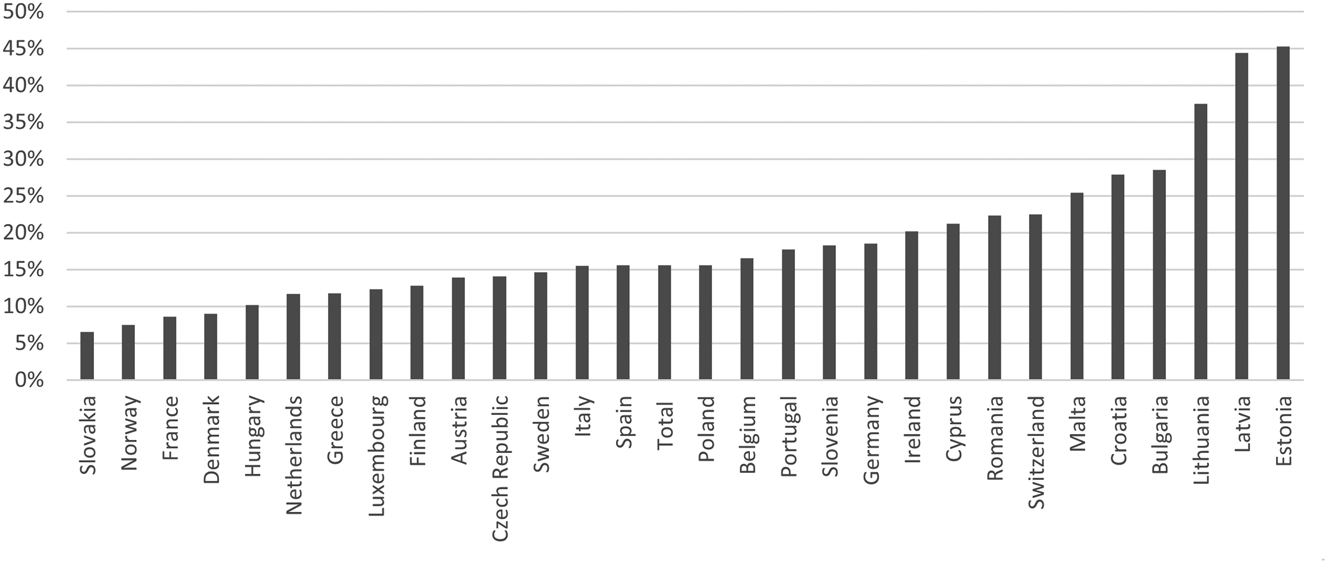
The analysis makes a key distinction according to the respondents' poverty status, which indicates whether a household's income is below or above the EU's official poverty threshold. Households with equivalised disposable incomes of less than 60 per cent of the national median income are defined as poor and households over the 60 per cent median threshold are defined as non-poor. The threshold, which is calculated by Eurostat, accounts for household size and is defined individually for each country. The share of older people living at risk of poverty varies across countries and ranges from around 7 per cent in Slovakia to 45 per cent in Estonia (Figure 1).
Percentage of older people (aged 65+) at risk of poverty in European countries in 2018.

Measures
Main variables
We are interested in assessing the ability of older people to pay for usual and unexpected expenses and the combination of both these dimensions of economic hardship. The question concerning the ability to pay for usual expenses is phrased as follows: ‘A household may have different sources of income and more than one household member may contribute to it. Thinking of your household's total income, is your household able to make ends meet, namely to pay for its usual expenses?’ The six preset response categories are: (a) with great difficulty, (b) with difficulty, (c) with some difficulty, (d) fairly easily, (e) easily, and (f) very easily. We interpret the first two responses as expressions of hardship. Among respondents defined as poor, 30.9 per cent reported some difficulties, but this category is excluded from our definition of hardship because we are interested in its more severe forms. The content of ‘usual expenses’ was not defined in the questionnaire, leaving it for the respondents to interpret. The United Kingdom is excluded from the sample because of substantial missing information on usual expenses. The share of missing values in the remaining countries was very low, ranging from 0 to 2.7 per cent (in the Netherlands).
The ability to pay for unexpected expenses is asked with the following question: ‘Can your household afford an unexpected required expense (amount to be filled) and pay through its own resources?’ Responses are either (a) yes or (b) no. Households responding ‘no’ are considered to experience hardship on this dimension. ‘Own resources’ means that one does not ask for financial help from anybody, that the bank account is debited within the required period and that one's debt situation does not deteriorate. Examples given of unexpected expenses included surgery, a funeral, major repairs in the house, and the replacement of durables such as a washing machine or a car. For the calculation of the amount expressed in the questionnaire, the national at-risk-of-poverty threshold is used per single consumption unit, which means it is used independently of the size and structure of the household. A ratio of 1/12 of the above value is used in the questionnaire. For example, this value was around €1,000 in France and around €400 in Estonia in 2018 (GESIS Leibniz Institute for the Social Sciences, 2023). The share of missing values on unusual expenses ranged from 0 to 2.9 per cent (in the Netherlands).
These two hardship variables measure different dimensions of economic wellbeing. The ability to pay for usual expenses measures the balance between incomes and needs that vary across households. The content of the ability to pay for large unexpected expenses is somewhat more ambiguous. In EU-SILC, Demertzis et al. (Reference Demertzis, Domínguez-Jiménez and Lusardi2020) link this question to the concept of financial fragility, which they use to analyse households' capacity to face unexpected shocks, if necessary by relying on social networks or borrowing money, and eventually their financial resilience. Mood and Jonsson (Reference Mood and Jonsson2016) apply the concept of cash margin in an item included in the Swedish Level-of-Living Survey concerning the ability of households to raise a given sum of money in a week (€1,600 in 2013) and further, whether they can do this by drawing on their own resources or by borrowing. The ability to pay for large unexpected expenses (out of one's own means) might be seen as equivalent to having a cash margin, but given the low incomes of poor older people, it is in fact a measure of whether one has been able to put money aside to save.
Based on the above questions, we build a measure that includes information on the overlap of different hardship dimensions and call this variable combined hardship. Households are categorised as experiencing hardship (a) only in usual expenses, (b) only in unexpected expenses, or (c) on both dimensions combined. Combined hardship indicates a situation where households' incomes are inadequate to pay for usual expenses and there is a lack of cash margin to pay for large unexpected expenses.
Control variables
We also take into account correlates of economic wellbeing at older age. While there is no previous empirical evidence on possible differences in correlates for difficulties in paying for usual and unexpected expenses, we assume that these two dimensions of hardship and their combination are associated with similar household characteristics. Previous research has shown that women, those living alone, people renting their houses, those with lower education and those in poorer health more often have difficulties in making ends meet than men, those living as couples, owner-occupiers, the higher educated and those in better health (Litwin and Sapir, Reference Litwin and Sapir2009; Palomäki, Reference Palomäki2017; Polvinen et al., Reference Polvinen, Laaksonen, Rantala, Palomäki and Kuivalainen2019). The older the person, the less they have difficulty making ends meet (Litwin and Sapir, Reference Litwin and Sapir2009; Palomäki, Reference Palomäki2018; Žiković, Reference Žiković2020). Statistics further show that migrants more often suffer from difficulties in making ends meet than national citizens (Federal Statistical Office, 2022).
In our sample of older Europeans, two-adult households consist mainly of couples (90%). Around 30 per cent of other households include dependent children while 70 per cent do not. Perceived health measures respondents' perception of their overall health. The category ‘good’ includes those with very good and good health, and the category ‘bad’ includes those with very bad and bad health. Information on perceived health is missing from relatively many cases. In EU-SILC, for many of the countries that draw information on incomes from registers and apply the selected-respondent method, information on health is not provided for all household members. We address this limitation in robustness checks.
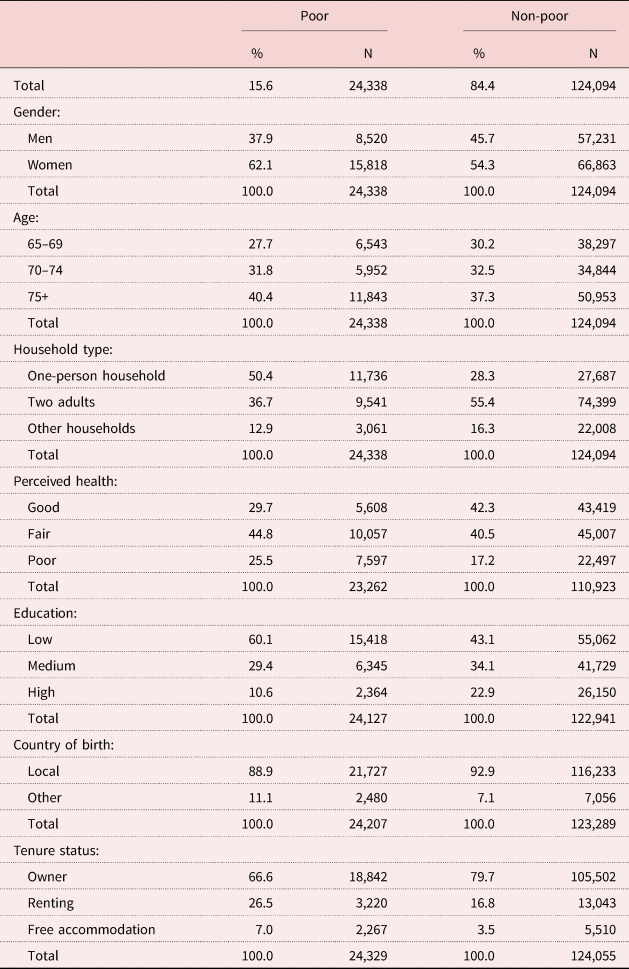
Those with lower secondary education at most are classified as having low education and those having at least post-secondary non-tertiary education are categorised as highly educated. The degrees in between are categorised as medium-level education. In order to account for the migration background, we control for the country of birth. Those born in the current country of residence (‘local’) are compared with those born either in other EU or some other country (‘other’). Information on education and country of birth is missing from some cases as well. This concerns mostly Poland, where the share of missing values in these variables were around 8 per cent. The household characteristics of the sample by poverty status are presented in Table 1.
Poverty status and other household characteristics of the sample

Notes: Cross-sectional weights have been applied. In Germany, age is bottom-coded at 74.
Analytical strategy
Our analysis consists of two parts. In the descriptive part, we first present the frequencies of hardship for each dimension among the poor and then the frequencies for the combined hardship dimension, including a comparison with the non-poor across countries. This comparison with the non-poor is essential in order to understand to what extent the experience of different hardship dimensions is specific to the poor. The percentage shares are presented from least to most frequent, which makes it easier to compare the different countries. Cross-sectional weights are applied in the descriptive analysis.
The multivariate part of the analysis examines the association between poverty status and combined hardship by controlling for household characteristics that are related to economic hardship in older age. The analysis applies multinomial logit regression modelling, which is suitable for categorical dependent variables with outcomes that have no natural ordering and which fits our understanding of economic hardship as composed of different yet to some extent overlapping dimensions. The results are presented in relative risk ratios (RRR) that indicate how the risk of belonging to the comparison groups (only in usual expenses, only in unexpected expenses, combined) changes compared with the reference group (no hardship). RRRs above 1 indicate a higher risk of the outcome falling in the comparison group relative to the risk of the outcome falling in the reference group, and vice versa. The first part of the multivariate analysis presents the associations between poverty status and the various dimensions of combined hardship among the whole sample while controlling for sample characteristics and differences across countries. The second part presents the RRRs related to poverty status individually for each country. When interpreting the results, we have to bear in mind that the analysis is based on the strong assumption that the unobserved heterogeneity is similar across compared countries (Mood, Reference Mood2010).
Results
Descriptive results
Frequency of hardship by dimension among the poor
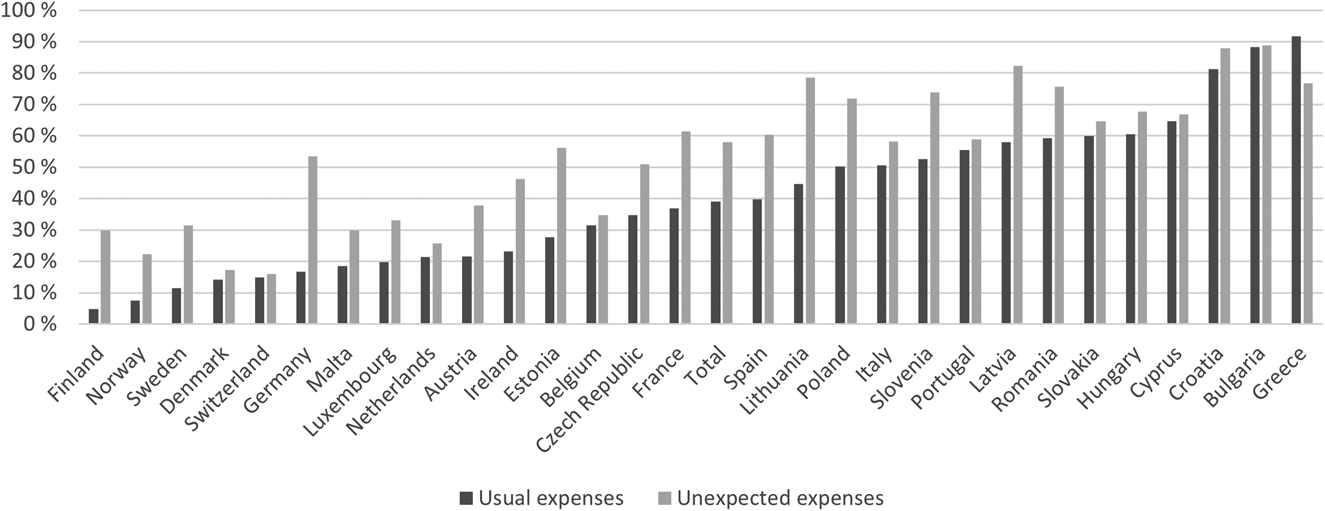
We begin by looking at how often poor older Europeans experience hardship in paying for usual and unexpected expenses in different countries. Figure 2 reveals that the frequency of hardship in paying for unexpected expenses is higher than for usual expenses. In total, 39 per cent face difficulty or great difficulty paying for usual expenses, while 58 per cent are unable to pay for large unexpected expenses.
Frequency of hardship in meeting usual and unexpected expenses among poor older people (aged 65+) in European countries.

Hardship in meeting usual expenses is relatively infrequent in all Nordic and Continental European countries and in individual countries from other regions, such as Malta and Estonia. It is more common in Central Eastern European countries and Greece and in a few other Southern European countries.
The country ranking for hardship in meeting unexpected expenses is somewhat different than for usual expenses. Overall, while hardship levels are lower in the Nordic and Continental European countries, the poor in these countries are often unable to pay for large unexpected expenses. Finland, in particular, stands out as a country where poor pensioners can easily make ends meet but struggle with unexpected expenses. The situation is similar in Germany. In the Baltic countries of Estonia and Lithuania, hardship in meeting unexpected expenses is also relatively more common than hardship in meeting usual expenses. Countries where levels of hardship are almost the same on both dimensions include both countries where hardship in general is frequent (Bulgaria, Croatia) and less frequent (Belgium, Switzerland).
Combined hardship and comparison with the non-poor
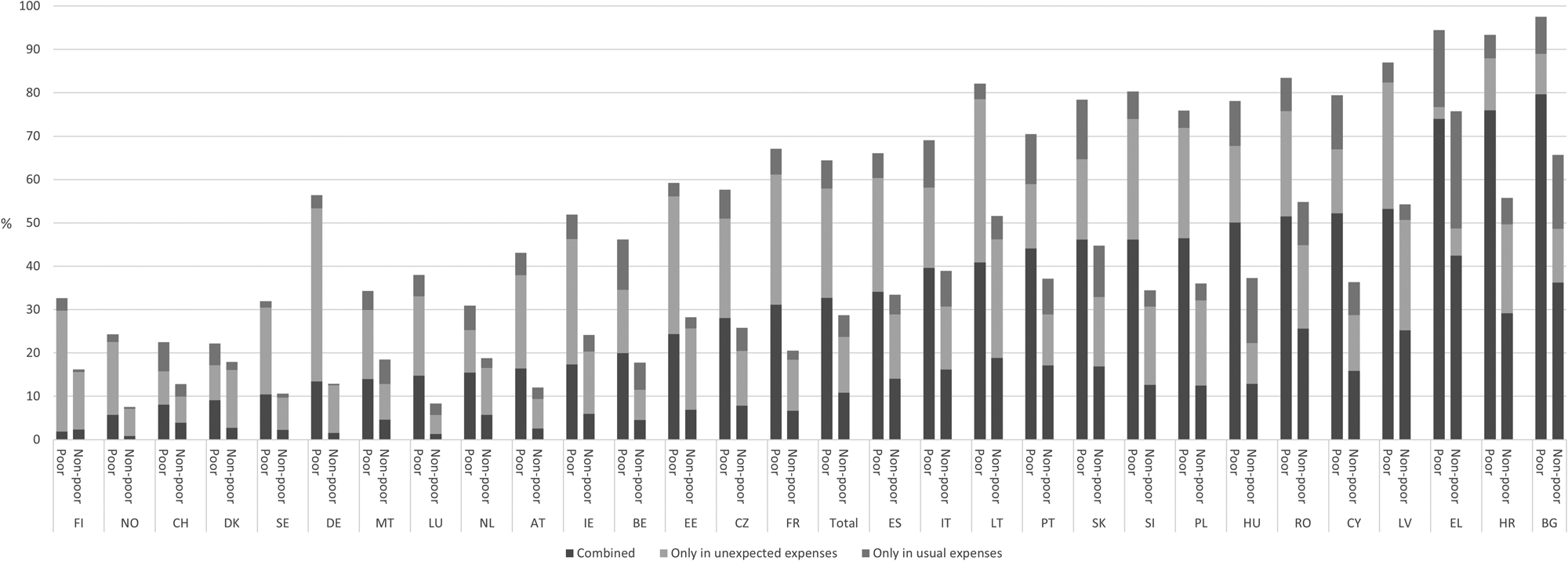
We move on to examine the overlap of hardship dimensions and to compare the results for the poor with the situation of the non-poor (Figure 3). On average, 36 per cent of poor people do not experience hardship on the measured dimensions. This means that relatively low incomes are not necessarily synonymous with economic hardship. Hardship is typically experienced in both (33%) or only in unexpected expenses (25%). Very few, 7 per cent, report having difficulty only in paying for usual expenses. Overall, the picture of combined hardship in different countries is similar to that shown in Figure 1.
Overlap of hardship dimensions among poor and non-poor older people (aged 65+) in European countries.
Notes: FI: Finland. NO: Norway. CH: Switzerland. DK: Denmark. SE: Sweden. DE: Germany. MT: Malta. LU: Luxemburg. NL: The Netherlands. AT: Austria. IE: Ireland. BE: Belgium. EE: Estonia. CZ: Czech Republic. FR: France. ES: Spain. IT: Italy. LT: Lithuania. PT: Portugal. SK: Slovakia. SI: Slovenia. PL: Poland. HU: Hungary. RO: Romania. CY: Cyprus. LV: Latvia. EL: Greece. HR: Croatia: BG: Bulgaria.

In Central Eastern and Southern European countries, around 60 per cent or more experience hardship on the measured dimensions. In Bulgaria, Croatia and Greece, hardship is typically combined. In these countries, over 70 per cent experience combined hardship and 90 per cent hardship on at least one dimension. Combined hardship is less common, again, in the Nordic and Continental European countries. Poor older people living in the Nordic countries and Germany experience hardship often only in meeting unexpected expenses.
The non-poor also experience hardship, but clearly to a lesser extent. In this group, experiences of hardship are nearly equally frequent in both usual and unexpected expenses (11%) and only in unexpected expenses (13%), while 5 per cent report difficulty only in meeting usual expenses. In some Central Eastern European countries, over half of the non-poor experience hardship, whereas the lowest hardship rates, around 10–20 per cent, are found in the Nordic and Continental European countries. More detailed comparisons between the poor and non-poor are presented in the multivariate analysis.
Multivariate results
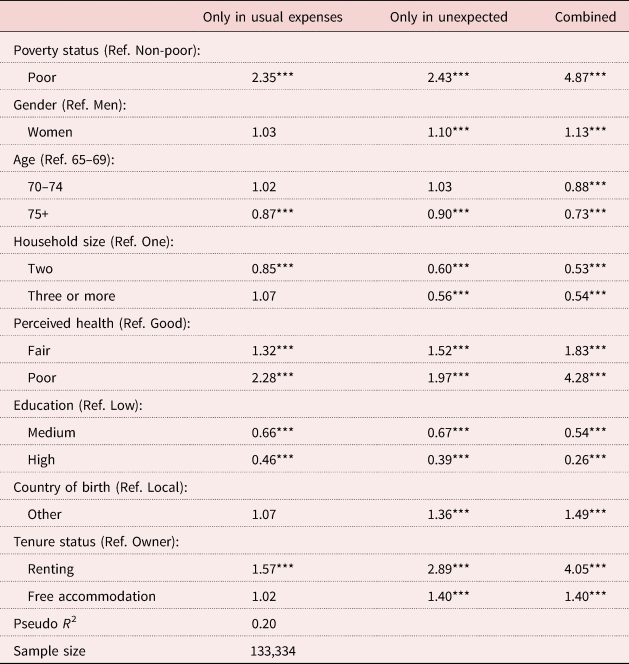
Next, we explore the association between poverty status and combined hardship while controlling for the differences in household characteristics, in addition to dummies controlling for differences across countries. Table 2 shows that the poor are at higher risk of experiencing hardship in meeting usual or unexpected expenses and both expenses than the non-poor. The risks of hardship in meeting only unexpected or usual expenses are about equal, 2.35 for usual expenses and 2.43 for unexpected expenses, whereas the risk of combined hardship is 4.87.
Multinomial logit regression with country dummies describing the relationship between poverty status, other household characteristics and combined hardship

Notes: Relative risk ratios are reported. The reference category is ‘no hardship’. Ref.: reference category.
Significance levels: * p < 0.05, ** p < 0.01, *** p < 0.001.
There are also clear differences by household size, respondent's perceived health, education and tenure status. Those living alone face hardship more often than those who live with others. The only exception is older people living with three or more household members, whose risk of experiencing hardship in meeting only usual expenses is equal to those living alone. The ability of those in poorer health, with lower education and renting their homes to pay for different kinds of expenses is lower compared with those in better health, the higher educated and homeowners. The relative risk of combined hardship is notably high in older people with poor health, low education and those renting their homes. Altogether, low income, poor health, lower education and rental tenure status emerge as factors increasing the relative risk of combined hardship. The differences by gender, age and country of birth are somewhat smaller. Women are slightly more likely than men to experience hardship in only unexpected and in the combination of expense types. Similarly, the risk is higher for those born in other countries than for nationals. The risk of combined hardship decreases with age, and it is lower for the oldest in all aspects.
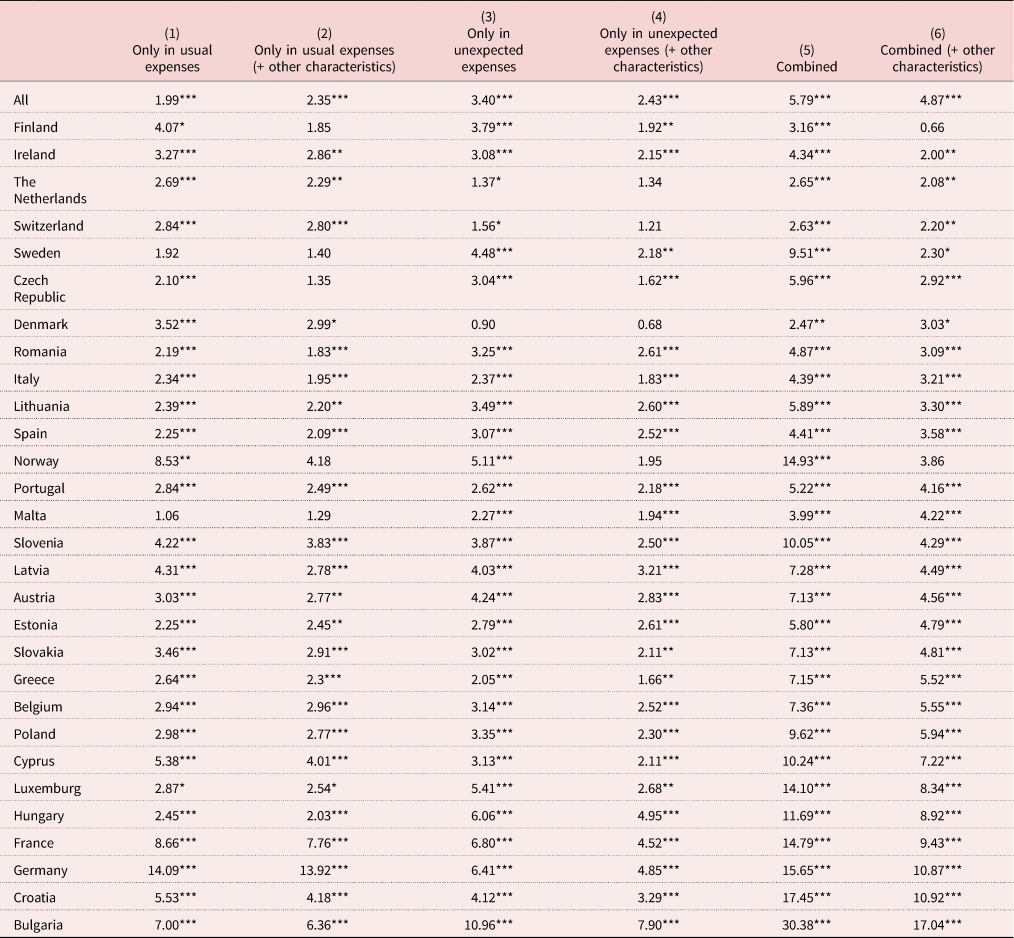
Table 3 shows the RRRs for the poor by introducing, first, poverty status into the analysis (columns 1, 3 and 5) and, second, by adding the household characteristics (columns 2, 4 and 6) for individual dimensions and their combination by country. Altogether, the results show that there is considerable country variation in the economic situation of the poor. In most countries, the poor experience hardship more often than the non-poor on individual dimensions and their combination, even though in some countries the experience of hardship is more pronounced on one of the dimensions.
Multinomial logit regression analysis describing the associations between poverty status (poor versus non-poor) and combined hardship by country among older people (aged 65+) in Europe

Notes: Relative risk ratios are reported. The reference category is ‘no hardship’. Results are sorted by column 6.
Significance levels: * p < 0.05, ** p < 0.01, *** p < 0.001.
Regarding usual expenses (columns 1 and 2), we observe that the association between poverty status and hardship becomes rather clearer, as the RRR increases from 1.99 to 2.35. The risk is high in Germany, France, Bulgaria, Croatia and Cyprus, for example, reflecting the diversity of countries in which the poor face hardship relatively often. These countries are located in Central Eastern, Southern and Continental Europe, and include both countries with lower and higher living standards. On the other hand, in most Nordic countries (Finland, Sweden and Norway) and the Czech Republic and Malta, the poor do not have difficulty meeting usual expenses more often than the non-poor, especially when the differences in household characteristics are taken into account.
When looking at unexpected expenses (columns 3 and 4), the RRR decreases from 3.40 to 2.43, which indicates that the difference in hardship by poverty status becomes less pronounced when household characteristics are taken into account. The poor are at higher risk of experiencing hardship in meeting unexpected expenses in the same countries where they relatively often have difficulty paying for usual expenses (Bulgaria, France and Germany). Higher than average risks are found in Hungary, Latvia and in Croatia as well. The Netherlands, Switzerland, Denmark and Norway are countries in which the poor do not experience hardship in unexpected expenses more often than the non-poor, especially when the differences in household characteristics are taken into account. Norway, in particular, stands out as a country in which differences in household characteristics between the poor and the non-poor explain higher risks of the poor experiencing hardship in different dimensions.
A very high relative risk of combined hardship (columns 5 and 6) reflects the economic situation of the poor in different European countries. Combined hardship ratios are especially high in the same countries where hardship on individual dimensions is high. The relatively unfavourable economic position of the poor in Continental European countries becomes apparent, with very high ratios in most of them (Germany, France, Luxembourg, Belgium and Austria). Switzerland makes an interesting exception. Finland and Norway are the only countries where the poor do not face combined hardship more often than the non-poor when household characteristics are taken into account. Household characteristics also explain a large part of combined hardship in Sweden and Slovenia. Detailed analysis (not reported here) revealed that in Sweden, for example, combined hardship is strongly associated with the poor more often living alone and having poorer health than the non-poor.
Throughout the analysis (columns 1–6), the RRRs mainly decrease slightly when household characteristics are introduced into the models for specific dimensions. This indicates that hardship is mainly associated with lower income levels – not with other household characteristics. However, when looking at the risk of combined hardship, where the differences between the poor and the non-poor are greater, household characteristics play a somewhat greater role.
As a robustness check to address the higher number of missing values especially in perceived health, we estimated all the models in Table 2 and in Table 3 only for the household respondents, for which the household characteristics were more comprehensively available. That did not change the overall results. However, it can be mentioned that in these results the risk of hardship for women was slightly higher in all dimensions. This analysis is available upon request.
Discussion
This study analysed the economic hardship of poor older people living in different European countries by focusing on the ability to pay for usual and unexpected expenses. We further compared how poor and non-poor older Europeans experience difficulties in meeting expenses on one or both dimensions of hardship. The results provide a nuanced picture of both income adequacy and lack of cash margin among older people who are defined as poor based on the EU's official poverty threshold. As well as highlighting country differences, the results underline the importance of distinguishing between different dimensions of hardship in the daily lives of older Europeans. Their experiences reflect the financial means available to older people who have lived in a particular country in a certain historical period, surrounded by certain socio-economic and institutional structures – a characterisation previously applied to describe old-age poverty (Gabriel et al., Reference Gabriel, Oris, Studer and Baeriswyl2015).
It is more common to experience hardship in paying for unexpected expenses than in paying for usual expenses. People often experience both types of financial difficulty or only difficulties in paying for unexpected expenses. Having difficulty meeting only usual expenses is less common. However, 36 per cent of older Europeans defined as poor have no difficulty meeting expenses, which suggests the conclusion that poverty is not necessarily synonymous with hardship. This is consistent with the findings of Whelan et al. (Reference Whelan, Layte and Maître2004) on the mismatch between income poverty and deprivation.
Possible explanations for the lower frequency of hardship in meeting usual expenses include adjusted consumption preferences during the earlier lifecourse, practical help from close ones, and adequate minimum pension levels and other forms of public income support (Kotecha et al., Reference Kotecha, Arthur and Coutinho2013; Brűnner, Reference Brűnner2019). It has also been shown that perceived income adequacy is shaped by comparisons to other pensioners (Palomäki, Reference Palomäki2017). In addition, having savings is known to lower the risk of difficulties in paying for usual expenses (Ilmakunnas et al., Reference Ilmakunnas, Uotinen and Vaalavuo2023). These are all factors that might have a greater effect on the ability to pay for usual expenses than on the ability to pay for unexpected expenses. It is easier for people to adjust their daily consumption to a lower income than to make large unexpected payments from their own means, which requires larger cash margin.
European countries differ considerably in how poor older people manage financially, and our results convey a similar picture as earlier studies among all pensioners (Litwin and Sapir, Reference Litwin and Sapir2009; Palomäki, Reference Palomäki2018; Isengard and König, Reference Isengard and König2021). A clear pattern of regional differences can be discerned across Europe, but the situation in individual countries may nonetheless differ from that pattern. While previous research has described how older people manage and get by on lower incomes and shown that some are even quite satisfied (Airio and Nurminen, Reference Airio and Nurminen2016; Brűnner, Reference Brűnner2019), our results indicate that this only seems to hold for the Nordic and Continental European countries, even though hardship in meeting unexpected expenses is relatively common in these countries. In many Central Eastern and some Southern European countries, poor people often experience hardship, as observed previously by Isengard and König (Reference Isengard and König2021) in their study on income positions in old age.
Economic hardship is not limited to the poor in any of the countries in our comparison. Our results suggest that in Continental Europe, poor people are disadvantaged in terms of economic wellbeing as compared to the non-poor. The poor and the non-poor differ widely with regard to experienced hardship in Luxembourg, Germany, France and Austria, for example, particularly on the dimension of combined hardship. The exact reasons for this are not clear, but they may have to do with the contributory Bismarckian pension systems that perform relatively well in reducing poverty while reproducing inequality stemming from the labour market (Ebbinghaus, Reference Ebbinghaus2021). In these countries, income inequality among older people is reportedly at least at the average European level or higher (European Commission, 2021b). For many people in the Nordic and Continental European countries, pension levels might be generous enough for daily necessities, but not generous enough to build a financial buffer during retirement. This finding calls for broader attention. Altogether, experienced hardship is mainly associated with the lower income levels of the poor, as differences in other household characteristics were clearly related to experiences of hardship only in some affluent Nordic countries.
It is important to bear in mind that the ability to pay for usual and unexpected expenses is influenced by the country context in which older people live. Countries differ in their affluence, pension systems, public provision of health care and other means of support such as public transportation, costs of housing and food, and help provided by social networks, all of which directly affect the economic wellbeing of the poor (Goedemé et al., Reference Goedemé, Penne, Hufkens, Karakitsios, Bernát, Franziskus, Simonovits, Álvarez, Kanavitsa, Cussó Parcerisas, Romaní, Mäkinen, Matsaganis, Arlotti, Kopasz, Szivós, Ritakallio, Kazepov, Van den Bosch and Storms2019). Future studies should incorporate macro-level indicators in their analyses, as contextual factors have been shown to be associated with deprivation (Bárcena-Martín et al., Reference Bárcena-Martín, Lacomba, Moro-Egido and Pérez-Moreno2014; Saltkjel and Malmberg-Heimonen, Reference Saltkjel and Malmberg-Heimonen2017) and to provide a keener understanding of people's reference groups and economic stress (Whelan and Maître, Reference Whelan and Maître2013).
Income poverty is a relative measure, and whether or not someone is defined as poor also depends on changes in the national income level. Future studies should therefore look at changes in hardship, as changes in the poverty threshold have a greater impact on poverty rates in older people than in other age groups (Ilmakunnas, Reference Ilmakunnas2022). Low-income households are particularly affected by changes not only in incomes but also in consumer prices – consider the high inflation in energy and food prices at the time of writing in 2023 (Menyhért, Reference Menyhért2022). As the results of our study show, more detailed attention should be paid to different aspects of economic hardship, especially when countries are facing economic turmoil. We further acknowledge that people also experience hardship in other areas of life, such as in access to health care, housing and education (Lanau et al., Reference Lanau, Mack and Nandy2020; Kamal et al., Reference Kamal, Basakha and Alkirein press). Finally, comparing hardship between older and younger age groups would increase knowledge concerning the relative position of older people. This position has traditionally been viewed as worse (Walker, Reference Walker1981), but recent research shows that younger people currently face more difficulties than older people, especially in wealthier European countries (Ilmakunnas et al., Reference Ilmakunnas, Uotinen and Vaalavuo2023).
Conclusion
Our results provide insights into how the poverty threshold differentiates experiences of economic hardship among poor and non-poor older Europeans. In this sense, the poverty threshold is more indicative of living standards in Continental European countries, where relatively many poor people experience hardship compared to the non-poor. In some Nordic countries, on the other hand, we found no large differences in the living standards of older people below and above the poverty threshold, especially after differences in household characteristics were taken into account. Overall, low incomes overlap with economic hardship to a greater extent in Central Eastern and some Southern European countries.
While European countries differ considerably in their pension and other social protection systems, labour markets and living standards, pension systems across Europe play a crucial role in determining the income levels of poor older people. Across Europe, poor older people depend for their income on pensions. Higher minimum pensions would help to ease their daily lives especially in many poorer countries, but also in Continental European countries. Our results also show that many poor older Europeans lack a financial buffer and therefore policies to increase financial resilience throughout the lifecourse might lead to higher saving rates and thus improved ability to face financial shocks (Demertzis et al., Reference Demertzis, Domínguez-Jiménez and Lusardi2020; Suh, Reference Suh2022; Kuitto et al., Reference Kuitto, Madia and Podesta2023). Providing opportunities for people in less-advantaged economic positions to accrue cash margin would increase financial security in older age.
Acknowledgements
We would like to thank two anonymous reviewers for their helpful comments.
Author contributions
All authors contributed to the study conception and design. Material preparation and analysis were performed by L-MP. The first draft of the manuscript was written by L-MP. A-JR and KK commented on and revised all versions of the manuscript. All authors read and approved the final manuscript.
Financial support
All work for the article was done under employment contracts with the Finnish Centre for Pensions.
Competing interests
The authors declare no competing interests.
Ethical standards
Not applicable – this paper uses secondary data; ethics approval and consent were obtained by the original EU-SILC team.