INTRODUCTION
Multiple Sclerosis (MS) is a neurological disease with lesions and plaques dispersed across the central nervous system, resulting in motor, cognitive, and psychiatric problems. Approximately half of MS patients suffer cognitive impairment, including deficits in long-term memory (LTM: 40–65% of patients) leading to reduced quality of life (Chiaravalloti & DeLuca, Reference Chiaravalloti and DeLuca2008 for review). There are different reasons why some MS patients are able to maintain memory function despite disease. First, there may be minimal neuropathology affecting memory structures in some patients. In addition, recent evidence suggests that MS patients with greater lifetime intellectual enrichment (frequently estimated with indices of premorbid verbal intelligence, c.f., Lezak (Reference Lezak2004)) are protected against the negative effects of MS neurologic burden on memory (Sumowski, Wylie, Chiaravalloti, & DeLuca, Reference Sumowski, Wylie, Chiaravalloti and DeLuca2010). This is known as the cognitive reserve hypothesis. Similar findings have been shown in aging/Alzheimer’s disease (Stern, Reference Stern2009). A remaining question is how intellectual enrichment affords this cognitive benefit. Recently, Barulli and Stern (Reference Barulli and Stern2013) suggested researchers focus on identifying the “cognitive mechanisms that mediate the relationship between brain challenge and cognitive performance” (p. 507).
Working memory (WM) capacity may represent the cognitive mechanism underlying the protective effects of intellectual enrichment on LTM (i.e., how cognitive reserve works). WM is the information processing system involved in the control, regulation, and maintenance of a limited amount of information (Miyake & Shah, Reference Miyake and Shah1999) and WM is tightly linked with LTM. To form new representations in LTM, information must first pass through WM. WM is a limited capacity system and individual differences in WM capacity are highly correlated with intelligence, although WM capacity and intelligence are not isomorphic constructs (Conway, Kane, & Engle, Reference Conway, Kane and Engle2003). In fact, WM is a multifaceted construct with multiple interacting sources of variance contributing to its relationship with intelligence, e.g., capacity, attentional control, and secondary memory (i.e., LTM) (Unsworth, Fukuda, Awh, & Vogel, Reference Unsworth, Fukuda, Awh and Vogel2014). Individuals with more efficient WM systems (higher WM capacity) are more efficient at processing goals, less susceptible to interference, better at suppressing irrelevant information, use more controlled processing strategies, better able to integrate new information into LTM, and more proficient in many everyday cognitive abilities including tasks related to reading and language (see, Barrett, Tugade, & Engle, Reference Barrett, Tugade and Engle2004). MS patients with higher cognitive reserve may have more efficient WM systems, and those systems may underlie the protective benefit of higher intellectual enrichment (estimated with premorbid verbal intelligence) on memory function.
Information processing deficits are common among MS patients, but such deficits are characterized by slowed processing speed rather than impaired WM capacity, especially in relapsing-remitting MS patients (DeLuca, Chelune, Tulsky, Lengenfelder, & Chiaravalloti, Reference DeLuca, Chelune, Tulsky, Lengenfelder and Chiaravalloti2004). In fact, DeLuca and colleagues showed that WM capacity on the Wechsler Memory Scale, Third Edition was within the average range in a sample of 215 MS patients (mean T=45; 31st percentile), whereas processing speed on the Wechsler Adult Intelligence Scale, Third Edition was below average (mean T=38; 12th percentile). The maintenance of WM capacity despite disease lends credence to the notion that WM capacity may be the mechanism by which intellectual enrichment helps to preserve LTM. The present study investigated whether WM capacity holds a mediating relationship between intellectual enrichment (a proxy of cognitive reserve) and LTM decline in individuals with MS.
METHODS
Participants
The sample consisted of 70 (60 female) MS patients. The average age was 48.84 (±9.49) with an average of 15.40 (±2.12) years of education. Patients were at least one month from their most recent exacerbation, not currently taking corticosteroid medication, spoke English as their primary language, and did not have a history of learning disabilities, substance abuse, serious psychiatric illness (e.g., schizophrenia), or other neurological illness. The sample included 52 relapsing-remitting, 6 secondary progressive, and 12 primary progressive subtypes with a mean disease duration of 12.61 (±7.87) years. The Ambulatory Index score was 2.21 (±2.61) representing mild to moderate progression of physical disability. The Institutional Review Board at the Kessler Foundation approved this study and all participants provided informed consent before enrollment. All patients completed the following measures as part of a larger neuropsychological testing session.
Intellectual Enrichment
Intellectual enrichment was estimated using the Wechsler Test of Adult Reading (WTAR) (Wechsler, Reference Wechsler2001) and form A of the Peabody Picture Vocabulary Test, fourth edition (PPVT) (Dunn & Dunn, Reference Dunn and Dunn2007). The WTAR and PPVT provide estimates of premorbid verbal intelligence. On the WTAR, patients are read a list of 50 words out loud and scoring is based on the number of words pronounced correctly. On the PPVT, patients are presented with a grid of four pictures, the experimenter says a target word and the patient selects the picture from the grid that best describes the target word, and this is repeated over several trials. Semantic vocabulary knowledge is considered to be a good estimate of pre-morbid verbal intelligence that is resistant to neurocognitive decline associated with neurological insult. Raw scores for both the WTAR and PPVT were transformed into norm referenced standard scores using the manuals, then converted to Z scores to orient them on the same scale, and finally averaged into a single composite Z-score. Standard scores on the WTAR (108.40 ± 12.65) and PPVT (102.06 ± 11.11) indicated the sample was within the range of the normal population.
Verbal Long-term Memory
Verbal LTM was estimated using delayed recall of the Hopkins Verbal Learning Test–Revised (HVLT-R) (Brandt & Benedict, Reference Brandt and Benedict2001) and Logical Memory–II (LM; delayed recall) from the Wechsler Memory Scale, Fourth Edition (Wechsler, Reference Wechsler2008). For the HVLT-R, patients were asked to learn a list of 12 words over a series of 3 learning trials. LTM was defined as the number of words freely recalled following a 25-minute filled delay. For LM, patients were read two stories and asked to verbally recall each story immediately after hearing it and then recall it a second time, after a 20-min filled delay. To quantify LTM, only scores for delayed recall were used rather than scores for immediate recall. This is because immediate recall tests measure both WM and LTM. Using only the delayed recall scores avoids confounded measurement of WM and LTM. Raw scores of the HVLT-R and LM were transformed into T-scores (41.94 ± 13.16) and scaled scores (9.33 ± 3.37) using the respective manuals. The values were further converted to Z-scores to orient them on the same scale while maintaining reference to the normative sample, and finally averaged into a single LTM composite Z-score. A one-sample t test (against zero) on the LTM composite Z-scores was significant, indicating that the sample was memory impaired, t(69)=3.87, p<.001, d=.46, with 23% of the sample scoring 1.5 standard deviations or more below the mean. Memory impairment is expected considering the prevalence of memory impairment typically accompanying a diagnosis of MS; therefore, the present sample was representative of the MS population.
Working Memory Capacity
WM capacity was estimated using the Digit Span total (DST) score from Wechsler Adult Intelligence Scale–IV (Wechsler, Reference Wechsler2008). DST is calculated using digit span forward (the patient is read a set of numbers and recalls them in the same order), digit span backward (the patient is read a set of numbers and recalls them in reverse order – starting with the last number presented), and digit span sequencing scores (the patient is read a random set of numbers and recalls them in ascending/numerical order). DST raw scores were converted to scaled scores using the manual, the average of which (10.08 ± 3.19) reflected the general population. To remain consistent with the intellectual enrichment and LTM composite Z-scores, these values were converted into Z-scores. Of note, including digit span sequencing (a complex span measure of WM capacity) in the computation of the total score is advantageous compared to an index using only forward and backward digit span (both of which are considered simple span measures of WM capacity). This is because digit span sequencing includes both a storage and processing component – equating it more closely with lab-based measures of WM capacity that show strong correlations with intelligence (c.f., Shelton, Elliott, Hill, Calamia, & Gouvier, Reference Shelton, Elliott, Hill, Calamia and Gouvier2009).
Statistical Mediation Analysis
Mediation analyses are conducted by computing a series of linear regressions models. To establish mediation, several relationships must be identified between the variables of interest. The independent variable of intellectual enrichment must predict the dependent variable (LTM) as well as the mediating variable (WM capacity). Partial and full mediation is then tested in a final regression analysis with both intellectual enrichment and WM entered as predictors in the model. The presence of a significant mediating relationship is then tested with a Sobel test.
RESULTS
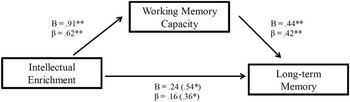
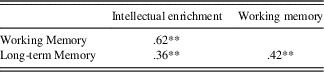
We first established that correlational relationships exist among all variables (Table 1) and tested the hypothesis that WM mediates the relationship between intellectual enrichment and LTM (Figure 1). In Step 1 of the model, the relationship between intellectual enrichment and LTM, ignoring the mediator, was significant, B=.54 p<.003. In Step 2, the relationship between intellectual enrichment and the mediator, WM capacity, was significant, B=.91, p<.001. In Step 3, WM capacity significantly predicted LTM, B=.44, p<.001. In the final step, WM capacity fully mediated the relationship between intellectual enrichment (B=.24; p=.27) and LTM (B=.33; p=.03). A Sobel test revealed significant mediation, Z=3.31, p<.001.
Mediation model showing full mediation between Intellectual Enrichment and Long-term Memory. Note. Direct effect of Intellectual Enrichment (R2 =.13) and indirect effect through the mediator (R 2 =.19). Coefficient presented in parentheses indicates direct effect. B=unstandardized values. β=standardized values, *p<.01**p<.001.

Correlation matrix between observed variables used in mediation analysis

Note. ** p≤.001
DISCUSSION
Through an exploratory mediation analysis, we found that WM capacity completely explains the relationship between intellectual enrichment and LTM in MS. The mechanism linking intellectual enrichment with LTM may in fact be WM. The relationship between intellectual enrichment, the proxy measure of cognitive reserve, and WM as well as the relationship between WM capacity and LTM were positive (see Table 1). This suggests that high reserve/capacity individuals are less prone to (or perhaps more protected from) deficits in LTM. The various sub processes that contribute variability to an individual’s WM capacity and explain this relationship need to be explored further. These mechanisms have been extensively explored in cognitive psychology and several tests have been developed to investigate how these mechanisms vary across individuals (see Barrett et al., Reference Barrett, Tugade and Engle2004). Future research using these theoretically motivated and empirically validated experimental paradigms will be useful in further decomposing why/how WM mediates this relationship. This is an important finding for theories of cognitive reserve as well as future research studies directed at investigating methods to prevent, maintain, or improve cognitive impairment (particularly LTM impairment) associated with MS.
Given the present finding that WM mediates the relationship between intellectual enrichment and LTM, it seems possible that targeting WM may help build cognitive reserve against LTM memory decline. Efforts to improve cognitive reserve in healthy aging adults provide some support for the notion that cognitive training can improve WM. Training on a video game led to improvements on a complex span measure of WM (Stern et al., Reference Stern, Blumen, Rich, Richards, Herzberg and Gopher2011). Older adults were randomly assigned to one of three conditions and played the video game 3 times per week over a 12-week period. Adults who were assigned to the “emphasis change training” condition were required to pay attention to different game-related attributes while playing different sections of the game. The emphasis change condition requires skills of attentional control, something that is implicit in many theoretical definitions of WM capacity (see Unsworth et al., Reference Unsworth, Fukuda, Awh and Vogel2014). Of note, the authors of the video game training study found a positive effect of training on WM; however, the authors administered but did not report a delayed recall memory test so the possibility of improvement on tests of LTM needs to be further evaluated. Additional support that training WM improves related cognitive systems comes from recent literature on cognitive psychology.
Lately, the topic of WM training has received a great deal of attention in the cognitive psychology literature. Although this literature is fraught with many diverse and competing viewpoints (Melby-Lervåg & Hulme, Reference Melby-Lervåg and Hulme2013), one recent finding from a tightly controlled experiment in healthy individuals found that a WM training program led to cognitive improvements in WM (near transfer to the same cognitive system on an alternate measure) as well as improvements in closely related cognitive domains (moderate transfer to different but related cognitive systems, i.e., the secondary memory [LTM] component of an immediate free recall task). Importantly however, training did not seem to transfer to other distantly related cognitive domains (far transfer, e.g., intelligence) (Harrison et al., Reference Harrison, Shipstead, Hicks, Hambrick, Redick and Engle2013).
Given there is evidence for WM training transferring and improving memory processes in healthy populations, a population whose memory performance may arguably be functioning at or near ceiling levels, it seems reasonable to hypothesize that individuals who are memory impaired would have even more to gain from training. Past research does support the hypothesis that use of a computerized WM training program leads to improvements on measures of WM in MS (Vogt et al., Reference Vogt, Kappos, Calabrese, Stöcklin, Gschwind, Opwis and Penner2009). Unfortunately the Vogt et al. study did not include a measure of LTM and many training studies suffer from serious methodological flaws (e.g., lack of adequate control groups, interventions that are not theoretically motivated), thus, transfer between WM training and LTM remains largely untested in MS and other neurological populations. The outlook for using WM training as a clinical tool to improve LTM in MS does appear promising.
Future work investigating transfer between cognitive training and LTM in MS should take special steps to design training programs that engage the appropriate underlying processes that contribute to WM. This may increase the probability that training will transfer between cognitive systems. These suppositions must be tested and replicated in MS and other neurological populations. Ideal protocols will include measures of LTM (delayed recall) to begin to investigate improvements and transfer to this memory system. Transfer from cognitive training to LTM may also result from training other related cognitive systems, for example, training processing speed or attention. Additionally, many cognitive training tasks may overlap and training in one cognitive domain may result in complimentary training in a related cognitive domain. Because of this, it is impossible to assume a training program (or measure), is process-pure (c.f., Jacoby, Reference Jacoby1991). That is, tasks that train WM may also train processing speed, attention, or other cognitive systems, and the contrary.
Although more females than males are affected by MS, the present sample was disproportionately female (6:1). This should be kept this in mind when making comparisons across studies or generalizing these findings to the larger MS population as a whole. An additional limitation is that the present study relied on transformed values and lacked a control group for comparisons. This renders the findings as preliminary.
The present study suggests that WM may be the mechanism through which greater lifetime intellectual enrichment protects against LTM deficits in MS patients. Interventions directed at improving specific sub-processes of the WM system may lead to improvements in cognitive reserve, and concomitant protection against LTM decline. It remains unclear whether WM capacity underlies reserve in other populations, or whether this mechanism is specific to reserve in MS patients. Future research is necessary to identify whether WM capacity underlies reserve in other populations, and whether interventions to improve WM will lead to improvements in cognitive reserve and LTM.
ACKNOWLEDGMENTS
J.S. supported by National Multiple Sclerosis Society Postdoctoral Fellowship Grant MB0024. Study supported by NIH R00 HD060765 to J.F.S. The authors have no conflicts of interest to report.