Introduction
An important adaptation of a plant species to its habitat is that seed germination occurs at a time when conditions are favourable for establishment and growth of the seedlings. Thus, an understanding of the geographical distribution of a species is enhanced by information on the kind of dormancy in freshly matured seeds and the environmental conditions required for dormancy-break and germination (Baskin and Baskin, Reference Baskin and Baskin2014). Five classes of seed dormancy are recognized: physiological (PD, low growth potential of the embryo due to a physiological inhibiting mechanism), morphological (MD, small, underdeveloped embryo that needs to grow inside the seed prior to germination), morphophysiological (MPD, a combination of MD and PD), physical (PY, water-impermeable seed/fruit coat) and combinational (PY and PD) (Nikolaeva, Reference Nikolaeva1969; Baskin and Baskin, Reference Baskin and Baskin2004).
The breaking of MPD (the class of dormancy of concern in this paper) requires exposure of seeds to environmental conditions that promote growth of the embryo and the breaking of PD. For seeds with differentiated small (underdeveloped) embryos, nine levels of MPD have been distinguished based on temperature requirements for growth of the embryo, breaking of physiological dormancy (PD) and emergence of the radicle and shoot and on responses of seeds to gibberellic acid (Baskin and Baskin, Reference Baskin and Baskin2014).
The genus Ilex L. (Aquifoliaceae) consists of about 600 species and is distributed in Asia, Europe, North and South America, northern Australia, a few Islands in the Pacific Ocean, Madagascar and sub-Saharan Africa (Cuénoud et al., Reference Cuénoud, Del Pero Martinez, Loizeau, Spichiger, Andrews and Manen2000; Loizeau et al., Reference Loizeau, Barriera, Manen and Broennimann2005). Using two nuclear genes and calibrating with three macrofossil records, Yao et al. (Reference Yao, Song, Yang, Tan and Corlett2021) concluded that Ilex originated in southeast Asia with a Late Cretaceous stem age of 84.7 million years ago (Ma) and the crown clade in the Eocene at 50.8 Ma. Furthermore, clades of Ilex had become established in South America and North America by 30.4 and 23.1 Ma, respectively.
Seeds of all Ilex species studied thus far have MPD (Ives, Reference Ives1923; Barton and Thornton, Reference Barton and Thornton1947; Hu, Reference Hu1975; Nikolaeva et al., Reference Nikolaeva, Rasumova, Gladkova and Danilova1985; Ng, Reference Ng1991; Young and Young, Reference Young and Young1992; Tsang and Corlett, Reference Tsang and Corlett2005; Chien et al., Reference Chien, Chen, Chien, Baskin and Baskin2011; Tezuka et al., Reference Tezuka, Yokoyama, Tanaka, Shiozaki and Oda2013). Non-deep simple, intermediate simple and deep simple levels of MPD have been identified in Ilex, and two ways by which deep simple MPD is broken in nature have been identified. Non-deep simple MPD, for example I. maximowicziana, is broken by 12–16 weeks of warm (≥15°C) stratification (Chien et al., Reference Chien, Chen, Chien, Baskin and Baskin2011), and intermediate simple MPD, for example I. dumosa, is broken by a period of dry storage at room temperatures (after-ripening) followed by 18 weeks of warm stratification (Galíndez et al., Reference Galíndez, Ceccato, Bubillo, Lindow-López, Malagrina, Ortega-Baes and Baskin2018). Deep simple MPD in temperate regions, for example I. opaca, is broken by warm stratification followed by cold (c. 0–10°C) stratification (Ives, Reference Ives1923; Barton and Thornton, Reference Barton and Thornton1947), while deep simple MPD in subtropical regions, for example I. paraguariensis, is broken by warm stratification for 12–40 or more weeks (Galíndez et al., Reference Galíndez, Ceccato, Bubillo, Lindow-López, Malagrina, Ortega-Baes and Baskin2018).
Loizeau et al. (Reference Loizeau, Barriera, Manen and Broennimann2005) noted that additional research is needed to fully understand the distribution patterns of Ilex. These authors emphasized the need for more information on species variability and ecological niche, which includes seed dormancy/germination, that is, the level of MPD. In particular, we are interested in deep simple MPD broken by warm followed by cold stratification in temperate regions vs deep simple MPD broken by only warm stratification in tropical/subtropical regions. In the subtropical region of Argentina, seeds of I. argentina and I. paraguariensis have deep simple MPD that is broken by extended periods of warm stratification (Galíndez et al., Reference Galíndez, Ceccato, Bubillo, Lindow-López, Malagrina, Ortega-Baes and Baskin2018). However, this requirement to break deep simple MPD has not been reported for any Ilex species in other subtropical/tropical regions.
To enhance our knowledge of MPD in seeds of the large genus Ilex, we conducted studies on three species of this genus from Taiwan. Based on the occurrence of Ilex in the subtropical/tropical regions of Taiwan (Lu, Reference Lu1993), we hypothesized that some species of Ilex in subtropical/tropical Taiwan have deep simple MPD that is broken only during prolonged periods of warm stratification. To test this hypothesis, we determined the level of MPD in seeds of I. formosana, I. rotunda and I. uraiensis collected in Taiwan. Seeds of I. formosana and I. uraiensis were collected in the subtropical zone, while those of I. rotunda were collected in both the subtropical and tropical zone. To determine the level of MPD in the seeds, we investigated the temperature requirements for embryo growth and germination and the effects of cold stratification and gibberellins on germination.
Materials and methods
Experimental materials
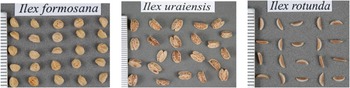
The evergreen trees I. formosana and I. uraiensis are distributed in subtropical (northern) and central Taiwan at 300–1000 m a.s.l., and those of I. rotunda grow throughout Taiwan at 100–1000 m a.s.l. (Hu, Reference Hu1953; Lu, Reference Lu1993). Mature, red fruits of I. formosana and I. uraiensis were harvested in Yangmingshan and Wulai, subtropical (northern) Taiwan, at 700 and 200 m a.s.l., respectively, on 30 January 2012 and 17 January 2013, respectively. Mature, red fruits of I. rotunda were harvested on 17 January 2013 in Yangmingshan, subtropical (northern) Taiwan, at the same site where those of I. formosana were collected. In addition, seeds of I. rotunda were collected on 6 December 2012 in Manjhou Township, Pingtung County, the tropical region (southern tip of Taiwan) at 100 m a.s.l. Approximately 1500 matured fruits were harvested from three to four trees each Ilex species. All fresh fruits were kept in laboratory (temperature about 25°C) for 2–3 d before the pulp was removed. We examined 50 fruits each of I. formosana and I. uraiensis and found an average of 3.9 ± 0.2 and 4.0 ± 0 seeds (drupes) per fruit, respectively. Fifty fruits of I. rotunda from subtropical and tropical Taiwan had an average of 5.3 ± 0.5 and 4.7 ± 0.5 seeds per fruit, respectively. There were about 75,100 and 19,700 seeds per litre of I. formosana and I. uraiensis, respectively, and for subtropical and tropical populations of I. rotunda, 196,750 and 148,500 seeds per litre, respectively (Fig. 1).
Intact seeds (endocarp with seed inside) of Ilex formosana, I. uraiensis and I. rotunda. The scale is in mm.

The germination unit (hereafter the seed) is the true seed covered by a hard but water-permeable endocarp. Seeds were extracted from fruits by removing the thin exocarp and fleshy mesocarp, using a sieve and running water. The cleaned seeds that sank in water were retained, while those that floated were discarded. Seeds were air-dried on paper at room temperature for 1 d and then temporarily stored in a sealed polyethylene bag at 5°C for 2–3 d. Moisture content (fresh weight basis) of seeds of I. formosana, I. uraiensis, I. rotunda (subtropical) and I. rotunda (tropical) was 6.4 ± 0.5, 11.5 ± 0.7, 8.0 ± 0.4 and 7.5 ± 0.2%, respectively, as determined using the oven drying (17 h at 103°C) method (International Seed Testing Association, Reference Nijënstein, Nydam, Don and McGill2007).
Effect of temperature on germination of fresh seeds
Seeds of I. formosana, I. uraiensis and I. rotunda (subtropical) and I rotunda (tropical) (hereafter, the four collections are referred to as the Ilex species) were mixed with small pieces of moist sphagnum moss (about 400% of its dry mass) and sealed inside transparent polyethylene bags (0.04 mm thick). The dry sphagnum moss was washed with running water three times before use. Moist sphagnum moss provides a good germination medium and contains the fungi Trichoderma and actinomycetes that are antagonistic to growth of seed-destroying micro-organisms (Wang et al., Reference Wang, Lin and Chang1998). Seeds were incubated in light/dark (12 h day/12 h night) at 30/20, 25/15, 20/10, 15/5°C and at 25°C for 30–74 weeks. The light source in the incubators (Saint Tien Co., Ltd, Taiwan) was cool white fluorescent tubes, and photon irradiance (400–700 nm) was about 60–80 μmol m–2 s–1. Each treatment consisted of three replications of 50 seeds each. Germination (root emergence ≥2 mm) was recorded weekly (presented at 1- or 2-week interval). Results were expressed as mean germination percentage and 95% binomial confidence interval (CI).
Effect of GA3 and GA4 on germination
Fresh seeds of the Ilex species were soaked in double-distilled water (ddH2O) and in 250, 2500 and 5000 μM solutions of GA3 (potassium salt, 95% purity, Sigma, St Louis, Missouri, USA) and GA4 (90% purity, from Professor Lewis N. Mander, Australian National University) for 24 h at room temperature (about 25°C) prior to incubation. After soaking, the seeds were mixed with moist sphagnum moss and incubated at 25/15°C for 12–16 weeks. Germination was monitored weekly. Each treatment consisted of three replications of 50 seeds each. Results were expressed as mean germination percentage and 95% binomial CI.
Embryo growth
To determine if embryos are underdeveloped (i.e. grow inside the seeds prior to root emergence), we measured seed and embryo length of fresh seeds and of seeds with a split seed coat, which indicated that the radicle was about to emerge. Fresh seeds of the Ilex species were mixed with moist sphagnum moss in sealable polyethylene bag and incubated at 30/20, 25/15 and 20/10°C. Seeds were examined at 2-week intervals, at which time 10 seeds of the Ilex species at each temperature regimes were cut open longitudinally using a razor blade. Length of the seed and of the embryo was measured using a dissecting microscope equipped with a calibrated micrometer, and photographs were taken. Embryo (E) length:seed (S) length ratio (E:S ratio) was calculated for each seed.
Embryo growth in seeds of I. uraiensis was so slow that the seed supply was exhausted in 2013 before embryo growth could be documented. Thus, we harvested more fruits of the species at the same location in 2014. The seeds were incubated in the following sequence: 30/20°C for 8 weeks → 25/15°C for 8 weeks → 20/10°C for 8 weeks → 15/5°C for 4 weeks → 5°C for 4 weeks. This temperature sequence occurs in the natural distributional range of the species. Ten seeds were cut open every 2–8 weeks and length of seed and embryo measured and E:S ratio calculated.
Effect of cold stratification on seed germination
Seeds of the Ilex species were placed in sealed polyethylene bags with moist sphagnum moss and stratified at 5°C in a dark cold room for 0, 4, 8 and 12 weeks. In addition, the cold stratification period for seeds of I. rotunda was extended to 16, 34 and 52 weeks. Cold-stratified seeds of the Ilex species were incubated in light at 25/15°C for a maximum of 52 weeks. Germination was recorded weekly (presented at 1- or 2-week interval), and results were expressed as mean germination percentage and 95% binomial CI (three replications with 50 seeds each) after roots grew to ≥2 mm long (based on the number of incubated seeds).
Climate in northern and southern Taiwan
Average daily temperature regimes in Yangmingshan, Taipei city, subtropical (northern) Taiwan are 28/21 to 30/23°C in summer (June–August) and 16/10 to 17/11°C in winter (December–February) (https://www.whereandwhen.net/when/east-asia/taiwan/yangmingshan-national-park). Average daily temperature regimes in Manjhou township, Pingtung county, tropical (southern) Taiwan are 30/25 to 31/26°C in summer and 23/18 to 24/19°C in winter (https://www.accuweather.com/en/tw/manzhou-township/314395/november-weather/314395). The distance between Yangmingshan and Manjhou township is about 390 km.
Statistical analysis
Statistical analyses of seed germination percentages from different temperatures, GA3 and GA4 treatments, and moist cold stratification were carried out using the generalized linear model (GZLM) with logit link function and binomial distribution. Moreover, the embryo length and E:S ratio data were carried out using the GZLM with identity link function and normal distribution. The statistical significance was tested using Wald test with post hoc Sidak test (α = 0.05). All statistical analyses were performed using SPSS Statistics 20 (IBM Corp., Armonk, NY, USA).
Results
Effect of temperature on germination of fresh seeds
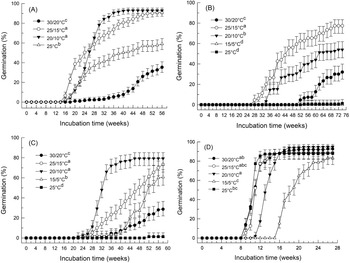
Fresh seeds of I. formosana began to germinate after 14 weeks of incubation, and germination increased slowly thereafter. After 50 weeks of incubation, 90 and 88% of the seeds had germinated at 25/15 and 20/10°C, respectively, but at 25 and 30/20°C only 55 and 25% of the seeds, respectively, had germinated (Fig. 2A). Fresh seeds of I. uraiensis began to germinate after 26 weeks at 25/15°C, and after 70 weeks germination was 77, 50, 27, 0.7 and 0% at 25/15, 20/10, 30/20, 25 and 15/5°C, respectively (Fig. 2B). Fresh seeds of I. rotunda (subtropical) began to germinate after 20 weeks at 20/10°C, and after 50 weeks germination was 80, 50, 37, 17 and 0% at 20/10, 25/15, 15/5, 30/20 and 25°C, respectively (Fig. 2C). Fresh seeds of I. rotunda (tropical) began to germinate after 8 weeks at 25, 30/20 and 25/15°C, and after 14 weeks germination was 87, 83, 80, 46 and 0% at 25, 30/20, 25/15, 20/10 and 15/5°C, respectively (Fig. 2D).
Cumulative germination percentages (means and 95% binomial confidence intervals) of fresh seeds of Ilex formosana (A) and Ilex uraiensis (B) from subtropical Taiwan and Ilex rotunda from subtropical (C) and tropical (D) Taiwan incubated at various temperatures. Final seed germination percentages among the incubation temperatures followed by different letters differ significantly (Sidak test, α = 0.05).

Effect of GA3 and GA4 on germination
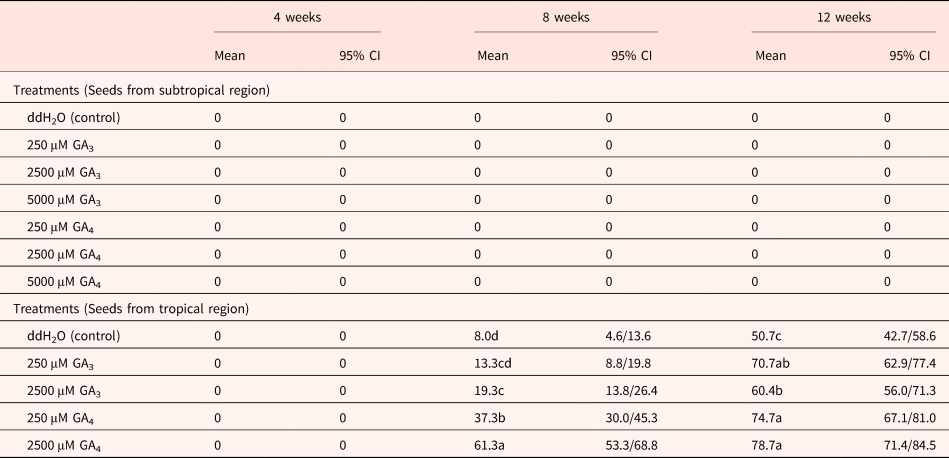
Pre-treatment with 250, 2500 μM GA3 and GA4 significantly increased the germination percentages of I. formosana seeds during 16 weeks of incubation, and seeds treated with GA4 germinated to 43.3–48.0%, which is significantly higher than that of seeds treated with GA3 (Table 1). Regardless of GA treatment, no seeds of I. uraiensis had germinated after 16 weeks (data not shown). After 12 weeks of incubation, no GA-treated weeds of I. rotunda (subtropical) had germinated, while seeds of I. rotunda (tropical) had germinated to 50.7% in the control and to 60.4–78.7% in the GA treatments (Table 2).
Effect of GA3 and GA4 on germination percentages (mean and 95% binomial confidence interval [CI]) of Ilex formosana seeds after 8 and 16 weeks incubation at 25/15°C

Means (n = 3) in a column followed by different letters differ significantly (Sidak test, α = 0.05).
Effect of GA3 and GA4 on germination percentages (mean and 95% binomial confidence interval [CI]) of Ilex rotunda seeds from subtropical and tropical regions of Taiwan after 4, 8 and 12 weeks incubation at 25/15°C

Means (n = 3) in a column followed by different letters differ significantly (Sidak test, α = 0.05).
Embryo growth
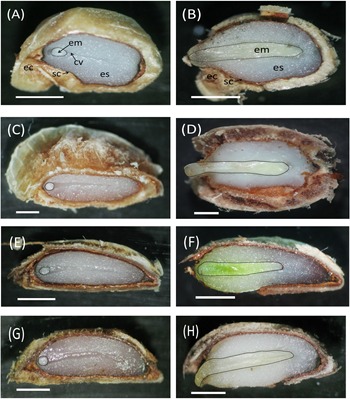
In fresh seeds of I. formosana, mean (±SE) embryo length was 0.27 ± 0.04 mm and E:S ratio was 0.09 ± 0.01 (Fig. 3A and see supplementary Table S1). After 18 weeks when the endocarps split just prior to radicle emergence, length of the embryo was 1.45 ± 0.52 mm and the E:S ratio was 0.44 ± 0.15 mm (Fig. 3B and see supplementary Table S1). In fresh seeds of I. uraiensis, mean (±SE) embryo length was 0.43 ± 0.09 mm, and growth did not occur until seeds were transferred to 20/10°C (Figs 3C and 4). After 8 weeks at 25/15°C, embryos grew slowly, and embryo length reached its maximum of 3.14 ± 0.28 mm (730% increase in length) with an E:S ratio of 0.48 ± 0.05 mm at 20/10°C (Figs 3D and 4). Seed germination also occurred at 20/10°C and rapidly increased to 45%. When seeds were moved from 20/10 to 15/5°C, germination increased to 58%, and it increase to 65% when seeds were moved from 15/5 to 5°C (Fig. 4).
Embryo growth in seeds of Ilex formosana (A, B) and Ilex uraiensis (C, D) from subtropical Taiwan and Ilex rotunda from subtropical (E, F) and tropical (G, H) Taiwan. Longitudinal sections of fresh seeds with a small, underdeveloped embryo (A, C, E, G) and fully developed embryos (B, D, F, H) are shown. The scale is 1 mm. Embryo (em) in cavity (cv), endosperm (es), seed coat (sc), endocarp (ec).

Cumulative seed germination (●) (mean and 95% binomial confidence interval) and embryo (E):seed (S) length ratio (x) of Ilex uraiensis seeds incubated in a sequence of temperature regimes beginning at 30/20°C. The E:S ratio in fresh seeds was 0.06 ± 0.01, and it reached a maximum of 0.48 ± 0.05 during incubation at 20/10°C.

In fresh seeds of I. rotunda (subtropical), mean (±SE) embryo length was 0.27 ± 0.02 mm and the E:S ratio was 0.07 ± 0.01 (Fig. 3E and see supplementary Table S2). After 28 weeks when the endocarps split, length of the embryo was 1.38 ± 0.35 mm, and the E:S ratio was 0.35 ± 0.10 mm (Fig. 3F and see supplementary Table S2). For I. rotunda (tropical), mean (±SE) embryo length in fresh seeds was 0.27 ± 0.04 mm and the E:S ratio was 0.06 ± 0.01 (Fig. 3G and see supplementary Table S3). At 16 weeks when the endocarps split, length of the embryos was 2.17 ± 0.33 mm, and the E:S ratio was 0.48 ± 0.09 mm (Fig. 3H and see supplementary Table S3).
Effect of cold stratification on seed germination
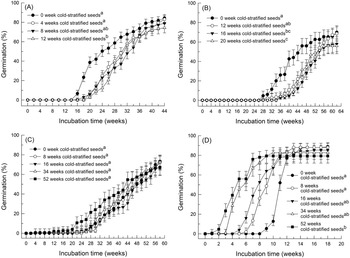
Germination of I. formosana seeds cold-stratified at 5°C for 4, 8 and 12 weeks was delayed compared with seeds without moist cold stratification (Fig. 5A). Similar results were found for seeds of I. uraiensis and those of I. rotunda (subtropical) (Fig. 5B, C). However, cold stratification increased the speed of germination of I. rotunda (tropical) (Fig. 5D).
Effect of moist cold stratification at 5°C on seed germination (means and 95% binomial confidence intervals) of Ilex formosana (A) and Ilex uraiensis (B) from subtropical Taiwan and Ilex rotunda from subtropical (C) and tropical (D) Taiwan. Final seed germination percentages among the different cold stratification times followed by different letters differ significantly (Sidak test, α = 0.05).

Discussion
Seeds of I. formosana, I. uraiensis and I. rotunda required >30 d to germinate, and embryos in seeds of each species increased in length by 710% or more before radicle emergence. Thus, seeds of the three Ilex species have MPD, as expected. The question we need to answer is: do seeds have a simple or complex level of MPD? In seeds with a simple level of MPD, embryo growth occurs at ≥15°C, that is, during warm stratification, while in those with a complex level of MPD embryo growth occurs at ≤10°C, that is, during cold stratification (Baskin and Baskin, Reference Baskin and Baskin2014). Since embryo growth and germination occurred at warm-stratifying temperatures (e.g. 25/15°C), seeds of the three species have a simple level of MPD.
The non-deep, intermediate and deep levels of simple MPD are distinguished by the depth of the PD component of MPD, that is, non-deep, intermediate and deep PD, respectively. Non-deep PD is broken by warm or cold stratification (depending on the species), seeds usually germinate when treated with GA and may come out of dormancy during dry storage of room temperatures (after-ripening). Intermediate PD is broken by extended periods of cold or warm stratification (depending on species), but a period of after-ripening will decrease the length of the cold or warm stratification period required to break dormancy. GA may, or may not, break intermediate PD. Deep PD is broken by several months of cold or warm stratification (depending on species), and GA does not break dormancy (Nikolaeva, Reference Nikolaeva1969).
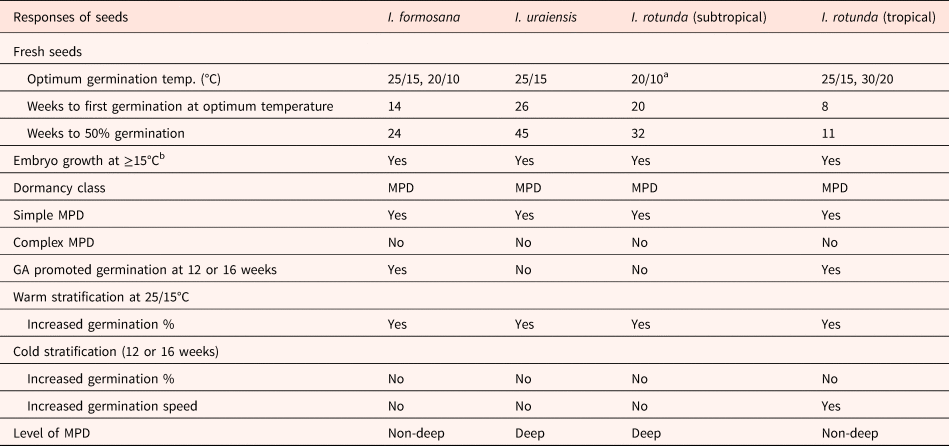
A comparison of the dormancy-breaking and germination requirements of the three Ilex species (Table 3) leads to the conclusion that seeds of I. uraiensis and I. rotunda (subtropical) have deep simple MPD that is broken by long periods of warm stratification, like seeds of I. argentina and I. paraguariense from the subtropical zone of Argentina (Galíndez et al., Reference Galíndez, Ceccato, Bubillo, Lindow-López, Malagrina, Ortega-Baes and Baskin2018). Thus, our hypothesis that some Ilex species from subtropical zones of Taiwan have deep simple MPD broken only by warm stratification is supported. However, seeds of I. formosana (subtropical) and those of I. rotunda (tropical) have non-deep simple MPD broken by relatively short periods of warm stratification compared with I. uraiensis and I. rotunda (subtropical). Yang et al. (Reference Yang, Chen, Yang and Chien2014) reported that seeds of I. asprella harvested from northern, central and southern Taiwan had begun to germinate after 10–14 weeks and the suitable temperature was 20/10°C. Moist cold stratification and GA treatment increased seed germination percentage and rate, suggesting that seeds of I. asprella have non-deep simple MPD. Seeds of I. maximowicziana from both northern and southern regions of Taiwan had non-deep simple MPD (Chien et al., Reference Chien, Chen, Chien, Baskin and Baskin2011). Thus, in the subtropical and tropical regions of Taiwan seeds, some Ilex species have non-deep simple MPD, and seeds of other species have deep simple MPD. The dormancy formula for non-deep simple MPD is C1bBb and that for deep simple MPD is C1bBb–C3b, where (for both formulas) B is underdeveloped embryo; C, physiological dormancy; subscript b, exposure to warm temperature is required for dormancy break (Cxa or Cxb) or embryo (B) grows during exposure to warm (Bb) temperatures; and subscripts 1 and 3, non-deep and deep physiological dormancy, respectively (Baskin and Baskin, Reference Baskin and Baskin2021).
Summary of the dormancy-breaking and germination requirements of seeds of three Ilex species from Taiwan

a Reached 50% germination at 25/15°C at week 48.
b As shown by seed germination at 25/15°C.
Temperatures of the tropical region of Taiwan are higher than those in the subtropical region. Also, the tropical region has a dry season from October to April or May, but there is some rainfall during this time in the subtropical zone (see Fig. 6 in Chien et al., Reference Chien, Chen, Chien, Baskin and Baskin2011). Clearly, some Ilex species with non-deep simple MPD and deep simple MPD occur in the relatively cool, mesic subtropical region and others with non-deep simple and deep simple MPD occur in the relatively warm, seasonally dry tropical zone. Thus, the climate of both regions is suitable for the persistence of Ilex species with either non-deep simple or deep simple MPD.
In their consideration of phylogeny and biogeography of Ilex, Yao et al. (Reference Yao, Song, Yang, Tan and Corlett2021) concluded that moisture was more important than temperature in determining the geographical range of Ilex clades. Further, these authors suggested that Ilex has increased its tolerance of low temperature but not low soil moisture. One possible adaptation to relatively short periods of moist soil is the rapid breaking of the PD component of MPD, that is, non-deep PD. On the other hand, the requirement for warm followed by cold stratification to break the PD component of deep simple MPD in temperate regions (Ives, Reference Ives1923; Barton and Thornton, Reference Barton and Thornton1947; Nikolaeva et al., Reference Nikolaeva, Rasumova, Gladkova and Danilova1985) likely is an adaption for growth of some Ilex species in climates with cold winters. Furthermore, since Ilex originated in subtropical/tropical southeast Asia long before clades of Ilex became established in North America with a temperate climate, we might conclude that deep simple MPD broken by warm followed by cold stratification is more recent than deep simple MPD being broken by extended periods of warm stratification. However, it should be noted that when seeds of I. uraiensis were given warm stratification at 30/20 and 25/15°C and then moved to 20/10°C they reached c. 45% germination on week 24 of imbibition, whereas seeds incubated continuously at 20/10°C did not reach 45% germination until week 60. These results for I. uraiensis seem to suggest that while deep simple MPD of some Ilex species in subtropical/tropical regions is broken by extended periods of warm stratification, some cold stratification after several weeks of warm stratification may speed up dormancy break and germination.
Seeds of I. rotunda at subtropical Taiwan mature and are dispersed in winter (December through January). No embryo growth or seed germination occurred at the cold temperature but did occur with the onset of warm spring temperatures. However, seeds of I. rotunda in tropical (southern) Taiwan also mature and are dispersed in winter (November through December), but they receive warm temperatures after dispersal because the temperature is not below 10°C in this region. Thus, we speculate that seeds of I. rotunda from subtropical Taiwan may have adapted to variable winter conditions with the cold stratification to prevent embryo growth and seed germination; however, seeds of I. rotunda from tropical Taiwan have not been affected by the cold stratification with embryo growing continuously to final germination.
Supplementary material
To view supplementary material for this article, please visit: https://doi.org/10.1017/S0960258523000016.
Acknowledgements
The authors thank Yen-Wei Chang, Chia-Yi Chen, Chang-Yen Chen, Yu-Cheng Hsieh, Shu-Niu Liau, Yu-Han Tsai, Kai-Chun Yang, Taiwan Forestry Research Institute, for technical assistance, and Tzu-Hao Su, National Chung Hsing University, for assistance in statistical analyses of the data.
Financial support
This research was supported by a grant (MOST 104-2313-B-054-003-MY2) from the Ministry of Science and Technology, Taiwan, ROC.
Conflicts of interest
The authors declare no conflict of interest.