

The history of Chenopodium berlandieri (C. berlandieri subsp. jonesianum and C. berlandieri subsp. berlandieri var. bushianum and its intermediate forms) in Ontario, Canada, is not well-known despite its wide distribution in eastern North America and its significance in the archaeological record in the eastern United States. One native crop among several that comprise the Eastern Agricultural Complex, C. berlandieri subsp. jonesianum, was important by Early Woodland times from central Arkansas on the west to central Kentucky on the east, and from 35° to 39° north latitude; however, it has not been identified north of this region during the Early Woodland or in the Ontario archaeological record until now. Only two Eastern Agricultural Complex crops, sunflower (Helianthus annuus var. macrocarpa) and squash (Cucurbita pepo), are considered part of the Indigenous economy in precontact Ontario, introduced during the early Late Woodland (Crawford and Smith Reference Crawford, Smith and Minnis2003). The earliest confirmed crop reported in Ontario was, until now, maize (Zea mays), with its unbroken sequence in the province beginning during the early Late Woodland, circa cal AD 500 (Crawford et al. Reference Crawford, Smith and Bowyer1997, Reference Crawford, Saunders, Smith, Staller, Tykot and Benz2006). The plant assemblage associated with the maize indicates that the later Iroquoian mixed economy, which included significant plant production, was being established (Crawford Reference Crawford2014; Crawford et al. Reference Crawford, Saunders, Smith, Staller, Tykot and Benz2006).
This article reports on a large cache of charred, domesticated chenopod (Chenopodium berlandieri subsp. jonesianum) seeds from a shallow pit at the Early Woodland Tutela Heights site (AgHb-446) in Brantford, Ontario. Not only is this among the oldest domesticated chenopod examples in North America, it is the first time the crop has been reported in precontact Canada. The Tutela Heights domesticated chenopod was likely exchanged into Ontario as part of a broad Late Archaic and Early Woodland interaction network. The discovery raises questions about the extent to which people in Ontario before the early Late Woodland were aware of crops and gardening and whether its presence signaled a lasting change in human-plant interaction in the province.
Background
Eastern Agricultural Complex crops were undergoing domestication some time during the Late Archaic period in the Oak-Savannah and Oak-Hickory forest regions of eastern North America (ENA), and by 850 cal BC, five crops had coalesced to form a single Eastern Agricultural Complex (Smith and Yarnell Reference Smith and Yarnell2009). Any concern that Chenopodium berlandieri subsp. jonesianum was domesticated in ENA has been erased by modern DNA and aDNA analyses (Kistler and Shapiro Reference Kistler and Shapiro2011). Early Woodland cultures in the region were supported by a mixed economy of hunting, fishing, gathering, and production of chenopod, erect knotweed (Polygonum erectum), little barley (Hordeum pusillum), maygrass (Phalaris caroliniana), sumpweed (Iva annua var. macrocarpa), sunflower, bottle gourd (Lagenaria siceraria), and squash (Arzigian Reference Arzigian and Keegan1987; Fritz Reference Fritz and Scarry1993; Fritz and Smith Reference Fritz and Smith1988; Smith Reference Smith1989, Reference Smith, Cowan and Watson1992; Smith and Cowan Reference Smith and Cowan1987; Yarnell Reference Yarnell and Cleland1976). These crops were also important to many Hopewell (Middle Woodland), Late Woodland, and Mississippian people in eastern North America (Asch and Asch Reference Asch, Asch and Styles1981, Reference Asch, Asch, Stafford and Sant1985; Pauketat et al. Reference Pauketat, Kelly, Fritz, Lopinot, Elias and Hargrave2002). Sunflower and squash became important crops in Ontario, while little barley is reported from a few sites, and sumpweed is reported from only one site, the latter two taxa appearing in very small quantities (Ounjian Reference Ounjian1998). Little barley and sumpweed were likely adventive weeds rather than locally grown crops. The three sumpweed specimens from Windemere are small and so appear to be phenotypically wild (Crawford and Smith Reference Crawford, Smith and Minnis2003; Ounjian Reference Ounjian1998). Erect knotweed is found at many Late Woodland sites in the province, but its abundance is usually less than a few percent (Crawford and Smith Reference Crawford, Smith and Minnis2003). One exception is the Neutral-affiliated Windemere site, where 50 erect knotweed seeds are reported (Ounjian Reference Ounjian1998). Chenopod is relatively abundant at late precontact and early contact period sites, but they appear to be C. berlandieri subsp. berlandieri, the wild/weedy phenotype (Crawford and Smith Reference Crawford, Smith and Minnis2003; Monckton Reference Monckton1992; Ounjian Reference Ounjian1998). Eastern complex crops, other than sunflower and squash, have an ambiguous role in the subsistence history of Ontario, and there is a great deal still to learn.
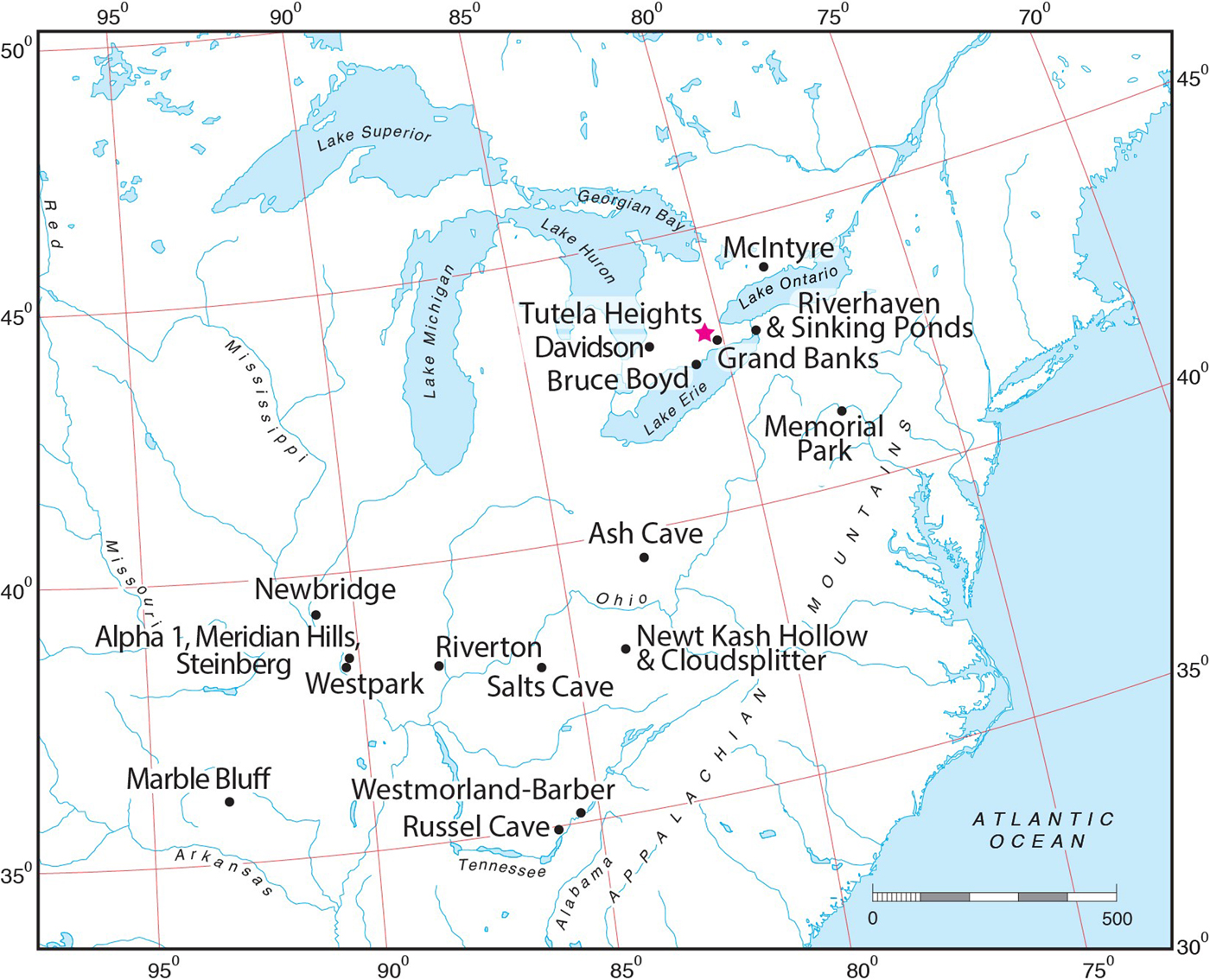
Our understanding of Early Woodland life in the Canadian Great Lakes region is not well documented, as it is largely based on research undertaken decades ago (Granger Reference Granger, Engelbrecht, Grayson and White1978a, Reference Granger1978b; Ritchie Reference Ritchie and Books1980; Ritchie and Funk Reference Ritchie and Funk1973; Spence and Fox Reference Spence, Fox, Farnsworth and Emerson1986; Spence et al. Reference Spence, Williamson and Dawkins1978, Reference Spence, Pihl, Murphy, Ellis and Ferris1990; Williamson Reference Williamson1979, Reference Williamson1980). A few recent studies have enhanced that understanding (Taché Reference Taché2011a, Reference Taché2011b; Williamson et al. Reference Williamson, Robertson, Cooper, MacDonald, Austin and Pihl2010). The Riverhaven site, on Grand Island in the Niagara River, and the nearby Sinking Ponds site yielded evidence of dense and varied artifact assemblages dating to around 800 and 400 cal BC (Granger Reference Granger, Engelbrecht, Grayson and White1978a, Reference Granger1978b; Figure 1). The communities represented by these sites were likely organized into small bands that were connected by interaction networks of varying spatial scales. Evidence from the Bruce Boyd site (AdHc-4), a cemetery in Norfolk County, Ontario, dating to about 800–400 BC, suggests that these bands were composed of about 35 people (Spence et al. Reference Spence, Pihl, Murphy, Ellis and Ferris1990). Individuals in Early Woodland networks exchanged marine shell gorgets, copper tools, bracelets, beads, and galena, all of which have only been found as burial offerings (Spence Reference Spence, Ericson and Earle1982; Spence et al. Reference Spence, Williamson and Dawkins1978). Exchange networks, at least in Ontario, were based on egalitarian partnerships. The earliest evidence for social ranking in Ontario postdates the Early Woodland at the Hopewell-influenced Middle Woodland Serpent Mounds site (BdGm-2; Spence et al. Reference Spence, Pihl, Murphy, Ellis and Ferris1990).
Location of Tutela Heights site and other sites mentioned in text. Map prepared by Gary W. Crawford and finalized by Alison Dias.

Systematic research on Early Woodland subsistence in the Canadian Great Lakes region has languished, with limited evidence of plant use (Crawford and Smith Reference Crawford, Smith and Minnis2003). Two Early Woodland features at the Peace Bridge site (AfGr-9) yielded walnut (Juglans nigra), nightshade (Solanum americanum), and cleavers (Galium sp.), as well as remains of deer, raccoon, squirrel, chipmunk, muskrat, fisher, bird (including wild turkey), turtle, and several species of fish (Williamson et al. Reference Williamson, Robertson, Cooper, MacDonald, Austin and Pihl2010:56–58). Late Archaic subsistence is better documented. Flotation samples from the Late Archaic component of the McIntyre site (BbGn-2) recovered a diverse array of plant remains, signaling anthropogenesis and potential butternut (Juglans cinerea) management (Yarnell Reference Yarnell and Johnston1984). Chenopod (C. gigantospermum, now classified as C. simplex) was among the most important plants utilized by the Late Archaic population there. Early Woodland people must have been doing much the same. Ongoing analyses of the Davidson site (AhHk-54) plant assemblage indicates a similar diversity of plants, including an emphasis on butternut, although no chenopod is reported (Ellis et al. Reference Ellis, Keron, Dann, Desloges, Eastaugh, Hodgetts, Malleau, Monckton, Nielsen, Phillips, Stewart and Van Sas2014). An unconfirmed and undated squash rind fragment is also reported from Davidson. Squash, sumpweed, and probably sunflower, dating to the Early Woodland, have been reported from adjacent Michigan, indicating that Eastern Agricultural Complex crops were being moved quite far north at the time (Crawford and Smith Reference Crawford, Smith and Minnis2003; Ozker Reference Ozker1982; Parker Reference Parker and Garland1984). The northernmost report of domesticated chenopod until now was at the early Late Woodland Memorial Park site (36CN164) in the Susquehanna River basin, Pennsylvania (Hart and Asch Sidell Reference Hart and Asch Sidell1996).
The Tutela Heights site was identified during a 2010 archaeological assessment of a residential development situated beside a small stream about 500 m from the main channel of the Grand River near Brantford, Ontario (Figure 1). The site is on a flat rise characterized by well-drained sandy soil with artifacts extending across an area of approximately 80 m north-south by 95 m east-west.
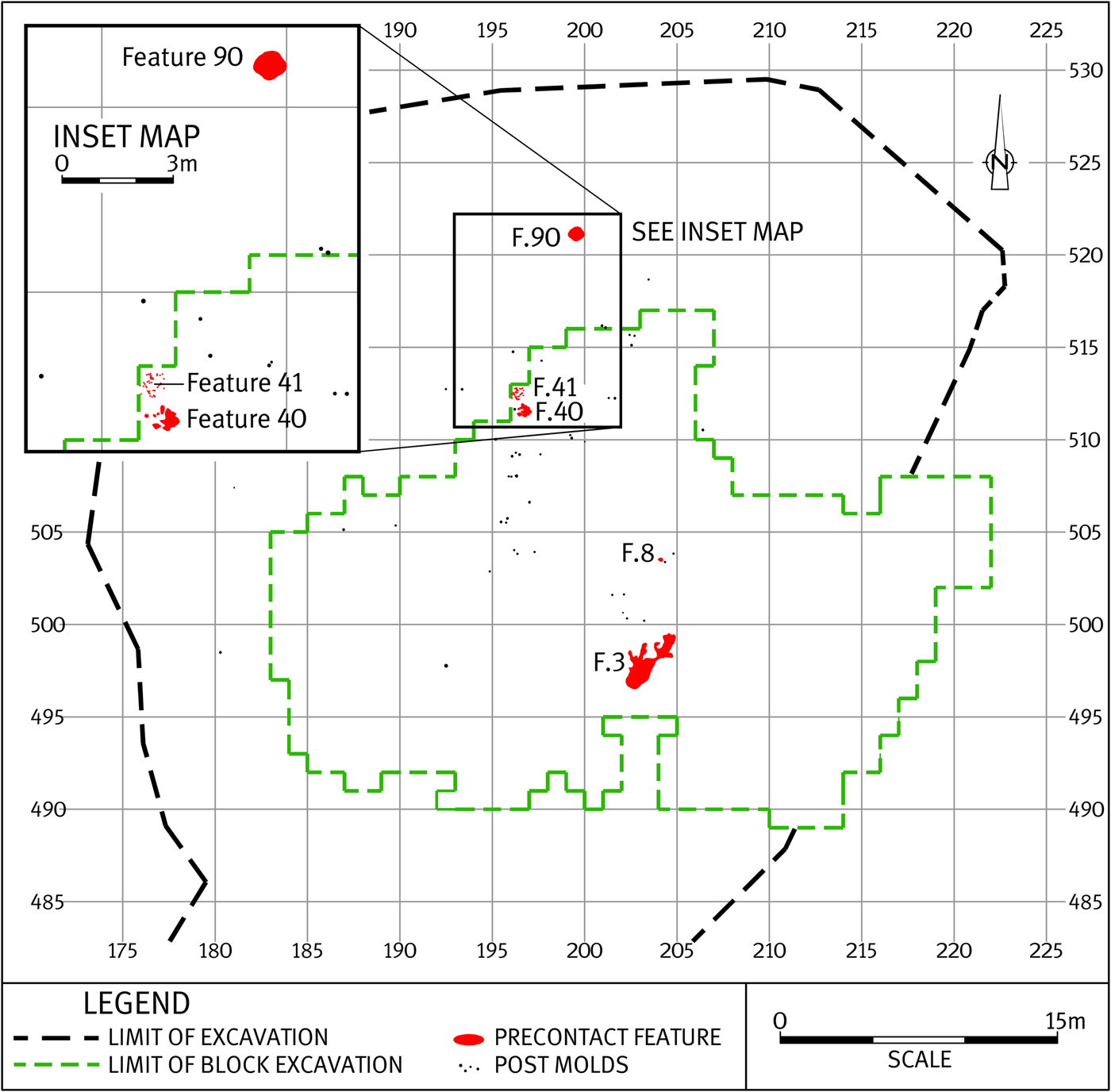
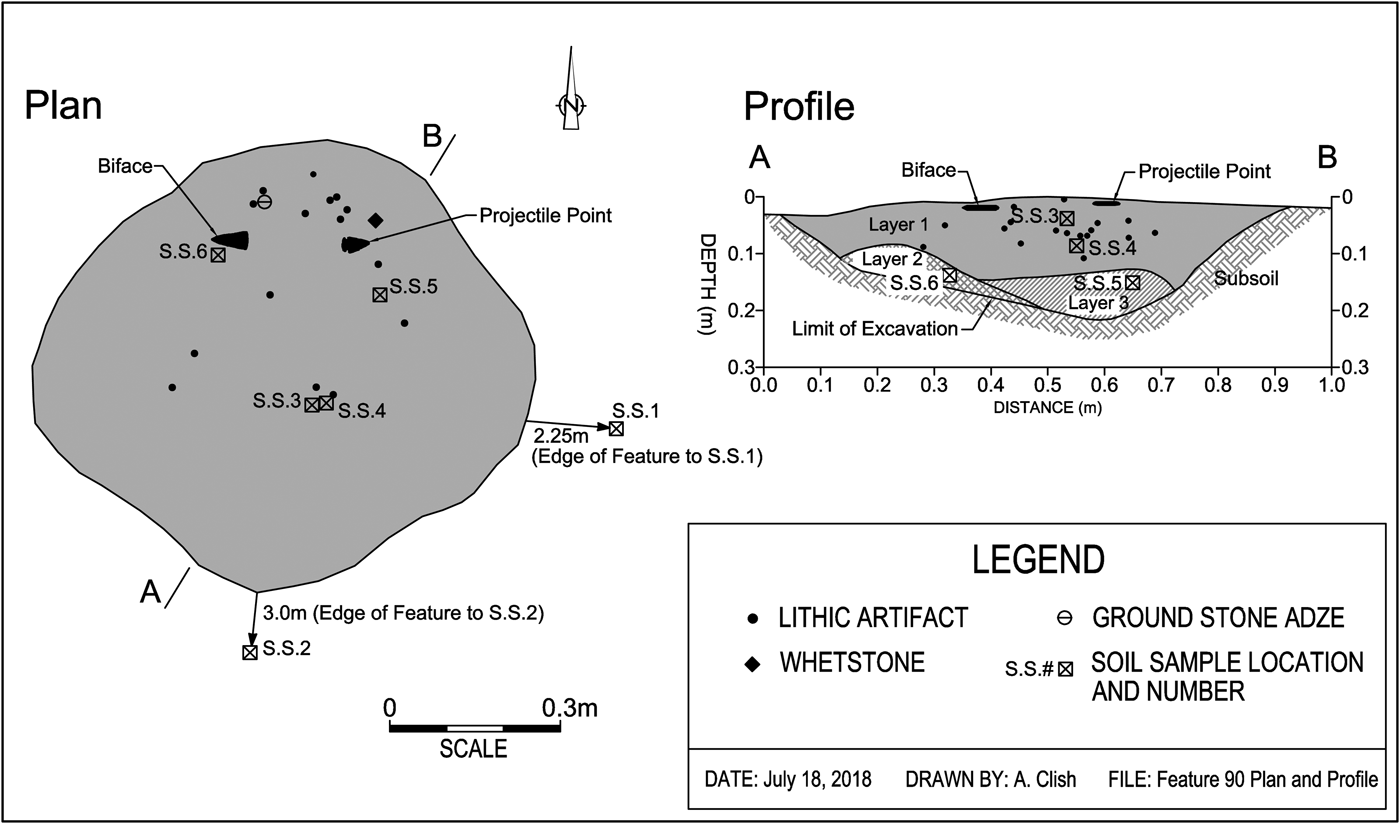
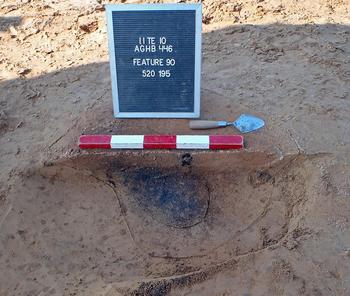
The excavation consisted of 653 one-meter-square units (block excavations, Figure 2) and exposed 86 features, only 4 of which are clearly of Indigenous origin, while the rest are Euro-Canadian. The Indigenous features included a hearth (Feature 41), a refuse-filled depression, a small feature complex (Feature 40), and a shallow pit (Feature 90; Figures 3 and 4), as well as 54 precontact post molds (including those comprising Feature 40). The majority of post molds surround the hearth (Feature 41) and the small feature complex (Feature 40). A second, smaller group of post molds is immediately north of the refuse-filled depression. None of the postholes are associated with Feature 90, so the pit does not appear to be associated with a residential structure.
Tutela Heights site map showing location of features. Illustration by Andrew Clish.

Plan view and profile of Feature 90, Tutela Heights Site, showing location of flotation samples and associated artifacts. Illustration by Andrew Clish.

Photo of Feature 90 excavation viewed from east to west. The charred chenopod seed concentration is visible in the center of the pit. The subtle reddening of the sediment above the cache and in the north portion of the feature suggests in situ heating. The scale represents 50 cm. Photograph courtesy of Archaeological Services Inc.

Artifacts are concentrated within the east-central sector of the excavation area (Figure 2). Artifact yields are highest within the center of this concentration and gradually decrease outward. The assemblage is entirely stone tools and flakes, totaling 4,230 pieces. Debitage dominates the collection (99.1%); only 6 flakes are retouched. The rest of the collection is 40 formal tools and tool fragments: 16 biface fragments, 10 projectile point fragments, 4 complete bifaces, 4 end scrapers, 2 projectile points, 1 drill fragment, and 1 lateral edge scraper. A ground stone hammer and a ground stone chisel were also found. The vast majority of debitage and tools are made of Onondaga (86%) and Lockport (13%) varieties of chert. These cherts were procured not far from Tutela Heights. Onondaga chert was sourced at most from about 100 km to the southeast, near the eastern end of Lake Erie; Lockport chert was quarried about 40 km to the east in what is now the city of Hamilton. No material culture evidence of participation in the Early Woodland interregional exchange system was recovered.
Tutela Heights is multicomponent, with several pre- and postcontact Indigenous components, as well as an early nineteenth-century Euro-Canadian occupation. Only nine formal, temporally diagnostic, Indigenous tools were recovered from the block excavation: a biface fragment, two complete projectile points, and six projectile point fragments. None of these tools are associated with features. The Meadowood biface fragment, from the Early Woodland period, is a characteristically thin, refined midsection and is the only Early Woodland artifact recovered from the block excavation. It was manufactured from Onondaga chert. Meadowood is the earlier of two complexes (the second being the Middlesex complex), comprising the Early Woodland in Ontario, dating to about 900 or 800–600 BC and 600 BC–AD 1, respectively (Spence et al. Reference Spence, Pihl, Murphy, Ellis and Ferris1990). Meadowood is usually distinguished from the Late Archaic by the appearance of Vinette 1 pottery and a distinctive side-notched projectile point usually made with Onondaga chert; several other traits such as Meadowood cache blades or preforms and trapezoidal gorgets appear (Spence et al. Reference Spence, Pihl, Murphy, Ellis and Ferris1990). Pottery is seldom associated with Meadowood points, preforms, or gorgets, as is the case at Tutela Heights. No pottery was recovered from the entire site.
The other projectile points are a Late/Terminal Archaic Normanskill narrow point (2000–800 cal BC; Ritchie Reference Ritchie1971) and a Crawford Knoll small point (1300–800 cal BC; Ellis et al. Reference Ellis, Timmins, Martelle, Emerson, McElrath and Fortier2009:818–820). The projectile point fragments include a Lamoka point base (2500–2000 cal BC; Ritchie Reference Ritchie1971), an Innes point base (1500–1300 cal BC; Ellis et al. Reference Ellis, Timmins, Martelle, Emerson, McElrath and Fortier2009:819), a Normanskill point base, a Hind point base (900–700 cal BC; Ellis et al. Reference Ellis, Timmins, Martelle, Emerson, McElrath and Fortier2009:819–820), and a small Late Archaic point base. A bifurcate point base is Early Archaic (7000–6000 cal BC).
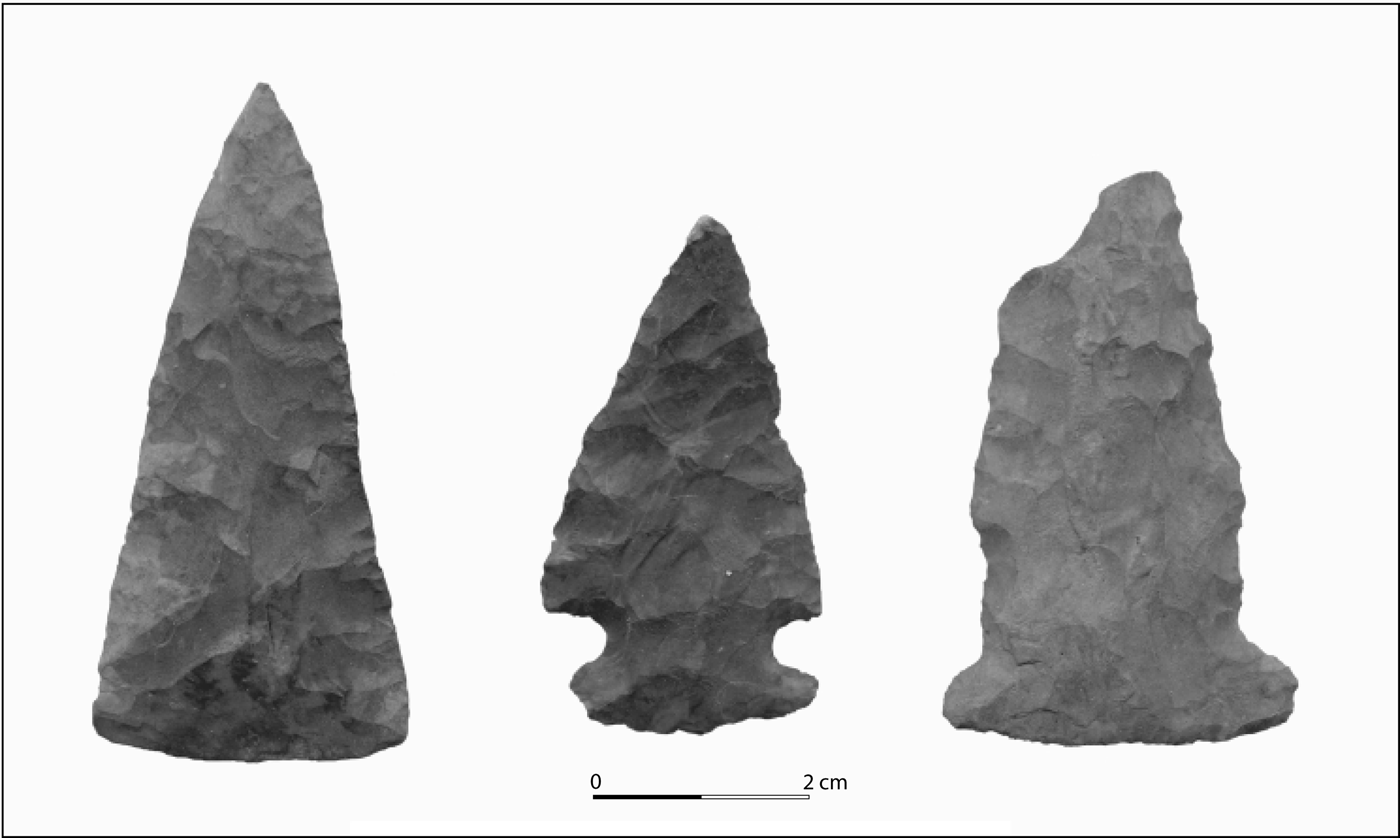
Sediment samples were collected from five pits, three postholes, and a hearth at Tutela Heights, but charred plant remains were recovered only from Feature 90. Feature 90 is about 25 m northwest of the site center and measures 87 cm long, 78 cm wide, and 22 cm deep with three layers (Figures 2–4). All precontact artifacts in Feature 90 (the projectile point, complete biface, and stone flakes) were recovered from Layer 1, the upper surface of the pit (Figure 3). Six sediment samples of equal volume, totaling 1.5 L, were taken for flotation processing, two from outside the pit, two from Layer 1, and one each from Layers 2 and 3. This sample represents roughly 20% of the feature fill. The remainder of the fill was screened through 3.0 mm mesh to facilitate small artifact recovery. Items in the feature fill include 1 small unidentified mammal fragment, 7 formal tools, and 14 pieces of debitage. The tools included a complete biface and a projectile point. The biface consists of a thin, refined, triangular biface produced from Onondaga chert, exhibiting collateral flaking, a beveled margin, and basal retouch, consistent with the attributes of the typical Meadowood biface (cache blade; Figure 5 left; Granger Reference Granger, Engelbrecht, Grayson and White1978a; Ritchie Reference Ritchie1971). The projectile point is a thin, side-notched point manufactured from Onondaga chert and exhibits a convex base and transverse ventral flaking. Its morphology is consistent with Meadowood side-notched projectile points (Figure 5 center; Ritchie Reference Ritchie1971). Three other tools were recovered from deeper within the feature fill: a biface, a ground stone adze, and a whetstone. One of them is a Meadowood projectile point produced from Onondaga chert (Figure 5 right). The ground stone adze is typical of the Middle Archaic through Early Woodland period (6000 cal BC–AD 1; Ellis et al. Reference Ellis, Timmins, Martelle, Emerson, McElrath and Fortier2009; Granger Reference Granger1978b). Feature 90 is the only verified Meadowood feature at Tutela Heights.
Meadowood biface (left) and projectile points (center and right) from Feature 90 (ca. 3000 BP). Photograph courtesy of Archaeological Services Inc.

Plant Remains
The light fractions for each of the six samples were weighed and screened through 2.0 mm, 1.3 mm, and 0.4 mm geological sieves. No heavy fraction resulted. The analysis followed procedures detailed in Crawford (Reference Crawford1983, Reference Crawford, Marquardt and Watson2005). Initial sorting and identification were accomplished using an OMAX trinocular stereo microscope. Separation of Chenopodium types and diameter measurements were obtained with a Nikon SMZ1000 and DS-Ri1 camera, a JEOL JSM-6610LV scanning electron microscope, and a KEYENCE digital microscope.
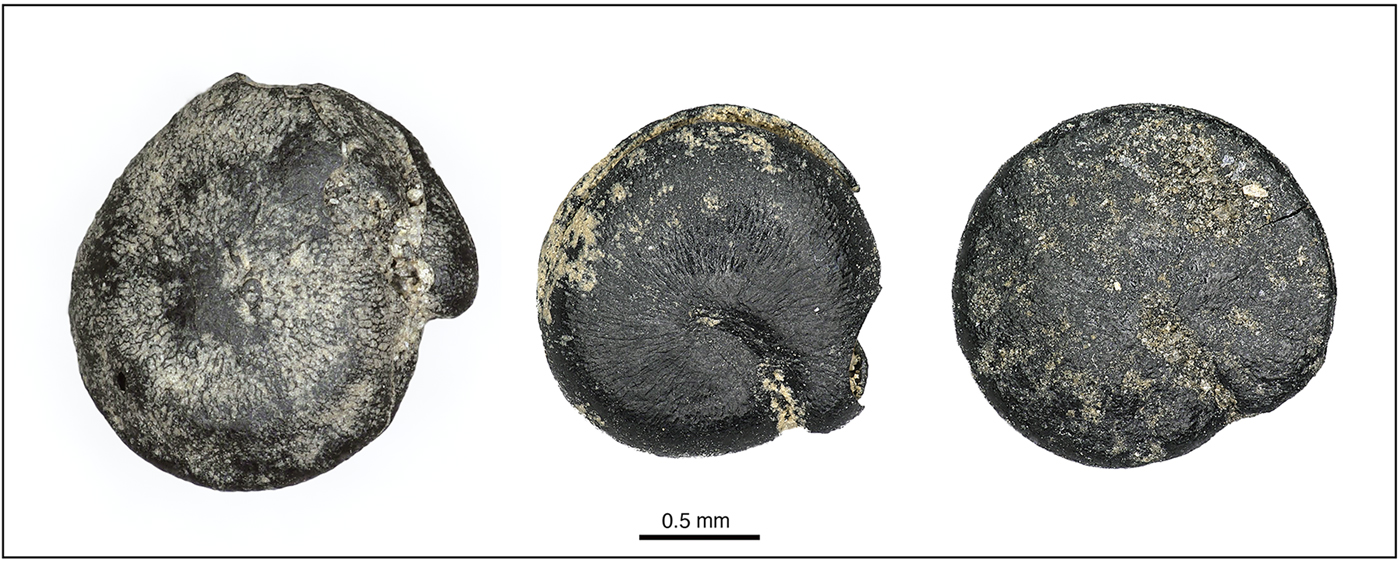
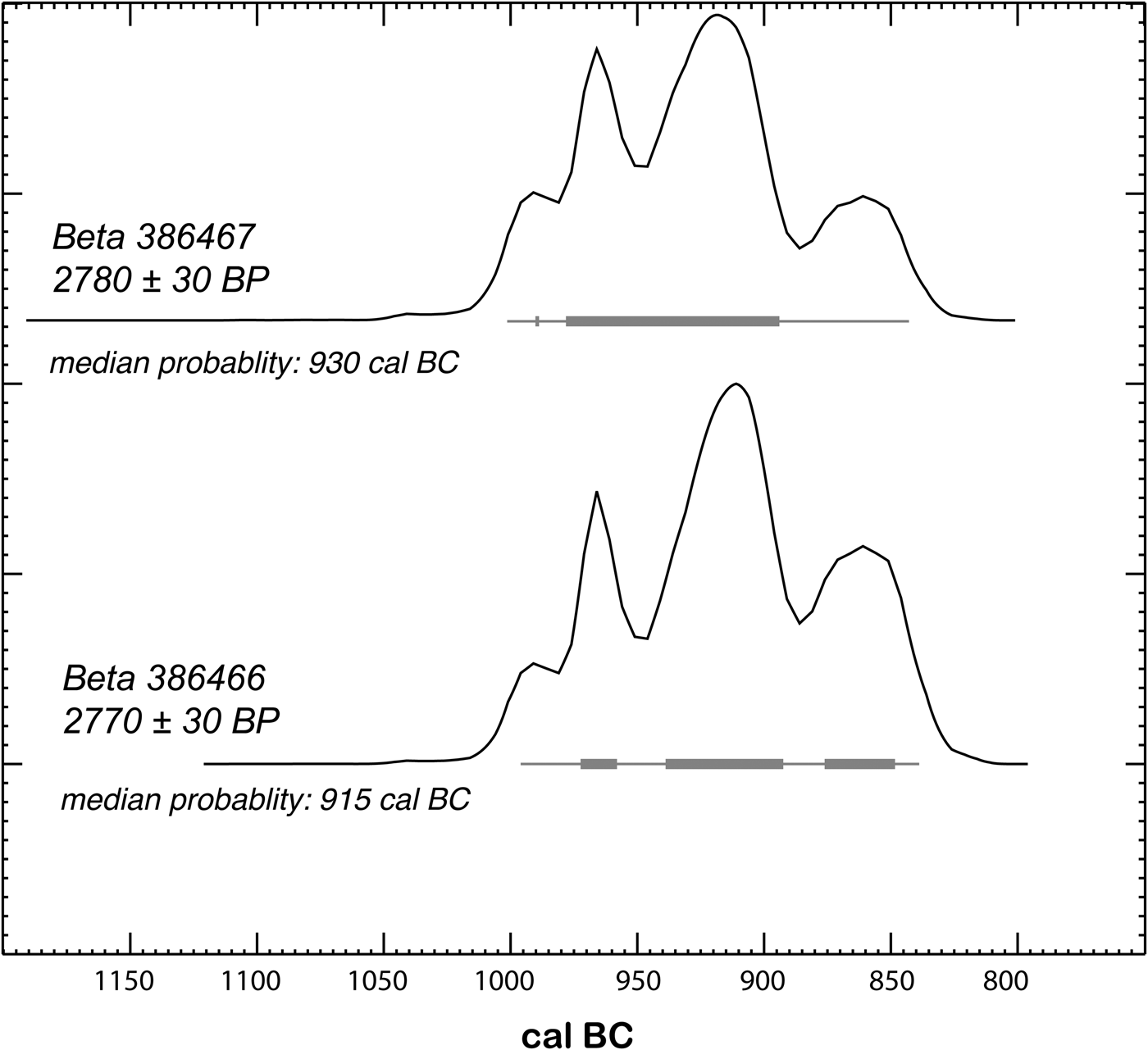
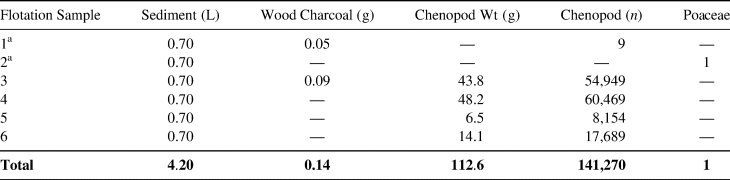
The charred sample is nearly entirely seeds; wood charcoal comprises only 0.3% of the sample (Table 1). We estimate that a little more than 141,000 charred seeds were recovered. This represents a remarkable density of 50,450 seeds/L for the four samples taken from inside the pit (Table 1). Chenopod seeds in the two control samples have a density of 6.4 seeds/L, the low quantity (one control sample is sterile) probably representing spillover from the pit. The seed number estimate is based on counting and weighing a subsample of 1,200 chenopod and extrapolating the total number. The seeds are all Chenopodium berlandieri except for a single grass (Poaceae) caryopsis from a control sample (Figures 6 and 7). AMS radiocarbon assays on two separate Chenopodium berlandieri seeds are 2770 ± 30 BP (Beta-386466) and 2780 ± 30 BP (Beta-386467) and have median probabilities of 915 and 930 cal BC (Figure 8). The dates and projectile point types are consistent with the early Meadowood.
Scanning electron microscope images of Tutela Heights Chenopodium berlandieri. Top left: intermediate, weedy type with thick seed coat split open along suture, prominent beak, and reticulate surface pattern. Top right and bottom row: C. berlandieri subsp. jonesianum. Top right: radiating, elongate alveolate pattern on the thin seed coat and less prominent beak; bottom row left: two seeds adhering along one side showing truncate cross section as well as variation in seed coat thickness and margin configuration that varies from flattened to slightly rounded; bottom row right: detail of alveolate pattern and seed coat cross section. Photographs by Gary W. Crawford and Anna Soleski.

Computational images obtained with a KEYENCE VHX-6000 microscope. Tutela Heights Chenopodium berlandieri subsp. jonesianum (left) with elongate, alveolate seed coat and Chenopodium berlandieri subsp. berlandieri (center) with thick, ruptured seed coat and prominent beak. Chenopodium simplex from the Late Archaic McIntyre site, Ontario (right). Photographs by Gary W. Crawford and Celio Baretto (Royal Ontario Museum).

AMS radiocarbon dates from Tutela Heights, Feature 90 calibrated with CALIB REV7.1.0 using IntCal 2013 (Reimer et al. Reference Reimer, Bard, Bayliss, Beck, Blackwell, Ramsey, Buck, Cheng, Edwards, Friedrich, Grootes, Guilderson, Haflidason, Hajdas, Hatté, Heaton, Hoffmann, Hogg, Hughen, Kaiser, Kromer, Manning, Niu, Reimer, Richards, Scott, Southon, Staff, Turney and van der Plicht2013; Stuiver et al. Reference Stuiver, Reimer and Reimer2018). The uncalibrated ages are based on the Libby 5,568 year half-life. The 2σ range for Beta-386466 is 975–830 cal BC (δ = −25.9‰) and for Beta-386467 is 1005–840 cal BC (δ = −24.8‰).

Summary of Flotation Sample Contents from Tutela Heights, Feature 90.

aControl sample, immediately outside Feature 90.
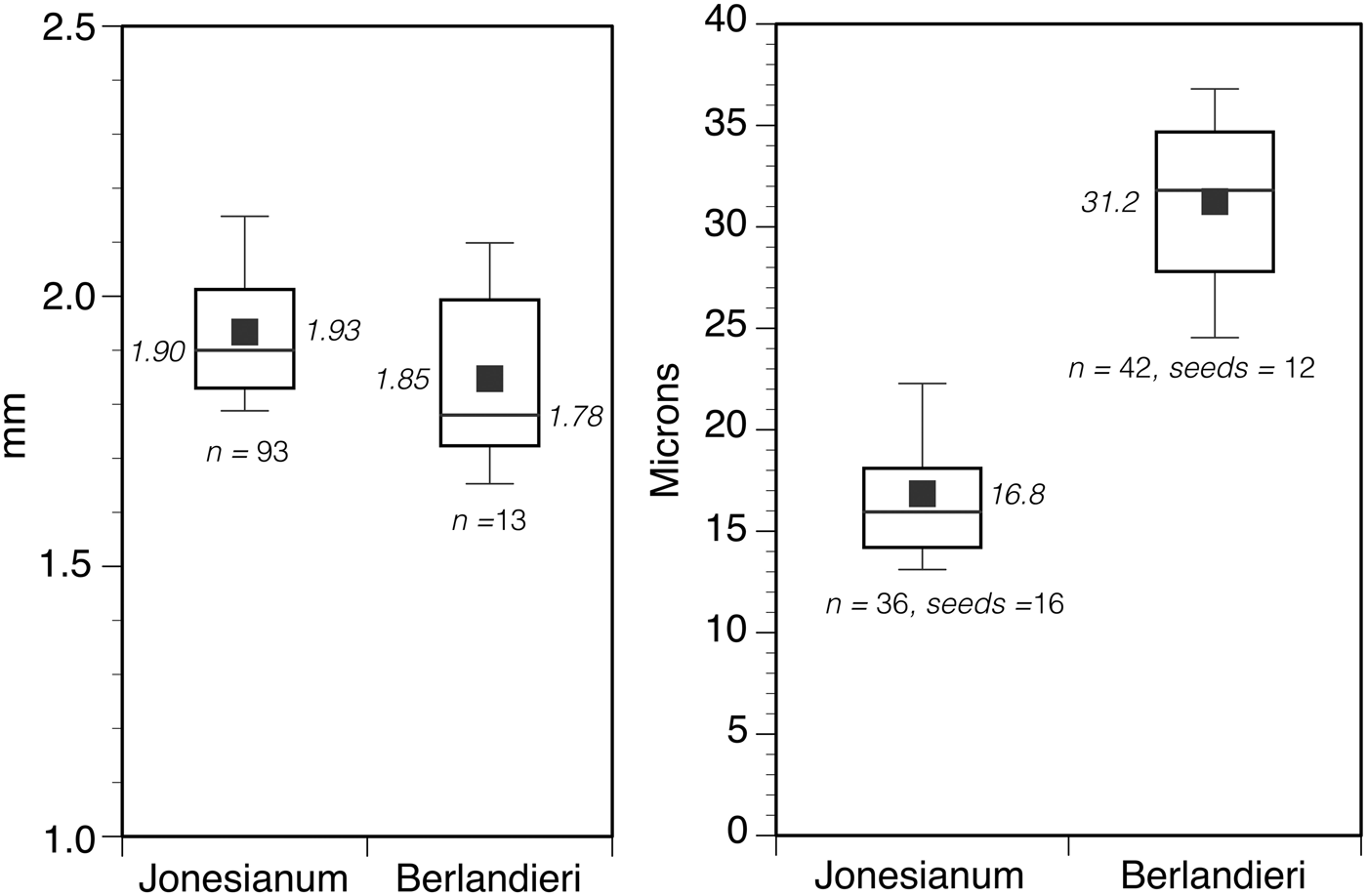
Thin testa (seed coat) Chenopodium seeds comprise most of the sample. Most, but not all, are missing a significant portion of the testa that would have covered the embryo. The margins of the seeds with a significant degree of retained testa are truncate, and many of the incomplete testa specimens have enough tissue to indicate that the testa rests closely against the embryo, so they are clearly truncate margined too. The seed coats are relatively smooth on one side and alveolate (pitted) on the other. The seed coat thickness averages 16.8 microns (n = 36) and the mean diameter (n = 93) is 1.93 mm (Figure 9). Two types of domesticated chenopod are known in ENA, black and a pale-seeded. Both types were present by 850 cal BC (Smith and Yarnell Reference Smith and Yarnell2009). The Tutela Heights chenopod is the black-seeded type Chenopodium berlandieri subsp. jonesianum. The seed coat thickness ranges from 10.9 to 26.4 microns, averages 16.8 microns (Figure 9), and is similar to that of other populations (e.g., Ash Cave, 33HO1; 14.9 microns; Smith Reference Smith1985). Fifty specimens from Riverton (11CW170) are 12.6–15.2 microns (Smith and Yarnell Reference Smith and Yarnell2009). The mean diameter (1.93 mm) of the Tutela Heights population is larger than any other C. berlandieri subsp. jonesianum population (e.g., Riverton: 1.2–1.6 mm; Ash Cave: 1.87 mm). The larger mean diameter of the Tutela Heights seeds fits the trend predicted by the south to north gradient of increasing seed diameters noted by Smith (Reference Smith1985) if the chenopod from Tutela Heights was grown somewhere from Ohio through southern Ontario.
Box plots of Chenopodium diameters and testa thicknesses: right, seed diameters (mm) of thin testa Chenopodium berlandieri var. jonesianum and the wild/weedy C. berlandieri subsp. berlandieri; left, seed coat thickness of Chenopodium berlandieri subsp. jonesianum and C. berlandieri subsp. berlandieri (microns). The top, bottom, and line through the middle of the box correspond to the top quartile, bottom quartile, and median respectively. The black square is the mean. The whiskers on the bottom extend from the 10th percentile and top 90th percentile.

A second type of chenopod is a variant of Chenopodium berlandieri subsp. berlandieri. It is extremely rare in the assemblage. During the 1980s, these seeds were classified as C. bushianum, a distinct North American species, but this taxon is now classified as Chenopodium berlandieri subsp. berlandieri var. bushianum (USDA 2018). It has well-preserved, mostly intact seed coats with radial pitting and, in some cases, an alveolate seed coat (Figures 6 and 7). The seeds are partially open along the suture that joins the two halves of the testa, exposing the endosperm and embryo. The seeds have weakly developed beaks. The testa thicknesses average 31 microns (n = 42; Figure 9). Their testa is thinner than that of seeds of the wild type, so this chenopod is a C. berlandieri that is neither wild nor domesticated; that is, an intermediate phenotype. The margins on most of these seeds are slightly truncate to rounded, a consequence of testa that are thinner than the wild phenotype. Nearly all archaeological Chenopodium berlandieri collections are dimorphic, seed coat thickness being the main distinction (Gremillion Reference Gremillion1993).
Mean and median seed diameters of the two types in the Tutela Heights assemblage indicate the thin testa type is only slightly larger than the thick testa type (C. berlandieri subsp. jonesianum has a mean of 1.93 mm and median of 1.90 mm; n = 93, and C. berlandieri subsp. berlandieri has a mean of 1.85 mm and median of 1.78 mm; n = 13), unlike other assemblages that are significantly smaller than the domesticated phenotype (Gremillion Reference Gremillion1993; Smith Reference Smith1985). However, well over half the specimens are smaller than the domesticated examples (Figure 9). The diameter assessment is not conclusive because so few of the weedy type were measurable. The seed margins of the weedy form are truncate in some portions of the seed perimeter but not others, and the occasional alveolate seed coat makes it difficult to separate the two types. Most of the domesticated specimens are incomplete, with the portion of the seed coat covering the embryo missing. The seed coat thicknesses overlap very little, but in some instances (fewer than 10%) are similar at the upper range of the domesticated subspecies and lower range of the weedy subspecies. These details indicate that the Tutela Heights cache is not as clearly dimorphic as the seed coat thicknesses suggest. The intermediate and domesticated types grade one into the other. The general consensus is that the thicker, intermediate seed coat chenopods represent a commensal weed form of C. berlandieri subsp. berlandieri (Gremillion Reference Gremillion1993; Smith Reference Smith1985). The intermediate characteristics may be the result of the two forms hybridizing (Gremillion Reference Gremillion1993).
In contrast, the Late Archaic McIntyre chenopod seeds (C. gigantospermum syn. C. simplex; Yarnell Reference Yarnell and Johnston1984) do not have prominent beaks, nor do the seed coats have prominent pitting, so they are easily distinguished from C. berlandieri (Figure 6). Chenopod from Feature 210 at the Grand Banks site (AfGx-3; ca. cal AD 1000), on the other hand, are C. berlandieri and have the characteristic alveolate seed coats and prominent beaks. Seed coat thickness is about 33–34 microns, so is similar to the Tutela Heights commensal weed. Chenopod seeds are a small percentage of plant remains assemblages from most sites postdating cal AD 1000 in Ontario. They all appear to be C. berlandieri, but no large deposits have been found despite routine flotation sampling at most Iroquoian sites over the last three decades. A few specimens found at Late Woodland sites in ongoing projects at the University of Toronto appear to be the domesticated phenotype, but analysis is just beginning. Until we can properly document them and assess their relative abundance in these collections, we can say little about their significance other than the crop appears to have been present in Ontario during the Late Woodland.
Discussion
The contents of Feature 90 at Tutela Heights represent a stored cache of processed/winnowed domesticated chenopod. The cache from inside Feature 90 contains no other charred plant remains. Two types of chenopod, primarily the crop along with a few commensal weed seeds, would have been harvested together. Fecal samples from Salts Cave, Kentucky (15HT4), contain both types of seeds, so it appears that they were normally eaten together (Gremillion Reference Gremillion1993). The low number of weedy chenopod seeds in the Tutela Heights sample is evidence that harvesting excluded most of the weed and that the harvested population was relatively isolated from the commensal weed type.
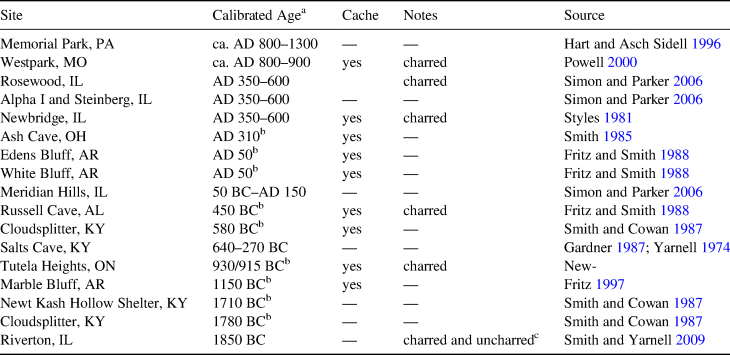
Reports of C. berlandieri subsp. jonesianum from the Late Archaic/Early Woodland transition are rare in North America (Table 2). The oldest records of C. berlandieri are from Riverton, Illinois (1800 cal. BC), Cloudsplitter (15MF36; direct AMS date with a median probability of 1780 cal BC), and Newt Kash Hollow Shelter (15MF1; direct AMS date with a median probability of 1715 cal BC) in Kentucky. Within 500 years, domesticated chenopod distribution had expanded west to Arkansas (Table 2), indicating that the crop was becoming a valued commodity over a wider area. Shortly thereafter, domesticated chenopod made its way to southern Ontario, about 800 km north of Salts Cave (640–270 cal BC), and Cloudsplitter in Kentucky (Table 2). The Tutela Heights chenopod is slightly older than the earliest Salts Cave chenopod and overlaps with the sample from Cloudsplitter. By AD 1–400, chenopod was exceptionally important throughout a region that encompassed Arkansas, Alabama, Kentucky, Illinois, and Ohio, yet seems to have been absent north of these states at the time. This may simply be an artifact of paleoethnobotanical research intensity.
Significant Chenopodium berlandieri subsp. jonesianum Reports in Eastern North America.

aMedian(s).
bAMS or conventional date on Chenopodium seeds.
c55 charred (similar to the Tutela Heights type) and 540 uncharred seeds of the pale-seeded cultivar.
Caches of chenopod similar to the cache at Tutela Heights have been recovered from at least seven other sites. In Arkansas, a bag of chenopod was recovered from Marble Bluff (3SE1), and two gourds from White Bluff, Arkansas, contained a large quantity of chenopod (Fritz and Smith Reference Fritz and Smith1988). To the east, 7 L of chenopod from Cloudsplitter, Kentucky, date to the Early Woodland period (Smith and Cowan Reference Smith and Cowan1987; Smith and Yarnell Reference Smith and Yarnell2009). To the north, a deposit of 28,458 chenopod seeds is reported from Ash Cave, Ohio (Smith Reference Smith1985). A mixed assemblage of erect knotweed and chenopod seeds from the early Late Woodland Newbridge site, Illinois (11GE456), numbers about five million (Styles Reference Styles1981). The southeasternmost cache is from Russell Cave, Alabama (1JA940), where about 50,000 seeds are reported (Fritz and Smith Reference Fritz and Smith1988). Finally, the latest cache is from the Emergent Mississippian Westpark site (11MO96) in Missouri where a pit contained roughly 22,000 chenopod seeds (Figure 1; Table 2; Powell Reference Powell2000).
In many cases, the recovered seeds are only a small portion of what may have been millions of seeds (Fritz Reference Fritz and Scarry1993). Only the Russell Cave, Westpark, Newbridge, and Tutela Heights caches are charred (Table 2). We can only speculate on the genesis of the cache at Tutela Heights. The context, being a small, shallow pit, is likely a primary deposit, so offers little or no support for it being the result of a ceremony. Styles (Reference Styles1981) ponders overparching, spontaneous combustion, intentional burning, or some form of indirect carbonization related to a later heating event to explain the charred cache at Newbridge. Feature 90 may have been a shallow storage pit with a single, segregated taxon similar to features at Westpark and other sites in the American Bottom (Powell Reference Powell2000). The slight reddening of the sediment in Feature 90 (Figure 9) suggests that the chenopod cache was charred in situ. If the Tutela Heights cache was stored food or seed for planting the following spring, the charring event represented significant waste. We have no way of knowing whether the cache represents all or a portion of what was originally placed in the pit.
The Meadowood inhabitants of southern Ontario are the earliest and, so far, possibly the only precontact people with the crop in Canada. Whether the chenopod in the cache was locally grown or grown outside Ontario and imported as an exchange item is ambiguous. For example, the ecological indicators of cultivation (e.g., specific anthropogenic annual plants identified in Ontario Late Woodland collections) are not present, nor is there any evidence of long-term habitat change. The size of the Tutela Heights seeds, being the largest in a south to north size gradient, is additional evidence that the crop grew further north than other domesticated chenopod at the time, if it was not grown in Ontario. This still does not clarify where it was grown. If the seed size is any indication, the source of the chenopod seeds may lie in the Adena heartland. The only other evidence for chenopod in Ontario dating earlier than Tutela Heights is from the Late Archaic component of the McIntyre site (Yarnell Reference Yarnell and Johnston1984). However, the chenopod recovered from McIntyre is the native C. simplex rather than C. berlandieri. Until now, the northernmost and earliest domesticated chenopod in the Northeast is from the Early Clemson Island component of the Memorial Park site (Table 2), but the sample consists of only seven seeds (Hart and Asch Sidell Reference Hart and Asch Sidell1996). The C. berlandieri seeds from the early Late Woodland Princess Point culture are an intermediate phenotype.
The precise mechanism that brought chenopod into southern Ontario during the Early Woodland is not clear. Early Woodland peoples in the Great Lakes region engaged in interregional exchange and shared mortuary ceremonialism with their contemporaries in the Midwest (Granger Reference Granger, Engelbrecht, Grayson and White1978a, Reference Granger1978b; Spence Reference Spence, Ericson and Earle1982). Strong connections extend throughout the Northeast (Taché Reference Taché2011b), and as far east as New Brunswick (Turnbull Reference Turnbull1976). The Meadowood complex, according to Taché (Reference Taché2011a:41–42), was a macroregional interaction sphere involving the sharing of socially valued goods. This interaction is likely a continuation of Late Archaic exchange systems that focused on the distribution of exotic items such as copper tools, marine shells from the Atlantic coast that are fashioned into necklaces, banded slate pendants and birdstones, and cubes of galena, a lead mineral from sources in New York (Ellis Reference Ellis, Munson and Jamieson2013:42–43; Spence Reference Spence, Ericson and Earle1982). Until now, evidence of Meadowood interaction has been limited to these exotic inorganic items associated with burials.
The discovery of Chenopodium berlandieri subsp. jonesianum is clear evidence that an exotic, perishable food was exchanged in the Late Archaic–Early Woodland interaction network along with silver, shell, copper, and galena. This deeply rooted interaction was the likely mechanism that brought domesticated chenopod to southern Ontario. Until now, evidence of such perishable exchange items has been elusive. The chenopod from Tutela Heights is, so far, the earliest record of a nonlocal, perishable resource being imported into Southern Ontario. Furthermore, exotic items have so far only been recovered from mortuary contexts in Ontario. The example here is particularly significant because none of the Indigenous features at Tutela Heights are related to mortuary ritual. Based on the evidence of this single cache, we suggest that exotic perishable goods had broader use and social meaning and were not solely limited to, or associated with, mortuary ritual. Of course, domesticated chenopod played a more mundane role during the Ontario Early Woodland if it was an introduced crop that was grown at Tutela Heights.
The legacy of Early Woodland chenopod in the province is unknown. If C. berlandieri subsp. jonesianum was an Early Woodland crop in Ontario, why would there be no record of continued cultivation? In fact, Late Woodland Chenopodium specimens appear to have intermediate characteristics similar to the commensal weed (Crawford and Smith Reference Crawford, Smith and Minnis2003), and ongoing research suggests that some seeds belong to the domesticated phenotype. The late precontact chenopod seeds from the Westmorland-Barber site in Tennessee are the intermediate, weedy type too, leading to speculation that, if chenopod was diminishing in value, selection pressures that maintained the crop were relaxed when other crops, such as maize, were more readily available (Gremillion Reference Gremillion1993). Wilson (Reference Wilson1990) notes that the C. berlandieri complex is represented only in contemporary fields in eastern North America and only by Chenopodium berlandieri subsp. berlandieri, a crop that is extinct today. The modern agricultural weed may be the surviving remnant of the precontact crop-weed complex. The preliminary observation that C. berlandieri subsp. jonesianum was not entirely absent during the Late Woodland in Ontario, and that Late Woodland chenopods appear to be intermediate rather than wild, is consistent with this hypothesis. Future research should explore the extent to which domesticated chenopod was a diminishing resource during the Ontario Late Woodland. Finally, C. berlandieri subsp. jonesianum likely had a much broader distribution that included the Northeast during the Early Woodland, but evidence for the crop will be elusive until more systematic paleoethnobotanical research is undertaken at Late Archaic and Early Woodland sites located between Kentucky and Ontario.
Acknowledgments
The project was funded and otherwise supported by Walton Development and Management. We are grateful for the assistance of two First Nations monitors, Rose Miller and Tyler Greene, from the Six Nations of the Grand River. George Kretschmann, engineering technologist, and Anna Soleski, doctoral candidate, both in the Department of Earth Sciences, University of Toronto, helped obtain images with the JEOL JSM-6610LV scanning electron microscope. Celio Baretto provided technical assistance obtaining images with the KEYENCE VHX-6000 microscope at the Royal Ontario Museum in Toronto. Marie-Annick Prévost prepared the French language abstract.
Data Availability Statement
The chenopod specimens are curated at the Archaeological Services Inc. facility, 200-2321 Fairview Street, Burlington, Ontario. The raw data are available upon request from Jessica L. Lytle, JLytle@asiheritage.ca.