INTRODUCTION
During the end of the 2nd millennium BC in the Eastern Mediterranean the social and political organization changed, resulting in weakening of the Hittite and Egyptian empires, and Aegean centers. During this period, according to some scholars, foreign groups of people settled along the coastlines of the Levant, which resulted in the appearance of new material culture, locally produced, and associated typologically to Aegean styles (Dothan Reference Dothan1982; Ben-Shlomo et al. Reference Ben-Shlomo, Shai, Zukerman and Maeir2008; Faust and Lev-Tov Reference Faust and Lev-Tov2011; Hitchcock and Maeir Reference Hitchcock and Maeir2013; Killebrew and Lehmann Reference Killebrew and Lehmann2013; Maeir et al. Reference Maeir, Hitchcock and Horwitz2013). Other scholars propose cultural exchange rather than migration to explain the appearance of new material culture (Sherratt Reference Sherratt2013).
Based on the extensive studies in Tel Ashdod and Tel Miqne-Ekron (located on the coastlines of the southern Levant), a sequence of the early styles of locally produced Aegean-like material culture was established, and their appearance was associated to the historical arrival of the Philistines (Albright Reference Albright1932; Dothan Reference Dothan1982; Dothan and Zukerman Reference Dothan and Zukerman2004). The early styles were labeled specifically as “Philistine 1” or Monochrome style, and the developed styles, found in larger distributions (Gilboa et al. Reference Gilboa, Cohen-Weinberger and Goren2006), were labeled as “Philistine 2” or Philistine Bichrome style (Dothan et al. Reference Dothan, Gitin and Zukerman2006).
The appearance of the new material culture is limited at first to the coastlines of Canaan (Mazar Reference Mazar2007), creating a complex material culture situation, which is reflected in the different terminologies used in relation to the Late Bronze to Iron Age (LB/Ir) transition (Asscher et al. Reference Asscher, Cabanes, Hitchcock, Maeir, Weiner and Boaretto2015b). One of the main reasons for the different annotations is that the local Canaanite material culture does not change much during this period (Martin Reference Martin2013), and the presence of early Aegean-style pottery marks the LB/Ir transition from the material culture point of view. Therefore, the terminology of the LB/Ir transition differs between coastal sites in Philistia and the rest of Canaan (Finkelstein Reference Finkelstein1995; Bunimovitz and Yasur-Landau Reference Bunimovitz and Yasur-Landau1996; Dothan and Zukerman Reference Dothan and Zukerman2004; Mazar Reference Mazar2007; Killebrew and Lehmann Reference Killebrew and Lehmann2013).
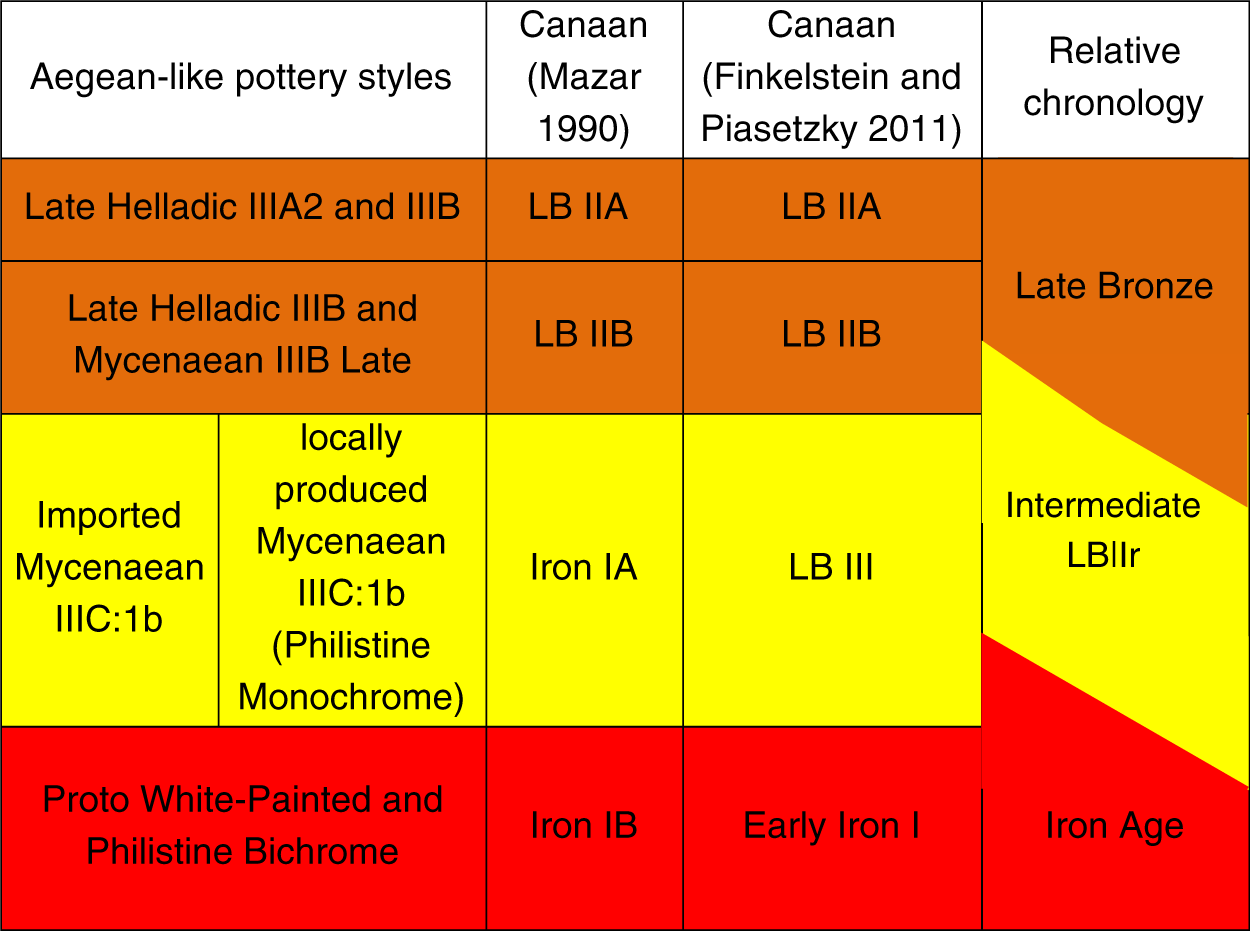
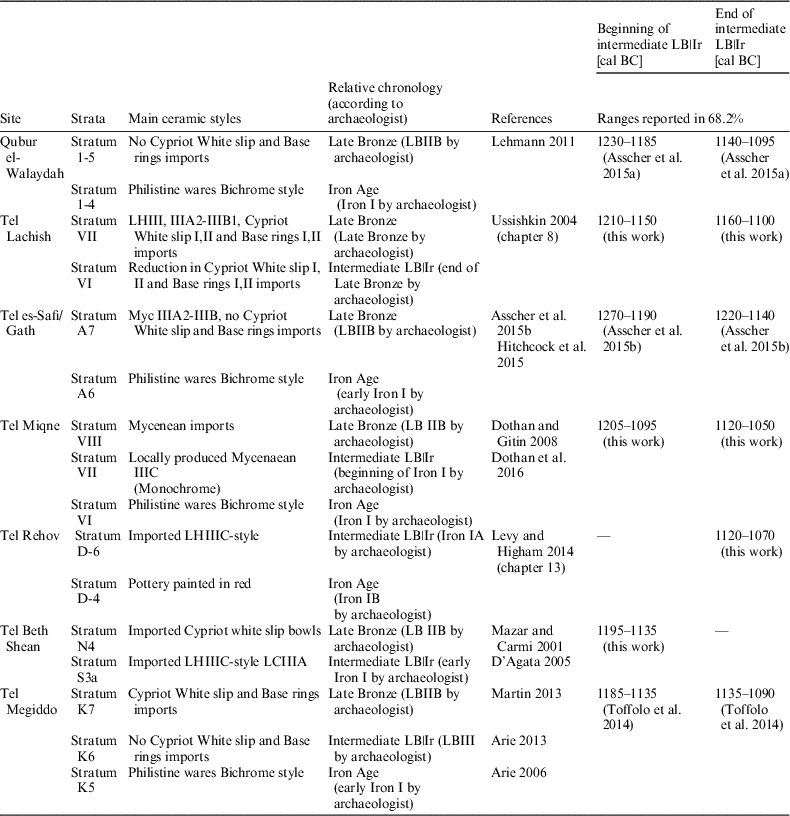
Table 1 summarizes the relative chronology of the Aegean-like pottery styles in Canaan (adapted from Killbrew and Lehmann Reference Killebrew and Lehmann2013). Different archaeologists report that the Iron Age started following the LB IIB period (LBIIB/Iron IA; Mazar Reference Mazar1990), while others report that the Iron Age started following another period after the LBIIB, namely LB III (LB III/Early Iron I; Finkelstein and Piasetzky Reference Finkelstein and Piasetzky2011). Therefore, as the transition might be a long period, we use the notation “intermediate LB|Ir” for the period that follows the Late Bronze IIB in Canaan, to acknowledge the complexity of the relative chronology during this time.
Pottery styles, periods, and their annotations during the Late Bronze (brown/top row), Intermediate LB|Ir (yellow/middle row), and Iron Age (red/bottom row) in Canaan (adapted from Killbrew and Lehmann Reference Killebrew and Lehmann2013). (See online version for colors.)

Based on Egyptian historical records mentioning the arrival of the “Sea People” and Egyptian artifacts that are associated with the appearance of Aegean-style material culture (Master et al. 2011), the historical chronology puts the beginning and end of the intermediate LB|Ir period during the first half of the 12th century BC, at the time of the 20th Egyptian Dynasty reign in Canaan (Albright Reference Albright1932; Finkelstein Reference Finkelstein1998; Mazar Reference Mazar2007; Asscher et al. Reference Asscher, Lehmann, Rosen, Weiner and Boaretto2015a).
We hypothesize that the differences in terminologies of the Intermediate LB|Ir period (Table 1) reflect not only differences in the Aegean-style pottery distributions in Canaan, but also discrepancies in the absolute time frame. To test this hypothesis we evaluate these discrepancies by determining the absolute chronology of the beginning and the end of the intermediate LB|Ir separately for different sites in Canaan (site-by-site appraoch).
14C chronologies during this period show poor precision due to wiggles in the 14C calibration curve (Reimer et al. Reference Reimer, Bard, Bayliss, Bec, Blackwell, Bronk Ramsey, Buck, Cheng, Edwards, Friedrich, Grootes, Guilderson, Haflidason, Hajdas, Hatté, Heaton, Hoffmann, Hogg, Hughen, Kaiser, Kromer, Manning, Niu, Reimer, Richards, Scott, Southon, Staff, Turney and van der Plicht2013), which cause a 200-year plateau between the 13th and 11th centuries BC. Recent 14C-based chronological studies use different strategies to improve the precision of the chronology of the intermediate LB|Ir period for each site, to increase the resolution within the plateau. One strategy is to directly 14C date transitional layers, and then use historical considerations to constrain the transition date (Kaniewski et al. Reference Kaniewski, Campo, Lerberghe, Boiy, Vansteenhuyse, Jans, Nys, Weiss, Morhange, Otto and Bretschneider2011). A second strategy is to directly incorporate historical constraints, in addition to the sequence of 14C dates of different strata, and use Bayesian statistics to model the transition range (Finkelstein and Piasetzky Reference Finkelstein and Piasetzky2009; Fantalkin et al. Reference Fantalkin, Finkelstein and Piasetzky2015). A third strategy is to 14C date stratified layers before, during, and after the transition, and then use Bayesian statistics to model the transition range (Manning et al. Reference Manning, Weninger, South, Kling, Kuniholm, Muhly, Hadjisavvas, Sewell and Cadogan2001; Manning 2006–Reference Manning2007; Toffolo et al. Reference Toffolo, Arie, Martin, Boaretto and Finkelstein2014; Asscher et al. Reference Asscher, Lehmann, Rosen, Weiner and Boaretto2015a, Reference Asscher, Cabanes, Hitchcock, Maeir, Weiner and Boaretto2015b). Note that the first two strategies mix chronological inputs (14C dates and historical data). The third strategy only uses the stratigraphic information and the dates as input, and then compares the results to the historical information. We consider the third strategy most appropriate for our site-by-site approach, as the 14C dates are not biased by the historical dates that are found in only a few sites, and represent the age of the archaeological layers.
METHODS
Establishing an absolute chronology for each site requires an integrated approach that combines a systematic analysis of the dated contexts, their stratigraphic relations, and evaluation of the 14C data to identify possible outliers and noise that will influence the intermediate LB|Ir transitions dates. A Bayesian model is then constructed from the 14C dates, sequenced according to the stratigraphy in each site and the transition ranges are determined. Recent studies that took this approach, with relevant associated material culture of the intermediate LB|Ir, are Tel Megiddo (Toffolo et al. Reference Toffolo, Arie, Martin, Boaretto and Finkelstein2014), Tell es-Safi/Gath (Asscher et al. Reference Asscher, Cabanes, Hitchcock, Maeir, Weiner and Boaretto2015b), and Qubur el-Walaydah (Asscher et al. Reference Asscher, Lehmann, Rosen, Weiner and Boaretto2015a). While surveying other sites that report 14C dates from the LB|Ir period, we noted that different sites contain different material cultures during the LB|Ir period, and that the stratigraphic relations between datable contexts are not always described with the same details. A suggested different methodology for selecting sites and contexts for chronological purposes was proposed by Finkelstein Reference Finkelstein2016 (Ägypten und Levante). The site selection criteria are as follows: solid stratigraphy, large exposure of the layers, datable materials from primary contexts, good control over ceramic typology, and continuity of depositions with no gaps. As sites have very different formation processes, diagenesis, and excavation methodologies, and those criteria are not all fulfilled. Each site therefore has its own strengths and weaknesses, and these need to be taken into consideration when using 14C dates to determine the chronology of the intermediate LB|Ir. We chose the sites based on the following guidelines:
1. We included sites with different pottery types in the transitional layers: (a) sites containing layers with LHIIIC imports, found in Tel Beth Shean (D’Agata et al. Reference D’Agata, Goren, Mommsen, Schwedt and Yasur-Landau2005; Mazar Reference Mazar2007; Yasur-Landau Reference Yasur-Landau2010; Mountjoy Reference Mountjoy2011); (b) locally produced Aegean-like pottery such as Philistine 1 and Philistine 2 (Dothan Reference Dothan1982) that were found in Tel Miqne-Ekron (Dothan and Zukerman Reference Dothan and Zukerman2004) and in smaller numbers in Tell-es-Safi/Gath (Maeir and Ehrlich Reference Maeir and Ehrlich2001) and Qubur el-Walaydah (Asscher et al. Reference Asscher, Lehmann, Rosen, Weiner and Boaretto2015a); and (c) sites with no imports nor locally produced Agean-like pottery were also incoporated as references for the intermediate LB|Ir local culture such as in Tel Lachish, Tel Megiddo, and Tel Rehov (Mazar and Carmi Reference Mazar and Carmi2001; Ussishkin Reference Ussishkin2004).
2. We incorporated sites in which the the relation between the dated contexts and the stratigraphy are reported in detail before, during, and after the intermediate LB|Ir. This will allow an increase in the resolution within the 13th–11th centuries BC plateau, using Bayesian analysis (Bronk Ramsey Reference Bronk Ramsey2009).
3. Only short-lived samples were incorporated in this study, to avoid the “old wood effect” (Sharon et al. Reference Sharon, Gilboa, Jull and Boaretto2007).
4. To establish an absolute chronology, a full sequence of well-dated ceramic assemblages is required for each site. We are aware that not all the sites in Canaan contain a full sequence of well-documented 14C dates in clear stratigraphic relations before, during, or after the intermediate LB|Ir. Gaps in the sequences at different sites were found as a result of actual occupational gaps or lack of datable remains found in situ. Sites that present gaps were incorporated in this study only if these gaps were securely anchored below and above by a sequence of dated contexts, which made it possible to simulate a gap in the Bayesian model, as if a full sequence of ceramic assemblages were found and dated.
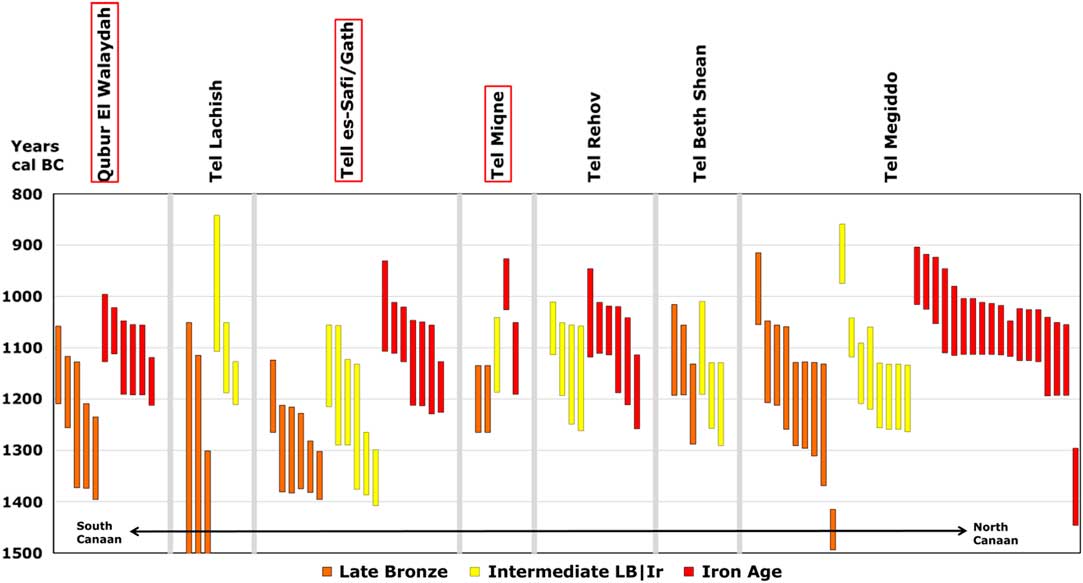
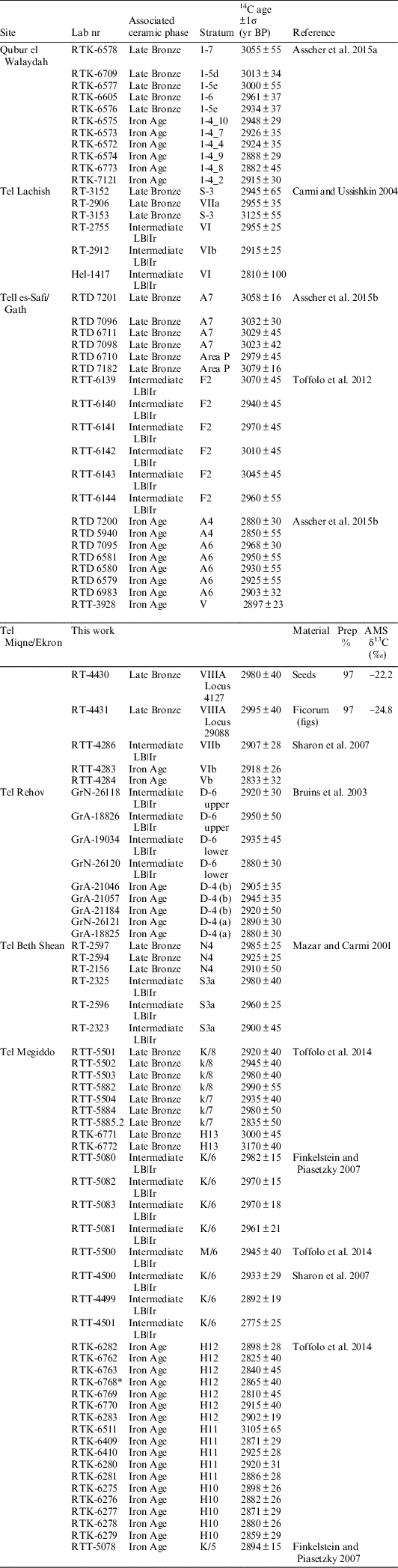
Table 2 summarizes available 14C dates of transitional strata in Canaan that follow these guidelines. Ceramic assemblages associated with the LB IIB period are referred to as the “Late Bronze Age,” LB III or Iron IA as “Intermediate LB|Ir,” Iron IB or early Iron I as the “Iron Age.” The relevant site 14C dates in Table 2 are illustrated in Figure 1 as ±1 σ (68.2% probability) calibrated ranges, and the site locations are shown in Figure 2.
Calibrated 14C date ranges, from the Late Bronze, Intermediate LB|Ir, and the Iron Age, based on associated pottery found locally at different sites in Canaan, arranged from south to north. Vertical bars represent the calibrated time range BC of individual dates (for ±1σ, 68.2% probability), colored according to associated material culture. See Table 2 for details of the 14C dates, associated strata, and references. Sites containing Aegean-like pottery from the intermediate LB|Ir (associated with the Philistines) are surrounded by a red line. (See online version for colors.)

Map of archaeological sites in Canaan that contain 14C dates in stratigraphic relations before, during, and after the intermediate LB|Ir.

Uncalibrated 14C dates for Late Bronze Age (LB IIB), Intermediate LB|Ir (LB III and Iron IA), and Iron Age (early Iron I and Iron IB). These dates are before and after the intermediate LB|Ir, based on associated pottery found locally at different sites in Canaan, arranged according to period. An * near the Lab nr indicates a cluster of charred seeds. Also reported are the strata, individual 14C dates, and references.

THE MODELS
The models in this study (see the appendix for run files) are based on Bayesian statistics using OxCal software v4.2.4 (Bronk Ramsey Reference Bronk Ramsey2009), with the calibration curve IntCal13 (Reimer et al. Reference Reimer, Bard, Bayliss, Bec, Blackwell, Bronk Ramsey, Buck, Cheng, Edwards, Friedrich, Grootes, Guilderson, Haflidason, Hajdas, Hatté, Heaton, Hoffmann, Hogg, Hughen, Kaiser, Kromer, Manning, Niu, Reimer, Richards, Scott, Southon, Staff, Turney and van der Plicht2013). Each model included all the 14C dates from the Late Bronze, intermediate LB|Ir period, and Iron Age, ordered in a sequence based on the stratigraphic information in the published reports. The sequence is then evaluated by the model agreement index, which shows how well the data fit the archaeologists stratigraphic interpretation, and the number of outliers. The transition dates for the intermediate LB|Ir were determined by the model with the highest agreement index at ±1σ (68.2% probability), assuming a continuous transition.
Outliers were identified based on the individual agreement index within the overall sequence (individual agreement indices of less than 60% are considered outliers). Only Tel Lachish contained two outliers that were also noted by the archaeologist (Carmi and Ussishkin Reference Carmi and Ussishkin2004), and they were excluded from the analysis.
Most dated materials were assumed to have been found in situ by the archaeologist and therefore represent the period with which they were associated. Dated materials were usually reported without further information regarding depositional processes and associated sediments. Depositional information helps to determine if the contexts are in situ by associating them to the sediments in which they were found (Boaretto Reference Boaretto2015). Therefore, we accepted models with no outliers and an agreement index above 60% to account the lack of information regarding depositional processes.
In the cases where gaps were found in the archaeological sequence, because of a lack of datable remains or a gap in occupation, we followed the procedure discussed in detail elsewhere (Asscher et al. Reference Asscher, Lehmann, Rosen, Weiner and Boaretto2015a). Briefly, a virtual gap is simulated to represent the cultural period that did not have reported dates. Then, by changing the gap length, the model agreement index and the number of outliers are monitored. The overall trend of the agreement index allows us to estimate the optimum time span for the gap, which produces the highest model agreement index and no outliers. Including a gap in the sequence would complete the sequence in absolute time frame and associated cultural periods for each site. Incorporating a gap enables a comparison of transition dates between sites that did not contain the full sequence.
RESULTS
Sites that contain 14C dates from secure contexts vary in the details of the stratigraphic relations between the contexts. We therefore discuss in detail the stratigraphic relations of the dated contexts in relation to determining the chronology of the intermediate LB|Ir period.
Tel Beth Shean
Tel Beth Shean is in the Jezreel valley of northern Caanan. Northern Canaan sites do not contain Aegean-like pottery, locally produced, on a large scale as occurs in Philistia. In Tel Beth Shean, a sequence of layers associated with the Late Bronze Age was found, including a governor’s Egyptian building from the end of the Late Bronze Age (Mazar and Carmi Reference Mazar and Carmi2001).
The strengths of the site in relation to dating the transition are that Egyptian finds such as the temple of Ramesses III, based on a statue of the king (Mazar Reference Mazar1990), link Stratum VI with the beginning of the 20th Dynasty (first half of the 12th century BC). Another strength is that the LB short-lived charred samples were found in a room associated with fire, and although they were not studied using microarchaeological indicators, it is assumed that the charred samples are in primary deposition. One weakness of the site is that there are no 14C dates for the Iron Age period, and only two contexts are relevant for dating the transition—one context is associated with the Late Bronze and the other to the intermediate LB|Ir. This provides a date for the beginning of the intermediate LB|Ir. Another weakness is that the stratigraphic relations between samples were based on associated cultural materials, since samples were collected in different areas: area S and area N.
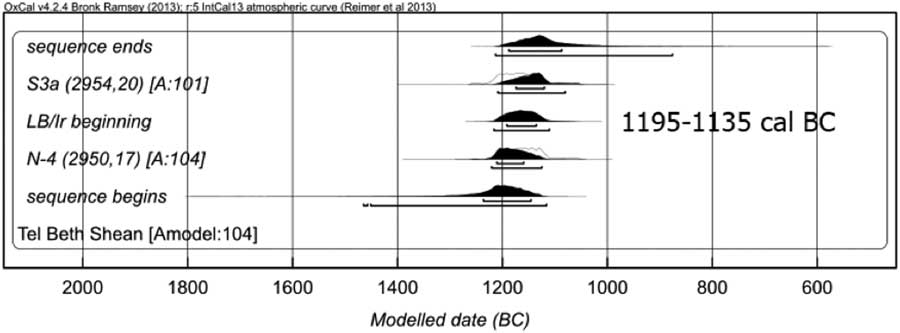
We used Bayesian statistics to model the 14C dates based on the associated stratigraphy (Mazar and Carmi Reference Mazar and Carmi2001). 14C dates from Stratum N-4 (associated with the LB IIB, containing a single imported Cypriot White Slip bowl) and Stratum S3a (associated to the following phase Iron IA, i.e. the intermediate LB|Ir) were used to determine the beginning of the intermediate LB|Ir (Mazar Reference Mazar2011). Three dates were obtained from a single assemblage of charred cereal grains in Stratum N-4: RT-2597, RT-2594, RT-2156 (see details in Table 2). Three dates were obtained from charred linen seeds and grains found in a small bin in Stratum S3a: RT-2325, RT-2596, RT-2323. The average combined dates (N-4: 2950±17 BP and S3a: 2954±20 BP) are positioned in a Bayesian model according to the stratigraphy based on material culture (Mazar and Carmi Reference Mazar and Carmi2001), shown in Figure 3. The modeled transition shows that the beginning of the intermediate LB|Ir in Tel Beth Shean is between 1195 and 1135 cal BC at the 1σ confidence level.
Calibrated and modeled dates from Beth Shean. Dates are arranged in a sequence from the LB IIB period (Stratum N-4 averaged dates) to the intermediate LB|Ir layers (Stratum S3a averaged dates). The modeled date of the beginning of the intermediate LB|Ir is between 1195 and 1135 cal BC at 1σ confidence level.
Tel Rehov
Tel Rehov is in northern Canaan, 7 km south of the site of Tel Beth Shean, in a region that did not contain Aegean-like pottery on a large scale as occurred in Philistia. In Tel Rehov, a sequence of layers associated with the Iron Age were 14C dated (Bruins et al. Reference Bruins, van der Plicht and Mazar2003).
The strengths of this site in relation to dating the transition are that a large sequence of short-lived samples from the intermediate LB|Ir layers and after the transition, were dated. This provides a date for the end of the intermediate LB|Ir. The stratigraphic relations between samples were based on architecture and associated cultural materials in a single area (area D). The weakness of the site is that contexts for dating were not studied using microarchaeological indicators to confirm that they were in primary deposition. Another weakness is that the Late Bronze period was not dated and that the stratigraphic relations between samples within the same stratigraphic layer were not described in detail.
We used Bayesian statistics to model the 14C dates reported by Bruins et al. (Reference Bruins, van der Plicht and Mazar2003), following the stratigraphic sequence (see dates from the intermediate LB|Ir in Table 2). We report the dates of Strata D-6, D-4, and D-3 as phases since the samples are not described in the original publication as from the same event, or a cluster, rather collected from the same layer or locus (Bruins et al. Reference Bruins, van der Plicht and Mazar2003: supplementary information). Therefore, the phase of Stratum D-6 lower (samples GrN-26120 and GrN-19034 gave an average of 2897±28 BP, associated with the intermediate LB|Ir since the associated material culture was similar to the one found in Tel Beth Shean layer S-3) were positioned below the phase of Stratum D-6 upper (samples GrN-26118 and GrN-18826 gave an average of 2928±26 BP). Dateable materials were not found in Stratum D-5 (associated to the Iron I). Then, the phase of D-4b (samples GrN-21046, Gr-N21057, and GrN-21184 gave an average of 2924±23 BP), D-4a (samples GrN-26121 and GrN-18825 gave an average of 2885±26 BP), D-3 (samples GrA-16757, GrA- 19033, GrA- 21044, GrA- 21056, and GrA- 21183 gave an average of 2831±19 BP) and D-2 (GrN-26112: 2805±15 BP) were sequenced according to the stratigraphy. The modeled transition of the end of the intermediate LB|Ir in Rehov is 1110–1050 cal BC at 1σ confidence level (Figure 4), and the model agreement is 138% with one outlier (Gr-N21057 in phase D-4b).
Calibrated and modeled dates from Tel Rehov (see details of the dates and associated strata in Table 2). Dates are arranged in a sequence from the intermediate LB|Ir (Stratum D-6) to Iron Age IIA (Stratum D-2). Dates are presented with their phase name, samples name, age before calibration and precision (in round brackets), and their agreement index (in square brackets). The modeled date of the end of the intermediate LB|Ir is 1110–1050 cal BC at 1σ confidence level.

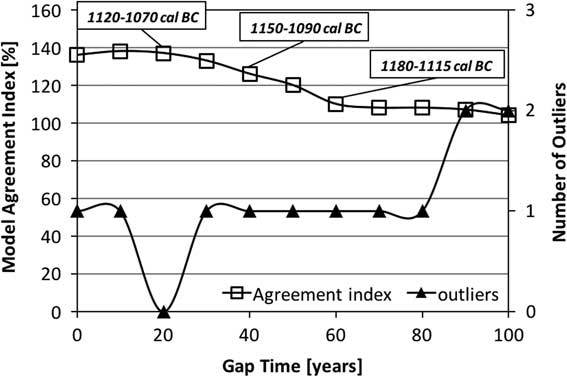
The model can be refined by introducing a gap to take into account the lack of dates from Stratum D-5 (associated with the Iron I period). Figure 5 shows the model agreement index for a changing gap span 0–100 years for level D-5, and associated transition dates. The range of agreement is 108–136%, showing the highest agreement for a gap of 20 years that shows no outliers. Introducing a gap of 20 years did not change significantly the transition date of the end of the intermediate LB|Ir, which is 1120–1070 cal BC at 1σ confidence level. Larger transition gaps would push back the transition of the end of the intermediate LB|Ir to the beginning of the 12th century BC, which has no evidence in the archaeological record.
Plot of the overall model agreement index, outliers and associated transitional dates as a function of increasing gap time of levels D-5 (associated with the Iron I period) in Tel Rehov. The highest model agreement index that shows no outliers is for a gap of 20 years (136% agreement).

Tel Lachish
Lachish is located in the south (Figure 2). Lachish is important for dating the Late Bronze to Iron transition because it was the site of a major occupation during the Late Bronze Age, including a large temple (the Fosse temple), as well as a major occupation of the intermediate LB|Ir (layer VI), which ends in the destruction of the city (Ussishkin Reference Ussishkin2004, Reference Ussishkin2007).
The strength of the site in relation to dating the transition is that a long sequence of short-lived samples from before, during and after the intermediate LB|Ir, were dated and Egyptian finds link the floating relative material culture chronology to the 14C established Egyptian chronology. Another strength is that the pottery assemblage of the intermediate LB|Ir is well-defined and is used as a relative chronological marker for sites that do not contain the early styles of Aegean-like pottery (Finkelstein Reference Finkelstein1995; Ussishkin Reference Ussishkin2004). The weakness of the site is that contexts for dating were not studied using microarchaeological indicators to confirm they were in primary deposition (as evidenced by several outliers), and stratigraphic relations between the contexts for dating within the same period were not carefully examined. Another weakness is that the material culture associated with the Iron I period is missing in Lachish, creating an occupational gap.
We constructed a Bayesian Outlier Analysis model based on 11 14C dates that cover 7 stratigraphic phases from different excavation areas (Carmi and Ussishkin Reference Carmi and Ussishkin2004). The model follows the stratigraphy in Carmi and Ussishkin (Reference Carmi and Ussishkin2004). Briefly, the 14C dates from the phase of Stratum S3a (associated with Late Bronze Age, RT-3152: 2945±65 14C year BP and RT-3153: 3125±55 BP) are positioned before Stratum S2 (associated with Late Bronze Age, RT-2754: 3945±25 BP). Stratum VIIa and P-1 (associated with the end of the Late Bronze Age, RT-2906: 2955±35 BP and RT-2913: 3855±40 BP), are positioned before Stratum VIb (associated with the LB|Ir, RT-2912: 2915±25 BP) and the phase of Stratum VI (associated with the intermediate LB|Ir, RT-2755: 2955±25 BP and Hel-1417: 2810±100 BP). Then a sequence of 14C dates from Iron Age Strata V (RT-3159: 2775±55 BP), IVb (RT-2908: 2715±40 BP), IVa (Hel-1418: 2650±90 BP) are positioned. The modeled transition of the beginning of the intermediate LB|Ir (Strata VIIa/VIb) in Lachish is 1210–1120 cal BC at the 1σ confidence level (Figure 6), and the model has an 80% agreement and contains 1 outliers (RT-2755 in stratum VI).
Calibrated and modeled dates from Tel Lachish in an Outlier Model. Dates are arranged in a sequence from the Middle Bronze Age (Stratum P-4) to the Iron Age (Stratum III). If dates are considered outliers, the probability index “P” shows a 0% agreement, and the dates are not included in the model. The modeled transition of the beginning of the intermediate LB|Ir is 1210–1120 cal BC at 1σ confidence level.

Additional information could be incorporated into the stratigraphic model, based on associated material culture. Stratum V contains material culture associated with the Iron II period. Stratum VI is a destruction layer associated with the intermediate LB|Ir phase. Therefore, there is a gap in occupation between Strata VI-V that is associated with the early Iron Age period. The length of the gap could be estimated by simulating a gap in the sequence of the modeled dates. Figure 7 shows that the time gap that best accounts for the lack of dates from the Iron I is 240–250 years, and associated transition dates of the beginning and end of the intermediate LB|Ir. The modeled transition of the beginning of the intermediate LB|Ir is 1210–1150 cal BC at 1σ confidence level and the earliest end of the intermediate LB|Ir (assuming a hypothetical maximum gap of 240–250 years) is 1160–1100 cal BC at 1σ confidence level. Another indication for the length of gap in Lachish comes from the archaeology. A gap of 245 years models the dates of Stratum V in area S to 920–860 cal BC, in agreement with the expected date (Carmi and Ussishkin Reference Carmi and Ussishkin2004). Gaps of 100–200 years, show Stratum V should be during the 10th centruy BC, which is not in agreement with the archaeology.
Plot of the overall model agreement index, outliers and associated transitional dates as a function of an increasing gap in time representing the Iron I lack of occupation. The model agreement index is the highest for 240–250 years (85%). Above a 260 years as gap, one outlier is produced.

Tel Miqne-Ekron
Tel Miqne-Ekron is located within the core area of Philistia in the southern coastal plain of Canaan. Miqne includes large occupations from the Late Bronze and Iron Ages. The intermediate LB|Ir includes sediments associated with the appearance of the Philistines (Stratum VII, Field INE), based on the presence of locally produced early Aegean-like pottery (Dothan and Zukerman Reference Dothan and Zukerman2004; Killebrew Reference Killebrew2005).
The strengths of Miqne in relation to dating the intermediate LB|Ir are that a sequence of short-lived samples from during (Stratum VIIb, RTT-4286) and after the LB|Ir (Strata VIb, RTT-4283 and Vb, RTT- 4284) were dated (Sharon et al. Reference Sharon, Gilboa, Jull and Boaretto2007). New unpublished dates (RT-4430, RT-4431) were included in the model. These samples are clusters of seeds from two contexts within the destruction level of stratum VIIIa1. Another strength is that the pottery assemblage of the intermediate LB|Ir is well-defined and is used as a relative chronological marker for sites that contain early Aegean-like pottery (Dothan and Zukerman Reference Dothan and Zukerman2004). The weakness of the site is that Iron Age contexts for dating were not studied using microarchaeological indicators to confirm that they were in primary deposition, which resulted in dating intrusive contexts that had to be excluded from the analysis (Sharon et al. Reference Sharon, Gilboa, Jull and Boaretto2007).
The Bayesian model presented in Figure 8 is based on five 14C dates from two excavation areas (Field INE and ISW) and modeled according to the stratigraphic sequence. The modeled transition of the beginning of the intermediate LB|Ir (Stratum VIIIa1/VIIb) is 1205–1095 cal BC at 1σ confidence level. The modeled transtion of the end of the intermediate LB|Ir (stratum VIIb/VIb) is 1120–1050 cal BC at 1σ confidence level. The model contains no outliers and has 93% agreement.
Calibrated and modeled dates from Tel Miqne-Ekron. The modeled date of the beginning of the LB|Ir is 1205–1095 cal BC at 1σ confidence level. The modeled date of the end of the intermediate LB|Ir is 1120–1050 cal BC at 1σ confidence level.

DISCUSSION
The recent chronology of the Late Bronze to Iron Age transition proposed by Fantalkin et al. (Reference Fantalkin, Finkelstein and Piasetzky2015) attempts to synchronize Aegean and Cypriot pottery styles in absolute time based only on the available 14C dates of the Levant. The method implies that absolute time measurments of well controlled contexts in a single region (e.g. the Levant), make it possible to determine the chronology of the entire Eastern Mediterranean. This approach (Finkelstein and Piasetzky Reference Finkelstein and Piasetzky2009; Kaniewski et al. Reference Kaniewski, Campo, Lerberghe, Boiy, Vansteenhuyse, Jans, Nys, Weiss, Morhange, Otto and Bretschneider2011; Fantalkin et al. Reference Fantalkin, Finkelstein and Piasetzky2015) was recently criticized due to the fact that they combined 14C and historical inputs into a single model and in a large region (Knapp and Manning Reference Knapp and Manning2016).
The approach used here examines this hypothesis of material cultural contemporaneity by reporting transition dates of individual sites. The results of this site-by-site analysis show that the timing of similar pottery assemblages varies between sites by more than a century, showing that they are not contemporanous in sub-century resolution. This supports other studies that show that timing of similar pottery assemblages within the same site vary by more than 50 years (Toffolo et al. Reference Toffolo, Arie, Martin, Boaretto and Finkelstein2014; Asscher et al. Reference Asscher, Cabanes, Hitchcock, Maeir, Weiner and Boaretto2015b).
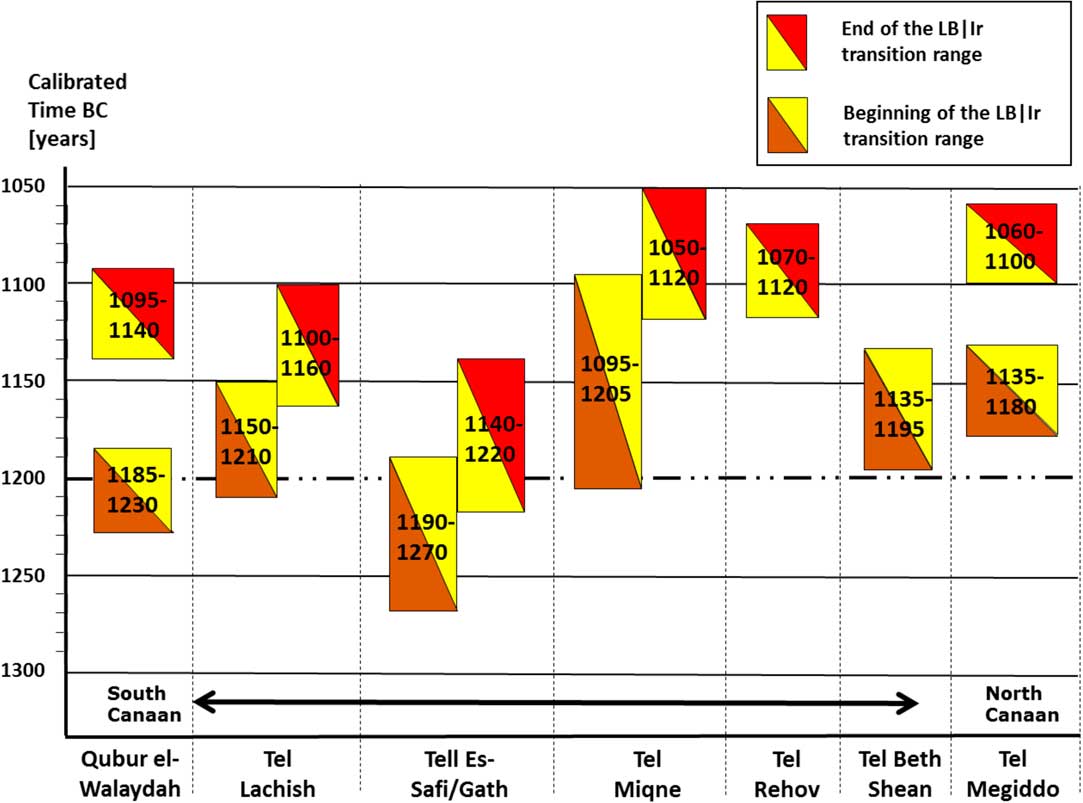
The archaeological discussion on the appearance of the Aegean-like pottery in the Levant is associated to cultural changes during the intermediate LB|Ir (Benl-Shlomo et al. Reference Ben-Shlomo, Shai, Zukerman and Maeir2008), associated with the arrival of the Philistines to the southern coastal Levant. Therefore, the appearance/absence of locally produced foreign material attributes were compared between the different sites. Table 3 shows transition dates of strata with Aegean-like pottery styles in Tel Beth Shean, Tel Rehov, Tel Lachish, and Tel Miqne-Ekron, and they are compared with the transition dates of Tell es Safi/Gath (Asscher et al. Reference Asscher, Cabanes, Hitchcock, Maeir, Weiner and Boaretto2015b), Qubur el Walaydah (Asscher et al. Reference Asscher, Lehmann, Rosen, Weiner and Boaretto2015a), and Tel Megiddo (Toffolo et al. Reference Toffolo, Arie, Martin, Boaretto and Finkelstein2014). Conventional seriation assumes that the stylistic change of similar pottery assemblages are contemporanous. However, Table 3 shows that sites containing similar ceramic assemblages do not have similar transitional dates. This is well demonstrated by the transitions between early and later styles of Aegean-like pottery which vary between sites by around 100 years.
Transitional dates, relevent strata and main ceramic styles from before and after the intermediate LB|Ir period in different sites in Canaan.

Figure 9 compares the transition dates in Table 3. The overall span in Caanan of the intermediate LB|Ir period is between the 13th–11th centuries BC. The transition date of the end of the intermediate LB|Ir at Tel Rehov and the beginning of the intermediate LB|Ir at Tel Beth Shean are consistent with those of Tel Megiddo, supporting that the intermediate LB|Ir in the north starts and ends later than in the south.
Calibrated modeled transition dates at 68.2% (±1σ) of the beginning and end of the intermediate LB|Ir period of sites in Canaan, arranged from south to north. Each vertical gradient colored box represents a transition time range at each site, in a specific area, based on Table 3 (showing the dates from area K in Tel Megiddo and area A in Tell es-Safi/Gath). Colors indicate the periods (shown in Figure 1). The dotted horizontal line marks the tranditional transition date of 1200 BC. (See online version for colors.)

In Tel Lachish, the intermediate LB|Ir is between the southern and northern sites. The indication for a very short intermediate LB|Ir period is hypothesized in Tel Lachish and Tell es-Safi/Gath based on the overlapping of the beginning and end of the transitions. The absolute chronology of Tel Miqne shows the end of the intermediate LB|Ir period overlaps with the northern sites, suggesting that the early styles of Aegean-like pottery were in use until the 11th century BC.
One of the main applications in dating the intermediate LB|Ir period site-by-site is reconciling the chronological gap between the arrival of the Philistines to the southern coastal Levant, the Egyptian withdrawal from Canaan, and the lack of Egyptian-Philistine interaction (Martin Reference Martin2011; Ben-Dor Evian Reference Ben-Dor Evian2017). The conventional Philistine paradigm dates the arrival of the Philistines to the time of the battle between Ramesses III and the “Sea People,” during the 8th year of Ramesses III (ca.1177 BC) (Cline Reference Cline2015), assuming a straight forward interaction between the two entities. However, Egyptian strata from the early 20th Dynasty (associated with Ramesses III) do not contain Philistine material culture (in particular Lachish VI, Tel Mor V and Tel Sera IX), while Philistine settlements (Ashdod XIII, Ashkelon XVII and Miqne-Ekron VII) do not contain Egyptian material culture (Ussishkin Reference Ussishkin1985; Bietak Reference Bietak1993; Martin Reference Martin2008). This resulted in an archaeological-historical criticism on the paradigm (Silberman Reference Silberman1998; Finkelstein Reference Finkelstein2007; Maeir et al. Reference Maeir, Hitchcock and Horwitz2013; Middleton Reference Middleton2015), and a suggestion to lower the chronology of the arrival of the Philistines to the southern Levant to after Ramesses IV, i.e. 1140 BC (Finkelstein Reference Finkelstein1995, Reference Finkelstein1998). Another suggestion, was a political and cultural segregation by the Egyptian rule, following the battle with Ramesses III, during the first phase of the Philistines settlement (with Monochrome being the definitive marker). This hyposthesis assumes that following the Egyptians withdrawal from Canaan, the Philistines material culture influenced the local cannanite forming the Bichrom phase (Bietak Reference Bietak1993; Mazar Reference Mazar1997; Bunimovitz and Faust Reference Bunimovitz and Faust2001; Yasur-Landau Reference Yasur-Landau2010).
The dating of the Monochrome style phase (found mostly in Philistia) has been heavily debated, mainly because there are limited amounts of Egyptian artifacts that can link the Egyptian chronology to these phases (Master et al. 2011) and there are limited 14C dates (Albright Reference Albright1932; Finkelstein Reference Finkelstein1995, Reference Finkelstein1998, Reference Finkelstein2016; Mazar Reference Mazar2007; Asscher et al. Reference Asscher, Lehmann, Rosen, Weiner and Boaretto2015a, Reference Asscher, Cabanes, Hitchcock, Maeir, Weiner and Boaretto2015b). The results from this study are in agreement with reports that date the appearance of early styles of Aegean-like pottery in Cyprus and southwest Asia Minor to during the 13th century BC (Lehmann Reference Lehmann2007; Iacovou Reference Iacovou2013), associating the appearance of these styles with cultural exchange between the Levant and Aegean-like ceramic traditions (Ben-Dor Evian Reference Ben-Dor Evian2017). The Bichrome styles (found widespread in Canaan) are associated with the integration between Aegean-like pottery styles with some of the local Cananites stylistic features. Interestingly, this study shows that the period of time (approximately 100 years) in which Monochrome and Bichrome styles were contemporaneous in Canaan reflects the social interactions between the foreign and the local entities, supporting the notion that foreigners arrived to Canaan in more than a single event (Yasur-Landau Reference Yasur-Landau2007) and that Monochrome pottery was still in use after the appearance of Bichrome styles. Moreover, this longue durée process, would allow for multiple social interactions to take place, supporting a view of a “deep change” in the local material culture (Yasur-Landau Reference Yasur-Landau2010). The complex interactions between the locals and the foreign entities that would cause a “deep change” are found in material cultures, social practices and world views (Hitchcock and Maeir Reference Hitchcock and Maeir2013). Different terminologies are used to describe the interactions that shaped the Philistine political entity, such as entaglement between the local Cananites and the foreign entities (Stockhammer Reference Stockhammer2013), cultural mixing or creolization (Killebrew Reference Killebrew2005) and hybridization (Knapp Reference Knapp2008).
Dating the appearance of Bichrome pottery in Tell es-Safi/Gath and Qubur el-Walaydah (Philistia) during the 12th century BC and the appearance of Bichrome pottery in Tel Megiddo, Tel Miqne and Tel Rehov to the 11th century BC indicates that the integration process between foreign and local pottery styles were finalized more than 100 years following the foreigners’ first appearance. This has implications on the hypothesis that the foreign identities were segregated by the local Egyptian regime, which ruled the northern valleys, while the Philistines ruled the southern coastal plains. This hypothesis was initially based on the low distribution of early styles of Aegean-like material culture outside Philistia (Bietak Reference Bietak1993; Mazar Reference Mazar1997). The 14C chronology presented here provides an independent evidence for cultural segregation by showing that the Bichrome pottery appeared in the coastal region of Philistia during the time of Ramesses III, and diffused to northern sites only after the retreat of the 20th Egyptian Dynasty, following Ramesses IV, i.e. 1140 BC. Cultural segragation of the early foreigners is partially supported by the historical reference of the Papyrus Harris I of Ramesses III, that mentions the relocation of the foreign identities in Egyptian strongholds (Killebrew and Lehmann Reference Killebrew and Lehmann2013), although recently criticized (Ben-Dor Evian Reference Ben-Dor Evian2017). The discrepency in time between Ramesses III and the first appearance of Agean-like pottery, and the longue durée process of integrating foreign styles with local pottery styles reflects the complex nature of migration processes, that is over-simplified in historical documentations (Yasur-Landau Reference Yasur-Landau2007; Knapp and Manning Reference Knapp and Manning2016).
The 14C chronologies presented here show Monochrome and Bichrome styles appear earlier in Philistia than northern sites. We note that the existence of sub-phases of Monochrome and Bichrome, e.g. Ashkelon 19b, 19a, 18b, 18a, 17, Ashdod XIIIa, XII, XI, and Tel Miqne VIIa, VIb, Via, Vb, Va (Dothan Reference Dothan1982; Dothan and Zukerman Reference Dothan and Zukerman2004; Master et al. 2011), cannot be synchronized in this study, because only Tel Miqne has 14C dates and even these are very limited. The authors believe that the main reason for the different terminologies of the transitions (see Table 1) in Canaan is the geographical distribution of early styles of Aegean-like material culture (Finkelstein Reference Finkelstein1995; Bunimovitz and Yasur-Landau Reference Bunimovitz and Yasur-Landau1996; Mazar Reference Mazar2007; Killebrew and Lehmann Reference Killebrew and Lehmann2013). Large assemblages of Monochrome pottery were found only in Philistia, especially in Ashkelon, Ashdod and Tel Miqne-Ekron. Smaller quantities of Monochrome pottery were found in Tell es-Safi/Gath (Maeir and Ehrlich Reference Maeir and Ehrlich2001), in particular in the transitional Stratum A6 (forthcoming), and sporadic sherds were found in Tel Haror, Haruba, Tell Jerishe, Akko, Ras Ibn Hani, Sarepta, Gezer, Beth Shean (Dothan and Zukerman Reference Dothan and Zukerman2004), and Qubur el-Walaydah (Asscher et al. Reference Asscher, Lehmann, Rosen, Weiner and Boaretto2015a). In the following phase, Bichrome pottery was abundant in Philistia, Upper Galilee (Hazor and Dan), northern coast and Akko Plain (Dor and Tell Keisan), Jezreel Valley and its margins (mainly Megiddo and Afula), Central Hill Country (Shiloh, Bethel, and Tell en-Nasbeh), and in the Negev Desert (Beersheba and Tel Masos) (Gilboa et al. Reference Gilboa, Cohen-Weinberger and Goren2006). While different archaeologists debate about the association of the period following the LB IIB to the Late Bronze (LB III) or Iron Age (Iron IA), there is a wide agreement that the Bichrome phase is associated with the Iron Age (Ben-Dor Evian Reference Ben-Dor Evian2017).
To conclude, dating the Late Bronze to Iron transition in Canaan using a site-by-site approach shows the complexity in ascribing pottery assemblages to periods, which is commonly oversimplified, and assuming contemporaneity for similar assemblages. Dating the different sites transitions not only shows that different sites have different transitional dates, but also that early styles of Aegean-like pottery appear in southern sites before northern sites. This has implications on the complex interactions that took place between the local entities and the foreign influence, that occur between the 13th–11th century BC.
CONCLUSIONS
Radiocarbon chronologies from different sites in the southern Levant show that the Late Bronze to Iron Age transition spanned approximately 200 years and are not contemporaneous even between sites in a relatively small region. These chronologies, based on a site-by-site approach for dating, show that early and developed Aegean-like pottery styles appeared in southern sites prior to sites in the north, between late 13th century and late 11th century BC for the 68.2% probability (±1σ). The appearance of developed styles (Bichrome) in Philistia is dated to the time of Ramesses III and the diffusion to northern sites is dated to after the retreat of the 20th Egyptian Dynasty. This chronology contributes to the understanding of migration processes and foreign material culture diffusion, and questions the approach of synchronizing events over large areas in an absolute time frame based only on material culture.
ACKNOWLEDGMENTS
Funding for this research was provided by the Kimmel Center for Archaeological Science, Max Planck-Weizmann Center for Integrative Archaeology and Anthropology and Dangoor-REAMS Radiocarbon Laboratory. We wish to thank Prof Sy Gittin for samples, pottery and stratigraphic association for Tel Miqne. We thank Prof Steve Weiner for many suggestions and discussions in the preparation of this manuscript.
APPENDIX
Bayesian models run files for OxCal v4.2.4 of Tel Lachich, Tel Beth Shean, Tel Miqne-Ekron, and Tel Rehov.
Run file of Tel Lachish Bayesian model outlier analysis:
Plot()
{
Outlier_Model(″lachish″, T(5), U(0,4), ″t″);
Sequence(″Tel Lachish″)
{
Boundary(″sequence begins″);
phase(″S_3″)
{
R_Date(″RT-3152″, 2945, 65);
R_Date(″RT-3153″, 3125, 55);
};
R_Date(″S-2″, 3945, 25){outlier(″lachish″)};
R_Date(″s_VIIa″, 2955, 35);
R_Date(″P-1″, 3855, 40){Outlier(″lachish″)};
Boundary(″LB/Ir beginning″);
R_Date(″S_VIb″, 2915, 25);
phase(″VI″)
{
R_Date(″S_RT-2755, Stratum VI″, 2955, 25);
R_Date(″P_Hel-1417, Stratum VI″, 2810, 100);
};
R_Date(″S_V″, 2755, 55);
R_Date(″S_IVb″, 2715, 40);
R_Date(″S_IVa″, 2650, 90);
Boundary(″sequence ends″);
};
};
Run file of Tel Beth Shean Bayesian model:
Plot()
{
Sequence(″Tel Beth Shean″)
{
Boundary(″sequence begins″);
R_Combine(″N-4″)
{
R_Date(″RT-2597″, 2985, 25);
R_Date(″RT-2594″, 2925, 25);
R_Date(″RT-2156″, 2910, 50);
};
Boundary(″LB|Ir beginning″);
R_Combine(″S3a″)
{
R_Date(″RT-2325″, 2980, 40);
R_Date(″RT-2596″, 2960, 25);
R_Date(″RT-2323″, 2900, 45);
};
Boundary(″sequence ends″);
};
};
Run file of Tel Miqne-Ekron Bayesian model:
Plot()
{
Sequence(″Tel Miqne″)
{
Boundary(″Start sequence″);
Phase(″VIIIa″)
{
R_Date(″RT 4430″, 2980, 40);
R_Date(″RT 4431″, 2995, 40);
};
Boundary(″LB|Ir beginning″);
R_Date(″VIIb″, 2907, 28);
Boundary(″LB|Ir end″);
R_Date(″VIb″, 2918, 26);
R_Date(″Vb″, 2833, 32);
Boundary(″End sequence″);
};
};
Run file of Tel Rehov Bayesian model:
Plot()
{
Sequence(″Tel Rehov″)
{
Boundary(″sequence begins″);
Phase(″D-6 lower″)
{
R_Date(″GrN-26120″, 2880, 30);
R_Date(″GrN-19034″, 2935, 45);
};
Phase(″D-6 upper″)
{
R_Date(″GrN-26118″, 2920, 30);
R_Date(″GrN-18826″, 2950, 50);
};
Boundary(″LB/Ir ends″);
Phase(″D-4 b″)
{
R_Date(″GrN-21046″, 2905, 35);
R_Date(″GrN-21057″, 2945, 35);
R_Date(″GrN-21184″, 2920, 50);
};
Phase(″D-4 a″)
{
R_Date(″GrN-26121″, 2890, 30);
R_Date(″GrN-18825″, 2870, 50);
};
Phase(″D-3″)
{
R_Date(″GrA-16757″, 2820, 50);
R_Date(″GrA-19033″, 2835, 45);
R_Date(″GrA-21044″, 2845, 35);
R_Date(″GrA-21056″, 2825, 35);
R_Date(″GrA-21183″, 2820, 50);
};
R_Date(″D-2″, 2805, 15);
Boundary(″sequence ends″);
};
};