Introduction
Although, at the present time, neither the North American nor European medicine regulatory agencies have approved any psychotropic medications for the treatment of behavioral and psychological symptoms of dementia (BPSD), these drugs are widely prescribed in clinical practice, particularly for patients with Alzheimer's disease (AD). A recent consensus conference proposed guidelines for clinicians on the prescription of psychotropic medications for various BPSD (Salzman et al., Reference Salzman2008), including antidepressants.
Depressive symptoms are found in approximately 40% of AD patients, while the prevalence of clinically significant symptoms ranges from 20–30% (Starkstein et al., Reference Starkstein, Mizrahi and Garau2005). These high prevalence rates support the increased prescription of antidepressants in this population. Depression in AD, also known as Alzheimer-associated affective disorder, has a negative impact on autonomy and quality of life, on the course of the dementia itself, and on the caregiver's health (Lyketsos et al., Reference Lyketsos, Breitner and Rabins2001). Several studies have evaluated the efficacy of antidepressant treatment in AD. A recent meta-analysis confirmed that these agents were superior to placebo (Thompson et al., Reference Thompson, Herrmann, Rapoport and Lanctot2007). Although several experts have proposed recommendations for the treatment of depression in AD, there is no literature-backed support for specific treatment strategies.
Antidepressants, particularly selective serotonin reuptake inhibitors (SSRI), have also been tested in clinical trials as treatment for delusions and aggression (Pollock et al., Reference Pollock2002). Strong arguments for a disturbed serotoninergic system in AD have been put forward on the basis of neuronal loss in the raphe nucleus and loss of cortical serotonin receptors (Meltzer et al., Reference Meltzer1998). Aggressive behavior and depressive or psychotic symptoms are thought to stem from these physiological disturbances (Lanctôt et al., Reference Lanctôt, Herrmann, Eryavec, Reekum, Reed and Naranjo2002). Alterations in the serotoninergic system during aging, and modification of this system in AD, suggest that serotoninergic antidepressants might be effective against the behavioral and psychiatric symptoms of this disease. In addition, because the use of antipsychotic agents is limited by their side-effects and possible lack of effectiveness, other therapeutic options have been proposed in this indication (Schneider et al., Reference Schneider2006).
A change in prescribing practice in the psychopharmacological management of BPSD was highlighted by Lopez et al. (Reference Lopez2003), who examined the pattern of psychiatric drug prescriptions in 1155 AD patients between 1983 and 2000. In their study, the prescription of antidepressants, sedatives, hypnotics and anxiolytics by physicians increased over time, paralleling a decrease in prescription of antipsychotic agents. The authors suggested that this evolution could reflect growing evidence that newer antidepressants (e.g. selective SSRIs) can be used to treat not only mood-related disorders but also abnormal behavior (e.g. aggression, agitation) in AD (Lopez et al., Reference Lopez2003). As a result, when clinicians prescribe these drugs they must do so empirically, given the lack of robust scientific evidence. Few studies have investigated prescribing practices and antidepressant use in AD in care environments and, to our knowledge, no study has been conducted among AD outpatients. The objective of the present study was to assess the prevalence of antidepressant prescription in community-dwelling patients with mild to moderate AD and to identify the clinical factors associated with prescription. It was hypothesized that other clinical factors in addition to depressive symptoms would be associated with antidepressant prescription in AD outpatients.
Methods
Study design and participants
This paper reports the results of a cross-sectional analysis based on data obtained from a four-year prospective cohort at baseline.
The REAL.FR cohort has been described in detail previously (Gillette-Guyonnet et al., Reference Gillette-Guyonnet2003). The study population included subjects meeting DSM-IV and NINCDS-ADRDA criteria for Alzheimer-type dementia. Participants thus suffered from mild to moderate dementia with a Mini-mental State Examination (MMSE) score ranging from 10 to 26, corresponding to stages 3–5 of Reisberg's Global Dementia Scale (GDS). The sample was community-based and all participants were living at home and were cared for by an informal caregiver. Exclusion criteria included: severe dementia (MMSE score <10), institutionalized patients, associated disorders compromising short-term prognosis, and individuals whose caregiver could not be clearly identified. Patients were recruited during consultation in a university hospital-based network of 16 departments of neurology, geriatrics or psychiatry. Informed consent was obtained from all patients and caregivers.
Data collection
At inclusion, each participant underwent a comprehensive assessment including neuropsychological evaluation and a brain CT scan. Follow-up of the cohort included six-monthly evaluation of the patients’ and caregivers’ burden using a standardized assessment.
The following parameters were recorded at baseline: sociodemographic characteristics (age, gender, educational level), medical and surgical history, physical disability using both the Activities of Daily Living (ADL) scale and Instrumental Activities of Daily Living scale (Katz et al., Reference Katz, Ford, Moskowitz, Jackson and Jaffe1963; Lawton and Brody, Reference Lawton and Brody1969), cognitive function relying on both the MMSE and Alzheimer's Disease Assessment Scale-cognitive components (Rosen et al., Reference Rosen, Mohs and Davis1984), severity of dementia using both the Reisberg GDS scale and Clinical Dementia Rating scale (Hughes et al., Reference Hughes, Berg, Danziger, Coben and Martin1982), and nutritional status by the Mini Nutritional Assessment (MNA) (Vellas et al., Reference Vellas1999). Questions on use of a home help service, sources of income, former employment, living arrangements, and social support were also included. Caregiver burden was assessed using the Zarit scale (Zarit et al., Reference Zarit, Reever and Bach-Peterson1980).
Prescribed medications were recorded at baseline based on prescriptions bought by the caregiver. Antidepressant medications were classified according to the Anatomical Therapeutic Chemical classification (WHO Collaborating Centre for Drug Statistics Methodology, http://www.whocc.no/atcddd/).
Assessment of BPSD was performed using the Neuropsychiatric Inventory (NPI; Cummings et al., Reference Cummings, Mega, Gray, Rosenberg-Thompson, Carusi and Gornbein1994). The NPI is a caregiver-informant interview rating the severity (S) and frequency (F) of 12 behavioral and psychological symptoms over the previous month. A continuous score for each symptom is obtained by multiplying severity (range 1–3) by frequency (range 1–4). A total score is obtained by adding the 12 F × S scores obtained for each item. A F × S score of ≥4 indicates clinical significance of each individual symptom. This cut-off is commonly used as an inclusion criterion in clinical studies on outpatients (Aalten et al., Reference Aalten, de Vugt, Jaspers, Jolles and Verhey2005) and nursing home inpatients (Selbaek et al., Reference Selbaek, Kirkevold and Engedal2008) investigating behavioral and psychiatric disorders of dementia (Schneider et al., Reference Schneider2001). The validated French version of this scale shows good reliability (Robert et al., Reference Robert, Medecin and Vincent1998). Current depressive disorder was therefore defined according to the NPI scale: not depressed (NPI < 4) and depressed (clinically significant symptoms: NPI ≥ 4).
Statistical analysis
Descriptive analyses of the study population at inclusion comprised mean values ± standard deviation (SD) and proportions for quantitative and qualitative variables, respectively.
Bivariate analyses were conducted to examine the association between antidepressant prescription entered as a qualitative variable (coded “0” for no antidepressant and “1” for antidepressant prescription) and NPI items and social and demographic characteristics. The association with qualitative variables was tested using Pearson's χ2 test and Fisher's exact test for theoretical numbers <5. The association with quantitative variables was tested using the Student's t-test, after controlling for the homogeneity of variance between the two groups. For variables with non-gaussian distribution, the Kruskal-Wallis nonparametric test was used. Finally, NPI and Zarit scores were transformed by taking their square root in order to obtain a gaussian distribution and apply parametric statistics.
A backward stepwise multivariate logistic regression analysis was performed to determine the factors associated with antidepressant prescription using adjusted odds ratios (OR) and their 95% confidence intervals (CI). Independent variables with p < 0.25 in bivariate analysis were included in the model. The following factors were therefore included in the model: gender, living arrangement, severity of depressive symptoms, NPI score for hallucinations, anxiety, apathy, irritability, aberrant motor behavior and sleep disturbances, prior history of depression, inclusion center, non-medical care, number of non-psychotropic medications. Statistical interactions were verified in the final model. The goodness of fit of the final model was assessed using the Hosmer and Lemeshow test. The level of significance was set at 0.05 (2-sided) and all analyses were conducted using SAS software version 9.1 (SAS Institute, Inc. Cary, NC, U.S.A.).
Results
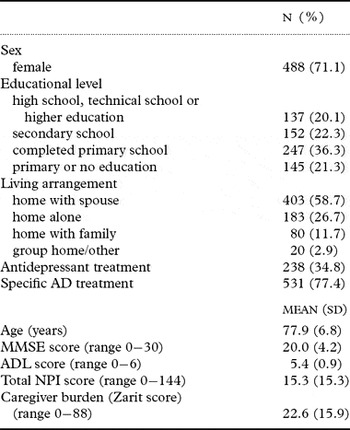
Between 2000 and 2002, a total of 686 subjects were included in the study (mean age 77.9 ± 6.8 years, 488 (71%) female). Over three-quarters of patients were treated with cognitive enhancers (100% cholinesterase inhibitors). The medical and sociodemographic characteristics of the patients are shown in Table 1.
Medical and sociodemographic characteristics of study participants at inclusion (n = 686) in the REAL.FR study

MMSE = Mini-mental State Examination; ADL = Activities of Daily Living; MNA = Mini Nutritional Assessment; NPI = Neuropsychiatric Inventory; SD = standard deviation; AD = Alzheimer's disease.
Over half of the total population was treated with at least one psychotropic medication. Anxiolytic, antipsychotic and sedative/hypnotic agents were prescribed to 20%, 6% and 7% of the participants, respectively. One-third of the subjects were prescribed an antidepressant, of which 76% were SSRIs. Paroxetine was the most frequently prescribed SSRI (40%), followed by citalopram (24%) and sertraline (15%). Tricyclic antidepressants were only prescribed to 2% of patients. In 37% of patients, antidepressants were co-prescribed with another psychotropic medication (mostly anxiolytics).
Clinically significant depressive symptoms (NPI ≥ 4) were observed in 141 patients (20.5%), 84 (60%) of whom were treated with an antidepressant.
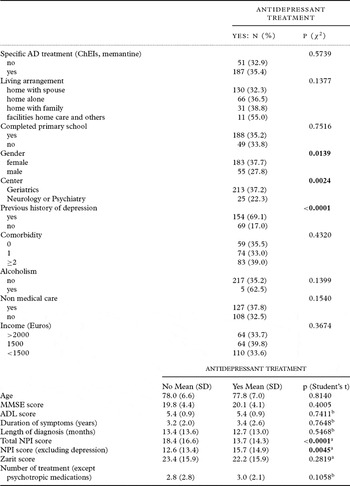
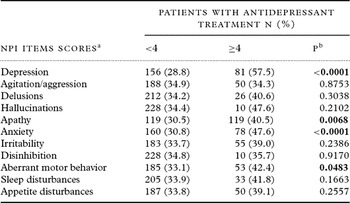
Bivariate analysis of the social and clinical features associated with antidepressant prescription is reported in Table 2. Female gender (p = 0.0139), total NPI score (p<0.0001) and NPI score excluding the depression item (p = 0.0045) were significantly related to antidepressant prescription. Antidepressant prescription was also associated with clinically significant depressive symptoms (p<0.0001), anxiety (p<0.0001), apathy (p = 0.0068) and aberrant motor behavior (p = 0.0483) (Table 3).
Frequency of antidepressant prescription according to social and clinical features in the REAL.FR cohort at inclusion (n = 686)

aStudent's t test was performed after transforming the variable into a square root to obtain a gaussian distribution.
bKruskal-Wallis test (nonparametric test for non-gaussian distribution).
ChEIs = cholinesterase inhibitors; AD = Alzheimer's disease; MMSE = Mini-mental State Examination; ADL = Activities of Daily Living; NPI = Neuropsychiatric Inventory; SD = standard deviation.
NPI items associated with antidepressant prescription at inclusion in the REAL.FR cohort (n = 686)

aNPI = Neuropsychiatric Inventory.
bχ2 test.
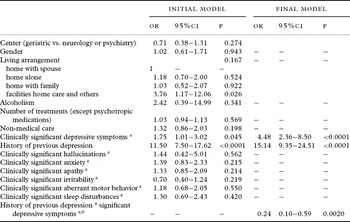
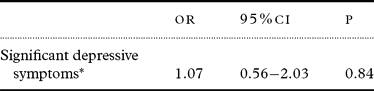
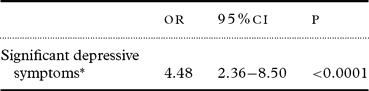
Multivariate analysis controlled for confounding factors (gender, living arrangement, severity of depressive symptoms, NPI score for hallucinations, anxiety, apathy, irritability, aberrant motor behavior and sleep disturbances, previous history of depression, inclusion center, non-medical care, number of non-psychotropic medications). The initial model is shown in Table 4. After backward stepwise logistic regression, only clinically significant depressive symptoms and previous history of depression were associated with antidepressant treatment. A relationship was found between history of previous depression and clinically significant depressive symptoms (Table 4, final model). As a consequence, the data were stratified according to previous history of depression (Tables 5 and 6). In subjects without a previous history of depression, clinically significant depressive symptoms (based on NPI score) were associated with antidepressant prescription, with a greater than four-fold chance of receiving an antidepressant (95% CI 2.36−8.50). On the other hand, clinically significant depressive symptoms were not associated with antidepressant prescription in individuals with a previous history of depression (OR = 1.07; 95% CI 0.56−2.03).
Variables associated with antidepressant prescription (initial and final models, n = 589).

aNPI item – frequency × severity (≥4 vs. <4).
bInteractions were tested in the final model.
Deviance: 580.682; final model p<0.001; goodness of fit: Hosmer-Lemeshow χ2 = 0 (df = 3), p = 1.
Variables associated with antidepressant prescription if subjects had a previous history of depression (n = 589)
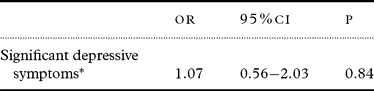
*NPI depression – frequency × severity (≥4 vs. <4).
Variables associated with antidepressant prescription if subjects did not have a previous history of depression (n = 589)
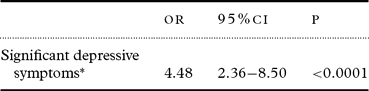
*NPI depression – frequency × severity (≥4 vs. <4).
Discussion
In this cohort of 686 patients, antidepressants were the most commonly prescribed psychotropic medication after cognitive enhancers, and were prescribed to over one-third of patients. To our knowledge, the present study is the first to evaluate antidepressant prescription in community-dwelling AD patients. In a large sample (933 subjects) of Dutch nursing home patients with dementia, Selbaeck et al. (Reference Selbaek, Kirkevold and Engedal2008)) recently showed that 39% of patients were treated with antidepressants. Margallo-Lana et al. (Reference Margallo-Lana2001) reported that 19% of 209 institutionalized patients with dementia received antidepressants. In both these studies, the prevalence of clinically significant depressive symptoms, assessed using the NPI, was 22.4% and 24%, respectively. Although the proportion of individuals displaying depressive symptoms is similar, antidepressant prescription rates differed in these two studies. Apart from an obvious difference in study populations (outpatients vs. nursing home patients), it is difficult to explain this discrepancy, underlining the absence of clinical guidelines that would address the disparity in antidepressant prescription in AD patients. In contrast to our expectations of a lower antidepressant prescription rate in outpatients, our results show a relatively high rate of prescription of antidepressants in a cohort of community-dwelling AD patients.
Forty percent of AD outpatients in our cohort presenting with clinically significant depressive symptoms were not treated with antidepressants. Although the risks associated with depression in elderly subjects (including excess disability, medical morbidity, mortality from medical causes and suicide) have been well established, depression appears to be undertreated in this population (Steffens et al., Reference Steffens2000).
In our cohort, antidepressant prescriptions were in line with recommendations concerning the choice of therapeutic class, since tricyclic antidepressants were rarely prescribed. The anticholinergic adverse effects of tricyclic antidepressants are well known, leading physicians to avoid prescribing these drugs, particularly in elderly subjects with AD treated with cholinesterase inhibitors. Tricyclic antidepressants are still prescribed in the elderly, particularly in nursing homes, where they may account for up to 20% of antidepressant prescriptions (Rigler et al., Reference Rigler, Webb, Redford, Brown, Zhou and Wallace2001). However, it should be noted that prescriptions are sometimes motivated by non-psychiatric symptoms such as pain, isolated insomnia, incontinence, and pruritus. The dosages used are lower than when treating depression (Borson et al., Reference Borson, Scanlan, Doane and Gray2002).
The only factor associated with antidepressant prescription in our population was the presence of clinically significant depressive symptoms. Other BPSD studied (such as aggression, apathy or irritability) did not influence prescription in multivariate analysis. Notwithstanding the overlap of depressive and behavioral symptoms in AD (Arbus et al., Reference Arbus2008), no colinearity was found in the statistical analysis.
The interaction between previous history of depression, depressive symptoms and prescription of antidepressants is a new finding and raises concerns about the interpretation of current depressive symptoms among AD patients with or without a previous history of depression. The results suggest that in AD patients, a prior history of depression may influence the perception of depressive symptoms. In the absence of any previous history, depressive symptoms might be interpreted as a manifestation of AD complication, whereas they might be perceived as a secondary comorbid depressive disorder in AD patients with a history of depression. Thus, these patients may receive less treatment because the AD diagnosis is more important. Depressive symptoms should be better assessed and accounted for in patients without a previous history of depression, in order to ensure better management of these symptoms with antidepressants.
To date, several studies have examined the efficacy of antidepressants in AD depression. New-generation antidepressants such as SSRIs, or noradrenalin and serotonin reuptake inhibitors, have now superseded early antidepressants. The serotoninergic system is implicated in various functions such as mood regulation, anxiety, sleep, sexual activity, learning and memory, impulse control and aggression, and SSRIs are effective in irritability, anxiety, depressed mood and emotional disturbances (Burke et al., Reference Burke, Dewan, Wengel, Roccaforte, Nadolny and Folks1997). The term “emotional stabilizers” was introduced by Gottfries et al. reporting the efficacy of antidepressants in AD (Gottfries et al., Reference Gottfries, Karlsson and Nyth1992). SSRIs are superior to placebo in the treatment of depression, but the results do not always reach statistical significance due to a marked placebo response (between 30–45%). On the other hand, SSRIs are generally well tolerated.
The efficacy of SSRIs has also been evaluated in other BPSD such as agitation, aggression, and against psychotic symptoms. These symptoms are generally improved by antipsychotics. In dementia, SSRIs were superior to placebo in the treatment of anxiety, agitation and aggression, irritability and dysphoria. Pollock et al. (Reference Pollock2002) found no significant difference between citalopram and perphenazine in the improvement of behavioral disturbances. However, only citalopram demonstrated statistically significant greater efficacy than placebo in agitation and emotional ability.
The main limitation to our study was that psychiatric disorders were not assessed. The NPI was used, which is a dimensional tool aimed at the caregiver. The criterion of severity reliability in the NPI is highly dependent on personal experience of the disorder (Rosenberg et al., Reference Rosenberg, Mielke and Lyketsos2005). The use of the commonly accepted cut-off score of 4, indicating a degree of symptom severity which requires medical management, could have limited this bias. Furthermore, the lack of measurement of psychiatric disorders according to a structured interview prevented us from taking into account individuals who might have been depressed and receiving antidepressants but who have instead been described as “not depressed”. The prevalence of depression might have been underestimated because of this measurement bias.
Finally, all study participants were outpatients recruited in a French university hospital. Thus, it might not be possible to generalize the study findings to all AD patients or to AD patients in other countries.
In summary, our results show that clinically significant depressive symptoms were associated with antidepressant prescription only in AD patients without a prior history of depression. Other BPSD, even if clinically significant, were not associated with antidepressant prescription. Thus, available data on the efficacy of antidepressants in BPSD other than depression (in particular agitation, aggression and sometimes even psychotic symptoms) have not yet influenced prescription habits. Prescribing habits appear to be in line with the current consensus concerning depression in older patients without dementia. Further studies are required to assess the impact of antidepressants on BPSD other than depressive symptoms. The preferential choice of antipsychotic treatment in these indications could then be questioned.
Conflict of interest
None.
Description of authors’ roles
C. Arbus wrote the paper. V. Gardette performed the statistical analyses and assisted in writing the paper. E. Bui assisted in writing the paper and C. Cantet supervised the data collection and assisted in the statistical analyses. F. Nourashemi assisted in writing the article, S. Andrieu supervised the statistical design of the study and the statistical analysis, L. Schmitt supervised the writing of the paper and B. Vellas designed the study and secured the funding.
Acknowledgments
This work was supported by a grant from the Clinical Research Hospital Program from the French Ministry of Health (PHRC No. 98–47N / 01–010-01).
REAL.FR Group: Principal investigator: Professor B. Vellas (Toulouse); Co-investigators: Professor M. Rainfray, Dr S. Richard-Harston (Bordeaux); Professor A. Franco, Dr P. Couturier (Grenoble); Professor F. Pasquier, Dr M. A. Mackowiak-Cordoliani (Lille); Dr B. Frigard, Dr H. Idiri, Dr K. Gallouj (Wasquehal); Dr B. Michel (Marseille); Professor Cl. Jeandel (Montpellier); Professor J. Touchon, Dr F. Portet, Dr S. Lerouge (Montpellier); Professor Ph. Robert, Dr P. Brocker, C. Bertogliati (Nice); Professor B. Forette, Dr L. Teillet, Dr L. Lechowski (Paris); Professor J. Belmin, D. S. Pariel-Madjlessi (Paris); Professor M. Verny, Dr M. A. Artaz (Paris); Professor F. Forette, Dr A. S. Rigaud, Dr F. Latour (Paris); Professor P. Jouanny, Dr S. Belliard, Dr O. Michel (Rennes); Dr C. Girtanner, Dr Thomas-Anterion (Saint Etienne); Study coordinators: F. Cortes, S. Gillette-Guyonnet, Professor F. Nourhashemi, Dr P. J. Ousset (Toulouse); Epidemiologist: Professor S. Andrieu (Toulouse); Data analysis: C. Cantet (Toulouse).