I. IntroductionFootnote 1
With a growing print culture, unprecedented literacy rates, and the refinement of communication and transportation networks, knowledge and worship of popular Buddhist cults spread rapidly across Edo or Tokugawa (early modern) Japan (1600–1868), especially in and around the booming capital of Edo (modern-day Tokyo). This article examines how popular urban storytelling, entertainment, and material culture aided the spread of one devotional cult, that of the Narita Fudō 成田不動 of Shinshōji 新勝寺 Temple,Footnote 2 across Edo's religious culture during the early eighteenth to mid-nineteenth centuries. Taking a cue from recent trends in regionally based studies of early modern religion,Footnote 3 and moving beyond canonical sources to engage local, trans-sectarian materials, I examine the highly mobile nature of the cult's narratives and sacred objects as they became portable commodities shared among and beyond Buddhist traditions.
In particular, I approach the Narita Fudō from a less-studied, though important, perspective: that of a sword cult. I give special attention to the sword as a sacred Buddhist object, especially the temple's legendary Sword of Amakuni, through an investigation of miracle tales, biographies, temple documents, and popular sources produced by non-clerical circles. While there exist excellent studies of popular Edo-period cults examining, for instance, the socio-economics and political landscapes of pilgrimage and patronage,Footnote 4 the Narita sword cult offers a unique case-study of how Buddhist storytelling and material culture facilitated cultic movement beyond sectarian boundaries and into new artistic and theatrical spaces. The shared currency of the cult sheds light on the highly mobile nature of the deity and its fluidity across cultural spaces in early modern Japan, balancing scholarly trends which have tended to emphasize static, trans-local features across time and place specific to sectarian tradition.
II. The Narita Fudō cult
Early modern sources list scores of sites devoted to the esoteric Buddhist (Mikkyō 密教) deity Fudō dotting the landscape of eastern Japan, but it was the Shingon 真言 temple Shinshōji (popularly known as Naritasan 成田山) that often stole the limelight.Footnote 5 Although located in Narita 成田 Town, a four-day journey outside Edo in Shimōsa Province (modern-day Chiba Prefecture), the Narita Fudō nonetheless became one of the most famous deity cults in the capital alongside the likes of Kanda Myōjin and Asakusa Kannon. Popular worship of the deity initially spread during the vibrant Genroku period (1688–1703) with the advent of the temple's first “restorer” (chūkō), the abbot Shōhan 照範 (d. 1725) in 1700, under whose direction the temple secured a lasting patronage that, with a booming travel and print culture, propelled the cult beyond the walls of Shinshōji and across Edo's urban landscape.Footnote 6
The public allure of the emerging Narita cult rested heavily on the creation and promotion of a unique “brand” of the deity to distinguish the temple from competing sites and attract patrons. This stylization reflected not a universal or trans-local “Fudō”, but, as suggested by the naming of local images, a manifestation particular to Narita. The process of deity localization drew on sectarian scriptures, but was more grounded in narrative literature, primarily in the form of temple engi 縁起 (foundation legends and sacred chronicles) and associated miracle tales (reigenki 霊験記) and biographies of eminent monks. As popular cultic sites were largely defined as the spiritual domain of a miraculous deity, a central function of these narratives was to position scriptural, iconographical and ritual traditions within the context of regional culture in the service of establishing a unique deity meaningful to time and place.
Shinshōji's narrative literature thus served intimately to associate certain common features of the deity – such as his wrathful, militant iconography and character as defined by centuries of Mikkyō traditionFootnote 7 – with Narita geography. The localization process was, however, a selective one. While some “classic” features significant to canonical or iconographical sources (in particular the sword) took on new, region-specific meanings at Shinshōji, others such as Fudō’s pantheonic position as a manifestation of the cosmic sun Buddha Dainichi Nyōrai 大日如来 and central deity of the Godai Myōō 五大明王 (The Five Kings of Great Illumination) played little if any role in the cult's public presentation. The negotiation of these “canonical” and “local” traditions provided a distinct personality, range of abilities, and body of material objects demonstrating the deity's ongoing miraculous benefits to its community. As we shall see, a central instrument in the Narita localization and its popularization across Edo was the sword, the logic of which drew from Fudō’s iconic weapon as a central defining feature of the deity.
III. Engi origins of the Narita Fudō
The narrative foundation of the Narita Fudō was established with the temple's first complete engi in 1700 written by the Shingon monk Kakugen 覚眼 (1643–1725),Footnote 8 entitled Shimōsa no kuni Naritasan Jingo Shinshōji honzon raiyūki 下総国成田山神護新勝寺本尊来由記 (A Record of the Origins of Naritasan Jingo Shinshōji of Shimōsa Province and its Main Object of Worship) (hereafter Daiengi).Footnote 9 Completed in 1700 (probably under Shōhan's direction) and written in approximately 1,750 characters in Sino-Japanese (possibly to lend a prestige to the temple's emerging official engi history), the text can be divided into two primary and somewhat violent miracle tales,Footnote 10 each strongly associated with hagiographical literature and the sword as a sacred Buddhist object.
The central frame of the first tale is the Masakado Rebellion of 939–940, an uprising led by the ill-fated warrior Taira no Masakado 平将門 (?–940) in Shimōsa against Emperor Suzaku 朱雀 (923–952) and his imperial court in Kyoto. With an exciting cast of heroes and villains, and immortalized as Japan's earliest extant war chronicle,Footnote 11 Shinshōji claimed ancestral connections and strategically adopted the rebellion as part of the temple's engi heritage. Specifically, the Daiengi positioned Shinshōji as a heroic player in the rebellion using a unique twist on the standard tale: that imperial triumph over the insurrection was assisted by the divine intervention of the Narita Fudō. As the tale goes, a Shingon monk from Kyoto named Kanchō 寛朝 (also Kanjō, 916–998), armed with a special statue of Fudō carved by the great Kūkai 空海 (774–835), sailed east under imperial orders, and installed the image in the Narita area near the rebellion. There Kanchō petitioned the image using goma 護摩 rites of subjugation (chōbuku 調伏), a practice drawn from Fudō’s centuries-old heritage as a guardian deity of state protection (chingo kokka 鎮護国家).Footnote 12 With the rebellion ended under its miraculous presence, the statue announced its intention to remain and protect the area from evil and grant divine favour to all who wish it. In gratitude, the emperor commissioned the construction of a temple to house the deity, naming it “Shinshōji” (Temple of the New Victory).Footnote 13 Kanchō was celebrated as the founder, and the image became known as the Narita Fudō.
Though the Daiengi makes no mention of any sword in this first episode, later accounts added that Kanchō had been charged with a sacred sword from the emperor in support of his mission.Footnote 14 This was the Amakuni 天国 Sword, which, like other imperial swords such as the legendary Kusanagi 草薙 (“grass-cutter”), typically bore the appellation of “treasured sword” (hōken 宝剣). As the name implies, the weapon was the celebrated work of the legendary eighth-century swordsmith Amakuni. This added detail was possibly drawn from a sixteenth-century biography of Kanchō recorded in Sonkai's 尊海 (1472–1543) Nin'naji goden 仁和寺御伝 (Biographies of Nin'naji).Footnote 15 Sonkai describes Kanchō as a miracle worker whose prayers subjugated an imperial enemy and earned the emperor's favour. Also mentioned is a similar legendary sword forged by Amakuni, the Kogarasu 小烏 (“little crow”), commissioned to the warrior Taira no Sadamori 平貞盛 by Emperor Suzaku for the purpose of suppressing the rebellion, a notable detail found in other versions of the tale,Footnote 16 though no doubt a later interpolation meant to bolster Sadamori's line. Shinshōji's claim to the Amakuni Sword thus seems to have been partially built on top of the rebellion, with Kanchō in the role of the military hero instructed to protect the throne with a commissioned imperial sword. Much like the Kogarasu later became to the Taira warrior family,Footnote 17 it provided the temple with a trophy and sacred heirloom that, along with the Narita Fudō statue, offered material proof of Shinshōji's miraculous origins.
IV. Blood and swords
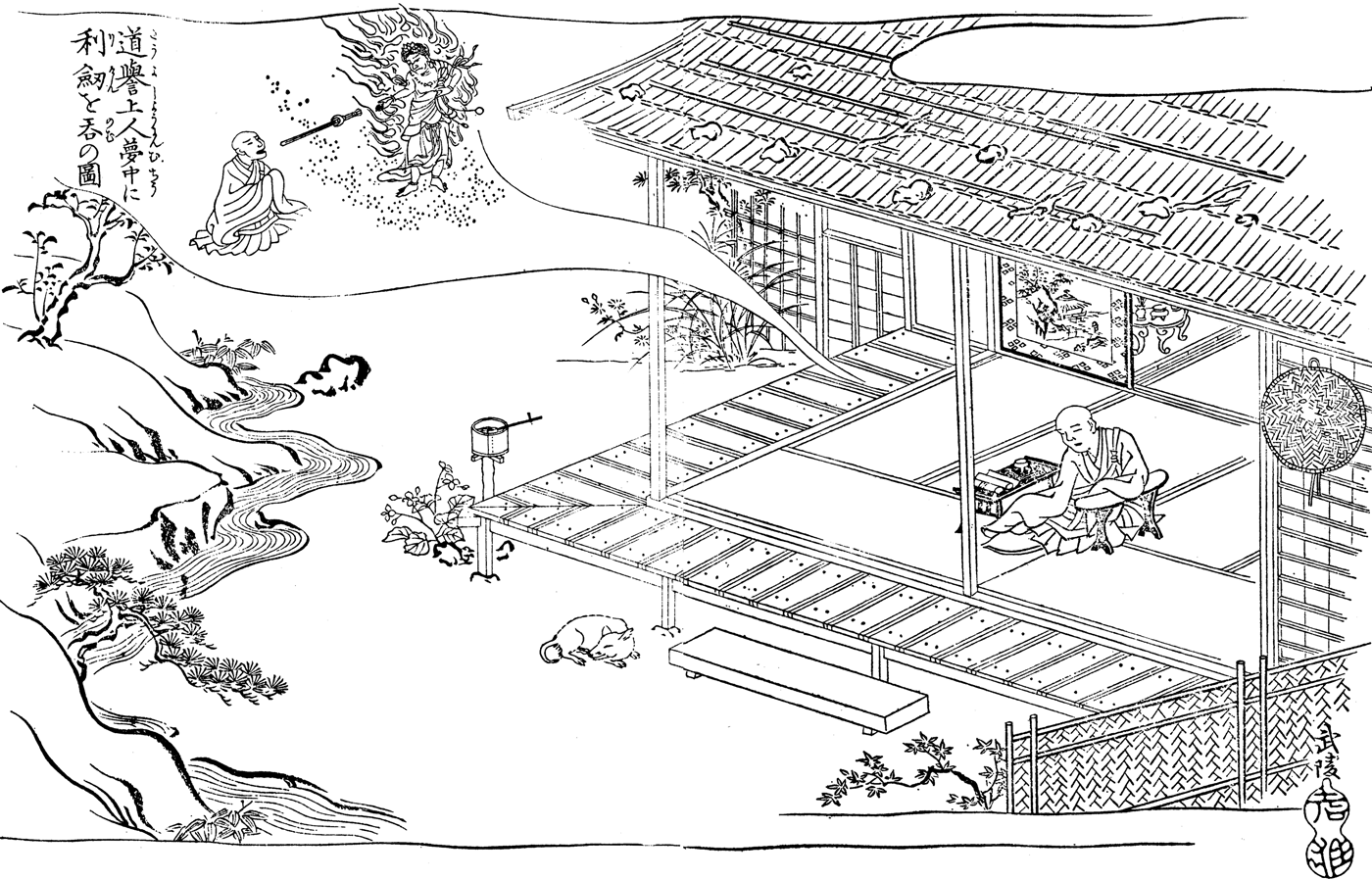
Though Kakugen makes no mention of Amakuni, the Daiengi next describes Fudō’s weapon as a “treasured sword”, suggesting that a possible identification had already taken place. The Daiengi notes the sword's particular ability to drive out madness and cure illness through the act of “anointing” (chōdai 頂戴) worshippers. This anointing later provided a narrative basis for a new ritual tradition at Shinshōji (discussed below), and advertised the object's ability to bestow “this-worldly benefits” (genze riyaku 現世利益) to devotees by mere ritual contact. The sword's curative powers further set the stage for the second – and here more relevant – engi miracle tale.Footnote 18 The action shifts sharply away from the Shingon Kanchō to a somewhat unexpected focus on a Pure Land monk, Saint Dōyo (Dōyo Shōnin 道誉上人, 1515–74), founder of the Pure Land temple Daiganji 大巌寺 near Shinshōji in the Shimōsa domain of Oyumi 生実 (present-day Chiba City). The Daiengi recounts how Dōyo, despite best intentions, was a slow-witted fool who suffered from “innately dull faculties” (tenshi dodon 天資駑鈍) that impeded his study of the dharma. He called on the Narita Fudō for one-hundred days and nights, who on the final eve of petitions appeared before the monk in a dream. In the role of a divine physician whose instrument roots out an offending sickness, Fudō thrust his “sharp sword” (riken 利剣) down the monk's throat, a symbol of divine transformation, the conquest of spiritual hindrances, and miraculous birth (see Figure 1).Footnote 19 Dōyo awoke to find himself and the temple floor covered in a purged “dark” (kurai黯) blood (later dubbed donchi 鈍血 or “dull blood”). The bloody rebirth endowed Dōyo with an intellectual brilliance that soon won him a reputation as an eminent Pure Land scholar.Footnote 20
“Image of Saint Dōyo Swallowing the Sharp Sword While Dreaming” (from Nakaji Sadatoshi, Narita meisho zue, Reference Sadatoshi1858). Image courtesy of Naritasan Bukkyō Toshokan.

Dōyo's gruesome “anointing” likewise drew from scriptural accounts of the deity's Mikkyō background, here of his “sharp sword” as a weapon of wisdom that combats spiritual defilements,Footnote 21 and placed it within the context of local Narita history as the instrument of Dōyo's salvation. Later versions of the tale added that Fudō had presented two swords, one “dull” (don 鈍) to symbolize Dōyo's poor condition, and the other “sharp” (ri 利) to represent the promise of cure. Dōyo chooses the latter, reaffirming the treatment of Fudō’s sword as a weapon of wisdom.Footnote 22 Its association with the Amakuni Sword thus would not have taken much of a logical leap, as both shared the concepts of subjugation and destruction of spiritual defilements.
Under the Daiengi’s impetus, both miracle tales provided a meaningful “PR” narrative promoting a sacred history and identity for Shinshōji and its deity. Although independent and somewhat disjointed from one another, they served a like purpose in the deity's localization at Narita, and reveal the sword as a uniquely central symbol in the process.
V. The Narita sword cult on the move
While the Daiengi firmly embedded Fudō within Narita geography, localization did not immobilize the cult nor bind the deity or Amakuni Sword to the temple. Rather, the violent account of swords and blood made for an entertaining tale that, with Edo's growing print and information cultures, was soon circulating beyond Shinshōji's exclusive ownership.
The mobility and shared currency of the engi is illuminated by Shinshōji's kaichō 開帳 (lit. “opening the curtain”), or exhibition, programme, which allowed the temple's treasures to move temporarily to alternate locations where they could be directly displayed to new audiences.Footnote 23 Attracted by the burgeoning population and the wealth of Edo's townspeople, Shinshōji's clergy brought the Narita Fudō to the capital twelve times in all from 1703 to 1856 where it was paraded through the streets and unveiled in a host shrine to attract the prayers and patronage of Edoites. With two exceptions (1751 and 1809), these degaichō 出開帳 (“travelling exhibitions”) were held in Fukagawa 深川 within the shrine precincts of Tomioka Hachimangū 富岡八幡宮 near Edo's waterfront.Footnote 24 Over the years Fukagawa grew to become a distant representative of the temple's sacred space in Edo – its spiritual home from home – where contact with the provincial deity was made possible in the big city.Footnote 25
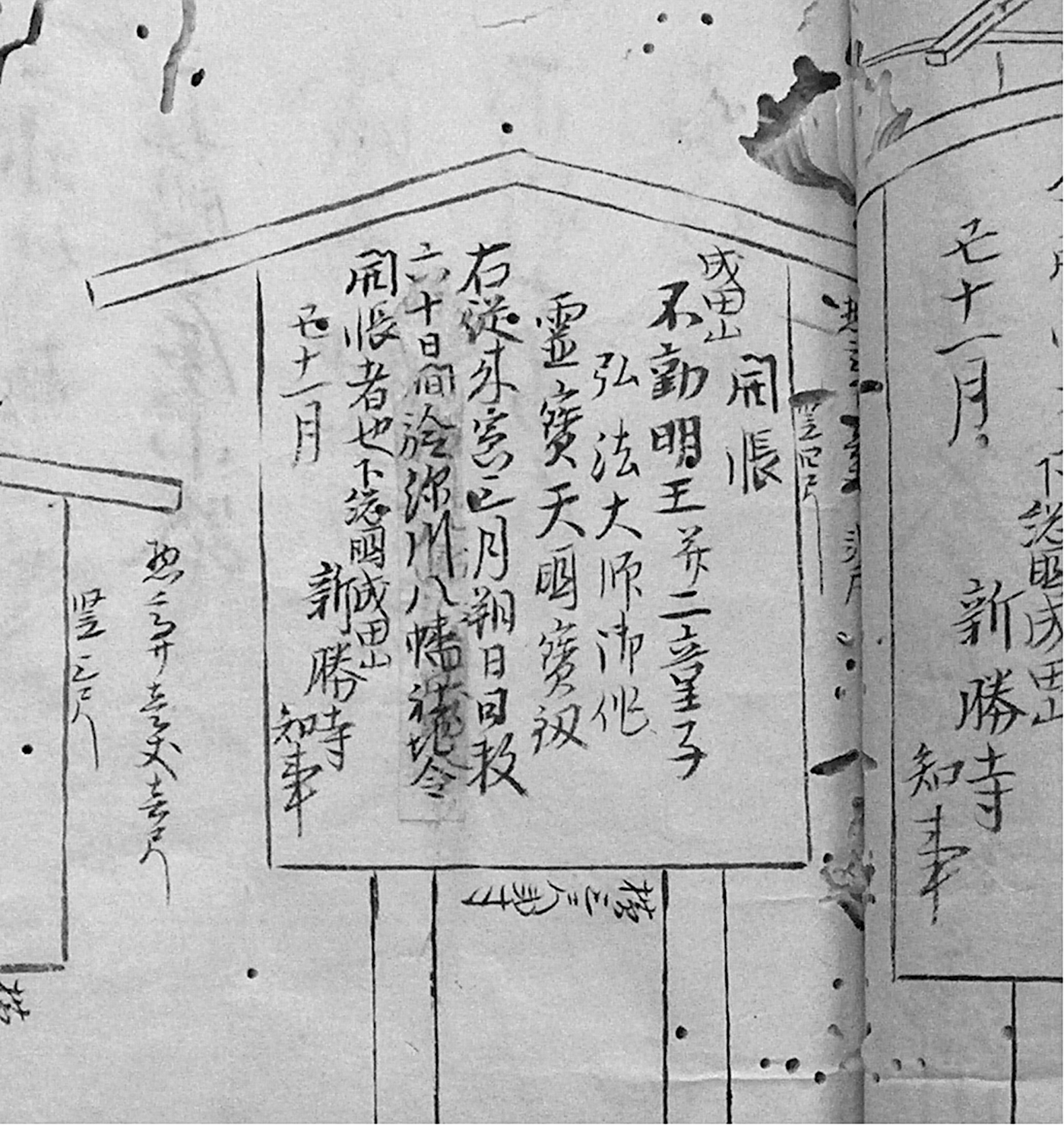
As kaichō grounds were a prime opportunity for clergy to offer public sermons and aggrandize the temple properties on display, both the engi and sword were from the outset promoted alongside the Narita Fudō statue. A donor list (kishinchō 寄進帳) from the initial 1703 Edo exhibition notes that, along with coin offerings (kaisen 賽銭) and the sale of omamori 御守 talismans and wooden goma prayer sticks (goma ki 護摩木), the temple earned money from “engi images” (engi miei 縁記御影) and the “treasured sword”.Footnote 26 The presence of swords reappears in subsequent kaichō records in the 1700s, but as in the Daiengi, the name of Amakuni is nowhere to be found. It is not until the turn of the century at the 1806 Fukagawa exhibition that the “treasured sword” is identified as the work of Amakuni in the kaichō diary (nikki 日記) of Shinshōji's abbot, Shōyo 照誉 (d. 1819).Footnote 27 Although the Amakuni association had possibly been made years previously, it only becomes explicit in the temple's extant kaichō records when the sword emerged as a major fixture at the exhibitions. Shōyo's sketches of fuda 札 signboards, posted months in advance at Edo's major intersections to advertise the coming event,Footnote 28 illustrate how the sword was now formally headlining exhibitions alongside the Fudō statue (see Figure 2).
1806 Kaichō advertisement signboard (detail). Image courtesy of Naritasan Bukkyō Toshokan.Footnote 29
Following the 1806 exhibition, the Amakuni Sword stood on a par with the Narita Fudō statue as the main attraction in the capital and headlined all but one (1814) of the remaining five Edo exhibitions (1821, 1833, 1842, 1856). Shōyo notes that the display of the Amakuni Sword was to attract worshippers with the promise of kechien 結縁 (“karmic connection”) through the act of “anointing” (physical contact), no doubt inspired by the engi. Like Buddha relics that receive their own cultic veneration, the sword had become a formal object of worship with its individual miraculous power. Before long it became celebrated as Shinshōji's “number one spiritual treasure” (daiichi no reihō 第一の霊宝),Footnote 30 and was transported with its own palanquin and parade bannersFootnote 31 under the care of a specialist confraternity, the “Nihonbashi Treasured Sword Confraternity” (Nihonbashi Hōken Kōsha 日本橋宝釼講社).
Shōyo's diary also provides the first extant mention of a second popular engi treasure at the 1806 exhibition – the “dull-blood robes” (donchi no koromo 鈍血衣) – purportedly the very blood-stained garments worn by Dōyo during his miraculous encounter with Fudō.Footnote 32 Shōyo notes that the robes were the property of the nearby Pure Land temple Daiganji, founded by Dōyo, and temporarily borrowed with permission for the sixty-day exhibition. With three additional objects on loan from Daiganji accounting for nearly half of all “treasures” (reihō 霊宝) on display, the Pure Land temple seems to have enjoyed a special presence at the exhibition.
The engi as shared sectarian property unsurprisingly bonded the two temples together almost from the beginning. Soon after the appearance of the Daiengi in 1700, the sword-swallowing tale quickly found its way into Dōyo's Pure Land biographies starting with the Jōdo honchō kōsōden 浄土本朝高僧伝 (Biographies of Eminent Japanese Pure Land Monks, 1704–1713),Footnote 33 and Daiganji's engi recorded in a 1722 gazetteer.Footnote 34 As illustrated by Kaneko Tamotsu, Daiganji's history was partially built on top of that of Shinshōji. Not only does Daiganji's engi include the account of Dōyo at Shinshōji, but it also describes how, out of gratitude for his reborn life, he had “re-enshrined” (kanjō 勧請) the Narita Fudō at Daiganji. The Daiganji Fudō became known as the “Fortune-bestowing, wisdom-increasing” (kaiun zōe 開運増慧) Fudō.Footnote 35 Moreover, a Daiganji document called the Goyu shosho 御由諸書 (c. 1818–28), perhaps written for submission to its head temple Zōjōji 増上寺,Footnote 36 records various temple treasures owned by Daiganji, three of which are relevant here:
1. 道誉上人感得天国宝劍壱握
One Treasured Sword of Amakuni Miraculously Received by Saint Dōyo
2. 同大聖不動尊壱躯
One Statue of the Great Sacred Fudō Also [Received by Saint Dōyo]
3. 開山呑劍吐血之衣
Robe of Temple Founder [Dōyo] with Disgorged Blood from Swallowing the Sword [of the Narita Fudō]Footnote 37
The record reveals that Daiganji not only shared a similar engi heritage, but also mimicked Shinshōji's very temple treasures. Daiganji's ownership of Dōyo's robes was clearly acknowledged in Shinshōji records,Footnote 38 but its claim to the Amakuni Sword may have sparked a contested ownership. A Zōjōji record entitled San'enzan shi 三縁山志 (A Record of San'enzan [Zōjōji] Temple, 1819) gives the following interlinear note glossing the Dōyo tale:
今龍澤山に鈍血の劔あり成田山開帳の時はこれを結縁せしむ
At present [Dōyo's] “dull blood” sword is at Ryūtakusan [Daiganji]. During Naritasan [Shinshōji] exhibitions, it is used for kechien.Footnote 39
A few decades later the above passage was reproduced for a Shinshōji guidebook, the Narita meisho zue 成田名所図会 (Illustrated Guide to Famous Places in [and on the Way to] Narita, 1858), but with a single conspicuous alteration:
今龍澤山に鈍血の法衣あり成田山開帳の時はこれを結縁せしむ
At present [Dōyo's] “dull blood” robe is at Ryūtakusan [Daiganji]. During Naritasan [Shinshōji] exhibitions, it is used for kechien.Footnote 40
The minor, though significant, textual alteration from “sword” to “robe” may suggest Shinshōji asserting ownership and control over any sword having to do with the miracle. Despite Daiganji's potential encroachment, the relationship did, however, seem reciprocal: both temples are recorded to have again combined their treasures to mutual advantage at least twice more during the 1855 igaichō 居開帳 (“home exhibition”) in NaritaFootnote 41 and the 1856 degaichō in Fukagawa.Footnote 42 Daiganji's contribution of the robes offered a complement to Shinshōji's sword as a second relic and object of kechien worship, and strengthened the collaborative proselytization effort indebted more to geography and shared engi tradition than sectarian affinity.
VI. Enter Yūten
Shōyo's diary reveals yet another significant detail from the 1806 exhibition. Among the five listed treasures owned by Shinshōji were three calligraphic nembutsu 念仏 scrolls, one attributed to Dōyo, and a second to another, and more famous, Pure Land monk and legendary exorcist named Saint Yūten (Yūten Shōnin 祐天上人, 1636–1718).Footnote 43 Despite Dōyo's shared importance to Shinshōji and Daiganji, the increasing inertia of the sword-swallowing tale was such that various versions were soon circulating in and around Edo attributed to different monks.Footnote 44 The most popular account in the Edo area was credited to Yūten, abbot of Edo's Zōjōji, and was attached to the monk's biographies around the turn of the nineteenth century. According to the Yūten daisōjō godenki 祐天大僧正御伝記 (Biography of Yūten Daisōjō)Footnote 45 Yūten received a vision from an old white-haired man at Zōjōji to seek out the Narita Fudō. There he fasted in prayer, where the deity appeared and revealed that the monk's intellectual plight – the result of past sin – will plague his religious career for lifetimes to come. In the style of the Dōyo version, Fudō presented a choice of two swords (here one long and one short) with the promise of disgorging Yūten's “bad” or “diseased blood” (akuchi 悪血) and severing the bad karma. Yūten swallowed the long sword, and like Dōyo, regurgitated the offending blood in a symbolic death of ignorance and rebirth to wisdom.
How exactly the association with Yūten came about is unclear, though the monk's similar heritage, lineage, and name to Dōyo, may have provided some logic.Footnote 46 Whether the new Yūten version was the result of confusion on the basis of their like careers, or consciously incorporated to augment the monk's posthumous biography, is difficult to say.Footnote 47 A Daiganji record, Danrin Oyumi Daiganji shi 壇林生実大巌寺志 (A Record of the Danrin Temple Daiganji of Oyumi, Bunsei period, 1818–29), predictably adopts the former stance, suggesting both a confusion over the two versions as well as an apparent rivalry:
These days there are books that associate this [event] with Yūten Daisōjō. What a big lie! To this day both the “dull blood” sword and robe are kept together within the treasure house of our temple [Daiganji]… .The benefits [received from the Narita Fudō] by the swallowed sword surely began with Saint Dōyo during the Tenbun era [1541–1554]. Footnote 48
By “books”, the record was probably referring to the Yūten biographies circulating at the time as independent works such as the Yūten daisōjō den 祐天大僧正伝 (Biography of Yūten Daisōjō, 1802) and Yūten daisōjō riyaku ki 祐天大僧正利益記 (Record of the Blessings of Yūten Daisōjō, 1808). These books, and their impact at Daiganji, were indicative of Yūten's greater posthumous popularity in the capital and his common linkage to the tale, as suggested by his added appellation of “Gushin” 愚心 (“Dull-minded [One]”).Footnote 49
The synchronous rise in popularity of the Yūten and Amakuni Sword at the turn of the nineteenth century illustrates an expanding storytelling world in which Shinshōji was not solely responsible for the miracle's popularity. As a result, Shinshōji's engi had become a travelling tale; it was being remapped onto a wider range of locales creating a larger network of Shingon and Pure Land sites that now included Zōjōji (and by extension Yūtenji 祐天寺 Temple founded by Yūten in Edo) that could claim participation in, and thus benefit from, the miracle and its properties.Footnote 50
It may thus have been at this time that Daiganji consequently began lending Dōyo's robes to the exhibitions. While there is evidence that Dōyo's robes existed as early as 1722,Footnote 51 they, like the Amakuni Sword, do not seem to have become significant at the exhibitions until after 1800. The robes may have been the temple's chance to capitalize on the tale's increasing popularity while competing with the recent Yūten cult by offering irrefutable evidence of Dōyo as the saint in question.
Meanwhile back in Narita, the increasing popularity of the Yūten tale and Amakuni Sword post-1800 marked a noticeable increase in the frequency of Shinshōji's home exhibitions starring the sword.Footnote 52 Records suggest the degree to which the sword had become a visible draw of the cult. In a catalogue of items on display at the 1815Footnote 53 and 1822Footnote 54 Narita “treasure exhibitions” (hōmotsu kaichō 宝物開帳), listed are over a dozen additional swords on display alongside the Amakuni Sword. The sight was confirmed by the poet and nativist scholar Shimizu Hamaomi 清水浜臣 (1776–1824) in his travel diary during his 1815 visit: “One can see many old paintings and an abundance of ancient swords, in particular among them the Amakuni Sword passed down by the temple”.Footnote 55 Double-edged replica swords (tsukurimono 作り物) given as offerings by patrons were similarly spotted by Taijō Keijun 大浄敬順 (n.d.) at the 1821 Edo exhibition and noted in his Yūreki zakki 遊歴雑記 (Miscellaneous Records of Recreational Travels, 1814–1829).Footnote 56 Underlining the narrative basis for the sword cult and the miraculous currency of the Amakuni blade are wooden votive tablets (ema 絵馬) donated by patrons with illustrations of the Yūten tale, attesting to a desire to venerate the deity and sword and acquire the benefits promoted by the temple's miracle tale traditions.Footnote 57 The 1844 sword exhibition helped further establish a regular annual temple event during Narita's Gion 祇園 festival. This was the “Anointing of the Treasured Sword” (hōken chōsai 宝釼頂載, still practised to this dayFootnote 58) which is said to bestow various benefits such as curing madness, healing sickness, removing evil hindrances, and providing good health.Footnote 59 The sword's “anointing” (chōsai 頂載) and its ability to cure “madness” (kyōran 狂乱), we may recall, come directly from the Daiengi.
VII. The Narita sword cult in popular culture and entertainment
While the kaichō display of sacred objects was formally promoted by Buddhists for spiritual betterment of society, they also served as major hotspots of entertainment and key sources for early modern media culture, storytelling and art. The Edo exhibitions were thus not a terminus for the cult's spread, but served as a launching ground into popular culture (no doubt facilitated by Fukagawa as one of the city's best-known entertainment districts). The tale's gruesome attention to violence, swords and blood made for a popular tale that quickly drew the attention of artists from non-clerical circles.
One of the initial places where we find the tale is the theatre. Not long after its appearance in the Daiengi it was quickly turned into a noh playFootnote 60 (yōkyoku 謡曲), possibly during the Hōei-Shōtoku era (1704–15).Footnote 61 The play, simply titled Naritasan 成田山, made Shinshōji a prime beneficiary of the play's publicity, though the presence of Dōyo naturally made it of comparable importance to Pure Land tradition. The play concerns Mutetsu 無哲, Mr “No Philosophy”, the characteristic travelling waki 脇 (deuteragonist) monk of noh tradition. Like Dōyo, Mutetsu is a devout Buddhist from Daiganji Temple but suffers from the same “dull faculties” (donkon 鈍根). The play opens:
Shidai:Footnote 62 Fan the lamp of wisdom and illuminate the darkness of ignorance.
Waki: Here is the monk named Mutetsu, in training at Daiganji in Oyumi. I have entered the Buddhist priesthood and followed the teachings of the patriarchs. However, though I cultivate non-retrogression and rebirth in the western direction, the misery of my ignorance from my dull faculties is such that I cannot commit a single verse of scripture to heart. As I have heard that the image of Fudō of Narita in Shimōsa Province is truly most miraculous, I now set off on the journey [to Narita] to pray that I may attain the way of a peaceful mind for rebirth [in the Pure Land].Footnote 63
Making his way to Shinshōji and inspired by Dōyo's identical lot and miraculous transformation, Mutetsu prays to the Narita Fudō. Dōyo, as the conventional nochi shite 後仕手 (second act protagonist) in the form of a spirit, appears at Narita and explains how he too once sought the deity's healing powers. Through the two men's exchanges, the play unfolds, with Mutetsu eventually cured of his condition by swallowing the Amakuni Sword.
Details about the play's origins are obscure, and it is unclear to what extent, if any, Shinshōji (or Daiganji) played a role in the production.Footnote 64 What is certain, however, is that the recently popular tale of Dōyo's gruesome encounter with the Narita Fudō provided a direct inspiration for the play. The miraculous dream, sword-swallowing, and blood-spewing episode are repeated multiple times, complete with a description of the sword, its Amakuni provenance, and even length (given here as two shaku 尺, eight sun 寸, or approximately 85 centimetres). The Masakado rebellion, the origin of the Narita Fudō image, and founding of the temple by Kanchō are also mentioned. With this added detail, one cannot help but notice the implicit advertising permeating the play's text. In addition to its incorporation of the engi, the play extols Fudō’s numinous powers and, through the character of Mutetsu, offers a spiritual model encouraging its audience to re-enact the pilgrimage to Shinshōji to view the Amakuni Sword first-hand and to pray to Fudō. Thus in concert with spreading the engi, the play may also have functioned as a type of promotion and guide, similar to the meisho 名所 (“famous places”) genre, detailing local history and attractions of interest to visitors and pilgrims.
While the play reaffirms the trans-sectarian currency of the miracle tale, it importantly illuminates an evolving shift away from the standard account. The ultimate objective of Dōyo and Mutetsu's prayers to the Narita Fudō does not end with curing their poor faculties but extends to attaining rebirth in the Pure Land, a significant addition not present in any version of the engi. Throughout the play, “Pure Land” terminology (for example, ōjō 往生, raigō 来迎, nembutsu 念仏, and sanbu no kyō 三部の経) is seamlessly intermixed with those traditionally associated with “Mikkyō”.Footnote 65 Mutetsu announces, “May the Myōō also lend me his assistance so that I may realize my karmic chance for rebirth [in the Pure Land]. Homage to Fudō!” While Fudō had developed connections to death and Pure Land rebirth centuries earlier,Footnote 66 no such Fudō nembutsu (namu Fudōson 南無不動尊) is to be found in Shinshōji's miracle tale tradition, nor the tale as a model for rebirth into the Pure Land. The adaptation reflects how artists were already exercising an artistic license beyond the immediate control of Shinshōji, possibly drawing on an old and popular Fudō tale of the Pure Land monk Shōkū 証空 (1177–1247) who prayed to the deity to overcome a life-threatening illness and obtain Pure Land rebirth.Footnote 67
While Dōyo was of some early interest to the noh theatre, Yūten similarly became known to the kabuki stage with his rising posthumous popularity in the early 1800s. In 1821 the tale was performed as a jōruri 浄瑠璃 song praising the Narita Fudō and his sharp sword during a kabuki play at Edo's Nakamuraza Theatre, with the famous Shinshōji patron, Ichikawa Danjūrō 市川団十郎 VII (1791–1859), in the role of Fudō.Footnote 68 A few years later the same actor again starred as both the Narita Fudō and Yūten in Kesakake matsu Narita no riken 法縣松成田利剣 (A Surplice-Hanging Pine and the Sharp Sword of Narita,Footnote 69 1823) at the Moritaza Theatre in 1823.Footnote 70 The play was a hit, and repeat performances were subsequently staged.Footnote 71
Under the impetus of its founder, Ichikawa Danjūrō I (1660–1704), the actors’ line had become celebrity patrons of the Narita deity as advertised by their guild name (yagō 屋号) of “Naritaya” 成田屋 (House of Narita) since 1697.Footnote 72 The incorporation of Fudō into the Danjūrō repertoire facilitated their trademark acting style of aragoto 荒事 or “wild stuff”, which emphasized wrathful deities, bombastic action and oversized weaponry that appealed to townspeople and samurai citizenry alike.Footnote 73 A signature aragoto move was the fudō mie 不動見得 (“Fudō pose”) wherein the actor would mimic the iconography of the deity by imitating his sword, rope and menacing glare. As in such famous aragoto plays as Kanjinchō 勧進帳 (The Subscription List) and Narukami 鳴神 (Saint Narukami), the actor would glare fixedly with a sword vertically in one hand and his rosary in the other (to mimic Fudō’s rope)Footnote 74 as a momentary expression of the god.
That the artistic personalities of the Danjūrō actors and their faith became a vehicle for the violent Yūten tale and Amakuni Sword is thus not surprising, evidenced by a kawaraban 瓦版, a type of news sheet sold around the city containing the latest news, popular tales and gossip. The untitled news sheet details the news that Ichikawa Danjūrō II (1688–1758) had been saved from a life-threatening illness by the Amakuni Sword in the vein of Yūten (see Figure 3).
It is said that long ago, Saint Yūten had a miraculous dream of Fudō Myōō in which he swallowed the Amakuni Treasured Sword and [awoke] vomiting “diseased blood”, only to become possessed of outstanding brilliance. However, just after the seventh hour on the evening of the twenty-third of the fifth month of this year [1735], our favourite Ichikawa Danjūrō suddenly coughed up over two masu Footnote 75 of “diseased blood” and lost consciousness. When he uttered not a single word, people were completely dumbfounded. Among the many who attended to him was one in particular, a servant named Mankichi Eiji, who had taken the tonsure. At first light he made a great petition to the Narita Fudō before the [temple] treasury, and a wonder took place. That night around the ninth hour [Danjūrō] gradually began to regain consciousness. Everyone was overjoyed. Day after day he [improved until he] made a complete recovery. Before long he was as good as new. It is said that his revival [sōsei] could not have been due to anything but the divine favour of Fudō Myōō. There was not a single person who was not awe-struck. How awesome! How awesome! How awesome!
Later, in 1851, Danjūrō VIII (1823–54) is said to have fallen ill on stage, his condition so severe that a shinie 死絵 (“death print”), a type of memorial picture announcing the death of a celebrity, had already been prepared. He soon recovered, however, and prints (surimono 刷物) entitled Ichikawa Danjūrō sosei no shidai 市川団十郎蘇生の次第 (How Ichikawa Danjūrō Revived from Death) celebrating the event were soon being sold.Footnote 76 The print's title – particularly its use of the word “revived” (sosei 蘇生) – suggests that Danjūrō’s return to health had also been celebrated after the style of Yūten's near-death encounter. Since kawaraban were produced for the urban masses and sold on the streets by vendors (yomiuri 読売), their existence, like the memorial print, is a strong indication of the extent to which the tale and sword had taken on a new life outside sectarian tradition.
Kawaraban news sheet of Ichikawa Danjūrō II, the Narita Fudō, and Amakuni Sword. Image courtesy of The University of Tokyo Interfaculty Initiative in Information Studies.
By the end of the period, the sword-swallowing tale had even found its way into Edo's world of misemono 見世物, carnival-like sideshows run by townspeople showcasing a wide variety of attractions from craftworks and street performances to freak shows and exotic animals. A misemono chronology records that Yūten and Fudō became the subject of an 1856 misemono doll show by Ōe Chūbei 大江忠兵衛 (n.d.), a craftsman specializing in the display of “mechanical living dolls” (karakuri iki ningyō 機関生人形) fashionable at the time.Footnote 77 The display featured a number of life-like folk characters popular in Edo theatre such as Chūjōhime 中将姫 and the demon of Adachigahara 安達原. The inclusion of Yūten and Fudō was a natural fit; the tale was known to the theatre, and such displays commonly featured gruesome violence, swords and blood.Footnote 78
The doll display was commemorated in nishiki-e 錦絵 prints by artists from the popular Utagawa 歌川 school, Kunitsuru 国鶴 (1807–78) and Kuniyoshi 国芳 (1797–1861), which featured a menacing Fudō brandishing his sword over a terrified Yūten, somewhat lessened of religious significance and more concerned with its shocking imagery.Footnote 79 The Kuniyoshi print is notable for its pairing of the tale with a popular scene from the Adachigahara folktale of the demon Onibaba 鬼婆 (“demon granny”) who preys on unborn children. The imagery of Fudō threatening Yūten with sword and rope was made to parallel the demon's knife attack on the belly of a haplessly restrained pregnant woman, underlining its popularity in the gothic horror popular at the end of the period. A decade later an even more graphic depiction entitled Yūten Shami 祐天沙弥 (Yūten the Novice), was included in the Azuma nishiki ukiyo kōdan 東錦浮世稿談 (Tales of the Floating World in Eastern Brocade, 1867–68), an ukiyoe 浮世絵 collection of popular violent tales by Kanagaki Robun 仮名垣魯文 (1829–94) and illustrated by Tsukioka Yoshitoshi 月岡芳年 (1839–92). Though the accompanying text does not deviate from the standard tale, the image again depicts Fudō in a near-thuggish manner with his sword to Yūten's throat.Footnote 80
Finally, the date and location of the misemono doll display are notable. It is recorded that it was held in the precinct of Hachimangū Shrine in Fukagawa during the third month of 1856,Footnote 81 the location and opening date of Shinshōji's Edo exhibition featuring the Amakuni Sword that year.Footnote 82 The timing of the two events was not an unlikely coincidence: misemono shared a similar culture of urban display for religious curiosities and were commonly held alongside kaichō exhibitions – an apt indicator of the mobility of the tale and sword across the interconnected worlds of religion and entertainment.
VIII. Summation
That the provincial Narita Fudō became one of the capital's most worshipped deities underlines a significant yet hitherto underappreciated factor in understanding early modern Japanese religion: that while popular cults were grounded in local sites of sacred power, the geographic characteristics which defined such localizations did not render them centralized or static, but rather translated into a mobility inviting wider participation. The relevance of place, person, and event in the definition of a deity illuminates how popular, entertaining narratives and material objects stood as important local agencies in the fluidity of early modern Buddhist properties across geographical, sectarian and artistic boundaries, thus functioning in different ways to different audiences.
The mobility of the Narita Fudō cult, and its remapping atop new cultural spaces in and around the capital, is to be understood as a distinct product of early modern Japan as an age of unprecedented physical movement. The shared currency of the deity demonstrates in detail the cultural shifts in Edo Japan explored by scholars such as Nenzi (Reference Nenzi2008) and Berry (Reference Berry2006), such as the effects of increased travel and the spread of print information on transforming early modern spaces into highly polysemic and elastic geographies. The markedly improved roads connecting Edo to its environs, and the diffusion of popular storytelling literature and theatre now accessible to the masses, allowed Buddhist objects like the Narita Fudō statue and Amakuni Sword to become multivalent commodities operating across an expanded network of sites. The sword and legends of Dōyo and Yūten operated among popular narratives, biographical literature, and local temple cultures to produce a distinctively new complex of Pure Land and Shingon institutions defined less by sectarian tradition and more by regional power structures. The fluid dynamics of worship and commercial entertainment further suggest that non-elites such as playwrights, storytellers, actors and artists should be considered on a par with clergy as key players in the promotion of religious traditions. The case study of the Narita cult reveals an intricate and shifting network of institutions, spaces, agents and media operatives behind early modern Buddhist properties in which temple clergy were not always the immediate proprietors or even participants.