The transfer efficiency of viruses from various types of fomites (ie, inanimate objects and surfaces) to the finger pads of hands is key in the development of pathogen exposure and quantitative microbial risk assessment models. Reference Nicas and Best1,Reference Haas, Rose and Gerba2 Previous studies have documented the transfer efficiencies of nonenveloped viruses from various types of fomites to finger pads. Reference Ansari, Sattar, Springthorpe, Wells and Tostowaryk3,Reference Lopez, Gerba, Tamimi, Kitajima, Maxwell and Rose4 In this study, we evaluated the transfer efficiency for enveloped viruses such as coronavirus (HCoV surrogate 229E).
Material and methods
Preparation of the test virus
Human coronavirus 229E (HCoV 229E) was procured from the American Type Culture Collection (ATCC VR-740; Manassas, VA) and propagated using the MRC-5 cell line (ATCC CCL-171). Infected cells were freeze-thawed and clarified lysates underwent a polyethylene glycol (PEG) extraction [12% (w/v) PEG (8000 mw) and 0.5 M sodium chloride] overnight at 4°C. The suspension was centrifuged (10,000 ×g for 60 minutes), and the virus pellet was resuspended in 0.01 M phosphate-buffered saline (PBS; pH 7.4) to 10% of the original suspension volume. Aliquots were stored at −80°C until use on the respective study dates. Virus stock titers were determined prior to the study by thawing and diluting (1:10) a stock vial using 0% fetal bovine sera (FBS) in minimal essential media (MEM). Dilutions were plated in replicates of 6 onto MRC-5 monolayers prepared in multiwell trays and incubated for 7 days (35°C) in a 5% CO2 atmosphere. Wells were scored for cytopathogenic effects and recorded as tissue culture infectious dose at the 50% end point (TCID50) per mL. Reference Payment and Trudel5
Pre- and post-experiment hand decontamination
The study participant was healthy 75-year-old male whose hands lacked visible cracks, abrasions, cuts, or other compromising skin conditions. Permission was obtained and the protocol was approved by University of Arizona Institutional Research Board prior to conduct of the study; a human subjects review was not required. Prior to all experiments, the study participant’s hands were washed using an antibacterial liquid hand soap for 45 seconds, rinsed with deionized water, and dried using paper towels. Each hand was then sprayed twice with 70% ethanol and rubbed over the hands and wrists for 15 seconds followed by air drying for a minimum of 5 minutes. After conducting fomite-to-finger viral transfer experiments, the study participant’s finger pads were sprayed twice using 70% ethanol, and the entirety of each hand was wrapped within 70% ethanol-saturated paper towels for 30 seconds. The hands were then washed, rinsed, and dried as previously described.
Test carrier preparation and inoculation with HCoV 229E
On the test dates, a vial of stock virus (∼107 TCID50/mL) was thawed and amended with FBS to achieve an organic load of 5% (v/v). Cleaned, sanitized (70% ethyl alcohol) test carriers (Table 1) were inoculated with 10 μL of virus, which was spread over an area of 1-cm2 using a bent pipette tip. The carriers were dried (no liquid) in a controlled humidity chamber (22 ± 1oC and 40% ± 5% relative humidity) for ∼30 minutes with the petri dish lids on. A triplicate set of carriers was immediately harvested to determine levels of infectious virus per carrier just prior to the transfer experiments. Carriers were rinsed with 1 mL of 0% FBS MEM with antibiotics 3–5 times and treated with a sterile cell scraper to further facilitate virus detachment. Dilutions and plating onto MRC-5 cell monolayers followed as previously described.
Fomites/Surface Types Tested

Fomite-to-finger transfer experiments
The remaining carriers underwent transfers from fomite to finger pad within 15 minutes after drying. The study was conducted under controlled conditions (22 ± 1oC temperature; 55% ± 5% relative humidity). One transfer trial consisted of 6 transfer events using the index, middle, and ring fingers of both hands for each surface type. The transfer protocol was conducted according to Lopez et al Reference Lopez, Gerba, Tamimi, Kitajima, Maxwell and Rose4 by placing the finger pad directly onto the contaminated carrier, achieving full contact with the 1-cm2 inoculum zone for 10 seconds at 1.0 kg/cm2 of average pressure (range, 900 g/cm2 to 1,200 g/cm2).
Finger sampling
HCoV 229E was initially recovered from contaminated fingers using the nylon swab method described by Rusin et al Reference Rusin, Maxwell and Gerba6 ; however, low viral recoveries were achieved. An alternative method was then employed during which the contaminated fingers were washed in 1 mL 0% FBS MEM with antibiotics within a sterile petri dish. The individual fingers were placed into the liquid at the bottom of the petri dish and rotated touching the bottom of the petri dish for 10 seconds to facilitate viral removal, and the suspensions were diluted (1:10) using 0% FBS MEM with antibiotics. Dilutions and plating onto confluent MRC-5 host cell monolayers followed as previously described.
Results
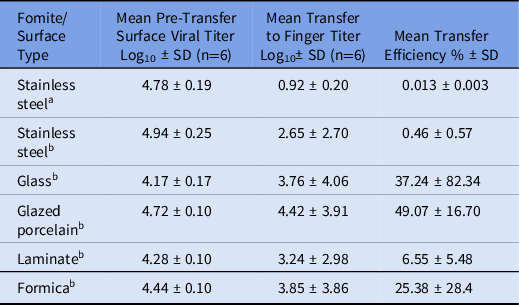
The swab method for sampling HCoV 229E transferred to the finger pads yielded lower numbers) than the fingers directly rotating into 1 mL 0% MEM with antibiotics (Table 2). Overall, the highest numbers of HCoV 229E were transferred from glazed porcelain (49.07% ± 16.70%) to the fingers compared to stainless steel (<1%), which demonstrated the lowest mean transfer efficiency of HCoV 229E (Table 2).
Fomite-to-Finger Pad Transfer Efficiencies of Human Coronavirus 229E

Note. SD, standard deviation.
a Swab method.
b Wash method.
cAverage represent the results of 6 replicates.
Discussion
Fomite-to-finger pad transfer data has been published for nonenveloped viruses; however, it cannot be extrapolated to enveloped viruses due to differences in viral structure and methodologies. The transfer efficiencies presented herein for HCoV 229E are similar to those of nonenveloped viruses, Reference Ansari, Sattar, Springthorpe, Wells and Tostowaryk3,Reference Lopez, Gerba, Tamimi, Kitajima, Maxwell and Rose4 although they may be greater for glazed porcelain. The reason for greater fomite-to-finger transfer from glass and glazed porcelain is unknown but may be attributable to the microscopically smoother surface of these fomites compared to others (eg, stainless steel) or the hydrophobicity of the surfaces. Properties including fomite/surface and viral hydrophobicity, and electrostatic interactions also contribute to the stability of virus-surface interfacial boundaries and should be considered factors. Lopez et al Reference Lopez, Gerba, Tamimi, Kitajima, Maxwell and Rose4 demonstrated a 7.1% transfer of MS-2 from ceramic tiles, and both MS-2 and PRD-1 phages were transferred from glass at efficiencies of 19.3% and 33.47%, respectively. Ansari et al Reference Ansari, Sattar, Springthorpe, Wells and Tostowaryk3 reported a mean transfer efficiency of rotavirus from stainless steel of 16.8%.
Respiratory viruses such as influenza, rhinoviruses, and respiratory syncytial virus, and coronavirus can be transmitted, in part, by inoculation of the nose, mouth, or eyes via contaminated hands. Thus, fomites may play a role in the transmission of these viruses, including coronavirus. For this reason, infection prevention measures recommended to preclude the transmission from an environmental surface or object by hands to the nose, mouth, or eyes include disinfection of surfaces and hand hygiene. Reference Ansari, Sattar, Springthorpe, Wells and Tostowaryk3,Reference Lopez, Gerba, Tamimi, Kitajima, Maxwell and Rose4 In the case of rhinoviruses and respiratory syncytial virus, inoculation of the nose, mouth, or eyes may be the major route of transmission. Reference Evans and Kaslow7 Intranasal inoculation has been demonstrated as a route of transmission of human coronavirus 229E and SARS-CoV-2. Reference Bradburne, Bynoe and Tyrrell8,Reference Richard, Kok and de Meulder9 With regard to fomites, modeling has shown that spread of the infleunza virus depends on touching frequency and other factors in indoor environments. Reference Zhao, Eisenberg, Spicknall, Li and Koopman10 In contrast, the role of fomites in the transmission of coronavirus SARS-CoV-2 is not currently known. However, this study has demonstrated the potential for coronaviruses (eg, SARS-CoV-2) to be transferred from various fomites to the fingers.
Acknowledgments
None
Financial support
This study was supported in part from a grant to the University of Arizona from Allied Biosciences and Disinfection Gift Trust Fund at the University of North Carolina.
Conflicts of interest
Dr Rutala is a consultant to Professional Disposables International (PDI). All other authors report no conflicts of interest relevant to this article.