

Introduction
The worldwide popularity of employing foreigners to provide home-care services can be attributed to several factors, including socio-demographic changes, such as the increase in lifespan, reduced fertility and family sizes, the increased number of women in paid work, and the fragmentation and nuclearisation of the family system (Ehrenreich and Hochschild Reference Ehrenreich and Hochschild2000; Salazar Parrenas Reference Salazar Parrenas2001; Yeoh, Huang and Gonzalez Reference Yeoh, Huang and Gonzalez1999). The fact that home care is a much cheaper alternative than institutional care, especially if provided by foreign workers, also encourages this care arrangement (Heller Reference Heller2003). The low status assigned in most of the developed world to care-giving in general and particularly that for older adults also contributes to the increasing prevalence of home-care workers from the developing world (Feldbaum and Feldbaum Reference Feldbaum and Feldbaum1981). Finally, another reason for the popularity of the arrangement is that home care fulfils the wishes of older adults and their family members to keep the cared-for person in their home environment (Keysor, Desai and Mutran Reference Keysor, Desai and Mutran1999).
The Israeli government actively supports older adults and their family members with the aim of facilitating the residence of older adults in the community for as long as possible. Support is available to community-dwelling older adults who present with significant disability (Heller Reference Heller2003). Because most Israeli personal-care workers are willing to provide only part-time care, they serve less impaired individuals, whereas the more impaired older adults who require higher levels of care tend to be cared for by foreign workers. Hence, most round-the-clock home-care services are provided by females of Asian or East European descent. Whereas Israel's official policy in recent years has limited the number of foreign workers (Borowski and Yanay Reference Borowski and Yanay1997), the home-care sector has seen an influx of foreign workers because work permits are granted for this activity (Klein-Zeevi Reference Klein-Zeevi2003). It is estimated that in Israel currently there are over 54,000 documented foreign home-care workers and at least another 40,000 who are undocumented (Nathan Reference Nathan2008).
To be eligible for a foreign home-care worker, the older adult must be completely impaired in the activities of daily living (ADLs). This results in foreign home-care workers providing care to the sickest and frailest older adults under minimal supervision or support (Heller Reference Heller2003; Weisblay Reference Weisblay2005). Although sharing a residence with the care recipient is not required by current Israeli immigration laws, this is often the case because it is a cheaper arrangement than paying additional housing costs. This also is a desired alternative for many impaired older adults who require round-the-clock supervision. In addition, although it is now established by law that foreign workers should have one day off work each week, a recent survey found that as many as 11 per cent of the workers provide care seven days a week and do not have even one day off. Similarly, although the law requires that foreign home-care workers have several hours off work each day, over 40 per cent reported working over 15 hours each day (Ayalon Reference Ayalon2009a).
The international literature has portrayed home-care workers as invisible care-givers, whose work is acknowledged by care recipients and their families only when problems arise. Many experience discrimination on the basis of gender, ethnicity or race, religion, legal status, financial status and employment status (Ehrenreich and Hochschild Reference Ehrenreich and Hochschild2000; Neysmith and Aronson Reference Neysmith and Aronson1997), as the workers' are considered inferior to the citizens of the host country. Whereas the salary of foreign home-care workers in the host culture is higher than could be earned for equivalent work in their country of origin, their social status in the host country is lower because they occupy positions that are shunned by the host labour force (Raijman, Schammah-Gesser and Kemp Reference Raijman, Schammah-Gesser and Kemp2003). Furthermore, in contrast to other countries that may allow foreign workers eventually to become citizens, as a Jewish state Israel makes every attempt to limit their stay in the country, does not allow their family members to join them, and actively limits the options of foreign workers to become full citizens (Borowski and Yanay Reference Borowski and Yanay1997).
Elder mistreatment
Despite sporadic media reports of elder mistreatment under round-the-clock foreign home care, until recently the topic attracted little systematic study although national surveys are now being conducted. Elder mistreatment is defined as intentional actions aimed to cause harm or to create a serious risk of harm, or a failure to satisfy the basic needs of a vulnerable older adult by a trusted individual (National Research Council Reference Bonnie and Wallace2003). This definition of elder mistreatment refers to abuse, neglect, abandonment, discrimination against and exploitation of the older adult. The consequences of elder mistreatment include psychological distress, physical impairment and even earlier death (Lachs et al. Reference Lachs, Williams, O'Brien, Pillemer and Charlson1998). Thus, it is well acknowledged that elder mistreatment requires early attention and intervention.
Estimates of the rates of elder abuse and neglect in different countries vary greatly, from 1.4 to 28 per cent (Cohen et al. Reference Cohen, Levin, Gagin and Friedman2007; Cooper et al. Reference Cooper, Manela, Katona and Livingston2008; Eisikovits, Winterstein and Lowenstein Reference Eisikovits, Winterstein and Lowenstein2004; Pillemer and Finkelhor Reference Pillemer and Finkelhor1988; Vida, Monks and Des Rosiers Reference Vida, Monks and Des Rosiers2002). The few studies of home care have also produced a great range of prevalence estimates, from 4.6 to 28 per cent (Cooper et al. Reference Cooper, Katona, Finne-Soveri, Topinkova, Carpenter and Livingston2006; Ogioni et al. Reference Ogioni, Liperoti, Landi, Soldato, Bernabei and Onder2007; Pittaway and Westhues Reference Pittaway and Westhues1993). This variability may be attributed to inconsistent definitions, different instruments and methods of data collection, whether professionals or lay people make the estimates, whether the data refer to actually observed instances or perceptions, and actual country variations. The majority of research to date has evaluated elder abuse and neglect primarily from the perspective of a single informant, such as older adults (Eisikovits, Winterstein and Lowenstein Reference Eisikovits, Winterstein and Lowenstein2004), their family members (Compton, Flanagan and Gregg Reference Compton, Flanagan and Gregg1997; Coyne, Reichman and Berbig Reference Coyne, Reichman and Berbig1993) or professional carers (Wang Reference Wang2005), whereas others have used objective indicators of elder abuse, such as unexplained bruises, frequent injuries or apprehension on the part of the older adult (Cohen et al. Reference Cohen, Levin, Gagin and Friedman2007). Most methods probably under-report, as many victims or perpetrators of abuse and neglect refrain from admitting elder mistreatment in order to keep the issue within the private realm, where they most often take place (Cooper, Selwood and Livingston Reference Cooper, Selwood and Livingston2008). Further, research has shown that the rates obtained using objective indicators tend to produce lower estimates than self-report measures, because elder mistreatment closely resembles many medical conditions that are common among older adults (Cohen et al. Reference Cohen, Levin, Gagin and Friedman2007; Cooper et al. Reference Cooper, Manela, Katona and Livingston2008). The rates of elder abuse and neglect also depend on the particular sample, with some studies limiting recruitment to cognitively-intact older adults. Finally, the rates of abuse and neglect depend on the specific type of mistreatment evaluated, with psychological abuse, neglect and financial exploitation being the most prevalent and sexual abuse being the least prevalent.
The subjectivity hypothesis
A possible explanation for the variability in reports of elder abuse and neglect is the subjectivity hypothesis, which is that the perception of elder abuse and neglect varies among individuals and situations. Although there are guidelines as to what constitutes elder abuse and neglect (National Research Council Reference Bonnie and Wallace2003), they are broad, somewhat abstract and difficult to apply in everyday situations. For instance, whereas some may view yelling at the older adult as abusive even if rare, others see such behaviour as abusive only if it happens frequently (Selwood, Cooper and Livingston Reference Selwood, Cooper and Livingston2007). Support for the subjectivity hypothesis can be found in three recent studies of attitudes towards elder abuse and neglect. One showed that individuals are less likely to view behaviour as abusive when performed towards an individual with dementia (Matsuda Reference Matsuda2007), and another demonstrated discrepancies between family and professional care-givers as to what constitutes elder abuse (Selwood, Cooper and Livingston Reference Selwood, Cooper and Livingston2007). Earlier findings from our own study found that foreign home-care workers were more lenient towards abusive behaviour than family members and care recipients (Ayalon Reference Ayalon2010). Unlike the study reported here, however, all three studies evaluated hypothetical case scenarios and did not test the applicability of the subjectivity hypothesis in real life.
The vulnerability and risk model
A model that has been prominent in explanations of elder abuse and neglect is the vulnerability and risk model (Rose and Killien Reference Rose and Killien1983). It proposes that the characteristics of both the care recipients and care-givers associate with and can precipitate elder abuse. Vulnerability factors (of the care recipient) include dementia and ‘difficult behaviour’, functional impairment and social isolation, whereas risk factors (associated with the care-giver) include burnout and distress, alcohol abuse and isolation. Relationship factors as applied to both the care-giver and care recipient have also shown to be associated with elder abuse and neglect; they include quality of past relationship, co-dependency, past abuse and family conflict (Homer and Gilleard Reference Homer and Gilleard1990; Pillemer and Wolf Reference Pillemer and Wolf1986).
In support of this theoretical model, several researchers have shown that cognitive impairment, functional disability and financial dependence are predictors of elder mistreatment (Coyne, Reichman and Berbig Reference Coyne, Reichman and Berbig1993; Lachs et al. Reference Lachs, Williams, O'Brien, Hurst and Horwitz1997). Researchers have consistently found that older adults identified as neglected are sicker, have fewer financial resources, and receive less help in their home, whereas risk factors at the care-giver level include the care-giver's functional status, childhood trauma and certain pre-morbid personality characteristics (Fulmer et al. Reference Fulmer, Paveza, VandeWeerd, Fairchild, Guadagno, Bolton-Blatt and Norman2005). Although research on elder mistreatment in the home-care system has been scarce, one United States study identified a specific risk factor, namely that those older adults served by home-care workers from a professional agency were more likely to suffer abuse than older adults that had chosen his or her home-care worker (following a consumer-directed model) (Matthias and Benjamin Reference Matthias and Benjamin2003).
The foreign home-care sector in Israel
The foreign home-care system in Israel has several characteristics that may make older adults more vulnerable to abuse and neglect by both foreign home-care workers and family members. First, care-giving is taxing and generates high levels of burnout (Schulz et al. Reference Schulz, O'Brien, Bookwala and Fleissner1995). In the foreign home-care system, as noted care is provided to the most impaired older adults, many of whom suffer from cognitive impairment as well as functional limitations. Given the well-documented relationship between cognitive impairment, disability and elder abuse and neglect (Coyne, Reichman and Berbig Reference Coyne, Reichman and Berbig1993; Ogioni et al. Reference Ogioni, Liperoti, Landi, Soldato, Bernabei and Onder2007), it is likely that the prevalence of elder abuse and neglect towards very frail and dependent elders is higher than that experienced by less frail older people. Second, when care is provided by people of low status who are little acculturated and have limited social support, care-giving likely has a worse effect on the care-giver (Ayalon Reference Ayalon2009a), which may raise the likelihood of abuse and neglect (Wang, Lin and Lee Reference Wang, Lin and Lee2006). Furthermore, foreign home-care workers come from various cultures that have attitudes towards elder care that may differ from those in Western countries (Ayalon Reference Ayalon2010), and attitudes shape the actual behaviour of foreign home-care workers towards older adults. Third, home care takes place behind closed doors. Oftentimes, no one supervises the relationship between the home-care worker and the care recipient, and both are socially isolated and receive little support from others (Ayalon, Kaniel and Rosenberg Reference Ayalon, Kaniel and Rosenberg2008). Because isolation and limited social support have been shown as risk factors for elder abuse and neglect (Rose and Killien Reference Rose and Killien1983), one expects a higher prevalence of elder abuse and neglect in the home-care setting as compared to among community-dwelling older adults who do not receive round-the-clock assistance.
The present study
The overall goal of the study reported in this paper was to test two hypotheses regarding elder abuse and neglect: the subjectivity hypothesis of elder abuse and neglect, which predicts discrepancies in reports of abuse and neglect by the reporting source and the situation evaluated; and the vulnerability and risk theory of elder abuse and neglect, which argues that the characteristics of the victim and the perpetrator both play a role as predictors of elder abuse and neglect. To test the two hypotheses, reports of elder abuse and neglect have been evaluated from three parties: older adults, their family members, and their foreign home-care workers. It was expected that older adults would report higher levels of abuse and neglect relative to the other two parties, and anticipated that there would be positive associations between the prevalence of elder abuse and neglect and vulnerability factors, such as greater functional and cognitive impairment, and risk factors, such as low levels of care-givers' wellbeing and abuse of the home-care worker.
It is important to note that this paper supplements previous publications from the study. A recent paper in International Psychogeriatrics used a mixed-methods design to evaluate the experience and prevalence of abuse of Filipino home-care workers by older care recipients and their family members (Ayalon Reference Ayalon2009a). Another paper reported an in-depth examination of fears of and experiences of abuse and neglect among older care recipients who were cared for by foreign home-care workers (Ayalon Reference Ayalon2009c). A third paper, recently published in Ageing & Society, reported a qualitative examination of the division of roles and the interactions within families that had employed a foreign home-care worker (Ayalon Reference Ayalon2009b). In addition, a fourth paper complements the present article (Ayalon Reference Ayalon2010). It also examines all parties' perspectives on elder mistreatment but does so using a hypothetical case of an older woman suffering from dementia and does not evaluate the correlates of the different perceptions among the three groups. The present article, by contrast, examines actual reports of abuse and neglect in the home setting.
Methods
The three groups included in the study were:
• Family members, those who self-identified as the primary care-giver of a family member aged 60 or more years who received round-the-clock home care by a foreign home-care worker.
• Paid carers, being foreign home-care workers who provided round-the-clock care to a person aged 60 or more years.
• Care recipients, being people aged 60 or more years who received round-the-clock foreign home care, and had a score of at least ‘4’ on the cognitive screen (Callahan et al. Reference Callahan, Unverzagt, Hui, Perkins and Hendrie2002).
The participants were recruited during 2007–08 through snowballing that began in adult day-care centres, and in meetings of the Alzheimer's Association and other settings. Trained research assistants first approached family members and subsequently contacted the care recipient and the foreign home-care worker to invite participation in the study. Those who consented were interviewed separately for approximately 45 minutes. Most of the interviews were conducted at the home of the care recipient or the home of his or her family member. To ensure confidentiality, we first interviewed the family members, because they usually have the supervisory role, and later interviewed separately the older adults and the foreign home-care workers. Most interviews were conducted in person, but a few respondents chose to complete the questionnaire on their own. Participation was voluntary and all participants signed an informed consent prior to their enrolment in the study. The study was approved by the Bar Ilan University Research Ethics Committee.
The measures
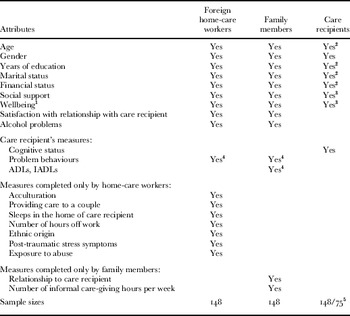
The measures were pilot-tested and evaluated for readability and content by the involved parties. Data concerning abuse and neglect as well as their potential correlates were obtained from each party separately, with the exception of the cognitively-impaired care recipients, for whom the socio-demographic details were collected from their family members and to whom no questions were put directly. Table 1 lists all the administered measures by participant group. The collected socio-demographic attributes were: age, gender, education, marital status (married or not), perceived financial status (have just enough or comfortable), relationship to care recipient (spouse or non-spouse), number of informal care-giving hours, ethnic origin of the home-care worker (Asian or East European), and the working conditions of the foreign home-care worker (e.g. number of hours off work per day, providing care to a couple or to one recipient, sleeping in the home of care recipient).
Data obtained from respondents by participant group

Notes: 1. Measure of older adults' wellbeing differs from measures of the other parties. Hence, p-value relates to a comparison of family members to foreign home care workers only. 2. When cognitively impaired, obtained from family members. 3. Only when cognitively intact. 4. Concerning care recipient. 5. Socio-demographic data were available for 148 older adults, but 54 older adults who were cognitively impaired or too physically frail were not interviewed. ADL: standard activities of daily living. IADL: instrumental activities of daily living.
A multi-faceted questionnaire for the assessment of elder abuse and neglect in the community had previously been developed and evaluated among a sample of community-dwelling older Israelis (Eisikovits, Winterstein and Lowenstein Reference Eisikovits, Winterstein and Lowenstein2004). On the basis of the responses to qualitative interviews conducted prior to the present study, the instrument was slightly revised. The questionnaire has seven items on neglect, e.g. needing but not receiving personal hygiene services or assistance with transport, two items on physical abuse, e.g. been hit, slapped, shaken, or handled roughly by others, five items on financial abuse, e.g. been forced to give money or other valuables against one's will, two items on sexual abuse, e.g. intimate body parts had been touched against one's will, and six items on emotional abuse, e.g. been yelled and screamed at. Each abuse and neglect item was scored ‘1’ if it happened during the past year, and ‘0’ otherwise. If the abusive event happened, the respondent was asked to indicate who was responsible (home-care worker, family member, other). The neglect scale ranges from ‘0’ to ‘7’ and the abuse scale from ‘0’ to ‘15’, with higher scores representing greater exposure. The measure was completed separately by all three parties. Cronbach's alpha for the scores were 0.57 (family members) and 0.93 (foreign home-care workers).
As for the measure of social support, the participants were asked to indicate how satisfied they had been with the help provided by friends and relatives over the last month and how many friends or relatives they felt close to. The sum of the two items represents overall social support. This composite score ranged from ‘2’ to ‘10’, with a higher score representing greater perceived support. For wellbeing, the World Health Organization (1998) Well-Being Index (WHO-5) was used. The instrument has five items including ‘I have felt cheerful and in good spirits’ and ‘I have felt calm and relaxed’. Responses are scored on a scale from ‘0’ ‘at no time’ to ‘5’ ‘all of the time’, with higher scores representing better wellbeing. The possible range of the aggregate scores is from 0 to 25. Both family members and foreign home-care workers completed the instrument. Cronbach's alpha was 0.86 for family members and 0.88 for foreign home-care workers.
The cognitive status of the care recipients was assessed using a six-item screen, three being ‘orientation to time’ items and three memory items (Callahan et al. Reference Callahan, Unverzagt, Hui, Perkins and Hendrie2002), that is based on the Mini-Mental State instrument (Folstein, Folstein and McHugh Reference Folstein, Folstein and McHugh1975). The six-item screen takes into consideration its diagnostic properties, ease of administration and validity. The measure was designed particularly for use in research as a brief and efficient tool to detect cognitive impairment. This measure has been shown to be as sensitive as the 30-item Mini Mental State instrument for measuring cognitive impairment. The possible range is from ‘0’ to ‘6’, with a higher score representing better cognitive functioning. A score lower than ‘4’ indicates cognitive impairment. Cronbach's alpha for the scores in this study was 0.71.
The older adults completed the Quality of Life in Alzheimer's Disease instrument (QOL-AD) (Logsdon et al. Reference Logsdon, Gibbons, McCurry and Teri2002). This is a measure of quality of life in older adults with cognitive impairments and its items include ‘ability to do things for fun’ and ‘physical health’. It has shown to be a reliable and valid measure for individuals with a Mini Mental State score greater than 10. It is therefore appropriate for use with individuals with a score of at least ‘4’ on this cognitive screen. The responses are rated on a scale of ‘1’ ‘poor’ to ‘4’ ‘excellent’, with a higher score representing better wellbeing. The possible range of the QOL-AD is from 13 to 52. Cronbach's alpha for the scores in this study was 0.78.
For a measure of the care recipients' functional limitations, standard activities of daily living (ADL) and instrumental ADL (IADL) scales were used. Family members were asked to indicate whether older care recipients needed assistance with six ADLs (e.g. eating, grooming) and five IADLs (e.g. running errands, cooking). Higher scores indicated more limitations. Both measures have a range from ‘0’ to ‘11’. Cronbach's alpha for the collected scores was 0.86.
Alcohol abuse
Three screening questions were used in order to identify alcohol problems (e.g. number of days drinking alcohol, number of alcoholic drinks per day). A positive screen for at-risk drinking was defined as consumption of more than seven drinks per week or more than four drinks in a day more than twice over three months (binge drinking) (Sobell Reference Sobell, Sobell, Leo and Cancilla1988). This measure was completed by both foreign home-care workers and family members.
Problem behaviours of care recipient
Problem behaviours (e.g. aggression towards others, threats to self-harm, losing or misplacing things) were assessed using the Revised Behaviour and Memory Checklist (RMBC). This is a checklist of common problem behaviours in older adults with dementia (Teri et al. Reference Teri, Truax, Logsdon, Uomoto, Zarit and Vitaliano1992). The scores range from ‘0’ to ‘24’, with a higher score representing more problem behaviours. Cronbach's alpha was 0.85 for family members and 0.89 for foreign home-care workers.
Satisfaction with the relationship with care recipient
This is a seven-item self-report scale that assesses satisfaction in various areas of the relationship, such as communication, intimacy, role in the relationship, and overall satisfaction (Burns and Sayers Reference Burns and Sayers1988). In the present study, participants were specifically instructed to refer to the relationship with their care recipient. Participants were asked to rate each of the items on a scale of ‘0’ ‘very dissatisfied’ to ‘5’ ‘very satisfied’. The scale ranges from ‘0’ to ‘35’. Both family members and foreign home-care workers completed the measure. Cronbach's alpha in the present study was 0.93 for foreign home-care workers and 0.91 for family members.
Acculturation
Number of years in the country, number of years speaking Hebrew, food, language, and social preferences were evaluated to assess a foreign home-care worker's level of acculturation. This measure was adapted from the Short Acculturation Scale for Filipino Americans (Cruz, Padilla and Butts Reference Cruz, Padilla and Butts1998) and qualitative interviews with the involved parties (Ayalon Reference Ayalon2009a; Ayalon, Kaniel and Rosenberg Reference Ayalon, Kaniel and Rosenberg2008). The measure ranges between ‘6’ and ‘48’. Cronbach's alpha in the present study was 0.59.
Worker's abuse in the home/work environment
Foreign home-care workers were specifically asked about their experiences in the home/work environment since their arrival to Israel. Questions from a scale of sexual harassment (Gettman and Gelfand Reference Gettman and Gelfand2007) were added to an existing questionnaire of abuse in the home/work environment that had been developed specifically for use with foreign home-care workers (Ayalon Reference Ayalon2009a). The final measure contains 19 items. Example questions are: ‘are you not receiving the food you need and like?’ and ‘have you been told offensive stories or jokes?’ The respondents were asked to indicate whether the event had ever happened in their current position as home-care workers in Israel. The scale ranges from ‘0’ to ‘19’, with a higher score representing greater exposure to abuse. Cronbach's alpha in the present study was 0.86.
Post-traumatic stress symptoms
Post-traumatic stress symptoms were assessed using a four-item screen that focused on numbing, avoidance, and hyper arousal (Levkoff et al. Reference Levkoff, Chen, Coakley, Herr, Oslin, Katz, Bartels, Maxwell, Olsen, Miles, Costantino and Ware2004). In the present study, higher scores indicate greater post-traumatic symptoms, ranging from ‘0’ ‘none’ to ‘3’ ‘all symptoms endorsed’. Only foreign home-care workers completed this measure.
The statistical analysis
All the outcome variables (e.g. reports of abuse and neglect by the three stakeholders) were positively skewed and so converted to dichotomies. To test the subjectivity hypothesis, the reports of abuse and neglect were compared among the three groups of participants using repeated-measures analyses of variance for continuous variables and non-parametric analyses for categorical variables. To test both the subjectivity hypothesis and the vulnerability and risk theory, the bivariate associations of elder abuse and neglect from the perspectives of older care recipients, their family members, and their foreign home-care workers were examined. Significant bivariate correlates of each of the six outcome variables (e.g. foreign home-care workers' reports of abuse or neglect, family members' reports of abuse or neglect, older care recipients' reports of abuse or neglect) with characteristics at the level of the perpetrator (i.e. risk factors) or victim (i.e. vulnerability factors) were entered into the final models. Six separate logistic regression analyses, clustered by family (i.e. care recipient, his or her family member, and foreign home-care worker) were conducted in order to estimate correlates of elder abuse and neglect from the perspective of each of the three parties. Pair-wise deletion was employed.
The results
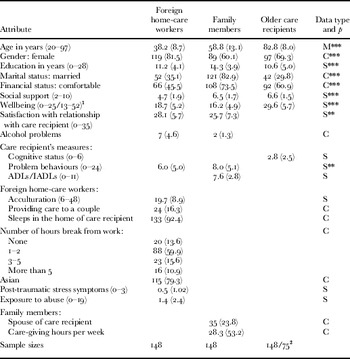
Table 2 presents the socio-demographic and clinical characteristics of the sample. The final sample was 148 pairs of foreign home-care workers and family carers and 75 triads of foreign home-care workers, family carers and older care recipients. The majorities in all three groups were female, and most foreign home-care workers and older care recipients were not married. The family members were significantly more educated than the other two groups.
Socio-demographic and clinical characteristics of the three groups of participants

Note: M: means and standard deviations (SD) are presented. C: frequency counts and percentages are presented. S: scores and SD are presented. 1. Measure of older adults' wellbeing differs from measures of the other parties. Hence, p-value relates to a comparison of family members to foreign home-care workers only. 2. Socio-demographic measures were available for 148 older adults, but 54 older adults who were cognitively impaired or too physically frail were not interviewed.
Significance levels: ** p<0.01, *** p<0.001.
The subjectivity hypothesis of elder abuse and neglect
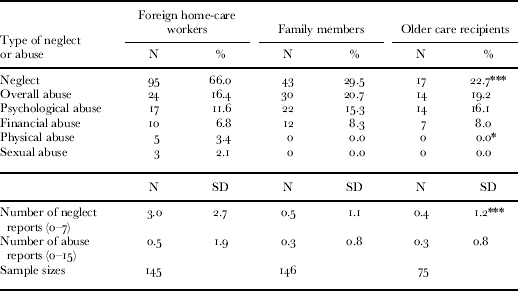
Table 3 summarises the reports of abuse and neglect by the three stakeholder groups. There were significant differences in the percentages of the three parties that reported elder neglect (29.5% of family members, 66.0% of foreign home-care workers, and 22.7% of older care recipients), but the differences in the reports of abuse, which ranged from 16.4 to 20.7 per cent, were not significant. Agreement between judges was minimal at best, with the closest being between reports of abuse made by older adults and their family members (kappa=0.24, p=0.02), and reports of abuse made by foreign home-care workers and family members (kappa=0.21, p=0.01). The most common type of unmet need reported by older adults (12.0%) and family members (17.1%) was assistance with transport, whereas foreign home-care workers (53.1%) were most likely to report unmet medical needs. All three parties identified emotional abuse as the most prevalent type of abuse. When asked to identify the individual responsible for the abuse, 43 per cent of older adults mentioned their home-care workers, whereas family members (52%) and foreign home-care workers (76%) were most likely to identify family members.
Reports of abuse and neglect by the three groups of participants, Israel, 2007–08
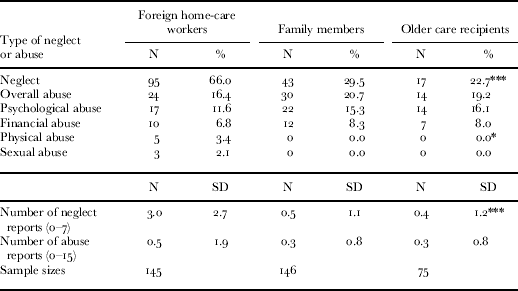
Notes: SD: standard deviation. Repeated measures analyses of variance were conducted for continuous variables and non-parametric analyses for categorical variables.
Significance levels: *p<0.05, *** p<0.001.
Risk and vulnerability factors associated with reports of neglect
The bivariate analyses showed that the likelihood of workers' reports of neglect positively associated with the family member being male (r=−0.19, p=0.02), having higher levels of education (r=0.18, p=0.02), and expressing greater dissatisfaction with the relationship with the care recipient (r=−0.17, p=0.03), the home-care workers being of Asian descent (r=0.18, p=0.03), and the care recipient having greater post-traumatic stress symptoms (r=0.19, p=0.02). In contrast, family members' reports of neglect were associated with being younger (r=−0.16, p=0.04), being dissatisfied with the relationship with the care recipient (r=−0.16, p=0.04), and the care recipient having lower financial status (r=−0.18, p=0.03). The older care recipients' reports of neglect were associated with being younger (r=−0.25, p=0.03), the family members having lower levels of education (r=−0.28, p=0.01), the home-care worker having a lower level of education (r=−0.40, p=0.001), and being less acculturated (r=−0.29, p=0.01), of East European origin (r=−0.28, p=0.01), and having lower social support (r=−0.34, p=0.002), and with a lower financial status of the care recipient (r=–0.29, p=0.001).
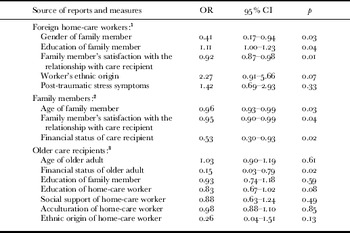
Only significant variables identified in the bivariate analyses were entered into the multivariate models. Table 4 summarises the multivariate analyses of reports of neglect by the three stakeholders. Workers were more likely to report neglect when the primary family care-giver was a male, had a higher level of education and reported less satisfaction with the relationship with the care recipient. Turning to the regression of the primary family care-givers' reports of neglect, these were more likely from those who expressed greater dissatisfaction with the relationship with care recipient, were younger or cared for an older adult who reported financial difficulties. By contrast, the older care recipients' reports of neglect inversely associated with their financial status.
Risk and vulnerability factors associated with elder neglect

Notes: 1. Wald (5)=16.2, p=0.006. 2. Wald (3)=10.7, p=0.01. 3. Wald (7)=12.8, p=0.07. OR: odds ratio. CI: confidence interval.
Risk and vulnerability factors associated with reports of abuse
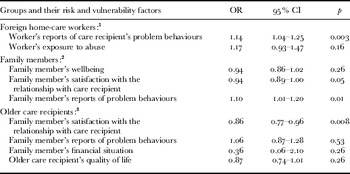
The bivariate analyses indicated that the foreign home-care workers' reports of abuse associated with their perception of more problematic behaviour on the part of the care recipient (r=0.32, p<0.001) and a worker's exposure to abusive experiences in the house (r=0.32, p<0.001). Family members' reports of abuse associated with their lower wellbeing (r=−0.16, p=0.04), greater dissatisfaction with the relationship with the care recipient (r=−0.25, p=0.003), and problematic behaviour of the care recipient (r=0.24, p=0.003). The older care recipients' reports of abuse associated with a family member being dissatisfied with their relationship (r=−0.35, p=0.004), with family members' reports of the care recipient's problematic behaviour (r=0.28, p=0.02), a family member's lower financial status (r=−0.28, p=0.01), and the older care recipient's lower quality of life (r=−0.31, p=0.007). Only the significant variables identified in bivariate analyses were entered into the multivariate models. Table 5 summarises the multivariate analyses of reports of abuse by the three stakeholders. Taking first the foreign home-care workers' reports, reports of the care recipient's problematic behaviour associated with the workers' reports of the abuse of the recipients. Turning to the family members' reports, the multivariate analysis showed that greater problem behaviours of the care recipient associated with reported abuse, whereas their dissatisfaction with the relationship with the care recipient was marginally significant. The multivariate analysis also found that reports of abuse by the older care recipients associated with the family member's dissatisfaction with the care recipient.
Risk and vulnerability factors associated with elder abuse

Notes: 1. Wald (2)=18.1, p<0.001. 2. Wald (3)=14.9, p<0.001. 3. Wald (4)=18.1, p<0.001. OR: odds ratio. CI: confidence interval.
Discussion
This pilot study has evaluated elder abuse and neglect in the round-the-clock, home-care system in Israel from the perspective of the three key players in the arrangement: the older care recipients, the primary family carers, and foreign home-care workers. The results are alarming as even the most conservative estimate of neglect suggests that about 22 per cent of older care recipients do not have their basic needs met, despite the fact that they receive round-the-clock, paid home-care services with financial support from the state. Furthermore, even the most conservative estimate suggests that at least 16 per cent of older adults cared for by these arrangements are exposed to at least one type of abuse, with all stakeholders reporting emotional abuse as having being the most common. It is, however, important to note that the estimates are of the abuse perceived by various stakeholders, and given the small and non-representative sample they must be interpreted with caution and not reported as confirmed prevalence rates.
The most striking finding has been that reports of neglect and abuse depend heavily on the respondent's point of view. The ‘outsiders’ in this family arrangement, the foreign home-care workers, were the most likely to notice neglect, which may be because of their different worldview of what constitutes the mistreatment of older adults. As previous studies have noted, the subjective nature of elder mistreatment is particularly pronounced in less clear-cut cases, such as being deprived of transport to visit with family members or friends, or inadequate assistance around the house (Fulmer et al. Reference Fulmer, Guadagno, Bitondo Dyer and Connolly2004). Nevertheless, even with regard to abuse, the agreement among the three groups of informants was low. The fact that the foreign home-care workers were from a very different cultural background might account for some of the differences, but agreement between family members and care recipients, who supposedly shared a similar cultural background, was also limited, which suggests that discrepancies in reports of abuse and neglect arise not only from cultural differences but also reflect the reporter's position in the care-giving arrangement.
Another demonstration of the subjectivity of reports of elder mistreatment was that the various stakeholders identified different perpetrators. Whereas the older care recipients were more likely to identify their home-care worker as responsible for abuse, family members and foreign home-care workers were more likely to point to family members. Older adults might prefer not to blame their relatives. The findings emphasise the subjective nature of reports of elder abuse and neglect and provide evidence that vulnerability factors correlate with elder abuse and neglect. For instance, as Ogioni et al. (Reference Ogioni, Liperoti, Landi, Soldato, Bernabei and Onder2007) found, older adults exhibiting problem behaviours were more likely to experience abuse according to the reports of both foreign home-care workers and family members, but assessments of problem behaviour by foreign home-care workers associated with their reports of elder abuse, whereas similar assessments by family members associated with their reports of elder abuse. It therefore appears that a care-giver's perception of a care-recipient's problem behaviour correlates with their perception of elder mistreatment.
As with previous research (Homer and Gilleard Reference Homer and Gilleard1990), this study has found that family members' dissatisfaction with their relationship with the care recipient associated with reports of neglect by both family members and foreign home-care workers, as well as with reports of abuse by family members and older care recipients. Interestingly, however, only the family member's dissatisfaction with the relationship, and not the foreign home-care worker's dissatisfaction with the relationship, associated with reports of abuse or neglect. One possible explanation emerged from a recent qualitative study, which found that emotional abuse was more common by family members than by foreign home-care workers, because the latter could ‘keep their distance’ and view problems in the relationship more objectively, whereas family members reacted more emotionally to relationship problems (Ayalon Reference Ayalon2009c). The only vulnerability factor consistently identified in the reported analyses was the financial status of the care recipient, with being less well-off associating with reports of neglect by both older care recipients and their family members. This again suggests that current government financial support for less affluent older adults living in the community may be insufficient and a contributory factor in inadequate care.
A number of the study's limitations should be noted. First, the evidence is from a convenience sample recruited partly by snowballing. It is possible that older adults who experienced the highest levels of abuse and neglect were not included because of selective exclusion. Further, the small sample size in this pilot project allows initial inferences to be drawn but firm conclusions will require larger representative samples. Given the small sample size, only the main hypotheses of the study have been tested and, for example, the correlates of perpetrator type have not been analysed. Another limitation is that the care recipients were limited to older adults who were cognitively and physically able to participate in the study, so the voices of those most susceptible to elder abuse and neglect were not heard. The use of other means of assessment, such as reliance on objective indicators of abuse, might help identify those older adults who are too impaired to participate in an interview. In addition, evaluating elder abuse and neglect over one year might be too long a period because of the possibility of recall bias. To overcome this limitation, I examined the presence or lack of abuse and neglect, rather than their frequencies. This had the advantage of enabling foreign home-care workers that provided care for less than one year to be included. In addition, the cross-sectional design did not allow for inferences of cause and effect. Finally, certain scales had only moderate reliability.
Policy and practice implications
The findings of this study have several important implications. The most notable is that reports of elder abuse and neglect are highly subjective, which implies that any assessment of elder abuse and neglect should draw on multiple sources of information or observers. The finding also supports the argument that more education about what constitutes elder abuse and neglect would result in more accurate and consistent reports and help to resolve disagreements among assessors. Clinicians should be aware that the subjective perception of the care recipient by his or her care-givers may be more predictive of elder abuse and neglect than the care recipient's condition and behaviour. The quality of the relationship between a family member and the care recipients, and a care-giver's perception that the care recipient displays problematic behaviour, should receive particular attention as potential risk factors for elder abuse and neglect.
Another important finding is that the rates of abuse and neglect under the live-in foreign home-care system are consistent with those previously reported for older adults living in the community, which suggests that even when substantial funds are made available to maintain older adults in the community and to assist family care-givers, many older adults (especially those of lower financial status) do not have their needs met and many are exposed to abuse. The implication is that greater supervision of and governmental assistance for this care-giving arrangement is necessary. It is nonetheless important to note that the study has not provided consistent evidence about the most likely perpetrators, because the different stakeholders gave conflicting reports. So while it appeared that elder mistreatment is quite prevalent under this care-giving arrangement, it was not necessarily the worker who was responsible, and indeed in many cases it was a family member that was the alleged perpetrator. Given that the care recipients were less likely to identify family members as abusers than the other two groups of stakeholders, it may be that, at times, foreign home-care workers are in a position where they are can protect the older adult from abuse and neglect by family members. Because foreign home-care workers may hold cultural beliefs concerning elder mistreatment that are quite different from the beliefs held by the majority culture, educational interventions should focus on enhancing their ability to recognise elder mistreatment and alert authorities about it. Needless to say, family members and older care recipients alike should also receive extensive education concerning the recognition and prevention of elder mistreatment in round-the-clock, foreign, home-care arrangements.
Acknowledgement
This study was supported by a grant from the German–Israeli Foundation for Scientific Research and Development.