INTRODUCTION
Nine species of lessepsian amphipods are recorded in the Mediterranean Sea: Cymadusa filosa Savigny, Reference Savigny1816, Bemlos leptocheirus (Walker, Reference Walker1909), Unciolella lunata Chevreux, Reference Chevreux1911, Gammaropsis togoensis (Schellenberg, Reference Schellenberg and Michaelsen1925), Photis lamellifera Schellenberg, Reference Schellenberg1928, Elasmopus pectenicrus (Bate, Reference Bate1862), Linguimaera caesaris Krapp-Schickel, Reference Krapp-Schickel2003, Stenothoe gallensis Walker, Reference Walker1904 and Caprella scaura Templeton, Reference Templeton1836sensu lato. These species represent 1.9% of the known Mediterranean amphipod fauna (Bellan-Santini & Ruffo, Reference Bellan-Santini and Ruffo2003). Among them, only one species, Cymadusa filosa, has been recorded from Tunisian coasts. It was first reported from the Goulette Canal and Jerba Island by Chevreux (Reference Chevreux1911) and later, from all Tunisian coasts (Zakhama-Sraieb et al., Reference Zakhama-Sraieb, Sghaïer and Charfi-Cheikhrouha2009). The amphipod fauna of the Tunisian coast remained relatively unexplored until 2003 when investigations were conducted to establish a complete list of this group (Zakhama-Sraieb et al., Reference Zakhama-Sraieb, Sghaïer and Charfi-Cheikhrouha2006a, Reference Zakhama-Sraieb, Sghaïer and Charfi-Cheikhrouhab, Reference Zakhama-Sraieb, Sghaïer and Charfi-Cheikhrouha2008, Reference Zakhama-Sraieb, Sghaïer and Charfi-Cheikhrouha2009).
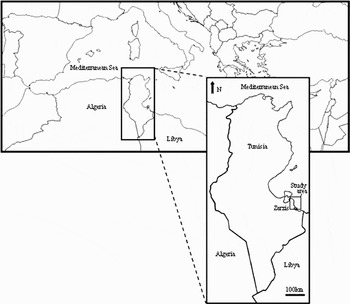
Elasmopus pectenicrus and Stenothoe gallensis were collected in August 2006 from a Posidonia oceanica meadow (2 m-deep) on the rocky habitats of Zarzis (33°31′N 11°06′E) on the south-east of Tunisia (Figure 1). More studies conducted in July 2007 and July 2008 confirmed the settlement of the two species in the studied area.
Location of the study area on Zarzis coast (south-east Tunisia).

In July 2007, the mean density of amphipods was estimated by using a 30 cm long and 25 cm high quadrate. The quadrate was randomly placed in the P. oceanica meadow. The shoots were pulled up and collected in a mesh bag (mesh size 0.3 mm). Three replicates were taken for statistical analyses. Mean densities estimated were 462.96(68.69) m−2 and 311.11(58.18) m−2 respectively for S. gallensis and E. pectenicrus.
Specimens of the two species were deposited in the collection of the Research Unit of Animal Biology and Systematic Evolutionary, Faculty of Sciences of Tunis. Sieving of collected specimens showed that their morphological features match with the findings of Ruffo (Reference Ruffo1982, Reference Ruffo1993). A review of inventory studies relevant to the amphipod species indicates that those specimens were identified as two newly recorded species from the Tunisian coasts.
Moera pectenicrus Bate, Reference Bate1862, p. 192, pl. 34, figure 8; Elasmopus pectenicrus Ruffo, Reference Ruffo1938, p. 136; J.L. Barnard, Reference Barnard1955, p. 8, figure 4; Ruffo, Reference Ruffo1959, p. 21; Nayar, Reference Nayar1959, p. 27, pl. 9, figures 20–35; J.L. Barnard, Reference Barnard1970, p. 125, figures 73 & 74; Karaman in Ruffo, Reference Ruffo1982, p. 286, figure 192; Elasmopus serrula Walker, Reference Walker1904, p. 277, pl. 8, figure 37.
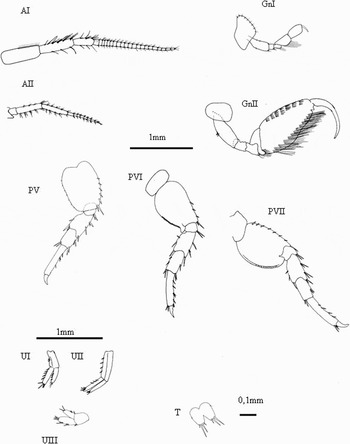
DESCRIPTION (FIGURE 2)
Total length of males is 4.5–7.9 mm, females is 4.1–6.3 mm. Body smooth. Eyes ovoid and large. Antenna I longer than antenna II, accessory flagellum present with 3–4 articles. Gnathopods I and II subchelate, gnathopod I smaller than gnathopod II particularly in males. Gnathopod II very large, propodus broad with numerous long setae on palm and posterior margin; palm with one tubercle provided with 2 spines near base of dactylus. Pereopods V, VI and VII stout, marginally spinose. Pereopod V basis slightly longer than broad. Basis of pereopod VII subovate, with weakly serrate posterior margin. Pereopod VI basis with posterior margin strongly serrate, distally concave (in adult male). Uropod III short and telson deeply cleft.
Elasmopus pectenicrus (Bate, Reference Bate1862), ♂ from the Tunisian coasts (Zarzis). A, antenna; Gn, gnathopod; P, pereopod; U, uropod; T, telson.

DISTRIBUTION
Elasmopus pectenicrus was firstly described by Bate (Reference Bate1862) on the coast of New Guinea. It is supposed to be a circumtropical species, distributed mainly in the Atlantic Ocean, Red Sea, Indian Ocean, Pacific Ocean and the Mediterranean Sea. It was recorded in Egypt in Port Said (Schellenberg, Reference Schellenberg1928) and Alexandria (Schellenberg, Reference Schellenberg1936), in Israel (Ruffo, Reference Ruffo1959), Italy (Sconfietti, Reference Sconfietti1983; Mizzan, Reference Mizzan1998), Spain in the Balearic Islands (Garcia & Jaume, Reference Garcia and Jaume2006) and on the Levantine coast of Turkey (Sezgin et al., Reference Sezgin, Bakir and Tuncer2007). Due to its passive dispersal, E. pectenicrus colonized gradually all the Mediterranean area and expanded its distribution to the subtropical Atlantic area (Marques & Bellan-Santini, Reference Marques and Bellan-Santini1990).
In the southern Mediterranean, the species was recorded in Egypt and Tunisia. In the present study, we assume the presence of this species on all southern Mediterranean coasts. However, more research should be done to cover the lack of information due to the rarity of amphipod studies in this region.
ECOLOGY
This species has been recorded in the infra-littoral zone (up to 50 m depth), within algal communities such as Padina pavonica (Sezgin et al., Reference Sezgin, Bakir and Tuncer2007) or in shell bottom (Ruffo, Reference Ruffo1982). In addition, E. pectenicrus also occurred in different habitats like artificial substrates in brackish waters (Sconfietti, Reference Sconfietti1983; Sconfietti & Danesi, Reference Sconfietti and Danesi1996), and in rocky pools (Gottlieb, Reference Gottlieb1960).
Meanwhile, in Tunisia, E. pectenicrus was found inhabiting seagrass meadows of P. oceanica at 2 m depth.
Probolium polyprion Catta, Reference Catta1876, p. 15, pl. 2, figure 1; Stenothoe gallensis Walker, Reference Walker1904, p. 261, pl. 3, figure 19; Stenothoe gallensis Stebbing, Reference Stebbing1906, p. 725; Reid, Reference Reid1951, p. 228, figure 27; J.L. Barnard, Reference Barnard1955, p. 3, figure 1; Ledoyer, Reference Ledoyer1973, p. 889, figure 10b; Krapp-Schickel, Reference Krapp-Schickel1976, p. 15, figures 14–16, Reference Krapp-Schickel1996, p. 701, figure 481; Stenothoe cattai Stebbing, Reference Stebbing1906, p. 195; Stenothoe crenulata Chevreux, Reference Chevreux1907, p. 412; Chevreux, Reference Chevreux1908, p. 471, figures 1–3; Shoemaker, Reference Shoemaker1935, p. 237, figure 2.
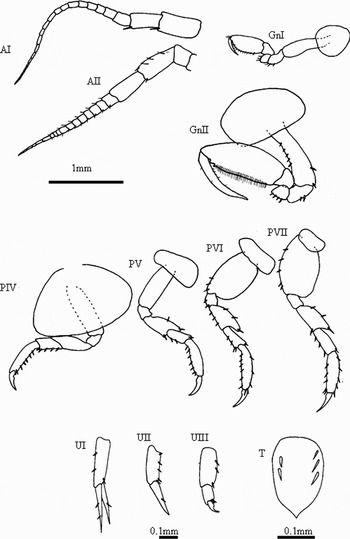
DESCRIPTION (FIGURE 3)
Total length of males is 2.8–3.4 mm, females is 2.5–3.1 mm. Body smooth, eyes round and small; antenna I and antenna II subequal, accessory flagellum absent; antenna II with long peduncle. Coxa I small, hidden by coxa II; gnathopods I and II subchelate. Gnathopod I carpus triangular, propodus with spines. Gnathopod II bigger than gnathopod I particularly in the male. Gnathopod II male basis curved, propodus enormous, very long, anterior margin convex, palm with many little setae, with two teeth near articulation of dactylus, dactylus about as long as propodus, curved, with little setae on inner margin. Uropod III uniramous, armed with spines in two first articles. Telson and pereopods strongly armed; telson entire, subtriangular with many spines.
Stenothoe gallensis Walker, Reference Walker1904, ♂ from the Tunisian coasts (Zarzis). A, antenna; Gn, gnathopod; P, pereopod; U, uropod; T, telson.

DISTRIBUTION
This amphipod was recorded firstly by Walker (Reference Walker1904) in Ceylon. This species is present in the Atlantic Ocean, Caribbean Sea, Suez Canal, Red Sea and Indo-Pacific Ocean. In the Mediterranean Sea, this species was recorded from France (Banyuls-Sur-Mer and Marseille) and Sicily (Catania, Pantelleria) by Krapp-Schickel (Reference Krapp-Schickel1976).
ECOLOGY
Stenothoe gallensis is commonly present in the upper littoral among algae with good water-movement and rarely more deeply than 4 m (Ruffo, Reference Ruffo1993). In our sampling, this species was collected among the seagrass P. oceanica meadows at 2 m depth.
According to our study, the number of alien amphipod species in Tunisia reaches three from the nine species present in the Mediterranean Sea. More investigations could be useful to find other species, especially those widely distributed such as Caprella scaura.
ACKNOWLEDGEMENTS
The authors want to express their gratitude to two anonymous referees who helped to improve the quality of the manuscript. Thanks are due to Dr Yasser Geneid for revision of the English text.