Introduction
A recent workshop at NASA Ames Research Center explored the potential roles for synthetic biology in NASA's mission (NASA 2010). The possible applications of synthetic biology identified at the workshop included a variety of ideas, ranging from biologically manufactured products (e.g. food, fuels, medicines, light production and building materials) to diverse biologically aided processes (e.g. in situ resource utilization (ISRU), biomining, biosensing, advanced life support and waste processing). Discussions at the workshop also focused on the broad ethical and societal implications of synthetic biological applications in space. While such research is in an embryonic stage at best, it is advisable even now to anticipate the kinds of questions and concerns that may emerge in the years ahead (Guston & Sarewitz Reference Guston and Sarewitz2002). Fortunately, this can be accomplished by examining how synthetic biology and other emerging technologies have been reviewed on Earth, and evaluating how similar or dissimilar space applications are from the broader synthetic biology agenda, especially in practical, legal, societal and ethical areas. Overall, it is likely that early exploratory research on potential space applications will face many of the same issues as synthetic biology research and applications on Earth. In the longer term, however, synthetic biology in space potentially raises additional questions that include consideration of space microbiology and environmental factors, legal complications and lack of decision-making infrastructure, planetary protection, long-duration human missions, terraforming and the possible discovery of extraterrestrial (ET) life.
Overview of concerns associated with synthetic biology on Earth
Before examining concerns about synthetic biology in space, it is useful to review how the social and ethical implications of synthetic biology are considered on Earth. When researchers first attempted to construct minimal and new genomes, a group of ethicists examined concerns and found that the work does not violate any fundamental moral precepts or boundaries, but does raise questions that are essential to consider before the technology advances further (Cho et al. Reference Cho, Magnus, Caplan and McGee1999). In the intervening years, the research landscape has broadened considerably with attempts to create entirely synthetic biological organisms, as well as to manipulate and re-engineer natural biological systems into new technological applications. The expanded expertise, coupled with uncertainties about unpredictable, emergent behaviour in engineered organisms and ecosystems, have prompted calls for further discourse about appropriate policies and oversight, particularly in light of the different trajectories ahead for the technology (e.g. Bedau et al. Reference Bedau, Parke, Tangen and Hantaxhe-Tangen2009; Deplazes & Huppenbauer Reference Deplazes and Huppenbauer2009; Gaisser & Reiss Reference Gaisser and Reiss2009; Schmidt et al. Reference Schmidt, Dando, Deplazes, Luisi and Chiarabelli2011). Because synthetic technologies are expected to lead to larger and more diverse applications in the future, their risks and benefits need to be evaluated broadly (i.e., not only for safety and security, but also in terms of environmental, social and economic risks and benefits, and philosophical, ethical and theological concerns) as part of research planning and design in the United States and internationally (e.g. Schmidt Reference Schmidt2009; Schmidt et al. Reference Schmidt, Ganguli-Mitra, Torgersen, Kelle, Deplazes and Biller-Andorno2009; Cho & Relman Reference Cho and Relman2010; Gutmann Reference Gutmann2011; Murray Reference Murray2011). As the field continues to advance, experts in science and engineering have joined with those in policy, social sciences and humanities to broaden the focus and increase public discourse about these matters (e.g. Dabrock Reference Dabrock2009; Gaisser & Reiss Reference Gaisser and Reiss2009; Pauwels Reference Pauwels2009; Rabinow & Bennett Reference Rabinow and Bennett2009; Torgersen Reference Torgersen2009; Wellhausen & Mukuda Reference Wellhausen and Mukuda2009; Gutmann Reference Gutmann2011).
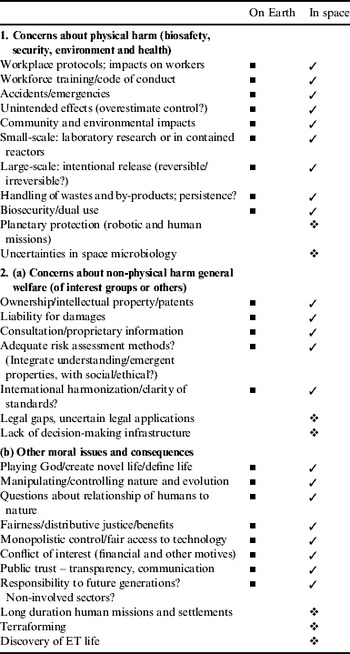
Interestingly, ethical and societal concerns about synthetic biology are essentially the same as those associated with most new and emerging biotechnologies, and can be divided roughly into two large categories: (1) concerns about physical harms and (2) concerns about non-physical harms (Parens et al. Reference Parens2009a, Reference Parens, Johnston and Mosesb). Because the latter category includes such a wide range of issues, non-physical harms can be divided into two subcategories: (a) concerns that seem to be of greatest interest to those closest to the action (e.g. fair distribution of benefits, proprietary control, access to the tools necessary to do synthetic biology, etc.) and (b) concerns that have largely not gained traction with those engaged in the action (e.g. concerns with moral positions – related to attitudes about life and human relationships to the natural world).
In general, the physical harms category generally includes concerns about risks and consequences of synthetic biology linked to health, safety and environmental impacts and the non-physical category includes concerns related to moral values, moral consequences, general welfare and social justice.
Contrasting approaches to evaluating risks of synthetic biology
Just as the concerns about synthetic biology can be divided into two main categories, so too, can perspectives about risks and benefits. There is a tendency for advocates and critics of emerging technologies, including synthetic biology, to adopt distinctly different ethical frameworks in evaluating the advancing field (Parens et al. Reference Parens, Johnston and Moses2009b). Advocates often adopt a proactionary approach to the risks of physical harm, and usually endorse a policy of non-interference with the development of the emerging technology unless there is good reason to suspect there will be serious physical harm. They are generally enthusiastic supporters of the technology and tend to argue for minimal governmental regulation, preferring instead some form of self-governance. Advocates also tend to communicate with the public in ways that emphasize education about risks and benefits and encourage the public to become better-informed consumers of the new technology. Some advocates may also have personal, professional and/or financial interests in seeing the field progress.
In contrast, critics are usually more concerned about the specific risks and overall direction associated with synthetic biology or other emerging technologies. They typically take a precautionary view and are more likely to oppose progress if they believe in the potential for serious harm. In general, they argue for strong regulations, regular oversight, transparent public deliberation about risks and benefits, and active public involvement in shaping development of the advancing field.
While it is sometimes suggested that only a lay, non-scientific public would have critical concerns, the few polls conducted in synthetic biology support earlier findings that members of the public could be both enthusiasts and critics of emerging technologies (Hart Research Associates 2010). Additionally, there can be critical tensions within scientific fields (e.g. between molecular biologists and conservation biologists) as much as between scientists and the public (Jennings Reference Jennings2010).
Current perspectives of risks and benefits of synthetic biology
These two contrasting approaches can already be seen in relation to synthetic biology. The recent report on the risks and benefits of synthetic biology by the Presidential Commission for the Study of Bioethical Issues (2010) took a proactionary approach, indicating that synthetic biology offers promise for producing biofuels, new medicines and countless other applications, but does not yet pose risks to the environment or health that are not already covered by the current ‘patchwork quilt’ of Federal regulation. The report emphasized that intellectual freedom and realizing the upside benefits of synthetic biology must be coupled with responsibility (Kaiser Reference Kaiser2010a). While calling for neither moratoria nor new restrictions, the Commission instead recommended continued dialogue, monitoring of the field and additional reviews of funding, licensing policies, risk assessment gaps, ethics education and oversight rules for researchers. The Commission also recommended that if the reviews identify significant unmanaged security or safety concerns, the government should make compliance with certain oversight or reporting measures mandatory for all researchers (Presidential Commission for the Study of Bioethical Issues (2010); Kaiser Reference Kaiser2010b). Others have also supported this incremental approach, noting the importance of adopting self-governance unless significant risks are identified (e.g. Schmidt et al. Reference Schmidt, Ganguli-Mitra, Torgersen, Kelle, Deplazes and Biller-Andorno2009; Carlson Reference Carlson2011; Erickson et al. Reference Erickson, Singh and Winters2011; Kaebnick Reference Kaebnick2011).
Shortly after the release of the Commission's report, a coalition of 58 non-governmental organizations (NGOs, comprised environmental, religious and other groups) wrote a formal letter to the Commission criticizing the report as flawed because it did not properly evaluate the environmental risks of releasing synthetic organisms; it relies too much on ‘suicide’ genes to prevent replication of escaped synthetic organisms; and it depends on industry to regulate itself. Taking a precautionary approach, they called for a moratorium on the commercial use and release of synthetic organisms until the risks are better understood (ETC Group et al. 2010; Kaiser Reference Kaiser2010b).
It is interesting that the differences in approaches (proactionary versus precautionary) seem to reflect different time horizons. The Commission report tackled many near-term concerns associated with small-scale laboratory research projects anticipated during the early development stages of synthetic biology. Commission members emphasized the need to strike a balance between what they called ‘letting science rip’ and a version of the precautionary principle that waits until all risks are understood (Kaiser Reference Kaiser2010a). In contrast, the NGOs emphasized longer-term issues including those associated with scale-up, commercial development, deliberate environmental releases, widespread human applications and equity and fairness considerations. The longer-term ramifications and social consequences of synthetic biology – like those associated with human genomics – are difficult to include in analyses of risks and deliverables during early stages of evaluation. Some have argued the importance of moving ethical and human considerations ‘upstream’ in the deliberative processes in order to have fuller evaluation of actual ethical and social ramifications for all stakeholders, along with the technical, organization and policy aspects of new technology (e.g. Khushf Reference Khushf2007; Rabinow & Bennett Reference Rabinow and Bennett2009).
It is useful to acknowledge that these two perspectives and approaches have played out repeatedly since the early days of genetic engineering (Race Reference Race, Sullivan and Baross2007), and are likely to be revisited for both Earth and space applications of emerging biotechnologies, including synthetic biology. For synthetic biology in particular, the key ethical and societal concerns have been recognized for more than a decade, even though progress on incorporating that information into the policy front continues to lag (Caruso Reference Caruso2008; Rodemeyer Reference Rodemeyer2009; Caplan Reference Caplan2010). Thus, it is likely that debates about appropriate policies will continue as the field matures, reflecting the diverse perspectives and concerns of various stakeholders.
As discussed by Cho & Relman (Reference Cho and Relman2010), there may be a need for a new model to address ethical and policy issues in synthetic biology because of the complexity of the biological systems being mimicked and manipulated. Ethicists are already integrated in the review and decision-making process for biomedical technologies or experimental uses, which tend to focus on risks to individuals and human health, emphasizing issues like safety, responsibility, informed consent, conflicts of interest and ‘rights’. The situation is different beyond small-scale biomedical applications of emerging biotechnologies. Apart from perhaps environmental impact statements, there is nothing akin to ethical review or societal informed consent for proposals in synthetic biology (or other emerging biotechnologies) with potential scale-up, commercial and long-term implications for humans, ecosystems or non-human life. At this point, decisions and policies are being determined incrementally via self-governance by those closest to the action, with arguable advantages technologically, politically and/or financially. It is far from certain how synthetic biology policy issues and societal concerns will be resolved. What we do know, however, is that space synthetic biology introduces a number of special considerations that must also be acknowledged and addressed.
Identifying risks and issues specific to space applications
As shown in Table 1, both Earth- and space-based applications raise questions in the categories of physical and non-physical harm. Although many of the concerns about space applications overlap with those identified for Earth-based synthetic biology, there are added complications likely to challenge researchers as they aim to use the technology beyond Earth. In particular, uses of synthetic biology in space raise additional questions related to space law, planetary protection and cross-contamination, space microbiology and risk assessments, decision-making infrastructure, long duration human missions, terraforming and the possible discovery of ET life, as discussed briefly below.
Issues/concerns associated with synthetic biology

Space microbiology
Based on extensive research in space microbiology, it is likely that synthetic biology applications in space could behave quite differently than they would on Earth, with significant implications for human life support, overall ‘product’ and ‘process’ effectiveness and perhaps controllability. As comprehensively reviewed by Horneck et al. (Reference Horneck, Klaus and Mancinelli2010), microgravity, radiation and other space factors (e.g. dehydration, vacuum, etc.) can alter biophysical relationships between cells and their extracellular environments in ways not seen on Earth, with significant impacts on cellular behaviour and functions. Data from four decades of experimental in vitro work in space and simulated environments have shown that microgravity can affect cell mobility/motility, nutrient availability in the extracellular environment, membrane function and even gene expression and exchange. Ionizing radiation can cause DNA double-strand breaks at rates high enough to induce mutations or death in microbes, as well as health effects in diverse experimental organisms. Numerous applied experiments in space suggest that microbial drug resistance and virulence are both increased in space, which combined with the potential for immunosuppression in astronauts heightens concerns for crew health and effectiveness on long-duration missions. While studies in ambient spacecraft environments suggest that microbes can contribute to regenerative life-support processes (e.g. waste degradation, water recovery, food and oxygen production), they can also be causes of serious health and contamination concerns, via biofilm formation, biodegradation of structural materials and activation of opportunistic pathogens. Obviously, the many challenges posed by spaceflight conditions will require continued research attention; they will also necessitate initiation of an entirely separate research focus on proposed uses of organisms and/or processes based on synthetic biology. Furthermore, there are essentially no data available on ‘outdoor’ survival or dissemination of terrestrial micro-organisms on planetary bodies beyond Earth. Thus, extrapolations from Earth-based results with synthetic biology are likely to be insufficiently predictable in space to ensure safety and security under varied spacecraft, habitat or environmental conditions. Obviously, considerable new research over and above that for synthetic biology on Earth will be needed to navigate the review and decision-making processes ahead for space applications.
Legal complications and lack of decision-making infrastructure
For over four decades, activities in space have been guided by the U.N. Outer Space Treaty (OST) and related international legal agreements, which guide government, scientific and commercial activities in space, whether in Earth orbit or beyond (Race Reference Race and Berkman2011). In addition to limiting military and nuclear activities in space, the OST prohibits governments from extending national sovereignty or making new resource claims. Moreover, each country is responsible for authorization and supervision of national activities, whether undertaken by governmental or non-governmental entities. Signatories agree to provide freedom of scientific investigations and exploration; assist astronauts in the event of accidents or emergencies; retain control and ownership of their launched objects; and accept liability for damages caused by activities and objects in their control. Since most space activities have been concentrated in Earth orbit for the past five decades (e.g. satellites, Shuttles, International Space Station, etc.), there are no specific regulations or guidelines about environmental impact assessments, commercial or private activities, environmental management, exploitation or use of natural resources on the Moon or other celestial bodies. Thus, in addition to facing many of the same legal, policy and ethical questions as Earth-based synthetic biology, applications in space could face both domestic and international legal scrutiny over topics like physical impacts, potential harm or contamination to other planetary bodies; commercial/legal rights and ramifications of human activities; reversibility of impacts; or liability for damages, whether deliberate or accidental.
At its 2010 General Assembly in Bremen, Germany, the Committee on Space Research (COSPAR) Bureau approved a proposal from its Panel on Planetary Protection (PPP) and Panel on Exploration (PEX) to plan an international workshop in 2011 on ‘Development of Foundational Ethical Principles Applicable to Planetary Protection and Space Exploration’ (Rummel Reference Rummel2010). Like the examination of issues and decision-making in biotechnology over the past several decades, the consideration of ethical principles and their relationship to responsible space science could take considerable time to resolve. As deliberations proceed slowly and incrementally on what new or appropriate infrastructure of guiding principles are needed for synthetic biology on Earth, it is unclear what oversight, monitoring and review requirements would be appropriate for scientific commercial, governmental or private activities proposed beyond Earth.
Planetary protection (PP)
Article IX of the OST specifically applies to avoidance of harmful contamination during space exploration. The Treaty requires that exploration of outer space be done in ways that avoid contaminating planetary bodies with terrestrial hitchhiker microbes or contaminants (forward contamination) or causing adverse changes in the environment of the Earth by the introduction of returned ET matter (back contamination). Oversight of the PP policy is maintained by the international COSPAR, which advises the United Nations on space science matters and updates the policy based on the latest science information. Implementation is maintained through a voluntary compliance and self-governance system adopted by launching nations with the acknowledgement that there is no way to police or enforce PP requirements beyond Earth.
In essence, planetary protection policy aims to prevent the human-aided spread of potentially harmful or invasive microbes beyond their natural hosts, habitats or ecosystems. Not only could ‘hitchhikers’ cause irreversible changes in environments beyond Earth, they might also interfere with scientific study of the bodies in their natural states and compromise the search for indigenous ET life. PP policy applies to all planets, as well as moons, asteroids, comets or other celestial objects within the Solar System. The stringency of controls (e.g. spacecraft cleaning, operational requirements, documentation, etc.) depends on where a mission is going and what activities are planned. In general, locations with ‘habitable’ conditions (for either terrestrial or putative ET organisms) have more stringent controls than locations without such ‘biological potential.’ Within NASA, the Planetary Protection Officer is responsible for ensuring that all missions comply with international COSPAR policy and NASA directives – prior to launch, while in space, and through the end of the mission – whether the mission is one-way or round-trip. (For details about PP policy and requirements, see NRC (2006); also NASA's planetary protection website, www.planetaryprotection.nasa.gov.)
In the near term, robotic missions that include experiments or studies with synthetically engineered microbes that are targeted for locations beyond Earth orbit would likely be subject to careful review, and possibly imposition of varying levels of PP controls or restrictions depending on COSPAR and NASA requirements at the time. This does not preclude experiments or uses in Earth orbit, or on bodies such as the Moon and asteroids, which have few or no PP controls compared with places with biological potential, like Mars. As applications of space synthetic biology are developed, basic research and experimentation in Earth orbit or on missions to bodies with less stringent PP controls (i.e., the Moon) will be needed to provide critical information for evaluating their effectiveness and impacts both within spacecraft, and as part of deliberate environmental releases (e.g. ISRU, biomining, fuel production, waste disposal, etc.). Both scientific/safety questions and ethical concerns about space applications will likely introduce unusual complications to future deliberations and planning, and will need to be addressed separately from similar Earthly concerns.
Human missions
NASA and the European Space Agency (ESA) have already held several workshops examining planetary protection and human missions, particularly missions to Mars (Criswell et al. Reference Criswell, Race, Rummel and Baker2005; Hogan et al. Reference Hogan, Race, Fisher, Joshi and Rummel2006; Kminek et al. Reference Kminek, Rummel and Race2007). Already, it has been established that the primary goals of the COSPAR planetary protection policy do not change when humans are involved. Clearly questions about microbial contamination and spread will need special attention and research, meaning that synthetic biology technologies and bio-engineered organisms will be scrutinized intensely for use in future space products or processes. Coordinated planning will be needed among the scientific, engineering, operations, medical and planetary protection communities to develop the suite of guidelines and controls necessary to maintain crew health and safeguard both enclosed and external environments during human missions and exploration (Rummel et al. Reference Rummel, Race, Conley, Liskowsky, Levine and Schild2010).
While advances in synthetic biology offer exciting prospects for improved products and processes adaptable to space uses, the associated microbes bring with them many forward contamination concerns about both crew health and environmental protection, which will translate into the need for special research for long-duration crewed missions. Key areas of concern that will need to be understood and addressed include:
• Contaminant transfer (human microbiome, host–microbe interactions, monitoring and quarantine, cleaning/maintenance, validated monitoring and mitigation systems, etc.).
• Mobile infrastructure and support including extravehicular activities (EVAs) (transfer of microbes at ingress/egress, spacesuit/human microbiology, sampling equipment and operations, etc.).
• Habitats and permanent emplacements (designation and avoidance of special regions or scientific reserves; separation of living and science areas, etc.).
• Materials containment and waste disposal (microbial systems containment; recycling; waste processing; biodeterioration, corrosion/fouling and their mitigation, etc.).
• Biological life support systems (food production; air and water systems; ISRU technologies; monitoring and warning systems for fluctuations).
• Human health monitoring systems and medical intervention throughout the mission.
Beyond the many science and health concerns about microbes during missions, questions about back contamination during human missions will also be significant. COSPAR PP policy indicates that safeguarding the Earth from harmful back contamination remains the highest planetary protection priority for round-trip human missions, particularly to Mars. An elaborate PP-human protocol will eventually need to be developed, much like during the Apollo program. Some have even suggested the prospect of one-way human missions and permanent human settlements beyond Earth in the long term (e.g. Schultz-Makuch & Davies Reference Schultz-Makuch, Davies, Levine and Schild2010), raising further questions about the benefits and risks of relying on synthetically engineered technologies during human missions. The extreme selective pressures in space (e.g. radiation, microgravity, atmospheric chemistries, etc.) will have unknown impacts on mutation rates in both microbes and humans, which on the one hand could be useful in adaption to new environments, but also raise questions about long-term human-directed evolution, speciation and the nature of life and humans.
Terraforming and large-scale environmental modifications
The idea that humans could deliberately change planetary environments to make them more habitable for life has been discussed for a long time (McKay Reference McKay1982, 1990; McKay et al. Reference McKay, Toon and Kasting1991; McKay & Marinova Reference McKay and Marinova2001). Such terraforming raises many ethical questions about the value of life, the value of lifeless landscapes, deliberate human intervention, directed evolution and even which type of life should be favoured (Haynes & McKay Reference Haynes and McKay1992; McKay Reference McKay2001b).
The use of synthetic biology may be an important technology for enabling human exploration in the search for life. On the other hand, synthetic biology and engineered microbes could allow life forms from Earth to survive and even spread globally on other worlds before we can determine if indigenous life is present. Clearly, the purposeful introduction of biology, synthetic or otherwise, on other planets requires careful consideration of benefits in view of the risks of release, and may require the development of removal and decontamination strategies in the event of accidents or the discovery of indigenous life (McKay Reference McKay2010, Reference McKay2011).
Possible discovery of ET life
The discovery of a truly ET life form during Solar System exploration, particularly if it is distinctly different from life as we know it, would have significant implications in many ways. At the very least, an ET discovery would result in re-examination of the very way we define and relate to life and nature. It would also raise questions of how PP policies and controls should be modified, and whether bioengineered organisms and technologies should even be used on other planets. In June 2010, COSPAR, NASA and ESA held an international workshop at Princeton University (Rummel et al. Reference Rummel2011) to discuss planetary protection policy in a broader perspective, going beyond standard scientific and biosafety information to include ethical considerations aimed at protecting natural planetary environments and possible indigenous biota (just as we do on Earth). Although the space and science communities have adopted PP policy as a guide to responsible exploration for the past four decades, there is currently no code of conduct or operating policy applicable to when and if ET life is discovered, or any long-term plans for whether and how to explore afterwards on planets that harbour indigenous life (Race & Randolph Reference Race and Randolph2002). Discovery of ET life would raise scientific questions about possible hybridization with terrestrial life, mixing of ecologies, the advisability of some ISRU technologies, the displacement or extinction of indigenous life, as well as other procedural and ethical questions. Who should make decisions about appropriate actions? Should the existence of microbial ET life preclude humans from further activities on particular planets, or oblige us to take actions to improve its fate? (McKay Reference McKay2001b, Reference McKay2010, Reference McKay2011). Additional questions arise over how to incorporate into deliberations the interests of future generations, non-spacefaring nations and indigenous life itself?
Conclusion
Potential uses of synthetic biology in space share much in common with uses on Earth, and face a broad array of complex questions that have yet to be addressed comprehensively. Space applications also have additional issues and concerns based on space microbiology and environmental factors, legal complications, planetary protection, lack of decision-making infrastructure, anticipated long-duration human missions, terraforming and the possible discovery of ET life. It will be helpful to re-examine previous experiences and understanding of new technologies when considering potential adaptations of synthetic biology for use in space, particularly because both grapple with an information shortfall needed to address all the impacts and their moral consequences in the short and long terms.
Recognizing the importance of continuity, history and context in our decision-making processes will certainly be important. Scientists should be aware that the policy and societal issues will be addressed incrementally – even as we strive to integrate scientific advances into changing public and governmental decision-making processes. All of us – scientists, engineers, technologists, policymakers, ethicists and broader public – need to be engaged in forward thinking about synthetic biology and other emerging biotechnologies. We should expect that reasonable people may agree about the facts but disagree about how we should respond to them, making continued scientific and societal debate all but inevitable.
Although we currently have general processes for making decisions for new and emerging technologies, there is still a need to develop better methodologies to integrate social and ethical perspectives into the deliberations. Moreover, the assumptions and values built into these tools need to be as transparent as possible to ensure that they are justified. Advances in space exploration and exploitation, as aided by synthetic biology, will undoubtedly require further discussions of the underlying basic assumptions about these ventures and the difficulties of decision making in the face of unprecedented uncertainty.
We have argued that potential space applications of synthetic biology raise a number of novel questions beyond those expected for Earth-based applications. These centre on special considerations about space microbiology and environmental factors beyond Earth, as well as issues arising from ambiguity in space legal areas and decision-making infrastructures, implementation of planetary protection policies, concerns about human long-duration missions, terraforming and the possible discovery of ET life, all of which represent issues that have no Earth-based counterparts. As researchers continue to explore the diverse benefits offered by synthetic biology in the coming years and decades – on Earth and in space – they should also be mindful that legitimate questions remain in important areas beyond the scientific realm. We must work together with other disciplines to narrow the gap between development of emerging technologies and formation of thoughtful, responsible policies. It would be wise to do this now rather than wait until it is too late – or irreversible.