Introduction
Subjective memory complaints (SMC) are a common symptom in elderly people. The study of SMC is of great importance since these complaints can predict cognitive decline or even dementia (Geerlings et al., Reference Geerlings, Jonker, Bouter, Ader and Schmand1999; Jessen et al., Reference Jessen2010). SMC prevalence in the elderly population is between 25% and 50% according to different studies (Jonker et al., Reference Jonker, Geerlings and Schmand2000). A current research priority is to create a framework and unify concepts in this area, because the diverse characteristics of memory complaints (which fall within the broader concept of cognitive complaints) are key elements to consider in prodromal Alzheimer's disease (Jessen et al., Reference Jessen2014). These characteristics include age at onset of memory complaints, feeling worse than others do at the same age, memory decline only versus presence of other cognitive dysfunctions, having general or specific memory complaints, etc. All these characteristics should be considered in two axes: quantity and quality of complaints.
The variables associated with SMC and the effect size of each one are matters of debate and studies frequently show discrepancies. The main question is whether people concerned about their memory really display memory impairment. While some studies have found a direct relationship between cognitive impairment and memory complaints (Jonker et al., Reference Jonker, Geerlings and Schmand2000), others have not (Jungwirth et al., Reference Jungwirth, Fischer, Weissgram, Kirchmeyr, Bauer and Tragl2004), although a recent meta-analysis did find a weak association (r=0.06) (Crumley et al., Reference Crumley, Cinnamon, Cinnamon and Horhota2014). Thus far, the data are inconclusive. Old age, female sex, low level of education, and limited social activity have been linked to SMC although not all authors have reported all of these associations (Jonker et al., Reference Jonker, Geerlings and Schmand2000). Likewise, depressed patients are more likely than the rest of the population to manifest memory problems (Brigola et al., Reference Brigola, Manzini, Oliveira, Ottaviani, Pacheco and Carvalho2015); the association between depression and SMC is a solid finding in the literature (Hülür et al., Reference Hülür, Hertzog, Pearman, Ram and Gerstorf2014). In the area of personality, a combination of traits (self-discipline, self-consciousness, and anxiety) could explain almost a third of the variance in SMC, compared to only 4% that is attributable to objective memory impairment (Pearman and Storandt, Reference Pearman and Storandt2004). Poorer quality of life has also been linked to SMC (Mol et al., Reference Mol, Carpay, Ramakers, Rozendaal, Verhey and Jolles2007; Montejo et al., Reference Montejo, Montenegro, Fernández and Maestu2012).
Moreover, self-perceived memory performance (whether or not it corresponds to the patient's actual state) is an important aspect that may affect the patient's self-image, self-evaluation, and other health-related aspects. As Jorm pointed out (Jorm et al., Reference Jorm2004), a subjective impression of memory impairment is a major motive for seeking medical attention. Studies have also been carried out to examine the link between physical health and SMC. Participants with SMC had a higher number of somatic complaints, more physical health-related anxiety, and significantly higher scores on the hypochondriac scale (Hanninen et al., Reference Hanninen1994). Memory complaints have also been studied in the context of a variety of mainly chronic illnesses: arthritis, cardiovascular or respiratory disease, and diabetes are more frequent among people who report SMC (Comijs et al., Reference Comijs, Deeg, Dik, Twisk and Jonker2002). A population study using different health measures (subjective health status, perceived changes in health status, number of functional limitations, and vision and hearing impairments) concluded that each of the above is associated with SMC. Additionally, whereas 45% of people without functional impairment report SMC, this percentage increases to 70% among those with a functional limitation. Moreover, 49% of the population without vision or hearing problems has memory complaints compared to 70% of those displaying serious impairment of those senses (Cutler and Grams, Reference Cutler and Grams1988). Aarts et al. (Reference Aarts2010) conducted a population-based study with a representative sample of 15,188 participants that constitutes the first study on multimorbidity and its relationship with SMC; they concluded that SMC are associated with multimorbidity and that this association is stronger among people aged 55 years to 69 years than among people aged 70 years and above. Some authors have also analyzed the frequency of SMC in the context of certain illnesses, but their results were not confirmed by certain other works (Sachs-Ericsson et al., Reference Sachs-Ericsson, Joiner and Blazer2008). Pain is associated with SMC (Westoby et al., Reference Westoby, Mallen and Thomas2009); this association is related to anxiety/depression according to several studies, but independent from these factors in others (Schnurr and MacDonald, Reference Schnurr and MacDonald1995). As far as we know, only one study has established risk profiles based on morbidity factors (Van den Kommer et al., Reference Van den Kommer, Comijs, Rijs, Heymans, Van Boxtel and Deeg2014). In this interesting study, the authors examined functional limitations, neuroticism, chronic diseases, medications, cardiovascular disease, hearing, vision, pain, sleep problems, loneliness, frequency of visits to organizations, cognitive function, etc. among people aged 55–65 years and 65–75 years in relation to incident memory complaints. By means of logistic regression, they established groups which were labeled “at-risk” or “healthy.” At-risk profile 1 is composed of people who are taking medication, are former smokers, and have difficulty hearing, 33.3% of whom reported SMC. At-risk profile 2 comprises people with a low sense of mastery and pain; they are at the highest risk of developing SMC (56.9%). At-risk profile 3 consists of people with normal-high mastery, but who rarely if ever visit organizations and who have poor memory performance, 46.8% of whom reported SMC. Healthy profile 1 comprises people who take medication but have good self-perceived health and have never smoked (only 4.9 % with SMC). Healthy profile 2 (7.3% SMC) includes people with a normal body mass index, normal-high self-efficacy, and no cardiovascular disease. These authors describe specific interventions targeted for particular risk profile groups. Other research has examined the relationship between SMC and the use of healthcare services and their financial costs. In an elderly primary care population, presence of SMC was suggested to increase healthcare costs by 60% over a three-year period (Waldorff et al., Reference Waldorff, Siersma and Waldemar2009). While these studies do highlight the relevance of SMC and their link to physical health, only a few have examined this specific topic.
These frequent discrepancies between SMC studies may be due to the type of study (clinical, population based, cross-sectional, longitudinal), the independent variables analyzed (different memory subsystems, cognitive variables, depression/anxiety, other health variables, personality traits, etc., using different tools to assess each one), the sample selected (young or elderly people or both), the methodology used to evaluate SMC, and even the statistical methods (most authors use multivariate regression models, some use structural models, and others employ classification models with decision trees, multilevel models, etc.). In addition, evaluating SMC is not a simple issue. We must establish differences between who does and does not have SMC, and examine the quantity and quality of complaints. There are two main ways of assessing SMC: by asking one or a few general questions or by administering a questionnaire. Both methods correlate moderately with one another, although they are not equivalent. Few studies have compared these two methods of evaluating complaints (Montejo et al., Reference Montejo, Montenegro and Fernández2014; Burmester et al., Reference Burmester, Leathem and Merrick2015). In most studies, only one question is used to assess SMC: “Do you have any memory problems?” (Reid and MacLullich, Reference Reid and MacLullich2006), permitting a categorical response of “yes” or “no.” This method is especially applicable to population studies.
In a previous paper pertaining to the Madrid City Health Survey (Montejo et al., Reference Montejo, Montenegro, Fernández and Maestu2011), we found that the prevalence of SMC in the city of Madrid was 32.4% for people over 65 years. The frequency of complaints increases with age, rising from 24% for those 65 years to 69 years old to 57% for those aged 90 years and older. Altered temporal orientation (the strongest association), depression, and poorer quality of life were found as potential predictors of SMC. Another paper analyzing this survey (Montejo et al., Reference Montejo, Montenegro, Fernández and Maestu2012) studied the relationship between SMC and dimensions of quality of life and the basic and instrumental activities of daily living. The predictor variables obtained were certain instrumental activities (using the telephone and managing medication) and selected dimensions of quality of life (perceived state of health and social activities). In the present study, we use the same sample and conduct a closer examination of some of those health factors not specifically studied in our previous works.
In daily practice, in order to diagnose memory disorders and determine the appropriate management strategy, we must identify participants with SMC to understand the reason for their concerns and thus establish risk profiles. Furthermore, few studies have focused on diseases, multimorbidity, and use of services in conjunction with SMC. Since there are several ways of studying multimorbidity, we aim to investigate this factor from different points of view: the effects of a primary illness when no others are present, the effects of a primary illness presenting with others, and the effects of several diseases (multimorbidity).
The aims of the present study are as follows: (1) to examine the association between SMC and such health variables as subjective perceived health, multimorbidity, certain illnesses, and vision and hearing impairments; (2) to study the association between SMC and use of medication and health services; (3) to establish risk groups taking multimorbidity into account. We will study effect size for each of these relationships.
Methods
Sample
The sample consisted of 1,342 participants aged 65 years to 102 years (mean age 74.25 years ± 6.68) and carried out using the Madrid City Health Survey. This is a cross-sectional descriptive epidemiological study based on the census. A random sample was taken following a two-stage cluster method and taking into account the size of the census cross-sections, age, and sex. A total of 8,504 participants with an age range of 16–102 years were recruited; the sample size for the survey, corresponding to the population aged 65 years and older, was 1,637. We excluded in this paper participants with Alzheimer disease and other types of dementia (n=41), depression (n=234), or both (n=20) because these entities show a strong association with SMC and because they are not coherent with the objectives of this study.
The questions used here are part of a global questionnaire taking about 1 hour to complete and whose general objective is to examine different social, health, and other related variables, as well as how these variables and specific determinants interact with one another in the different population groups in our city. In addition to sociodemographic variables, the items addressed frequency of use of health and social services, diseases, medications, food, legal and illegal drug consumption, use of orthopedic devices, and socioeconomic data such as housing and surroundings, economic variables, etc. Questions were asked in two different sessions held in the same month. Data were obtained in face-to-face interviews conducted with a structured questionnaire. The reference population consists of non-institutionalized residents of Madrid listed by the census.
Three samples were taken: the main sample and two reserve samples with an equivalent number of substitute sample elements. For participants unable to respond because of cognitive or other impairments, a live-in or visiting caregiver with a thorough knowledge of the individual selected for the survey provided the responses; such proxy respondents are frequently used in survey methodology (Nelson et al., Reference Nelson, Longstreth, Koepsell, Checkoway and Van Belle1994; Magaziner et al., Reference Magaziner, Bassett, Hebel and Gruber-Baldin1996). Given the general aim and the length of the survey, no specific cognitive assessments were included. Further details on the methodology are described elsewhere (Madrid Salud, 2005; Montejo et al., Reference Montejo, Montenegro, Fernández and Maestu2011).
Assessment
Subjective memory complaints
The global questionnaire included questions about memory complaints. All participants were required to give a dichotomous “yes” or “no” answer to the question “do you have memory problems?” and the criterion for recording SMC in our study is based on the response to this question. As stated in the introduction, this is the most frequently used question in population studies (Reid and MacLullich, Reference Reid and MacLullich2006). In the second session, we asked two other questions about memory complaints, but those questions were outside the scope of the present study. The other questions were: “Do you forget where you put things?” and “Do you forget the names of family and acquaintances?” The relationships between the three questions can be found in Montejo et al., (Reference Montejo, Montenegro, Fernández and Maestu2011).
Health status and use of health services
Self-reported health status was assessed with a subjective indicator in three categories: “excellent-very good,” “good,” and “fair to poor.” To obtain data for other health variables/diseases, we asked questions such as “has your doctor told you that you have. . .?” (cancer, allergy, osteoarthritis, etc.). The responses were coded dichotomously as 1-Yes/2-No. Two questions were asked to determine presence of vision and/or hearing impairments: “can you read and see with or without glasses?” and “can you hear a conversation with or without a hearing aid?” The four possible responses to these questions range from “can see/hear without difficulty” to “no, I cannot.” To corroborate their diagnoses, participants were also asked about medications they were taking, including psychotropic drugs (tranquilizers, antidepressants, stimulants, hypnotics, etc.) and any other medications. Other population studies have also used this methodology to assess health status in participants with complaints (Comijs et al., Reference Comijs, Deeg, Dik, Twisk and Jonker2002). Participants were also asked about functional activity and frequency of visits to healthcare providers. We asked about visits to the general practitioner in the preceding two weeks, plus any hospital admissions, use of emergency services, and mental health service visits in the preceding 12 months; the possible responses were “Yes” and “No.”
Statistical analysis
Data were analyzed using the SPSS statistical program version 20. The dependent variable was the question about SMC. The association between categorical variables was studied with the χ 2 test, using Cramer's V statistic to measure the strength of the association. To study the association between each illness and SMC while taking into account the multimorbidity present in most elderly people, we analyzed participants with only one illness (the reference illness) and compared them to people with no illnesses. Here, we considered only those diseases present in more than ten people, and we also studied individuals with multiple diseases using logistic regression analysis to control for each disease. SMC predictors were studied using this logistic regression method: We first checked all relevant variables with Cramer's V statistic and used the “enter” method and the odds ratio (OR) for the regression by introducing variables showing a statistically significant association. The variables “number of diseases” and “number of drugs taken” were categorized in the bivariate analysis with four categories each to show inter-category increases in the percentage of participants with complaints. For the multivariate analysis, however, the total number of diseases and the total number of medications were given. For the categorical variables, “perceived health,” “number of drugs taken,” and “vision or hearing impairment,” the higher number corresponds to the category with the most disturbances. In logistic regression, we dichotomized the variables “perceived health,” “vision” or “hearing impairment,” and “pain” in their respective logistic regression analyses; the major differences between categories for “perceived health” are established by combining the “excellent-very good” and “good” categories as opposed to “fair to poor”; likewise, the categorizations with the greatest effect size for vision and hearing impairment were “can see/hear without difficulty” as opposed to the combination of “some or great difficulty” and “cannot see/hear.” For the pain variable, we established a dichotomy of “no pain” versus all other categories. A Chaid decision tree was implemented to search for risk groups. The independent variable “multimorbidity” was used as the first variable to split the sample in the analysis; our aim was to study the predictive value of variables linked to an increased or decreased risk of memory complaints. This procedure allowed us to identify different risk profiles.
Some variables include missing patients that correspond to participants who did not answer any of the questions.
Results
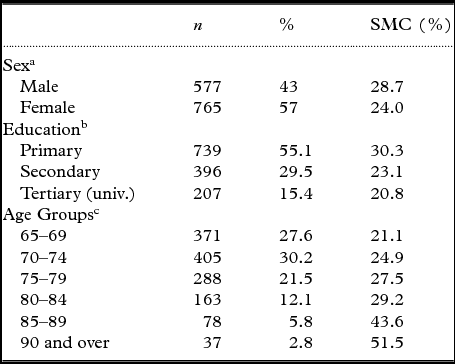
Percentage of SMC broken down by demographic categories appears in Table 1.
Percentage of SMC by demographic category (SMC frequency in total sample=26.7%)

a χ 2=3.691; p=0.055; Cramer's V=0.053.
b χ 2=11.151; p=0.004; Cramer's V=0.092.
c χ 2=29.026; p=0.000; Cramer's V=0.148.
Data did not reveal any statistically significant sex differences, show a lower SMC frequency with higher levels of education, and major age differences; the latter two effects are significant.
Perceived health
Among participants who rated their health as “excellent-very good” (8.2% of the total sample), 18.8% reported SMC, compared to 21.5% among those rating health as “good” (35.9 % of the total sample), and 34.1% of those rating health as “fair to poor” (55.9%). There is association between self-reported health and SMC (χ 2=29.097; p<0.001; Cramer's V (SMC dependent)=0.148).
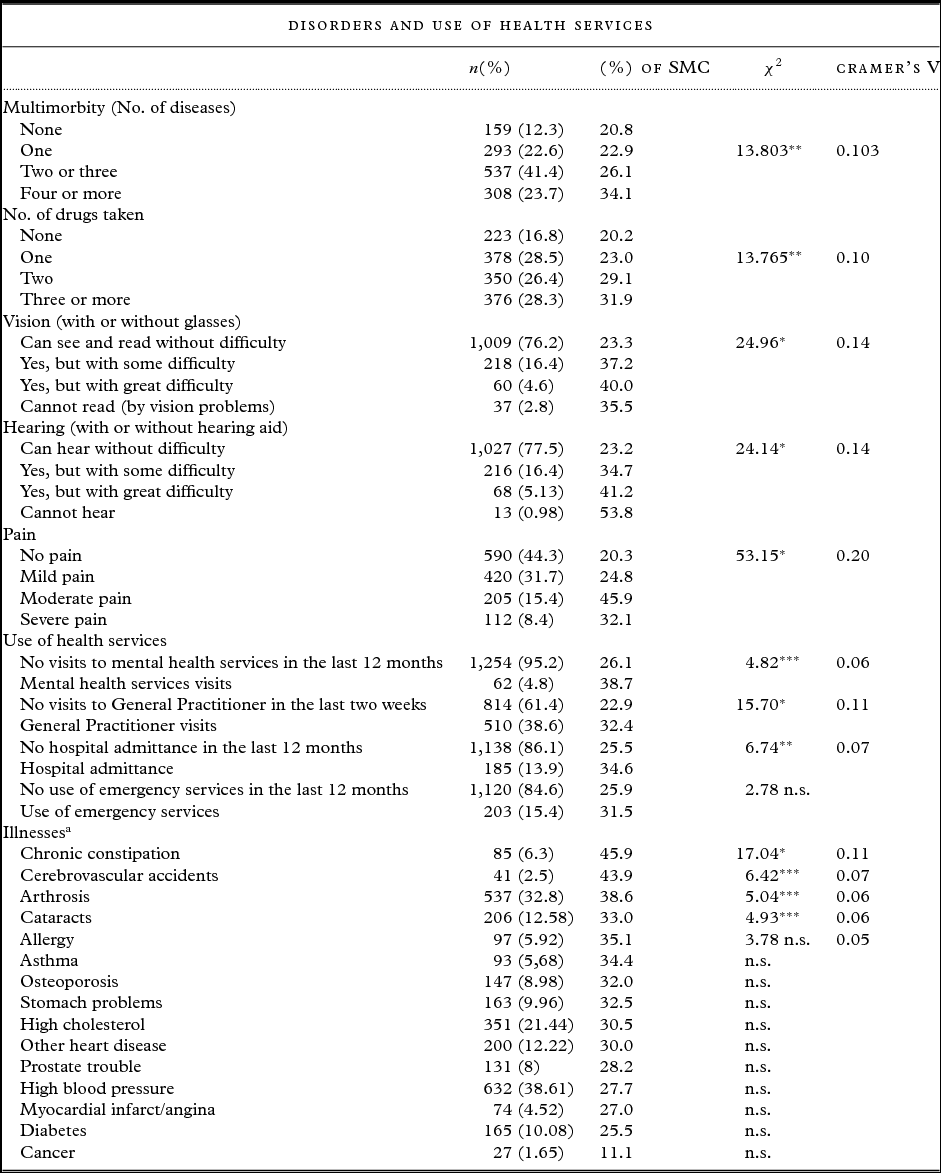
Table 2 shows the percentages of individuals with SMC and the association with different disorders and use of health services.
Association of SMC with different disorders and use of health services

*p=0.000; **p<0.01 (0.009); ***p<0.05.
a Different diseases when this is the main disease in participants with multiple diseases.
Disorders and use of health services
We observe a statistically significant association between SMC and each of the variables except for use of emergency services. The percentage of SMC increases with higher numbers of disorders and drugs taken. Pain is associated with higher rates of SMC. Vision and hearing impairment have equal effect sizes, and the percentage of SMC among people with vision and/or hearing problems is approximately twice that recorded in the rest of the population. The SMC rate in people with severe impairments of both vision and hearing (those unable to see or hear, or with profound difficulty), is 72.5%. The highest percentage of SMC with respect to the use of health services was found for participants visiting mental health services (note that we have excluded patients of anxiety-depressive disorder). Table 2 displays associations between SMC and specific diseases regarded as the main disease in each participant with multiple illnesses. Certain entities (chronic constipation, cerebrovascular accidents, osteoarthritis, and cataracts) are associated with higher percentages of SMC that are statistically significant. To control for comorbidities, we performed logistic regression in which the independent variables were the diseases showing a statistically significant association, with the addition of allergies (p=0.052). The model is significant (χ 2=26.669; p=0.000; Nagelkerke R 2=0.029). Statistically significant differences were identified for the variables chronic constipation (OR=2.161; confidence interval (CI)=1.364–3.424; p=0.001) and cerebrovascular accidents (OR=2.078; CI=1.073–4.022; p=0.03). We used the χ 2 test to determine whether SMC was associated with specific illnesses by comparing results to those from people with no diseases (n=159; 12.3% of the whole sample). There were 293 people listed as having a single illness, including participants with high blood pressure only (n=91; with SMC: n=20; 21.9%), high cholesterol only (n=27; with SMC: n=3; 11.1%), osteoarthritis (n=58; with SMC n=16; 27.5%), diabetes (n=17; with SMC: n=3; 17.6%), prostate disorders (n=16; with SMC: n=2; 12.5%), heart disease (n=15; with SMC: n=3; 20%), and stomach problems (n=13; with SMC: n=2; 15.3%). Data for other diseases are not presented because of their low frequency (n<10). We did not find any statistically significant associations between each specific illness and SMC.
Considering that such variables as osteoarthritis, chronic constipation, pain, and analgesic use may be related, we performed cross-tabs. Associations of pain with all other variables were as follows: with osteoarthritis, Cramer's V=0.38 (p=0.000); with chronic constipation, Cramer's V=0.12 (p=0.000); with use of analgesics, Cramer's V=0.23 (p=0.000). Association of osteoarthritis with chronic constipation was calculated, Cramer's V=0.13 (p=0.000); and with use of analgesics, Cramer's V=0.19 (p=0.000). The association of chronic constipation with analgesics was significant, Cramer's V=0.07 (p=0.01). Then, we conducted a logistic regression analysis with pain, dichotomized, as a dependent variable and the remaining three variables as predictors (χ 2: 200.637; Nagelkerke R 2=0.22; p=0.000): osteoarthritis OR=4.564 (CI, 3.453–6.034), analgesics OR=3.110 (CI, 2.119–4.564), and chronic constipation OR=1.957 (CI, 1.086–3.529).
Participants who had reduced their functional activities (housework, walks, visits, etc.) in the preceding two weeks as a result of disease had higher percentage of SMC (39.3%) compared to participants whose activity had not changed (24.4%) (χ 2=19.308; p=0.000; Cramer's V=0.12); data from those whose functional activity had been reduced in the preceding 12 months due to chronic conditions were very similar (SMC: 37.2% with reduced activity vs. 23.7% without reduced activity; χ 2=21.145; p=0.000; Cramer's V=0.13). The correlation between the two variables describing reduced functional activity was Cramer's V coefficient=0.545 (p=0.000) (in a forthcoming analysis, we study only reductions in functional activity in the preceding 12 months due to chronic conditions).
Medication use and SMC
In the two weeks preceding the survey, 83.3% of participants had taken some type of medicine. The SMC frequency in medicated participants was 28% versus 20.4% among people taking no medications (χ 2=5.741; p=0.019; Cramer's V=0.064). Regarding medication type, only analgesics and vitamins/supplements showed a statistically significant association with SMC. Analgesics: n=235; % SMC with analgesics: 34%; without: 26.4%; χ 2=5.428; p=0.02; Cramer's V=0.07; vitamins/supplements: n=57; % SMC with vitamins/supplements: 40.4%; without: 27.3%; χ 2=4.557; p=0.03; Cramer's V=0.06. No significant associations were found between SMC and medicines to treat osteoarthritis/rheumatic disease (n=254), cough or cold (n=125), allergy (n=23), heart disease (n=192), high blood pressure (n=582), gastrointestinal disorders (n=148), high cholesterol (n=243), asthma (n=52), diabetes (n=132), obesity (n=5), poor circulation or clotting disorders (n=46), vision disorders (n=28), or osteoporosis (n=20). There were no associations between SMC and consumption of tranquilizers (n=71), hypnotic drugs (n=86), alternative medicines (n=74), herbal medicines (n=127), or non-prescription drugs (n=46). Taking vitamins and supplements was not associated with poor perceived health (χ 2=0.730; p=0.417) or pain (χ 2=1.263; p=0.328); however, it was associated with reduced functional activity in the preceding 12 months (χ 2=4.425; p=0.043; Cramer's V=0.064).
Multivariate study
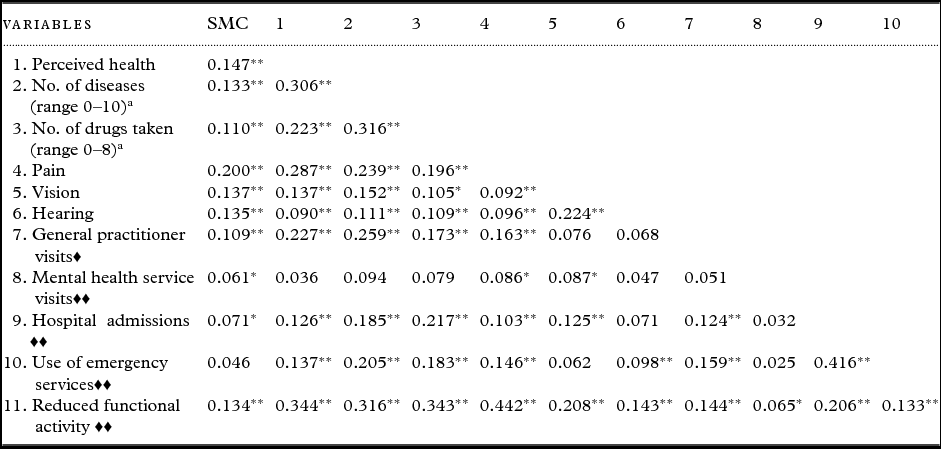
We examined SMC predictors using a multivariate study. Table 3 shows associations between all relevant variables.
Associations between all relevant variables (Cross-tab, Cramer's V, and Eta statistics)

**Significant at the 0.01 level (two-tailed). *Significant at the 0.05 level (two-tailed).
a Eta statistic ♦ Last 2 weeks; ♦♦ Last 12 months.
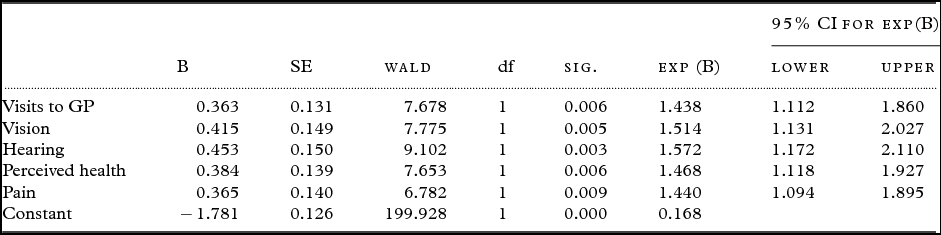
We can observe significant associations between SMC and all variables except for use of emergency services in the preceding 12 months. The strongest effects correspond to pain, perceived health, vision or hearing impairments reduced functional activity, and number of diseases. Logistic regression analysis was performed by entering the following variables: perceived state of health, number of diseases, pain, difficulty hearing, difficulty seeing, number of drugs taken, reduced functional activity in the past 12 months, and the three significant variables having to do with use of health services. The model is significant (χ 2=67.723; p=0.000; Nagelkerke R 2=0.073; −2 log likelihood=1,466.156). Variables entered in the model for the regression study were as follows: perceived state of health, difficulty hearing, visits to the general practitioner in the past two weeks, pain, and vision impairment (Table 4). The interaction between vision and hearing disorders was not significant.
SMC predictors

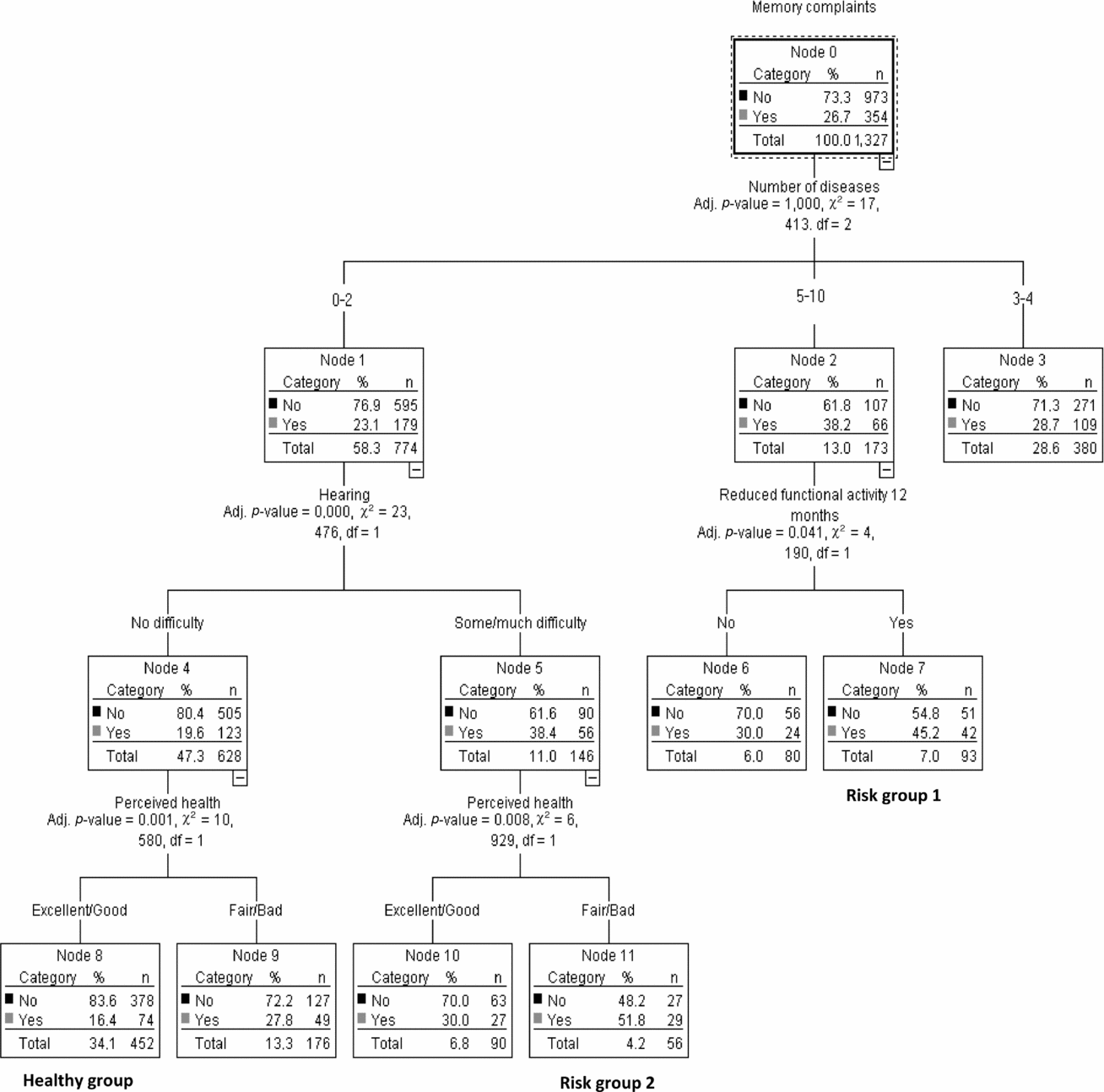
Figure 1 shows the decision tree in which the sample was initially split by the multimorbidity (= number of diseases) variable. In this figure, at the first level, we can observe several at-risk groups constituted according to multimorbidity. SMC were found in 23.1% of people with 0–2 diseases (node 1), 28.7% of those with 3–4 diseases (node 3), and 38.2% of those with 5–10 diseases (node 2). For people in node 1, which includes 58.3% of the total sample (n=774), the next variable that splits this group is hearing. Among participants in node 1, plus poor hearing (node 5) and fair/bad self-rated health (node 11), 51.8% had memory complaints (p=0.008); this is “at-risk group 1.” Node 2 encompasses 13% of the total sample (n=173); the variable that splits this group (p=0.041) is reduced functional activity in the last 12 months (Yes/No); 45.2% of people with reduced functional activity (node 7; 7% of the total sample; n=93) had SMC; this is “at-risk group 2.” In contrast, among those with fewer than three diseases (node 1) and no difficulty hearing (node 4; 47.3% of the total sample; n=628), 19.6% had SMC. Among those that also had good or very good perceived health (node 8; 34.1% of the total sample; n=452), only 16.4% had SMC (p=0.001). Thus, node 8 represents a “healthy group.” As a result, we have two at-risk groups and one healthy group.
Each node shows the category “Yes/No” (with/without SMC) and the percentage (%) and number (n) of participants on each category. Total row shows the percentage of participants in this node with respect to the whole sample and the total “n” in the node.
Adj. p-value=adjusted p-value; df=degrees of freedom.

Discussion
Our results from the multivariate study show that SMC are associated with generally poor self-rated health, hearing or vision impairments, pain, and visits to the general practitioner in the past two weeks; nevertheless, the effect size is only 0.07. The bivariate analysis revealed other associated variables: number of diseases (multimorbidity), number of drugs taken, and use of health services (mental health service visits and hospital admissions, both in the preceding 12 months). SMC is also associated with functional limitations when they limit the participant's activities. Both chronic constipation and cerebrovascular accidents were found to be associated with SMC, but not with any other specific illness manifesting as the only illness, and not with any specific medical treatments other than analgesics and vitamins/supplements. Both osteoarthritis and cataracts were associated with SMC in the bivariate study. In addition to the risk profile derived from the multivariate analysis, we have identified, based on multimorbidity, other risk profiles in which more than 45% of participants have SMC: (1) participants with more than four diseases who reduced their activity in the past 12 months; (2) participants with fewer than three diseases plus difficulty hearing and fair or poor self-perceived health. In contrast, SMC has a low presence among participants with fewer than three diseases, excellent or good perception of their health, and no hearing impairment.
Subjective perceived health
Subjective perceived health has been found to be linked to SMC. Our data show a considerable difference between the percentage of SMC in the population reporting excellent or very good health and those who consider it fair or poor. Participants with a negative perception of their health, tend to overrate their own memory failures, even if they are banal, and make them complain about their memory; this tendency exists whether or not their health or their memory is objectively good or poor. Following the same line of reasoning, individuals who are deeply concerned about their health problems, or who display hypochondriac traits, would tend to underestimate their state of health, and therefore their memory as well. Each person's life experience is probably derived from overall self-assessment of numerous aspects (achievements, abilities, personality, health, etc.); this global experience contributes to how we rate each of these areas and will therefore also affect self-assessment of memory.
Organic diseases – multimorbidity
We have employed several strategies to study this issue. First, we examined participants with only one disease and found no statistically significant associations between SMC and the following diseases: hypertension, diabetes, high cholesterol, osteoarthritis, prostate disorders, heart disease, and stomach problems. However, since multimorbidity is common among elderly people, the absence of a significant association may be also due to the low numbers of participants with only one specific disease. Regarding the second strategy, we did find an association between SMC and various specific diseases in individuals who were also affected by other illnesses (cerebrovascular accidents, chronic constipation, asthma, cataracts). Nevertheless, after adjusting for the other diseases, only the associations with cerebrovascular accidents and chronic constipation remained statistically significant. Some studies using stepwise regression models have found associations between complaints and such entities as pain, stroke, ulcers, headaches, etc., albeit with low OR and in populations with an average age of 45 years (Sachs-Ericsson et al., Reference Sachs-Ericsson, Joiner and Blazer2008). Comijs et al. (Reference Comijs, Kriegsman, Dik, Deeg, Jonker and Stalman2009) have found that certain diseases (diabetes mellitus, stroke, cancer, and peripheral arteriosclerosis) alter cognitive performance by acting directly upon brain function, and this can lead to memory complaints. Some studies (Jorm et al., Reference Jorm2004; Sachs-Ericsson et al., Reference Sachs-Ericsson, Joiner and Blazer2008, and others) have found an association between SMC and cardiovascular disease, but it seems unclear to us whether their patients have only one disease or if other comorbidities are present. Our results lead us to think that this disease alone may not be enough to establish an association with SMC. But we consider that, due to low effect sizes, some studies may find this association while others, like ours, cannot. When we study several diseases together, our results show that the factor with the greatest power is multimorbidity, which is associated with SMC. Most authors have found similar results: Multimorbidity and diseases with a high frequency of SMC have been correlated with variables such as quality of life, depression and anxiety, and self-perceived health (Pearman and Storandt, Reference Pearman and Storandt2005). These variables probably constitute some of the causes mediating the increase in memory complaints observed in people with certain diseases. In particular, we note the association between a range of chronic conditions and perceived health; a collaborative international study found that a third of the variance of this association is mediated by disability (Alonso et al., Reference Alonso2013). Our study also found an association between SMC and functional limitations when they reduced the participant's activity. Moreover, people concerned about their diseases have less available attentional resources for processing external information. They could therefore exhibit poorer performance on everyday memory tasks, and in turn, report more SMC. Taking vitamins and supplements is associated with SMC. We might suppose that this association occurs in participants with poor perceived health or even pain; however, we found no association with these two variables. We have noted that taking medicines and supplements was associated with decreased functional activity in the last 12 months; according to these data, we might hypothesize that patients take these substances to try to compensate for lower functional activity. In addition, another possible reason for taking vitamins and supplements is the widespread popular belief that taking these substances improves memory. A growing number of studies are investigating the association of these substances with cognitive performance and any possible improvements. So far, the results are mixed (Benton et al., Reference Benton, Winichagoon, Ng, Tee and Isabelle2012; Cederholm et al., Reference Cederholm, Salem and Palmblad2013).
Pain
Few population studies have addressed the association between SMC and pain. According to our bivariate analysis, this association is stronger than that between SMC and multimorbidity or several other factors, such as number of medications, impaired vision and hearing, and use of health services. The complaints/pain association may be partially due, first of all, to a decreasing amount of attention dedicated to activities of daily life, since participants have become more concerned about their pain symptoms, and consequently make more memory failures, and second, due to sensing and experiencing general discomfort and dissatisfaction. Interestingly, participants with severe pain have less SMC than those with moderate pain, and these results have also been confirmed by other authors (Siersma et al., Reference Siersma, Waldemar and Waldorff2013). Severe pain tends to focus all people's attention, which would prevent them from dwelling on any memory problems. Our results also showed that osteoarthritis, use of analgesics, and, to a lesser effect, chronic constipation are associated with SMC. This association may be, at least in part mediated by pain, particularly considering that osteoarthritis causes pain leading to analgesic consumption.
Vision and hearing
The frequency of SMC is accepted to be higher in participants with severely impaired vision and hearing (Cutler and Grams, Reference Cutler and Grams1988). Our data also support this finding: participants with hearing or vision impairments are almost twice as likely as healthy controls to exhibit SMC, and this phenomenon occurs more often with impaired hearing and much more often if both vision and hearing are impaired. Some studies have found poorer physical and mental health in people with severely impaired vision and hearing and have even established a causal relationship (Hogan et al., Reference Hogan, O'Loughlin, Miller and Kendig2009). We propose several possible explanations for high SMC frequency, and they are not mutually exclusive. Vision and hearing mediate cognitive functions. Severe impairment of these senses impedes the first phase of the memory process, the information recording or coding phase. In the Berlin Aging Study, Linderberger and Baltes (Reference Lindenberger and Baltes1994) state that, in old and very old age, sensory functioning (vision and hearing) is indicative of the integrity of brain physiology. This visual and auditory impairment is also the cause of withdrawal from the surroundings, a return to introspection, and greater dependency on external factors, thereby leading to more frequent episodes of absent-mindedness and forgetfulness. In addition, these people have a general impression of poor perceived health and poor physical and mental health.
Use of services
Our study found an association between memory complaints and more frequent visits to mental health services, the general practitioner, and hospital services. Other authors have also found an association between SMC and use of health services, nursing home services, and cost increases for these services (Waldorff et al., Reference Waldorff, Siersma and Waldemar2009). Use of health services is also linked to the presence of actual physical or mental disorders, reduced quality of life, and other subjective and social variables. Participants with poor self-rated health use health services five times more frequently than those rating it as excellent (Bierman et al., Reference Bierman, Bubolz, Fisher and Wasson1999). The variables found in our study that are frequently associated with memory complaints include two variables that have an impact on use of health services: multimorbidity and poor self-perceived health.
Risk groups
To analyze risk factors, we chose multimorbidity as a split variable, given that suffering several diseases is very common in older people and the great relevance of this variable in the few investigations carried out on the present topic. The variables involved in the risk groups, and also in the healthy group, are: number of diseases (arbitrarily chosen by us), self-perceived health, hearing, and reduced functional activity. In addition to others that we have not studied, these last three variables are also present in the Van den Kommer et al. (Reference Van den Kommer, Comijs, Rijs, Heymans, Van Boxtel and Deeg2014) risk groups. Our risk group 1 is constituted by participants with many diseases (five or more) and who self-rate their functional activity as reduced probably because of these diseases. The situation can result in the person experiencing a sense of general decay in their life, and consequently they may interpret their memory failures as part of this impression of decay and express complaints more frequently than other participants. Risk group 2 is formed by people with few or no diseases (0–2), but with significant hearing difficulties; this last factor, a source of social isolation, along with a low perception of their health, leads them to manifest more memory complaints. In these two risk groups, we can interpret that suffering in several important areas of life “contaminates” other areas. In contrast, the healthy group comprised people with few or no diseases (0–2), without hearing difficulties, and who perceived their health as excellent or good. It is very likely that they would interpret memory lapses benevolently and consider their memory failures to be relatively unimportant.
In summary, our results illustrate that memory complaints are a complex phenomenon. SMC are part of a conglomerate comprising multimorbidity, pain, difficulty seeing and hearing, use of health services, polypharmacy (especially for pain medication and vitamins/supplements), and poor self-perceived health. All these factors are linked and we have seen that they display statistically significant associations. These factors are associated with complaints on both the subjective and objective levels. Regarding subjective level, the factors presented above lead some individuals to feel vulnerable, inadequate, and that they are living with deficits, which results in frequent complaints. In such situations, participants express their hypochondriac traits more intensely. Consequently, when they perceive memory lapses, which may be banal and typical for their age and have no effect on daily life, they tend to overstate them. In some health systems, this factor, along with many others, may increase the use of health services (Waldorff et al., Reference Waldorff, Siersma and Waldemar2009). There is also an objective component: Some factors associated with complaints actually decrease memory performance by altering the recording and coding phase. This decrease in performance, which directly results in increased forgetfulness in everyday life, is perceived by some participants, so they manifest memory complaints. However, if we review the studies of these variables, we observe that their effect sizes are almost always low (OR are rarely higher than 2). This means that these factors have little impact on the entire sample or they affect only a small percentage of participants, so the effect on the entire sample remains small. Low effect sizes could explain why some authors found no significant associations between SMC and certain variables (morbidity, use of services, cardiovascular disease, etc.) when working with small samples. Considering our studies drawing from the same sample (Montejo et al., Reference Montejo, Montenegro, Fernández and Maestu2011; Reference Montejo, Montenegro, Fernández and Maestu2012), the factors associated with SMC with the largest effect size were orientation in time (a function linked to memory), depression (the second largest effect size), quality of life, some of the Basic and Instrumental Activities of Daily Living, and the factors discussed in the present paper.
Limitations
One of the limitations of the present study is that not every disease was assigned a precise diagnosis; however, this is an epidemiological study, not a clinical study. The absence of a clinical diagnosis is a consequence of the circumstances and objectives of our study, which examines individuals’ health, socioeconomic data, and use of healthcare services. Furthermore, the design of studies of this type is not sufficient to establish causal relationships. We have not studied other variables shown to be associated with SMC. We chose the most common question used to establish the presence or absence of SMC, although it has not been validated. The use of proxies is another limitation of the survey; there has been a debate in epidemiological studies about strengths and weaknesses of these kinds of data. A proxy may introduce bias, but for this type of epidemiological study they may be a necessary evil (Gruber-Baldini et al., Reference Gruber-Baldini, Shardell, Lloyd, Magaziner, Newman and Cauley2012). Finally, there is the effect of sample size. Analyses of large samples, like those of epidemiological studies, may result in type-I errors. One strength of the study is that the sample was representative of the general population of older adults in our city.
Conclusions
There are many reasons why elderly people may feel concern about their memory. Understanding which factors are associated with complaints and defining at-risk groups are important undertakings because these steps contribute to designing appropriate everyday management strategies. When examining a patient with complaints we may consider the possibility of cognitive impairment and therefore order neuropsychological, analytical, and imaging studies to diagnose cognitive impairment. But another possibility is that SMC may arise from the patient's poor perception of his/her state of health, multimorbidity, poor quality of life, sensory deficits, or other factors. The approach to managing each of these scenarios is very different, and discriminating between these two types of patients presents a major challenge. Results from our study may help in this regard.
Conflict of interest
None.
Authors’ roles
Montejo C. Pedro and Montenegro-Peña Mercedes, were responsible for the design of the study, carried out the statistical data analysis, and wrote the paper; López-Higes Ramón revised the paper for important clinical and scientific content; Montejo R. Borja supervised the data collection and revised the paper.
Acknowledgments
This work was supported by the Ministry of Science and Innovation of Spain: PSI 2012-38375-C03-01.