Introduction
Parents of children in the paediatric cardiac ICU often are perceived by clinicians as having an incomplete understanding of their child’s condition. Reference Morell, Miller and Lu1 This may be due in part to suboptimal communication between parents and the complex clinical teams in the cardiac ICU, which are composed of a large number of rotating clinicians from different subspecialties and disciplines. Indeed, this situation works against ensuring highly reliable teamwork and communication within teams. Reference Mosser and Begun2 Optimising team communication and collaboration is essential for patient safety as well as ensuring consistent messaging to families about the patient’s care. Reference Harris, Treanor and Salisbury3–Reference Hathaway, Tarini, Banerjee, Smolkin, Koos and Pati5 Poor collaboration within clinical teams can also have a negative impact on patient outcomes Reference Li and Hambrick6–Reference Acal Jiménez, Swartz and McCorkle8 and can undermine parental decision-making.
Family meetings, where interprofessional team members meet with families to discuss a patient’s current status and potential paths forward in care, have been recommended to optimise team communication with families. Reference Davidson, Aslakson and Long9 Some but not all family meetings are preceded by an interprofessional pre-family meeting huddle, wherein team members can coordinate communication and consolidate the management plan offered to families. These huddles can provide a structure to team discussions which foster interprofessional-shared decision-making: a collaborative process among clinicians that allows for team involvement in important clinical decisions, considering the combined expertise of clinicians involved as well as the patient’s values, goals, and preferences as understood by the interprofessional team. Reference Michalsen, Long and DeKeyser Ganz10 A benefit of fostering interprofessional-shared decision-making is an increased consistency and clarity in family meetings because the team has already worked through within-team disagreements and pooled knowledge and understanding not only about the patient’s condition but also about how to communicate with families about the potential treatment options prior to meeting with the family. Reference Michalsen, Long and DeKeyser Ganz10
Notably, pre-family meeting huddles often have features that can negatively impact team collaboration and interprofessional-shared decision-making in family meetings. For example, physicians often lead the huddle and on average speak over 80% of the time, Reference Walter, Schall and DeWitt11 which can contribute to the exclusion of other interprofessional clinicians’ Reference Lingard, Vanstone and Durrant12,Reference Gair and Hartery13 expertise regarding parental understanding and coping. We, therefore, developed an intervention to promote optimal pre-family meeting huddles, entitled CICU Teams and Loved ones Communicating (CICU TaLC) described elsewhere. Reference Walter, Hill and Drust14 The objective of this Medical Research Council Phase II pilot study Reference Campbell, Fitzpatrick and Haines15 was to evaluate the feasibility of enrolling and training clinicians in the intervention, clinician’s perception of the acceptability of the intervention, fidelity to the intervention protocol, and how that intervention may impact teamwork in pre-family meeting huddles. Results for parent perceptions of acceptability and improvement of family meetings in the cardiac ICU have been reported elsewhere. Reference Walter, Hill and Cetin16
Method
Study design and setting
This pretest-posttest pilot intervention study was conducted from 2018-2022 at the Children’s Hospital of Philadelphia (CHOP), a children’s hospital with 32 cardiac ICU beds.
For context, family meetings are typically initiated by clinicians choosing one patient each week for discussion among the patients who have been admitted in the cardiac ICU for longer than 14 days, which is considered an extensive stay and warrants review and discussion with the family. One cardiac ICU clinician collects recommendations from the cardiac ICU interprofessional team for which patient should be discussed based on their length of stay, that they have not already had a meeting in the recent past, and whether there is the need to give new information or make a clinical decision for the child with input from the family. An attending not currently on service who has the time to fully review the patient’s course leads the pre-family meeting huddle and then the family meeting. These structured pre-family meeting huddles and family meetings are held for one patient each week and do not replace other ad hoc family meetings which may occur for patients at points in decision-making or transition. The huddles include a comprehensive review of the patient’s clinical course in the cardiac ICU, the families’ psycho-social coping, and preparation for what to discuss with the parents in the family meeting. The agenda for what will be discussed in the family meeting is determined by issues the clinicians want to discuss as well as addressing parental questions and concerns. Often there is a large representation from the attendings and other clinicians allowing for pooled experience caring for the patient and collective decision-making about next steps in their care. The family meeting, however, is not designed to have this large exchange of different clinical opinions but rather to communicate the conclusion of the huddle with the family, answer their questions, and listen to their concerns. This is best done with a smaller circle of clinicians that the family knows or has seen before. This is usually an attending, a social worker, a nurse, and sometimes a specialist who has also participated in the preceding huddle. In rare instances, a clinician new to the family may partake in the family meeting. The CHOP Institutional Review Board approved this study; the study is registered on ClinicalTrials.gov (NCT03749330).
Population
We recruited cardiac ICU clinicians most likely to participate in family meetings. Clinicians included cardiac ICU attendings, cardiac ICU social workers, cardiac ICU nursing representatives in meetings, and nurse practitioners. Other clinicians participating in individual pre-family meeting huddles were enrolled at the time they attended the huddle and included both cardiac ICU clinicians as well as consultants such as neurologists and palliative care specialists.
Intervention
We developed cardiac ICU TALC using an experience-based codesign with cardiac ICU clinicians and parents of children hospitalised in the cardiac ICU, as described elsewhere. Reference Walter, Hill and Drust14 The clinician-facing elements intended to optimise all team members’ skills and participation in both the pre-family meeting huddle and subsequent family meeting.
Processes standardised the pre-family meeting huddle by identifying a nurse facilitator to lead the last 15 minutes to prepare for the family meeting using a set of standardised questions. These questions included learning from the social worker about parental communication preferences and about questions the family would likely ask in the family meeting portion. The processes prompted the clinical team to discuss what they wanted to achieve in the family meeting so as to agree on the goals of the meeting and also to practice language that would be used in the meeting if new information needed to be conveyed to the family (Supplementary Document S1). The typical nurse representative who facilitated these meetings was a nurse clinical supervisor or certified nurse educator who had consulted with the bedside nurses in advance of the meeting.
Due to the COVID-19 pandemic, we adapted cardiac ICU TALC from an in-person training to a virtual and partially asynchronous training. Reference Dedeilia, Sotiropoulos, Hanrahan, Janga, Dedeilias and Sideris17 A private website was designed for the clinicians to partake in 11 sessions that taught the following components: parent preparation for family meetings (with parent-facing worksheets in advance of a family meeting), team preparation for family meetings (described above), professional role clarity for team and family meetings by defining and assigning distinct roles for each meeting (Supplementary Document S1), communication skills training in giving serious news to families using a Vital Talk module Reference VitalTalk18 and training on how to support and collaborate one’s colleagues modeled on other interprofessional communication interventions Reference Donesky, Anderson, Joseph, Sumser and Reid19 (Supplementary Table S2), best practices in conducting family meetings with an outline provided for steps in a family meetings (Supplementary Document S3), and debrief of teamwork after family meetings to promote skill reinforcement and commitment to collaboration (Supplementary Document S4). The website included video didactics and interactive discussion boards to demonstrate and review comprehension of the material. Synchronous sessions were conducted virtually for communication skills training and were video recorded to assess fidelity of delivery.
Data collection
The research team tracked participant eligibility, enrollment, data collection, completion rates, and fidelity to intervention protocol. Clinician questionnaires were collected via REDCap. Each pre-family meeting huddle was audio recorded, transcribed, and attendance was tracked to help identify and assign roles to each speaker. Discussion boards on the intervention website provided additional qualitative data. Clinician interviews were conducted over the phone, audio recorded, and then transcribed.
Outcomes
Primary pilot trial outcomes were feasibility of enrolling clinicians in the intervention, acceptability of intervention, and fidelity of intervention. Secondary outcome was the impact of the intervention on clinician teamwork behaviours in pre-family meeting huddles.
Feasibility
Feasibility outcomes were measured by intervention enrollment numbers, retention, and data collection. Retention was assessed by examining the proportion of clinicians who completed all intervention elements. Data collection was the amount of data collected compared to the intended data elements.
Fidelity
Treatment fidelity processes Reference Resnick, Inguito and Orwig20 monitored three components of an intervention: (1) To measure delivery of the intervention (is intervention delivered as intended?), all asynchronous interactions with the website were tracked with response to question prompts and synchronous sessions were video recorded to ensure all elements of the intervention were conveyed. (2) Measurement of receipt of intervention (has training been received and understood by participants?) was done at end of their training with clinicians taking a knowledge test via REDCap with questions about central aspects of the intervention such as roles and parent facing materials. Regardless of their score, each clinician received an answer sheet reinforcing those elements. (3) We assessed enactment (do participants perform treatment-related behaviour in relevant real-life settings?) at post-intervention by evaluating whether central elements of the intervention were completed using meeting transcripts and recordings of the huddles. Enactment criteria were having a non-physician facilitator for the huddle, having a nurse present, assigning roles for the family meeting (e.g., information giver or emotional support coordinator), discussing family’s questions, their communication preferences, and the family meeting agenda.
Acceptability
Clinician acceptability of the cardiac ICU TALC intervention was assessed post-intervention using a previously published questionnaire. Reference Clayton, Adler and O”Callaghan21 The questionnaire consisted of 12 items on a 4-point Likert scale. This data was supplemented by semi-structured interviews designed to elicit perspectives about the acceptability and utility of the intervention materials and the need for additional adaptation or improvement. Discussion board posts provided additional insight into how clinicians perceived the usefulness of the intervention elements as they moved through the intervention training.
Clinician teamwork behaviours in pre-family meeting huddles
We assessed clinician teamwork behaviours in the pre-family meeting huddles using PACT novice, a TeamSTEPPS Reference Clancy and Tornberg22 validated measure, to grade the transcribed meetings. The measure evaluates the domains Team Structure, Leadership, Situation Monitoring, Mutual Support, and Communication on a five-point scale (1 = poor; 3 = average; 5 = excellent). We utilised a slightly adapted version of the TeamSTEPPS scoring system described previously. Reference Walter, Schall and DeWitt11
Statistical analyses
We used descriptive statistics to summarise quantitative acceptability, feasibility, and fidelity data. Wilcoxon rank sum tests were used to compare teamwork ratings for the pre- and post-interventions. We followed COREQ guidelines Reference Tong, Sainsbury and Craig23 for qualitative data. An integrated approach Reference Bradley, Curry and Devers24 was used to analyse the clinician interview data for acceptability, with a priori intervention-related codes as well as grounded theory codes that emerged from the interview transcripts and discussion board posts. Study team members iteratively developed a code book for both by independently reviewing and comparing 2 interview transcripts. When a common understanding of the codebook was established, 2 research coordinators coded the remaining interviews and resolved any coding disagreements through comparison and discussion.
A mixed methods approach was used to analyse the clinician behaviours in the pre-family meeting huddles. First, the huddle transcripts were evaluated using the PACT novice observation form by trained study team members with double coding performed by at least 20% of transcripts. Discrepancies were resolved through comparison and discussion. We assessed intervention impact on communication and teamwork at the meeting level comparing pre- and post-intervention data using the Wilcoxon rank sum test.
The qualitative analyses were performed using NVivo 13. 25 Quantitative data was analysed using R (4.2.2) statistical software. 26
Results
Population
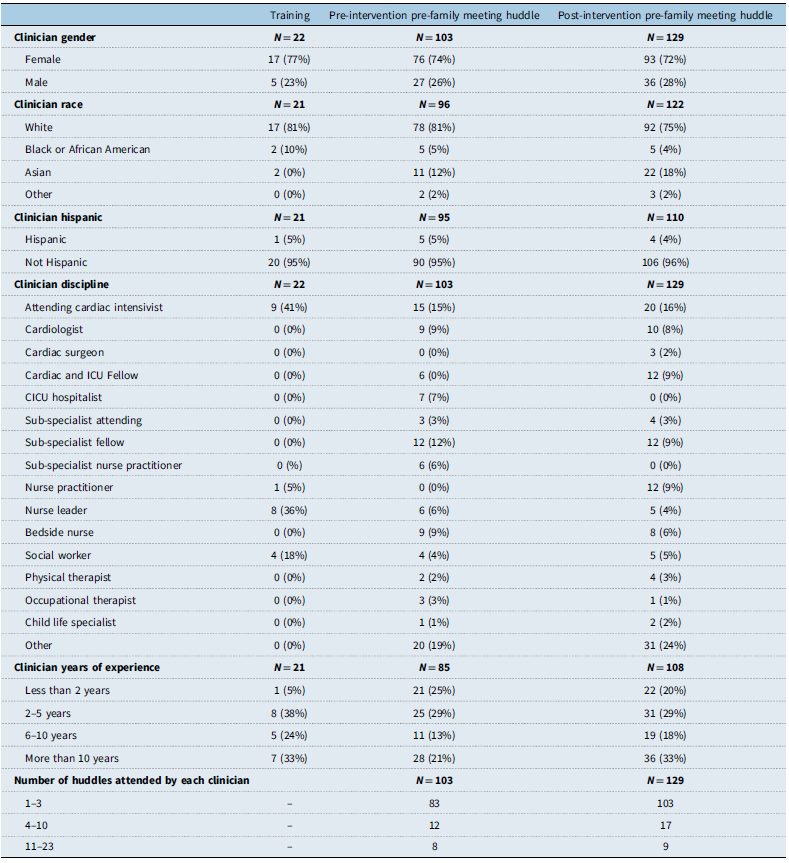
Twenty-two clinicians participated in the intervention training of whom 77% were female and 81% White (Table 1). 103 unique clinicians participated in the pre-intervention pre-family meeting huddles (n = 28) and 129 in the post-intervention (n = 30). See Table 1 for more details.
Characteristics of clinicians who participated in training and pre-family meeting huddles

Clinicians in pre-intervention pre-family meeting huddles
On average, 11 clinicians (SD 4) participated in the pre-intervention pre-family meeting huddles with 7 being physicians (SD 3), 1 nurse (SD 1), and 1 social worker (SD 0). All participants participated in person. An average of 88.6% (SD 12.8%) of clinicians were from the cardiac ICU and 39.4% (SD 10.5%) of all participants were non-physicians. A palliative care team member was present in 3 pre-intervention pre-family meeting huddles (10.7%). Clinicians spent an average of 47 minutes (SD 10) in a pre-family meeting huddle.
Clinicians in post-intervention pre-family meeting huddles
In the post-intervention pre-family meeting huddles, which took place during the COVID-19 era (July 2021-August 2022), we had an average of 15 clinicians (SD 4) present with 9 (SD 3) participating virtually. 29 out of 30 meetings had virtual participants. The average number of professions were 9 physicians (SD 3), 1 nurse (SD 1), and 1 social worker (SD 1). On average 84.6% (SD 16.9%) of participating clinicians were from the cardiac ICU and 39.2% (SD 10.24%) were non-physicians. Palliative care clinicians were present in 5 post-intervention pre-family meeting huddles (16.7%). At least one clinician (physician, nurse, or social worker) that was trained in the intervention was present in each pre-family meeting huddle. 28 (93%) huddles were led by a physician who was trained in the intervention. In 53% of the huddles, a nurse trained in the intervention was present and in 90% a social worker trained in the intervention. On average, pre-family meeting huddles lasted 52 minutes (SD 10) during post-intervention.
Feasibility
9 (90%) of core cardiac ICU attendings, 4 (100%) of cardiac ICU social workers, and 2 of 4 (50%) clinical nurse specialists, 5 of 5 (100%) clinical nurse supervisors and 2 of 4 (50%) clinical nurse educators enrolled in the intervention (70% overall). 24 Clinicians enrolled in the intervention but 2 nurses disenrolled due to leaving their position in the cardiac ICU prior to initiating intervention training (92% retention). The 22 remaining clinicians completed 100% of intervention training. Post-intervention acceptability data was collected from all remaining 22 clinicians (100%). The duration of the training phase was approximately 7 months with a total of 8 hours spent on training elements per participant over several months to accommodate their busy clinical schedules.
Acceptability
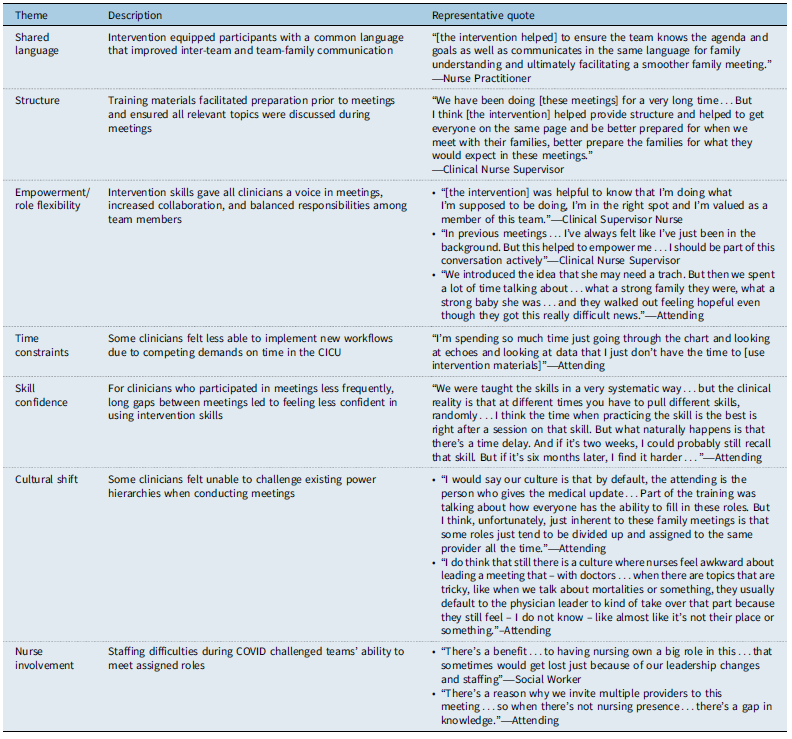
Post-intervention ratings of intervention acceptability were strong (Fig 1), with all participants (n = 22) rating either strongly agree or agree that the training providing clinicians with useful skills and would recommending training to others. We interviewed 8 clinicians from different professions who had participated most frequently in pre-family meeting huddles after the intervention was enacted to assess for acceptability of implementing the intervention in actual clinical practice. These clinicians included 4 attending intensivists, 2 clinical supervisors (nursing), and 2 social workers. Qualitative themes included shared language, structure, empowerment/role flexibility, time constraints, skill confidence, and cultural shifts (Table 2).
Clinical percption of intervention N = 2.

Clinician perceptions of intervention acceptability from interviews

Shared language
Clinicians felt that the intervention equipped them with a common language that improved intra-team and team-family communication. Shared communication skills led team members to explicitly invite participation from each other and facilitated collaboration within the group. Several noted that they use their new communication skills in daily interactions.
Structure
Implementing the intervention in real meetings led clinicians to perceive a structure to pre-family meeting huddles improving meeting quality and clinician experience. Training materials provided by the intervention facilitated clinician preparation prior to meetings and ensured that all relevant topics were discussed during meetings. Several clinicians felt that they were able to make better use of their time in meetings because of these materials. Clinicians often noted that assigned roles minimised guesswork about which team member would be responsible for which aspects of the discussion, improved the flow of conversation during meetings, and focused their preparation efforts prior to meetings.
Empowerment/role flexibility
Clinicians appreciated the interventions’ emphasis on the valuable role that all members have in the pre-family meeting huddle. Nurses and social workers reported feeling more empowered to speak up in meetings, particularly with the use of the “polite interruption” and “thoughtful questions” skills. Attendings also discussed feeling greater comfort navigating the emotional components of family meetings and noted the positive impact this had on families.
Time constraints
Clinicians described that the acceptability of the intervention was somewhat limited by competing demands on their time. Some clinicians reflected that the asynchronous/online training components helped accommodate time constraints and increased acceptability. Many clinicians also noted that the live trainings were essential to practice and achieve competence with new communication skills.
Skill confidence
While clinicians felt the intervention skills were valuable and applicable to their practice, some reported feeling that they did not have the opportunity to practice enough to feel confident using their new skills. Particularly because there may be long gaps between the opportunity to participate in or lead team meetings for certain clinicians, they felt less fluency with their new skills. Several clinicians described that a “booster session” may have been helpful to reinforce skills.
Cultural shift
Some clinicians discussed the difficulty of challenging existing power hierarchies when conducting meetings. Because the culture of their unit historically placed attendings in the position of primarily leading team meetings and family discussions, clinicians struggled to challenge this arrangement and share role responsibilities equitably among teammates.
Fidelity
We tracked fidelity to receipt of training as our intervention was based on a website with online material providing a consistent training experience throughout the intervention phase to all participants. All synchronous sessions were video recorded to ensure consistent content. Participants were able to revisit all elements of the training after the intervention was completed. Overall, participants scored average 86.9% (SD 14%) on the knowledge test with a median value of 88.9% (77.8, 100%). Participants with more than 2 errors on the test received individualised coaching in intervention elements.
Intervention fidelity was monitored according to recommended practice. Reference Resnick, Inguito and Orwig20,Reference Bellg, Borrelli and Resnick27 After evaluating the adherence to the intervention protocol for 8 successive post-intervention pre-family meeting huddles, the research team decided to provide augmented intervention delivery support to increase fidelity (see Supplementary Document S5). Our data shows an increase in all enactment of intervention measures after the delivery support was implemented, with 5 out of 6 measures exceeding our pre-specified fidelity threshold of 85%. Teams discussed families’ communication preferences (before: 50.0%, after: 95.5%), families’ questions (before: 75.0%, after: 86.4%), and family meeting agenda (before: 62.5%, after: 90.9%) more often after implementation of the delivery support (Supplementary Table S6).
Clinician teamwork behaviours in pre-family meeting huddles
In reviewing team performance in real meetings including both individuals who had undergone the training and other clinicians who had not, all 5 domains of the PACT Novice assessment were significantly higher in post-intervention huddles (N = 30) than in pre-intervention (N = 28) (p < 0.001). Teams displayed (Table 3) more Team Structure in post-intervention huddles (median 5.00; IQR: 5.00 – 5.00) than in pre-intervention huddles (median 2.00; interquartile range 1.75 – 2.00) and scored higher in the domain Leadership in post-intervention (median 5.00; interquartile range 5.00 – 5.00) versus pre-intervention (median 3.00; interquartile range 2.00 – 3.00).
Teamwork ratings pre- and post-intervention

*Wilcoxon rank sum test.
Note: The above table shows the distribution of the responses pre and post as ordinal variables of the Performance Assessment for Communication and Teamwork Toolset. The p-values (<0.001) of the Wilcoxon rank sum test indicate that “on average” the responses of post-intervention team are significantly higher than the responses of pre- intervention.
Discussion
This study demonstrated the feasibility and acceptability of implementing a complex team-based intervention for pre-family meeting huddles. Further, while not powered to assess efficacy, the intervention did correlate with improved interprofessional teamwork, which is essential to ensuring highly reliable care. Reference Schmutz, Meier and Manser28 We were also able to collect relevant data from pre-family meeting huddles and clinicians and learned important lessons about how to ensure fidelity to the intervention protocol, all of which is central for future efficacy trials of the intervention.
Three aspects of the study warrant further discussion. First, our study demonstrated the ability to enroll and retain practicing ICU clinicians in a complex behavioural intervention intended to improve teamwork and how clinicians communicate both with each other and families of their patients. This is particularly meaningful given that the intervention was implemented during the COVID-19 pandemic and had to be administered virtually. Given the competing demands of clinicians during the pandemic, the completion rate of an 8-hour training programme demonstrates the feasibility of implementing this intervention. Given the intervention could be done in multiple sittings with short time commitments for each portion may have increased the likelihood of clinicians fitting it into their schedules. The intervention was administered partially via access to a website which contained short videos and interactive modules, which also allowed for these resources to be available to clinicians in an enduring way so they can refer to them for “just in time” re-training.
Second, we found substantial support and high rates of acceptability in both our quantitative and qualitative assessment of clinician perception of the intervention. Development of an intervention using a co-design process which included clinician participants has been demonstrated to improve clinician perceptions of acceptability and uptake. Reference Robert, Cornwell, Locock, Purushotham, Sturmey and Gager29 Despite the time-consuming nature of the training and particularly of the synchronous session, clinicians perceived its usefulness and called out the importance of the communication skills training to practice and achieve competence with the new skills. In fact, some clinicians indicated they wished they had additional time for further skills practice and even refreshers after the initial training to optimise their communication skills. Clinicians also reported that the structure and materials the intervention provided improved the quality of pre-family meeting huddles and their experience in those meetings. They were able to make best use of their time in the pre-family meeting huddle. Clear role definitions and instructions to discuss topics clarified the family meeting structure. As a result, clinicians felt more prepared and confident navigating through conversations with families in the subsequent family meeting. Of note, other interprofessional trainings in a similar ICU setting also had strong acceptability ratings. Reference October, Dizon, Hamilton, Madrigal and Arnold30
Third, we saw an increase in all 5 domains of teamwork in post-intervention pre-family meeting huddles compared to pre-intervention: Team Structure, Leadership, Situation Monitoring, Mutual Support, and Communication as measured by the PACT Novice assessment, a validated tool that was created to measure teamwork in the TeamSTEPPS training. Even though many healthcare team communication trainings also demonstrate improved teamwork, most interventions’ effectiveness is measured using only participant feedback and behaviours rather than communication-specific measures or established scales. Reference Hathaway, Tarini, Banerjee, Smolkin, Koos and Pati5 Subsequently, finding significant improvement in teamwork and communication using a validated measure adds to the significance of this study. Equally important, a minority of the participating clinicians had participated in the intervention training, but their ability to implement the team processes still improved teamwork for all clinicians in these pre-family meeting huddles.
In the interviews, clinicians reinforced these findings. Clinicians reported that the intervention helped challenge the existing power hierarchies in meetings. Marginalised team members such as nurses and social workers reported that they felt more empowered to speak up in meetings. The shared language they developed through the training helped explicitly invite participation from each other and facilitated collaboration. Like other interprofessional trainings, our intervention was able to contribute to a more positive attitude towards teamwork, Reference Heier, Schellenberger, Schippers, Nies, Geiser and Ernstmann31 a shared language, and improve relationships between clinicians who care for the same patients. Reference October, Dizon, Hamilton, Madrigal and Arnold30
The improvement demonstrated in all domains of teamwork suggests that broader implementation of the intervention may well see improvement in patient outcomes. First, there is an association between poor interprofessional communication within healthcare teams and adverse patient outcomes. Reference Hathaway, Tarini, Banerjee, Smolkin, Koos and Pati5 Second, studies show that teams engaging in teamwork processes are more likely to achieve higher performance regarding adherence to treatment guidelines and patient outcomes such as mortality and morbidity. Reference Schmutz, Meier and Manser28
There were some limitations to the study as well. First, the intervention training was implemented during the COVID pandemic which meant it was completed at the clinician’s discretion given the competing work and family demands. While the average time of completion was around 7 months, this did offer opportunities for continued reinforcement of the core content and ability to refresh their memories about aspects over an extended period of time. For institutions who would need to implement the training in a more condensed time period, a greater amount of time away from clinical work would need to be protected to support clinicians in completing the training more efficiently. Second, after the intervention training completed, there was no formal boosters to the intervention behaviours increasing the possibility that the improvement in clinician teamwork may extinguish over time.
Conclusion
An interprofessional team intervention in the paediatric cardiac ICU is feasible to implement and can be done so with high fidelity. This intervention is acceptable to clinicians and improves teamwork and communication in pre-family meeting huddles. These results warrant future efficacy testing of the intervention for broader impacts on interprofessional teamwork, clinician communication skills, families, and patient outcomes.
Supplementary material
The supplementary material for this article can be found at https://doi.org/10.1017/S1047951125000010.
Acknowledgements
CICU Leadership for their support.
Financial support
Dr Walter was supported by the National Heart, Lung, And Blood Institute of the National Institutes of Health under Award Number K23HL141700.
Competing interests
None of the authors report any conflicts of interest.
Ethical standards
The authors assert that all procedures contributing to this work comply with the ethical standards of the relevant national guidelines on human experimentation (the Common Law) and with the Helsinki Declaration of 1975, as revised in 2008, and has been approved by the Institutional Review Board of the Children’s Hospital of Philadelphia.