Introduction
A.V.-A. Kreuzberg, a well-known expert in Palaearctic Papilionidae (especially Parnassiinae: Parnassiini), passed away in 2012. He did not finish all his work, and some of his unpublished lectotypes are formally designated here. During my work in the Museum für Naturkunde Leibniz-Institut für Evolutions- und Biodiversitätsforschung (formerly Museum für Naturkunde der Humboldt-Universität), Berlin, Germany (2010–2015) most of these unpublished designations were discovered. As the primary types designations are very important in ensuring stability of Papilionidae nomenclature, they are published here in order to meet the criteria of the International Commission on Zoological Nomenclature (1999). Specimens were examined from following institutions: The Natural History Museum, London, United Kingdom (BMNH), Staatliches Museum für Tierkunde, Dresden, Germany (SMTD), Zoological Institute of the Russian Academy of Sciences, St.-Petersburg, Russia (ZISP), and Museum für Naturkunde Leibniz-Institut fur Evolutions- und Biodiversitätsforschung, Berlin, Germany (ZMHB).
Parnassius Latreille, 1804
Parnassius delphius albulus Honrath, Reference Honrath1889 (Parnassius delphius Eversm. var. n. Albulus) (Fig. 1). ♀, lectotype (ZMHB), designated here, labelled: “Origin. | albulus | Honr.” (pink paper, printed first line, handwritten second and third lines); “Ex specimini- | bus typicus” (pink paper, printed); “Alai or. | 88. Hbhr. jr” (brown paper, handwritten); “albulus Honrath Reference Honrath1889 | Lectotypus ♀ | Kreuzberg design. | 21.09.1989” (red paper, handwritten). Paralectotypes: 1 ♀, same locality (ZMHB); 2 ♂, 2 ♀, same locality data (BMNH) (Ackery Reference Ackery1973: 8). Type locality was detailed in the original description: “in dem östlich von Osch gelegenen Theile des Alai-Gebirges in einer Höhe von etwa 3600 Meter” (in the parts of Alai Mountains located east of Osh City), which is in Kyrgyzstan (Honrath Reference Honrath1889: 162). This name was originally published as a variety. As the name was not expressly given infrasubspecific rank, and the content of the work does not unambiguously reveal that the name was proposed for an infrasubspecific entity, it is available under Article 45.6.4 (International Commission on Zoological Nomenclature 1999).
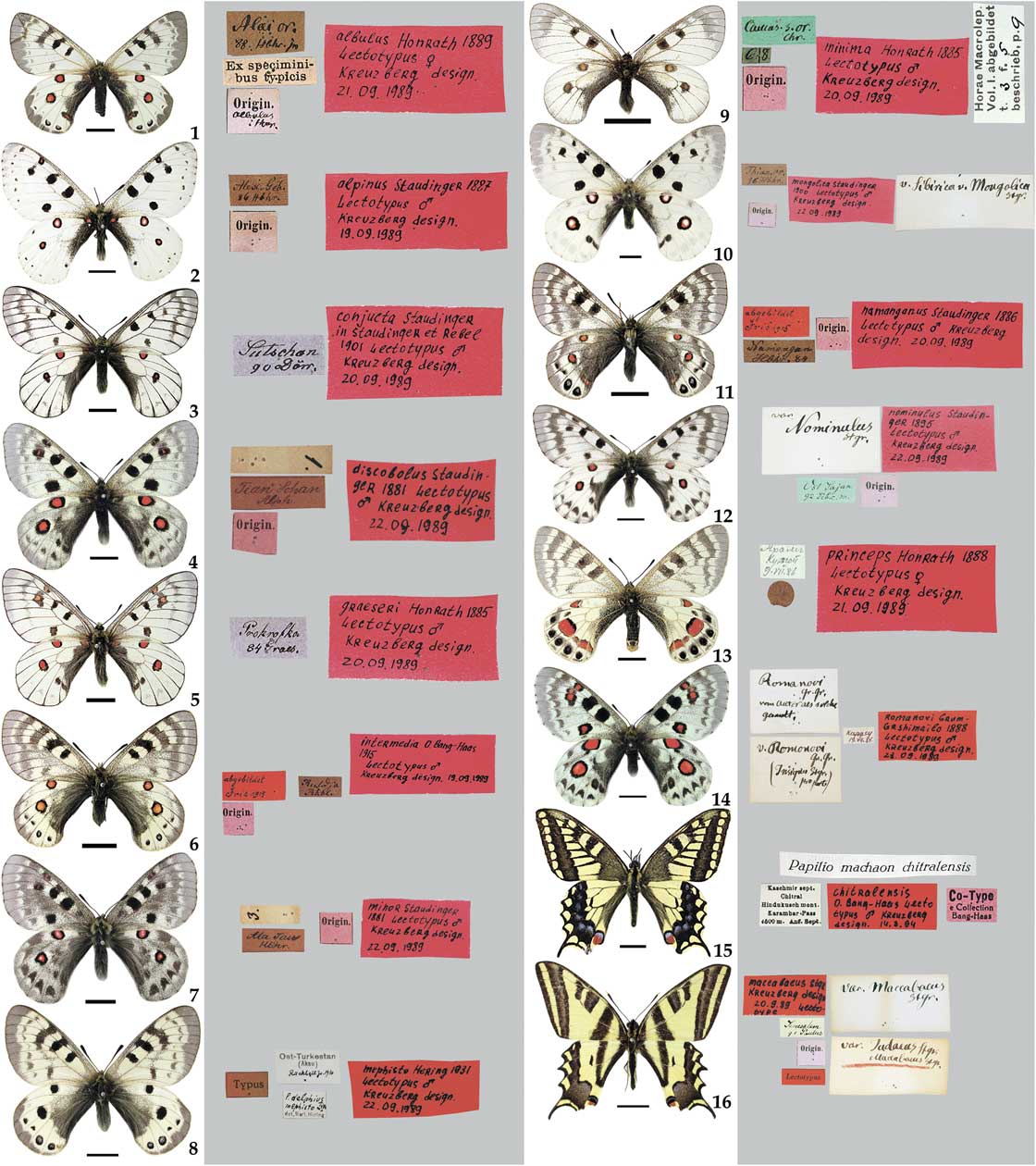
Parnassius and Papilio, primary types. 1. Parnassius delphius albulus Honrath, Reference Honrath1889, lectotype; 2. Parnassius apollonius alpinus Staudinger, Reference Staudinger1887, lectotype; 3. Parnassius bremeri conjunctus Staudinger, Reference Staudinger1901, lectotype; 4. Parnassius discobolus Staudinger, Reference Staudinger1881, lectotype; 5. Parnassius bremeri graeseri Honrath, Reference Honrath1885, lectotype; 6. Parnassius delphius intermedius Bang-Haas, 1915, lectotype; 7. Parnassius tianschanicus minor Staudinger, Reference Staudinger1881, lectotype; 8. Parnassius delphius mephisto Hering, 1931, lectotype; 9. Parnassius nordmanni minimus Honrath, Reference Honrath1885, lectotype; 10. Parnassius apollo mongolicus Staudinger, 1900, lectotype; 11. Parnassius delphius namanganus Staudinger, Reference Staudinger1886, lectotype; 12. Parnassius nomion nominulus Staudinger, 1895, lectotype; 13. Parnassius charltonius princeps Honrath, Reference Honrath1888, lectotype; 14. Parnassius romanovi Grum-Grshimailo, Reference Grum-Grshimailo1888, lectotype; 15. Papilio machaon chitralensis Bang-Haas, Reference Bang-Haas1934, lectotype; 16. Papilio alexanor maccabaeus Staudinger, Reference Staudinger1892, lectotype. Scale bar=1 cm.
Parnassius apollonius alpinus Staudinger, Reference Staudinger1887 (Parnassius apollonius Ev. var. Alpinus) (Fig. 2). ♂, lectotype (ZMHB), designated here, labelled: “Origin.” (pink paper, printed); “Alex. Geb. | 86 Hbhr.” (brown paper, handwritten); “alpinus Staudinger Reference Staudinger1887 | Lectotypus ♂ | Kreuzberg design. | 19.09.1989” (red paper, handwritten). Paralectotypes: 1 ♀, same locality (ZMHB). Type locality: Alex.[ander-]Geb.[irge] is the old German name of Kirghizsky Mountains, which is its type locality. In the original description (Staudinger Reference Staudinger1887) the type locality stated a little bit more detailed: “vom Alexandergebirge, die etwa in einer Höhe von 8–10 000'” (Kirghizsky Mountain range where it flies at elevations of 8000–10 000 feet), Kyrgyzstan. This name was originally published as a variety. As the name was not expressly given infrasubspecific rank, and the content of the work does not unambiguously reveal that the name was proposed for an infrasubspecific entity, it is available under Article 45.6.4 (International Commission on Zoological Nomenclature 1999).
Parnassius bremeri conjunctus Staudinger, Reference Staudinger1901 (Parnassius bremeri v. Conjuncta) (Fig. 3). ♂, lectotype (ZMHB), designated here, labelled: “Sutschan | 90 Dorr.” (violet paper, handwritten); “conjucta [sic!] Reference StaudingerStaudinger | in Reference StaudingerStaudinger et Rebel | 1901 Lectotypus ♂ | Kreuzberg design. | 20.09.1989” (red paper, handwritten). Paralectotypus: 1 ♀, same locality (ZMHB). Type locality: the region of Suchan (today the city of Partizansk in the Ussuri Region (Primorsky Kray) of Russia), cited as “Uss.[uri] Sutschan” in the original description (Staudinger Reference Staudinger1901). This name was originally published as a variety. As the name was not expressly given infrasubspecific rank, and the content of the work does not unambiguously reveal that the name was proposed for an infrasubspecific entity, it is available under Article 45.6.4 (International Commission on Zoological Nomenclature 1999).
Parnassius discobolus Staudinger, Reference Staudinger1881 (Parnassius discobolus) (Fig. 4). ♂, lectotype (ZMHB), designated here, labelled: “1.” (white paper, handwritten); “Origin.” (pink paper, printed); “Tian Schan | Alph.” (brown paper, handwritten); “discobolus Staudin- | ger Reference Staudinger1881 Lectotypus | ♂ Kreuzberg design. | 22.09.1989” (red paper, handwritten). Paralectotypes: not found, but according the original description (Staudinger Reference Staudinger1881: 275), there should be several as indicated in the paper (“…einer großen Anzahl…” [in great number]). Type locality: “aus dem Ala Tau”; Staudinger (Reference Staudinger1881) indicated that P. discobolus was named by “Alpheraky in litt.”, but formally Reference StaudingerStaudinger gave the name and wrote the diagnosis of this taxon, so he is the author. Regardless, the type material was collected by Alpheraky, thus we must refer to his specimens. Alpheraky (Reference Alpheraky1881: 352) collected the first specimens of this taxon on 15 May 1880. Between 11 and 22 May, the expedition of Alpheraky was working in the mountains around the Kunges River in China (Alpheraky Reference Alpheraky1881: 342). Therefore, this region should be considered the type locality.
Parnassius bremeri graeseri Honrath, Reference Honrath1885 (Parnassius bremeri Feld. var. n. Graeseri) (Fig. 5). ♂, lectotype (ZMHB), designated here, labelled: “Pokrofka | 84 Graes.” (violet paper, handwritten); “graeseri Honrath Reference Honrath1885 | Lectotypus ♂ | Kreuzberg design. | 20.09.1989” (red paper, handwritten). Paralectotypes: not found. Type locality: “bei Pochrofka im Apfelgebirge (Jablotschnoi Gorja), Gouvernement Transbaikalien, zwischen dem Baikalsee und den Wasserläufen nach dem Amur gelegen” (near Pokrovka in Apple Mountains, Transbaikalian Province, located between Baikal Lake and Amur river); Pokrovka, Oktyabrsky District, Ussuri Region, Russia, coordinates: 43°57'00"N, 131°38'05"E. This name was originally published as a variety. As the name was not expressly given infrasubspecific rank, and the content of the work does not unambiguously reveal that the name was proposed for an infrasubspecific entity, it is available under Article 45.6.4 (International Commission on Zoological Nomenclature 1999).
Parnassius delphius intermedius Bang-Haas, 1915 (Parnassius delphius v. intermedia) (Fig. 6). ♂, lectotype (ZMHB), designated here, labelled: “Kuldja | Rkbl.” (brown paper, handwritten); “Origin.” (pink paper, printed); “abgebildet | Iris 1915” (red paper, handwritten); “v. intermedia | Ver.” (white paper, handwritten); “intermedia O. Bang-Haas | 1915 | Lectotypus ♂ | Kreuzberg design. 19.09.1989” (red paper, handwritten). Paralectotype: 1 ♀, same locality (ZMHB). Type locality based on the original description is quite wide: “Kuldscha (Thianschan occ.) Kungei Ala Tau, Nord- und Ostseite des Issyk-kuls, Alexander Gebirge, bei Wjernyi; Ingiltschek, Issyk-kul m. or.”. This lectotype designation restricts the type locality to the environs of Kuldja, Eastern Tian-Shan Mountains in China (coordinates: 43°55'N, 81°19'E). This name was originally published as a variety. As the name was not expressly given infrasubspecific rank, and the content of the work does not unambiguously reveal that the name was proposed for an infrasubspecific entity, it is available under Article 45.6.4 (International Commission on Zoological Nomenclature 1999).
Parnassius tianschanicus minor Staudinger, Reference Staudinger1881 (Parnassius (Corybas Fisch.? var.?) Discobolus Alph. (var. minor)) (Fig. 7). ♂, lectotype (ZMHB), designated here, labelled: “3.” (white paper, handwritten); “Origin.” (pink paper, printed); “Ala Tau | Hbhr.” (brown paper, handwritten); “minor Reference StaudingerStaudinger | Reference Staudinger1881 Lectotypus ♂ | Kreuzberg design. | 22.09.1989” (red paper, handwritten). Paralectotypes: 1 ♂, 2 ♀, same locality (ZMHB). Type locality: “im Ala Tau” after original description and the same after this lectotype designation; Ala Tau is the old German name of Dzhungarian Alatau Mountains, Kazakhstan, which is the type locality of this taxon. This name was originally published as a variety. As the name was not expressly given infrasubspecific rank, and the content of the work does not unambiguously reveal that the name was proposed for an infrasubspecific entity, it is available under Article 45.6.4 (International Commission on Zoological Nomenclature 1999).
Parnassius delphius mephisto Hering, 1931 (Parnassius delphius subsp. mephisto) (Fig. 8). ♂, lectotype (ZMHB), designated here, labelled: “Ost- Turkestan | (Aksu) | Rückbeil jr. 1910” (white paper, two first lines printed, third line handwritten); “P. delphius | mephisto Type | det. Mart. Hering” (white paper, two first lines handwritten, third line printed); “Typus” (orange paper, printed); “mephisto Hering 1931 | Lectotypus ♂ | Kreuzberg design. | 22.09.1989” (red paper, handwritten). Paralectotypes: not found. Type locality: the Rückbeil brothers collected butterflies in 1910 in the mountains north of Aksu in the Chinese part of Tian-Shan (Püngeler Reference Püngeler1901: 177). These mountains are at the confluence of the Kokshaaltoo, Sary-Dzhaz, and Inylchek-Tau mountain ranges near Khan-Tengri Peak in China. This name was originally published as a variety. As the name was not expressly given infrasubspecific rank, and the content of the work does not unambiguously reveal that the name was proposed for an infrasubspecific entity, it is available under Article 45.6.4 (International Commission on Zoological Nomenclature 1999).
Parnassius nordmanni minimus Honrath, Reference Honrath1885 (Parnassius nordmanni Mén. var. n. minima) (Fig. 9). ♂, lectotype (ZMHB), designated here, labelled: “6|8” (dark green paper, handwritten); “Caucas. s. or. | Chr.” (green paper, handwritten); “Origin.” (pink paper, printed); “Horae Macrolep. | Vol. I. abgebildet | t. 3 f. 5 | beschrieb. p. 9” (white paper, printed, numbers handwritten); “minima Honrath Reference Honrath1885 | Lectotypus ♂ | Kreuzberg design. | 20.09.1989” (red paper, printed). Paralectotype: 1 ♀, same data (ZMHB); 1 ♂, 1 ♀, same data (Nekrutenko Reference Nekrutenko1990: 52) (BMNH). Type locality: According to the original description, the type locality of P. nordmanni minimus is “bei Basardjusi im östlichen Kaukasus (Daghostan) in einer Höhe von 14 000 Fuss” (near Basardjusi village in eastern Caucasus (Daghestan) at 14 000 feet) (Honrath Reference Honrath1885: 273). This name was originally published as a variety. As the name was not expressly given infrasubspecific rank, and the content of the work does not unambiguously reveal that the name was proposed for an infrasubspecific entity, it is available under Article 45.6.4 (International Commission on Zoological Nomenclature 1999).
Parnassius apollo mongolicus Staudinger, 1900 (Parnassius apollo var. Mongolica) (Fig. 10). ♂, lectotype (ZMHB), designated here, labelled: “Origin.” (pink paper, printed); “Thian. or. | 96 Hbhr.” (brown paper, handwritten); “v. Sibirica v. Mongolica | Stgr.” (white paper, handwritten); “mongolica Staudinger | 1900 Lectotypus ♂ | Kreuzberg design. | 22.09.1989” (red paper, handwritten). Paralectotypes: 1 ♂, 2 ♀, same locality (ZMHB). Type locality based on the lectotype designation: mountains south of Issyk-Kul, Kyrgyzstan. This name was originally published as a variety. As the name was not expressly given infrasubspecific rank, and the content of the work does not unambiguously reveal that the name was proposed for an infrasubspecific entity, it is available under Article 45.6.4 (International Commission on Zoological Nomenclature 1999).
Parnassius delphius namanganus Staudinger, Reference Staudinger1886 (Parnassius delphius var. Namanganus) (Fig. 11). ♂, lectotype (ZMHB), designated here, labelled: “Origin.” (pink paper, printed); “Namangan | Hbhr. 84” (brown paper, handwritten); “abgebildet | Iris 1915” (red paper, handwritten); “namanganus Staudinger Reference Staudinger1886 | Lectotypus ♂ Kreuzberg | design. 20.09.1989” (red paper, handwritten). Paralectotype: 1 ♀, same locality (ZMHB). Type locality: Namangan is a city in Uzbekistan located in the northern part of Fergana Valley; the type locality was explicitly stated by Staudinger (Reference Staudinger1886: 196) to be “den Alpen bei Namangan”. The only high mountain located near Namangan is the Chatkalsky mountain ridge in Uzbekistan, which I consider as the type locality of this taxon. This name was originally published as a variety. As the name was not expressly given infrasubspecific rank, and the content of the work does not unambiguously reveal that the name was proposed for an infrasubspecific entity, it is available under Article 45.6.4 (International Commission on Zoological Nomenclature 1999).
Parnassius nomion nominulus Staudinger, 1895 (Parnassius nomion var. Nominulus) (Fig. 12). ♂, lectotype (ZMHB), designated here, labelled: “Origin.” (pink paper, printed); “var. | Nominulus | Stgr.” (white paper, handwritten); “Ost Sajan | 92 Leb.c.m.” (green paper, handwritten); “nominulus Staudin- | ger 1895 | Lectotypus S | Kreuzberg design. | 22.09.1989” (red paper, handwritten). Paralectotypes: 1 ♀, same locality (ZMHB). Type locality: “aus dem Ost-Sajan-Gebiet”, which is the East Sayan mountain range in Russian Siberia. This name was originally published as a variety. As the name was not expressly given infrasubspecific rank, and the content of the work does not unambiguously reveal that the name was proposed for an infrasubspecific entity, it is available under Article 45.6.4 (International Commission on Zoological Nomenclature 1999).
Parnassius charltonius princeps Honrath, Reference Honrath1888 (Parnassius charltonius Gray var. n. Princeps) (Fig. 13). ♀, lectotype (ZMHB), designated here, labelled: brown circle; “Арамъ | Кунгей | 9.VII.86” [Aram | Kungei | 9.VII.86] (white paper, handwritten); “princeps Honrath Reference Honrath1888 | Lectotypus ♀ | Kreuzberg design. | 21.09.1989” (red paper, handwritten). Paralectotypes: 1 ♂, Transalai (Ackery Reference Ackery1973: 22) (BMNH). Type locality: “Transalai-Gebirge” in the original description (Honrath Reference Honrath1888); Aram-Kungei Pass in Transalai Mountain range (Kyrgyzstan) based on this lectotype designation. This name was originally published as a variety. As the name was not expressly given infrasubspecific rank, and the content of the work does not unambiguously reveal that the name was proposed for an infrasubspecific entity, it is available under Article 45.6.4 (International Commission on Zoological Nomenclature 1999).
Parnassius romanovi Grum-Grshimailo, Reference Grum-Grshimailo1888 (Parnassius romanovi) (Fig. 14). ♂, lectotype (ZMHB), designated here, labelled: “Карасу | 19.VII.84.” [Karasu | 19.VII.84] (white paper, handwritten); “Romanovi | Gr.Gr. | von Autor als solche | gesandt” (one side), “v. Romanovi | Gr.Gr. | (Insignis Stgr. | pro part)” (second side) (white paper, handwritten); “romanovi Grum- | Grshimai’lo 1888 | Lectotypus ♂ | Kreuzberg design. | 23.09.1989” (red paper, handwritten). Paralectotypes: 1 ♂, 1 ♀, same locality (ZISP). Type locality: Grum-Grshimailo (Reference Grum-Grshimailo1885: 236) wrote that his expedition left Katta-Karamuk, passed Aguyurma Pass, and established the camp in Balakty where the expedition worked for 10 days. In the same paper (next page) he listed the taxon P. romanovi from this locality. Thus, the type locality of P. romanovi is Balakty location near the Aguyurma Pass (modern name: Sharkrama Pass, Tajikistan), which was cited as “Transalai” in Grum-Grshimailo (Reference Grum-Grshimailo1888).
Papilio Linnaeus, 1758
Papilio machaon chitralensis Bang-Haas, Reference Bang-Haas1934 (Papilio machaon subsp. chitralensis) (Fig. 15). ♂, lectotype (ZMHB), designated here, labelled: “Co-Type | e Collection | Bang-Haas” (light red paper, printed); “Papilio machaon chitralensis” (white paper, printed); “Kaschmir sept. | Chitral | Hindukusch mont. | Karambar-Pass | 4500 m. Anf. Sept.” (white paper, printed); “chitralensis | O. Bang-Haas Lecto | typus ♂ Kreuzberg | design. 14.3.84” (red paper, handwritten). Paralectotype: 1 ♂, same locality (SMTD). Specimen of uncertain status (possible paralectotype): 1 ♂, “chitralensis O. Bang-Haas Reference Bang-Haas1934 | ?-SYNTYPUS | Y. Nekrutenko det. 9.10.2000” (yellow paper); “Staatl. Museum für | Tierkunde Dresden” (white paper); “Chitral sept. | Hindukusch | Baroghil Pass | 3800 m Juli” (white paper); “Stauding. & Bang-Haas | Dresden, Ankauf 1961” (white paper) (SMTD). Type locality: Karambar Pass, a high mountainous pass in Pakistan, coordinates: 36°52'46"N, 73°40'28"E. This was cited in the original description as “Karambar-Pass” (Bang-Haas Reference Bang-Haas1934).
Papilio alexanor maccabaeus Staudinger, Reference Staudinger1892 (Papilio alexanor L. var. Maccabaeus) (Fig. 16). ♂, lectotype (ZMHB), designated here, labelled: “Lectotypus” (red paper, printed); “Origin.” (pink paper, printed); “Jerusalem | 91 Paulus” (yellow paper, handwritten); “var. Maccabaeus | Stgr.” (one side), “var. Judaeus Stgr. | Maccabaeus Stgr.” (other side) (white paper, handwritten); “maccabaeus Stgr | Kreuzberg design | 20.9.88 | Lecto- | type” (red paper, handwritten). Paralectotypes: not found. Type locality: Jerusalem, Israel based on the original description (Staudinger Reference Staudinger1892) and lectotype designation. This name was originally published as a variety. As the name was not expressly given infrasubspecific rank, and the content of the work does not unambiguously reveal that the name was proposed for an infrasubspecific entity, it is available under Article 45.6.4 (International Commission on Zoological Nomenclature 1999).
Acknowledgements
The author thanks Dr. Wolfram Mey for help in the Museum fur Naturkunde Leibniz-Institut fur Evolutions- und Biodiversitatsforschung and for granting access to curated collections. He was also very thankful to an anonymous referee, who helped to improve an earlier version of this paper.