Hypoplastic left heart syndrome accounts for about 2%–3% of all CHDs and is lethal if left untreated with 95% mortality within the first month of life. Reference Greenberg, Pribble and Singareddy1 In hypoplastic left heart syndrome, the left ventricle is non-functional, systemic circulation is ductus arteriosus-dependent and is maintained by the right ventricle. Since the left ventricle is functionally absent, atrial septal defect constitutes the only exit for pulmonary venous flow. Reference Gobergs, Salputra and Lubaua2 Following birth, acute decline in pulmonary arterial resistance and spontaneous ductal closure occurs, leading to an increase in pulmonary circulation and decrease in systemic and coronary perfusion. A series of surgical interventions are carried out to maintain adequate systemic circulation. The first stage surgical intervention involves the Norwood procedure and a modified Blalock–Taussig shunt. Reference Hoashi, Imai, Okuda, Komori, Kurosaki and Ichikawa3 The Glenn procedure is the second stage of correction, Reference Rai, Gładki, Dudyńska and Skalski4–Reference Arslanoglu, Tuncer and Cine6 and its success or failure have been associated with various factors, including atrioventricular valve regurgitation, pre-operative mean pulmonary artery pressure, pre-operative PVRi, post-operative mean pulmonary artery pressure and diaphragmatic paralysis. Reference Sethasathien, Silvilairat and Lhodamrongrat7
Inflammatory activity is expected to develop after surgery and is necessary for healing; however, the complexity of the procedures and the sheer number of required manipulations may lead to excessive inflammation—which has been demonstrated to be associated with adverse in-hospital outcomes. Reference Puchinger, Ryz and Nixdorf8 Neutrophil-to-lymphocyte ratio, platelet-to-lymphocyte ratio, and mean platelet volume have emerged as novel, easily accessible markers of systemic inflammation. Reference Luo, Zhang and Liu9 There is accumulating data demonstrating the role of these markers in subjects with cardiovascular disorders. However, little is known concerning their role in determining adverse outcomes after surgery for CHDs, especially in the paediatric population.
Predicting post-procedural mortality and morbidity in paediatric patients undergoing the Glenn procedure by taking into account pre-operative or early post-operative parameters can be important to identify necessary precautions needed during the intra-operative and early post-operative periods. The purpose of this study was to address the role of neutrophil-to-lymphocyte ratio, platelet-to-lymphocyte ratio and mean platelet volume on in-hospital adverse outcomes in subjects undergoing the Glenn procedure.
Materials and methods
Subjects undergoing Glenn procedure for hypoplastic left heart syndrome at our institute between January 2010 and December 2021 were analysed in a retrospective manner. Subjects with chronic malnutrition, those with elevation in blood urea and creatinine, patients diagnosed with bleeding disorders and subjects undergoing emergency surgery were excluded. The study was approved by the local ethics committee. Written informed consent was obtained from all patients’ families. Patients were divided into two groups: Group 1 consisted of 78 patients who were discharged, and Group 2 included 12 patients who died after surgery.
All surgical procedures were performed by the same surgical team in a standardised fashion. Cardiopulmonary bypass was established through cannulae in the aorta, superior caval vein and the right atrium. Surgery was performed under moderate hypothermia. Following cardiopulmonary bypass, the BT shunt was occluded and then promptly divided and oversewn. Superior caval vein was transected from its right atrium junction, the right atrium was oversewn and the superior caval vein was anastomosed to the right pulmonary artery.
Demographic data and regularly ordered laboratory measurements, including pre-operative and post-operative complete blood counts, were retrieved from the institutional digital database and from patient charts. Pre- and post-operative pulmonary arterial pressure, oxygen saturation, duration of the cardiopulmonary bypass, drainage, length of intubation, ICU stay and hospital stay were also recorded.
The primary outcome measure of this study was to evaluate the predictive role of novel inflammatory markers including neutrophil-to-lymphocyte ratio, platelet-to-lymphocyte ratio and mean platelet volume on post-operative mortality. The secondary outcome measure was to investigate whether neutrophil-to-lymphocyte ratio, platelet-to-lymphocyte ratio and mean platelet volume had a role in prediction of the length of ICU and/or hospital stay.
Statistical analysis
All analyses were performed on SPSS v25 (SPSS Inc., Chicago, IL, USA) and were subject to a significance threshold of 0.05 (p value). Histogram and Q–Q plots were employed to assess normality of distribution in quantitative variables. Data were given as median (1st quartile–3rd quartile) for continuous variables with respect to the results of these distribution analyses, while frequency (percentage) values were used for categorical variables. Between-group analyses of quantitative variables were performed with the Mann–Whitney U test since parametric assumptions were not met for any comparisons. Repeated measurements were analysed with Friedman’s analysis of variance by ranks. Pairwise comparisons were performed with the Bonferroni correction method. Categorical variables were analysed with the Fisher’s exact tests. Diagnostic performance of the variables was assessed by using receiver operating characteristic curve analysis. Multiple logistic regression analysis (forward conditional method) was performed to determine factors independently associated with mortality. Spearman correlation coefficients were calculated to evaluate relationships between continuous variables.
Results
We included 90 patients (35 females and 55 males) into our study, median age was 11 (range: 8 – 29) months. Fourteen of the cases had previously undergone the Norwood procedure (3 hybrid palliation, 11 classical). Ten patients were receiving inotropic support before the procedure. Of note, 76 patients were extubated on the third post-operative day, while the remaining 14 patients were re-intubated. In-hospital mortality occurred in 12 (13.33%) patients and 78 (86.67%) patients were discharged from the hospital. There were no significant differences between exitus and discharged groups in terms of age, sex, weight and duration of cardiopulmonary bypass.
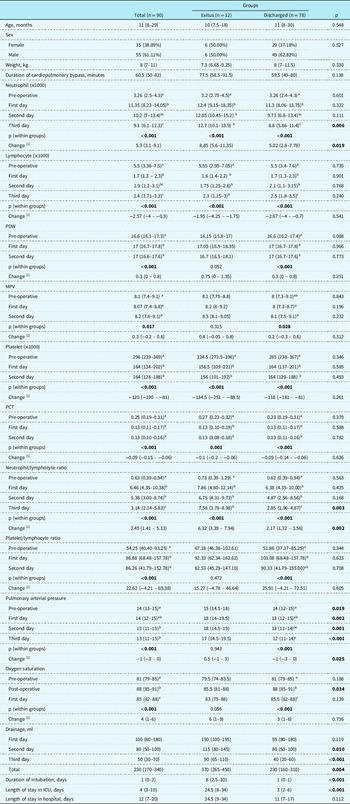
There was a significant post-operative improvement in oxygen saturation and pulmonary artery pressure in surviving subjects compared to the exitus group (p < 0.001). Surviving subjects demonstrated a lower amount of post-operative drainage compared to exitus group [370 (265 – 450) ml vs. 230 (160 – 310) ml, p = 0.004]. Length of ICU stay was also longer in the exitus group compared to survivors [24.5 (8 – 34) days vs. 3 (2 – 6) days]. Among measurements of neutrophil count, lymphocyte count, neutrophil-to-lymphocyte ratio, platelet-to-lymphocyte ratio and mean platelet volume, we found that third-day neutrophil count and neutrophil-to-lymphocyte ratio value were significantly higher in the exitus group compared to that of the discharged group (p = 0.006 and p = 0.003, respectively) (Table 1).
Summary of variables with regard to groups

Data are given as median (1st quartile–3rd quartile) for continuous variables according to normality of distribution and as frequency (percentage) for categorical variables. (1) Difference between last and pre-operative measurements, negative values represent decrease and positive values represent increase
Same letters denote the lack of statistically significant differences between repeated measurements
PDW: Platelet distribution width
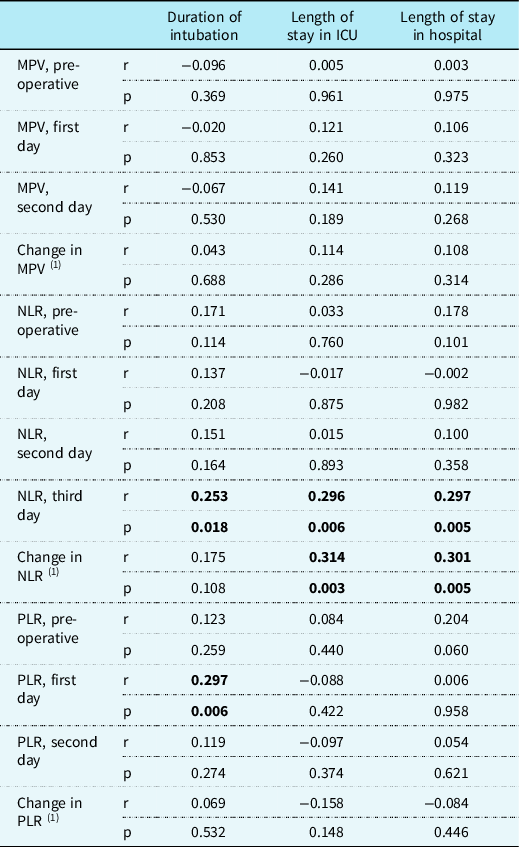
Third-day neutrophil-to-lymphocyte ratio was also weakly but significantly correlated with duration of intubation (r = 0.253, p = 0.018), length of stay in ICU (r = 0.296, p = 0.006) and length of hospital stay (r = 0.297, p = 0.005) (Table 2).
Correlations between MPV, neutrophil-to-lymphocyte ratio, PLR and morbidity variables

r: Spearman correlation coefficient, NLR: Neutrophil/lymphocyte ratio, PLR: Platelet/lymphocyte ratio. (1) Difference between last and pre-operative measurements
We performed multiple logistic regression analysis to determine prognostic factors best associated with mortality. Patients with high third-day neutrophil-to-lymphocyte ratio (≥6) had 14.227-fold higher risk of death than other patients (OR: 14.227, 95% CI: 2.404–84.181; p = 0.003). In addition, we found that higher pulmonary arterial pressure increased the risk of death (OR: 1.743, 95% CI: 1.240-2.451; p = 0.001) (Table 3). Other variables included in the model, age (p = 0.142), sex (p = 0.965), weight (p = 0.101), duration of cardiopulmonary bypass (p = 0.306), second-day mean platelet volume (p = 0.979), second-day platelet-to-lymphocyte ratio (p = 0.378), post-operative oxygen saturation (p = 0.093) and total drainage (p = 0.389) were found to be non-significant for predicting mortality.
Significant risk factors of the mortality, multiple logistic regression analysis

Dependent variable: mortality; Nagelkerke R2 = 0.560; Correct prediction=90.80%.
CI: confidence interval, NLR: neutrophil/lymphocyte ratio.
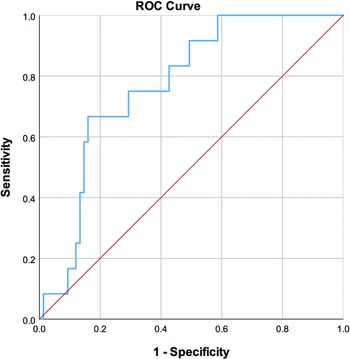
The ROC curve analysis revealed that neutrophil-to-lymphocyte ratio had 66.67% sensitivity, 84% specificity, 81.61% accuracy, 40% positive predictive value and 94.03% negative predictive value with a cut-off point of 6 (equal or higher than this value) to predict mortality. Area under the ROC curve was 0.771 (95% CI: 0.652–0.890) (Fig 1).
ROC curve of third-day neutrophil-to-lymphocyte ratio to predict mortality.

Discussion
Findings of this retrospective study show that neutrophil count and neutrophil-to-lymphocyte ratio value measured on the third post-operative day is higher in patients who died after the Glenn procedure compared to those who survived. Also, third-day neutrophil-to-lymphocyte ratio was associated with longer duration of ICU and hospital stay. More importantly, third-day neutrophil-to-lymphocyte ratio and post-operative pulmonary arterial pressure were found to be significant predictors for in-hospital mortality. A cut-off value of ≥6 for post-operative third-day neutrophil-to-lymphocyte ratio predicted mortality with 66.67% sensitivity and 84% specificity.
The Glenn procedure is an inter-stage surgery between Norwood procedure and Fontan procedure performed to gradually lower the exposure of pulmonary circulation to systemic pressures. A number of studies have reported 95% 5-year and 74% 8-year survival rate following the Glenn procedure. Reference Scheurer, Hill and Vasuki10,Reference Alsoufi, Manlhiot and Awan11 Factors associated with early mortality demonstrate a wide variety in different studies. The study by Francois et al. reported that younger age, lower weight, longer bypass time and requirement for reintubation were related to operative mortality. Reference François, Vandekerckhove and De Groote12 In another study by Sethasathien and colleagues, atrioventricular valve regurgitation, pre-operative mean pulmonary artery pressure of ≥17 mmHg, pre-operative PVRi of ≥3.1 Wood Units/m2 were found to be associated with early mortality. Reference Sethasathien, Silvilairat and Lhodamrongrat7
The neutrophil-to-lymphocyte ratio value has been accepted as a novel marker of systemic inflammation. Accumulating data indicate that neutrophil-to-lymphocyte ratio has a close relation with worse outcomes in patients with cardiovascular disorders including arterial stiffness, hypertension, acute coronary syndrome, coronary artery disease burden, percutaneous coronary intervention and heart failure. Reference Mozos, Malainer and Horbańczuk13–Reference Shi, Zhao, Tian, Guo and Song18 Moreover, there is extensive data concerning the predictive role of neutrophil-to-lymphocyte ratio for unfavourable outcomes following adult cardiac surgery. A study by Urbanowicz et al. showed that an neutrophil-to-lymphocyte ratio of >3.5 was associated with adverse outcomes in subjects undergoing off-pump coronary artery by-pass grafting. Reference Urbanowicz, Olasińska-Wiśniewska and Michalak19 A retrospective study conducted by Walian and colleagues revealed that an increased neutrophil-to-lymphocyte ratio was significantly correlated with post-operative mechanical ventilation duration, mean vasoactive-inotropic scores and length of ICU and hospital stay in congenital cardiac surgical patients with pre-existing pulmonary hypertension. Reference Walian, Kohli and Magoon20 Sahin et al. evaluated patients undergoing on-pump and off-pump coronary artery bypass grafting, and found that post-operative first hour and post-operative first day neutrophil-to-lymphocyte ratio (>6.4 and >31.8, respectively) predicted mortality regardless of the technique used. Reference Şahin and Sisli21 A recent systemic review and meta-analysis of 12 studies involving 13,262 patients undergoing cardiac surgery has shown that peri-operative neutrophil-to-lymphocyte ratio was a significant predictor of short- and long-term mortality following cardiac surgery. Reference Perry, Liu and Loth22
There is limited data concerning the role of neutrophil-to-lymphocyte ratio in prediction of the adverse outcomes following cardiac surgery in the paediatric population. The study by Gao et al., conducted with 424 infants undergoing cardiac surgery, reported that elevated neutrophil-to-lymphocyte ratio was related to increased mechanical ventilation time and length of stay in the ICU and hospital. Reference Gao, Liu and Wang23 A recent study published by Savluk et al. provided similar results to earlier research; the authors found that subjects with a peri-operative neutrophil-to-lymphocyte ratio value of >2.57 had a 13-fold increase risk for early mortality, Reference Savluk, Guzelmeric and Yavuz24 indicating similarities with our findings. A more specific study which had assessed the prognostic role of neutrophil-to-lymphocyte ratio in subjects undergoing bidirectional Glenn procedure with a 48-month follow-up reported that increased neutrophil-to-lymphocyte ratio was associated with prolonged length of hospital and ICU stay, and increase in mechanical ventilator time. Reference Manuel, Miana and Guerreiro25 The role of neutrophil-to-lymphocyte ratio for predicting adverse post-operative outcomes was also studied in subjects undergoing tetralogy of Fallot repair. Higher pre-operative neutrophil-to-lymphocyte ratio was shown to be related to longer hospital and ICU stay. Reference Manuel, Miana and Guerreiro26
Our study is the first to demonstrate the predictive value of neutrophil-to-lymphocyte ratio on adverse post-operative outcomes and in-hospital mortality in subjects undergoing bidirectional Glenn procedure. Our findings show that post-operative third-day neutrophil-to-lymphocyte ratio value of ≥6 is associated with a 14-fold increase in early mortality when compared with those with lower values. Preexisting hypoxemia, which is an important post-operative risk factor for mortality, may induce inflammation in this patient population and can yield elevated neutrophil-to-lymphocyte ratio. During cardiac surgery, cardiopulmonary bypass itself may induce neutrophil activation. The imbalance between neutrophils and lymphocytes may further cause direct myocardial damage. With this in mind, we suggest that neutrophil-to-lymphocyte ratio, a cheap, readily available and useful marker of systemic inflammation can be used to predict early mortality following Glenn procedure.
The incidence of mortality after the Glenn procedure in our study was higher than in previous studies. It was thought that there may be different reasons for this situation. Firstly, the hospital where the study was conducted is a tertiary healthcare institution in Turkey, and therefore, cases with advanced disease and more serious clinical conditions are referred to this hospital. Secondly, the inclusion of delayed interventions applied to Syrian refugees (due to forced immigration) may have resulted in more negative outcomes.
This study has some limitations to be mentioned. The retrospective nature of the study is a major limitation. However, given the low prevalence of hypoplastic left heart syndrome, the relatively low number of patients receiving Glenn procedure, and the fact that surgical/management approaches are subject to be altered due to patients’ clinical progress, it is difficult to conduct unbiased and strictly controlled prospective studies concerning this topic. Despite this, we believe that our findings provide a reliable insight into the role of systemic inflammation and neutrophil-to-lymphocyte ratio on early mortality after bidirectional Glenn procedure.
Conclusion
In conclusion, post-operative third-day neutrophil-to-lymphocyte ratio and post-operative pulmonary arterial pressure were found to be significant predictors for in-hospital mortality among Glenn procedure recipients. A cut-off value of ≥6 for third-day neutrophil-to-lymphocyte ratio can predict mortality with 66.67% sensitivity and 84% specificity. Given its simplicity and availability, post-operative neutrophil-to-lymphocyte ratio should be monitored on a daily basis to identify patients with high risk for mortality after the Glenn procedure.
Acknowledgements
None.
Financial support
This research received no specific grant from any funding agency, commercial or not-for-profit sectors.
Conflicts of interest
None.
Ethical standards
The authors assert that all procedures contributing to this work comply with the ethical standards of the relevant national guidelines on human experimentation and with the Helsinki Declaration of 1975, as revised in 2008, and have been approved by the institutional committees.