Introduction
Since conservation compliance provisions were implemented in the 1985 farm bill (Gillespie et al. Reference Gillespie, Hatch and Duffy1990), conservation tillage has been widely adopted. During 2008, nearly 35% of US cotton was in conservation or reduced-tillage systems (CTIC 2008). With decreasing tillage, preplant herbicides have become essential (York et al. Reference York, Culpepper and Stewart2004). Glyphosate and paraquat have traditionally been relied upon to control most weeds preplant. Prior to selection for resistance, glyphosate provided excellent horseweed control (87% to 100%) (Bruce and Kells Reference Bruce and Kells1990; Scott et al. Reference Scott, Shaw and Barrentine1998). Paraquat adequately controls smaller horseweed; however, paraquat-resistant biotypes have been identified (Eubank et al. Reference Eubank, Poston, Nandula, Koger, Shaw and Reynolds2008; Heap Reference Heap2018; Keeling et al. Reference Keeling, Henniger and Abernathy1989). In response to horseweed resistant to glyphosate, acetolactate synthase (ALS)–inhibitors, and photosystem II inhibitors, cotton producers turned to synthetic auxin herbicides to control this troublesome weed preplant (Bruce and Kells Reference Bruce and Kells1990; Wilson and Worsham Reference Wilson and Worsham1988; York et al. Reference York, Culpepper and Stewart2004). Dicamba and 2,4-D are the most widely used synthetic auxins for herbicide-resistant horseweed control prior to planting cotton (Byker et al. Reference Byker, Soltani, Robinson, Tardif, Lawton and Sikkema2013; Flessner et al. Reference Flessner, McElroy, McCurdy, Toombs, Wehthe, Burmester, Price and Ducar2015; Kruger et al. Reference Kruger, Davis, Weller and Johnson2010). In the southeastern United States, these herbicides are typically applied 3 to 4 wk prior to cotton planting in combination with glyphosate for control of emerged horseweed and other winter annual weeds and with flumioxazin for residual weed control (Cahoon et al. Reference Cahoon, York, Jordan, Everman and Seagroves2014). However, 2,4-D does not consistently control horseweed that has bolted and is taller than 10 cm (Keeling et al. Reference Keeling, Henniger and Abernathy1989).
Halauxifen-methyl is a new Group 4, synthetic auxin herbicide and a member of the pyridine-2-carboxylate (or arylpicolinate) herbicide family (Epp et al. Reference Epp, Alexander, Balko, Buysse, Brewster, Bryan, Daeuble, Fields, Gast, Green, Irvine, Lo, Lowe, Renga, Richburg, Ruiz, Satchivi, Schmitzer, Siddall, Webster, Wimer, Whiteker and Yerkes2016; WSSA 2018). Other members of the pyridine-2-carboxylate family include picloram, clopyralid, and aminopyralid (Epp et al. Reference Epp, Alexander, Balko, Buysse, Brewster, Bryan, Daeuble, Fields, Gast, Green, Irvine, Lo, Lowe, Renga, Richburg, Ruiz, Satchivi, Schmitzer, Siddall, Webster, Wimer, Whiteker and Yerkes2016). Halauxifen is marketed for use preplant burndown targeting broadleaf annual weeds (Anonymous 2018a). Halauxifen is also being marketed in a premix with florasulam, an ALS-inhibiting herbicide, for POST control of broadleaf weeds in wheat (Triticum aestivum L.), barley (Hordeum vulgare L.), and triticale (Triticosecale rimpaui C. Yen & J.L. Yang [Secale cereal × Triticum aestivum) (Anonymous 2018b).
In previous research, halauxifen controlled horseweed similarly to 2,4-D and dicamba (Ellis et al. Reference Ellis, Walton, Richburg, Haygood, Huckaba, Lovelace, Perry and Peterson2017; McCauley and Young Reference McCauley and Young2016; Zimmer et al. Reference Zimmer, Young and Johnson2018a, Reference Zimmer, Young and Johnson2018b). Askew (Reference Askew2018) reported that halauxifen controlled small (5 cm tall) and large (15 cm tall) horseweed 98% and 69%, respectively. In the same study, the researchers determined that halauxifen effectively controlled henbit (Lamium amplexicaule L.) and common vetch (Vicia sativa L.). Similar to these observations, Zimmer et al. (Reference Zimmer, Young and Johnson2018a, Reference Zimmer, Young and Johnson2018b) observed 87% to 97% control of glyphosate-resistant horseweed from treatments containing halauxifen. In another study, halauxifen and dicamba controlled 30-cm-tall glyphosate-resistant horseweed 80%, whereas 2,4-D provided ≤50% control (McCauley and Young Reference McCauley and Young2016).
Most labels for 2,4-D–containing products require preplant application 30 d prior to cotton planting (Anonymous 2018c, 2018d, 2018e; York and Cahoon Reference York and Cahoon2018). Other 2,4-D products require 90 d between application and planting of a nonlabeled crop (Anonymous 2018f, 2018g; York et al. Reference York, Culpepper and Stewart2004). Enlist Duo™ and Enlist One™, products containing 2,4-D choline salt, are labeled for use in cotton with the Enlist™ trait and may be applied any time prior to or during planting of Enlist™ cotton cultivars (Anonymous 2018h, 2018i). Dicamba formulations labeled prior to planting cotton require 2.5 cm of rainfall or overhead irrigation and 21 d per 280 g acid equivalent (ae) ha–1 rotation interval prior to planting cotton that is not resistant to dicamba (Anonymous 2018j, 2018k, 2018l, 2018m; York et al. Reference York, Culpepper and Stewart2004). Low-volatility dicamba products are labeled for preplant, PRE, and POST use in dicamba-resistant cotton. In previous research, injury to cotton that is not resistant to dicamba from dicamba applied preplant burndown seemed to be inversely correlated with rainfall between application and planting (Ferguson Reference Ferguson1996). No cotton injury was observed when at least 2.5 cm of rain fell between herbicide applications and cotton planting; however, dicamba injured cotton more than 2,4-D when <2.5 cm of rainfall was received between application and cotton planting (Guy and Ashcraft Reference Guy and Ashcraft1996). York et al. (Reference York, Culpepper and Stewart2004) observed similar results; dicamba, regardless of rate, was more injurious than 2,4-D when applied sooner than 21 d prior to planting cotton. However, early-season injury caused by dicamba was transient and had little effect on cotton yield when applied ≥2 wk before planting (WBP). In the same study, 2,4-D injured cotton at only one of seven locations when applied 1 WBP. Similar to findings by Ferguson (Reference Ferguson1996) and Guy and Ashcraft (Reference Guy and Ashcraft1996), York et al. (Reference York, Culpepper and Stewart2004) noted that cotton injury from 2,4-D and dicamba applied preplant was inversely related to rainfall received between herbicide applications and cotton planting. Halauxifen currently has a 14-d rotational interval to corn (Zea mays L.) and soybean (Glycine max L. Merr.) and a 30-d rotational interval to cotton (Anonymous 2018a). Although cotton response to 2,4-D and dicamba applied preplant burndown sooner than product labels allow is well understood, research is limited on cotton tolerance to halauxifen applied <30 d prior to planting. The objective of this study was to evaluate cotton tolerance to halauxifen when applied preplant burndown at intervals <30 d prior to planting.
Materials and Methods
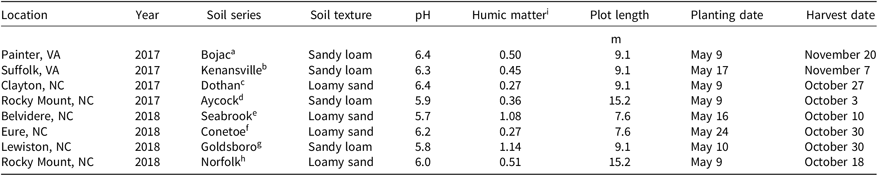
Experiments were conducted at the Eastern Shore Agriculture Research and Extension Center near Painter, VA (37.5909°N, 75.8216°W), at the Tidewater Agriculture Research and Extension Center near Suffolk, VA (36.7282°N, 76.5836°W), at the Central Crops Research Station near Clayton, NC (35.6507°N, 78.4564°W), and at the Upper Coastal Plain Research Station near Rocky Mount, NC (35.9382°N, 77.7905°W) during the 2017 growing season. During the 2018 growing season, experiments were conducted at the Tidewater Agronomics Research Farm near Belvidere, NC (36.2688°N, 76.5358°W), a producer’s field near Eure, NC (36.4202°N, 76.6875°W), at the Peanut Belt Research Station near Lewiston, NC (36.1229°N, 77.1766°W), and at the Upper Coastal Plain Research Station near Rocky Mount. Soils are described in Table 1. The experiment was arranged in a randomized complete block design with treatments replicated four times. Treatment structure was a four-by-five factorial arrangement of four herbicide treatments by five preplant burndown timings. Herbicide treatments included nontreated, 2,4-D dimethylamine salt applied at 1,060 g ae ha–1, dicamba diglycolamine salt applied at 280 g ae ha-1, and halauxifen-methyl applied at 5 g ae ha–1. These herbicides were applied 4, 3, 2, 1, and 0 WBP. Applications at 0 WBP were made approximately 1 h before planting. Plots were four 91-cm wide rows by 8 to 15 m in length, depending upon location. Herbicide and adjuvant sources are listed in Table 2.
Locations, soil descriptions, planting dates, and harvest dates at the North Carolina and Virginia research locations, 2017 and 2018.

a Coarse-loamy, mixed, semiactive, thermic Typic Hapludults.
b Loamy, siliceous, subactive, thermic Arenic Hapludults.
c Fine-loamy, kaolinitic, thermic Plinthic Kandiudults.
d Fine-silty, siliceous, subactive, thermic Typic Paleudults.
e Loamy-sand, mixed, thermic Aquic Udipsamments.
f Loamy, mixed, semiactive, thermic Arenic Hapludults.
g Fine-loamy, siliceous, subactive, thermic Aquic Paleudults.
h Fine-loamy, kaolinitic, thermic Typic Kandiudults.
i Humic matter determined according to Mehlich (Reference Mehlich1984).
Herbicides and adjuvants used in experiments. a

a Specimen labels for each product and mailing addresses and web site addresses of each manufacture can be found at www.cdms.net.
Stoneville cotton cultivars ‘ST 4946GLB2’ or ‘ST 5020GLT’ (Bayer CropScience, Research Triangle Park, NC), resistant to glufosinate and glyphosate, were planted on dates listed in Table 1. Cultivars without 2,4-D or dicamba tolerance were selected to avoid the possibility of either trait conferring tolerance to halauxifen. Cotton at both Virginia locations and the Eure location was planted using a strip-tillage system; however, strip-tillage occurred prior to any herbicide applications so as not to disturb herbicides. At the Clayton, Lewiston, and Rocky Mount 2017 and 2018 locations, cotton was planted no-till. At the Belvidere location, cotton was planted using conventional tillage, with tillage occurring prior to application of herbicides. Trials in Clayton, Eure, Lewiston, Painter, and Suffolk received glyphosate at 1,260 g ae ha–1 plus glufosinate at 655 g ai ha–1 applied immediately prior to planting, whereas Rocky Mount received paraquat applied at 840 g ai ha–1 (Table 2). Plots were maintained weed-free at all locations using glyphosate plus glufosinate applied in-season as needed at the rates listed above. Experiments in Clayton and Rocky Mount 2017 received aldicarb [2-methyl-2-(methylthio)propionaldehyde O-(methylcarbamoyl)oxime] insecticide (Temik®; Bayer CropScience, Research Triangle Park, NC) applied in-furrow at 5,600 g ai ha–1. Experiments in Eure and Belvidere received imidacloprid [1-(6-chloro-3-pyridinylmethyl)-N-nitroimidazolidin-2-ylideneamine] (Admire Pro™; Bayer CropScience, Research Triangle Park, NC) applied in-furrow at 370 g ai ha–1. All other locations received acephate (O,S-Dimethyl acetylphosphoramidothioate) (Orthene® 97; AMVAC, Newport Beach, CA) applied POST at 204 g ai ha–1. All other agronomic practices varied among locations but were consistent with recommendations for the region (Edmisten et al. Reference Edmisten, Collins, Crozier, Meijer, York, Hardy, Reisig, Bullen, Thiessen and Vann2018).
Interest is increasing in halauxifen plus florasulam applied preplant burndown for control of herbicide-resistant horseweed and other winter annual weeds. However, the current label for halauxifen plus florasulam premix products prohibits planting cotton within 90 d of the application (Anonymous 2018b). To determine when halauxifen plus florasulam can be safely applied preplant prior to planting cotton, halauxifen plus florasulam premix applied 2 and 4 WBP was added to experiments during 2018. Halauxifen plus florasulam premix was applied at 5.3 g ae ha–1 halauxifen plus 5.3 g ai ha–1 florasulam. Herbicides were applied using a CO2-pressurized backpack sprayer equipped with flat-fan nozzles (TTI 11001 Turbo TeeJet® Induction Flat Spray Tip; TeeJet Technologies, Wheaton, IL). Applications were made at 140 L ha–1 of solution delivered at 206 kPa.
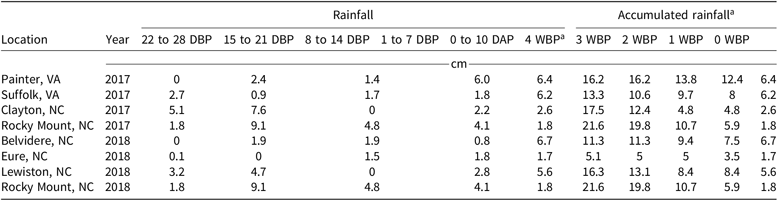
Weekly rainfall totals prior to cotton planting, for the first 10 d after planting and accumulated rainfall between each application and cotton emergence can be found in Table 3. Cotton growth reduction and total injury, recorded separately, were estimated visually 1, 2, and 4 wk after emergence (WAE) using a 0 to 100% scale, where 0 = no injury and 100 = complete crop death. Cotton stand and percentage of plants with distorted leaves were recorded 2 and 4 WAE. Cotton stand was determined by counting all cotton plants in the middle two rows of each plot. Leaf distortion was determined by counting the number of plants with visibly distorted leaves in the middle two rows of each plot and dividing that by the total number of plants (York et al. Reference York, Culpepper and Stewart2004). Thrips were managed early in the season according to North Carolina Extension recommendations to ensure that insect injury did not mask cotton response to herbicide treatments (Edmisten et al. Reference Edmisten, Collins, Crozier, Meijer, York, Hardy, Reisig, Bullen, Thiessen and Vann2018). Cotton plant height was recorded from 10 plants in each of the middle two rows of a plot at 4 and 8 WAE. Plots were harvested on dates listed in Table 1 using a spindle-type picker modified for small-plot research and weighed to determine seed cotton yield.
Rainfall 1 to 28 d before planting (DBP) and for the first 10 d after planting (DAP), and accumulated rainfall between each application and cotton emergence.

a WBP, weeks before planting. Cotton emergence occurred at least 10 DAP.
Data were subjected to ANOVA using the PROC GLIMMIX procedure in SAS software (version 9.4, SAS Institute Inc., Cary, NC). Application timing and herbicide treatment were considered fixed factors, whereas location and replications were treated as random. Because the halauxifen plus florasulam premix was only evaluated during 2018, a separate analysis, using the aforementioned statistical procedure, was used to analyze 2018 data including halauxifen plus florasulam applied 2 and 4 WBP. The three-way interaction of application timing, herbicide treatment, and location was significant for cotton growth reduction, total injury, leaf distortion, and cotton stand 2 an 4 WAE. However, the F values associated with the main effects of application timing and herbicide treatment were at least 10 times greater than the F values associated with the interaction; hence, data were pooled across locations. Furthermore, the main effect of application timing and herbicide treatment as well as the two-way interaction of application timing by herbicide treatment were significant for cotton growth reduction, total injury, leaf distortion, and cotton stand 2 and 4 WAE. However, little injury was observed from herbicides applied 1, 2, 3, and 4 WBP, whereas herbicides applied 0 WBP were more injurious. Exclusion of data for the 0 WBP timing allowed pooling of growth reduction, total injury, and stand data for 1, 2, 3, and 4 WBP. Data from the 0 WBP applications are presented separately. The two-way interaction of application timing by herbicide treatment was not significant for cotton height and seed cotton yield. Data for these parameters are presented pooled over all application timings. Means were separated using Fisher’s protected LSD at P = 0.05 when appropriate.
Results and Discussion
Cotton response to herbicides applied at planting
Cotton treated with dicamba and 2,4-D at 0 WBP was slower to emerge than cotton treated with halauxifen at the same timing and slower also than nontreated cotton. Cotton stand totaled 87 plants 10 m row–1 in nontreated 2 WAE and was similar to cotton stand in plots treated with halauxifen 0 WBP (83 plants 10 m row–1) (Table 4). Relative to nontreated cotton, dicamba and 2,4-D applied 0 WBP reduced cotton stand 15% to 17% 2 WAE. At 4 WAE, cotton stand totaled 76, 77, 84, and 88 plants 10 m row–1 in response to 2,4-D, dicamba, halauxifen, and no herbicide, respectively. York et al. (Reference York, Culpepper and Stewart2004) reported that dicamba (280 g ha–1) and 2,4-D (1,060 g ha–1) reduced cotton stand when applied 1 WBP in a strip-till system. These researchers did not investigate cotton response to these herbicides applied at planting.
Cotton growth reduction, total injury, distorted leaf, and stand 2 and 4 wk after emergence (WAE) in response to halauxifen, dicamba, and 2,4-D applied at planting at all locations.a, b

a Herbicides applied immediately prior to planting were allowed to dry for 1 h prior to planting.
b Means within a column followed by the same letter are not different according to Fisher’s protected LSD test at P = 0.05.
c Halauxifen, dicamba, and 2,4-D were applied at 5, 280, and 1,060 g ae ha–1, respectively. Herbicide sources can be found in Table 2.
Cotton response was greatest when synthetic auxin herbicides were applied at planting. Dicamba applied at planting caused 20% and 10% growth reduction 2 and 4 WAE, respectively, which was the greatest growth reduction among herbicides evaluated (Table 4). Growth reduction in response to 2,4-D applied 0 WBP was 2% to 3% less than response to dicamba. Halauxifen was the safest of all auxin herbicides evaluated, reducing cotton growth 3% and 0% 2 and 4 WAE, respectively. Total cotton injury followed a trend similar to that of growth reduction. Dicamba applied at-planting caused 26% total injury 2 WAE and was more injurious than 2,4-D (21%) and halauxifen (9%). Overall, injury decreased as the season progressed. At 4 WAE, dicamba and 2,4-D caused similar injury (11% to 12%). Early cotton injury caused by halauxifen was transient, with no injury observed 4 WAE.
Typical injury from low doses of synthetic auxin herbicides or preplant applications of these herbicides includes malformed leaves, twisting and bending of stems, and cracked or swollen stems (Al-Khatib and Peterson Reference Al-Khatib and Peterson1999; Andersen et al. Reference Andersen, Clay, Wrage and Matthees2004; Auch and Arnold Reference Auch and Arnold1978; Guy and Ashcraft Reference Guy and Ashcraft1996; Kelley et al. Reference Kelley, Wax, Hager and Riechers2005; Sciumbato et al. Reference Sciumbato, Chandler, Senseman, Bovey and Smith2004; Solomon and Bradley Reference Solomon and Bradley2014; Wax et al. Reference Wax, Knuth and Slife1969; York et al. Reference York, Culpepper and Stewart2004). To capture this injury in these experiments, percentage of plants with visible leaf distortion was determined similar to methods outlined by York et al. (Reference York, Culpepper and Stewart2004). Dicamba caused the greatest percentage of cotton plants with distorted leaves 2 WAE (22%), whereas fewer plants exhibited visible leaf distortion when treated with 2,4-D or halauxifen (6% to 9%). Cotton leaf distortion symptomology caused by halauxifen differed from dicamba and 2,4-D. Whereas 2,4-D and dicamba produced leaf strapping and leaf cupping, respectively, halauxifen caused cotton leaves to curl or roll upward much like early cotton symptomology resulting from aminopyralid exposure (Rhodes et al. Reference Rhodes, Israel and Steckel2015). At 4 WAE, dicamba continued to cause some leaf distortion; leaf distortion in response to dicamba at this time was 5%, whereas 2% leaf distortion was noted with 2,4-D, and no leaf distortion was observed in plots treated with halauxifen.
Cotton response to herbicides applied prior to planting
Cotton response was minimal from herbicides applied 1, 2, 3, and 4 WBP; therefore, data were pooled across these timings. Cotton growth reduction and total injury was 2% or less at 2 WAE, and early-season cotton injury dissipated quickly (Table 5). No cotton growth reduction or injury was observed 4 WAE when synthetic auxin herbicides had been applied 1 WBP or earlier. In contrast to the percentage of cotton plants with distorted leaves observed when herbicides were applied at planting, herbicides applied 1 WBP or earlier produced ≤3% cotton leaf distortion (data not shown). Similarly to synthetic auxin herbicide injury, thrips can cause distorted cotton leaves (Reisig Reference Reisig2019). However, in this study, thrips were managed early in the season to ensure that insect injury did not mask cotton response to herbicide treatments. Like injury, cotton stand was not influenced by 2,4-D, dicamba, or halauxifen applied 1 to 4 WBP. Cotton stand in response to all herbicide treatments applied 1 to 4 WBP ranged 83 to 85 plants 10 m row–1 at 2 WAE and 86 to 88 plants 10 m row–1 at 4 WAE and were similar to the nontreated cotton. York et al. (Reference York, Culpepper and Stewart2004) noted ≤10% cotton plants with distorted leaves at five of seven locations when dicamba (280 g ae ha–1) and 2,4-D (1,060 g ae ha–1) were applied 1 to 6 WBP. At the remaining locations in this study, dicamba at 280 g ae ha–1 produced 12% to 40% and 0 to 30% plants with distorted leaves when applied 1 and 2 WBP, respectively. The percentage of cotton plants with distorted leaves in response to 2,4-D at 1,060 g ae ha–1 applied 1 to 2 WBP ranged from 0 to 29%. Differences in cotton injury across locations observed by York et al. (Reference York, Culpepper and Stewart2004) were probably influenced by rainfall. The risk of cotton injury from synthetic auxin herbicides applied preplant burndown is reduced when moderate rainfall accumulates between herbicide application and cotton planting (Anonymous 2018c, 2018d, 2018j; York et al. Reference York, Culpepper and Stewart2004). At locations where York et al. (Reference York, Culpepper and Stewart2004) observed <2.5 cm accumulated rainfall for the 3 wk preceding cotton planting, percentage of cotton plants with distorted leaves was at most 74%. In contrast, ≤2% cotton plants exhibited distorted leaves at locations with ≥2.5 cm rainfall. Other researchers have noted a similar relationship between accumulated rainfall and cotton response to synthetic auxin herbicides applied prior to planting (Ferguson Reference Ferguson1996; Guy and Ashcraft Reference Guy and Ashcraft1996). North Carolina and Virginia both experienced abnormally wet springs during 2017 and 2018, which explains limited injury observed by synthetic auxin herbicides applied prior to cotton planting. In these experiments, accumulated rainfall following herbicides applied 1, 2, 3, and 4 WBP and cotton planting ranged from 3.5 to 21.6 cm (Table 3). Following synthetic auxin herbicides applied at planting, rainfall the first 10 d after planting totaled at least 1.7 cm but was less than rainfall prior to cotton planting. Cotton response to synthetic auxin herbicides applied at planting may be more exaggerated under drier conditions than experienced in this study.
Cotton growth reduction, total injury, and stand 2 and 4 wk after emergence (WAE) in response to halauxifen, dicamba, and 2,4-D applied 1, 2, 3, and 4 wk prior to planting. a , b

a Means within a column followed by the same letter are not different according to Fisher’s protected LSD test at P = 0.05.
b Data were pooled over timings 1, 2, 3, and 4 wk before cotton planting.
c Halauxifen, dicamba, and 2,4-D were applied at 5, 280, and 1,060 g ae ha–1, respectively.
Cotton height and seed cotton yield
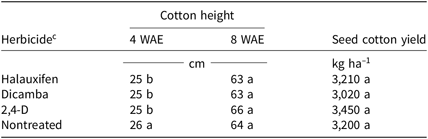
The two-way interactions of application timing by herbicide treatment for cotton height and seed cotton yield were not significant; therefore, data for these parameters are presented by herbicide treatment pooled over all application timings. Despite early-season growth reduction, synthetic auxin herbicides had little effect on cotton height 4 WAE (Table 6). Cotton in nontreated plots averaged 26 cm in height, whereas cotton treated with 2,4-D, dicamba, and halauxifen averaged 25 cm. At 8 WAE, cotton height ranged from 63 to 66 cm with no differences between herbicide treatments and the nontreated check. York et al. (Reference York, Culpepper and Stewart2004) reported that cotton height and number of main-stem nodes in mid-July were not affected by 2,4-D or dicamba applied prior to cotton planting. Similar to cotton height, seed cotton yield was not influenced by early-season cotton injury or stand reduction. Seed cotton yield totaled 3,020 to 3,450 kg ha–1, and plots treated with 2,4-D, dicamba, and halauxifen yielded similarly to nontreated plots. State average cotton lint yields during 2017 were 1,090 kg ha–1 and 1,250 kg ha–1 for North Carolina and Virginia, respectively (USDA-NASS 2017a, 2017b); average yields for both states in 2018 are estimated to be >930 kg lint ha–1 (USDA-NASS 2018). Cotton is an indeterminate plant capable of simultaneous vegetative and reproductive growth, giving the plant the ability to recover well from early-season stressors, including drought, insects, diseases, weed competition, and herbicide injury (Edmisten and Collins Reference Edmisten and Collins2018). Cotton lint yields during 2017 and 2018 are evidence of plentiful rainfall during these years and may explain why seed cotton yields in these experiments were not affected by minimal to moderate cotton injury observed early in the season.
Cotton height 4 and 8 wk after emergence (WAE) and seed cotton yield in response to halauxifen, dicamba, and 2,4-D applied 0, 1, 2, 3, and 4 wk prior to planting at all locations. a , b

a Means within a column followed by the same letter are not different according to Fisher’s protected LSD test at P = 0.05.
b Data were pooled over applications 0, 1, 2, 3, and 4 wk before cotton planting.
c Halauxifen, dicamba, and 2,4-D were applied at 5, 280, and 1,060 g ae ha–1, respectively. Herbicide sources can be found in Table 2.
Cotton tolerance to halauxifen plus florasulam premix
Halauxifen plus florasulam premix was applied 2 and 4 WBP during 2018 only. Halauxifen plus florasulam did not affect cotton stand compared to the nontreated (data not shown). Likewise, cotton response to halauxifen plus florasulam was minimal, with ≤3% cotton growth reduction and ≤2% total injury (data not shown). Similar to cotton response to 2,4-D, dicamba, and halauxifen applied at the same application timings, halauxifen plus florasulam did not affect cotton height or seed cotton yield compared to the nontreated (data not shown).
In general, results from these experiments and from other research from North Carolina and Georgia (York et al. Reference York, Culpepper and Stewart2004) confirm that cotton can be safely planted following 2,4-D and dicamba applied preplant burndown if label requirements for plant-back interval and rainfall or soil moisture are met. Current labels for halauxifen and halauxifen plus florasulam require at least 30 and 90 d between application of these herbicides and cotton planting, respectively. Much shorter plant-back intervals were investigated in this research. Cotton tolerance to halauxifen applied preplant burndown was greater than tolerance to 2,4-D or dicamba. Early-season cotton injury caused by halauxifen was transient, with no injury observed in response to the herbicide 4 WAE. Furthermore, regardless of timing, halauxifen did not affect cotton stand or seed cotton yield. Likewise, halauxifen plus florasulam applied 2 and 4 WBP during 2018 caused little injury and did not affect cotton stand or seed cotton yield.
This research confirms that halauxifen and halauxifen plus florasulam can be safely applied prior to planting cotton at currently required plant-back intervals and indicates that plant-back intervals could be shortened with a minimum rainfall or irrigation requirement between herbicide application and cotton planting. These herbicides applied at least 2 WBP with ≥4.8 cm rainfall between application and cotton planting injured cotton ≤2%. Because cotton tolerance to halauxifen plus florasulam was only investigated during 2018, more research is needed on cotton tolerance to this premix applied prior to planting. As a result of wet conditions during April and May of each year, cotton tolerance to halauxifen applied preplant when conditions are dry between application and cotton planting should also be investigated.
Author ORCIDs
Charles W. Cahoon https://orcid.org/0000-0001-9460-6350
Acknowledgments
Partial funding for this research was provided by the cotton producers of North Carolina and Virginia through the Cotton Incorporated State Support Program and by the Virginia Cotton Board. No conflicts of interest have been declared.