INTRODUCTION
Over the last 40 kyr, changes in atmospheric radiocarbon concentration are best recorded in laminated sediments of Lake Suigetsu, Japan (Bronk Ramsey et al. Reference Bronk Ramsey, Staff, Bryant, Brock, Kitagawa, van der Plicht, Schlolaut, Marshall, Brauer and Lamb2012). The record includes numerous distinct centennial-to-millennial-scale periods of constant 14C ages called 14C plateaus, where the short-term scatter of 14C ages hardly exceeds 100–300 14C yr. In the age-depth profile of Lake Suigetsu, 14C plateaus show a ratio of 14C years versus calendar years with an overall gradient of less than 1 (Sarnthein et al. Reference Sarnthein, Balmer, Grootes and Mudelsee2015). Atmospheric 14C signals are transferred to ocean surface waters within a decade (Nydal et al. Reference Nydal, Lovseth and Skogseth1980; Sweeney et al. Reference Sweeney, Gloor, Jacobson, Key, McKinley, Sarmiento and Wanninkhof2007). Accordingly, 14C plateaus may likewise be documented in the planktic 14C record of marine sediments.
Indeed, some 14 sediment cores from various parts of the ocean (Figure 1) already record pertinent glacial and deglacial 14C plateaus with approximately constant 14C ages that extend over ~5–50 cm and up to 200-cm sediment thickness, where long-term average rates of hemipelagic sedimentation exceed 10 cm/kyr (Sarnthein et al. Reference Sarnthein, Grootes, Kennett and Nadeau2007, Reference Sarnthein, Balmer, Grootes and Mudelsee2015). The atmospheric 14C plateau boundaries have been age-calibrated to the incremental timescale of the Suigetsu record (Figure 2A) that is based on varve counts independent of any radiometric dating (Bronk Ramsey et al. Reference Bronk Ramsey, Staff, Bryant, Brock, Kitagawa, van der Plicht, Schlolaut, Marshall, Brauer and Lamb2012). The boundaries (identified by visual inspection) may thus provide a suite of narrow-spaced age control points for marine sediment records (Sarnthein et al. Reference Sarnthein, Balmer, Grootes and Mudelsee2015). In addition, the position of plateau boundaries was successfully reproduced by an objective mathematical approach using the 1st derivative record of all downcore changes in the 14C age–core depth relationship (Sarnthein et al. Reference Sarnthein, Balmer, Grootes and Mudelsee2015; Balmer et al. Reference Balmer, Sarnthein, Mudelsee and Grootes2016).
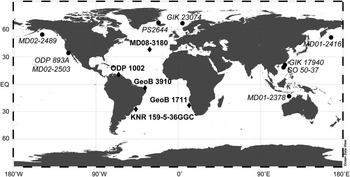
Locations of 14C plateau-tuned sediment cores (Sarnthein et al. Reference Sarnthein, Balmer, Grootes and Mudelsee2015, supplemented; Balmer et al. Reference Balmer, Sarnthein, Mudelsee and Grootes2016). Bold core numbers (diamonds) mark locations of cores discussed in this paper. Map based on Ocean Data View (Schlitzer 2015).

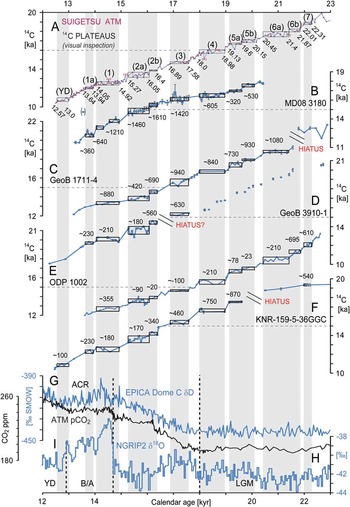
Comparison of marine 14C plateaus in five Atlantic sediment cores (B–F) with atmospheric (ATM) 14C plateaus of Lake Suigetsu (A) (Bronk Ramsey et al. Reference Bronk Ramsey, Staff, Bryant, Brock, Kitagawa, van der Plicht, Schlolaut, Marshall, Brauer and Lamb2012), and climate signals from southern and northern high latitudes at 12 to 23 cal ka (G–I). Black boxes, gray vertical bars, and numbers in brackets in 14C record of Lake Suigetsu (A) mark atmospheric 14C plateaus defined by visual inspection. White bars refer to 14C jumps that separate the plateaus. Numbers below boxes show calendar ages of plateau boundaries (Sarnthein et al. Reference Sarnthein, Balmer, Grootes and Mudelsee2015). Horizontal dashed lines show the 15 14C ka age for reference. Numbers above or below plateaus in 14C records B–F show surface water reservoir ages deduced by 14C plateau tuning (Sarnthein et al. Reference Sarnthein, Balmer, Grootes and Mudelsee2015; Balmer et al. Reference Balmer, Sarnthein, Mudelsee and Grootes2016). In 14C record D (GeoB 3910-1), the tuning does not extend beyond Plateau 3; further back ages of 14C dates are extrapolated using the sedimentation rate of Plateau 3. (G) δD record of EPICA Dome C (Jouzel et al. Reference Jouzel, Masson-Delmotte, Cattani, Dreyfus, Falourd, Hoffmann, Minster, Nouet, Barnola, Chappellaz, Fischer, Gallet, Johnsen, Leuenberger, Loulergue, Luethi, Oerter, Parrenin, Raisbeck, Raynaud, Schilt, Schwander, Selmo, Souchez, Spahni, Stauffer, Steffensen, Stenni, Stocker, Tison, Werner and Wolff2007); ACR=Antarctic Cold Reversal. (H) Deglacial rise in atmospheric pCO2 (Marcott et al. Reference Marcott, Bauska, Buizert, Steig, Rosen, Cuffey, Fudge, Severinghaus, Ahn, Kalk, McConnel, Sowers, Taylor, White and Brook2014). (I) δ18O record of NGRIP2 at 50-yr resolution (Rasmussen et al. Reference Rasmussen, Bigler, Blockley, Blunier, Buchardt, Clausen, Cvijanovic, Dahl-Jensen, Johnsen, Fischer, Gkinis, Guillevic, Hoek, Lowe, Pedro, Popp, Seierstad, Steffensen, Svensson, Vallelonga, Vinther, Walker, Wheatley and Winstrup2014); YD: Younger Dryas, B/A: Bølling–Allerød, LGM: Last Glacial Maximum.

However, planktic 14C plateaus may also have an alternative origin in marine sedimentation processes. Plateau-like structures each may derive from a short-lasting massive rise in sedimentation rate, in the extreme, from instantaneous turbidite deposition, which is a question addressed in this study. By contrast, periods of reduced hemipelagic sedimentation rate may shorten 14C plateaus down to a length below sampling resolution, which may lead to minor and/or major “jumps” in 14C age. In particular, jumps may apply to hiatuses, periods of nondeposition, and/or sediment erosion, the frequency of which necessarily rises with the time resolution established by our densely spaced age control points and with the increase of average sedimentation rates (following Sadler Reference Sadler1999).
To cope with these sources of uncertainty, various rules have been defined for 14C plateau tuning (Sarnthein et al. Reference Sarnthein, Grootes, Kennett and Nadeau2007). In particular, all sediment sections are ignored, where visual inspection indicates any small-scale turbidite-related structures that necessarily result in 14C plateaus independent of atmospheric 14C signals. As compared to average sedimentation rates of 0.1–2 cm/kyr that prevail over large regions in the deep sea (Seibold and Berger Reference Seibold and Berger1996), 14C plateau tuning is restricted to (hemi-) pelagic sedimentation rates >10 cm/kyr of sediment drifts, where short plateaus of >300/400 yr can still be resolved. The tuning technique strictly excludes sediment sections from shallow-sea regions, where changes in eustatic sea-level result in incoherent stratigraphic records (Sadler Reference Sadler1999).
Irrespective of these constraints, the potential origin of marine 14C plateaus still remains a matter of discussion, that is, whether it may result from changes in sedimentation rate. Further factors possibly contributing to apparent 14C plateaus, such as changes in ocean circulation and upwelling, were discussed elsewhere (Balmer et al. Reference Balmer, Sarnthein, Mudelsee and Grootes2016). In this study, we test the relationship between any individual 14C plateau and sedimentation rate in five sediment cores, where detailed age models have been first developed from plateau tuning (Sarnthein et al. Reference Sarnthein, Balmer, Grootes and Mudelsee2015; Balmer et al. Reference Balmer, Sarnthein, Mudelsee and Grootes2016). We focus on sediment records from the tropical and subtropical Atlantic, each representing a different depositional environment between 12 and 23 cal ka (Table 1). For each core, we compare the published short- and long-term average sedimentation rates deduced from plateau tuning with a set of different hypothetical short-term depositional scenarios of enhanced sedimentation pulses affecting each single 14C plateau (Figure 3). The long-term average sedimentation rates include the total sediment section deposited between the lower plateau boundary of the lowermost plateau and the upper plateau boundary of the topmost 14C plateau of any core displayed.
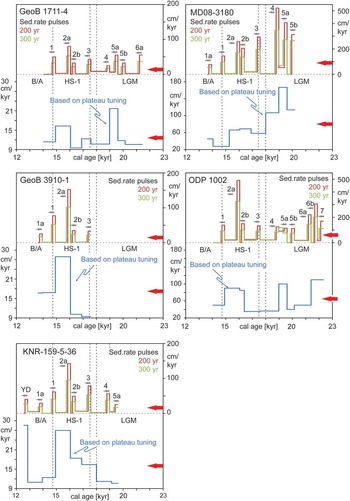
Sedimentation rates based on the sediment thickness between the age-calibrated upper and lower boundaries of a 14C plateau each (blue lines) versus hypothetical pulses of sedimentation rate estimated for 200- and 300-yr-long pulses and differential 14C plateau lengths in Atlantic sediment cores GeoB 1711-4, MD08 3180, GeoB 3910-1, ODP 1002, and KNR-159-5-36GGC. Red arrows mark the long-term average in sedimentation rate for the total sediment section deposited between the lower plateau boundary of the lowermost plateau and the upper plateau boundary of the topmost 14C plateau of the core displayed. Gray arrows mark the direction of sediment discharge. B/A: Bølling–Allerød, HS-1: Heinrich Stadial 1, LGM: Last Glacial Maximum.

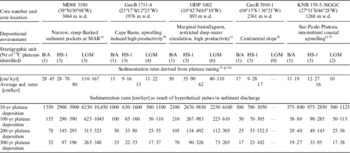
Plateau-tuning derived and hypothetical ranges of sedimentation rate (cm/kyr) for 14C plateaus in sediment cores MD08 3180, GeoB 1711-4, GeoB 3910-1, ODP 1002, and KNR-159-5-36GGC (MAR=Mid Atlantic Ridge).

(a) Richter 1998; (b) Summerhayes et al. 1995; (c) Peterson 1991; (d) Arz et al. 1999; (e) Curry and Oppo 2005; (f) Balmer et al. Reference Balmer, Sarnthein, Mudelsee and Grootes2016; (g) Sarnthein et al. Reference Sarnthein, Balmer, Grootes and Mudelsee2015; (h) This paper.
MATERIALS AND METHODS
For this theoretical study, we started by using published 14C records as well as published age models and sedimentation rate data derived by means of the 14C plateau tuning technique (Sarnthein et al. Reference Sarnthein, Grootes, Kennett and Nadeau2007) for Atlantic cores MD08 3180, GeoB 1711-4, GeoB 3910-1, ODP 1002, and KNR 159-5-36GGC (Fig. 2, Table 1) (Sarnthein et al. Reference Sarnthein, Balmer, Grootes and Mudelsee2015; Balmer et al. Reference Balmer, Sarnthein, Mudelsee and Grootes2016) (Details in the online Supplemental Material, Texts 1–2). To test whether the atmospheric age calibration is a necessary and best-possible rationale to explain the planktic 14C plateau suite or might be replaced by a sequence of climate-controlled sedimentation pulses, we established several hypothetical depositional scenarios for each 14C plateau in each core.
We tested 10-, 100-, 200-, and 300-yr long pulses of increased but nonturbiditic sediment accumulation starting right at the base of each 14C plateau. We derived the atmospheric calendar age of the plateau base from the Suigetsu atmospheric 14C record, hence arbitrarily considering these ages as “firm” reference levels for the lack of any other appropriate age markers. On top of them, the differential sedimentation rates are estimated from the sediment thickness of each plateau section and the hypothetical length of the differential sedimentation pulses. The rates necessarily produce a hypothetical “new” age for the plateau top, which differs from that derived by plateau tuning. The sedimentation rates of sediment sections that separate two subsequent 14C plateaus each are estimated from the “new” age of the plateau top now based on the end of the sedimentation pulse and the “firm” age of the next-following plateau base, moreover, from the sediment thickness deposited in between.
For the stratigraphic definition of the Last Glacial Maximum (LGM), we use the time slice of the Last Isotope Maximum (23–18 cal ka) defined by GLAMAP (Sarnthein et al. Reference Sarnthein, Pflaumann and Weinelt2003). We follow Denton et al. (Reference Denton, Broecker and Alley2006) and Sarnthein et al. (Reference Sarnthein, Grootes, Holbourn, Kuhnt and Kuhn2011) for Heinrich Stadial 1 (HS-1) (17.5–14.7 cal ka), Svenson et al. (Reference Svensson, Andersen, Bigler, Clausen, Dahl-Jensen, Davies, Johnsen, Muscheler, Parrenin, Rasmussen, Röthlisberger, Seierstad, Steffensen and Vinther2008) for the Bølling-Allerød (B/A), and Jouzel et al. (Reference Jouzel, Masson-Delmotte, Cattani, Dreyfus, Falourd, Hoffmann, Minster, Nouet, Barnola, Chappellaz, Fischer, Gallet, Johnsen, Leuenberger, Loulergue, Luethi, Oerter, Parrenin, Raisbeck, Raynaud, Schilt, Schwander, Selmo, Souchez, Spahni, Stauffer, Steffensen, Stenni, Stocker, Tison, Werner and Wolff2007) for the Antarctic Cold Reversal (ACR).
RESULTS
We calculated for each 14C plateau in each core four different hypothetical sedimentation rates derived for timespans of 10, 100, 200, and 300 yr each. The results show for each core a succession of up to 10 short-lasting pulses of increased sedimentation rate with maxima ranging from 17 to 350 cm/kyr for the 300-yr scenario and ranging from 500 to 10,450 cm/kyr for the 10-yr scenario (Figure 3, Table S1).
On top of each plateau, the hypothetical sedimentation rates need to drop to zero or less. This means that we need to postulate significant sediment erosion to keep balanced the long-term average sedimentation rate. In all cores, the rates by far exceed the average sedimentation rates deduced from atmospheric plateau tuning by a factor of 6 to 180. Also, these rates exceed hemipelagic sedimentation rates of 97–200 cm/kyr as listed for contourites along the Mid-Norwegian Margin, in the Gulf of Cadiz (Hernández-Molina et al. Reference Hernández-Molina, Soto, Piola, Tomasini, Preu, Thompson, Badalini, Creaser, Violante and Morales2015), and in the South China Sea (Bühring et al. Reference Bühring, Sarnthein and Erlenkeuser2004; Bryn et al. Reference Bryn, Berg, Stoker, Haflidason and Solheim2005; Shao et al. Reference Shao, Li, Geng, Pang, Lei, Qiao, Wang and Wang2007; Toucanne et al. Reference Toucanne, Mulder, Schönfeld, Hanquiez, Gonthier, Duprat, Cremer and Zaragosi2007) by a factor of 3.5–50.
In our test series (Figure 3), Cariaco Basin ODP Core 1002, Namibia core GeoB1711-4, and Brazilian Margin cores GeoB 3910-1 and KNR 159-5-36GGC show the highest hypothetical sedimentation rates during HS-1 (Plateau 2a), then reaching from 1600–9800 cm/kyr in the 10-yr and 50–325 cm/kyr in the 300-yr interval of 14C plateau deposition. By comparison, Azores core MD08 3180 shows hypothetical sedimentation rates of 270–8150 cm/kyr for all four scenarios of the late LGM (Plateau 5a) and a maximum of 350–10,450 cm/kyr for Plateau 4 in between LGM and HS-1 (Figure 3, Table S1).
In contrast to the suite of odd sedimentation rate “chimneys” that may result from short-lasting deposition pulses used to explain the suites of 14C plateaus, the sedimentation rates derived from plateau tuning (lower panels in Figure 3) show far more uniformity over timespans of 1000–4000 yr in all five Atlantic sediments cores analyzed.
When derived by means of 14C plateau tuning, the changes from high to low and low to high rates may each be ascribed to specific climatic scenarios. For example, cores MD08-3180, GeoB 1711-4, and ODP 1002 show relatively enhanced sedimentation rates during the late LGM, which are attributed to an increased discharge of eolian dust and terrigenous clay to the Atlantic basins (Bacon Reference Bacon1984; Harrison et al. Reference Harrison, Kohfeld, Roelandt and Claquin2001), to increased primary productivity (Sarnthein et al. Reference Sarnthein, Winn, Duplessy and Fontugne1988), and/or to the lowered sea level (Wallmann et al. Reference Wallmann, Schneider and Sarnthein2016), implying an enhanced sediment transport across shallow-water regions down to the deep sea. In all cores, the LGM rates dropped toward the HS-1 by a factor of 0.2–2.7. In part, the drop possibly resulted from global warming and decreasing wind gradients (Shakun et al. Reference Shakun, Clark, He, Marcott, Mix, Liu, Otto-Bliesner, Schmittner and Bard2012), in part from the global sea-level rise (Wallmann et al. Reference Wallmann, Schneider and Sarnthein2016), both of which led to a reduced sediment discharge to the ocean. However, toward the end of HS-1 the rates in all cores rose from 9–35 to 16–90 cm/kyr, except for MD08 3180, where they dropped from 70 to 28 cm/kyr. Along the Brazilian Margin and at ODP Site 1002, this rise may be ascribed to a wet period in the Brazilian northeast (Wang et al. Reference Wang, Auler, Edwards, Cheng, Cristalli, Smart, Richards and Shen2004) that induced an increase in river discharge (Jaeschke et al. Reference Jaeschke, Rühlemann, Arz, Heil and Lohmann2007). Later on, at the onset of B/A, sedimentation rates were widely reduced, except for a rise in cores MD08-3180 and KNR 159-5-36GGC.
DISCUSSION
Planktic 14C plateaus were tuned to a pertinent suite of 14C plateaus in the atmospheric record of Lake Suigetsu (Bronk Ramsey et al. Reference Bronk Ramsey, Staff, Bryant, Brock, Kitagawa, van der Plicht, Schlolaut, Marshall, Brauer and Lamb2012) to derive both an absolute age model and 14C reservoir ages for ocean sediment records. In effect, planktic 14C plateaus in marine sediments are considered as direct reflection of the suite of atmospheric 14C plateaus (Hypothesis 1). Alternatively, we may assume that planktic 14C plateaus merely result from a series of short transient pulses of extremely high sedimentation rates (Hypothesis 2). The rationales of the two hypotheses will be discussed below.
Transfer of Atmospheric 14C Signals to Sediments of Marine Plankton
The time it takes until a 14C signal is transferred from the atmosphere into ocean surface waters needs to be considered when assuming an atmospheric control of 14C plateau structures in planktic records of marine sediments. Nydal et al. (Reference Nydal, Lovseth and Skogseth1980) first traced the marine contamination by bomb 14C, thereby showing that an atmospheric signal is reflected in ocean surface waters within no more than a decade, with an oceanic uptake of 1.8 ± 0.5 Pg C yr–1 at modern average wind speeds (Sweeney et al. Reference Sweeney, Gloor, Jacobson, Key, McKinley, Sarmiento and Wanninkhof2007). Accordingly, surface dwelling foraminifera (e.g. Globigerinoides ruber) may rapidly incorporate this signal into their test chemistry to be preserved in the sediment record. Thus, our records may resolve without any problems even short-lasting plateaus with a timespan of 300 yr, if documented by at least two data points, given an average sampling resolution of 85–190 yr.
Bioturbational Bias in 14C Age Records
Bioturbation implies a vertical transport of sediment particles and, in turn, a potential repetition of 14C ages. The bioturbational mixed layer represents a section of homogeneous sediment mixing near to the sediment water interface, that averages 14C ages. Its thickness and the biogenic mixing intensity range from 2 to >10 cm and depend on the nutrient flux to the sea floor and the reactivity of particulate organic carbon (Trauth et al. Reference Trauth, Sarnthein and Arnold1997; Smith and Rabouille Reference Smith and Rabouille2002). Furthermore, large burrowing organisms such as Zoophycos have been reported to reach depths of more than half a meter (Wetzel Reference Wetzel1981; Came et al. Reference Came, Oppo and Curry2003). To cope with these sources of bias in the 14C age, Sarnthein et al. (Reference Sarnthein, Grootes, Kennett and Nadeau2007) confined 14C plateau tuning to sediment cores with average sedimentation rates >10 cm/kyr. Furthermore, 14C ages from sediment cores that show clear signs of perturbation by burrows were also excluded from 14C plateau tuning. Accordingly, these distortions were taken into account when discussing the origin of 14C plateau structures in the five Atlantic sediment cores studied.
Hemipelagic Sediment Features that Mimic a Record of Atmospheric 14C Plateaus
The sediments of our Atlantic core locations consist of neritic carbonate (GeoB 1711-4, GeoB 3910-1, KNR 159-5-36GGC, ODP 1002) and calcareous ooze (MD08 3180, MD07 3076) (Thurman and Burton Reference Thurman and Burton2001). In these sediment facies, turbidites may reflect events of instantaneous sediment deposition that may result in artificial 14C plateaus in the sediment record, independent of any change in atmospheric 14C. However, none of the sediment cores shows any structure (e.g. a Bouma sequence) and/or any other proxy signals (e.g. stable isotopes, XRF data) that might indicate an influence of intermittent turbidite deposition (Vidal et al. Reference Vidal, Schneider, Marchal, Bickert, Stocker and Wefer1999; Hughen et al. Reference Hughen, Southon, Lehman and Overpeck2000; Came et al. Reference Came, Oppo and Curry2003; Repschläger et al. Reference Repschläger, Weinelt, Kinkel, Andersen, Garbe-Schönberg and Schwab2015; Balmer et al. Reference Balmer, Sarnthein, Mudelsee and Grootes2016), which necessarily would exclude that sediment section from 14C plateau tuning sensu Sarnthein et al. (Reference Sarnthein, Grootes, Kennett and Nadeau2007).
However, we also need to consider potential short-term, nonturbiditic pulses and suites of pulses of enhanced hemipelagic sediment deposition that may produce 14C plateaus in a sediment record. For example, short periods of extreme sedimentation rates were indeed found as a result of short-lasting events of long-slope suspended sediment transport, such as contourites. These short pulses reached up to 180 cm/kyr in the South China Sea (ODP Core 1144) during Marine Isotope Stage 2 and 3 (Bühring et al. Reference Bühring, Sarnthein and Erlenkeuser2004), an Early Holocene maximum of 123 cm/kyr in the Gulf of Cadiz (MD99-2341) (Toucanne et al. Reference Toucanne, Mulder, Schönfeld, Hanquiez, Gonthier, Duprat, Cremer and Zaragosi2007), and some 120 cm/kyr along the Mid-Norwegian Margin over the last 5300 yr (Bryn et al. Reference Bryn, Berg, Stoker, Haflidason and Solheim2005).
In general, increased sedimentation rates lead to an enhanced resolution of the sediment record. In turn, however, they also imply a higher variance of these rates. Thus, sections of very high rates will alternate with small-scale hiatuses (Sadler Reference Sadler1999). In this way, we may indeed expect short-term abrupt changes between high and low sedimentation rates in each core for each of the four hypothetical timespans of depositional pulses under discussion as shown in Figure 3. Minimum rates (0 cm/kyr) may depict a suite of stratigraphic gaps and/or erosion for which, however, we did not find any textural evidence in the sedimentary record. Also, at a pulse duration of 10–300 yr many of the hypothetical maxima in sedimentation rate still exceed by far that is by a factor of 3 to 50 the rates actually reported for contourite deposits (Figure 3; Table 1 and S1). Sedimentation rates tied to hypothetical 300-yr-long sedimentation pulses may come closer to the range of rates that result from a purely atmospheric control of 14C plateaus. However, as long as at least one or two odd extremes occur within a suite of sedimentation rate pulses (examples that exceed the long-term average by a factor of 3–6 are marked red in Table S1), the hypothetical suite of pulses as a whole is considered unrealistic. We draw this conclusion since the glacial-to-deglacial suite of 14C plateaus always needs to be considered in its entirety, though some plateau rates indeed correspond to rates that appear realistic in coming close to and/or are falling below those reported for contourites (Figure 3, Table S1).
To distinguish any “artificial” 14C plateau structures that might have formed by mere sedimentary processes and, in particular, complete suites of such hypothetical sedimentation-controlled structures from atmosphere-controlled 14C plateaus, we follow the rules defined by Sarnthein et al. (Reference Sarnthein, Grootes, Kennett and Nadeau2007). More specifically, we employed 14C plateau tuning to complete plateau suites only. Moreover, our approach started with tuning some well-defined key structures such as plateaus 1, 2a, and 2b that suggest close parallels to structures in the atmospheric 14C record (though offset by the local 14C reservoir age). To further corroborate our results of plateau tuning, we employed additional stratigraphic evidence such as stable isotope records. In this way, Sarnthein et al. (Reference Sarnthein, Balmer, Grootes and Mudelsee2015) also identified a dichotomy of Plateau 1 in Core MD08 3180 (Figure 2B) as result of a temporary fast decrease in local reservoir age. On the basis of these reasons, we preferentially tuned the uncorrected 14C age records of the five cores under discussion to the atmospheric 14C record of Lake Suigetsu (Figure 2). Thus, we accepted a dominantly atmospheric control of planktic 14C plateaus and discarded the hypothesis that 14C plateau suites as entirety result from a series of short-term intermittent sediment pulses. Minor deviations in the plateau suite such as jumps in the 14C record were ascribed to local variations in surface water reservoir age (Sarnthein et al. Reference Sarnthein, Balmer, Grootes and Mudelsee2015; Balmer et al. Reference Balmer, Sarnthein, Mudelsee and Grootes2016).
Short-Lasting Sediment Pulses as Record of Climate Change
Climate changes imply several factors that in a specific way will result in significant changes in sedimentation rate as derived from our preferred 14C plateau tuning (Figure 2, lower panels), given the absence of any turbidite deposition. These changes include, for example, a wet period and increased river discharge in (northeastern) Brazil during HS-1 (Wang et al. Reference Wang, Auler, Edwards, Cheng, Cristalli, Smart, Richards and Shen2004; Jaeschke et al. Reference Jaeschke, Rühlemann, Arz, Heil and Lohmann2007) that indeed is reflected in the records from the Brazilian Margin (ODP 1002; GeoB 3910-1; KNR159-5-36). In other cores, sedimentation rate changes match climatic events documented in stable-isotope, temperature, and atmospheric pCO2 records from Antarctica and Greenland (Figures 2G and H). Necessarily, our theoretical approach includes an internal feedback, as extremes in the sediment thickness of a 14C plateau will also induce extremes in the rates estimated for the pertinent hypothetical pulse that each starts from the base of a plateau that in turn is tuned to the calendar age of the base of an atmospheric plateau. Thus, the hypothetical sedimentation rates may also appear as an artifact of atmospheric ages deduced for the 14C plateau base each, which we needed to employ for our calculations in the absence of any other narrow spaced age control points.
CONCLUSIONS
We tested two different hypotheses that attempt to explain the origin of 14C plateaus in marine sediment records, namely, whether these plateaus are the result of short transient pulses of extremely high sedimentation rates or that of intermittent changes in atmospheric 14C. In this context, we considered four different durations of sediment discharge (10, 100, 200, and 300 yr) that resulted in four hypothetical hemipelagic sedimentation rates for every 14C plateau encountered in five Atlantic sediment cores. These hypothetical rates were compared to rates derived by 14C plateau tuning that assumes an atmospheric control of 14C. Based on our results, we arrived at the following conclusions.
Sedimentation rates for pulse lengths of 10 to 300 yr may largely exceed the sedimentation rates reported for contourites—the best possible facies analog—by a factor of up to 50 and thus are considered unrealistic. This conclusion holds true though some sedimentation rate pulses within a plateau suite may come close or lie below the maximum rates of contourites, and thus may indeed be realistic.
The rules for 14C plateau tuning (Sarnthein et al. Reference Sarnthein, Grootes, Kennett and Nadeau2007) enable us to ascribe complete suites of plateaus to direct atmospheric forcing, moreover, to identify some sedimentary-process-controlled plateau structures in the sediment record. In turn, they enable us to discard the hypothesis claiming that a couple of sedimentation pulses have possibly induced the complete suites of 14C plateau structures in five Atlantic sediment cores, since the sediment pulses closely follow the atmospheric 14C record of Lake Suigetsu, though in part possibly the result of circular reasoning (since based on the assumption of atmospheric 14C plateau base ages).
Sedimentation rates derived from 14C plateau tuning show regional differences that reasonably resemble changes in climate on nearby continents in contrast to the hypothetical rates that largely vary without noticeable links to regional climate change.
ACKNOWLEDGMENTS
We acknowledge with thanks valuable comments and critical discussion of an initial version of this manuscript by Ann Holbourn, Wolfgang Kuhnt, and Pieter M Grootes. This study was supported by DFG grant SA207/48-1.
SUPPLEMENTARY MATERIAL
To view supplementary material for this article, please visit https://doi.org/10.1017/RDC.2016.100.