1 Introduction
While the s-genitive (e.g. John's book) and the of-genitive (e.g. the book of John) are widely considered competing variants of each other (see e.g. the studies conducted in this volume), the role of the oblique genitive as in the executor of Sir Ralph’s (authentic example, taken from the BNC) has often been ignored. This is not surprising given the fact that the oblique genitive is extremely infrequent, and that variation between all three constructions is extraordinarily rare.
The first aim of this article is to provide a quantitative account of the properties associated with the oblique genitive as compared with the s-genitive and the of-genitive. Points of comparison concern the animacy of the dependentFootnote 2 (e.g. John in a friend of John’s), whether the dependent is noun-headed or a pronoun, the length of noun-headed dependents, the type of determiner involved in the constructions and the semantic relations that hold between dependent and head (e.g. between John and friend) in the oblique genitive, the s-genitive and the of-genitive. In accordance with Payne (Reference Payne, Börjars, Denison and Scott2013), we demonstrate that the three constructions are not in complementary distribution exclusively, and that there are at least two syntactic environments in which variation in principle exists. The second aim of the article is to explore these contexts.
The article is organised as follows. In section 2, we will review the theoretical background on the oblique genitive, paying particular attention to previous studies on the semantic and syntactic restrictions that the oblique genitive is subject to. This is followed by an outline of the methodology in section 3. Sections 4–5 then provide quantitative and qualitative data on the oblique genitive, the s-genitive and the of-genitive. While section 4 is devoted to the oblique genitive in terms of the properties typically associated with the dependent and the semantic relations that obtain between head and dependent, section 5 compares the oblique genitive to the other two constructions. In section 6, we will explore two syntactic environments which allow for variation between all three constructions: (a) contexts in which the three constructions function as predicative complements of the clause; and (b) contexts in which the oblique genitive and the of-genitive are introduced by the determiner the. A quantitative and qualitative analysis of oblique genitives whose head is introduced by the determiner the, as in the advantage of ours, is then provided in section 7. While section 7.1 compares the semantic relations permitted between head and dependent in oblique genitives introduced by the determiner the to those permitted by all oblique genitive constructions, section 7.2 focuses on oblique genitives introduced by the determiner the exclusively and provides a quantitative account of the degree of modification associated with the head. In this section, we pay particular attention to those contexts in which the head noun occurs without any modification, as in the bowl of Rostov’s. In section 7.3 we ask what the motivations are for those rare cases where the oblique genitive is preferred over the s-genitive or of-genitive in the context of the determiner the. We propose three distinct motivations: (a) contrastive, (b) semantic and (c) discourse-functional. The article concludes with an outlook on future research in section 8.
2 Theoretical background
This article is concerned with the oblique genitive as an independent construction which in different ways competes with the s-genitive and the of-genitive. All three constructions are illustrated in (1)–(3). In these examples, the head noun selected is friend.Footnote 3
(1) a friend of John’s oblique genitive
(2) John's friend s-genitive
(3) a friend of John of-genitive
Various names have been applied to the oblique genitive, ranging from ‘double genitive’ (e.g. Quirk et al. Reference Quirk, Greenbaum, Leech and Svartvik1972: 203; Christianson Reference Christianson1997; Abel Reference Abel2006) to ‘post-genitive’ (e.g. Quirk et al. Reference Quirk, Greenbaum, Leech and Svartvik1985: 1283), ‘postposed genitive’ (Lyons Reference Lyons1986) and ‘postmodifying genitive’ (Taylor Reference Taylor1989). In accordance with Payne & Huddleston (Reference Payne, Huddleston, Huddleston and Pullum2002: 478) and Payne (Reference Payne, Börjars, Denison and Scott2013), we will refer to the construction in (1) as the oblique genitive. We will also call the first nominal (barring the determiner) in such constructions the head (in our case friend), and the noun phrase following of (in our case John) the dependent.
We will now first review previous research on the properties of the dependent in the oblique genitive construction and then proceed to the semantic relations that have been claimed to hold between head and dependent in such constructions. We will conclude with an overview of which determiners may introduce the oblique genitive according to previous studies.
One central claim is that the dependent in the oblique genitive has to be human (e.g. Quirk et al. Reference Quirk, Greenbaum, Leech and Svartvik1985: 1283), personal (Quirk et al. Reference Quirk, Greenbaum, Leech and Svartvik1972: 203) or at least animate (e.g. Lyons Reference Lyons1986). One example which meets all three requirements is given in (4).Footnote 4 A less prototypical example is mentioned by Christianson (Reference Christianson1997: 101), who suggests that the dependent may be non-human if it is personified through pronominalisation as in (5). To unify the different positions on the animacy of the dependent, we may refer to Payne (Reference Payne, Börjars, Denison and Scott2013: 180), who concludes that the dependent must be high on the animacy scale.
(4) Cyprus (to use a favourite expression of Elizabeth’s) was taking its toll of her too, for Renny, her son, was doing his military service there. (BNC)
(5) What a beautiful horse. That mane of hers is really gorgeous. (Christianson Reference Christianson1997: 101)
Another constraint on the choice of the oblique genitive is the length of the dependent. Lyons (Reference Lyons1986: 134–6) argues that the oblique genitive rarely occurs with long dependents, assigning two question marks to example (6).
(6) ??a friend of the man I was talking to yesterday's (Lyons Reference Lyons1986: 135)
While the s-genitive might be just as awkward in such cases (compare the man I was talking to yesterday's friend), the of-genitive in (7) represents a good alternative (though the of-genitive might introduce a different perspective on the friendship relation; see Payne & Huddleston Reference Payne, Huddleston, Huddleston and Pullum2002: 478 and section 6.1).
(7) a friend of the man I was talking to yesterday
Lyons (Reference Lyons1986: 135) further claims that pronouns, which may be argued to be the lightest of all NPs, are completely barred from the of-genitive. His claim is illustrated in examples (8) and (9), quoted from Payne (Reference Payne, Börjars, Denison and Scott2013: 182).
(8) *the car of him
(9) that car of his
Payne (Reference Payne, Börjars, Denison and Scott2013: 182), however, argues that if specific semantic relations hold between head and dependent (e.g. the pronoun functions as a thematic argument), they can license a pronoun in the of-genitive. His point is illustrated in (10), where the semantic relation between head (h) and dependent (d) may be paraphrased as ‘d has depiction h’ (a formulation appropriate to cases where the dependent is human and can in principle alternatively be expressed by the s-genitive).
(10) Rebecca West refers to a photograph of him taken at this time in army uniform as a private of the Worcestershire Regiment. (BNC, quoted from Payne Reference Payne, Börjars, Denison and Scott2013: 182)
We will now turn to the semantic relations permitted between head and dependent in the oblique genitive and compare them to those permitted by the s-genitive. Overall, we may say that the oblique genitive allows only for a subset of the semantic relations found in the s-genitive (see Payne Reference Payne, Börjars, Denison and Scott2013: 180, 187). While Taylor (Reference Taylor1989: 682) restricts the semantic set available to the oblique genitive to what he calls ‘true possession’ (such as a car of John’s) and various kinds of interpersonal relationship (such as a friend of John’s), with creator as in (11) and attribution as in (12) occupying marginal positions, Christianson (Reference Christianson1997: 102) argues that the latter two relations are far from marginal.
(11) A play of Shakespeare’s, that story of Mary’s, those remarks of yours (Taylor Reference Taylor1989: 682)
(12) a bad habit of John’s, that courage of your brother’s (Taylor Reference Taylor1989: 682)
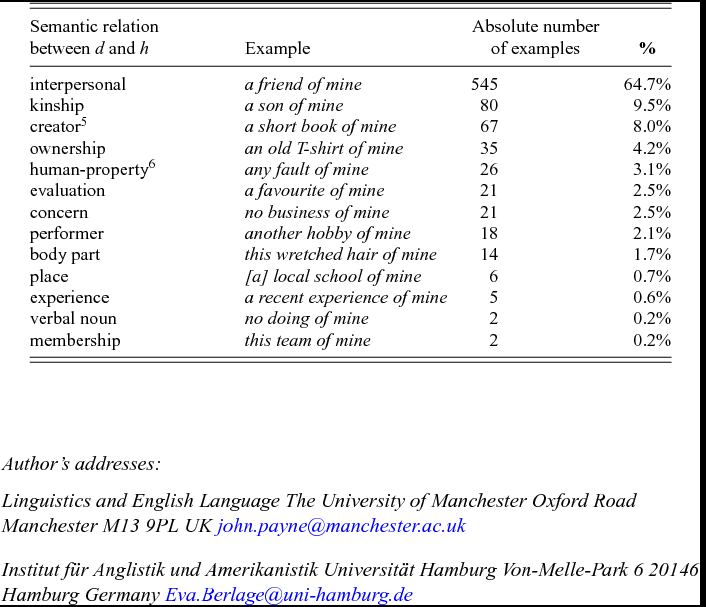
In a quantitative analysis limited to the pronoun mine in the dependent, Payne (Reference Payne, Börjars, Denison and Scott2013: 184–7) shows that the oblique genitive allows for a more varied set of semantic relations than has hitherto been assumed. The outcome of his analysis is presented in table 1, which is structured as follows: the left column specifies the semantic relation that holds between head and dependent, while column 2 provides one example from the BNC which illustrates the respective relation. Column 3 shows the absolute number of examples for that specific relation, with column 4 adding the corresponding percentages.
Semantic relations permitted by the oblique genitive construction of the type N+of mine in the BNC (adapted from Payne Reference Payne, Börjars, Denison and Scott2013: 187)

The table shows that interpersonal relations of the type a friend of mine are by far the most frequent semantic relation, accounting for 64.7 per cent of all cases. The remaining 35.3 per cent are distributed across twelve different semantic relations, two of which have ratios of more than 5 per cent of all cases. These are the kinship relation, with a share of 9.5 per cent of the examples, and creator accounting for 8.0 per cent of all cases. Next in the hierarchy come ownership, with 4.2 per cent of all cases, and human-property, with a share of 3.1 per cent of oblique genitive constructions. These findings seem surprising against Taylor's (Reference Taylor1989: 682) claim that the ownership relation should be at the top of the list (alongside interpersonal relations).
While all the semantic relations listed in table 1 can also be depicted by head and dependent in the s-genitive, we find many other relations which are fully compatible with the s-genitive but ungrammatical with the oblique genitive. Two such examples are quoted in (13) and (14). While example (13) illustrates the semantic relation ‘d has inherent part h’, the semantic relation in (14) can be paraphrased as ‘d is time of h’.
(13) *that funnel of the ship's (Payne Reference Payne, Börjars, Denison and Scott2013: 180)
(14) *this weather of the summer's (Payne Reference Payne, Börjars, Denison and Scott2013: 180)
Since the of-genitive allows for a much wider range of semantic relations that can hold between head and dependent than the s-genitive (see e.g. Payne & Huddleston Reference Payne, Huddleston, Huddleston and Pullum2002: 477; Payne et al. Reference Payne, Pullum, Scholz and Berlage2013: 815–16), there is even less overlap between the of-genitive and the oblique genitive than between the s-genitive and the oblique genitive. Two examples of semantic relations possible with the of-genitive but not with the oblique genitive are given in (15) and (16). The semantic relation between head and dependent in (15) may be paraphrased as ‘h has size d’, and the semantic relation in (16) as ‘h has content d’. A more detailed discussion of such examples will be provided in section 5.4.
(15) farms of 100,000 acres (BNC)
(16) questions of law or fact (BNC)
One of the most pronounced differences between the oblique genitive and the s-genitive is that the oblique genitive allows for a series of different determiners to occur in the head NP, as illustrated in (17), while the s-genitive is always definite. This is why it cannot be replaced by the indefinite pronoun one in (18).
(17) a/every/this/no/another book of John's (Payne Reference Payne, Börjars, Denison and Scott2013: 178)
(18) I was looking for John's book but couldn't find it/*one. (Payne Reference Payne, Börjars, Denison and Scott2013: 178)
Researchers generally agree that the oblique genitive cannot combine with the definite article unless it receives restrictive modification (see e.g. Jackendoff Reference Jackendoff, Anderson, Jackendoff and Keyser1968; Barker Reference Barker1998). Lyons (Reference Lyons1986: 124) even holds that the restrictive modification must be post-head, as illustrated in (19).
(19) the book of John's that you borrowed (Lyons Reference Lyons1986: 124)
Since restrictive relative clauses rarely follow the head in s-genitives, Lyons (Reference Lyons1986: 124) assumes a ‘rough complementary distribution’ to exist between the two constructions and marks (20) with an asterisk.
(20) *John's book that you borrowed (Lyons Reference Lyons1986: 124)
This tallies well with Barker's (Reference Barker1998: 679) claim of an anti-uniqueness effect. He contends that the oblique genitive is incompatible with unique reference. This means that (19) has to be interpreted in the way that John has more than one book. Uniqueness of reference is, however, precisely a characteristic of the s-genitive and explains why (20) is ungrammatical (if there is only one book, this book cannot receive restrictive postmodification). If Barker's and Lyons’ claims held true in all cases, there should be no variation between the oblique genitive and the s-genitive. In accordance with Payne (Reference Payne, Börjars, Denison and Scott2013), however, we will show that variation exists between the two constructions because, semantically, the oblique genitive is not bound to express anti-uniqueness (see Payne Reference Payne, Börjars, Denison and Scott2013: 190) and, syntactically, a dependent introduced by the definite article does not always need restrictive postmodification and may occasionally even occur without any modification at all (see Payne Reference Payne, Börjars, Denison and Scott2013: 189–90).
To summarise, previous research shows that the dependent in oblique genitives is subject to animacy constraints, to the weight of the dependent, to the semantic relation that obtains between head and dependent and to the type of determiner that precedes the head noun. With the exception of Payne (Reference Payne, Börjars, Denison and Scott2013), who provides quantitative data on the construction N+of mine, previous research has so far been restricted to qualitative analyses of such constraints. Our article, for the first time, provides quantitative data on the effect that such constraints have on the choice of the oblique genitive, allowing both for pronominal dependents and full NPs in the dependent slot.
3 Methodology
The quantitative analyses of the oblique genitive provided in this article are derived from corpus-based searches of the British National Corpus (henceforth BNC), with the BNCweb interface. Searching for the formula ‘N+of+genitive NP’ we retrieve a total of 2,859 relevant examples, with the NP extending to a maximum of four words. These include both pronominal dependents, such as a daughter of mine and non-pronominal ones such as a daughter of Mary’s. The analysis in section 4 is based on this data set, which we will call data set A1, and which aims to characterise the properties of the oblique genitive in isolation, independently of any comparison with the s-genitive and of-genitive. A restricted subset of data set A1, containing only the 56 untypical but informative cases where the determiner is the definite article the, is analysed in section 7 of the article. We call this data set A2.
For the purposes of comparison in section 5, as with the oblique genitive, examples of the s-genitive and of-genitive were retrieved from BNCweb. Since the space in which all three constructions compete is minuscule, it is impossible to carry out a regression analysis on a set of directly competing examples, as has been carried out for example with the s-genitive and of-genitive by O’Connor et al. (Reference O’Connor, Maling, Skarabela, Börjars, Denison and Scott2013) and Börjars et al. (Reference Börjars, Denison, Krajewski, Scott, Börjars, Denison and Scott2013). Our strategy has therefore been to work with a set of examples of the s-genitive and of-genitive which are directly in competition with each other, but restricted to a small set of semantic relations which coincide with a subset of those which represent the core of the oblique genitive.
Firstly, since the s-genitive induces definiteness, only those of-genitive constructions were included which are introduced by the definite article. Such comparability is not possible for the oblique genitive. If we were to restrict the oblique genitive to examples introduced by the definite article, we would expect to find such a low number of examples that the comparisons presented in section 5 would simply be impossible.Footnote 7 Definiteness of the whole NP is, however, unlikely to have any strong correlation with the factors involved in these comparisons, namely pronominal vs noun-headed dependent, and the length and animacy of noun-headed dependents.
We next impose a semantic restriction. Since only a subsection of the semantic relations covered by the s-genitive can also be expressed by the oblique genitive (with a still smaller overlap holding between the oblique genitive and the of-genitive), the set of semantic relations is restricted to four of those where a direct comparison is possible, namely interpersonal relation, kinship, body part and ownership. Since the BNC has no semantic coding, it would be virtually impossible to search for the totality of even this set of examples. In order therefore to make the search feasible, we selected one specific head noun (in the singular and plural) as a representative of each of the selected relations. It is of course a necessary assumption that the four head nouns selected are indeed representative. However, delimiting the search in this way enables a direct comparison with examples of the oblique genitive which exhibit the corresponding relation, even if not the same head noun. Ideally, more relations would have been covered, including for example the creator relation. The four relations chosen, however, represent a practical starting point: the full data set of oblique genitives used in section 4 is itself reduced only from 2,859 to 1,897 by this restriction.
Examples (21)–(24) illustrate the four shared semantic relations, either by means of the s-genitive or the of-genitive. In each case, the relevant head noun is given in boldface. In the remainder of this article, these relations will be referred to as the set of ‘shared’ semantic relations between all three constructions.
(21) interpersonal relation: the supporter of a tyrannical regime (BNC)Footnote 8
(22) kinship: Steve's parents (BNC)
(23) body part: the eyes of Laura Lynch (BNC)
(24) ownership: the victim's car (BNC)
The initial search for s-genitives and of-genitives with these four head nouns, and including both pronominal and non-pronominal dependents, isolates a total of over 27,500 examples to be compared with the shared 1,897 examples of the oblique genitive. We will call this data set B1. The vast majority of the former, an estimated 25,000, are s-genitives with pronominal dependents. Data set B1 forms the basis for the comparison of pronominal and non-pronominal dependents across the three constructions in section 5.1.
This very large data set was then reduced by excluding all examples with pronominal dependents. This procedure yields a total of 2,625 relevant examples for the s-genitive and of-genitive constructions, compared with a total of 366 for the oblique genitive. We call this data set, which contains only noun-headed dependents, data set B2. Data set B2 was subsequently coded for the following properties:
– animacy of the dependent
– length of the noun-headed dependent
These form the basis of the comparisons in sections 5.2 and 5.3 respectively. For all four data sets, the authors coded the examples jointly, reaching agreement in cases of doubt.
4 The oblique genitive
Using data set A1, the full set of oblique genitives consisting of 2,859 examples, we will give in this section an empirical account of the following five parameters: animacy of the dependent, noun-headed vs pronoun dependent, length of the noun-headed dependent, determiner of the head and semantic relation obtaining between head and dependent. For each parameter, we provide quantitative data from the BNC. We will start with a discussion of the properties associated with the dependent.
Previous research has revealed that the referent of the dependent has to be high on the animacy scale (see section 2). We may therefore expect to find a very high proportion of human dependents whereas inanimate dependents should be hardly existent. In order to get a more detailed picture, we will distinguish between the following four types of dependents, which, from (a)–(d), instantiate very high to low degrees of animacy.
(a) human or human-like referents of the dependent, such as girl, bride or mermaid
(b) organisations, such as government, family or NATO
(c) other animates, such as animal, cat or owl
(d) inanimates, such as contract, house or trip.
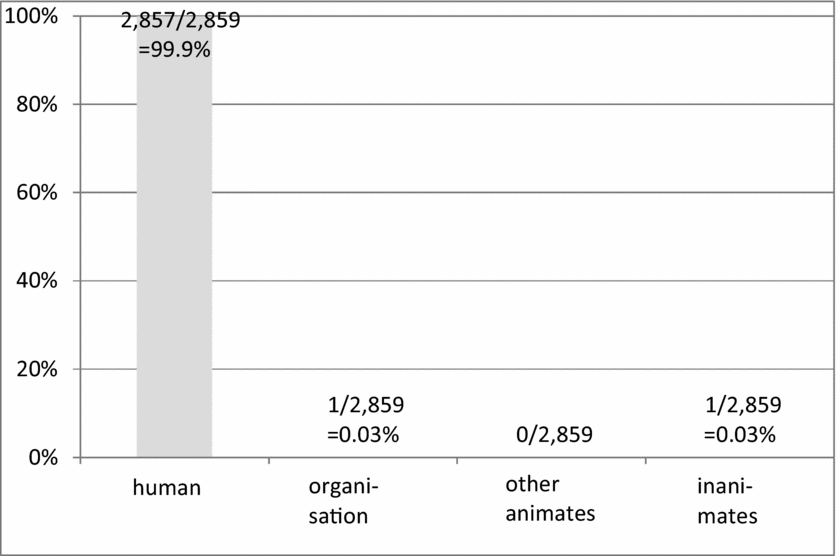
A quantitative overview of how the dependents in the oblique genitive are distributed across types (a)–(d) is provided in figure 1.
Animacy of the dependent in oblique genitive constructions
A quantitative analysis of all dependents in the oblique genitive shows us that nearly 100 per cent of the examples are represented by human dependents. With one hit each, dependents whose referents are organisations or inanimates are practically non-existent. The only two such examples found in the total of 2,859 hits are presented in (25) and (26). Since the inanimate dependent in (26) is personified, our research confirms previous findings (see section 2): the dependent in the oblique genitive is practically confined to human or human-like referents.
(25) Allianz, the largest German insurance group and strong rival of Deutsche Bank’s, looks likely to join the defence effort . . .. (BNC)
(26) A balancing-act of untouchable fruit, stacked any-old-how by a whim of gravity’s. (BNC)
The next question to be explored is how many of the dependents in the oblique genitive are noun-headed as in (27) and how many are represented by pronouns as in (28).
(27) Paddy Reilly, a friend of Lynch’s, once claimed to have had five ten-round fights in a week. (BNC)
(28) I met Kristy through an old boyfriend of hers. (BNC)
We know from research on the s-genitive and of-genitive (see e.g. Rosenbach Reference Rosenbach2002; Reference Rosenbach2005: 616; this volume) that pronouns frequently occur with the s-genitive (such as my car) but hardly feature in the of-genitive (for some rare examples, see Payne Reference Payne, Börjars, Denison and Scott2013). We will now need to determine what the role of pronouns is in the oblique genitive. In order to do so, we will distinguish between noun-headed dependents, pronouns and mixed dependents such as (29), which consist of a combination of pronoun and noun.
(29) Basically, I got a fax from him in LA yesterday, and apparently his daughter is a great fan of yours and Basil’s [. . .] (BNC)
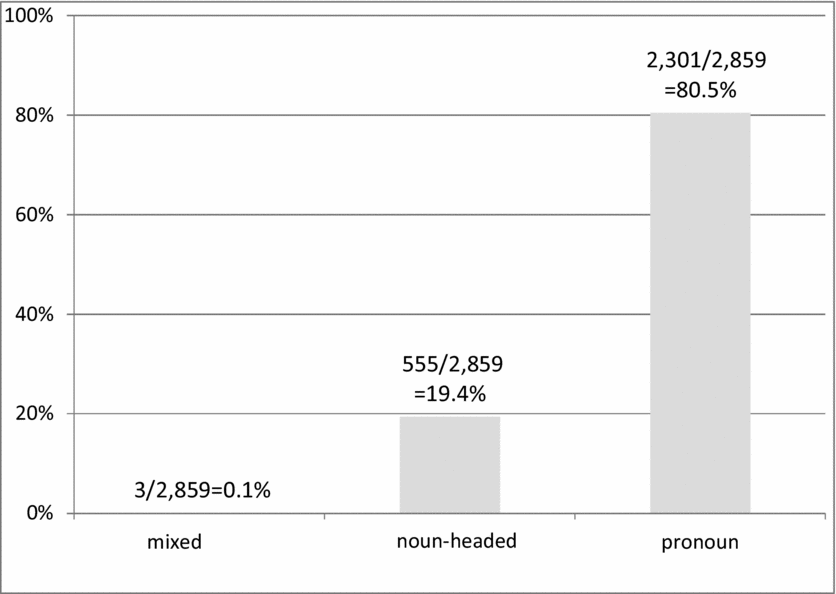
Figure 2 reveals that the biggest share of dependents is represented by pronouns. With a ratio of 19.4 per cent, noun-headed dependents clearly are the minority option, and mixed dependents, with no more than three hits in total, are practically non-existent.
Noun-headed vs pronoun dependent in oblique genitive constructions
Let us, in a next step, focus more closely on noun-headed dependents and ask what their average length is. In accordance with previous research, we would expect that the oblique genitive permits only short dependents such as (30). Dependents that consist of four words as in (31) are expected to be very infrequent.
(30) A boyfriend hooked her on drugs, and that boyfriend was a room-mate of Rickie’s. (BNC)
(31) Lady Deverill replied sharply, before bending down to make her face level with Artemis. A great friend of the first Lady Deverill’s. (BNC)
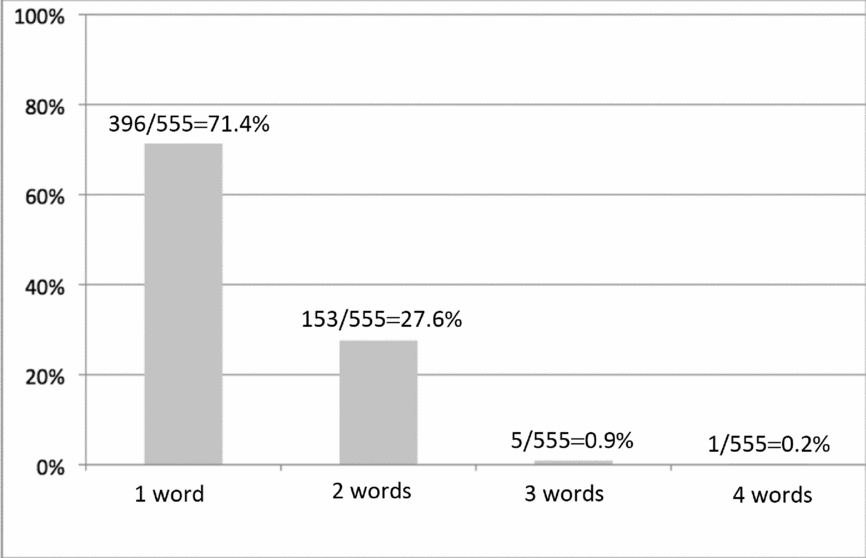
Figure 3 shows us that our hypothesis is borne out by the data. One-word dependents account for more than 70 per cent of all oblique genitive constructions, while, with a ratio of less than 30 per cent of all cases, two-word dependents are already considerably less frequent. With a proportion of less than 1 per cent of all cases, dependents of more than two words hardly occur at all.
Length of noun-headed dependent in oblique genitive constructions
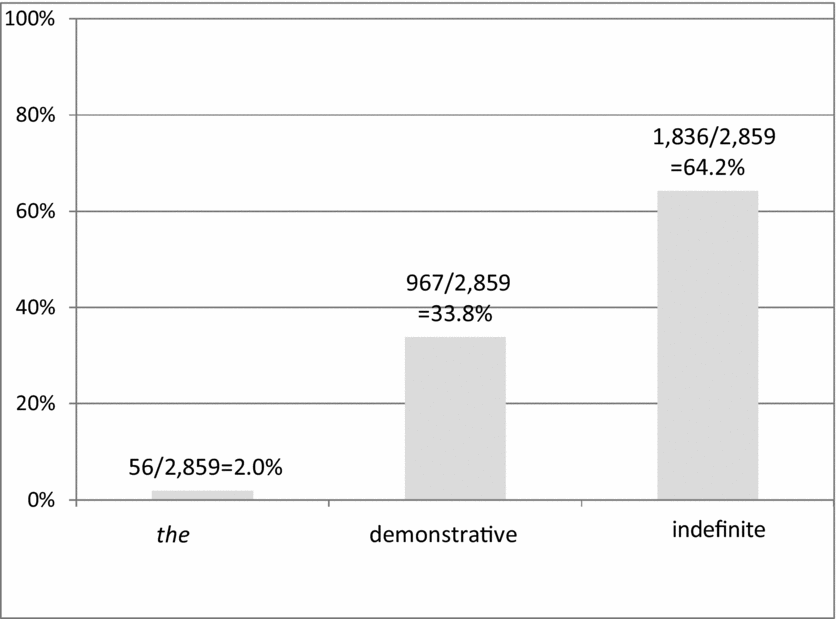
Previous research (see section 2) has claimed that the oblique genitive combines with a series of different determiners but can only occur with the definite article if it receives restrictive modification (see e.g. Jackendoff Reference Jackendoff, Anderson, Jackendoff and Keyser1968; Barker Reference Barker1998). Although a few counterexamples have been provided by Payne (Reference Payne, Börjars, Denison and Scott2013: 189–90; for the findings of the present study, see section 7.2), we can expect to find a very low percentage of definite articles as in (32). The reader will find this confirmed by the findings presented in figure 4: oblique genitives introduced by the definite article account for no more than 2.0 per cent of all oblique genitive constructions. On the contrary, we should find a high share of indefinite determiners, such as the indefinite article in (33). Although the anti-uniqueness claim advanced by Barker (Reference Barker1998: 679) has been proven wrong (see e.g. Lyons Reference Lyons1986: 126–8; Payne Reference Payne, Börjars, Denison and Scott2013), indefinite articles best fit the prototypical interpretation of the oblique genitive as a partitive construction. We reiterate though that the oblique genitive does not necessarily impose a partitive interpretation. Alternatively, the oblique genitive construction may contain a demonstrative as in (34). According to Abel (Reference Abel2006), an oblique genitive introduced by a demonstrative, which is clearly not a partitive construction, should be interpreted as a focus construction: an item that is familiar in the discourse is put into focus.
Choice of determiner in oblique genitive constructions
(32) ‘I am, after all’, he added, glaring round the room as if expecting a challenge, ‘the executor of Sir Ralph’s’. (BNC)
(33) Reginald Bray, a friend of Masterman's would remark on the same development [. . .] (BNC)
(34) This goddaughter of mine is a spending laughter. (BNC)
The analysis presented in figure 4 confirms our hypotheses. With a ratio of 64.2 per cent of all cases, indefinite determiners are clearly the most frequent type of determiner found in the oblique genitive construction. While the definite article does not account for more than 2.0 per cent of the examples, the demonstrative occupies a mid-position. It is about half as frequent as indefinite determiners.
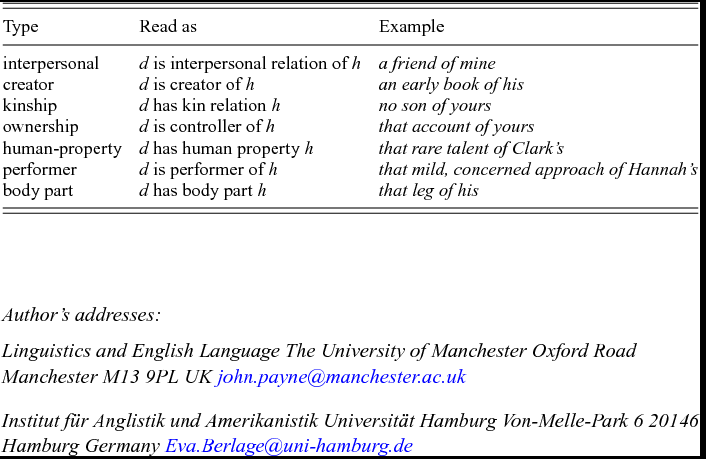
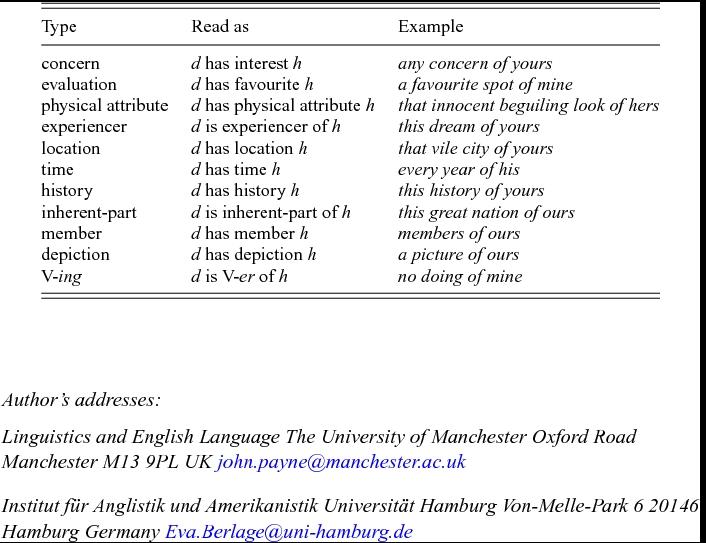
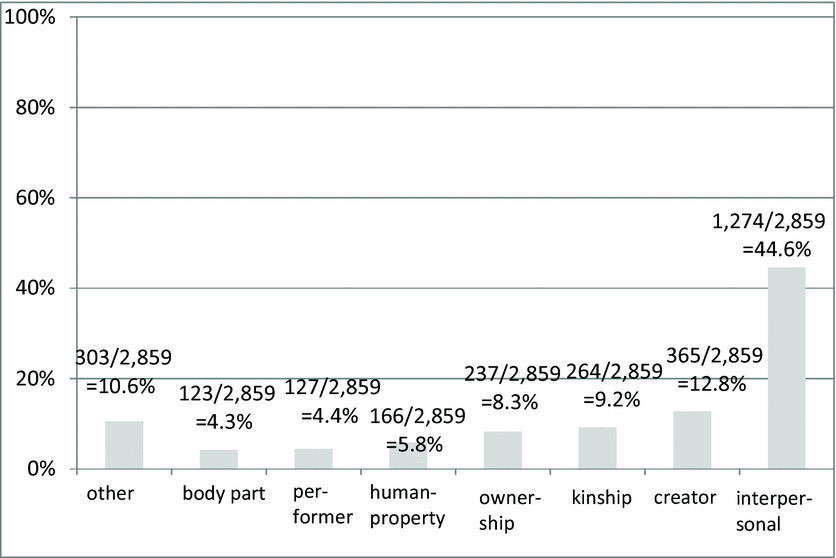
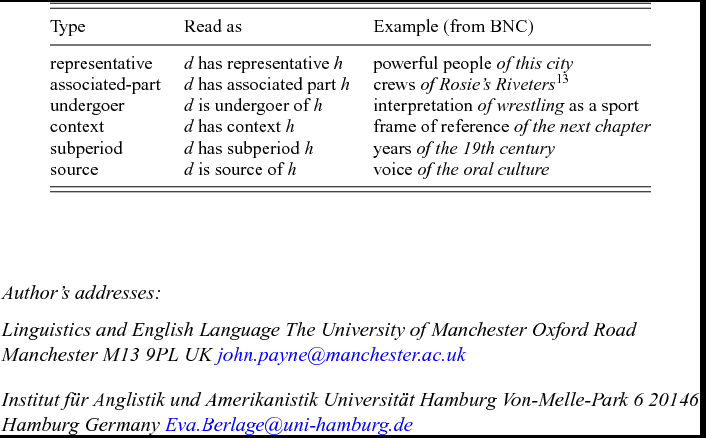
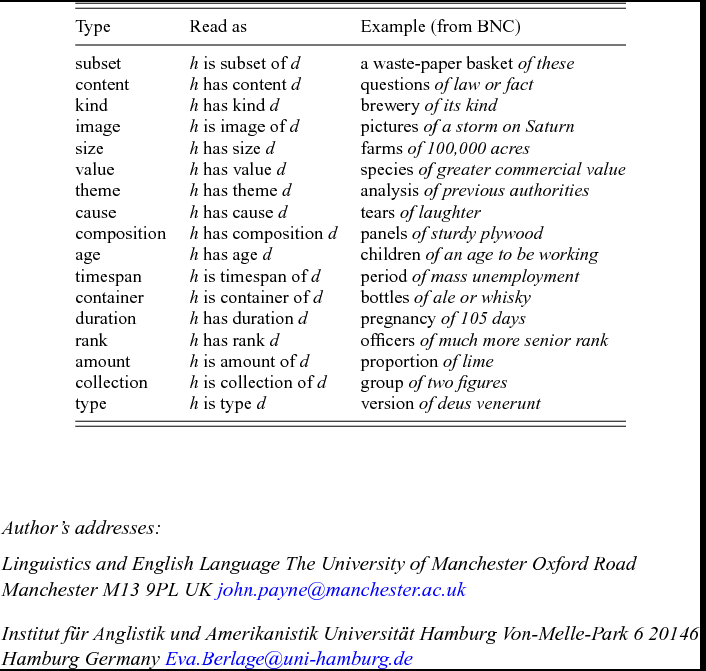
We will now turn to the semantic relations permitted between head and dependent in the oblique genitive. Research by Payne (Reference Payne, Börjars, Denison and Scott2013: 187) on the construction N+of mine has revealed that interpersonal relations of the type a friend of mine represent by far the most frequent relation but that the set of semantic relations that can be expressed by the oblique genitive is much more varied than previous research has assumed (see section 2). The quantitative analysis presented in figure 5 now extends Payne's (Reference Payne, Börjars, Denison and Scott2013) analysis by including not only all pronouns in the slot of the dependent but also full NP heads. It distinguishes between seven core semantic relations (which are the most frequent semantic relations in our data) and eleven other semantic relations (being semantic relations with lower frequencies of occurrence). The core semantic relations are listed in table 2; those that will be classified as ‘other’ in the analysis presented in figure 5 are given in table 3. For each semantic relation, we explain how to read the relation between head and dependent and provide one example from the BNC.Footnote 9
Core semantic relations permitted by the oblique genitive
Other semantic relations permitted by the oblique genitive
Semantic relations permitted by the oblique genitive
In accordance with Payne (Reference Payne, Börjars, Denison and Scott2013: 187), interpersonal relations come out as the most frequent ones by far. The most frequent head noun in the set of interpersonal relations, in turn, is friend(s), which accounts for a share of 31 per cent of all interpersonal relations. Creator is the second most frequent semantic relation, accounting for 12.8 per cent of all cases. Next come kinship and ownership relations, with kinship relations such as a son of mine being slightly more frequent than ownership, which account for 8.3 per cent of all cases. Human-property, performer and body part all account for between 4 and 6 per cent of all cases, with all others relations making up for 10.6 per cent of the examples.
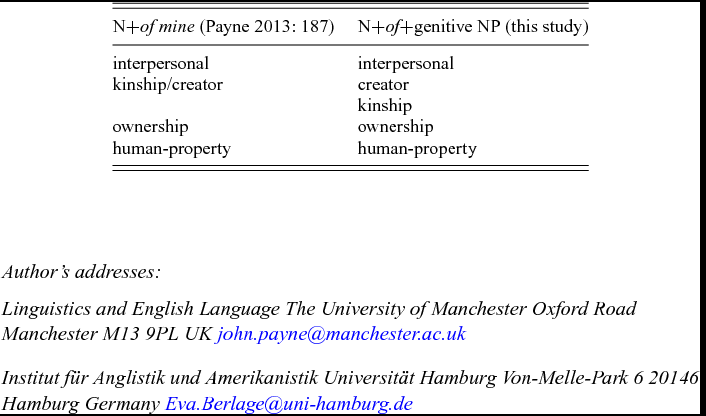
Comparing the seven core semantic relations to Payne's (Reference Payne, Börjars, Denison and Scott2013: 187) outcome for the semantic relations that hold between head and dependent in the construction N+of mine, what emerges is the overall similarity in the position occupied by these relations. However, while in Payne's analysis (Reference Payne, Börjars, Denison and Scott2013), there is no significant difference between kinship and creator relations, the second and third most frequent relations respectively, in data set A1 the creator relation emerges clearly as the second most frequent relation. Table 4 gives the ranking of the five most frequent semantic relations in the two analyses.
Comparison of Payne (Reference Payne, Börjars, Denison and Scott2013: 187) and Payne & Berlage (present study) in terms of the most frequent semantic relations that hold between head and dependent in the oblique genitive construction
To summarise, this section has shown that the dependent in the oblique genitive is almost exclusively human, that it is mainly represented by pronouns and that, if it is noun-headed, the dependent overwhelmingly consists of one word only. The most frequent determiner associated with the oblique genitive is indefinite and the core semantic relation that holds between head and dependent is the interpersonal one. Apart from this semantic relation, however, a total of seventeen other semantic relations can be expressed by the oblique genitive.
5 Comparison with the s-genitive and of-genitive
In this section, we compare the oblique genitive to the s-genitive and the of-genitive constructions. The parameters of comparison refer to the properties of the dependent (noun-headed vs pronoun dependent (section 5.1), animacy of the dependent (section 5.2), mean length/length of noun-headed dependent (section 5.3)) and to the semantic relations that obtain between head and dependent in all three constructions (section 5.4). The comparison will reveal to what extent the s-genitive and the of-genitive parallel the oblique genitive and to what extent they are different (for the methodology underlying the searches, see section 3). This will provide the background against which we can start to look for variation between all three constructions (see sections 6 and 7).
5.1 Noun-headed vs pronoun dependents
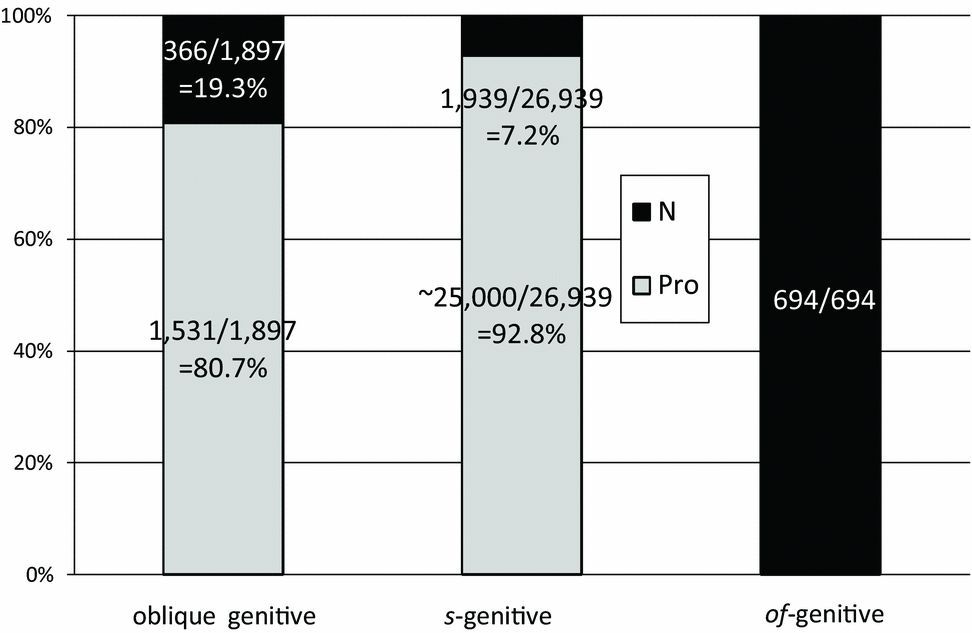
We begin with a comparison of noun-headed vs pronoun dependents in the oblique genitive, the s-genitive and the of-genitive constructions. This comparison uses data set B1: only those examples are included which represent one of the four shared semantic relations outlined in section 3 (interpersonal relation, kinship, body part, ownership). For the s-genitive and the of-genitive constructions, these are examples with the four head nouns supporter(s), parent(s), eye(s) and car(s), while the oblique genitive set includes all head nouns standing in the required relationship. Due to the high number of examples in the s-genitive of the type ‘possessive pronoun+N’ (e.g. my car), the number of pronouns in the s-genitive is an estimate based on an extrapolation of the number of false hits identified in a smaller sample.Footnote 10
Figure 6 shows us that the vast majority of dependents are represented by pronouns both in the oblique genitive and in the s-genitive. Yet there is a statistically significant difference (with χ 2 = 352.56; df = 1; p < 0.001) between them: while the oblique genitive takes pronouns in about 80.7 per cent of all cases, the share is much higher in the s-genitive. Here, pronouns account for as many as 92.8 per cent of all cases. Pronouns are completely absent from the of-genitive. In general, pronouns in the of-genitive construction are extremely rare (see O’Connor et al. Reference O’Connor, Maling, Skarabela, Börjars, Denison and Scott2013). They are found for example in the depiction relation (a photo of me), a relation where the oblique genitive is virtually impossible.
Noun-headed vs pronoun dependents in the oblique genitive, s-genitive and of-genitive (shared semantic relations)
5.2 Animacy of the dependent
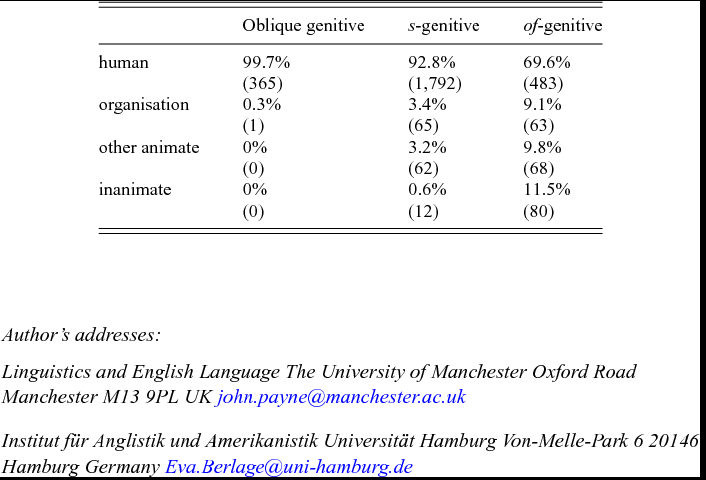
In this section we compare the degree to which the dependent is animate in the three constructions. This comparison uses the reduced data set B2, which is based on the same principles as data set B1 but contains only non-pronominal dependents. As in section 4, we adopt a fourfold categorisation into human dependents, organisations, other animates and inanimates. The columns in table 5 specify both the percentages retrieved for the four types of dependents based on all the examples of the individual constructions (the oblique genitive, the s-genitive and the of-genitive) and the absolute frequencies of occurrence.
Animacy of the dependent in oblique genitive, s-genitive and of-genitive constructions (shared relations, noun-headed dependents)
The results show that both the oblique genitive and the s-genitives take human dependents in more than 90 per cent of all cases. While the choice of human dependents is practically categorical for oblique genitives, which have only one dependent whose referent is an organisation (and no other animates or inanimate dependents), there is still a remnant of variation left for the s-genitive, which takes non-human dependents in 7.2 per cent of all cases. The of-genitive construction, by contrast, is associated with human dependents in only 69.6 per cent of all cases, allowing the remaining 30.4 per cent to be distributed across dependents whose referents represent organisations (9.1 per cent), other animates (9.8 per cent) or inanimates (11.5 per cent).
5.3 Length of noun-headed dependents
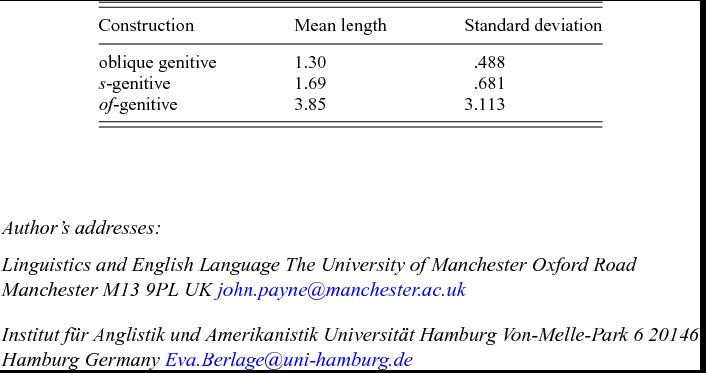
For this comparison we again use data set B2 (where the dependent is noun-headed), and ask what its average length is across all four constructions. The mean lengths of the dependents are presented in table 6, together with the standard deviations.
Mean length of noun-headed dependents in the oblique genitive, s-genitive and of-genitive construction (shared semantic relations)
The table reveals that the oblique genitive has the shortest dependents, with a mean length of 1.30, followed by the s-genitive, with an average of 1.69 words in the dependent. The dependent in the of-genitive, by contrast, is much longer, showing an average of 3.85 words. The contrast between the s-genitive and of-genitive can easily be explained referring to the Behaghel's (Reference Behaghel1909) Law of Growing Elements and Quirk et al.'s Principle of End Weight (Reference Quirk, Greenbaum, Leech and Svartvik1972: 943) according to which short elements tend to precede long ones and heavy constituents occur towards the end of the sentence. For the alternation between the s-genitive and of-genitive, this means that long dependents occur in the of-genitive (see e.g. Altenberg Reference Altenberg1982; Jucker Reference Jucker and Jucker1993; Rosenbach Reference Rosenbach2002, Reference Rosenbach2005).
A more detailed breakdown of the length of noun-headed dependents in the oblique genitive, the s-genitive and the of-genitive is given in figure 7.
Length of the dependent in the of-genitive, s-genitive and oblique genitive constructions
It emerges clearly from the findings presented in figure 7 that the oblique genitive is confined to very short dependents. This is a marked contrast to the of-genitive where only 10.5 per cent of the examples have one-word dependents. Barker's examples neatly illustrate the difficulty of having longer dependents in the oblique genitive.
(35) ?Those mothers of his and Bill’s! (Barker Reference Barker1998: 714)
(36) *That mother of the tall man’sFootnote 11 (Barker Reference Barker1998: 714)
Clearly, the length factor plays a very important role in determining the use of the oblique genitive as opposed to the of-genitive. It is not obvious at present that there is a functional motivation for this difference.
5.4 Semantic relations
The final comparison between the three constructions is primarily qualitative rather than quantitative, in the sense that we will be concerned with the types of semantic relation that can hold between head and dependent, rather than with the frequencies of examples illustrating each semantic relation. In section 4, we have outlined the semantic relations that can be expressed via the oblique genitive. We will now compare this set to those semantic relations possible with the s-genitive and the of-genitive. The comparison is in this case based on the semantic relations observed for oblique genitives in data set A1, and discussion in Payne et al. (Reference Payne, Pullum, Scholz and Berlage2013) of the semantic relations observed for s-genitives and of-genitives. This latter study was carried out for a totally independent purpose.Footnote 12
An overview of the number of semantic relations that can be expressed in each construction is given in figure 8.
Relations hierarchy between the of-genitive, s-genitive and oblique genitive constructions
Figure 8 represents the notion that the of-construction, the s-genitive and the oblique genitive form a hierarchy as to the semantic relations they can express. Thus, a core of eighteen semantic relations can be expressed by all three constructions (see tables 2 and 3 in section 4). An additional six semantic relations can be expressed by the s-genitive and the of-genitive but not by the oblique genitive, and more than seventeen semantic relations can only be expressed by the of-genitive (with the ‘+’-sign meaning ‘more than’). The six semantic relations permitted by the s-genitive and of-genitive, but not by the oblique genitive construction, are outlined in table 7, together with one example of each.
Semantic relations possible with the s-genitive and of-genitive but not with the oblique genitive (examples from Payne et al. Reference Payne, Pullum, Scholz and Berlage2013)
Seventeen semantic relations compatible with the of-genitive but not with the s-genitive and oblique genitive are listed in table 8. From Payne & Huddleston (Reference Payne, Huddleston, Huddleston and Pullum2002: 477) we know that this Footnote 13list should be extended to include further semantic relations between head and dependent, such as ‘h has colour d’ (e.g. the veil of purple) or ‘h has form d’ (e.g. the sign of the cross). These, however, were not found in the restricted analysis of Payne et al. (Reference Payne, Pullum, Scholz and Berlage2013).
Semantic relations possible with the of-genitive but not with the s-genitive and oblique genitive construction (adapted from Payne et al. Reference Payne, Pullum, Scholz and Berlage2013)
Overall, the findings shown here concerning the oblique genitive are in accordance with Payne & Huddleston (Reference Payne, Huddleston, Huddleston and Pullum2002: 473–78) and Payne (Reference Payne, Börjars, Denison and Scott2013: 187): the semantic relations compatible with the oblique genitive are a subset of those that may occur in the s-genitive (and this itself is a subset of those that can be expressed by the of-genitive).
6 Variation between the three constructions
In section 6, we outline the syntactic contexts in which we can expect to find variation between the oblique genitive, the s-genitive and the of-genitive construction. The first context to be discussed refers to situations where the oblique genitive, the s-genitive and the of-genitive function as the predicative complement of the clause (see section 6.1). In the second context, the oblique genitive is introduced by the definite article (see section 6.2).
6.1 Oblique genitive constructions as the predicative complement of the clause
The oblique genitive may compete with the s-genitive and of-genitive in those cases where all three constructions function as predicative complements of the clause. In formal terms, the structure of the clause then reads ‘X be Y’, with X being the subject and Y the predicative complement whose slot can be filled by the oblique genitive, s-genitive or of-genitive construction. The variation context is illustrated for the head noun friend in examples (37)–(39). While the oblique genitive forms the predicative complement in (37), this function is represented by the s-genitive in (38) and by the of-genitive in (39).
(37) Guy's a friend of Charles’s. (BNC)
(38) I am Russell's friend, my mother's son and the man who will vanquish the past for you. (BNC)
(39) She had assumed his letters were the product of his lifelong rage, the festering cancer of his childhood, driving him into unreasonable behaviour, and a tendency to see the worst in anyone who was a friend of Charles. (BNC)
The main reason that all three constructions can compete in this context is that the definiteness effect normally associated with the s-genitive is somewhat attenuated in the predicative context. While a noun phrase such as Russell's friend would in other contexts typically implicate uniqueness, here in the non-referential context of (38) it does not. It can simply be interpreted in the same way as the indefinite noun phrases in (37) and (39), i.e. as not implicating that Charles has only one relevant friend.
The choice between (37) and (39) is, however, perhaps not totally free. Even though with head nouns such as friend the relation is normally a symmetric one (i.e. if X is a friend of Y, then Y is a friend of X and X and Y are friends), a difference of perspective may be involved (Payne & Huddleston Reference Payne, Huddleston, Huddleston and Pullum2002: 478): in ‘X is a friend of Y’ the relation is viewed from the perspective of X, and in ‘X is a friend of Y’s’, it is viewed from the perspective of Y.
6.2 Oblique genitive constructions with determiner the
While Lyons (Reference Lyons1986: 124) claims that the s-genitive and the oblique genitive are in ‘rough complementary distribution’, Payne (Reference Payne, Börjars, Denison and Scott2013: 188–90) shows that variation exists where the oblique genitive is introduced by the definite article the. By means of illustration, compare the examples in (40) and (41), which have restrictive premodification of the head and which differ only in the choice of genitive construction.
(40) the closest friend of John's (Payne Reference Payne, Börjars, Denison and Scott2013: 179)
(41) John's closest friend (Payne Reference Payne, Börjars, Denison and Scott2013: 179)
Since the s-genitive is in competition with the of-genitive where the of-genitive is introduced by the definite article (see e.g. Rosenbach Reference Rosenbach2002; O’Connor et al. Reference O’Connor, Maling, Skarabela, Börjars, Denison and Scott2013), the oblique genitive in principle also competes with the of-genitive in the context of the determiner the. In order to compare variation in this syntactic context, we have to guarantee semantic comparability between all three constructions. As outlined in section 5.4, the oblique genitive, s-genitive and of-genitive construction can only compete where we look at a shared set of semantic relations. Since the oblique genitive is most restrictive, this shared set is simply the set of semantic relations observed in the oblique genitive construction.
Variation between all three constructions is illustrated in examples (42)–(44). Here, the semantic relation is ‘d is interpersonal relation of h’ and the head receives restrictive premodification.Footnote 14
(42) the best friend of Princess Diana’s
(43) Princess Diana's best friend (web-based example)
(44) the best friend of Princess Diana (web-based example)
The number of examples of the oblique genitive which occur with the definite article is 56. This is our final data set: data set A2. As shown in figure 4 (section 4), data set A2 represents only 2.0 per cent of the total number of oblique genitive examples (with all determiners) in data set A1. Examples of the oblique genitive introduced by the definite article are thus relatively rare. When analysed in detail, they do however provide a useful insight into the functions of the oblique genitive construction. It is to the analysis of data set A2 that we turn in section 7.
7 Analysis of oblique genitives with determiner the
In this section, we look in greater depth at the properties of the 56 examples of oblique genitives with determiner the which represent data set A2. In section 7.1, we analyse the distribution of semantic relations in this data set. In section 7.2, we consider types of modification. Then in section 7.3 we discuss the functions of the oblique genitive in the even rarer cases where there is no modification.
7.1 Semantic relations
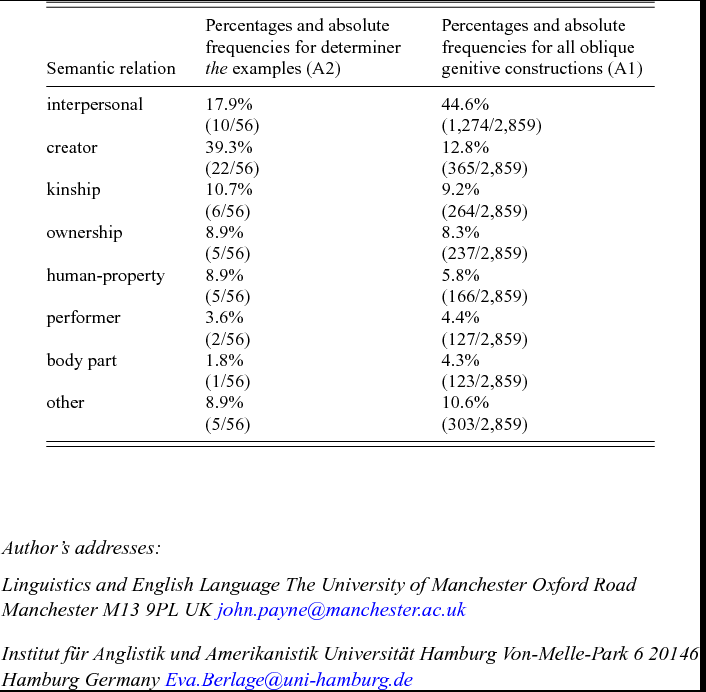
In order to get an initial insight into the properties of data set A2, we first compare the semantic relations found in data set A2 with those of data set A1 (see figure 5, section 4). The results are presented in table 9.
Semantic relations permitted by oblique genitive constructions introduced by the determiner the and all oblique genitive constructions
Comparing the relative frequencies for all seven core semantic relations, the most striking finding is that the creator relation comes out as the most frequent relation in the determiner the set. With a ratio of 39.3 per cent, it by far surpasses interpersonal relations, which account for no more than 17.9 per cent of all cases in the restricted set. Two examples of such creator relations are given in (45) and (46) below.
(45) The particular songs of his which affect me have helped me to understand what I ultimately want to make of my music [. . .] (BNC)
(46) Indeed, Robert Trivers in the original path breaking paper of his that launched the whole theory of parent offspring conflict, without knowing it, predicted it. (BNC)
Out of the 22 oblique genitives which represent creator relations, we get 18 different head nouns. Further research is needed to find out why creator relations are the ones that most frequently allow for variation with the s-genitive and of-genitive construction. It is not obvious, for example, that the larger proportion of creator examples can be attributed to modification patterns specific to these examples, for example a higher incidence of modification by restrictive relative clauses. As we show in section 7.2 below, the modification patterns of determiner the examples are in any event quite varied.
7.2 Modification
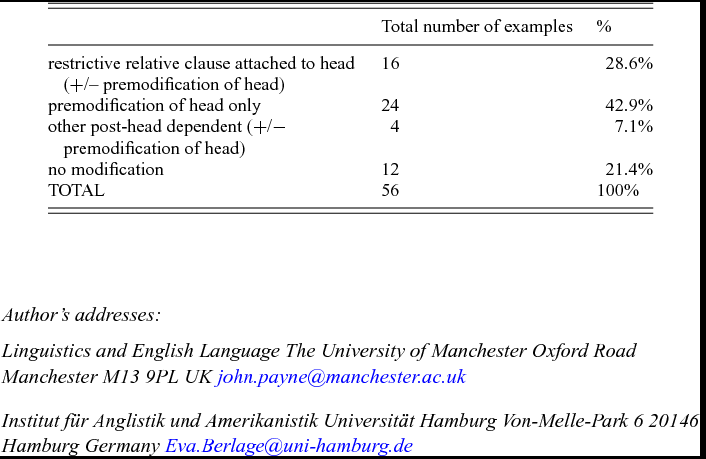
Previous research (e.g. Jackendoff Reference Jackendoff, Anderson, Jackendoff and Keyser1968; Barker Reference Barker1998) has claimed that the definite article can only occur in oblique constructions if the head receives restrictive modification. Payne (Reference Payne, Börjars, Denison and Scott2013: 189–90), however, is able to provide single corpus-based and web-based examples where the modification is either not restrictive or where there is no modification at all, as e.g. in the brainchild of yours (Payne Reference Payne, Börjars, Denison and Scott2013: 190). In order to see how many of the examples introduced by the definite article contain modification of the head and whether non-modified examples occur at all, we ran a quantitative analysis of all oblique genitives introduced by the determiner the in data set A2.Footnote 15 The analysis includes both noun-headed dependents and pronouns. The results are presented in table 10.
Modification of oblique genitives with determiner the
In table 10, we distinguish between four different cases. In line 1, we find those examples where the head is postmodified by a relative clause (which follows the dependent). These are the typical examples referred to by Lyons (Reference Lyons1986), where modification is restrictive and post-head. Two such examples are provided in (47) and (48). While the head is non-premodified in (47), it receives restrictive premodification in (48).
(47) I remember the friend of Aisha's who’d helped me escape from my house in London, . . .(BNC)
(48) He's the only old friend of yours I know who comes in here every night. (BNC)
Table 10 reveals that out of the 56 oblique genitive constructions introduced by the determiner the in the BNC, only 16 have a restrictive relative clause. This corresponds to 28.6 per cent of the total. The findings are surprising against the background of previous research and clearly show that the occurrence of the definite article is not restricted to (restrictive) post-head modification.
In contrast to the fairly low number of restrictive relative clauses attached to the head, we find a relatively high share of premodified heads, accounting for 42.9 per cent of all oblique genitive constructions introduced by the determiner the. In all of these cases, the head is non-postmodified. Two examples of such premodification are given in (49) and (50).
(49) About this time Wyndham Lewis expressed the wish to paint the Somerville friend of mine, [. . .] (BNC)
(50) If the least word of mine was to cause him trouble, I don't know what I’d do. (BNC)
In line 3 of table 10, we look at other post-head dependents, including those cases where the head is additionally premodified. Such postmodification may be an adjective phrase as in (51) or a post-head supplement as in (52).
(51) These were probably one of the few things of mine not due to be on show at the First Church of Christ the Spiritualist later this morning. (BNC)
(52) The following remark of Dennis Altman’s, even if not strictly correct historically, rightly implies how [. . .] (BNC)
Extremely interesting are the results obtained for those cases where we do not find any modification of the head. According to Jackendoff (Reference Jackendoff, Anderson, Jackendoff and Keyser1968), Barker (Reference Barker1998) and Lyons (Reference Lyons1986), these examples should be ungrammatical. While Payne (Reference Payne, Börjars, Denison and Scott2013: 189–90) presents three web-based examples of this type, these constructions represent a proportion as high as 21.4 per cent in our data. This means that about a fifth of all oblique genitive constructions introduced by the determiner the occur without modification. Two such examples are given in (53) and (54). While the dependent is noun-headed in (53), it is a pronoun in (54).
(53) The bowl of Rostov’s was so delicate that he felt that if he closed his hand too suddenly it would shatter. (BNC)
(54) [. . .] the woman who chooses silence instead of another death; the woman who is terrified lest any anger triggers the explosion of hers; (BNC)
Let us summarise the findings. Although the oblique genitive introduced by the determiner the is extremely rare (accounting for 2.0 per cent of the examples in the BNC; see figure 4 in section 4), it does exist and represents a potential context of variation with the s-genitive and of-genitive construction. Since the s-genitive generally does not occur with restrictive relative clauses (see e.g. Lyons Reference Lyons1986: 124), variation is limited to those cases where the oblique genitive occurs without a restrictive clause. In our analysis, we have been able to unearth 40 such cases, 12 of which occur without any modification at all. This is an intriguing theoretical finding: the claim stating that the oblique genitive introduced by the determiner the requires restrictive modification is simply false.
7.3 The functions of the unmodified oblique genitive with determiner the
Considering that about a fifth of all oblique genitive constructions introduced by the determiner the occur without any modification of the head, the question arises what the function of the oblique genitive is in these contexts. In other words: why has the speaker chosen the oblique genitive in these cases and not the s-genitive, which is the prototypical choice for definite NPs? In this section, we are going to offer three tentative answers to this question. We emphasise that the factors we next propose as conducive to the choice of oblique genitive should be considered as of relatively weak strength: the overwhelming choice whether these factors are present or not is the s-genitive.
We will start with the factor of contrast. The oblique genitive construction may be chosen in order to contrast different dependents. These dependents may either be mentioned explicitly in one and the same sentence, or the contrast is implicit as suggested by Abel (Reference Abel2006: 5). Abel (Reference Abel2006: 5) cites the example reproduced in (55), arguing that a batter on the opposing team had been hit on the hip earlier in the game.
(55) He might have a target on that hip of his. (Abel Reference Abel2006: 5)
While Abel (Reference Abel2006) refers to oblique genitives introduced by the demonstrative, our explanation is directed at oblique genitives introduced by the determiner the. One such example illustrating contrastive focus inside a single sentence is given in (56).
(56) That is our aim and it is the aim of the Government’s and I believe the people’s in the countries which I have visited and certainly here. (BNC)
In example (56), the aim of the Government’s, expressed via the oblique genitive, contrasts with the s-genitives our aim and the people’s (aim). Choosing the oblique genitive, rather than the s-genitive, allows contrastive focus to be placed on the final element of the construction, namely the dependent (government).
The second factor we propose is a semantic one. With some head nouns, the use of the oblique genitive can provide a clearer indication of the intended semantic relation than the s-genitive, for which more than one possible interpretation might be readily available. This will be illustrated on the basis of example (57).
(57) You’ve just said you remember the birth of Celia Hazell’s; Oh, no, I wasn't there when she delivered, the ex-matron reminded her. (BNC)
In this case, the context makes clear that Celia Hazell is not the baby but the mother giving birth to the baby. This means the relationship expressed between head and dependent in the oblique genitive is that of performer (d is performer of h). The s-genitive, by contrast, is ambiguous: Celia Hazell's birth could imply either that Celia Hazell is the mother, as here, or alternatively the baby is called Celia Hazell and the semantic relation expressed is ‘d is undergoer of h’. The choice of the oblique genitive avoids the ambiguity.Footnote 16
The third and last factor is a discourse-functional one. The oblique genitive is preferred over the s-genitive because it best serves the information structure of the sentence. This function is illustrated with example (58).
(58) Unlike Michelle in Eastenders, my situation was quite different as I was going out with the father of my son. But in the nine months of carrying my child, the feelings and reactions of Michelle’s were very much the same as my own. (BNC)
In this case, we may argue that the oblique genitive the feelings and reactions of Michelle’s is chosen because Michelle has already been mentioned in the preceding context (see Michelle in boldface). This means: Michelle represents old information which can be downplayed. Payne (Reference Payne, Börjars, Denison and Scott2013: 190), with reference to Fraurud (Reference Fraurud1990), argues that the oblique genitive construction downplays the anchor function that the dependent has in the s-genitive. The term ‘anchor function’ here refers to the way in which the genitive construction is processed. Let us refer back to example (58) to illustrate the difference in processing between a putative s-genitive Michelle's feelings and reactions and the oblique genitive construction in the example. If the processing of such constructions proceeds from left to right, the referent of the dependent is processed before the referent of the head in the s-genitive, but after it in the oblique genitive construction. So, in the NP Michelle's feelings and reactions, the hearer first cues Michelle and then, via the semantic relation holding between head and dependent, the feelings and reactions. This is the standard pattern. In the case of the oblique genitive the feelings and reactions of Michelle’s, by contrast, the hearer first identifies the feelings and reactions and only subsequently Michelle. Since Michelle has already been mentioned before, it is at least an option for the speaker to choose the oblique genitive for the second mention: he/she can expect the hearer to be already familiar with the referent and choosing the oblique genitive over the s-genitive enhances the discourse prominence of the head. Nevertheless, this factor seems rarely to outweigh the overwhelming structural and discourse-motivated preference for an s-genitive with single-word human dependents. The s-genitive would thus be totally felicitous in (58).
8 Conclusion and outlook
In this article, we have explored the niche role that the oblique genitive occupies in the context of genitive variation. While the oblique genitive should be considered an independent genitive construction (see also Payne Reference Payne, Börjars, Denison and Scott2013), variation with both the s-genitive and of-genitive construction is restricted to two syntactic contexts: those in which the constructions function as the predicative complement of the clause and those where the oblique genitive is introduced by the determiner the.
For theoretical reasons, the latter of the two contexts is particularly interesting because it shows us that oblique genitive constructions introduced by the determiner the are not confined to post- or premodification of the head. By contrast, the BNC data reveal that 21.4 per cent of all oblique genitives introduced by the definite article occur without any modification. This empirical finding clearly contradicts the claim, preponderant in previous publications (e.g. Barker Reference Barker1998; Lyons Reference Lyons1986), which states that oblique genitive constructions introduced by the definite article have to receive restrictive modification of the head.
Considering that oblique genitive constructions introduced by the determiner the account for only 2.0 per cent of all oblique genitive constructions (see figure 4 in section 4) and that out of these cases (only) 71.4 per cent of the examples (see table 10, section 7.2) allow for variation with the s-genitive (excluding those cases where the head is modified by a restrictive relative clause since this is unnatural with the s-genitive), conducting a multifactorial analysis that predicts variation for all three constructions (the oblique genitive, s-genitive and of-genitive) is not feasible. There is no doubt that, even if we had a database ten times as large as the BNC, the data set would still be too small to yield significant results for the oblique genitive construction.
Although the s-genitive and the of-genitive are used much more widely than the oblique genitive, we have been able to unearth three different functions of the oblique genitive that apply to contexts where it is introduced by the determiner the and therefore competes with the s-genitive and of-genitive (also introduced by the definite article). This means that in those cases where the oblique genitive construction is preferred over the s-genitive there is, no doubt, a functional motivation behind the choice of genitive. The oblique genitive may either be chosen for contrastive focus, for semantic reasons or in order to promote the information structure of the sentence, enhancing the discourse prominence of the head by downplaying the anchor function of the dependent.
Despite the lack of common ground between the oblique genitive and the two other constructions, the s-genitive and the of-genitive, we have been able to provide a quantitative or qualitative description of the similarities and differences that exist between them with respect to the following five features:
– noun-headed vs pronoun dependent
– animacy of the dependent
– length/mean length of noun-headed dependent
– determiner of the head
– semantic relations.
Out of these comparisons, semantic relations presumably come out as the most intriguing field of comparison. Here, our qualitative analysis has confirmed that the semantic relations that obtain between head and dependent in the oblique genitive construction are a subset of those that can occur in the s-genitive, which, again, are a subset of those available to the of-genitive construction. For variation between all three constructions, this means that in addition to finding an appropriate syntactic context that allows all three constructions to occur, we have to make sure that we only compare a shared set of semantic relations.
One avenue for future research will be to provide a quantitative account of the semantic relations permitted by all three constructions. If the oblique genitive, the s-genitive and the of-genitive construction show different preferences for the individual semantic relations that hold between head and dependent, this may enhance the semantic motivation for the choice of construction.