Implications
The function of biologically active peptides gained interest for the characteristics of safety, high-efficiency and multifunction. Of those, β-casomorphin plays an important role in regulating animal’s immune system, feed intake and metabolism. Fat content and composition in chicken meat are closely related with human health. This study revealed that β-casomorphin increased growth performance and fat deposition of broilers through changes in hormone secretion and enzyme activities by controlling the gene expression of lipid metabolism, increasing fat synthesis and deposition. This is important to enrich small peptide theory, accurately control usage and dosage of β-casomorphin and apply this technology in animal husbandry.
Introduction
β-Casomorphin, a biologically active peptide derived from β-casein of milk, plays a vital role in improving growth performance and immunity. β-Casomorphin could increase rats’ feed intake (Thonney et al., Reference Thonney, Arnold and Ross1991) by inhibiting the contraction of gastrointestinal smooth muscle, prolonging gastric emptying time and expediting the secretion of insulin and gastrin (Daniel et al., Reference Daniel, Vohwinkel and Rehner1990; Schnittler et al., Reference Schnittler, Liebmann, Schrader, Schulze, Neubert and Repke1990; Kil and Froetschel, Reference Kil and Froetschel1994). After absorption into the bloodstream, β-casomorphin accelerates immune system development of the neonatal rats by conditioning lymphocyte proliferation (Xu, Reference Xu1998) and work on the embryonic rat’s nervous system by binding to the μ-receptor (Minoru et al., Reference Minoru, Makoto and Masanori2001 and Reference Minoru, Makoto and Masanori2003). β-Casomorphin also can promote rats’ growth (Shu et al., Reference Shu, Xu, Wu, Jiao, Qi, Peng and Zhang2009) by influencing the growth-related hormones and growth factor levels in rat serum, and up-regulating the GHR messenger RNA expression in order to increase sensitivity of growth hormone in rat liver (Qin et al., Reference Qin, XU, Luo, Fang, Dong and Wang2004). Moreover, β-casomorphin can modulate lipid metabolism and improve anti-oxidation so as to protect the liver of mice from alcoholic damage efficiently (Gu et al., Reference Gu, Zhou, Yang, Wei, Tang, Li and Qin2013). The studies about β-casomorphin mostly focused on rats, less on chicken broilers, especially action of β-casomorphin on lipid deposition and metabolism of broilers. Chicken is a kind of popular food and main source of animal protein. Fat content in chicken is closely related to people’s health, such as hypertension, hyperglycemia and hyperlipidemia. Thus, the aim of this study was to investigate the effect of β-casomorphin on lipid metabolism in broiler chickens and its mechanism.
Material and methods
Animal housing and management
A total of 200 newly hatched male Arbor Acres broiler chickens (BW: 747.94±8.85 g) were obtained from a commercial hatch farm, Huadu Chicken Breeding Co. (Beijing, China), and raised in cages (cage dimensions: 100×100×100 cm) with ad libitum access to diets and water. All chickens were subjected to a photoperiod of 23-h light and 1-h dark on days 0 to 7, and 20-h light and 4-h dark thereafter. The room temperature was maintained at 33°C to 35°C on days 0 to 3, at 32°C to 34°C on days 4 to 7 and gradually reduced to 20°C by day 42. The relative humidity was kept at 70% during the 1st week and thereafter at ~60%. At 21-day old, 120 broilers with similar BW were chosen and randomly divided into four groups of 30 birds, with six cages per group and five birds per cage (cage dimensions: 100×100×100 cm). In all, three groups of broilers were injected with 0.1, 0.5 or 1.0 mg/kg BW of β-casomorphin (Sigma-Aldrich, Shanghai, China) in 1 ml saline for 7 days, whereas the control group received 1 ml saline only. The injection occurred subcutaneously in the abdomen at 0800 h daily.
Diets
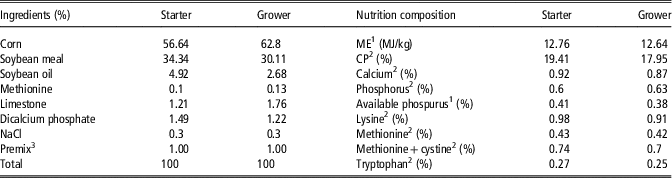
Broilers were fed a starter diet from days 1 to 21 and a grower diet from days 22 to 28 (Table 1), according to nutrient requirements for broilers published by the Ministry of Agriculture of the People’s Republic of China (2004). The calcium in diets was measured based on the standard procedures published by the Ministry of Agriculture of the People’s Republic of China (2010). The phosphorus, CP and amino acid concentrations in the diets were determined using standard procedures published by Standardization Administration of the People’s Republic of China (2000, 2002 and 2009).
Composition and nutritional levels of starter diets (days 1 to 21) and grower diets (days 22 to 28) for Arbor Acres male broilers

ME=apparent metabolizable energy.
1 Calculated values
2 Analyzed values, percent of diet.
3 Supplied per kg diet: vitamin A, 12 500 IU; vitamin D3, 3500 IU; vitamin E, 25 mg; vitamin B1, 3.5 mg; vitamin B2, 8.5 mg; vitamin B12, 0.03 mg; vitamin K3, 2.5 mg; nicotinic acid, 30 mg; pantothenic acid, 15 mg; folic acid, 1.0 mg; biotin, 0.1 mg; Zn, 110 mg; Mn, 110 mg; Fe, 80 mg; Cu, 8 mg; I, 0.35 mg; and Se, 0.15 mg.
Sampling
At day 28, following 8 h of fasting, all chickens were weighed and feed intake was measured on a per cage basis. Average daily gain, average daily feed intake (ADFI) and feed : gain (F:G) were calculated. Blood was withdrawn by cardiac puncture into EDTA- anticoagulated tubes, and centrifuged at 4000 rpm for 10 min at 4°C and stored at −20°C to determine the hormone and lipid levels. After electric stunning, about 3 to 5 g liver samples from broilers administered the 1.0 mg/kg BW β-casomorphin or saline were harvested and snap frozen in liquid nitrogen followed by immediate storage at −70°C for RNA isolation and the determination of gene expression. Approximately 30 to 50 g of the pectoral (breast) muscle, liver and abdominal adipose tissue of birds were also collected to analyze the fat content and enzyme level. All fat around the gizzard and abdomen were taken out to calculate the percentage of abdominal adipose tissue to live weight.
Measurements
The fat content in the pectoral muscle and liver was determined using fully automatic Soxhlet Apparatus (Sox416; Gerhardt, Bonn, Germany) using a procedure recommended by the China National Standardization Management Committee (GB/T 14772-2008). The concentrations of insulin, glucagon, thyroxin and growth hormone in blood were determined using the RIA kits at China Atomic Energy Research Institute (Beijing). Triglyceride and very-low-density lipoprotein (VLDL) were analyzed with a fully automatic biochemical analyzer (model CL7200; Shimadzu, Tokyo, Japan) in Beijing 309 Hospital. The concentrations of hormone-sensitive lipase (HSL) and malic dehydrogenase (MDH) in the pectoral muscle, liver and abdominal adipose tissue were measured by an ELISA kit (Cloud-Clone Corp., TX, USA) and the protocol by Rogdakis (Reference Rogdakis1974), respectively.
Total RNAs from the livers of broilers administered the 1.0 mg/kg BW β-casomorphin or saline were isolated using RNA prep pure Tissue Kit (Tiangen Biotech Co., Ltd, Beijing, China) and further purified using the RNeasy Ttotal RNA Isolation kit (Qiagen, Shanghai, China) according to the manufacturer’s instructions. Total RNA samples were then quantified based on OD260, and the purity was checked according to the OD260/OD280 ratios. The integrity of RNA samples was further confirmed on a 1% denaturing agarose gel electrophoresis. Transcriptional profiling of total RNA of 3 to 5 g liver samples was performed using the GeneChip Chicken Genome Array (GeneChip® Operating Software), at CapitalBio Corporation (Beijing, China) by following the standard procedures recommended by Affymetrix (http://www.affymetrix.com). Differentially expressed genes with a minimum fourfold change (P<0.05) were obtained using GeneSpring7.0 (Silicon Genetics, Redwood City, CA, USA). Functional annotation of differentially expressed genes was performed using DAVID Bioinformatics Resources 6.7 (Huang et al., Reference Huang, Sherman and Lempicki2009).
Statistical analysis
All data were subjected to one-way ANOVA analysis using the SPSS 16.0 software package for Windows (SPSS, Chicago, IL, USA). The results were presented as least square means±SEM. Differences were considered to be significant if P<0.05.
Results
Growth performance and fat deposition
The effect of β-casomorphins on broiler performance was found to be dose-dependent (Table 2). Administration of 1.0 mg/kg BW β-casomorphin increased average daily gain (ADG) by 15.34% and ADFI by 7.27%, and decreased F:G of broilers by 6.88% compared with the control group (P<0.05). β-Casomorphin at 0.5 mg/kg BW increased ADG of broilers by 4.71% (P<0.05). There was no difference in any performance trait between the control and the 0.1 mg/kg BW β-casomorphin group. β-Casomorphin promoted fat deposition in chickens (Table 3). Compared with the control group, fat contents in the liver of broilers from both 0.5 and 1.0 mg/kg BW β-casomorphin groups were greater by 2.80% and 11.30%, fat contents in the pectoral muscle of broilers from the 1.0 mg/kg BW group were greater by 21.32% and abdominal fat percentages to live BW of broilers from both 0.5 and 1.0 mg/kg BW groups were greater by 13.54% and 31.31%, respectively (P<0.05).
Effects of β-casomorphin on growth performance for 22- to 28-day-old Arbor Acres male broilers

ADG=average daily gain; ADFI=average daily feed intake; F:G=feed : gain.
a,b,cValues within a row with different superscript letters differ significantly at P<0.05.
Effects of β-casomorphin on fat content in liver and pectoral muscle and abdominal fat percentage of Arbor Acres male broilers (%)

a,b,cValues within a row with different superscript letters differ significantly at P<0.05.
Blood indices
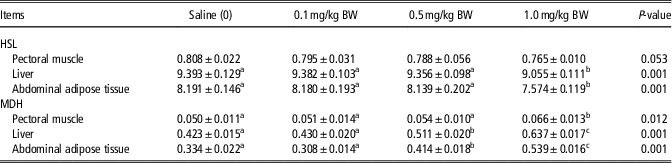
The effects of β-casomorphin on blood lipid and hormone levels are presented in Table 4. The concentrations of blood VLDL and triglyceride were increased by injecting 0.5 or 1.0 mg/kg BW β-casomorphin (P< 0.05), but unaltered with the 0.1 mg/kg BW group (P>0.05), relative to the control. Chickens had greater insulin levels in blood after injection with 1.0 mg/kg BW β-casomorphin, and reduced glucagon levels following a 0.5 or 1.0 mg/kg BW β-casomorphin injection, compared with the control group (P<0.05). No difference was observed in thyroxin or growth hormone levels among treatments (P>0.05). Table 5 shows the effect of β-casomorphin on the activities of HSL and MDH in the pectoral muscle, liver and abdominal adipose tissue. Administering β-casomorphin did not affect HSL activity in pectoral muscle. Moreover, supplementation of 0.1 and 0.5 mg/kg BW dose of β-casomorphin did not change HSL activity relative to the control. However, HSL activity in both liver and abdominal adipose tissue of broilers administered the 1.0 mg/kg BW dosage was increased (P<0.05), compared with the control. A greater MDH activity in pectoral muscle was present in the 1.0 mg/kg BW group, whereas the 0.1 and 0.5 mg/kg BW groups displayed a greater MDH activity in the liver and abdominal adipose tissue (P<0.05).
Effects of β-casomorphin on very-low-density lipoprotein, triglyceride and hormone content in blood for Arbor Acres male broilers (mg/l)

a,b,cValues within a row with different superscript letters differ significantly at P<0.05.
Effects of β-casomorphin on hormone-sensitive lipase (HSL) and malic dehydrogenase (MDH) activities in pectoral muscle, liver and abdominal adipose tissue in Arbor Acres male broilers (U/g)

a,b,cValues within a row with different superscript letters differ significantly at P<0.05.
Differential expression of the genes in liver
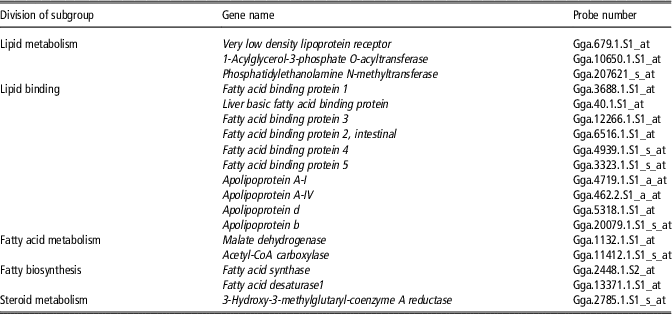
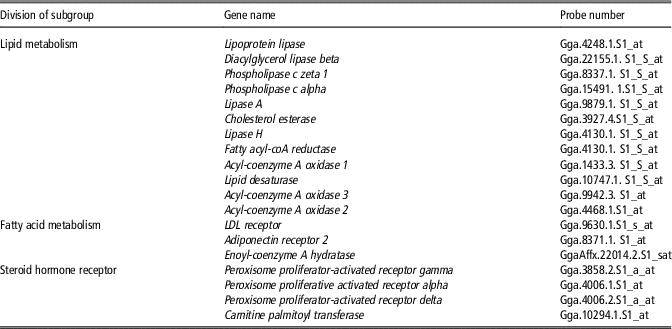
Among 32 773 transcripts on the Affymetrix GeneChip Chicken Genome Array (CapitalBio Corporation, Beijing, China), we detected the expressions of more than 28 000 genes in liver RNA samples of the chickens administered 1.0 mg/kg BW β-casomorphin or saline (control), showing a hybridization rate of 52.7% (data not shown). Using a fold difference of 4 and the false discovery rate of <0.05 as the cut-off, we identified a total of 168 differentially expressed genes, compared with control. Of those, 37 genes are directly related to lipid metabolism using DAVID Bioinformatics Resources 6.7. Among 18 genes that are induced by β-casomorphin, three genes are involved in lipid metabolism, 10 in lipid binding, two in fatty acid metabolism, two in fatty acid biosynthesis and one in steroid metabolism (Table 6). Among 19 genes that are suppressed by β-casomorphin, 12 genes are lipoprotein lipases and four genes are steroid hormone receptors, with the remaining three involved in fatty acid metabolism (Table 7).
Functional classification of up-regulated genes in liver of broilers administered 1.0 mg/kg BW β-casomorphin

Functional classification of down-regulated genes in liver of broilers administered 1.0 mg/kg BW β-casomorphin

Overall, β-casomorphin increased the growth performance, fat deposition, MDH activity in the pectoral muscle, liver and abdominal adipose tissue and the concentrations of insulin, VLDL and triglyceride in plasma, while simultaneously decreasing the activity of HSL in the liver and abdominal adipose tissue and the concentration of glucagon in plasma. These changes appear to be the results of differential expression of 37 genes related to lipid metabolism.
Discussion
β-Casomorphin derived from milk plays an important role in animal growth. It was reported that β-casomorphin may modulate gastrointestinal movement, endocrine functions and host metabolism (Nishi et al., Reference Nishi, Seino, Kitano, Kitano, Seno, Tsuji, Kurose, Taminato, Tsuda, Yanaihara, Yanaihara and Imura1987), whereas gastrointestinal hormones, such as gastrin, may modify the response of insulin and glucagon secretion to other stimuli (Exton et al., Reference Exton, Robison and Park1972). Qin et al. (Reference Qin, XU, Luo, Fang, Dong and Wang2004) showed that β-casomorphin could promote rats’ growth, influence growth-related hormones and growth factor levels in rat serum, which coincides with our partial results. In this study, injection with a greater level of β-casomorphins increased ADFI and ADG, and decreased F:G of chickens, although unaffected growth hormone and thyroxin, however, increased insulin concentrations, decreased glucagon levels in blood, which is in agreement with the result of Zhang et al. (Reference Zhang, Miao, Wang and Zhang2013). As we know, insulin secreted from pancreas can promote glycogen, protein and fat synthesis (Brockman, Reference Brockman1978), whereas glucagon could stimulate their catabolism (Gerich et al., Reference Gerich, Lorenzi, Bier, Tsalikian, Schneider, Karam and Forsham1976; Carlson et al., Reference Carlson, Snead and Campbell1993). It is reasonable that the improvement of growth performance was associated with increased insulin and reduced glucagon in the present study, and β-casomorphin increased the fat concentrations in the liver and pectoral muscle, the abdominal fat rate and VLDL and triglyceride levels in the blood of broilers in the present study. In broilers, triglyceride synthesis takes place mainly in liver. As the main form of fat stored in the body, triglyceride is transported principally by the VLDL through blood circulation. The previous research indicated that insulin as the key hormone can regulate liver lipid metabolism through the promotion of fatty acid synthesis and inhibits fat catabolism through the PI3K pathway in the liver (Shimomura et al., Reference Shimomura, Matsuda, Hammer, Bashmakov, Brown and Goldstein2000; Dong and Tang, Reference Dong and Tang2010), whereas glucagon can stimulate lipolysis (Gerich et al., Reference Gerich, Lorenzi, Bier, Tsalikian, Schneider, Karam and Forsham1976). It may deduce that administering β-casomorphin affected the lipid deposition by adjusting hormone levels related to lipid metabolism.
In addition, this study revealed that greater levels of β-casomorphin increased the activity of HSL and decreased MDH in liver and abdominal fat. Lipid metabolism is controlled by various enzymes, particularly HSL and MDH. Hormone-sensitive lipase is a rate-limiting enzyme in fat catabolism, whereas MDH is a rate-limiting enzyme in fat anabolism. So activities and levels of HSL and MDH directly affect lipid metabolism. In this study, increased fat deposition is related with raised MDH and reduced HSL activities resulting in enhanced fat anabolism and weakened catabolism. We speculate that regulation of fat deposition by β-casomorphin is achieved through interacting with hormone secretion, including insulin, and the nervous center, such as hypothalamus, and then affecting enzyme activities related with lipid metabolism and feed intake of birds, thereby promoting fat synthesis.
Body lipid metabolism is a complex physiological process involving a large number of genes. However, little is known by which β-casomorphins regulate lipid metabolism in broilers. Transcriptional profiling of the chicken liver revealed differential expression of 168 genes in response to β-casomorphin. Among the up-regulated genes related to lipid metabolism, the VLDL receptor gene is primarily expressed in hepatocytes and adipocytes. Knocking out the VLDL receptor gene caused a reduction in body fat content and BW (Frykman et al., Reference Frykman, Brown, Yamamoto, Goldstein and Herz1995), but an increase in the triglyceride concentration in the blood of mice (Sato et al., Reference Sato, Liang and Vaziri2002). This is consistent with the result that β-casomorphin increased VLDL and triglyceride content in blood of broilers in the present study. Apolipoprotein A-I gene was also found up-regulated by β-casomorphin in this study. As the main activator of lecithin-cholesterol acyltransferase, apolipoprotein A-I accelerates esterification, carting and transport of cholesterol in the cells (Kalogeris and Rodrignez, Reference Kalogeris and Rodrignez1997). Several fatty acid binding protein genes were also up-regulated. These proteins participate in the long-chain fatty acid metabolism and transport and are directly involved in triglyceride biosynthesis. Gerbens et al. (Reference Gerbens, Verburg, Van Moerkerk, Engel, Buist, Veerkamp and Pas2001) showed that the expression level of fatty acid binding proteins is directly correlated with the intramuscular fat deposition in pigs. Uysal et al. (Reference Uysal, Scheja, Wiesbrock, Bonner-Weir and Hotamisligil2000) indicated that triglyceride synthesis is reduced when the fatty acid binding protein gene is knocked out in rats.
Among the genes related to fatty acid metabolism, function of MDH mainly is to catalyze malate to oxaloacetic acid. Nicotinamide adenine dinucleotide phosphate produced in this process may supply H+ for fatty acid synthesis. Whitehead and Griffin (Reference Whitehead and Griffin1984) showed that a positive correlation existed between malate dehydrogenase activity and body fat composition in chickens. This is consistent with the result that β-casomorphin increased MDH activities in pectoral muscle, liver and abdominal adipose tissue in the present study. Acetyl-CoA carboxylase is the rate-limiting regulatory enzyme of fatty acid synthesis. It primarily works to catalyze extension of the fatty acid chain in synthetic process by biotin as prosthetic group. Douaire et al. (Reference Douaire, LeFur, Khadir-Mounier, Langlois, Flamant and Mallard1992) found that some enzymes including Acetyl-CoA carboxylase could increase the thickness of abdominal fat pad.
Among the genes related with fatty acid biosynthesis, fatty acid synthetase primarily catalyzes methylmalonyl-CoA or acetyl-CoA to palmitic acid. The level and activity of fatty acid synthetase affects lipid metabolism in animals. Lewis and Steiner (Reference Lewis and Steiner1996) indicated that insulin could promote the fatty acid synthetase gene levels and triglyceride synthesis via the regulation of assembly and secretion of hepatic VLDL. Thus up-regulated gene expression of fatty acid synthetase is associated with up-regulated gene expression of VLDL receptor and increased VLDL content in blood, and the key regulator insulin. Fatty acid dehydrogenase is a rate-limiting enzyme whose function is to catalyze the formation of an unsaturated bond at a special position. Fatty acid dehydrogenase is widely distributed in all living organisms. 3-Hydroxy-3-methylglutaryl-Coenzyme A reductase is related to steroids and plays a role in the reduction of 3-hydroxy-3-methylglutaryl-coenzyme A to mevolate. It is a rate-limiting enzyme in the process of catalyzing synthesis of cholesterol or other sterol. So far, little information exists on the effect of 3-hydroxy-3-methylglutaryl-coenzyme A reductase on lipid metabolism in birds. In brief, β-casomorphin up-regulated the expression of those genes related to fat anabolism.
In down-regulated genes related to lipid metabolism, lipoprotein lipase is a rate-limiting enzyme of fat catabolism. Its primary function is to hydrolyze triglyceride binding with lipoprotein in animal blood to produce glycerol and free fatty acid. Hermier et al. (Reference Hermier, Forgez, Williams and Chapman1989) proved that the lipoprotein lipase activity could affect the deposition rate of fatty acids in broilers. β-Diacylglycerol lipase is mainly related to triglyceride hydrolysis, whose function is to catalyze diacylglycerol to monoacylglycerol. It is not rate-limiting for triglycerol hydrolysis so as little research on its effect on birds has been completed so far. Phospholipase Cα/ζ is a member of the phospholipase C family, whose physiological function is to catalyze phosphatidylglycerol to diglyceride and phosphorylcholine. Lipase A/H belongs to acylglyceride carboxyl ester hydrolase. Its physiological function is to hydrolyze triglyceride to diglyceride and free fatty acid. Acyl-coenzyme A (1/2/3), the expression product of acyl-coenzyme A gene, is rate-limiting for β-oxidation of fatty acids.
In the genes related with fatty acid metabolism, lower density lipoprotein receptor gene, its expression product is a glycoprotein at the surface of cellular membrane, binds with apoproteins and transfers them into the cell. Thus, it plays a key role in regulating cholesterol metabolism. Adiponectin, the specific protein from adipocyte, is negatively related with obesity of animal. Adiponectin plays a role by binding with adipoR1 and adipoR2. Enoyl-coenzyme A hydratase gene has an expression product that is an enzyme in the β-oxidative system in cellular mitochondria and peroxisomes. Its main function is to catalyze the catabolism of fatty acids.
Among the genes related to steroid hormone receptors, peroxisome proliferator-activated receptor α, γ and δ genes belong to the peroxisome proliferator-activated receptor family and are intracellular receptor transcription factors. They mainly control adipocyte differentiation and cellular lipometabolism. The product of the carnitine palmitoyl transferase gene is distributed in cellular mitochondrial membrane and works to accelerate the oxidation of long-chain fatty acid in mitochondria. Lien and Horng (Reference Lien and Horng2001) proved that carnitine could regulate lipid metabolism of broiler chickens by controlling the carnitine transferase activity. Collectively, β-casomorphin down-regulated the expression of genes related to fat catabolism. These changes in the expression of genes were consistent with those in hormone levels, enzyme activities, blood lipid content and body fat deposition. From these, we deduced that administering 1.0 mg/kg BW β-casomorphin resulted in changes in insulin and glucagon, and then affected enzyme activities and the expression of gene related to lipid metabolism, thereby led to difference in lipid content in blood and body, compared with control.
In conclusion, β-casomorphin increased the growth performance and fat deposition of broilers. Regulations of β-casomorphin on fat deposition and feed intake are achieved through changing hormone secretion, enzyme activities and the expression of genes involved in lipid metabolism.
Acknowledgments
This study was supported by the China Agricultural Research System (CARS-41-G08) and the Agricultural Science and Technology Innovation Program (ASTIP). The authors thank professor Guolong Zhang (Oklahoma State University, Stillwater, OK, USA) for revising the language in this paper.
Declaration of interest
The authors have declared that none of the work contained in this manuscript is published in any other journal, and there are no conflicts of interest.
Ethics statement
The care and use of all experimental birds were approved by the Animal Care and Use Committee of the Feed Research Institute of the Chinese Academy of Agricultural Sciences (CAAS) in China.
Software and data repository resources
None of the data were deposited in an official repository.