Several years ago, I was watching a production of Lucia di Lammermoor at the Kansas City Lyric Opera. The title character had just signed her marriage contract near the end of Act II. She and Arturo, the ill-fated groom, left the stage for a theatrical reality unseen but imagined: the place where Lucia would become fatally unhinged, committing the infamous murder whose aftermath the audience had come to see. I awaited her next appearance, when she would no longer be an operatic Juliet nursing a forbidden love, but a madwoman with a homicidal past. Soon she emerged, bloodstained and disheveled, eyes fixed on a faraway place, hands clinging to the rail at the top of a staircase – a display of brutal operatic glory, arousing pity and horror from the onlookers on stage and off. She started to sing of marrying Edgardo, her melody recalling an intimate moment when the two had exchanged rings in simulation of a wedding ceremony during Act I.
But something about Lucia’s pose seemed uncannily familiar to me. I quickly dismissed the notion, thinking it both odd and obvious: of course it felt familiar. I had seen this opera, and others like it, many times. Nevertheless, I felt annoyed to have been drawn out of the drama by a distracting thought that had sneaked up on me unbidden, and before I quite realised what was happening, Lucia started to slip away from me. Soon another woman was inhabiting the stage – or rather, inhabiting the bride. Lucia became Norma Desmond. As I watched her mad scene unfold, I managed to stifle my laughter (but only just).
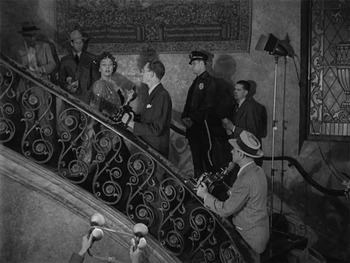
Unlike Lucia, Norma is no ingénue, and she commits murder in plain sight of the spectator. An aging movie star from the silent era, she occupies a decaying, decadent Los Angeles mansion that recalls both Miss Havisham’s place and the wasted castle of Lammermoor. Joe Gillis, a screenwriter-turned-gigolo, moves into Norma’s mansion, ostensibly to edit her convoluted screenplay of Salome, the film that she hopes will reignite her Hollywood career. When Joe finally packs his bags to leave Norma for good, she shoots him twice in the back, with a third shot sending him tumbling into the pool. She returns to her second-floor bedroom after the shooting, and the press arrives to document the crime. Seeing the cameras, Norma – played by Gloria Swanson – retreats to a fantasy of bygone glory. (Swanson described the final moments of the film as a mad scene in which her character ‘descended [the staircase] as if in a trance’.Footnote 1 ) Eyes fixed in a faraway gaze, Norma imagines that she is playing the role of Salome, unaware that the crowd of onlookers sees her as a criminal or a lunatic, and not a star (see Fig. 1).
Norma Desmond as Salome in Sunset Boulevard.

When I told academic friends about seeing Lucia-as-Norma, they advised that my experience signified the postmodern condition: embrace it, and be not troubled. Ghosts like Norma may impede the viewer’s suspension of disbelief, but they also may invite kaleidoscopic allusions external to the narrative, enabling viewers to generate vast networks of meaning that exceed those usually created from one dramatic vantage point. Was I not aware that the Author is dead?Footnote 2 That we are all at home in the age of the open text, when ‘every sign, linguistic or nonlinguistic, spoken or written (in the current sense of this opposition), in a small or large unit, can be cited’?Footnote 3 As Derrida said, the sign – including image and sound, for my purposes – ‘can break with every given context, engendering an infinity of new contexts in a manner which is absolutely illimitable’.Footnote 4 This is surely what happened with Norma, whom I had unwittingly ‘cited’ – and yet somehow the citation, instead of generating a profusion of meanings, seemed momentarily to neutralise meaning altogether. My impulse to laugh at Lucia-as-Norma was replaced almost immediately by a sense of loss, as the scene’s dramatic pretext gave way to a disjointed jumble of signs. I had thought that familiarity with postmodernist criticism would have inured me to this feeling. ‘We are all melancholic’, as Baudrillard pointed out decades ago, with neither sympathy nor surprise.Footnote 5
But I found myself longing to recapture my early experiences as an operatic spectator, when I watched differently, with little sense of expectation, less historical knowledge, and no sense of what I was getting myself into. Never would Norma Desmond have intruded then. I would have been fully immersed, entrained to each musical moment; there would have been no opportunity for my attention to waver, to notice Norma lingering at the threshold of my consciousness.
Did I ever truly watch this way? Or am I longing more for fantasy than memory? Of course I was aware of the act of watching an opera while watching it; I was captivated by an illusion, not a delusion. But if I watched opera the way in which Roland Barthes claimed to read a text, then I was not immersed in the way I had thought. Barthes suggested that it was not the content or structure of a narrative that he enjoyed, but the ‘abrasions I impose upon the fine surface: I read on, I skip, I look up, I dip in again’.Footnote 6 The pleasure of great narratives thus lay in ‘the very rhythm of what is read and what is not read’.Footnote 7 How could this be? I was sure that my greatest pleasure as a spectator was bound up in thorough immersion, not in skipping and dipping, and that somehow I had lost the capacity to be focused this way.
I was acting like a nostalgic who ‘dreams of a moment before knowledge and self-consciousness that itself lives on only in the self-consciousness of the nostalgic narrative’, as Susan Stewart notes.Footnote 8 A friend who introduced me to Stewart’s views on nostalgia did not say, ‘This is what you have. Now stop complaining.’ But had we been living in another age, she might indeed have described my post-operatic reaction as a kind of sickness. Nostalgia was once believed to have a physiological cause; in the seventeenth century, a Swiss medical student coined the term to describe a keen sense of homesickness felt by mercenary soldiers.Footnote 9 In the nineteenth century, nostalgia was considered a psychological disorder; during the Civil War, diagnoses of chronic nostalgia occurred so frequently that some regiments restrained their bands from playing ‘Dixieland’ or ‘Home, Sweet Home’ – songs that might inspire desertion, which could spread through a camp as swiftly as a cholera epidemic. By the twentieth century, as Michael Dwyer and Svetlana Boym claim, nostalgia became attached to a sense of temporal rather than spatial displacement.Footnote 10 It also continued to be pathologised by scholars, who have aligned it with kitsch, false memory and historical amnesia.Footnote 11 Boym characterises nostalgia differently, recognising that it involves a sense of mourning, even if the object of longing is a fantasy. Dwyer puts it more pointedly: ‘Nostalgia is the product of an affective engagement with the present that produces a sense of loss. Whether that loss is real or perceived is not the point. The point is that we find something lacking in our current condition.’Footnote 12
Nostalgia finds fertile ground in minds predisposed to imagining what might have been, but conditions must be ripe for its planting. If nostalgia is a ‘sentiment of loss and displacement’, as Boym suggests, then the appearance of Norma-as-Lucia might have created the sort of vexing disjunction that led me to develop nostalgic feeling.Footnote 13 Yet all sorts of perceptual disjunctions appear in theatres and concert halls without necessarily inspiring spectators to feel a sense of mourning for another place or time. Listeners often attend concerts without giving much thought to the arrangement of pieces on the programme, even when they reflect disparate temporal and stylistic juxtapositions – most of which occur ‘outside of historical time’,Footnote 14 as if Bach, Beethoven and Boulez might be relative contemporaries. In the theatre, spectators see period dramas festooned with disco balls and neon leg warmers, often without batting an eye. Perhaps this is because the incongruities and anachronisms are made apparent from the moment the curtain rises: spectators tend to acclimatise to oddities that might seem laughable or distracting in other contexts. This process of perceptual assimilation happens gradually, without disrupting the temporal linearity of the drama, as Norma did in Lucia.
One of the factors that determines whether or not we, as spectators, accept such incongruities is how we perceive dramatic time – an important element in all theatrical productions, but especially in those that incorporate extensive musical underscoring, such as opera. Drama creates an illusion of sequential passage with a variety of temporal strategies that include the work’s historical setting, the rhythm of the characters’ speech, prolepsis and analepsis, and temporal compression through narration. Operas interweave these familiar strategies with singing and orchestral music, producing a heterogeneous musical temporality characterised by ‘two entwined vectral forces: the musical laws of tempo and rhythm, melody and harmony and, with and through those, the associative trails of memory, affect and identification’.Footnote 15 Music mediates the spectator’s experience of temporal passage – or, alternatively, it replaces that sense of passage with something that arises from the musical experience itself. Since music also activates involuntary memory, it can elide the listener’s present and past. Indeed, as Tia DeNora argues, music does much more than construct memory: it ‘provides a device for unfolding, for replaying, the temporal structure of that moment’, serving as a ‘container for the temporal structure of past circumstances’.Footnote 16
No wonder I was annoyed. There I was, riding the opera’s musical current – an illusion of continuous and changeless temporal flow so effective that I was scarcely aware of it. Then Norma appeared, introducing a kind of reverse bricolage, as the image of Lucia at the top of a staircase redounded multiply, blurring the distinction between character and actor, awakening memories that I had long forgotten. Her appearance shattered the foundational illusion of theatrical spectatorship, exposing its structural undergirding. Dramatic time no longer seemed homogeneous, sequential, progressing irreversibly from beginning to end. And with this unravelling of time came a decentring of dramatic space, rendering its boundaries porous. The operatic performance, like Derrida’s open text, became ‘a differential network, a fabric of traces referring endlessly to something other than itself, to other differential traces’, its profligate multiplicities displacing the apparent singularities of character, setting, plot: these people, in this place, doing these things. Its ‘fabric of traces’ became so capacious as to seem meaningless.Footnote 17 Norma was one such trace, stirring my nostalgia for a time when I watched opera with fresh eyes and fixed intent.
It was one thing, I found, to be converted to the gospel of the open text as a scholar. It was quite another to live it as a spectator. Norma’s ghost had introduced a postmodern theatrical experience to an otherwise straitlaced operatic production, injecting it with fractures and discontinuities that muddled my sense of characterisation, dramatic trajectory, emotional engagement, and temporal passage. But to me, her ghosting also felt trivialising – a pop culture gloss, or a visual and sonic mash-up of duelling divas that rendered the emotional dangers of watching the opera lamentably small. I wondered: could I admit the ghostly Norma Desmond while remaining captivated by the dramatic world of the opera? Might I appreciate Lucia as a historical phenomenon in the midst of experiencing a glaring anachronistic irruption? Could I have my opera cake and eat it, too?
My attempt to reconcile Lucia and Norma in a shared dramatic space also led me to question the relationship between history and criticism, which I felt existed in a sort of guarded polarity. Criticism thrives on synchronic time both within and beyond the work itself: each work exists simultaneously for critics, who might draw upon a sound or image as if pulling it from a filing cabinet, without suffering pains about whether such juxtapositions answer to conventional historical accounts. (Juxtaposition is its own sort of method.) But historians locate a work within particular social and cultural infrastructures that form the crux of multiple, intersecting chronological narratives (with many more yet to be written). The historical position of the work always matters. When criticism adopts a chic postmodern garb, historical study can seem stodgy by comparison, especially when it occurs in the manner that Rita Felski describes it:
History presumes a confident knowledge of what really happened in the past and an imperious urge to organize the chaotic flux of time into a single streamlined story. In short, we can think of history as a modern mirage, an ephemeral fantasy spun out of words that tries to pass itself off as an objective account of how things really are. Postmodern thought shatters this apparently stable ground and radically alters our way of thinking about time … Time loses its arrow; it no longer has a coherent goal or direction.Footnote 18
Historians are not, I think, as confident about what really happened as Felski believes, nor are we beguiled by the fantasy of a single narrative (not anymore). But neither are we comfortable with reversing or distorting the arrow of time.
In what follows, I examine Lucia through a distinctly ahistorical, even anti-historical mode, with the ghost of Norma Desmond functioning as both a secondary subject and an interpretative device. In so doing, I show that spectres never arrive unaccompanied: Norma brings Salome to the party – another member of that ghostly club of murderous women for whom spectacle, madness, aging and adolescence converge. (Billy Wilder, the director of Sunset Boulevard, apparently had Strauss’s teenage princess haunting his vision, too. But more about that later.)
Salome’s presence affirms to me that in seeing Norma’s ghost, I experienced what Jodey Castricano calls ‘cryptomimesis’ – a spectral effect produced by attending to the borders that separate inside from outside, observing ‘spaces that have hitherto been disavowed: they are profane, mad, unconscious, feminine’.Footnote 19 Cryptomimesis further implies that these borders are not only porous but also illusory. I claim that seeing Norma-as-Lucia produced a temporal locus for nostalgia and mourning – a moment of present awareness bifurcated by my idealisation of past experience and my anticipation of a ghost-filled future. By extension, I suggest that the ghostly effects of spectatorship may inform opera scholarship by demanding greater attention to musical and dramatic peripheries, where voice, audience and orchestra (or soundtrack) converge. When such moments occur, as they do in Lucia and Sunset Boulevard, they reveal what audiences already know but have silenced or suppressed: our relationship to the work is, as Richard Dyer suggests, ‘at once within and without it, longing for it yet also knowing that we can never quite fully inhabit it; we are ironically attached’.Footnote 20
My study of spectral effects also unveils what seems like a paradox: that anti-historical criticism can be a historicising act. After seeing Norma’s ghost, I mourned over having lost an experience that I probably never had. This sense of nostalgia led me to critical paths that sundered chronological order, leaving it in tatters on the floor. And yet, by inverting temporality – by twisting the arrow of time back on itself – I acknowledged the temporal contradictions inherent in historical work and assigned productive meaning to nostalgic impulses that engage a reflective mode of thought. As Boym suggests, this type of nostalgia is ‘not merely a pretext for midnight melancholias’.Footnote 21 It can even undo the polarity that I had presumed to exist between history and criticism.
Spectral effects and the artifice of performance
The ghosts in Donizetti’s Lucia di Lammermoor behave as ghosts usually do, reviving the presence of the dead while reminding us of their absence. The opera, drawn from a novel by Walter Scott, features a Romeo-and-Juliet affair, as Lucia and Edgardo, the offspring of rival families, pursue a secret romance. But unlike Shakespeare’s Juliet, Lucia finds her relationship complicated by the recent death of her mother. It was near her mother’s gravesite that Edgardo had saved Lucia from a charging bull, stirring her ardour and securing her devotion. In Act I, as she awaits a morning tryst with Edgardo, she looks at a nearby fountain and recalls an encounter she once had with a ghost there – a Lammermoor ancestress who had been stabbed and drowned by a jealous Ravenswood. Lucia’s handmaid, Alisa, has not seen this ghost, and neither have we, the audience; its existence hinges on the memory of a woman whose grief has diminished her capacity for reason.Footnote 22 This grief intensifies as Lucia’s brother, Enrico, arranges for her marriage to Arturo, an alliance that will save the crumbling Lammermoor fortune. But the marriage is doomed when Lucia stabs and kills Arturo in Act III.
In the mad scene, Lucia herself evokes the ghostly duality of presence and absence: her ashen pallor renders her body spectral, even as her voice powerfully asserts her bodily existence.Footnote 23 Other ghosts enter and leave the stage without our seeing them, but Lucia is poised at the threshold of mortality, capable both of seeing them and being seen by us. She evokes Alice Rayner’s description of theatrical performance itself, which ‘gives appearances to the unseen, the hidden, and to the chronic return of the theatrical event from nothing to something’.Footnote 24 Rayner folds the dualities of ghostliness into the singularity of the theatrical event, distinguished by its temporal and physical transience.Footnote 25 Such qualities are heightened in musical performance: sound, which has neither material substance nor a fixed spatial location, envelops space, but it starts to decay immediately, giving the sense that it is forever escaping our capacity to hear it. Lucia’s vocal ebullience belies her ghostly presence, giving physical embodiment to the spectral qualities of music, filtered through the vertiginous fragmentation of delirium.
Like all characters, Lucia is also haunted by ghostly performers. The performance history of the opera itself supports the notion that she is a highly changeable being whose transfiguration into Norma should not have surprised me so much. Before 1850, her character-defining mad scene was shorter, less virtuosic, and so difficult to perform from an acting standpoint that some critics found it burdensome to watch.Footnote 26 Lucia was seen then to lack the virtue and tractability that typified the other mad girls in her peer group; her ravings had a homicidal quality that unfavourably contrasted with their moral and sexual purity.Footnote 27 By the late nineteenth century, her cadenza had expanded in length, virtuosity and prestige, and with it came perceptions of Lucia as a vampiric femme fatale,Footnote 28 more similar to Carmen and Salome than her mad operatic sisters. The ghost of Norma Desmond merely introduces a new phase in the characterisation of Lucia: from vampire to campy vamp.
This phase is rooted in cultural and artistic practices that were prevalent in the nineteenth century, if not before. For many spectators, the attractions of Romantic opera included the virtuosity of the singers and the sociality of seeing and being seen, both experiences that transcended – or, in some cases, besieged – the operatic drama. Modern spectators enjoy some of these same attractions: after watching my favourite tenor sing ‘Nessun dorma’, I might spin silent rhapsodies about the performance in my head, even as the drama propels forward without me. But ghosting complicates the temporal immersion of the spectator in ways that Donizetti could never have anticipated. Even as I empathise with his characters, pity them or gape at them with horror, postmodern fissures crack the dramatic frame. Ghosting foregrounds temporal synchronicity over chronology, drawing attention away from the linear temporality of the story and inviting the spectator to pursue fugitive thoughts in a sort of virtual present.
More troublingly, ghosting can function like an alienating gloss. To me, Norma was a foreign contagion in a body already under attack by hostile forces. Her presence poked holes in the apparent dramatic illusion, unveiling stunning incongruities that some spectators have long ignored: fifty-year-old women playing teenage virgins, voices that artfully bellow, flights of fioritura after the fatal blow. Norma’s face and stagecraft had aged beyond relevance in Hollywood, but she would have been in her prime at La Scala. Behind Norma’s spectral presence, spectators may spy other ghosts who know the confluence of age and obsolescence. Margo Channing, played with arch hauteur by Bette Davis in the 1950 film All About Eve, was beloved for portraying naïve Southern belles half her age. Joan Sutherland reprised the role of Lucia at the Metropolitan Opera in her mid-fifties, when she had a teenage son close to the age of the character she played.
Opera audiences – more so than viewers of film and theatre – have traditionally permitted the body to age, so long as the voice remains supple. And yet, when Norma inhabits Lucia, opera’s fiendish agreement with audiences that the voice shall transcend the body of the character, no matter how absurd the match, is broken. So, too, is the unspoken vow of solemnity that we take when seeing a tragic opera: whatever happens, we promise not to laugh. (At least, not for the wrong reasons.) But it seems impossible to keep such a vow when Lucia, Gothic ingénue, becomes Norma, campy celebrity burlesque.
Though ghosting disrupts dramatic linearity, it aligns nicely with a camp aesthetic. I imagine camp not according to Sontag’s definition, which sprawls from here to the hinterland, but in a modest, delimited sense.Footnote 29 Camp’s stylistic qualities, for my purposes, include exaggeration, theatricality, subversion and a tendency to fuse high and low art forms, often (but not exclusively) in a gay male context. But more important than these characteristics – which, once categorised, may cease to be subversive – is the potential for camp to manifest a queer temporality of the sort that Judith Halberstam describes. For Halberstam, ‘queer time’ emerges, in part, as a consequence of the AIDS crisis of the 1980s, from which the ‘constantly diminishing future creates a new emphasis on the here, the present, the now’.Footnote 30 Queer temporality might also be situated outside of chronologies governed by reproductive norms, creating lives of different rhythms and speeds from those that follow hetereonormative scripts.Footnote 31
Wayne Koestenbaum’s view of camp in operatic performance focuses chiefly on theatricality and excess. As he suggests, ‘it’s camp, and it’s vindication, to receive applause for maintaining a haughty distance from the role you’re supposed to inhabit’.Footnote 32 For singers disinclined to inhabit their roles – which was more common decades ago than it is today – the magnetic aura of celebrity glows from within the character’s body, as the performer refuses to sacrifice the ‘particularity of self’Footnote 33 to the anonymity of representation. Singers who perform in this manner have made themselves the spectacle, which contributes to the sense that their performance is camp: they have subverted the dramatic illusion of the opera, declaiming its artifice at the top of their lungs. They interrupt its temporal flow and introduce the queer temporality of ‘the present, the now’, which converges with, or replaces, the illusion of linear dramatic time. They put a spotlight on the boundary that seems to separate inside from outside, making the theoretical ‘open text’ a performative reality.
The flighty spectacle of Lucia’s mad scene, which launches the diva into histrionic excess, seems campy even without the spectre of a drag queen icon behind it. Add Norma’s leering cat-eye gazes, writhing hand gestures, and penchant for animal-print-everything, and the mad scene becomes spring-loaded with folly. As the wedding guests sing Donizetti’s hushed, quasi-liturgical chorus in a moment of repose from Lucia’s theatrics, spectators might imagine a musical gloss: the gaudy, grotesque tango written by Franz Waxman that accompanies Norma’s mad scene, as she glides towards the camera for her close-up. In the face of these incongruities, musical and dramatic teleology suffer the same fate (certain death), and spectators are left with a nettlesome problem: how to squash their laughter.
The camp effect may also occur, as Andrew Ross argues, when the ‘products … of a much earlier mode of production, which has lost its power to dominate cultural meanings, becomes available, in the present, for redefinition according to contemporary taste’.Footnote 34 Ross notes that in Sunset Boulevard, Norma is not just a garish anachronism of the silent era; she also represents the ‘crumbling aristocracy’ of Hollywood in the 1950s, reflecting contemporary anxieties about the value and prestige of film in an age increasingly turned on by television. (Much the same might be said of opera, which no longer dominates the Western cultural landscape despite its continued viability as an art form.)
The campy undertones that accompany Norma’s presence in Lucia make her seem cunningly modern. She evokes the technological, cultural and aesthetic transformations that have advanced new forms of media while upending old ones, like the advent of sound in silent film, or the continuing relevance of film in the age of television. Yet at the same time, she inhabits a film from a golden age past in which she herself was already a historical remnant. While Joe’s clipped, indifferent speech sounds dated to the modern ear, Norma’s stylised acting hails from a much more distant past, derived not only from the silent era, but also from nineteenth-century melodramas that gave rise to the earliest screen actors.Footnote 35 Her speech rhythms fit neither Joe’s era nor our own. They spin a temporal vortex in which she, alone, exists – a deliberate obstruction to the chronological linearity that has condemned her to irrelevance.
Norma displays her keen sense of temporal passage most poignantly when viewing film reels that show her frozen in time – an inversion of Dorian Gray’s experience, as she is ‘haunted by a screen image that refuses to grow old’.Footnote 36 Nevertheless, she wants to work in the film industry, not merely to remember it. She exited her child-bearing years without (as far as we know) giving birth, and she divorced her husband, rejecting the scripts conventionally assigned to women; she continues to seek starring roles in an industry that, for women, rewards youth, inexperience, beauty and pliability. In so doing, she inhabits a sort of queer temporality, responding to reproductive rhythms and gendered milestones with a list of alternative demands.
Jodi Brooks describes how a quintet of female film characters, including Norma Desmond, were once cultivated as visual commodities, but now resist becoming cultural refuse:
Both their refusal to leave the stage and the ways in which they negotiate their status as image take the form of stretching time, of re-pacing the temporality of spectacle, display, and performance. On the one hand, these women stand as dinosaurs, museum pieces, historical markers, and confront being left in the dead time of the museum … On the other hand (or at the same time), these characters’ negotiation of their position as cultural refuse takes the form of summoning and displaying the discarded.Footnote 37
Brooks’s words apply not only to Norma, but also to operatic performance itself. For those who love it and hate it alike, opera expertly manipulates time: a single plot point can take thirty minutes to unfold in Wagner’s hands, and operatic time can elongate to accommodate reflective arias that do little to advance the drama. Opera always risks becoming a museum piece, unfolding in what are already ‘historical markers’ – the grand theatres of yore that spectators might tour during daylight hours before the evening performances. Norma-as-Lucia is a mediated figure who embodies the declining position of opera in today’s entertainment hierarchy. Of course, opera still figures prominently in popular culture, mostly to sell consumer products from athletic shoes and airline travel to beer and chewing gum.Footnote 38 Perhaps this was another reason Norma’s presence irritated me: she was mocking opera’s artistic relevance while wearing Salome’s costume. But at least I could see how Norma’s struggle – her queer temporality, her campy proclivities – might belong in the world of opera, even if they did not seem to belong in Lucia herself.
I wonder now if the spectator-critic in me has aired enough of her discontents. So far, she is a hypocrite. She finds the open text appealing in theory, but not in practice. She wants to watch Lucia’s mad scene without thinking about camp, or aging, or the decline of opera. She still thinks that Norma is an interference; had a fire alarm gone off during the performance, she would have considered that to be an interference, too. She wants history to remain history, untainted by anachronistic critical pursuits. Can anything be done for her?
As it turns out, yes. But only by turning to the Gothic.
Gothic ghosts and temporal transpositions
The nineteenth-century fashion for oppressed operatic madwomen owes much to the Gothic writings of Horace Walpole and Ann Radcliffe.Footnote 39 These novels traffic in a ‘curious compound of the unknown and the too well-known’, as familiar atmospheric clichés – dungeons, blighted castles, ominous darkness – lend material substance to otherwise digressive and hallucinatory narratives.Footnote 40 The plot of Walpole’s 1764 novel, The Castle of Otranto, provided a template for writers seeking sensational and phantasmagoric effects. In the despotic Manfred’s pursuit of the ingénue Isabella, Walpole introduced scenarios that would come to define the Gothic tale: supernatural terror, escape through an underground crypt, imprisonment in a tower, familial murder. Walpole achieved his dark-alley haunts not just with setting and plot, but also through narrative technique. He often projected the thoughts and feelings of his characters in third-person narration, imperilling the observational status of the narrator. Characters are thus pursued by their ‘own internal desires and fears more than by any external monsters or demons’.Footnote 41
Lucia was certainly pursued by both. Like many Gothic heroines, she sees ghosts that the audience cannot see. She also perceives imaginary music that may or may not be audible to the theatrical audience – a phenomenon that resembles Walpole’s merging of character and commentator, which eliminates the marginal safety of an external narrative voice. Her story unfolds in a characteristically wasted castle, where she experiences emotional and sexual coercion, followed by madness.Footnote 42 Arturo’s murder is complicated in ironic fashion: Lucia wields a phallic object with deadly force and soaks her own gown in her victim’s blood. (Had things gone the way Arturo had planned, he would have penetrated Lucia instead, drawing the blood of defloration.)
The Gothic trappings of Lucia translate seamlessly to Norma’s story, and they might readily be found in other horror and suspense films, too. Sunset Boulevard opens with the latent strangeness of voice-over narration, with the viewer soon learning that the disembodied voice belongs to Joe, the corpse that the police are fishing out of Norma’s swimming pool. As Joe’s ghost narrates his tale through analepsis, Joe himself enacts it. In a reversal of gendered Gothic types, he plays the role of imprisoned ingénu, though he seems more complicit in his captivity than most Gothic victims. (Billy Wilder, the film’s director, underscores this inversion of gender roles and Joe’s accompanying anxiety; for example, when Norma tells Joe that she wants him to have a ‘big, luscious pearl’ as a cufflink, he replies, ‘Well, I’m not going to wear earrings, I can tell you that.’) The film’s morbid fascination with Old Hollywood evolves through the face and figure of Norma Desmond; images of Norma in her fashionable prime peer out at us like glamorous prisoners from another age. Joe’s first meeting with her resembles an encounter with Dracula or Nosferatu: she appears first as a silhouette, and then emerges dressed in black, presiding over the coffin of a chimpanzee.Footnote 43
The surface similarities between Lucia and Norma’s stories become more compelling in light of Anne Williams’s suggestion that Gothic tales almost always ‘express some anxiety about “meaning”’ – particularly how it is conveyed, manipulated or obscured.Footnote 44 Williams notes, ‘In Gothic, fragments of language often serve ambiguously to further the plot – in letters (lost, stolen, buried); in mysterious warnings, prophecies, oaths and curses; in lost wills and marriage lines. Such fragments may be misinterpreted … and frequently deceive or betray the interpreter.’Footnote 45 Lucia’s letters to Edgardo were intercepted thanks to her scheming brother, Enrico, who gave Lucia a forged letter in which ‘Edgardo’ reported that he loved someone else. Max, Norma’s butler (and first husband) faked Norma’s fan mail, leading Norma to believe that she was remembered and beloved many years after having left the screen.Footnote 46 Both women find themselves betrayed by the written word, which resists their attempts to draw truth from it. (Such is the fate of the critic in her own life.)
The fragmentary construction of meaning in Gothic texts reflects the process of cryptomimesis – the spectral effect produced by attending to boundaries that separate inside from outside. In Gothic literature, the potency of this effect depends upon boundaries that are clearly defined and regulated, whether by structure, theme or attentional and interpretative mode. But Gothic texts are also open texts, just like any others. Their borders, even when policed like a garrison state, are illusory. Madness, which turns up frequently in Gothic literature – particularly in female characters – is one way in which the text performs its own cryptomimesis: it turns the inside outside, externalising for the reader a psychological or physiological phenomenon (however we might construe it) that is deeply personal and often poorly understood.
Norma’s madness was a spectacle worthy of the operatic stage, complete with the film equivalent of a grandiose exit aria. While 1950s critics hailed the vision of Billy Wilder – auteur, director and co-writer – audiences were enticed by the film’s scandal and extravagant display.Footnote 47 Film critic Bosley Crowther suggested that the popular success of Sunset Boulevard lay partly in its ‘spewing madness and degeneration’, borrowing its tactics from sensationalistic journalismFootnote 48 (or, one might imagine, opera). Gloria Swanson ‘dominates the picture’, as one critic put it, noting that ‘even in those few scenes when she is not on screen, her presence is felt like the heavy scent of tuberoses’.Footnote 49 If Norma’s emotional fragility and homicidal madness relegate her to an operatic type – the oppressed woman who ‘escapes’ through delusion, drugs or death – Swanson’s performance mirrors the virtuosity of female singers who command the spectator’s attention. She returns our gaze and compels us to watch her.
Though Norma’s mad scene may be seen as a type of flight or a moment of transcendence, it arises from ugly constraints. Her body is her destiny – an iconic symbol of beauty admired, transfigured and lost. She cannot unmake the ravages of time, nor can she remake the expectations of Hollywood. Like Lucia, she shows signs of psychological instability long before her mad scene, including a suicide attempt on New Year’s Eve. Believing that Cecil B. DeMille plans to mount a production of her Salome script, she undergoes ambitious anti-aging treatments. Unable to recapture her former glory, she suffers delusions and commits murder. The spectacle of her madness is heightened by the presence of cameras, standing in for the theatrical spectator as they train their voyeuristic lenses on an unwitting subject. After Norma shoots Joe, she emerges from her bedroom accompanied by police officers. Reporters block the top of the staircase, jostling each other, camera bulbs flashing. Max issues a few verbal cues: ‘Quiet, everybody! Lights!’ Norma is initially confused, but after hearing Max, she falls into the character of Salome, assuming the traditional actor’s burden – to ‘become a ghost who wears a human, living mask’.Footnote 50 She transforms the present to suit her delusional reality, where she is not only relevant but also beloved.
At first it seems that Norma’s madness is safe for spectators, trapped behind a celluloid barrier that protects us from infection. Breaking character to address what she perceives to be a film crew, she describes the intimacy of spectatorship – ‘just us’ – and gestures towards the theatrical audience as she remarks on ‘those wonderful people out there in the dark’. As she moves in for her close-up, the camera image shifts out of focus and the lighting glares white. Her close-up creates the illusion of intimacy and physical proximity, but it is a phantom sensation that Van Elferen describes as ‘hauntography’, in which ‘hauntology’ is mediated by technology.Footnote 51 Norma enters an intermediate space that presses up against our own, her writhing fingers threatening to puncture the screen. We watch Norma ‘trespassing beyond where the lens can see’,Footnote 52 drawing us into her hallucinatory haze. As she occupies that intermediary threshold, we may recall instances when this boundary had already been trespassed – when other ghosts had moved noiselessly from reality to the screen. The silent film reels that she and Joe had watched were excerpts from Gloria Swanson’s starring role in the 1929 film Queen Kelly; Norma’s bridge partners, dubbed ‘the Waxworks’ by Joe, were former silent film actors. Sunset Boulevard, despite its Gothic policing of borders, is an open text, its every image, sound and word capable of being ‘cited’.Footnote 53 Norma’s madness simply manifests a quality that is present in all texts, impelling spectators to see what they might normally suppress in the service of dramatic teleology.
But most people don’t see evidence of ghosts: they hear it. In Gothic novels, a spectral presence makes itself known through the gusts of wind where windows are closed, the creaking floorboards where no one walks and the phantom songs that no one sings. Van Elferen notes that the Gothic ‘ascribes to music a more direct relation with the supernatural and the uncanny than other sounds, or indeed any other form of perception’.Footnote 54 Music can conjure ghosts and exorcise them; it can activate memory, converging the hearer’s past and present. The spectral qualities of music are perhaps most apparent in the non-diegetic film score, which both ‘lacks a verifiable physical origin and seems to emerge from nowhere’.Footnote 55 Spectrality also characterises the film score broadly figured, as Robynn Stilwell points out: there are moments when film music seems to belong neither exclusively within the world of the screen nor outside of it, occupying a ‘fantastical gap’ that marks the boundary of the inside–outside.Footnote 56 Further, music’s capacity to allude to other musical fragments – to ‘cite’ other texts – suggests that its conjuring power is self-replicative. Often the ghosts that music invokes are themselves other pieces of music.
In Norma’s mad scene, the phantom with particular relevance to Lucia (I have not forgotten about her) is a musical gesture that ushers in the ghost of Salome. I am thinking here not of Oscar Wilde’s Salome (or not exclusively his), but of Richard Strauss’s wilful princess, who was on Billy Wilder’s mind when he wrote the script for the film and shot the staircase scene. Early in his career, Wilder had worked as a journalist for Die Stunde, landing interviews with Strauss and playwright Arthur Schnitzler. (He also met Sigmund Freud, who unceremoniously dismissed him.)Footnote 57 As he wrote the screenplay for Sunset Boulevard, he reportedly listened to Strauss’s ‘Dance of the Seven Veils’; in an early draft of the text, Norma’s staircase descent occurred right before Salome’s dance.Footnote 58 On the last day of filming, Wilder arranged for ten takes of the staircase scene and, following the practice of silent film directors, accompanied them with music – in this case, the Dance of the Seven Veils.Footnote 59 Though Wilder had entertained the prospect of retaining Strauss’s music in the film, Franz Waxman offered an original cue in its place that Wilder ultimately preferred.Footnote 60
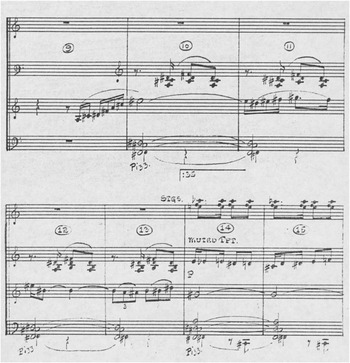
Throughout the film, Waxman’s score is stylistically heterogeneous, combining opulent, post-Romantic sonorities with stinging dissonance and harmonic parallelism. Norma is typically associated with dance, and specifically with the tango. When Joe first glimpses her – behind the drawn shades of a window, face partially concealed by dark glasses – Norma’s chromatic, serpentine theme appears in the alto flute, with tango rhythms following in the low strings. She mistakes Joe for an undertaker, and at first, he fails to recognise who she is. But as she removes the dark glasses, the alto saxophone picks up her theme. A tango rhythm underscores Joe’s moment of recognition (‘You’re Norma Desmond!’: see Ex. 1, bb. 9–10). The rhythm persists when Norma rebuts his barb that she ‘used to be big’, declaring, ‘I am big. It’s the pictures that got small’ (bb. 11–12).
Sunset Boulevard, cue for ‘An Aging Actress’, bb. 9–15, orchestrated by Sid Cutner. Franz Waxman Papers, Special Collections Research Center, Syracuse University Libraries.

On New Year’s Eve, Joe descends the stairs wearing a tuxedo, accompanied by the tango tune ‘La cumparsita’. The source of the music is at first unclear. Its orchestration – solo violin and viola, accordion and piano – suggests that the music is diegetic, but there is no performing group or playback device in sight. Norma’s association with the tango, established in previous scenes, implies that the music belongs to the underscore. But as Joe rounds a corner, a small ensemble of strings, piano and accordion comes into view, fronted by Norma swaying and vamping. The tango tune, lodged for a moment in the fantastical gap, suggests how Norma’s music elides boundaries, slipping imperceptibly from outside to inside, from underscore to diegesis, questioning the degree to which such conceptual boundaries should exist.
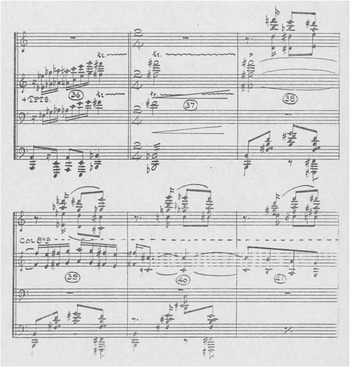
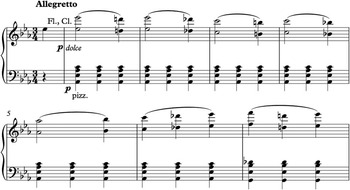
In the film’s final scene, when Joe confronts Norma and exposes her delusions of grandeur, the tango theme is harmonically distorted, mirrored by dissonant parallelisms. Following the murder, the theme reaches its grotesque apotheosis, as Norma descends the staircase accompanied by a garish fusion of strings, shrill brass and thumping percussion (see Ex. 2). But just before the final transformation of Norma’s theme, an insistent trill appears. It is not mere accompanimental frippery, having emerged as a distinct musical gesture earlier in the film when Norma was showing Joe yet another of her silent movies. As she railed against modern film producers – ‘Have they forgotten what a star looks like? I’ll show them, I’ll be up there again, so help me!’ – a woodwind trill had underscored her outburst. In the scene leading up to Joe’s murder, the trill can also be heard in the background when Joe tells Norma that an aide to DeMille had been calling to rent her antique car, not to buy her script or offer her a role. The trill becomes more prominent as Norma refutes Joe’s claim and clings instead to the delusion offered by Max: ‘You heard him. I am a star.’ After the murder, she retreats to her dressing table and gazes hypnotically at her face in the mirror as a police officer hurls questions at her. The moment she hears the word ‘cameras’, she emerges from her trance-like state, and the woodwind trill returns, lasting over two minutes before giving way to the grotesque metamorphosis of her theme.
Cue for ‘The Comeback’, bb. 36–41, orchestrated by Leonid Raab. Franz Waxman Papers, Special Collections Research Center, Syracuse University Libraries.

When I heard that quivering trill, I recognised it – not because I had seen the film many times and knew that it was coming (though that was true), but because I had put quotation marks around it in my mind. I had ‘cited’ it. In so doing, I had started to wonder if the trill was sonic evidence of Wilder’s fixation on Strauss’s Salome. As the film played on, the temporal envelope of my thinking had expanded, drawing me away from Wilder’s ordered, sequential storytelling into a virtual present in which temporal passage lay dormant. This pattern of events felt so familiar, it was like seeing Norma-as-Lucia all over again; I was experiencing a spectral interloper anew. I might have rationalised that trill away, as if it were a creaky floorboard or a mysterious gust of wind. But I had learned that when a sound emerges from a mad scene in a Gothic film, there is a very good chance it is an auditory manifestation of something from beyond. So I followed the trill to its hiding place. And the fugitive sounds of Norma’s madness led me back to opera – to another Salome who dances and offers her body for voyeuristic consumption.
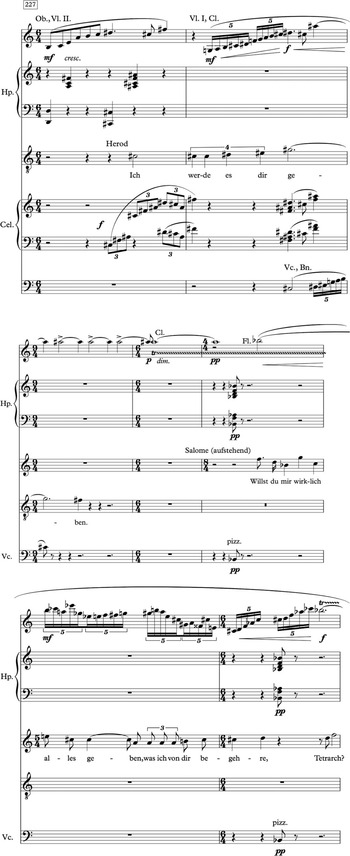
In Strauss’s Salome, Herod tells his sixteen-year-old niece and stepdaughter that he will give her anything she wants if she will dance for him. Right after his pronouncement, a trill in the clarinets alights on a dramatic moment patient enough to sustain it (Ex. 3). Salome responds by asking Herod to swear on his decree, and eventually she agrees to dance for him. After the dance concludes, the trill returns in the flutes as Herod expresses his prurient approval. Then the clarinets take up the trill, underscoring a taut moment of expectation as Salome declares her wish: the head of Jochanaan on a silver platter. The negotiations begin, as Herod offers her baubles, peacocks, a religious vestment. Salome refuses, her insistence accompanied by a trill that rises to a fury when the executioner finally delivers Jochanaan’s head. The trill returns at the end of the opera, hovering as Salome revels in kissing Jochanaan’s mouth, and vanishing just as Herod orders his soldiers to kill her.
Salome’s trill.

Both Norma and Salome have (or had) the power to entrance spectators through the skilful manipulation of their bodies. The trill aligns these characters and their dances in the same temporal and perceptual plane – one character serving as ground, the other as gloss. By crossing from one story to another, the trill collapses ‘formerly opposed binaries of time, space and being’; it becomes the very transgenerational phantom that haunts so many Gothic narratives.Footnote 61 And yet it also suggests a sort of temporal convergence, as Norma and Salome both enact roles that are asynchronous with their chronological ages. Norma’s anti-aging regime ‘acts as the perverse mechanical reversal of a youthful Salomé’s enthralled dance of the seven veils’, while Salome plays grown-up temptress by using the erotic stratagems of an adolescent girl.Footnote 62 Lois Cucullu argues that a half-century of Salomes, from Sarah Bernhardt to Norma Desmond, reflect how notions of female adolescence have come to define womanhood, as Oscar Wilde’s fusion of ‘schoolgirl and seductress had become by the mid-twentieth century a modern woman’s reality’.Footnote 63 As an inheritor of this reality, Norma participates in a kind of gendered masquerade – like Mae West, who exaggerated her own sexuality by imitating female impersonators. If West ‘plays at being what she is … already perceived to be’,Footnote 64 Norma plays at what she hopes she is perceived to be: a woman of twenty-five, for whom feminine glamour is effortless, desirable and ‘natural’. In her distorted performance of youthful femininity, she thinks that perhaps she can meet Salome somewhere in the chronological middle.
Norma’s masquerade deepens when it appears not through a material presence, but as Lucia’s ghost. Through a sort of transitive property of ghosting, we can see Salome through Lucia, with Norma as a ghostly intermediary. At first this perceptual gloss may seem unremarkable: both Lucia and Salome commit murders, and both are portrayed by (often older) singers who thrill audiences with extended displays of vocal virtuosity and transgressive behaviour. But when Lucia puts on the vampish, anachronistic gloss of Salome, she reminds us that she, too, is performing a culturally sanctioned version of young womanhood.Footnote 65 In contrast to the hypersexualised Salome, Lucia plays the dutiful sister and virginal bride-to-be, even as she wilfully pursues her own romantic interests without Arturo’s knowledge. She is not merely the manipulated ingénue: she is also the besotted lover who plots against the wishes of her family, using her performance of compliant femininity as a cloak of concealment. Through Norma’s operatic masquerade, characters old and young, virgins and vamps, coalesce in the figure of the ghost, whose vaporous edges are indefinable, even infinite, brought into alignment by an errant trill.
The trill thus exhibits a ‘synchronous nonsynchronicity’, occupying ‘both the same and different times’,Footnote 66 simultaneously inhabiting the worlds of Sunset Boulevard and Salome – and perhaps Lucia playing the background. Its teasing, anticipatory character invites the viewer to speculate: how will she (Norma) react after the homicide? Will she (Salome) react homicidally after the dance? In Salome, the trill so faithfully accompanies the princess’s expressions of will and desire that one wonders if she has conjured it herself. Perhaps Norma’s trill is also an audible symptom of her delusion. Norma, in her actor’s trance, cannot hear this sound, which exists as part of the sonic fluid that envelops the theatrical spectator. If the trill functions as an expression of Norma-as-Salome’s mania, then her madness achieves what she herself cannot, traversing the illusory barrier that separates her from those wonderful people in the dark, making it possible for us to hear the delusional sounds from which her very delusions protect her.
Waxman could certainly have intended for Salome’s ghost to turn up in Sunset Boulevard. He was, after all, a conservatory-trained German immigrant whose library of scores suggests a balanced diet of the classics (Bach, Mozart, Beethoven) and the moderns (Bartók, Stravinsky, Shostakovich). He owned dozens of Strauss’s orchestral scores, including Salome.Footnote 67 But whether Waxman – or Wilder – wanted me to hear Salome is not the point. What matters is that Salome appeared to me unbidden, and that her appearance mirrors the process of cryptomimesis, which ‘involves the production of an uncanny imaginary space: of writing and reading the other writing and reading (the other)’.Footnote 68 Seeing Norma-as-Lucia is not a singular phenomenon; it is part of a recursive process that absorbs other characters and texts, other fragments of music, without respect to style, genre or chronology. When the trill breaks free from Waxman’s score, it shows that madness cannot be contained – not Norma’s and not Lucia’s. The aural sign of Norma’s madness – the fugitive trill that haunts her and Salome, and who knows who else – reveals how musical apparitions transgress time, space and other (imaginary) boundaries. This is the insight I brought to Lucia’s mad scene, the lesson I learned by inverting historical chronology.
Sonic ghosts and the madness of interpretation
Lucia appears now as a figure of ghostly return. She has been glimpsed mostly through the superimposed images of Norma and Salome, transformed into a phantom through ‘ghost writing’, as Castricano describes it – a process that involves the ‘careful and sustained tracing of the other’.Footnote 69 Lucia gave birth to Norma; Lucia preceded Sunset Boulevard. Yet by inverting chronological sequence, I can imagine Lucia as Norma’s other, enacting the sort of temporally fragmented narrative that characterises Gothic temporality.
But let us, for a moment, examine Lucia as if she stood apart from Norma, like a butterfly pinned under glass. Her madness, the scene we have all come to witness, should be more discomfiting to watch than it usually is. If there is a certain appeal to the mad scene – and to the notion that characters may find relief through madness, as Susan McClary and Catherine Clément famously suggested – it is because Lucia’s ravings have been aestheticised: spectators enjoy listening to them, imagining that the woman who produces them has found a happy place. It seems to be a place where no lucid brain can go, entangling memory with mad fantasy, the product of a temporal rupture in which past and present events mingle recklessly.
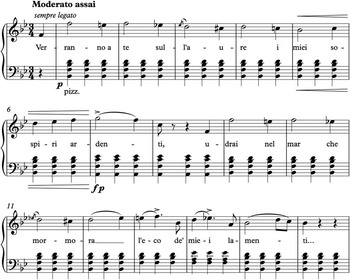
When Lucia enters, blood-soaked and stricken with a deathly pallor, the wedding guests wail over her appearance, for it seems as if she has ‘risen from the grave’ (‘dalla tomba uscita’). She hallucinates a vision of Edgardo and pledges herself to him, but suddenly a chill seizes her heart: she sees the Lammermoor spectre, who haunted the fountain where she and Edgardo used to meet. She urges Edgardo to hide behind the altar and then describes her wedding ceremony, pointing out the sound of the wedding hymn, the burning incense and the flickering torches. The orchestra abets her hallucination, playing a reminiscence of the music that she and Edgardo had sung in Act I, when they had exchanged rings (compare Exx. 4 and 5).Footnote 70 Throughout the scene, we can watch Lucia watch the ghosts she has conjured, but we cannot see them ourselves.
Lucia’s aria, Act I finale.

Act III reminiscence of Lucia’s Act I aria.

What we can hear is a different matter. Most interpretations of Lucia’s madness focus on the noises she makes, not the sounds she hears. In a now-classic series of texts, Clément proposed that Lucia’s ‘coloratura passages frolic in the intoxicated happiness of song’.Footnote 71 McClary then suggested that Lucia’s colouristic ornaments exceed the limits of conventional musical structure and stylistic propriety. Her ‘chromatic modulations’, tinged with eroticism, cannot be contained by the chorus of wedding guests – a sober, reflective body that provides the musical and dramatic frame which Lucia transgresses.Footnote 72 Mary Ann Smart in turn critiqued McClary’s interpretation of the scene by noting the many ways in which Lucia’s resistance falls short, including harmonic restraints applied to her coloratura and the structural regularity of the scene itself.Footnote 73 But my interest lies less in Lucia’s noise-making than in her role as medium, absorbing and amplifying spectral sounds for the theatrical audience.
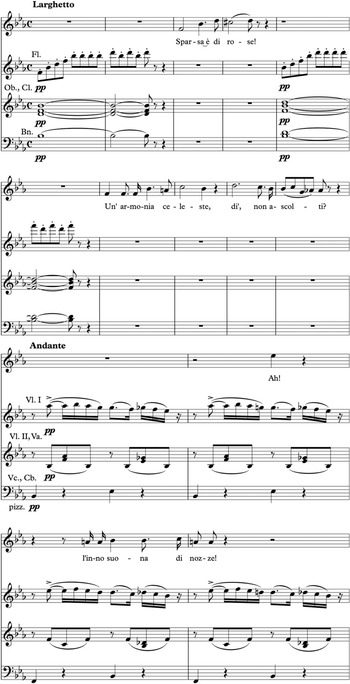
I want to draw attention to a particular point in Lucia’s mad scene. Even though it is well known, it needs to be rehearsed, because it is easy to elide a brief sequence of musical events, as if it were unfolding in space–time (like a painting) instead of time–space (like a play). After Lucia suggests that she and Edgardo hide behind the altar, a solo flute plays a lilting arpeggiation, supported by woodwinds humming a sustained B♭ major chord. Lucia reacts to this music – or at least, many modern Lucias do – and, in unaccompanied recitative, points out the roses that adorn the altar.Footnote 74 Another flute arpeggiation follows, higher this time, joined by another B♭ major chord. Again, Lucia sings unaccompanied recitative – this time noticing a ‘celestial harmony’ (‘un’armonia celeste’), and asking, ‘Do you not hear it?’ The orchestra then enters with a sinuous violin melody, played in common time and accompanied by swaying rhythms in the strings. In the second bar of the melody, Lucia recognises the music (‘Ah!’) and declares that it is – a wedding hymn? It sounds nothing like a hymn, resembling instead the sort of dolorous cantabile that often accompanies melancholy Romantic ingénues (Ex. 6). The ‘celestial harmony’ that she had heard when the solo flute was playing did not sound hymn-like either.Footnote 75
Act III mad scene.

This disjunction between what we perceive and what Lucia hears has been smoothed over by scholars. Heather Hadlock distinguishes between Lucia’s mad world and our own (presumably sane) one: Lucia is ‘guided by an ethereal orchestra that only she can hear’ and ‘enters into an altered state where reality cannot follow’.Footnote 76 Yet the music that she hears does not align with what she tells us about it. If she is guided by an ‘ethereal orchestra’, does that music-making body differ from the orchestra in the pit? Might we be hearing a worldly double of celestial vibrations that we could not otherwise perceive? Or is it possible that we are hearing the same music as Lucia but interpreting it differently?
When Lucia asks about the wedding hymn, ‘Do you not hear it?’, her question seems directed not just at the phantom Edgardo, but also at the chorus of onlookers – and the theatrical audience. As the mad scene unfolds, the flute acts as Lucia’s ghostly double, and Lucia loses her capacity for speech, becoming ‘a pure signifier’.Footnote 77 It seems that the flighty virtuosity of the voice and its instrumental doppelgänger both externalise her hallucinations; as McClary notes, spectators are ‘given licence to eavesdrop on the character’s interiority’ through music.Footnote 78 But what if, instead of Lucia entering ‘an altered state where reality cannot follow’ (as Hadlock puts it), we enter an altered state where reality cannot follow? What if Lucia’s madness is not something we merely spy upon but something we experience?
Melina Esse proposes a similar interpretative approach to Donizetti’s Maria de Rudenz. Written three years after Lucia, the opera presents the familiar theme of ghostly resurrection, but with a twist: the apparition doing the haunting turns out to be a woman who is just very, very hard to kill. Signs of the uncanny abound in the orchestral music, which rattles with string tremolos, timpani rolls, and figures of sobbing and lament. Esse resists the impulse to hear these sounds as ‘gestures towards the beyond – even the beyond that is unfolded within the psyche’.Footnote 79 Instead, she observes how the orchestral music evokes the sounds and movements of the body, but detached from a material source. Maria’s sobs multiply and disperse throughout the orchestra, as her ‘weeping body shows up where it should not, seeping beyond the boundaries of her vocal line’.Footnote 80 The Gothic predilection to turn the inside outside may refer not just to the corporeal and the metaphysical, but also to the relationship between voice and orchestra, or to the physical body itself.
I had thought that madness could be turned inside out, its physical symptoms put on display and its sensory effects merely translated to a medium that we can understand.Footnote 81 McClary felt similarly, claiming that the composer writing for a mad heroine faces a conundrum: he must ensure that however flighty her music becomes, it should remain distinct from the ‘musical voice of reason’, which may take the form of tonal structures, stylistic norms or architectural forms.Footnote 82 By observing this dictum, the composer thus assures that ‘the listener experiences and yet does not identify with the discourse of madness’.Footnote 83 But, as Shoshana Felman has suggested, madness in a work of fiction does not trouble just the characters. In her analysis of Henry James’s The Turn of the Screw, Felman notes that madness is ‘uncanny … to the precise extent that it cannot be situated, coinciding, as it does, with the very space of reading’.Footnote 84
Lucia’s madness coincides with the very space of listening. In the mad scene, it is never clear if we are hearing what Lucia hears. For how can we believe anything she tells us? Let us rehearse the possibilities again: the hymn music that doesn’t sound hymn-like could be a translation of Lucia’s sonic hallucination into a medium that makes sense to us, or it could be a spectral double that sounds hymn-like to Lucia because she is mad and we are not. But perhaps we hear the same music that she does because our senses, like Lucia’s, have betrayed us: we are pinned inside the glass with the butterfly.
If we are inside the glass, the mad scene still tempts us to catch ourselves in the act of spectating. The spectacle of Lucia’s madness unfolds in a self-reflexive manner typical of opera: as the chorus drinks in the sight of Lucia’s madness, it reminds us of our own voyeurism. The chorus models an appropriate response to Lucia’s madness by exhaling gasps and expressions of pity, even as Lucia implicates the audience in her delusions with a rhetorical appeal that is multiply directed – to the ghostly Edgardo, to the wedding guests, to us. Just as James in The Turn of the Screw ‘imposes the governess’s distorted point of view upon us as the rhetorical condition of our perception of the story’,Footnote 85 Donizetti’s audible manifestations of Lucia’s madness prevent us from relying on a detached, binary mode of perception: lucid, mad. Our interpretation is infected with her sickness. The expressions of pity offered by the wedding guests might well be turned on us.
But what of the reminiscence music that the orchestra plays when Lucia bids the phantom Edgardo to join her at the fountain? Perhaps this music might allow us to watch Lucia self-destruct at a safe remove. Mary Ann Smart suggests as much: the orchestral reminiscence of the Act I ring exchange is a device to orientate the spectator, anchoring the scene’s thematic focus; it ‘functions as an element of the rational form of the mad scene, which contains the irrationality of Lucia’s madness and ensures that it remains comprehensible’.Footnote 86 In this part of the mad scene, Smart maintains a division between Lucia’s ‘incoherent vocal fragments’ and the reminiscence theme, which begins in the orchestra (at Figure 25) and remains a domain separate from Lucia’s delusional mind. By the time Lucia hears the ‘hymn’ music (near Figure 27), it is clear that the musical signs of madness have slipped from her voice to the orchestra, initiating the debate about who heard what when.
It could be that Donizetti has destabilised our perceptual faculties before we ever noticed it. Indeed, if Lucia’s madness is contagious, then it makes sense that we would experience symptoms before even realising that we have been exposed. When we hear the reminiscence music in the orchestra, we might be feeling the first sign of infection. Lucia would not be merely ‘reliving the love duet’ while we observe her; we, the spectators, would be reliving it through her. The spectral qualities of music – its acousmatic capacity to emerge unseen, to hover in space independent from the bodies that create it – would become an aural sign of transgression, the delirious mind amplified, engulfing us in its hallucinations.
But let us suppose that Donizetti somehow provides the musical equivalent of rationality and patriarchal order, as McClary and Smart, in different ways, suggest. He and Salvadore Cammarano, the librettist, still would not be able to contain Lucia’s madness – and not because of a collaborative failure that might have been overcome by a different creative team. No composer–librettist pairing could hold such a threat in check, and no spectator should want them to. Lucia’s madness is more important to the opera’s Gothic themes than the ghosts she sees, the decaying castle she lives in, and the patriarchal oppression she endures. Her madness is an act of annihilation and convergence: past and present, memory and fantasy, presence and absence, singer and spectator – their edges merge onto a vertiginous slope.
Lucia’s madness exposes the many contradictions that form conscious and preconscious perceptual acts. As spectators, we perceive continuous temporal passage, but then divide it into discrete moments of past and present; we immerse ourselves in operatic drama, but then, as the drama unfolds, we applaud singers for their virtuosity and transcendence; we deconstruct the text in analysis, but then try to seal off that deconstruction in performance. To paraphrase Barthes, we watch, we tune out, we look away, we dip in again. We see how Lucia’s madness issues to spectators the sort of disorientating experience that Gothic narratives deliver to readers, who ‘may “see things” that are the product of their own desires, fantasies, and delusions’Footnote 87 (things like the ghost of Norma Desmond). We become, not witnesses of the Gothic, but participants in it: seeking interpretative meaning, we find ourselves deceived by sound, just as Lucia is misled by the written word. We understand, at last, how Lucia and Norma Desmond might be closely, inextricably linked, and how we, too, are linked to them through a bond of sympathy; we find ourselves to be not voyeurs, but fellow sufferers.
History and the spectral moment
Seeing Lucia-as-Norma, I glimpsed what Svetlana Boym describes as a ‘cinematic image of nostalgia’: the double exposure that ‘breaks the frame or burns the surface’ if its two superimposed images are forced into one.Footnote 88 Yet Lucia-as-Norma-as-Salome simply made apparent the perceptual dualities of theatrical representation, through which the dramatic frame might twist, crack and remake itself anew. Postmodern ghosts in Lucia heighten disjunctions that are already present: Lucia as ingénue or as extra-operatic diva may coexist with the campy Norma-as-Salome, without one figure usurping the other. Moreover, this reverse bricolage – the shattering of a single image, inventively reassembled without respect to artistic lineage or chronology – is endemic to Gothic literature.
Lucia-as-Norma-as-Salome erodes the sequential linearity of dramatic storytelling by inverting Gothic temporality, characterised by fragmentation and ghostly returns, and creating the ‘intoxicating excess of meaning’ found in Gothic tales.Footnote 89 Norma’s madness, signalled by a spectral trill, shows how ghosts have little regard for chronology, genre or the conceptual boundaries between singer and orchestra. Lucia’s hymn tune reflects a similar lack of concern for borders, however faithfully scholars and spectators might patrol them; her madness is a deconstructive act in the postmodern vein – and one that I might not have discovered without Norma’s help.
Norma’s spectral presence further illuminates the intertextuality of Gothic narrative, which reflects the ‘hauntedness of writing’Footnote 90 – or spectating, as the case may be. After seeing Lucia as part of a ghostly trinity, I was struck by how easily golden age film divas and operatic ingénues might slip from one genre to the other. I could even imagine a transhistorical, cross-genre society of ghostly women from operas, films, books, and plays. Carmen might ask Lucia, ‘What is it like to stab someone?’, while Anna Karenina would inquire of Emma Bovary whether arsenic was really the best choice. Judy Barton would ask Tosca, ‘Why did you jump?’, and Tosca would reply, ‘It was the best decision I ever made – after stabbing Scarpia, that is.’ Then, turning to Carmen, she would add, ‘Stabbing a man is a little like slicing braciole – against the grain, you know.’ For the kind of spectator that I used to be, such a scenario would have been rife with distraction. But for the spectator that I am now, aligning Lucia with her anachronistic double seems not only plausible but also sensible, as it renders her psychological fragmentation a perceptual reality.
When experiencing the opera, I felt the presence of ghosts, as Lucia did, and both of us struggled to construct meaning from that experience. I found my sympathy with her restored as I came to appreciate the critical burden of being attuned to a ghostly presence and wondering if I might be the only one aware of it. Conceiving of Lucia’s madness as a metaphor for interpretation might seem like an aestheticising (or anaesthetising) move, akin to the way that the mad scene itself has functioned, for many viewers, like a lurid spectacle. But this is true only if critics treat interpretation as existing in a sphere separate from the work. If we open up the work-in-performance – not just to intertextual references, but also to ourselves – then we do the sort of interpretative labour that involves personal risk and intellectual peril. In so doing, we may also acknowledge the open network of the body, which already incorporates that which is external or foreign.Footnote 91 Seen thus, Norma is not an exotic contagion, but a manifestation of the conflicts and incongruities that lie within all characters, all stories, and indeed ourselves. Her ghosting of Lucia reveals that my nostalgia was perhaps its own kind of sickness. Pathologising interpretative work is a risky gambit, as it has the potential to trivialise the suffering of those with harrowing physical and psychological ailments. And yet there is something productive, generative and empathetic in imagining a kinship with mad characters that is founded upon shared infirmities of differing degrees and kinds. That thought cheers me, despite its hazards.
So the critic is sated. And the spectator? She, too. But the historian remains dissatisfied. (What else is new?) Shall I begin again? I can start over, but it will be different this time. Every repetition will be different.
Ghostly returns
To be nostalgic is to remember what never was. When I found Norma’s ghost in Lucia, I started to long for a theatrical experience – fully immersive, undistracted, ‘pure’ – that I am quite sure I never had. My longing was emblematic of the ghostly return, which itself is figured both by theatrical performance and by musical repetition. Van Elferen describes how musical listening involves temporal disjunction:
Every new listening experience re-inscribes former ones with new connotations and readjusts listening subjectivities: this means that musical time is not only out of joint but also subject to continual rewriting. In listening, repetition becomes difference. Through this gradual differentiation the original musical experience becomes pushed farther and farther away into the unrepeatable past, until it can only be glimpsed at through the mystifying veils of reminiscence. Musical spectrality thus, in proper Gothic fashion, evokes the nostalgia for an irretrievable sameness.Footnote 92
Music conveys a sense of temporal passage, consisting of linearity and goal-directed teleology, while musical repetition suggests a cyclic return to the past. Yet the cycle can never be fulfilled, for the past cannot be reconstituted, and the present is rewritten even as it occurs. Longing for that ‘irretrievable sameness’, in music or in life, might certainly invite the midnight melancholias that Boym associates with nostalgia in its fallow mode. But that same longing, quixotic though it may seem, can be productive – even for the dissatisfied historian.
If the past is a foreign country, what should the historian make of anachronistic, cross-genre tourists like Norma Desmond? Perhaps her presence is discomfiting because it animates the ghostly resurrections that are routine in historical study. History is replete with temporal contradictions: its objects of study are ostensibly situated in the past, yet revived in the present by scholars who seek to leave no trace of ourselves behind. But where would such traces fall if the past is a creation of ourselves? Ghosts are fitting proxies for historians, evoking our virtual, anachronistic toil in an immaterial past made present. The ghostly meeting of scholar and subject produces a historicist paradox: the ‘spectral moment’ evoked by Derrida that ‘no longer belongs to time, if one understands by this word the linking of modalised presents’.Footnote 93 Whether we claim to remake or merely to reawaken the past, our work as historians involves a temporal negation – a synchronisation of past and present, dissolving the ordered chronologies that seek to protect us from inflecting historical study with presentist bias. But our own interpretative madness emerges as we confront the impossibility of temporal negation.
Ghosts may embody personages, particularly when they serve as representative agents of the past, but they also express possibilities, including the ‘structural openness’Footnote 94 that arises when historians embrace the temporal paradox we have created. If Norma’s ghosting generates a characteristically Gothic excess of meaning, the interpretative space that she creates is even more potent, revealing to historians the value of admitting the present into the past. When such admittance occurs, the past itself becomes an open text, detached from temporal sequence and historical context; it becomes an opportunity to re-envision historical narrative in ways that might not have been possible without inverting or radically displacing temporal order.Footnote 95 Inside becomes outside: criticism becomes history, and history criticism, with no antimony between them.
Music scholars have a greater stake than others in appreciating the value of transhistorical ghosts. The spectral nature of sound is a token of theatrical ghosting is a token of theatrical ghosting – both its sign and its clandestine partner. In Lucia, it brings theatrical ghosts into temporal and spatial synchronicity: a trill for Norma and Salome, a waltz theme for Lucia and the phantom Edgardo of her past. As music helps conjoin Lucia, Norma and Salome, it destabilises the perceptual faculties of the spectator and reminds us that ghosts are present in every story. Lucia’s ghostly sounds and Norma’s trespassed spaces both occupy sensory thresholds beyond the range of normal perception: special invitations are required to participate (‘just us’). But accepting their invitation means acknowledging all of the possibilities that the open text may bring – all of the ghosts that could turn up unbidden. And when we see (or hear) them, we must always wonder: are they really there?