Introduction
A gradual decline in function is characteristic of the dementia stage of Alzheimer's disease (AD). As patients progress from the mild through the moderate and then severe stages of AD, their ability to perform certain activities of daily living (ADL) will at first be reduced and later lost altogether. Patients with AD may initially have difficulty performing more complex instrumental activities such as managing finances or preparing food. Subsequently they will experience a reduced capacity for performing basic activities such as dressing themselves, bathing, or eating. Apart from causing distress to the patient, this progressive attrition of function has been closely associated with a greater burden of care (Feldman et al., Reference Feldman2003), increased health care costs (Hill et al., Reference Hill, Fillit, Thomas and Chang2006) and the need for institutionalization (Severson et al., Reference Severson1994).
A variety of measurement scales have been developed to examine ADL in patients with dementia (Lawton and Brody Reference Lawton and Brody1969; Donaldson et al., Reference Donaldson, Wagner and Gresham1973; Teunisse et al., Reference Teunisse, Mayke, Derix and van Crevel1991; Severson et al., Reference Severson1994; Galasko et al., Reference Galasko1997; Gelinas et al., Reference Gelinas, Gauthier, McIntyre and Gauthier1999; Cullum et al., Reference Cullum2001). This profusion of instruments has resulted in greater variability of reported functional outcomes compared with cognitive outcomes, and greater difficulty in comparing results or pooling data across studies. Consequently, developing a method to standardize results obtained using different functional scales could provide a means of reducing this variability and facilitate the pooling of functional outcome data. Fortunately, though scoring systems and methods of assessment do differ, there is considerable overlap between these scales regarding the actual activities being evaluated, which comprise a relatively small number of instrumental and basic activities common to daily functioning.
The cholinesterase inhibitor donepezil has been shown to provide benefits on numerous different measures of ADL in individual randomized, placebo-controlled studies of patients with mild to moderate AD (Burns et al., Reference Burns1999; Mohs et al., Reference Mohs2001; Winblad et al., Reference Winblad2001), moderate to severe AD (MSAD; Feldman et al., Reference Feldman2001) and severe AD (Winblad et al., Reference Winblad2006). In order to conduct an analysis of pooled functional data from these studies, we sought to develop and validate a method for the standardization of functional outcome data derived from these various instruments. We then used the resulting standardized functional scale to analyze the effects of donepezil therapy on basic and instrumental ADL in a large pooled population, particularly in relation to baseline disease severity.
Methods
Study selection
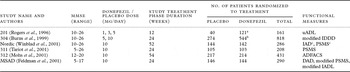
Studies were selected for inclusion in the present analysis if they met the following criteria: (i) randomized, double-blind, placebo-controlled parallel-group studies of the use of donepezil in the treatment of AD; (ii) conducted within the donepezil clinical development program and with available individual patient-level data; and (iii) available post-baseline functional data collected using at least one ADL scale as defined in the original study protocols. In total, six randomized double-blind trials met the pre-specified criteria and were included in the analysis (Table 1). The studies were conducted in Europe, North America, Australia, Asia and South Africa, and most were large multi-center trials. One study included a 12-week treatment phase (201 Study); the remaining five studies included a treatment phase of at least 24 weeks. Descriptions of study designs for the trials have been published previously (Rogers et al., Reference Rogers and Friedhoff1996; Burns et al., Reference Burns1999; Feldman et al., Reference Feldman2001; Mohs et al., Reference Mohs2001; Tariot et al., Reference Tariot2001; Winblad et al., Reference Winblad2001).
Trials included in integrated analyses

aPatients were randomized 1:1:1 to receive a daily dose of 1 mg, 3 mg or 5 mg donepezil.
bPatients were randomized 1:1 to receive a daily dose of 5 mg or 10 mg donepezil.
cOutcomes on these measures were not reported in original publication.
MMSE = Mini-Mental State Examination; uADL = uniform Activities of Daily Living; IDDD = Interview for Deterioration in Daily living activities in Dementia; IADL = Instrumental Activities of Daily Living; PSMS = Physical Self-Maintenance Scale; ADFACS = Alzheimer's Disease Functional Assessment and Change Scale; DAD = Disability Assessment for Dementia.
Patient population
Inclusion/exclusion criteria for patients entering the six original studies were similar (Rogers et al., Reference Rogers and Friedhoff1996; Burns et al., Reference Burns1999; Feldman et al., Reference Feldman2001; Mohs et al., Reference Mohs2001; Tariot et al., Reference Tariot2001; Winblad et al., Reference Winblad2001). In brief, all patients enrolled in the original trials were required to have a diagnosis of AD consistent with the criteria of the National Institute of Neurological and Communicative Disorders and Stroke and Alzheimer's Disease and Related Disorders Association (McKhann et al., Reference McKhann1984). Patients in the 201 and 304 studies were also required to meet criteria defined by the Diagnostic and Statistical Manual of Mental Disorders, revised third edition (DSM-IIIR) (American Psychiatric Association, 1987); patients in the 312 and Nordic studies were required to meet criteria defined in the DSM fourth edition (American Psychiatric Association, 2000). The 311 and 324 (MSAD) studies included patients with severe AD (baseline Mini-mental State Examination (MMSE <10)). In the 201 study, patients were randomized to receive donepezil at one of three doses (1, 3 or 5 mg/day) or matching placebo. In the 304 study, patients were randomized to either donepezil 5 mg/day, donepezil 10 mg/day or placebo. In this study, a blinded, forced dose escalation method was used for the higher dose group in which subjects received 5 mg/day for seven days and then 10 mg/day for the remainder of the study. In the remaining studies, donepezil was given at 10 mg/day following four weeks of treatment with the 5 mg/day dose. All studies were conducted in accordance with the Declaration of Helsinki and Good Clinical Practice.
Development of a standardized functional scale
Different scales were used to measure function/ADL across the six original studies. These included the uniform Activities of Daily Living (uADL) scale (Donaldson et al., Reference Donaldson, Wagner and Gresham1973); a version of the Interview for Deterioration in Daily living activities in Dementia (IDDD) (Teunisse et al., Reference Teunisse, Mayke, Derix and van Crevel1991) modified for use in the 304 study (Burns et al., Reference Burns1999); the Instrumental Activities of Daily Living (IADL) scale (Lawton and Brody Reference Lawton and Brody1969); the Physical Self-Maintenance Scale (PSMS) (Lawton and Brody Reference Lawton and Brody1969); a version of the IADL and the PSMS modified for use in the MSAD study (Feldman et al., Reference Feldman2001); the AD Functional Assessment and Change Scale (ADFACS), a measure specifically developed for use in the 312 study (Mohs et al., Reference Mohs2001); and the Disability Assessment for Dementia (DAD) (Gelinas et al., Reference Gelinas, Gauthier, McIntyre and Gauthier1999).
Scales can differ in the degree of specificity of individual items (e.g. “dressing” versus “putting on shoes”), the manner of scoring (a Likert scale or a categorical response), and the particular functions assessed. Because there was a high degree of similarity between the ADL items and functional categories assessed by the various ADL instruments, it was possible to develop a standardized functional scale anchored on the ten ADL items used for the DAD (six instrumental ADL items – finance, medication, going out, meal preparation, telephoning and leisure and housework; four basic ADL items – hygiene, dressing, eating and continence) (Gelinas et al., Reference Gelinas, Gauthier, McIntyre and Gauthier1999). Two additional basic ADL items were included in the standardized scale – a separate “undressing” item and a “physical ambulation” item – to better capture the full range of basic ADL evaluated across all nine instruments.
Having determined the 12 ADL components of a standardized scale, individual ADL items from each of the separate functional scales were evaluated and mapped to the matching/corresponding ADL item on the standardized scale. Thus, the “dressing” item of the ADFACS, for example, could be mapped directly to the “dressing” item of the standardized scale (matching). Similarly, the “shopping” and the “ability to get around inside and outside the home” items of the modified IADL could both be mapped to the “going out” item of the standardized scale (corresponding). Because the various scales used in the original studies used different scoring systems, each ADL item score from each of the original ADL scales was transformed to a 100-point scale, with 0 representing total independence and 100 representing total dependence. Therefore, an increase from baseline to endpoint in standardized scale item score indicates clinical worsening and a reduction indicates clinical improvement.
For example, the ADFACS has a single “dressing” item” – a five-point Likert scale, with 0 representing “no impairment” and 4 representing “severe impairment.” The transformed scores on the standardized functional scale are 0 = 0, 1 = 25, 2 = 50, 3 = 75 and 4 = 100. In contrast, the DAD has a compound “dressing” item comprising four separate elements (initiative, selection, sequence and completeness), each of which is scored as 1 for “No” (impaired) and 2 for “Yes” (not impaired). In this case, the transformed scores are based on the sum of all four elements, and the highest DAD score corresponds to the lowest standardized functional scale score: 4 = 100, 5 = 75, 6 = 50, 7 = 25 and 8 = 0.
Subsequent to the initial mapping of ADL items from the original functional scales to the standardized functional scale, the authors as a group reviewed, discussed and reached consensus on the assignment of each item. An external expert (co-developer of the DAD) was then chosen by the lead author (SG) to map independently each of the items from the original functional scales to the standardized functional scale. Lastly, each discrepancy between the internal and external assignment of items to the standardized functional scale was identified and recorded.
Statistical/data analyses
All ADL item scores from the original functional scales were based on observed case analyses using the intent-to-treat population from the relevant study. Following transformation of the original ADL item scores to standardized scale scores, changes in individual standardized scale item scores from baseline to Weeks 12 and/or 24 were assessed. Week 12 analyses were conducted on data pooled from all of the included studies; Week 24 analyses were conducted on data pooled from patients enrolled in trials that were at least 24 weeks in duration (all but one trial (Rogers et al., Reference Rogers and Friedhoff1996)). p values were calculated for the comparison between the donepezil and placebo groups using a two-sample t test. A p value of < 0.05 was considered an indication of a significant treatment effect.
Results
Patient population
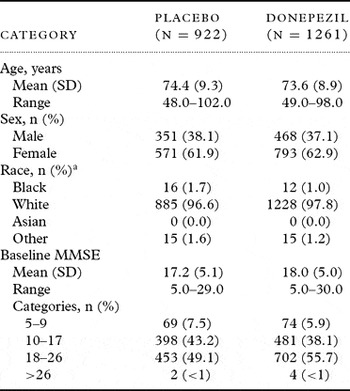
Overall, 2194 patients were randomized to donepezil or placebo in the six original trials and were evaluated for inclusion in the current analysis. Of these patients, 2183 (922 receiving placebo, 1261 receiving donepezil) had available Week 12 and/or Week 24 function data and were included in the initial analysis population. Baseline characteristics and demographics for these patients are shown in Table 2. No clinically relevant differences were noted between the placebo- and donepezil-treated patients. As shown in Table 2, baseline MMSE scores in the initial analysis population ranged from 5 to 30. However, a substantial majority of the overall analysis population (n = 2177; 99.7%) had baseline MMSE scores between 5 and 26. As the proportion of patients with baseline MMSE scores above 26 was negligible (n = 6; 0.3%), all subsequent analyses were conducted on a population comprising only those patients with MMSE scores of 5 to 26 inclusive.
Patient characteristics for the overall analysis population (N = 2183)

aRace data were not available for 12 patients (6 randomized to placebo; 6 randomized to donepezil).
Validation of ADL mapping to standardized functional scale
In total, 207 ADL items were assessed across nine functional scales for mapping to matching/corresponding standardized functional scale items (uADL, 77 items; Blessed, 12 items; IDDD, 33 items; IADL + modified IADL, 13 items; PSMS + modified PSMS, 16 items; ADFACS, 16 items; DAD, 40 items). External evaluation of the mapping process resulted in concordant assignment of 188 items (90.8%) and discordant assignment of only 19 items (9.2%). Discordant items were equally distributed between basic ADL items (10) and instrumental ADL items (9), and the largest number (7) was from the uniform Activities of Daily Living, which comprised the largest number of items (77). The highest rate of discordance was found for the modified Instrumental Activities of Daily Living + modified Physical Self-Maintenance Scale (four of 21 items, study 324 (MSAD; Feldman et al., Reference Feldman2001).
Baseline standardized functional scale scores
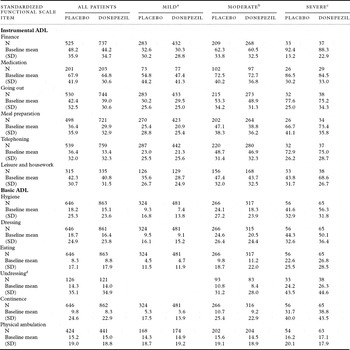
Mean baseline standardized functional scale scores for the total analysis population and for each of the baseline severity groups are shown in Table 3. As expected, scores for both basic ADL and instrumental ADL show progression of impairment across baseline disease severity, and basic ADL are impaired to a lesser degree than instrumental ADL. The number of patients in the severe group was much lower than in the mild and moderate groups because only two of the six studies included patients with baseline MMSE <10.
Mean baseline individual standardized functional scale item scores

aSubpopulation of patients with mild AD (MMSE scores 18–26).
bSubpopulation of patients with moderate AD (MMSE scores 10–17).
cSubpopulation of patients with severe AD (MMSE scores 5–9).
dNo data were available for the Undressing item in the mild subpopulation.
SD = standard deviation; ADL = activities of daily living; MMSE = Mini-mental State Examination.
Among instrumental ADL, Medication was the most impaired in the mild and moderate groups, whereas Meal Preparation was the least impaired. Although Leisure/Housework was the second most impaired in the mildly ill patients, scores remained remarkably constant across groups, such that it demonstrated the least impairment in severely ill patients. Among basic ADL, Physical Ambulation was the only category with mean score >10 in the mild group, but was also the only category with mean score <20 in the severe group. Hygiene and Dressing were consistently more impaired than Eating and Undressing.
Analysis outcomes
Total analysis population
At Week 24, scores for the placebo group showed a numerically greater increase (worsening) compared with the donepezil group for 11 of the 12 standardized scale items (Figure 1). Statistically significant treatment differences were observed for five items, all in favor of donepezil – two instrumental ADL items (Meal Preparation and Leisure and Housework) and three basic ADL items (Hygiene, Dressing and Eating). Continence was the only item on which the donepezil group had a greater decline (<1 point). At Week 12, scores for 10 of the 12 standardized scale items showed a numerically greater increase (worsening) in the placebo group compared with the donepezil group (data not shown); statistically significant differences in favor of the donepezil group were observed for four items – two instrumental ADL items (Finance, Telephoning) and two basic ADL items (Hygiene and Dressing). Two items showed a numerically greater increase (worsening) in the donepezil group at Week 12 (Continence and Physical Ambulation), but between-group differences were not statistically significant.
Change in individual standardized functional scale item scores from baseline to Week 24 for the total analysis population (n = 2177). *P < 0.05; **P < 0.01.

Baseline MMSE subpopulations
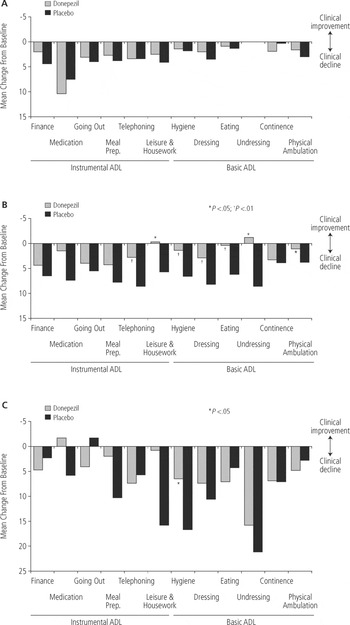
To investigate the effects of treatment on individual standardized scale items in relation to baseline disease severity, changes in item scores from baseline to Week 24 were assessed in subpopulations of patients with mild (MMSE 18–26), moderate (MMSE 10–17) and severe AD (MMSE 5–9). In the mild subpopulation (n = 1155), scores for eight of the 12 items showed a numerically greater increase (worsening) in placebo patients than in donepezil-treated patients, although treatment differences were not statistically significant for any individual item (Figure 2A and Table 3). For the Telephoning item, score changes were comparable in the two treatment groups.
Change from baseline to Week 24 in individual standardized functional scale item scores for subpopulations with (A) mild (Mini-mental State Examination (MMSE) 18–26), (B) moderate (MMSE 10–17) and (C) severe (MMSE 5–9) AD. In the analysis of the mild subpopulation, no data were available for the Undressing item. *P < 0.05; **P < 0.01.

In the moderate subpopulation (n = 879), all 12 item scores showed a numerically greater increase (worsening) in placebo patients compared with donepezil-treated patients (Figure 2B and Table 3). Statistically significant differences were observed for seven items, all favoring donepezil – two instrumental ADL items (Telephoning and Leisure and Housework) and all basic ADL items except Continence (Hygiene, Dressing, Eating, Undressing and Physical Ambulation). In this subpopulation, scores for two items (Leisure and Housework and Undressing) decreased (improved) in the donepezil group.
In the severe subpopulation (n = 143), scores for seven of the 12 items showed a numerically greater decline in the placebo group than in the donepezil group (Figure 2C and Table 3). A statistically significant difference between the donepezil and placebo groups was observed only for one item (Hygiene).
Discussion
In contrast to well-demonstrated improvements in cognition over a 24-week period, pharmacological treatments currently available for AD tend not to provide improvements in function/ADL over this same time course. Therefore, a more appropriate measure of their benefit is a slowing and/or delaying of decline. This analysis of a large pool of patients across different severity stages of AD indicates that donepezil treatment was generally associated with reduced decline in both basic and instrumental ADL in patients with mild to moderately severe AD compared with placebo. This benefit was most pronounced and most consistently significant in patients with moderate AD, as categorized by a baseline MMSE of 10 to 17. In fact, seven of 12 items on the standardized scale demonstrated significant differences between placebo- and donepezil-treated patients, whereas among those with either mild or severe AD there was only one significant finding out of 24 total comparisons.
In an analysis of pooled data from two clinical trials of patients with mild to moderate AD who received placebo, a MMSE score of 16 was identified as the transition point at which there is an accelerated decline in both instrumental and basic ADL (Feldman et al., Reference Feldman, Van Baelen, Kavanagh and Torfs2005). This observation was used to support the choice of 17 as the upper limit cut-off for moderate-stage AD in this analysis. The results observed in this well-defined moderate subgroup, however, are likely a reflection, at least in part, of the fact that the scales from which this standardized scale was derived were designed to demonstrate important disease- and treatment-related changes in ADL specifically in the moderate phase (Lawton and Brody Reference Lawton and Brody1969; Donaldson et al., Reference Donaldson, Wagner and Gresham1973; Gelinas et al., Reference Gelinas, Gauthier, McIntyre and Gauthier1999). Our results thus point to the need to develop scales that are more sensitive to the subtle functional changes (and possible treatment effects) that occur during the mild phase of AD.
Evaluating the results from the subpopulation of patients with severe AD is problematic in light of the relatively small sample size compared with the mild and moderate subpopulations. Moreover, the number of patients with severe AD providing data for the instrumental ADL items was very low, no doubt a reflection of how many patients at this stage of disease are either no longer capable of performing these activities or are in institutions where they are no longer responsible for these activities. In addition, the apparent lack of treatment effect on basic ADL, which is in direct contrast to the consistent benefit demonstrated in the moderately ill subgroup, may have been due, at least in part, to the very high degree of variability of domain scores (Table 3) among this subgroup of patients.
The novel method of standardizing different ADL scales employed in this analysis could be used by others to perform integrated analyses of ADL data across multiple studies in which different tools have been used. Although further investigation would be required to establish the reliability and validity of this particular standardized functional scale, the method itself is not complex and could be applied to any set of functional data derived from two or more different ADL scales. The high level of concordance between the internal and external mapping of items to the standardized functional scale (>90%) suggests that this is a highly reliable process.
This analysis is subject to a number of limitations. First, although the method of mapping items to the standardized scale demonstrated a high degree of reliability, the standardization of item scores is inherently limited by the scoring systems of the original scales. Those instruments that contained multiple items mapping to a single standardized item generated a score with finer gradation than those instruments that had only a single item. Also, it is important to recognize that even though the standardized scale of 0 to 100 appears to be an interval scale (i.e. a score of 50 would seem to represent a degree of impairment twice as great as a score of 25), it is still, in fact, an ordinal scale, like those from which it was derived (i.e. a larger number represents greater impairment – but only in rank, not to a specific, quantifiable degree). Second, because this is a post-hoc analysis in which statistical significance levels were not adjusted for multiple comparisons, our results must be interpreted with caution. Third, inclusion of patients living in an institutional setting introduced a subpopulation in which measuring of most of the instrumental ADL (e.g. finance, medication) was not possible. Fourth, the dosing of donepezil in two arms of the 201 study was below the accepted therapeutic dose; this may have influenced the ability to demonstrate a treatment effect in those patients, which could have affected the overall results of the 12-week analysis. Finally, this analysis comprises only donepezil trials, which limits its generalizability.
This analysis of the effect of pharmacological treatment of AD on functional outcome is the first to use a standardized functional scale, created by pooling items from different ADL scales and assigning each to one of 12 ADL domains, six instrumental and six basic. The most robust effects of donepezil treatment were observed in the moderate phase of AD (defined here as an MMSE of 10–17), suggesting that the effects of donepezil on function, or the utility of this instrument, or both, are greatest during this phase of AD. Analysis of large data sets from studies with other anti-dementia drugs using this or similar standardizing methodology would be valuable to assess the generalizability of these findings, provide additional information about treatment effects on ADL across the different stages of dementia and potentially encourage the use of functional assessment as a clinical tool.
Conflict of interest declaration
The analyses described herein resulted from a constituted expert working group initiated and funded by Eisai Inc and Pfizer Inc. Drs Richard Zhang, Rachel Schindler, and Elias Schwam are employees of Pfizer Inc. All other authors received honoraria from Pfizer Inc for their participation in the expert working group sessions. Dr. Cummings has also provided consultation to Pfizer and Eisai regarding donepezil.
Description of authors' roles
All authors were involved in formulating the objectives of the standardized scale, selecting studies for inclusion, reviewing the data and data analyses, contributing intellectual content to the paper, and approving the final version. Drs. Elias Schwam and Richard Zhang constructed the standardized scale; Dr. Zhang was primarily responsible for data analysis. Dr. Gauthier wrote the first draft of the paper.
Acknowledgment
Editorial assistance was provided by R. Daniel, PhD and B. Kadish, MD, at PAREXEL and was funded by Eisai Inc. and Pfizer Inc.