INTRODUCTION
Children with specific language impairment (SLI) exhibit a significant deficit in language ability, yet do not show clear evidence of accompanying deficits. Their hearing is within normal limits, they earn age-appropriate scores on tests of non-verbal intelligence, and their neurological status is unremarkable. In addition, their interactions with other persons and objects do not suggest the presence of autism. Although children with SLI experience difficulties in a wide range of language areas, morphosyntax appears to be a particularly serious problem for these children. This difficulty is most clearly seen in the use of tense and agreement morphemes by children with SLI. Relative to younger typically developing children with similar mean lengths of utterance (MLU) as well as typically developing same-age peers, children with SLI produce these morphemes with significantly lower percentages in obligatory contexts. In English, these especially problematic morphemes include copula and auxiliary forms of be (is, are, am, was, were), third person singular -s, past tense -ed and auxiliary forms of do (do, does, did).
In a previous report, we noted that a group of English-speaking children with SLI who underwent six months of intervention focusing on either third person singular -s or auxiliary is/are/was made significantly greater progress on the target than on control morphemes (Leonard, Camarata, Brown & Camarata, Reference Leonard, Camarata, Brown and Camarata2004; Leonard, Camarata, Pawłowska, Brown & Camarata, Reference Leonard, Camarata, Pawłowska, Brown and Camarata2006). However, the mean percentage of use of the target morphemes after treatment was only 51. We concluded that, overall, our intervention program was moderately successful in teaching the target agreement morphemes to children with SLI.
In addition, perhaps not unexpectedly, we noticed that different children benefited from the program to different degrees, which was reflected in the fact that the scores they obtained on the use of the target morpheme at the end of the intervention program ranged from 0% to 100%. We concluded that perhaps some of the children were more ready to acquire the target morpheme than others. A logical next step for us to take is to attempt to uncover factors which might have contributed to the fact that some children made much greater progress in intervention than others. This would allow us to make a more specific recommendation as to which aspects of the child's language should be assessed before one can decide whether she should be enrolled in an intervention program. More generally, this would also allow us to shed some more light on the reasons why some English-speaking children with SLI find it difficult to learn verb agreement morphemes.
The goal of the study reported in this paper was to identify possible factors that could predict the progress of children with SLI in intervention focused on verb agreement morphemes. We begin by reviewing the types of knowledge that we believe are necessary for the acquisition of verb agreement morphology. We then present several related hypotheses that are based on this review. These hypotheses are then evaluated through a series of regression analyses performed on the Leonard et al. (Reference Leonard, Camarata, Pawłowska, Brown and Camarata2006) data. We find that a substantial portion of the variance associated with children's gains in verb agreement morpheme use can be accounted for by a combination of two or three factors.
Agreement
In English, in the present tense the subject and the verb have to agree in number. The morpheme that marks agreement is attached to the verb, but the number value associated with it is determined by the number value of the subject. The number value of the subject can be defined either notionally (e.g. people, they) or morphologically (e.g. cars). It reflects the fact that the speaker is drawing our attention to either a single referent or multiple referents. The number value of the verb, on the other hand, is not determined by the referent of the verb. In other words, a verb such as bounce may refer to a single act of bouncing or to multiple acts of bouncing. The difference is neither clear from the meaning of the verb nor is it marked by a number morpheme attached to the verb. Instead, the number marking on the verb reflects the number value of the subject whether it is defined notionally or morphologically (Langacker, Reference Langacker1990; Bock, Nicol & Cutting, Reference Bock, Nicol and Cutting1999), and hence it is referred to as agreement marking.
Not only are English agreement markers conceptually dependent on the number value of the subject, but they can only be used when an overt subject is present. Although there are some exceptions (for example, elliptical sentences such as Sounds good to me), it is generally recognized that in English subjects are obligatory with finite verbs, of which agreement marked verbs are an example. Children appear to be sensitive to the obligatory use of subjects with finite verbs. Although they do initially produce some finite verbs without subjects (O'Grady, Peters & Masterson, Reference O'Grady, Peters and Masterson1989), their overall use of non-finite verbs without subjects by far outnumbers their use of finite verbs without subjects (Hoekstra, Hyams & Becker, Reference Hoekstra, Hyams, Becker, Hughes, Hughes and Greenhill1997). Thus, it appears that the use of a verb agreement marker largely depends on the use of a subject.
Developmental comprehension studies provide some more evidence for the dependence of verb agreement morphemes on the subject. In comprehension, initially children rely on the number features of the subject more heavily, if not exclusively, than on the verb agreement morphology (Keeney & Wolfe, Reference Keeney and Wolfe1972; Leonard, Miller & Owen, Reference Leonard, Miller and Owen2000; Johnson, deVilliers & Seymour, Reference Johnson, deVilliers and Seymour2005). Leonard and colleagues (Reference Leonard, Miller and Owen2000) studied the comprehension of noun plural and verb agreement morphemes in typically developing children and children with SLI. They found that, although the two groups predictably differed in overall levels of performance, they both exhibited the same pattern in which the noun plural inflection was comprehended more accurately than the verb agreement morphemes (third person singular -s and copula is/are). In addition, children in both groups were better at comprehending sentences with third person verbs if those sentences contained redundant number cues (i.e. if the noun and the verb morphology contained number information, e.g. The cat drinks, The squirrels eat), than if the presence or absence of the verb agreement morpheme was the only number cue (e.g. The deer jumps, The moose walk). These findings indicate that the children were better at comprehending noun plural than they were at comprehending verb agreement markers, and that they relied on the number cues offered by the subject noun more than on the number cues offered by the verb agreement morphology.
One intriguing finding of the Leonard et al. (Reference Leonard, Miller and Owen2000) study was the fact that the children, who appeared to be unable to use verb agreement morphemes as sole cues to comprehending number agreement, were at the same time able to use correct agreement morphology in their production at least on an inconsistent basis (cf. Keeney & Wolfe, Reference Keeney and Wolfe1972; Johnson et al., Reference Johnson, deVilliers and Seymour2005). Thus, a paradoxical discrepancy was observed between relatively advanced production and relatively poor comprehension of agreement morphemes. The authors attempted to explain the paradox by pointing out that the matching of appropriate noun and verb forms in production may require less advanced knowledge than comprehending the meaning of a verb agreement marker itself. In other words, children do not need to possess full knowledge of what an agreement marker means in order to produce correct subject/verb combinations. This explanation appears to be especially reasonable when one adopts an item-based constructivist view of language acquisition (Tomasello, Reference Tomasello2000; Wilson, Reference Wilson2003). In such a view, initially, agreement markers can be produced correctly in a limited number of lexical contexts. Such early uses do not presuppose complete knowledge of the usage and meaning of agreement markers. As the number of contexts expands, the child's understanding of the meaning of agreement markers becomes more general and less context-bound.
One way of analyzing the meaning of number agreement morphemes is by assuming that it is distributed over the subject and the verb (Langacker, Reference Langacker1990). Because children start using noun plural before they begin using agreement markers, it is reasonable to assume that their understanding of nominal number marking at this point is superior to their understanding of agreement marking. In addition, initially, children often use agreement markers with pronominal subjects, whose number value is lexically specified (Wilson, Reference Wilson2003). Therefore, it may be the case that in the early productions of verb agreement markers, the subject and its number value is the more prominent, or even the sole determinant of the meaning, while the verb agreement morpheme cannot yet be interpreted on its own. With increasing usage, the verb-related component of the meaning of the agreement marker may emerge on the basis of frequent co-occurrence of the agreement morpheme with subjects whose number value is notionally or morphologically specified. The singular/plural meaning of the agreement morpheme may thus be viewed as inherited from the singular/plural meaning of the subject through frequent co-occurrence. Such developments are frequently noted in the grammaticalization processes in language history, where the resulting semantic change is described as metonymic in nature (Hopper & Traugott, Reference Hopper and Traugott1993). If this scenario is also true for the acquisition of English number agreement morphology, then it appears that in order to learn the meaning of a verb agreement marker, a child must be able to use verbs accompanied by subjects marked for number.
In the current study, we assume that the ability to use subjects marked for number is based on two simpler skills: the ability to mark nouns for number and the ability to use subject/verb constructions. We would like to propose that the acquisition of verb agreement morphemes in English is dependent on the ability to mark nouns for number and the ability to use subject/verb constructions. We expect that before they can start using verb agreement morphemes productively, children have to have some use of the noun plural inflection and of subject/verb constructions.
The acquisition of verb agreement morphemes, noun plural and subject/verb constructions
Typically developing children learning English acquire noun plural before verb agreement morphology (Brown, Reference Brown1973; deVilliers & deVilliers, Reference deVilliers and deVilliers1973; Lahey, Liebergott, Chesnick, Menyuk & Adams, Reference Lahey, Liebergott, Chesnick, Menyuk and Adams1992; Rice, Wexler & Hershberger, Reference Rice, Wexler and Hershberger1998). Several factors may help explain this order of acquisition. First, regardless of its position in the sentence, whenever a noun is used it is usually grammatically either singular or plural. Verb agreement morphology, on the other hand, is only used in the third person present tense forms (past tense auxiliary and copula be being the only exception), and hence there are many contexts in which verbs are neutral with respect to agreement marking. Thus, noun plurals can be learned before verb agreement markers simply because they are more frequent and because the grammatical number distinction is not easily neutralized. In addition, noun plural may be easier to learn because it is more perceptually salient. Noun plural frequently occurs at the end of the utterance where it undergoes lengthening, whereas verb agreement markers rarely occur in utterance-final position and hence cannot benefit from lengthening (Hsieh, Leonard & Swanson, Reference Hsieh, Leonard and Swanson1999). Finally, noun plural may be acquired before verb agreement markers because it is conceptually easier to grasp, since in child-directed language it often refers to observable attributes of physical objects. The meaning of verb agreement markers, on the other hand, is much more abstract and less tangible. Although the temporal sequence in the acquisition of noun plural and verb agreement morphemes by English-speaking children has been well documented, we are not aware of studies suggesting that the acquisition of agreement morphemes may be dependent on the acquisition of noun plural.
Studies of the acquisition of noun plural by children with SLI are not unequivocal in their conclusions. They do show that children with SLI, like their typically developing peers, acquire this morpheme before the verb agreement morphemes (Rice & Oetting, Reference Rice and Oetting1993). They also show that children with SLI acquire noun plural later than age-matched typically developing peers (Rice et al., Reference Rice, Wexler and Hershberger1998). Whether children with SLI differ in their use of noun plural from MLU-matched peers is less certain. Some studies show significant differences between the two groups, although both groups achieve relatively high levels of use (Leonard, Bortolini, Caselli, McGregor & Sabbadini, Reference Leonard, Bortolini, Caselli, McGregor and Sabbadini1992; Rice & Oetting, Reference Rice and Oetting1993). However, Oetting & Rice (Reference Oetting and Rice1993) have shown that the use of noun plural by five-year-old SLI children was not significantly different from that of MLU-matched controls (cf. also Rice & Wexler, Reference Rice and Wexler1996). The only difference between the two groups in this study was that children with SLI used fewer noun plurals with nouns which are less frequently pluralized than with nouns which often take the plural inflection. The MLU-matched typically developing controls did not show similar frequency effects. Thus, although by age five most SLI children may have caught up with MLU-matched unaffected children in their use of noun plural, younger children may be more delayed in their use of noun plural.
The acquisition of verb agreement morphology by English-speaking children with SLI is usually studied together with the acquisition of tense morphology. Most studies support the view that these children acquire tense and agreement morphemes in similar ways to their typically developing peers, but they need more time and sometimes fail to reach the level of mastery (Rice et al., Reference Rice, Wexler and Hershberger1998). It has also been frequently documented that these children's use of verb agreement morphology falls below that of younger typically developing children matched for MLU (Leonard et al., Reference Leonard, Bortolini, Caselli, McGregor and Sabbadini1992; Rice & Wexler, Reference Rice and Wexler1996; Leonard, Eyer, Bedore & Grela, Reference Leonard, Eyer, Bedore and Grela1997).
Much of the former research into the acquisition of subjects by English-speaking children has been focused on finding a relationship between the obligatory use of subjects and the use of finite verbs (Hyams, Reference Hyams1986; O'Grady et al., Reference O'Grady, Peters and Masterson1989). Although some theories predict that obligatory subjects and finite verbs should appear at the same time, Ingham (Reference Ingham1992) has shown that, at least in the case of the child he studied, the emergence of obligatory subjects preceded the productive use of two agreement markers: third person singular -s, and contractible copula and auxiliary be. This empirical finding is consistent with our view that children need to develop some use of subject/verb constructions before they can start using agreement morphemes productively.
We are not aware of studies that directly compare the emergence of subject/verb constructions in English-speaking children with SLI and typically developing peers. The fact that children with SLI have significantly lower MLUs than unaffected age peers, however, may indirectly indicate that they may be more likely to use fewer subject/verb constructions. In addition, there is some evidence that children with SLI tend to omit subject arguments more frequently than their younger MLU-matched typically developing peers (Grela & Leonard, Reference Grela and Leonard1997; Grela, Reference Grela2003a, Reference Grela2003b). Grela (Reference Grela2003a, Reference Grela2003b) interpreted these omissions as a sign of difficulties with processing complex linguistic information. Thus, although we cannot say with certainty that children with SLI start using subject/verb constructions later than their typically developing peers, it appears that they do use subject/verb constructions less often.
In sum, it appears that children with SLI acquire verb agreement morphemes and noun plural and subject/verb constructions in the same order as typically developing children. Children with SLI show some delay in the acquisition of noun plural and lower levels of use of subject/verb constructions. They show a more pronounced delay in the acquisition of verb agreement morphemes.
Hypotheses
If our analysis of the nature and acquisition of agreement morphemes is correct, then one would expect that the difficulties children with SLI experience in acquiring noun plural and subject/verb constructions may compound the problems these children are facing in acquiring verb agreement morphology. If these children show delays in the acquisition of earlier emerging aspects of language which are related to agreement, then these delays may result in even greater delays in the acquisition of agreement morphemes.
In our intervention study, this would mean that those children who were the most delayed in their acquisition of noun plural before they started treatment would be the ones who would be the least likely to make progress in intervention, because their low levels of use of noun plural would hold them back from acquiring the agreement morphemes. If learning the meaning of agreement morphemes is dependent on the recognition of the number value of the noun, then children who cannot mark the number distinction on the noun will have difficulties with figuring out the meaning of the agreement marker. Consequently, we hypothesized that the children whose command of the noun plural prior to treatment was the greatest would be in the best position to benefit from increased exposure to verb agreement morphemes.
Similarly, we anticipated that children who used fewer subject/verb constructions prior to intervention would not do as well in intervention focusing on agreement morphemes as children who used more of these constructions. We reasoned that children who use subjects infrequently have fewer opportunities to practice using a verb agreement marker, if its presence is dependent on the presence of the subject. We did not assume that children needed to reach mastery of use of subject/verb constructions in obligatory contexts before they could make progress in the acquisition of agreement markers. Rather, adopting an item-based approach to the emergence of subject/verb constructions and agreement morphemes, we thought that the higher the proportion of subject/verb combinations among all the lexical verbs used by the child, the more likely it was that the child would begin to use an agreement morpheme. In addition, we reasoned that if low levels of use of subject/verb constructions by children with SLI are indeed a sign of problems with processing complex linguistic information (Grela, Reference Grela2003a, Reference Grela2003b), then it would be fair to expect that such children might find it difficult to increase the complexity of their utterances by adding an agreement morpheme.
The use of noun plural and subject/verb constructions is clearly linked to sentence length, given that the inclusion of noun plural inflections and subjects necessarily adds to the length of the utterance. This made us anticipate that the children's MLU in morphemes prior to treatment might also predict their progress in intervention. However, because the use of noun plurals and subject/verb constructions is more precisely relevant to the use of agreement markers than a global measure such as MLU, we anticipated that these more specific measures would be better predictors of progress in intervention than MLU. This prediction is consistent with the results of Rice et al. (Reference Rice, Wexler and Hershberger1998), who found that MLU was a very weak predictor of the development of tense and agreement morphemes in children with SLI and their typically developing peers.
In addition, we considered age prior to treatment as a factor that might have affected the children's ability to benefit from intervention. We assumed that, in one sense, age could be seen as reflecting the severity of the disorder. Since all children had to show no productive usage of the target morpheme at the start of intervention, then the older the child was, the more protracted her language delay up to that point was, and the more certain we could be in identifying that child as language disordered. Conversely, the younger the child was, the less protracted her language delay, and the more likely it was that she might show acceleration in her language development and join the ranks of ‘late bloomers’ – children who prove to have normal language skills despite a very slow start. Consequently, we hypothesized that younger children would make greater gains in intervention than older children.
Our hypotheses are based on the assumption that earlier acquired aspects of grammar which are involved in verb agreement will be predictive of progress in the acquisition of agreement morphemes. In order to ensure that this assumption is correct, we also decided to test a more general hypothesis that any earlier acquired aspects of grammar will be predictive of progress in acquisition of later emerging grammatical morphemes. We expected that this hypothesis would be wrong and that use of earlier acquired grammatical morphemes that are unrelated to agreement would not predict progress in the acquisition of agreement morphemes.
One grammatical morpheme that is acquired as early as noun plural and does not mark agreement is the progressive verb suffix -ing (Brown, Reference Brown1973; deVilliers & deVilliers, Reference deVilliers and deVilliers1973; Lahey et al., Reference Lahey, Liebergott, Chesnick, Menyuk and Adams1992). The use of this morpheme is related to the use of auxiliary is/are/was, which was one of intervention targets, in that both are elements of the progressive construction be+V-ing. However, the -ing suffix marks progressive aspect on the lexical verb and is not semantically related to agreement. The auxiliary verb be provides a temporal anchor for the process expressed by the lexical verb with the -ing suffix (Langacker, Reference Langacker1990). Thus, though both be and -ing contribute something to the meaning of the progressive construction, the meaning of the auxiliary be is not dependent on the meaning of the progressive -ing. Therefore, we expected that the use of the progressive -ing morpheme prior to intervention would not be predictive of progress in the acquisition of agreement morphemes in intervention, including auxiliary is/are/was.
Although progressive -ing can be useful as a control morpheme in that it does not mark agreement, it is less than ideal because it also appears to be one of the easiest grammatical morphemes for children with SLI. Significant differences in the use of this morpheme by children with SLI and their younger MLU-matched typically developing peers have not been found (e.g. Leonard, Deevy, Miller, Charest, Kurtz & Rauf, Reference Leonard, Deevy, Miller, Charest, Kurtz and Rauf2003). Because children with SLI are not clearly delayed in their acquisition of progressive -ing, this morpheme might in principle be less likely to be predictive of progress in the acquisition of agreement morphemes than a morpheme whose acquisition is delayed. For this reason, we decided to test our hypothesis with a second morpheme, non-thematic of (e.g. glass of milk, piece of paper). We chose this morpheme because it is both entirely unrelated to agreement marking and because its acquisition by children with SLI has been shown to be delayed relative to younger typically developing peers with similar MLUs (Leonard, Reference Leonard1995). Non-thematic of is not usually included in studies outlining the sequence of acquisition of grammatical morphemes by English-speaking children (Brown, Reference Brown1973; deVilliers & deVilliers, Reference deVilliers and deVilliers1973; Lahey et al., Reference Lahey, Liebergott, Chesnick, Menyuk and Adams1992). However, it is used in a higher percentage of obligatory contexts by typically developing three-year-olds than either auxiliary be forms or third person singular -s inflections (Leonard, Reference Leonard1995). Therefore, we decided to test whether, for the children in our program, non-thematic of was acquired prior to agreement morphemes, and whether the use of non-thematic of prior to treatment was predictive of success in intervention. We anticipated that the use of this morpheme prior to intervention would not be predictive of the progress SLI children made in acquiring agreement morphemes in intervention.
Thus, in this study we consider the use of noun plural, subject/verb constructions, MLU and age prior to intervention as likely predictors of progress in the acquisition of verb agreement morphemes by children with SLI in intervention. We propose that some level of use of noun plural and subject/verb constructions is necessary for the acquisition of verb agreement morphemes in English children with SLI. We expect that the use of noun plural and subject/verb constructions is a better predictor of progress in the acquisition of verb agreement markers than MLU. We also expect that the use of progressive -ing and non-thematic of, which are not related to agreement, will not be predictive of progress in the acquisition of agreement markers. If our proposal is supported, then high percentages of use of noun plural and subject/verb constructions may be seen as signs of a child's readiness to acquire verb agreement morphemes. Conversely, low scores on these two measures, especially when coupled with older age, may be seen as signs of more severe and long-lasting problems with the acquisition of agreement morphemes.
METHOD
Participants
Twenty-five children with SLI, age 3 ; 0 to 4 ; 4 (M=3 ; 5) participated in the intervention program. All children met the standard selection criteria for SLI and showed delayed language development in the absence of hearing and cognitive impairment. All children were below the 10th percentile on two measures of expressive language ability: the Structured Photographic Expressive Language Test – Preschool (SPELT-P; Werner & Kresheck, Reference Werner and Kresheck1983) and the Developmental Sentence Scoring (DSS; Lee, Reference Lee1974). As an additional criterion, the children's parents must have contacted a clinical service provider with concerns about the children's language development before they were informed about the study and given a chance to participate in it. All children passed a hearing screening at 20 dB (HL) for each ear at 500, 1000, 2000, and 4000 Hz. The children had a standard score above 85 (range from 87 to 127, M=107) on the Leiter International Performance Scale – Revised (LIPS, Roid & Miller, Reference Roid and Miller1997), and were thus judged to have age-appropriate cognitive skills. They also earned scores from 16·0 to 25·5 on the Childhood Autism Rating Scale (CARS, Schopler, Reichler & Renner, Reference Schopler, Reichler and Renner1988), which placed them within the ‘Non-Autistic’ end of the scale.
An additional set of criteria was used to ensure that the children could benefit from intervention. All children had to demonstrate the ability to produce word-final /s/, /z/, /t/ and /d/ to exclude the possibility that phonological limitations could prevent them from acquiring verb agreement morphemes. Finally, the children could only show limited use of verb agreement morphemes which were either targeted or monitored in intervention. Their use of these morphemes was evaluated through administration of production probes (see below) and inspection of spontaneous speech samples prior to enrolling in the program. Neither age, nor the use of noun plural, subject/verb constructions, progressive -ing, non-thematic of or MLU was used as a selection criterion.
Procedure
Each child was assigned to one of two treatment conditions, the third singular -s (3S) or the auxiliary is/are/was (AUX) condition. Assignments to conditions were made without regard to the children's pretreatment language characteristics or age. There were 15 children in the 3S treatment condition and 10 children in the AUX condition. All children participated in four treatment sessions per week for a total of 96 sessions. Each session consisted of two components: story time and free play. During story time, the clinician read and acted out a story, which was designed to include 12 instances of third singular -s in the 3S condition, or 12 instances of the auxiliary is/are/was (4 instances of each form) in the AUX condition. During playtime, the clinician provided the child with 12 recasts of third singular -s or auxiliary is/are/was (4 instances of each form), depending on the condition. For example, if the child said ‘Inside. And this dog get in’, the clinician might provide a recast by saying ‘Yeah, that dog gets in too!’.
Overall, across the 96 treatment sessions, there were 1152 presentations of the third person singular -s target in the stories and 1152 presentations of the target in recasts, for a total of 2304 exposures. In the case of the auxiliary targets, the overall number of presentations was the same, but the presentations were evenly divided among the three auxiliary forms. Thus, there were 768 presentations of each auxiliary form, 384 in stories and 384 in recasts.
Measures
The children's progress was monitored by administration of production probes at three time points: prior to treatment (Time 1), after the first 48 treatment sessions (Time 2) and after all 96 sessions (Time 3). In order to evaluate progress on the target agreement morphemes, a 12-item adaptation of Schütze and Wexler's (Reference Schütze, Wexler, Howell, Fish and Keith-Lucas2000) task was used for the third person singular -s, and an 18-item adaptation of McShane and Whitaker's (Reference McShane and Whitaker1988) task was used for auxiliary is/are/was. Both tasks involved short scenarios presented with the use of puppets followed by a prompt to which the child had to provide a response using the morpheme that was being probed for (see Leonard et al. (Reference Leonard, Camarata, Pawłowska, Brown and Camarata2006) for detailed descriptions). Since all prompts contained nominal subjects, our tasks probed the children's ability to use agreement morphemes with nominal subjects.
The auxiliary probe items which were designed to elicit auxiliary is and are were also used to evaluate the use of the progressive -ing. For this measure, probe responses were scored as correct when they contained a lexical verb with the -ing suffix, irrespective of whether or not the auxiliary was present. Probe responses were scored as incorrect when they contained a lexical verb stem without the -ing suffix. Subsequently, scores reflecting the percentage of lexical verbs used with the -ing suffix were calculated.
Time 1 use of copula is/are/was was evaluated through administration of an eighteen item production probe, with six items aimed at eliciting each of the three morphemes. For each item, the child was expected to use an appropriate copula form to complete an utterance provided by the experimenter which described some toys or props (cf. Leonard et al. (Reference Leonard, Camarata, Pawłowska, Brown and Camarata2006) for a detailed description).
The children's use of noun plural was evaluated by administering a production probe at three time points. The probe consisted of 10 items aimed at eliciting the plural form of a noun. The child looked at a picture while the experimenter read a prompt describing the picture. The child's task was to complete the prompt sentence with a plural noun corresponding to the picture. For example, while looking at a picture of a bird and some cats, the experimenter might say ‘Here is a bird and here are _____’. The child would be expected to fill in ‘cats’.
The use of non-thematic of was likewise evaluated through administration of a 12-item production probe. Again, the child looked at a picture and listened to the experimenter reading a prompt that described the picture. The child was then asked to complete the experimenter's description with a phrase containing of which described the picture. For example, the experimenter might say ‘I see money and bugs. Oh look! Cookie Monster has a cup of money and Barney has a cup ____ ’. The child would be expected to say ‘of bugs’. Since of is frequently realized as just a schwa, probe responses were scored in two ways: in the more conservative measure responses containing only a schwa were excluded from the analysis, while in the less conservative measure, responses containing just a schwa were included and scored as correct.
Spontaneous speech samples were also collected at Time 1, Time 2 and Time 3. They were transcribed using the SALT conventions for transcribing speech samples (Miller & Chapman, 1986–Reference Miller and Chapman2000). The SALT software was then used to calculate the MLU in morphemes at Time 1 and Time 3. The speech samples were also used to evaluate the use of subject/verb combinations. From the first 100 complete and intelligible utterances of each speech sample, only those utterances which contained a lexical verb were selected. Subsequently, the number of utterances with lexical verbs that contained a subject, either a noun or a pronoun, was recorded. This number was then divided by the total number of clauses containing a lexical verb (in the first 100 utterances) and multiplied by 100 to arrive at a score reflecting the percentage of use of subject/verb combinations. This measure was based on all lexical verbs used in the first 100 utterances, including imperatives, which do not obligate the use of a subject.
In order to evaluate the children's use of noun plural relative to norms for typically developing children at similar MLUs, percentage correct scores were also calculated on the basis of Time 1 and Time 3 speech samples. Following the work of Lahey et al. (Reference Lahey, Liebergott, Chesnick, Menyuk and Adams1992), at least three obligatory contexts for noun plural were required. Twenty-one samples met this criterion at Time 1, while 23 samples met the criterion at Time 3.
Scoring and reliability
We calculated the reliability of transcribing the children's responses to the grammatical morpheme probes by randomly selecting the transcriptions from 12 children and comparing them to the transcriptions prepared by an independent judge. Agreement was determined on an item-by-item basis and percentages of agreement were calculated for each child and for each grammatical morpheme. Percentages of agreement across the children ranged from 92 to 98. Among the grammatical morphemes, the lowest percentage of agreement was 95 for auxiliary are.
Percentage correct scores were calculated on the basis of all child responses to probe tasks that were considered scorable. A response was considered scorable if it contained a context that obligated the use of the grammatical morpheme targeted in the probe. If a child provided a lexical item that was different from the one anticipated (e.g. sleep instead of take a nap), that response was considered scorable if the lexical item was relevant to the situation and could be conceived as a plausible response to the probe task. For each probe test, we calculated the number of probe responses that contained the morpheme targeted in the probe and divided it by the number of scorable responses. The resulting number was then multiplied by 100 to arrive at the percentage correct score.
In order to evaluate the reliability of the measure reflecting the use of subject/verb constructions, five Time 1 and five Time 3 speech samples were randomly selected and scored by a second judge. Percentages of agreement were calculated for each child and ranged from 98 to 100.
RESULTS
Preliminary analysis: progress in intervention
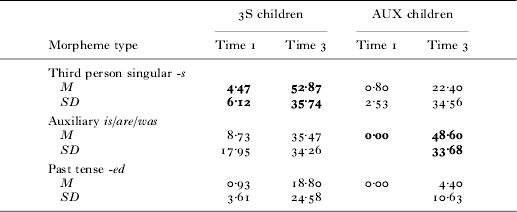
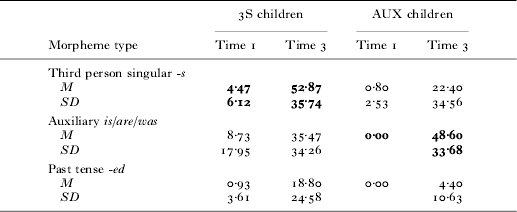
Before we tested the value of the hypothesized predictors of progress in intervention, it was important to establish that the gains the children made could be attributed to intervention. In Leonard et al. (Reference Leonard, Camarata, Pawłowska, Brown and Camarata2006), we reported that the children's scores on the target morphemes at Time 3 were significantly higher than their scores on a non-agreement verb morpheme, past tense -ed. Furthermore, the 3S children's scores on their target (third person singular -s) were higher than their scores on the agreement morpheme serving as the target for the AUX children (auxiliary is/are/was) and, conversely, the AUX children's scores on their target morpheme type were higher than their scores on the agreement morpheme serving as the target for the 3S children. A summary of the scores can be seen in Table 1. These findings were interpreted as evidence for gains on the target that could be attributed to treatment, over and above any gains that might have been driven by maturation.
A summary of Time 1 and Time 3 scores on the use of the target and non-target tense and agreement morphemes by 3S and AUX children. The target morpheme types are in bold
In Leonard et al. (Reference Leonard, Camarata, Pawłowska, Brown and Camarata2006), we also established that there was no significant correlation between Time 1 and Time 3 scores on the use of the target agreement morphemes (third singular -s for 3S children and auxiliary is/are/was for AUX children). If the children's use of the target morphemes at Time 1 predicted their use of the target morphemes at Time 3, it would be more parsimonious to attribute the gains in these morphemes to their initial level of use rather than to the factors (noun plural use, subject/verb use) that we are proposing are foundational skills for such gains. However, given the non-significant relationship, Time 1 scores for the target morphemes were not included in any regression models for testing.
Likewise, Time 1 probe scores on the use of copula is/are/was, another morpheme involving agreement, which was also monitored during the intervention program, were not significantly correlated with Time 3 scores on the use of target agreement morphemes. Although the children's use of this morpheme type was also quite limited at the outset of the study, it seemed plausible that children's Time 1 scores for copula could accurately predict the children's Time 3 scores on the target morphemes. That is, perhaps the children's early use of copula forms was a more direct measure of their emerging ability with agreement than either of our principal predictors of this ability, noun plural use and subject/verb use. However, since no significant relation was found, we did not include copula is/are/was in subsequent models used to predict Time 3 target morpheme use.
In the main analyses aiming at uncovering the predictors of progress in intervention, the dependent measure combines Time 3 scores on third person singular -s for 3S children and Time 3 scores on auxiliary is/are/was for AUX children. Time 3 scores on non-target third person singular -s (for AUX children) and non-target auxiliary is/are/was (for 3S children) are not included in this measure since progress in the acquisition of these morphemes cannot be directly attributed to intervention. The decision to collapse Time 3 target third person singular -s and auxiliary is/are/was scores was motivated by the fact that separate results for the two conditions might be difficult to interpret due to relatively small and unequal sample sizes (N=15 for 3S children, N=10 for AUX children). We felt that combining the two conditions was justified because the two groups of children received very similar treatment and were equally responsive to it (see Table 1). Our dependent measure had a mean of 51·16 and a standard deviation of 34·28. The scores ranged from 0% to 100% and were normally distributed.
Preliminary analysis: the use of noun plural
In order to determine whether the children's use of noun plural was delayed relative to what might be expected for typically developing children with similar MLUs, percentage correct scores based on Time 1 and Time 3 speech samples were compared to the normative data for typically developing children gathered by Lahey et al. (Reference Lahey, Liebergott, Chesnick, Menyuk and Adams1992). Eight out of 21 children had scores below one standard deviation (SD) of the mean for typically developing children in the same MLU range (Lahey et al., Reference Lahey, Liebergott, Chesnick, Menyuk and Adams1992) at Time 1. Seven of these children had scores lower than the lowest score recorded for typically developing children in Lahey et al. (Reference Lahey, Liebergott, Chesnick, Menyuk and Adams1992). At Time 3, 9 out of 23 children had scores below one standard deviation of the mean for peers with similar MLUs. Six of them had scores below the range recorded by Lahey et al. (Reference Lahey, Liebergott, Chesnick, Menyuk and Adams1992) for children with similar MLUs. Thus, 38% of the children at Time 1 and 39% of the children at Time 3 were clearly delayed in their acquisition of noun plural compared to typically developing children with similar MLUs. Even though some of them made progress in their use of noun plural during the intervention program, they did not catch up with their typically developing peers.
Predictors of progress
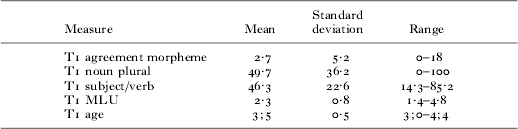
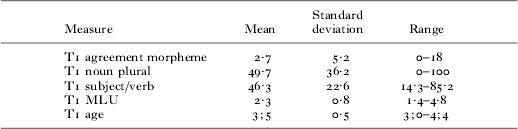
First we needed to establish that for our group of children the acquisition of noun plural and subject/verb constructions indeed preceded the acquisition of agreement morphemes. Because these three measures were based on percentage correct scores, they could be readily compared to each other (see Table 2 for summary of scores). We conducted paired-samples t-tests to see whether the children were significantly better in their use of noun plurals and subject/verb constructions than in their use of verb agreement morphemes. The tests showed that the mean score on the target agreement morpheme at Time 1 (M=2·7) was significantly lower than the score on both noun plural (M=49·7, p<0·001) and subject/verb constructions (M=46·3, p<0·001). We can thus conclude that for the children in this study, the acquisition of noun plural and subject/verb constructions preceded the acquisition of the target verb agreement morphemes.
A summary of the use of the target agreement morphemes and the predictor measures at Time 1 (T1)
Next, a series of regression analyses was carried out in order to evaluate the role of age, MLU, the use of noun plural and the use of subject/verb constructions at Time 1 as individual predictors of progress on the target verb agreement morphemes measured by responses to probes at Time 3 (see Table 3). The results of the regression analyses indicated that noun plural accounted for 21% of the variance (p=0·021), subject/verb constructions accounted for 21% of the variance (p=0·020) and age accounted for 30% (p=0·005) of the variance. Noun plural and subject/verb constructions were each positively correlated with the outcome of intervention, while age was negatively correlated with the outcome (for noun plural, r=0·459; for subject/verb constructions, r=0·462; for age, r=−0·549). There was also a tendency for the MLU to correlate with Time 3 target probe scores, but the correlation did not reach statistical significance (p=0·107).
R2 and significance values for individual Time 1 predictors of progress in the acquisition of target agreement morphemes

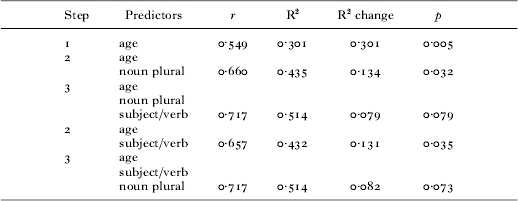
Hierarchical regression analyses were also carried out to test the joint and unique contributions of the three measures to the prediction of progress in the acquisition of agreement markers (see Table 4). Age was entered first for purely practical reasons: a child's age is known without obtaining measures of her noun plural and subject/verb construction use. Therefore, if noun plural or subject/verb construction use does not explain some of the variance beyond that accounted for by age alone, the applied value of these language measures may be rather low. A combination of age and noun plural accounted for 44% of the variance in Time 3 target morpheme scores (p=0·002). Noun plural accounted for 13% of the variance over and above the variance accounted for by age (p=0·032). When the use of subject/verb constructions was added as a third predictor, the resulting model accounted for 51% of the variance in Time 3 target morpheme scores (p=0·001). The use of subject/verb constructions accounted for about 8% of the variance when age and noun plural were controlled for, but this contribution was not significant (p=0·079). When the use of subject/verb constructions was entered second after age, then the model accounted for 43% of the variance in Time 3 target morpheme scores (p=0·002). The use of subject/verb constructions accounted for 13% of the variance over and above the variance explained by age (p=0·035). When noun plural was entered as the third predictor, it accounted for an additional 8% of the variance in addition to the variance explained by age and the use of subject/verb constructions, but this contribution was not significant (p=0·073).
Results of two hierarchical multiple regression analyses: multiple correlation, variance accounted for, change in R2 and significance of change
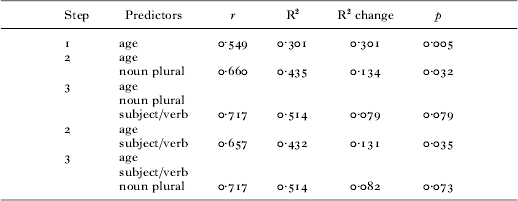
These findings suggest that, taken individually, each of the three predictors accounts for a significant portion of the variance in Time 3 target probe scores. This means that children who were younger or had a better command of noun plural or of subject/verb constructions were more likely to make greater gains on the target morpheme in intervention. The results of hierarchical regression analyses indicate that regression models based on two or three predictors have greater predictive power than regression models based on individual predictors. In models which combine two predictors, both the use of noun plural and subject/verb constructions explain unique portions of the variance over and above age. This means that children of the same age were in a better position to acquire agreement morphemes if they had higher levels of use of either noun plural or subject/verb constructions. The addition of a third predictor to the model resulted in a significant model which accounted for a higher portion of the variance. However, the third predictor did not account for a significant amount of unique variance (although it approached significance). This means that we cannot say with complete certainty that children who had a similar age and a similar level of use of noun plural did better in intervention if they had higher levels of use of subject/verb constructions, or that children who had a similar age and use of subject/verb constructions did better in intervention if they had higher levels of use of noun plural.
Predictors of progress – control morphemes
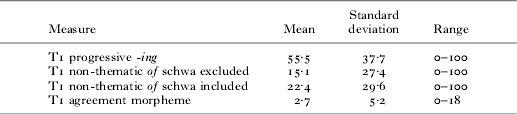
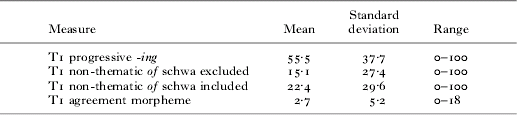
In order to test the hypothesis that earlier emerging grammatical morphemes which are not related to agreement are predictive of progress in the acquisition of agreement morphemes, we considered the relation between the use of progressive -ing and (separately) non-thematic of prior to intervention and the use of target agreement morphemes following intervention. First, we conducted paired samples t-tests in order to see whether, for our children, the use of progressive -ing and non-thematic of was higher than the use of target agreement morphemes prior to intervention (see Table 5). The results indicated that this was indeed the case (progressive -ing, p<0·001; non-thematic of, p=0·003; non-thematic of schwa excluded, p=0·034). Thus we concluded that, for this group of children, the acquisition of progressive -ing and non-thematic of preceded the acquisition of agreement morphemes.
A summary of the use of the target agreement morphemes and the control predictor measures at Time 1 (T1)
Next, we conducted regression analyses in order to see whether the use of progressive -ing and non-thematic of prior to intervention (Time 1) was predictive of the use of agreement morphemes following intervention (Time 3). We found that Time 1 use of progressive -ing did not predict Time 3 use of verb agreement morphemes (p=0·288). However, the target verb agreement morphemes for the 3S and AUX children were different. For the AUX children, these morphemes were auxiliary is/are/was. Since progressive -ing co-occurs with auxiliary is/are/was as part of the progressive construction, it seemed important to determine whether progressive -ing use might predict use of auxiliary is/are/was in particular. Therefore, we conducted a separate regression analysis using only the data from the AUX children, for whom auxiliary is/are/was was the target of intervention (N=10). We found that Time 1 use of progressive -ing did not predict Time 3 use of auxiliary is/are/was (p=0·589).
Regression analyses with Time 1 use of non-thematic of as an independent measure and Time 3 use of target agreement morpheme as a dependent measure showed that the use of non-thematic of prior to intervention did not predict progress in intervention. This was true both in the case of the more liberal measure of the use of non-thematic of (in which a schwa without a following fricative was counted as correct use) (p=0·485), and in the case of the more stringent measure in which a schwa without a following fricative was excluded from the analysis (p=0·733).
Individual data
Another way in which our claim might be discounted is by showing that at Time 1 there were children whose use of the target agreement morphemes was high, while their use of noun plurals was extremely low. This was highly unlikely, as all children had to have very low scores on the target morpheme prior to intervention in order to qualify for the program. Still we decided to investigate this possibility. There were only six children whose Time 1 scores on the target morpheme were greater than zero (18% was the highest score). Five of these children scored between 60% and 90% on the Time 1 plural probe, while the sixth child scored 0%. The last child's score of 8% on the target morpheme probe reflected the fact that this child used third singular -s in only one probe response. Because his score on the target probe at Time 2 was 0%, we can reasonably assume that his single use of third singular -s at Time 1 should not be taken as evidence of productive use of the agreement morpheme. Overall we can conclude that there were no individual cases of children who had high use of the target agreement morpheme and low use of noun plural at Time 1.
Next we inspected data from individual children at Time 3 to determine whether we could find individual cases of children whose use of noun plural remained low, but who nevertheless were able to acquire agreement morphemes. At Time 3, 16 out of 25 children had a score of 90% or more on the noun plural production probe. Three children had scores of 10% or less, while the fourth lowest score was 56%. The four children with the lowest Time 3 noun plural scores were the only children whose Time 3 score on the target morpheme probe was 0%. None of the children who had a low score on the Time 3 noun plural probe had a high score on the target morpheme probe. These findings show that those children who did not make considerable progress in their use of noun plural also did not make much progress in their use of the agreement morphemes. Conversely, there were three children whose Time 3 scores on the noun plural probe were 90% or above, and whose Time 3 scores on the target morpheme probe were rather low (11, 23 and 25%). Thus, a high command of noun plural did not guarantee that the children would make great gains in learning the target agreement morphemes, but a low command of noun plural was associated with a lack of progress in learning the target agreement morphemes.
Individual data were also inspected to check whether there were children who had low use of subject/verb constructions and a high score on the agreement morpheme probes. The existence of such cases might refute our claim that children who do not produce many subjects have a difficult time learning verb agreement morphemes. The mean percentage of use of subject/verb constructions at Time 1 was 46; SD=23. There were six children who had scores one standard deviation below the mean. All of these children had scores of 0% on the target probe at Time 1. The mean percentage of use of subject/verb constructions at Time 3 was 61; SD=19. Two children had scores two standard deviations below the mean. The child with the lowest score had a score of 0% on the target probe at Time 3, while the second child had a score of 38%. One child had a score one standard deviation below the mean on the use of subject/verb constructions and this child had a score of 44% on the target probe. Thus, it appears that children with extremely low scores on the use of subject/verb constructions at Time 1 or Time 3 were not able to use verb agreement morphemes with high levels of accuracy.
As in the case of noun plural, the frequent use of subject/verb constructions did not guarantee superior use of verb agreement morphemes. At Time 1, there were two children who used these constructions in 85% and 84% of lexical verb contexts. Yet the first child had a score of 0% on the target agreement morpheme at Time 1, while the second child had a score of 9% on the target probe at Time 1. Similarly, at Time 3 there were two children who had high levels of use of the subject/verb construction (73%) and who at the same time had no or limited use of the target morpheme (0% and 23%). Thus, a certain level of use of subject/verb constructions appeared to be a necessary but not a sufficient condition for the use of verb agreement morphemes.
Predicting gains related to intervention versus more general gains in agreement morphemes
Our hypothesis has been that initial noun plural and subject/verb use contributes to children's readiness to acquire agreement morphemes in treatment. However, the findings reported so far are not sufficient to demonstrate that the children's Time 1 scores for noun plural use and subject/verb use were predicting gains on the target that were specifically related to treatment. Therefore, we performed additional regression analyses to test this assumption further. We repeated the analyses shown in Table 3, but in this instance predicting Time 3 use of third person singular -s and auxiliary is/are/was when these were non-target morphemes. That is, while the analyses summarized in Table 3 involved the Time 3 use of third person singular -s by the 3S children and the use of auxiliary is/are/was by the AUX children, the new analyses involve the Time 3 use of auxiliary is/are/was by the 3S children and the use of third person singular -s by the AUX children. It is important to note that in these new analyses, precisely the same morpheme types are serving as the dependent measures, though, in this case, these were not the targets of intervention.
A summary of the findings appears in Table 6. As can be seen, noun plural -s (p=0·069), age (p=0·087) and MLU (p=0·089) approached significance, while subject/verb use did not (p=0·159). Hierarchical regression analyses indicated that, after age is considered, neither noun plural -s use, nor subject/verb use nor MLU accounted for a significant amount of additional variance. These models were not as successful as those shown in Table 3 and Table 4, in which the same agreement morpheme types were the focus of treatment.
R2 and significance values for individual Time 1 predictors of progress in the acquisition of non-target agreement morphemes

DISCUSSION
Our findings indicate that the use of noun plural and subject/verb constructions prior to intervention was related to the gains the children made in their use of agreement morphemes targeted in intervention. On the other hand, the MLU, the use of progressive -ing and non-thematic of prior to intervention were not significantly related to progress in intervention. More generally, the use of early emerging aspects of language which are related to agreement was predictive of progress in acquiring agreement markers, whereas the use of early emerging aspects of language which are not related to agreement was not predictive of progress in acquiring agreement markers.
Our data indicate that prior ability to use noun plural is necessary for children with SLI to acquire verb agreement morphemes. The use of noun plural predicted progress in intervention both by itself and when the effect of age was accounted for. Data from individual children appear to strengthen our case since we have found no cases of children who were proficient in their use of agreement morphemes but lacked the knowledge of noun plural at either Time 1 or Time 3. However, knowledge of noun plural was not sufficient for the children to acquire verb agreement morphemes since both prior to and following intervention there were children who had high levels of use of noun plural and low levels of use of verb agreement morphemes. The use of noun plural thus appears to be a necessary precondition for an SLI child to acquire verb agreement morphemes, but it does not guarantee that these morphemes will be acquired.
Previous research has found that, as a group, children with SLI show a moderate delay in the acquisition of noun plural, which, at the age of five, is visible only in slightly lower percentages of use in quantifier plus noun combinations and with nouns which are not frequently pluralized (Rice & Oetting, Reference Rice and Oetting1993; Oetting & Rice, Reference Oetting and Rice1993). The children in our study were younger (M=3 ; 5, SD=0·45) and had a wide range of scores on noun plural (from 0% to 100%) prior to treatment. However, because 38% to 39% of the children had scores that were lower than could be expected based on their overall language level as measured by MLU, we can conclude that, at the age range represented in our study, a sizeable proportion of the children with SLI lags behind their language-matched peers in the use of noun plural. If we are correct about the relationship between the acquisition of noun plural and verb agreement morphemes, then this finding is significant because it means that for these children the lag in the acquisition of noun plural will result in an even greater lag in the acquisition of verb agreement morphemes. It is an open question whether, at least for some children, treatment focused on noun plural -s would result in earlier acquisition of agreement morphemes. Although the results of one study indicate that this might not be the case (Gottsleben, Tyack & Buschini, Reference Gottsleben, Tyack and Buschini1974), research involving more subjects is needed in order to answer this question.
Our results can help us address another puzzle in the SLI literature. The processing accounts of SLI hypothesize that children with SLI have difficulties with items that have low phonetic substance (Leonard, Reference Leonard1989; Leonard et al., Reference Leonard, Eyer, Bedore and Grela1997). It is claimed that because these children have limited processing resources, they simply fail to register or fully process the least salient morphemes. This explanation has been used to account for the fact that SLI children have difficulties with acquiring tense and agreement morphemes, which tend to be rather brief. It has been pointed out, however, that this explanation fails to account for the fact that the affected children tend to acquire noun plural -s much sooner than third person singular -s, even though these morphemes are homophonous (Rice et al., Reference Rice, Wexler and Hershberger1998; Lahey et al., Reference Lahey, Liebergott, Chesnick, Menyuk and Adams1992). Hsieh et al. (Reference Hsieh, Leonard and Swanson1999) have addressed this problem by pointing out that noun plural -s may be acquired before third singular -s in part because it frequently occurs in the sentence-final position where it undergoes lengthening. We would like to propose that another reason for this inconsistency may lie in the fact that in order to start acquiring third person singular -s, children have to have some knowledge of noun plural. If SLI children have difficulties with processing and acquiring the plural -s, then it follows that they will have even greater difficulties with acquiring third person singular -s, because the acquisition of the agreement morpheme requires the child to be able to successfully process both the noun and the verb inflection and have at least partial knowledge of the plural.
If the use of noun plural is not a sufficient condition for the acquisition of verb agreement morphemes, then there must be other factors which account for these children's poor ability to learn agreement morphemes. In our study, the degree to which the child used subject/verb constructions at Time 1 proved to be an additional factor predicting success in learning the target verb agreement morphemes. The use of subject/verb constructions accounted for unique variance in scores reflecting the amount of progress children made when the effects of age had been controlled for. As in the case of noun plural, the individual data showed that there were no children with very low level of usage of subject/verb constructions who were proficient in the use of agreement morphemes, but there were children who had high levels of usage of subject/verb constructions and limited use of the target agreement morphemes. We can thus conclude that higher levels of usage of subject/verb constructions may be helpful but they do not guarantee the acquisition of verb agreement morphemes.
It is important to note that the subjects included in our subject/verb constructions measure were both nouns and pronouns. Wilson (Reference Wilson2003) showed that initially children use agreement marked copula and auxiliary be predominantly with pronominal subjects. This suggests that perhaps the use of pronominal subjects has a special role in the early acquisition of agreement markers. In our study, it was indeed the case that the majority of the subjects used in Time 1 speech samples were pronouns (M=79%, SD=18·39). However, the percentage of pronominal subjects used by children in these samples was not significantly correlated with Time 3 scores on the target agreement probe (r=0·255, p=0·219). Thus, our results allow us to say that overall frequent use of subjects is conducive to learning agreement morphemes. The precise role of pronominal and nominal subjects will have to be determined in future studies.
Age was the third factor which predicted the children's success in intervention: older children did not make as much progress in intervention as younger children. The fact that age combined with the use of noun plural and subject/verb constructions to allow higher levels of prediction adds a developmental component to our claims. It appears that the longer the delay in the acquisition of noun plural or subject/verb constructions persists, the more likely it is that the child will have more severe difficulties in learning a verb agreement morpheme. Thus, both the degree and the persistence of the delay in the acquisition of noun plural or subject/verb constructions can be seen as indicative of the degree to which the acquisition of verb agreement morphemes will also be delayed.
In regression models based on three predictors, the third predictor (either noun plural or subject/verb constructions) was not significant, although it approached significance. This result does not offer conclusive support for our claim that children need to use both noun plural and subject/verb constructions in order to acquire verb agreement morphemes. It is important to note, however, that our measures did not directly reflect the levels of usage of subject nouns marked for plural. We expect that future studies which employ such more direct measures may provide more conclusive evidence supporting the claim that frequent use of subjects marked for plural can aid English-speaking children with SLI in learning verb agreement morphemes.
As we expected, progress in the acquisition of agreement morphemes was not predicted by prior use of two morphemes which are not related to agreement: progressive -ing and non-thematic of. This finding supports our argument that some use of noun plural and subject/verb constructions is necessary for the acquisition of agreement morphemes. If the use of progressive -ing and non-thematic of were predictive of gains in the acquisition of agreement morphemes, then this could mean that these gains could be predicted by the use of any earlier emerging aspect of language prior to intervention. This would simply mean that children whose overall language use prior to treatment was more advanced were in a better position to benefit from intervention. However, this was not the case.
Similarly, MLU prior to intervention turned out not to be a good predictor of progress in the acquisition of verb agreement morphemes. We anticipated this finding because MLU is a global measure and it is related to agreement morphemes only by virtue of the fact that the use of noun plural and the use of subject/verb constructions adds to the length of the utterance. In addition, this finding suggests that a mere ability to produce long utterances may not predict success in the acquisition of agreement morphemes.
Our findings are consistent with those reported by Rice et al. (Reference Rice, Wexler and Hershberger1998), who found that although MLU was a significant factor in predicting progress in the acquisition of tense and agreement markers in children with SLI and typically developing children, it was a very weak predictor. Together with other predictors it accounted for only one percent of the variance in the scores reflecting progress in the acquisition of tense and agreement morphemes. However, since Rice et al. (Reference Rice, Wexler and Hershberger1998) were not able to find any factors which would substantially predict the development of tense and agreement morphemes in children with SLI and unaffected children, they concluded that the development of these morphemes is unrelated to any linguistic or environmental factors and is instead guided by genetically constrained timing mechanisms.
The results of our study suggest that other factors may be involved. Specifically, the use of noun plural and subject/verb constructions did predict growth in the use of agreement morphemes. Of course our study differed from that of Rice et al. (Reference Rice, Wexler and Hershberger1998) in terms of age (5 versus 3 ; 5 at the outset), the time scale involved (four years versus six months), the number of morphemes studied (all English tense and agreement morphemes versus third person singular -s and auxiliary is/are/was) and the rate of acquisition of these morphemes by children with SLI (slow versus accelerated due to intervention). However, these differences highlight the fact that more fine-grained analyses involving more specific language measures may be needed in order to uncover predictors of progress in the acquisition of verb-related morphology. The importance of finding such predictors lies in the fact that they allow us to consider alternative explanations of patterns of growth and they help us offer more specific clinical guidelines.
Our findings allow us to adopt a view of the role of maturation in language development in which maturation is understood as a child's growing ability to process more complex information. Such biological maturation may interact with the properties of a particular language to determine the order in which different aspects of language will be acquired. In the present study, it is the nature of English subject/verb agreement morphology that determines the order in which noun plural and verb agreement are acquired. If there was a language in which the verb was marked for number based on whether the action expressed by it occurred once or more than once, and the noun carried an agreement marker whose value was determined by the number value of the verb, then it might be expected that in such a language verb plural would be acquired before noun agreement morphology. Thus, in assessing the readiness of an English-speaking child with SLI to acquire verb agreement morphology, it is important to determine not only whether this child has reached a developmental stage in which she can process utterances of a certain length, but also, perhaps more importantly, to determine whether she has already acquired the linguistic constructions that provide the base of knowledge that will be necessary for the acquisition of verb agreement morphology.
The fact that the use of noun plural -s and subject/verb constructions was much less predictive of progress in learning agreement morphemes which were not targeted in intervention constitutes a rather stringent test of our hypothesis that these predictors are related to progress made in intervention. In principle, we suspect that noun plural -s and subject/verb use are, in fact, meaningfully related to growth in the use of third person singular -s and auxiliary is/are/was, even without treatment. However, given the relatively slow growth in agreement morpheme use by children with SLI and the duration of the study, we expected that this relationship would only be clearly demonstrable for those morphemes that were the focus of intense intervention efforts.
Our findings are also relevant to another general theoretical question of whether SLI children's difficulties with verb morphology should be described as limited to the grammatical category of tense (Rice & Wexler, Reference Rice and Wexler1996; Rice et al., Reference Rice, Wexler and Hershberger1998), agreement (Clahsen, Reference Clahsen1989) or both (Schütze & Wexler, Reference Schütze, Wexler, Stringfellow, Cahana-Amitay, Hughes and Zukowski1996). We would strongly argue that these children have difficulties with learning verb agreement morphemes in addition to tense morphemes. As we have shown, these difficulties may be related to the use of other items which are involved in the marking of agreement, such as noun plural and subject/verb constructions. The use of tense markers is clearly not dependent on the use of noun plural. However it would be interesting to see whether it could be shown to be related to the use of subject/verb constructions.
The results of our study raise a number of additional questions. Would they also be observed in the case of the remaining verb agreement morphemes: copula be, present tense auxiliary do and have? Would they hold for third person singular -s and auxiliary is/are/was separately, if larger groups of SLI children were involved in each condition? Would they find support in the data from typically developing children? Could non-linguistic factors such as family history of language impairment be used to predict progress made in intervention? If so, then would there be any interaction between family history and linguistic signs of readiness? We anticipate that many of these questions may find affirmative answers, but these answers will have to await future research.
CONCLUSION
Our analyses focused on children with SLI who participated in an intervention program targeting verb agreement morphemes. Progress in intervention was related to the children's age, and use of noun plural and subject/verb constructions prior to intervention. We concluded that in order to acquire verb agreement morphemes, children had to show some use of noun plural and subject/verb constructions. We interpreted these findings as supporting the view that the use of noun plural and subject/verb constructions is a prerequisite for the acquisition of verb agreement morphemes by English-speaking children with SLI. The children with SLI in our study appear to have had some difficulty with acquiring noun plural which seems to have compounded their difficulty with acquiring verb agreement markers. In order to be more reliable, these findings clearly need to be tested with different groups of SLI children as well as with typically developing children. However, at this point, they seem to warrant the recommendation that a decision to enroll a child in intervention focused on verb agreement morphemes should take into account the child's ability to use noun plural and subject/verb constructions.