Significant outcomes
∙ The Diagnostic Apathia Scale measures difficulties in memory and concentration, difficulties in decision making, reduced ability to work and engage in personal interests, somatic fatigue and muscle pains, tiredness and lack of energy, and sleep problems.
∙ The Mokken analysis of the Diagnostic Apathia Scale indicated adequate scalability, that is, the total score of the scale is a psychometrically valid measure of apathy.
∙ Only the Diagnostic Apathia Scale, and not the scales measuring severity of symptoms, disability, or psychological well-being, had predictive validity regarding return to work (RTW).
Limitations
∙ Concurrent validity between the Diagnostic Apathia Scale and other apathy rating scales has not been tested.
Introduction
Depression and anxiety disorders are among the most prevalent mental disorders (Reference Kessler, Berglund, Demler, Jin, Merikangas and Walters1,Reference Kessler, Aguilar-Gaxiola and Alonso2). Despite effective pharmacological and psychological treatment interventions, many of the patients suffering from these disorders fail to achieve full remission and are not able to RTW after treatment, at least 30% of patients with depression fail to do so (Reference Romera, Perez, Menchon, Polavieja and Gilaberte3,Reference Lam, Parikh and Ramasubbu4). Few studies have examined which factors predict the ability to RTW (Reference Hees, Koeter and Schene5), and these have mostly focused on the role of ‘disease characteristics’ such as age at onset, symptom severity, and duration of illness. However, recent studies have claimed that these factors alone are unable to predict RTW (Reference Lagerveld, Bultmann and Franche6), explaining <10% of the variation in work absence (Reference Van Der Werff, Verboom, Penninx, Nolen and Ormel7). Psychological (subjective) well-being has also been proposed as a predictor of RTW. In a recent prospective general population study with newly sick-listed persons with mental health problems, Hensing et al. (Reference Hensing, Bertilsson, Ahlborg, Waern and Vaez8) found that low well-being, as measured by the WHO (Ten) Well-being Index (WHO-10) (Reference Bech, Gudex and Johansen9), predicted late RTW. However, almost all patients with moderate/severe and persistent depression or anxiety report poor well-being, for example, as defined by the WHO (Five) Well-being Index (WHO-5) (Reference Bech, Olsen, Kjoller and Rasmussen10). Consequently, well-being is likely to be less efficient in predicting RTW in this population, compared with its predictive ability in the general population (Reference Hensing, Bertilsson, Ahlborg, Waern and Vaez8). In contrast to poor well-being, not all patients with depression and anxiety are burdened by apathy (lack of interest, lassitude, indifference, impassiveness) to the same extent.
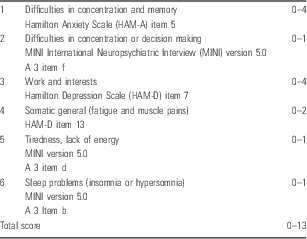
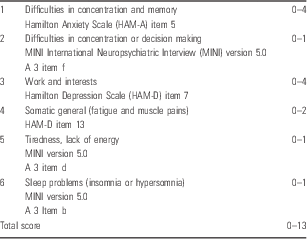
Apathy has been of interest to psychiatric researchers for decades. In considering apathy to be a general neuropsychiatric syndrome, Marin et al. (Reference Marin, Biedrzycki and Firinciogullari11) developed the Apathy Evaluation Scale. This scale contains mainly positively formulated items, which capture the level of motivation. In cognitive disorders such as dementia, stroke, Parkinson’s Disease, or epilepsy, apathy is generally associated with ‘abulia’, a term used by neurologists and neuropsychiatrists to denote lack of spontaneous goal-directed behaviour (Reference Berrios and Gili12,Reference Bech13). However, apathy may not manifest in the same way across all neuropsychiatric disorders. Through studies of patients with depressive disorders, we have identified a depression-related apathia syndrome in patients who were resistant to antidepressant medication (Reference Andreasson, Liest and Lunde14). These patients were measured at baseline with depression symptom scales such as the Hamilton Depression Scale (Reference Hamilton15), the Bech-Rafaelsen Melancholia Scale (Reference Bech, Kastrup and Rafaelsen16), or the Montgomery-Åsberg Depression Rating Scale (MADRS) (Reference Montgomery and Asberg17). By means of a principal component analysis of these scales, we identified an ‘apathy factor’ containing symptoms of fatigability, lassitude, concentration or memory problems, and sleep problems (Reference Andreasson, Liest and Lunde14). Using the symptoms identified in this study, we created a rating scale, the ‘Diagnostic Apathia Scale’ (Table 1). The symptoms used are all included in the International Classification of Diseases-10 (ICD-10) definition of both depression and anxiety (18).
The items defining the Diagnostic Apathia Scale
When considering the nature of this depression/anxiety-related apathy syndrome, and its intuitive antagonistic relationship to the ability to work, it seems likely that the severity of this syndrome may be superior to the level of well-being in predicting post-treatment capacity to RTW among patients with depression and anxiety. In this study, we therefore aimed to investigate the ability of this new ‘Diagnostic Apathia Scale’ in predicting RTW and to compare this ability against that of more established scales measuring severity of symptoms, disability, or psychological well-being in patients with depression or anxiety. Specifically, the following research questions were addressed:
1. Does the Diagnostic Apathia Scale have acceptable scalability, that is, is the total score of the individual items a psychometrically valid (unidimensional) measure for the severity of apathy?
2. Can the Diagnostic Apathia Scale predict RTW after 1 year among patients with depression or anxiety disorders?
3. Is the Diagnostic Apathia Scale superior to other relevant rating scales (Sheehan Disability Scale (SDS), Global Assessment of Functioning (GAF) or the WHO-5 Well-being Index (WHO-5), the Personal and Social Performance Scale (PSP), the Hamilton Core Anxiety Scale (HAM-A6), the Hamilton Core Depression Scale (HAM-D6), and the Global Assessment of Symptoms (GAS)) in predicting RTW?
Methods
Source of data
In an on-going randomised clinical trial using RTW as primary outcome measure, we are comparing an individualised supported employment intervention in addition to treatment as usual (TAU) versus only TAU in patients with depression or anxiety disorders (Reference Hellstrom, Bech, Nordentoft, Lindschou and Eplov19).
In brief, participants were recruited from psychiatric in- and outpatient hospital departments within the Capital Region of Denmark, starting October 2011. All participants had recently received treatment for anxiety (F40-41) or affective disorder (F30-39) according to ICD-10 criteria (18).
The trial protocol was submitted to the Regional Ethics Committees of the Capital Region for review (journal no.: H-2-2011-FSP20). The committee assessed the protocol to be exempt from formal approval, since it is not a biomedical trial. The trial has been reported to the Danish Data Protection Agency (RHP journal no.: 2007-58-0015, local journal no.: RHP-2011-20) and has been registered at http://www.clinicaltrials.gov identifier: NCT01721824.
In this analysis, we have focused on the 56 patients with available 1-year follow-up data regarding RTW status. For our two independent groups design with p<0.05, ∼30 patients in each group are sufficient (Reference Cumming20). The expected rate of patients who would RTW at the 1-year follow-up was 30–40% (Reference Hees, De Vries, Koeter and Schene21) implying that the comparison between the groups of RTW and non-RTW was statistically acceptable. The 56 participants were all interviewed by LCH at baseline, that is, just after discharge from hospital, and at 1-year follow-up. Concerning a description of the treatments the patients received, only their status at baseline was available.
The following rating instruments were employed:
Interview-based scales
Version 5.0 of the Mini-International Neuropsychiatric Interview (MINI) (Reference Sheehan, Lecrubier and Sheehan22) focussing on the items for depression and generalised anxiety disorder.
The six items from the Hamilton Depression Scale (HAM-D17) defining the core symptoms of depression (HAM-D6). A score of 9 or more indicates moderate depression and a score of 4 or less indicates remission (Reference Bech23).
The six items from the Hamilton Anxiety Scale (HAM-A14) defining the core of anxiety (HAM-A6). A score of 9 or more indicates moderate anxiety and a score of 4 or less indicates remission (Reference Bech23).
The PSP scale
A score of 50 or less indicates severe difficulties in one or more of the four areas of the PSP. A score of 51 to 70 indicates manifest to marked difficulties, and a score of 71 to 80: mild impairment (Reference Morosini, Magliano, Brambilla, Ugolini and Pioli24).
The GAF
A score of 50 or less indicates very severe impairment in occupational or social functioning and a score between 51 and 60 indicates moderate to marked impairment. A score between 61 and 70 indicates mild to moderate impairment (Reference Endicott, Spitzer, Fleiss and Cohen25–Reference Pedersen, Hagtvet and Karterud27).
The GAS
A score of 50 or less indicates serious symptoms. A score of 51 to 60 indicates moderate to marked symptoms, and a score between 61 and 70 indicates mild to marked symptoms (Reference Endicott, Spitzer, Fleiss and Cohen25,Reference Jones, Thornicroft, Coffey and Dunn26).
Self-reported questionnaires
SDS (Reference Sheehan28): work, social, family. A score of 5 or more on each of the individual subscales indicates marked disability.
WHO-5: a score below 30 indicates moderate to severe problems, a score between 31 and 50 mild to moderate problems, and a score of 70 or more indicates adequate well-being.
Definition of the Diagnostic Apathia Scale and calculation of its total score
Based on the factor analysis from our previous study of patients with depressive disorder (Reference Andreasson, Liest and Lunde14), we chose the following six items to define the Diagnostic Apathia Scale (See also Table 1): Items 7 and 13 from the Hamilton depression rating scale (Reference Hamilton15), item 5 from the Hamilton anxiety rating scale (Reference Hamilton29), and items b, d, and f from MINI version 5.0 (Reference Sheehan, Lecrubier and Sheehan22).
The total score of the Diagnostic Apathia Scale for each participant at the baseline of the RTW study was calculated by adding the individual scores of the six items. As shown in Table 1, the theoretical score range on the Diagnostic Apathia Scale is 0–13.
Evaluation of RTW
In the present study, RTW is defined as ‘standard’ employment, any competitive employment (including flexible jobs, wage-subsidised jobs, and being on rehabilitation benefits) or undergoing education 1 year after baseline. Information about employment and education was obtained by asking participants about their current job/educational status at 1-year follow-up.
Research question 1: does the Diagnostic Apathia Scale have acceptable scalability?
When evaluating the scalability of the Diagnostic Apathia Scale, the Mokken analysis was used (Reference Molenaar, Debels and Sijtsna30). As seen in Table 1, the gradings of the various apathy items differ as the MINI items are scored from 0=not present to 1=present; the HAM-D items are scored from 0 to 2 and 0 to 4, respectively, whereas the HAM-A item is scored from 0 to 4. In the Mokken analysis, all items have to operate on the same Likert scale (Reference Molenaar, Debels and Sijtsna30). Therefore, the items going from 0 to 4 were ‘decreased’ to Likert scales from 0 to 2, and items going from 0 to 1 were ‘increased’ to Likert scales from 0 to 2. According to Mokken (Reference Mokken31), a coefficient of homogeneity of 0.40 indicates acceptable scalability.
Research question 2: predictive validity (RTW) of the Diagnostic Apathia Scale
The predictive validity of the Diagnostic Apathia Scale was investigated using Fisher’s exact test (Reference Siegel32). RTW after 1 year was compared with whether apathy was present at baseline or not, defined by a cut-off total score of 8.
Research question 3: comparison of predictive validity (RTW) against other scales
Mean scores on HAM-D6, HAM-A6, PSP, GAF, GAS, SDS, and WHO-5 of participants who had returned to work or not after 1 year were analysed at baseline and at 1-year follow-up, and compared using Mann–Whitney test when the level of measurement was on an ordinal scale, and using Fisher’s exact test when the level was on a nominal scale (Reference Siegel32).
Statistical analysis
All statistical analyses were performed using the SAS statistical package (version 9.00, 2002). The level of statistical significance was p<0.05 throughout.
Results
Throughout the study, LCH participated in joint rating sessions with the HAM-D6 at which 28 patients were rated. The intra-class coefficient between LCH and PB was 0.81. At the beginning of the study, LCH made joint ratings with an experienced psychiatric nurse at which they rated seven patients. The intra-class coefficients were: HAM-A6 0.71; Diagnostic Apathia Scale 0.87; GAF-F 0.84; GAF-S 0.75; and PSP 0.92.
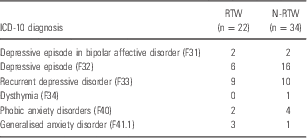
Of the 56 patients included in the analysis, 22 were employed at follow-up (RTW) and 34 were not employed (N-RTW). The mean age of the employed group was 33.8 (standard deviation=8.4) years, in the not-employed group it was 36.0 (standard deviation=11.4); (p=0.63). The proportion of females was 72.7% in the employed group and 67.6% in the not-employed group (p=0.72). Table 2 shows the ICD-10 diagnoses at the time of randomisation in the clinical trial. The diagnostic distribution was very similar in the two patient groups (RTW vs. N-RTW). The four patients with bipolar disorder all had bipolar depression at the time of randomisation (baseline). The proportion of patients treated with antidepressants was 68% in the RTW group and in the N-RTW group. Among the 56 patients, serotonin-specific reuptake inhibitors (SSRIs) were prescribed in 15 cases (27%) with the same percentage in the non-apathy group and the apathy group. Within the 10 anxiety patients, SSRIs were prescribed in five cases, of whom two had no apathy and three had apathy. In 8 of the 56 patients (14%), serotonin and norepinephrine reuptake inhibitors (SNRIs) were prescribed (11% in the non-apathy group and 16% in the apathy group). Atypical antipsychotics were prescribed in seven cases (12%) with 21% in the non-apathy group and 8% in the apathy group. Antidepressants such as mirtazapine or agomelantine were prescribed in <5% of the cases. Finally, no psychopharmacological treatment was prescribed in nine cases (16%), with the same percentage in the non-apathy and apathy groups. The apathy syndrome described at baseline was therefore not associated with the antidepressants received by the patients at this point in time.
Baseline characteristics concerning ICD-10 diagnoses of patients who 1 year later returned to work (RTW) (n=22) or not (N-RTW) (n=34)
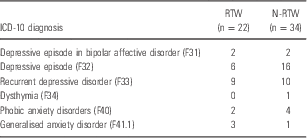
ICD-10, International Classification of Diseases-10.
The answers to the three research questions are outlined below.
Research question 1: is the Diagnostic Apathia Scale unidimensional?
The Mokken analysis of the Diagnostic Apathia Scale yielded a coefficient of homogeneity of 0.41 indicating adequate scalability (the total score is a psychometrically valid measure of apathy). The most ‘inclusive’ item (highest mean score) was fatigability, followed by concentration difficulties, and lack of interests while the most ‘exclusive’ item (lowest mean score) was sleep problems. The mean total score of the Diagnostic Apathia Scale for all 56 patients was 8.1 (standard deviation=1.9), and the median was 8 with a range from 3 to 11.
Research question 2: predictive validity (RTW) of the Diagnostic Apathia Scale
The baseline median total score on the Diagnostic Apathia Scale in the 22 patients who had returned to work at follow-up was 7.5, whereas the corresponding total score was 9.0 among the 34 patients who did not RTW (p=0.03). Table 3 shows the results for the Diagnostic Apathia Scale when using the cut-off score of 8 (i.e. the mean and median score) or more to indicate clinically significant apathy. At baseline, 76% of the patients not employed 1 year later met criteria for this clinical apathy syndrome, compared with 50% of those who were employed (p<0.05).
Baseline syndromes of patients who 1 year later had returned to work (RTW) (n=22) or not (N-RTW) (n=34)

HAM-A6, Hamilton Core Anxiety Scale; HAM-D6, Hamilton Core Depression Scale.
Research question 3: comparison of predictive validity (RTW) against other scales
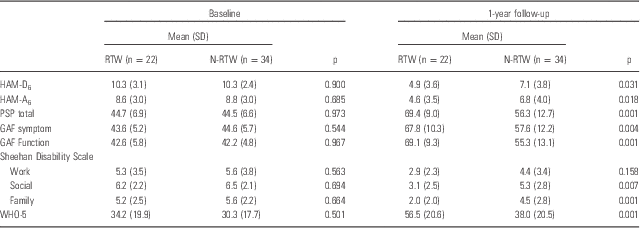
When the baseline HAM-D6 (Table 3), HAM-A6 (Table 3), or WHO-5 total scores were analysed, using a cut-off score of 9 or more for clinically significant depression or anxiety, and a cut-off score of <50 for decreased well-being (WHO-5) (Reference Bech23), no difference was seen between the two groups of patients (RTW vs. N-RTW) (Table 3). Table 4 shows the mean scores for the remaining scales at baseline. No statistically significant differences between the two groups of patients were found. When using the HAM-D6 to compare the 10 patients with an anxiety diagnosis with the 46 depressives at baseline, no statistical difference was obtained (9.1 vs. 10.5, p>0.05). Table 4 also shows the mean scores on the same scales at follow-up. Apart from the work subscale of the SDS, all these scales indicated a statistically significant difference between the two groups of patients. For the WHO-5, a higher score means better functioning. However, the WHO-5 mean score for the group of patients who had regained work was 56.5 and this is still far below the mean score for the Danish general population, which is ∼70 (Reference Bech23).
Psychopathological symptoms, level of functioning and quality of life at baseline and 1-year follow-up for patients who had returned to work (RTW) (n=22) or not (N-RTW; n=34) at follow-up

HAM-A6, Hamilton Core Anxiety Scale; HAM-D6, Hamilton Core Depression Scale; PSP, Personal and Social Performance Scale; GAF, Global Assessment of Functioning.
Discussion
The Diagnostic Apathia Scale was not only found to possess psychometric validity according to Mokken analysis (scalability), but also to have a significant predictive validity concerning patients’ ability to RTW 1 year after their discharge from hospital. None of the other outcome scales displayed the same predictive validity in the present study.
In trials of antidepressants, social functioning has previously been considered as an important outcome measure (Reference Bech33). In this context, it was recommended to use scales in which general population norms (mean scores) were available because the goal of therapy for patients with depression and anxiety is to reach a level of functioning similar to that of the general population. This is an essential criterion on remission in patients with disorders of depression and anxiety. Since we have general population values for the WHO-5, which is a score of 70 (Reference Bech23), this scale is often used.
In the present study, the group of patients who regained work (RTW) a year later had a mean score of 34.2 on the WHO-5 at baseline, and at the follow-up assessment the mean WHO-5 was 56.5. However, there was no significant difference in the WHO-5 values between the RTW and N-RTW groups at baseline. This lack of predictive validity of the WHO-5 well-being scale in our study as compared with the study by Hensing et al. (Reference Hensing, Bertilsson, Ahlborg, Waern and Vaez8) might be explained by the fact that only 29% of the patients in the Hensing et al. study scored below the cut-off score for poor well-being, whereas ∼85% of the patients in the present study reported poor well-being (WHO-5 score<50). This is well in line with the fact that at baseline ∼75% of the patients were still in a moderate to severe depression according to the HAM-D6 (Table 3).
Recently, Lam et al. (Reference Lam, Parikh and Ramasubbu4) conducted a trial combining pharmacotherapy and psychotherapy in patients with major depression, using work functioning after 12 weeks of therapy as primary outcome. In this study, the total score on the 10 items of the MADRS had no predictive validity regarding work function. This is completely consistent with our finding of poor validity of the HAM-D6 and HAM-A6 in predicting RTW in the present study although we also included anxiety disorder. On the other hand, Gustafsson et al. (Reference Gustafsson, Lundh, Svedberg, Linder, Alexanderson and Marklund34), in their longitudinal cohort study on patients with long-term sickness absence including patients with depression and anxiety, found that low scores on the MADRS apathy items (lassitude and fatigability) were associated with the ability to RTW. This is also in agreement with the results of our analysis, where the presence of the apathy syndrome predicted difficulties in RTW.
Focusing on the classes of antidepressants (SSRIs, SNRIs, TCAs) received by the patients at baseline, at which time apathy was diagnosed, no treatment-induced apathy was observed. However, the hypothesis that antidepressants may induce apathy in the residual phase (continuation therapy) as discussed by Fava (Reference Fava35) is certainly very important, but a test of this hypothesis is outside the scope of this study.
As discussed by Healy (Reference Healy36), the neuropsychological apathy symptoms of depression (tiredness, concentration/memory problems, sleep problems) might have a much greater impact on brain functioning than the more psychological symptoms of depression such as depressed mood, psychic anxiety, or guilt feelings. Sahakian (Reference Sahakian37) has especially focused on cognitive function in depression as an often overlooked impairment in patients who are remitting on the more psychological symptoms of depression. In our Diagnostic Apathia Scale, the reduced ability to concentrate or remember, and the reduced ability to make decisions are the first two items. It is therefore important to focus on both cognitive and on emotional apathy as principal components in depression. Our findings as reported in this study underline the practical value of measuring the full apathy syndrome separately from the more psychological symptoms of depression and anxiety. This full apathy syndrome as covered by the Diagnostic Apathia Scale (in which the items of the Marin et al. (Reference Marin, Biedrzycki and Firinciogullari11) Apathy Scale can be considered as a subfactor) is a dimension going across the DSM-5 (38) and ICD-10 syndromes of depression and generalised anxiety since fatigability, concentration problems, and sleep disturbances are overlapping symptoms within these two disorders.
We have found that the Diagnostic Apathia Scale has an acceptable predictive validity in terms of the ability to RTW 1 year after discharge from hospitalisation for patients with depression or anxiety. Taking the neuropsychological symptoms of apathy into account may not only help enhance treatment of the disorders per se, but could also support social workers in targeting the initiatives aimed at increasing the patients’ probability of regaining work. A prospective study is planned to further confirm our results as to the validity of the Diagnostic Apathia Scale in predicting the ability to RTW following depression or anxiety, with a more detailed monitoring of the treatment the patients are receiving.
Acknowledgements
Lone Hellström designed the randomised controlled study, which provided the data for manuscript. All authors contributed to the design of the data analysis aiming specifically at evaluating the validity of the Diagnostic Apathia Scale. Per Bech undertook the statistical analyses and wrote the first draft of the manuscript, which was critically revised by all authors. The final version of the manuscript was approved by all authors.
Financial Support
None.
Conflicts of Interest
The authors report no conflicts of interest.
Ethical Standards
The authors assert that all procedures contributing to this work comply with the ethical standards of the relevant national and institutional committees on human experimentation and with the Helsinki Declaration of 1975, as revised in 2008.