


Introduction
Over the past two decades, community engagement has evolved from an ethical aspiration to an increasingly formal expectation in all types of research. Funders and institutions now require explicit engagement plans, clear role definitions, and evidence that community and patient partners meaningfully shape the research lifecycle, from priority setting and study design to recruitment, interpretation, and dissemination. The Patient-Centered Outcomes Research Institute Engagement Rubric offers a framework for operationalizing engagement across research phases, emphasizing reciprocal relationships, co-learning, transparency, and shared decision-making [Reference Sheridan, Schrandt, Forsythe, Hilliard, Paez and Engage1]. The Principles of Community Engagement further establish that effective engagement requires trust-building, shared power, and institutional commitment to sustained partnership, responsibilities that rest with research institutions as much as with community members [Reference Cohn, McCloskey and Berman2]. Despite this maturation, the science of engagement continues to face foundational gaps, including inconsistent terminology, variability in implementation models, and limited availability of reliable measures to evaluate engagement quality and outcomes [Reference Luger, Hamilton and True3]. A second challenge is the risk of tokenistic engagement that occurs late in the research process, confers limited influence, or is used primarily to legitimize predetermined decisions. Stakeholders report that superficial engagement can undermine trust and reduce the perceived legitimacy of research partnership [Reference Wilkinson, Slack, Thabethe, Salzwedel and Wassenaar4]. These concerns are heightened when engagement structures fail to create accessible, reciprocal pathways for sustained involvement, or when the burden of “engagement readiness” is placed on communities rather than on institutions to develop shared language, mutual accountability, and opportunities for meaningful contribution. Communities bring essential lived experience, relational trust, and contextual knowledge that researchers cannot replicate; the goal of structured engagement programming is to create conditions where those assets can be effectively integrated into research processes, not to remediate perceived community deficits [Reference Norman, Bennett and Cowart5]. Importantly, meaningful community engagement does not require community members to become scientists, alternative models such as Boot Camp Translation demonstrate that researchers can adapt their communication and processes to meet communities where they are [Reference Norman, Bennett and Cowart5].
Community engagement and citizen/community science are related but distinct approaches to involving community members in research. Community engagement encompasses a broad range of strategies that promote meaningful participation of community members throughout the research process [Reference Wilkinson, Slack, Thabethe, Salzwedel and Wassenaar4]. Citizen and community science involve training and supporting community members to participate in specific research activities, contributing their lived experience and community knowledge within structured institutional frameworks [Reference Glasgow, Harden and Gaglio6,Reference Hensel, Askins and Ibarra7]. Although these approaches differ in their goals and implementation, both seek to strengthen connections between research and the communities they serve. The Community Scientist program described here was developed as a structured capacity-building model designed to expand opportunities for community participation in research.
Common institutional engagement strategies include community-based participatory research (CBPR) and community advisory boards (CABs) or patient-family advisory councils which provide forums for feedback and accountability but vary widely in representativeness and authority, and often function in consultative roles with limited scaffolding for complex domains such as genomics, biobanking, and data governance [Reference Norman, Bennett and Cowart5]. The community scientist (CS) model described in this paper is best understood as a citizen/community science initiative, one that builds capacity and creates structured institutional pathways that support the conditions necessary for more equitable and sustained community engagement in research over time. Rather than positioning trained community members as equivalent partners in governance, the CS model prepares individuals to contribute meaningfully within research teams while remaining grounded in lived experience and community priorities. Programs such as the Florida-California Cancer Health Equity Center (CaRE[Reference Cohn, McCloskey and Berman2]) Community Scientist Research Advocacy Program similarly position CSs as trained partners who bridge community and researcher perspectives [Reference Rosas, Rodriguez Espinosa, Montes Jimenez and King8]. Contemporary frameworks integrate citizen science with CBPR and systems science to support scalable population health impact, including through digital and asynchronous modalities that reduce barriers to participation [Reference Glasgow, Harden and Gaglio6].
Empirical evidence documenting how citizen/community scientist capacity-building shapes engagement readiness and contribution remains limited, particularly when community partners are asked to engage with specialized scientific and ethical domains such as genomics, biobanking, an IRB processes. Reviews highlight the promise of citizen science for health equity and the need for clearer implementation models, role clarity, and pragmatic evaluation strategies that connect capacity to sustained partnership and influence [Reference Luger, Hamilton and True3,Reference Rosas, Rodriguez Espinosa, Montes Jimenez and King8]. Critically, this evidence base must also grapple with the distinction between training outcomes- increased knowledge and confidence, and engagement outcomes- shared power, co-governance, and community-driven research priorities. The CS program described here contributes to the former, and we present it as such. This study evaluates the implementation, evolution, and outcomes of a multi-site CS training and experiential-learning program delivered across three Mayo Clinic regions. We assessed changes in participants’ research-related knowledge, confidence, and readiness to engage as partners in clinical and translational research within diverse geographic contexts. We present this program explicitly as a citizen/community science model that strengthens the institutional infrastructure and shared language necessary to support meaningful community engagement, recognizing that capacity-building at the individual level is a necessary but not sufficient condition for the equitable partnerships that community engagement, in its fullest sense, requires.
Materials and methods
Program design and curriculum
The Community Scientist Program was designed to integrate community members’ lived experiences into research relevant to their communities, strengthening the relevance, trustworthiness, and translational impact of research. The program aimed to increase research literacy while preparing participants to engage as informed partners within research teams. Through structured training and applied engagement, CSs gained exposure to research processes, ethical and regulatory safeguards, and opportunities for community perspectives to shape research design and implementation.
The curriculum was informed by and adapted from the Florida-California CaRE2 Community Scientist Research Advocacy Program [Reference Hensel, Askins and Ibarra7] and tailored to the institutional context, community needs, and evolving engagement priorities. The initial iteration (the Citizen Scientist Program) was delivered in 2021 as a single five-hour intensive training covering core topics including the CS role, research ethics, biostatistics, social determinants of health, genomics, biobanking, IRB processes, and working with investigators. In response to feedback from community members who felt the term ‘citizen’ was exclusionary, the program was renamed the Community Scientist Program although the underlying citizen science framework remains the conceptual foundation of the model. In 2022, the same content was distributed over four weeks to improve accessibility and learning pace.
In response to participant feedback, the program evolved in 2023 into a longitudinal model consisting of an eight-week didactic curriculum followed by a six-week experiential learning component. This redesign supported deeper engagement with complex research topics through weekly instruction by Mayo Clinic experts and added content emphasizing cancer research and inclusive participation. Formal pre- and post-training evaluation was implemented to assess participant knowledge and program impact.
The 2024 curriculum further expanded to reflect the full translational research continuum, adding content on basic-to-translational science and biomedical informatics. Evaluation of the experiential component was also introduced, incorporating feedback from both CSs and research preceptors. Program structure, duration, and content evolution are summarized in Table 1. In 2025, asynchronous training options were introduced through recorded sessions to support just-in-time engagement. Collectively, these refinements reflect a scalable, adaptive approach to community-engaged research training that balances standardization with flexibility.
Evolution of the community scientist program curriculum, structure, duration, and key content areas (2021–2024)

Table 1. Long description
The table has five columns: Year, Program structure, Duration and frequency, and Major content areas and key changes. It spans four rows for the years 2021 to 2024. Row 1: 2021, Single-day workshop, 1 day, ~5 hours, Citizen Scientist role introduction, Biostatistics and bioethics, Research advocacy, Social determinants of health, Genomics, Biobanking, Institutional Review Board (IRB) overview, Community engagement, working with Principal Investigators (PIs), Panel discussions, Baseline curriculum delivered in one session. Row 2: 2022, Multi-week short course (same as 2021), 4 weeks, 2-3 hours/week, Same topics as 2021, Structural change only—content unchanged. Row 3: 2023, Multi-week course with revised content, 8 weeks, ~1-1.5 hours/week, Week 1: Clinical trial diversity, Research advocacy, Week 2: Community-engaged research, Week 3: Institutional Review Board (IRB), Week 4: Working with Investigators/study teams, Week 5: Social determinants of health, Genomics, Week 6: Research ethics, Week 7: Biobanking, Week 8: Cancer 101; best practices from a Citizen Scientist, Curriculum reorganized with clearer thematic progression. Row 4: 2024, Expanded specialized intensive course (updated content), 8 weeks, ~1-1.5 hours/week, Week 1: Introductions, Clinical trial diversity & trial types, Week 2: Community-engaged research, Research advocacy, Week 3: Basic → translational research, Biobanking, Week 4: Working with investigators, Reading research, Reviewing informed consent, Consenting processes including non-English contexts, Week 5: Genomics, Biomedical informatics & big data, Week 6: IRB & research ethics (expanded), Week 7: Social determinants of health, Week 8: Cancer 101, Community Scientist best practices, Expanded technical depth, skills training, and cultural/linguistic considerations.
Program implementation
The Community Scientist Program was implemented using a structured, multi-phase process to support recruitment, training, and experiential engagement. Core curricular topics were identified and sequenced by program leads with professional backgrounds in community outreach and engagement, public health, and research administration. Curriculum development was informed by collaboration with Mayo Clinic faculty and staff representing clinical research, education, and community engagement, ensuring that content was both scientifically rigorous and accessible to a community audience. Presenters were recruited through a call for participation distributed across researchers through internal distribution lists and matched to curriculum topics based on subject matter expertise in their respective domains. For example, sessions on IRB and research ethics were delivered by content experts such as IRB leadership and coordinators. Presenters were oriented to the community audience prior to session delivery to support appropriate framing and communication of complex scientific content. Program development began with the identification of core curricular topics and establishment of an eight-week didactic training schedule. During this initial planning phase (1–2 weeks), program leads finalized content areas and instructional sequencing.
Approximately two months prior to the program launch, recruitment activities began. Participants were recruited through community outreach events and established partnerships with community organizations across Mayo Clinic’s three regional sites. Recruitment was conducted by community engagement staff with existing community relationships, prioritizing individuals from populations historically underrepresented in clinical and translational research.
Community Outreach and Engagement staff disseminated program flyers with application links and training timelines through established community partnerships, allowing sufficient time for interested applicants to identify themselves.
Concurrently, program leads recruited Mayo Clinic faculty and staff with subject-matter expertise to serve as presenters. Presenter recruitment occurred over a four-week period, followed by materials development beginning 1–2 months prior to program onset. During this phase, presenters were oriented to the community audience and supported in preparing session-specific materials.
Participant finalization occurred approximately 2–4 weeks before the didactic curriculum began. Accepted participants completed onboarding requirements, including submission of required documentation and completion of pre-program surveys, which were collected prior to instruction. The didactic phase consisted of eight structured weekly sessions delivered by recruited presenters. During this period, program leads identified potential experiential preceptorship matches based on participant interests. At the conclusion of the didactic curriculum, participants completed post-program surveys and, when applicable, were enrolled in the institutional non-employee access program to support experiential engagement. Missed sessions were addressed through recorded content review.
Following completion of the didactic curriculum, participants entered a six-week experiential learning phase. Program leads coordinated with preceptors to support engagement and alignment with program objectives. Post-experiential surveys were collected from both CSs and preceptors, and participant compensation was processed upon completion. The full implementation timeline is summarized in Table 2.
Implementation process and timeline

Table 2. Long description
A table with 10 rows and 4 columns detailing the implementation process and timeline for a program. The columns are labeled Phase, Activities, Timeline/duration, and Responsible party. The table outlines the steps from identifying topics to facilitating payment to participants. Each row specifies the phase, the activities involved, the timeline or duration for each activity, and the responsible party. For example, the first row under Phase is Identify topics, under Activities it states Select key topics for CS program and identify timeframe for 8-week training, under Timeline/duration it mentions Initial planning/1-2 months, and under Responsible party it lists CS program leads (program manager and coordinator).
COE = Community Outreach and Engagement; CS = Community Scientist; NEA = Non Employee Access.
* The NEA Program at Mayo Clinic is a standardized framework established in 2019 to ensure individuals in non-employee roles such as students, and collaborators have appropriate, role-based physical and electronic access to Mayo Clinic facilities, systems, and data throughout their engagement. The program uses the Lifecycle system to support transparency, protect patient and organizational information, and strengthen security while enabling non-employees to safely support Mayo Clinic’s clinical, research, and educational missions.
Community Scientist participants received financial compensation for their time across both the didactic and experiential components of the program. CSs who subsequently transitioned into active research partnerships based on interest and alignment with a Preceptor’s research agenda received additional remuneration through the research program budget. Preceptors, who were Mayo Clinic faculty and staff, volunteered their time as part of their institutional commitment to community engagement and research mentorship.
Evaluation design and measures
This evaluation was designed to address gaps in how community engagement initiatives are commonly assessed, particularly the limited use of pragmatic measures that capture engagement readiness and capacity-building outcomes. While engagement evaluations often emphasize process indicators such as attendance or participation, this evaluation focused on changes in participants’ preparedness, confidence, and perceived ability to engage across technically complex research domains, including ethics, genomics, and regulatory processes [Reference Luger, Hamilton and True3]. This approach emphasized feasible pre–post measures of familiarity and readiness, supplemented with qualitative reflections, consistent with implementation-oriented evaluation strategies used in real-world settings [Reference Glasgow, Harden and Gaglio6].
Participant evaluation data were collected from program cohorts between 2023 and 2025. Evaluation data were not collected during the program’s initial implementation period (2021–2022). Pre- and post-training surveys were administered at the beginning and conclusion of the didactic curriculum, and survey responses were aggregated across cohorts for this evaluation. The post-training survey included an opt-out option for session-specific items, allowing participants to indicate that they had not attended a particular session and to skip the corresponding rating. This ensured that post-training familiarity scores reflected only sessions participants attended, reducing the risk of artificially deflated ratings due to non-attendance.
Program descriptive data, including curriculum development, program evolution, and implementation characteristics, reflect the full 2021–2025 program period. Following completion of the didactic curriculum, Community Scientists were eligible to participate in an experiential learning component that paired participants with Mayo Clinic investigator preceptors engaged in active research studies. Preceptors were identified through voluntary participation, leadership nomination, and direct outreach by program staff. The experiential component was designed to provide hands-on exposure to the research process and create opportunities for community participation in ongoing research activities. Participant activities varied according to study needs and participant interests and included review of study protocols, informed consent documents, and recruitment materials; support for community outreach and recruitment efforts; and participation in dissemination activities. Expectations for each placement were established collaboratively between the CS and preceptor to ensure alignment with participant interests and study needs.
The experiential component paired trained Community Scientists with Mayo Clinic investigator preceptors engaged in active research studies. Preceptors were identified through voluntary participation, leadership nomination, and direct outreach by program staff. Investigators participated based on interest in community-engaged research, opportunities to incorporate community perspectives into ongoing studies, and institutional priorities supporting community engagement in research. Preceptors received a standardized orientation outlining best practices for integrating CSs into their research teams, including guidance on tailoring communication to diverse audiences, establishing learning objectives and weekly milestones, managing session content and pacing, and providing constructive feedback. The six-week experiential component followed a suggested weekly framework progressing from study introduction and team orientation to protocol review and patient-facing materials feedback, to dissemination planning and structured reflection. Formal minimum expectations were not prescribed; the specific scope of involvement was negotiated collaboratively between the preceptor and Community Scientist at the outset of each placement.
The experiential component was designed to provide participants with hands-on exposure to research activities and opportunities to apply concepts introduced during the didactic curriculum. Participant activities varied according to study needs and participant interests and included review of study protocols, informed consent documents, and recruitment materials; support for community outreach and recruitment efforts; and participation in dissemination activities. Expectations for each placement were established collaboratively between the CS and preceptor to ensure alignment with participant interests and study needs. The experiential component was intentionally flexible, and activities varied across placements rather than following a standardized set of minimum requirements.. The experiential component gives Community Scientists firsthand exposure to study protocols, recruitment materials, and dissemination, to see what they learned in the didactic curriculum in action, and in turn gives our research teams authentic community feedback on how to make research more inclusive and relevant to the communities we serve. It operationalizes bidirectional engagement rather than treating community input as a one-time consultation. A pre- and post-survey design was used to assess changes in self-reported knowledge and readiness associated with the didactic training component. Surveys were administered using Qualtrics and included Likert-scale items (1 = not at all familiar/knowledgeable to 5 = extremely familiar/knowledgeable) assessing familiarity with key research concepts, along with open-ended questions for reflections and feedback. Analyses were descriptive and conducted at the group level, examining overall trends between pre- and post-training responses rather than testing causal effects. This analytic approach aligns with implementation research methods when the primary aim is to document directional change and inform program refinement [Reference Proctor, Silmere and Raghavan9]. Qualitative responses were reviewed to identify recurring themes that contextualized quantitative findings.
To evaluate the experiential learning component, a follow-up survey was administered approximately six months after completion of the didactic curriculum to both CS participants and research preceptors. This survey assessed perceptions of how the six-week applied assignments supported understanding of research processes, confidence to contribute, and integration of community perspectives into active research projects.
Results
Participant characteristics
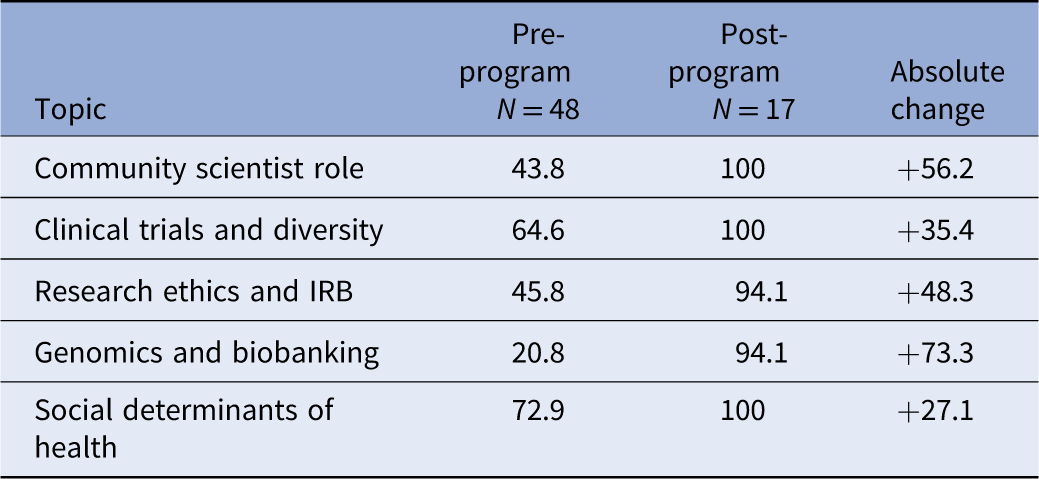
The CS Program included a racially and ethnically diverse group, consistent with its goal of engaging communities historically underrepresented in research. Across program components, 48 participants completed the pre-training survey, 30 completed the full didactic curriculum, 11 participated in the experiential learning component, and 17 completed the post-training survey.. Among respondents, 52% identified as Black or African American, 27% as Hispanic/Latino/Latinx, 15% as White, and 4% as American Indian or Alaska Native. Participants represented all three Mayo Clinic regions (Arizona, Florida, and the Midwest), reflecting geographic and contextual diversity. Pre- and post-training survey data are summarized in Table 3, and changes in positive familiarity are summarized in Table 4.
Group-level pre- and post-survey familiarity/knowledge with key topics

Table 3. Long description
A table comparing familiarity levels with key topics before and after a program. The table has 5 rows and 6 columns. The columns are labeled as follows: Topic, Timepoint, relative to program, Extremely familiar/knowledgeable no. (%), Very familiar/knowledgeable no. (%), Moderately familiar/knowledgeable no. (%), Slightly familiar/knowledgeable no. (%), Not at all familiar/knowledgeable no. (%). The rows are labeled with different topics: CS role, Clinical trials and diversity, Research ethics and IRB, Genomics and biobanking, Social determinants of health. Each topic has pre- and post-program data. For CS role, pre-program data shows 0 extremely familiar, 5 very familiar, 16 moderately familiar, 18 slightly familiar, and 9 not at all familiar. Post-program data shows 3 extremely familiar, 12 very familiar, 2 moderately familiar, 0 slightly familiar, and 0 not at all familiar. For Clinical trials and diversity, pre-program data shows 0 extremely familiar, 12 very familiar, 19 moderately familiar, 16 slightly familiar, and 1 not at all familiar. Post-program data shows 2 extremely familiar, 14 very familiar, 1 moderately familiar, 0 slightly familiar, and 0 not at all familiar. For Research ethics and IRB, pre-program data shows 0 extremely familiar, 7 very familiar, 15 moderately familiar, 14 slightly familiar, and 12 not at all familiar. Post-program data shows 1 extremely familiar, 11 very familiar, 4 moderately familiar, 1 slightly familiar, and 0 not at all familiar. For Genomics and biobanking, pre-program data shows 0 extremely familiar, 2 very familiar, 8 moderately familiar, 22 slightly familiar, and 16 not at all familiar. Post-program data shows 2 extremely familiar, 8 very familiar, 6 moderately familiar, 1 slightly familiar, and 0 not at all familiar. For Social determinants of health, pre-program data shows 4 extremely familiar, 17 very familiar, 14 moderately familiar, 10 slightly familiar, and 3 not at all familiar. Post-program data shows 6 extremely familiar, 10 very familiar, 1 moderately familiar, 0 slightly familiar, and 0 not at all familiar.
Sample sizes differed between pre- and post-program surveys, with 48 and 17 participants, respectively.
CS = community scientist; IRB = institutional review board.
Positive familiarity⃰ with program topics before and after the program

Table 4. Long description
The table presents data on positive familiarity with various program topics before and after the program. It has five rows and four columns. The columns are labeled Topic, Pre-program N=48, Post-program N=17, and Absolute change. The rows are labeled with different topics: Community scientist role, Clinical trials and diversity, Research ethics and IRB, Genomics and biobanking, and Social determinants of health. Each row contains values for pre-program, post-program, and absolute change. For example, the Community scientist role has pre-program value 43.8, post-program value 100, and absolute change +56.2. The table shows an increase in positive familiarity for all topics after the program.
⃰ Date reported as (%). Positive familiarity defined as extremely, very, or moderately familiar.
IRB = institutional review board.
Demographic characteristics are reported for pre-training survey respondents (n = 48) and may not fully represent the demographics of all program participants across cohorts.
Changes in research knowledge and role familiarity
Participants demonstrated increases in self-reported familiarity and knowledge across all curriculum domains following completion of the didactic training (Tables 3 and 4). Familiarity with the Community Scientist role increased from 43.8% pre-training to 100% post-training. Gains were particularly pronounced in genomics and biobanking, where positive familiarity increased from 20.8% to 94.1%. Knowledge of research ethics and Institutional Review Board (IRB) processes increased from 45.8% to 94.1%, and familiarity with clinical trials and diversity increased from 64.6% to 100%.
For social determinants of health, an area in which participants entered with relatively higher baseline familiarity, positive familiarity increased from 72.9% to 100%. Across all topic areas, post-training responses reflected a shift toward higher confidence categories (very or extremely familiar/knowledgeable) (Table 3). Reported percentages represent the proportion of respondents indicating moderate, high, or very high familiarity (i.e., moderately, very, or extremely familiar/knowledgeable) on the five-point Likert scale.
Qualitative evidence of capacity-building and role confidence
Open-ended survey responses contextualized the quantitative findings, describing participants’ experiences of the training and their roles within research contexts. Participants described increased confidence in engaging with research teams and contributing community perspectives, as well as the applicability of the curriculum across health domains.
I now have the confidence to ask questions about inclusion and diversity.
Most passionate and interested in projects related to genomics… thinking about all this in relation to addiction, recovery, smoking cessation, and cancer treatments.
Participants also offered constructive feedback regarding program structure, including suggestions to provide calendar invitations, edit session recordings for easier review, and introduce the CS role earlier in the curriculum. These comments highlighted areas for program refinement and participants’ engagement with program processes.
Readiness to engage and advocacy intent
All post-training respondents (100%) reported feeling prepared to engage as Community Scientists within their communities and research settings. Participants described readiness to advocate through multiple pathways, including promoting diversity in clinical trials, sharing information about genomics and biobanking, and supporting outreach focused on women’s health and rural health initiatives. One participant expressed:
I feel very ready to advocate for the Hispanic community in which I reside.
These responses reflected participants’ perceptions of role readiness and intentions for applied engagement.
Overall program satisfaction
Overall satisfaction with the program was high. Nearly nine in ten participants rated their overall experience as satisfied or very satisfied, and approximately three-quarters rated program materials as excellent. Participants cited the relevance of the content and the learning environment in open-ended responses.
Well planned and very comprehensive,
The quality of the training and the expertise of the instructors were outstanding.
Experiential learning outcomes: community scientist perspectives
At the six-month follow-up, 11 participants completed surveys evaluating the experiential learning component (Table 5). Most participants agreed or strongly agreed that the assignment increased their understanding of the CS role (82%) and research process (91%) and their confidence to contribute to research discussions (73%). Importantly, participants also reported opportunities for active contribution: 70% indicated that they provided community-perspective feedback to improve the clarity and inclusivity of research, and 70% contributed ideas about communicating research information to communities. Participants described the value of direct participation in research team activities, reflected in these quotes:
The time spent with the research team and learning about cancer research and opportunities available to the community.
Being able to join call sessions to hear how the research project is created and to hear all the researchers’ input was very helpful.
Community scientist participant evaluation from 6-week experiential learning

Table 5. Long description
The table presents participant feedback on an experiential learning component, structured with questions/topics in rows and response categories in columns. The columns are labeled as Strongly agree, Agree, Neutral, Disagree, Strongly disagree, and N. The table has 10 rows and 6 columns. Row 1: The experiential learning component helped me understand my role as a community scientist, 6 (54.6), 3 (27.3), 2 (18.1), 0 (0), 0 (0), 11. Row 2: The experiential learning component helped me understand the research process, 5 (45.5), 5 (45.5), 1 (9.0), 0 (0), 0 (0), 11. Row 3: The experiential learning component helped me understand how my assigned research project connects to cancer health equity, 6 (54.5), 3 (27.3), 2 (18.2), 0 (0), 0 (0), 11. Row 4: My experience with the research team increased my confidence to contribute to research discussions, 5 (45.4), 3 (27.3), 3 (27.3), 0 (0), 0 (0), 11. Row 5: The objectives of the 6-week experiential learning assignment were clearly communicated, 6 (60.0), 1 (10.0), 3 (30.0), 0 (0), 0 (0), 10. Row 6: The experiential learning offered valuable opportunities to meaningfully engage with research that are relevant to the community, 6 (60.0), 2 (20.0), 2 (20.0), 0 (0), 0 (0), 10. Row 7: I was able to offer feedback with my community perspective to improve the clarity and inclusivity of research, 4 (40.0), 3 (30.0), 3 (30.0), 0 (0), 0 (0), 10. Row 8: I was able to contribute ideas on how to share research information with the community, 6 (60.0), 1 (10.0), 3 (30.0), 0 (0), 0 (0), 10. Row 9: The experiential 6-week assignment provided adequate opportunities for reflection on my learning and contributions, 5 (50.0), 1 (10.0), 4 (40.0), 0 (0), 0 (0), 10.
Data reported as no. (%).
Suggestions for improvement included more structured onboarding, clearer expectations, increased in-person interaction when feasible, and extending the duration of the experiential assignment to allow for deeper integration.
Experiential learning outcomes: preceptor perspectives
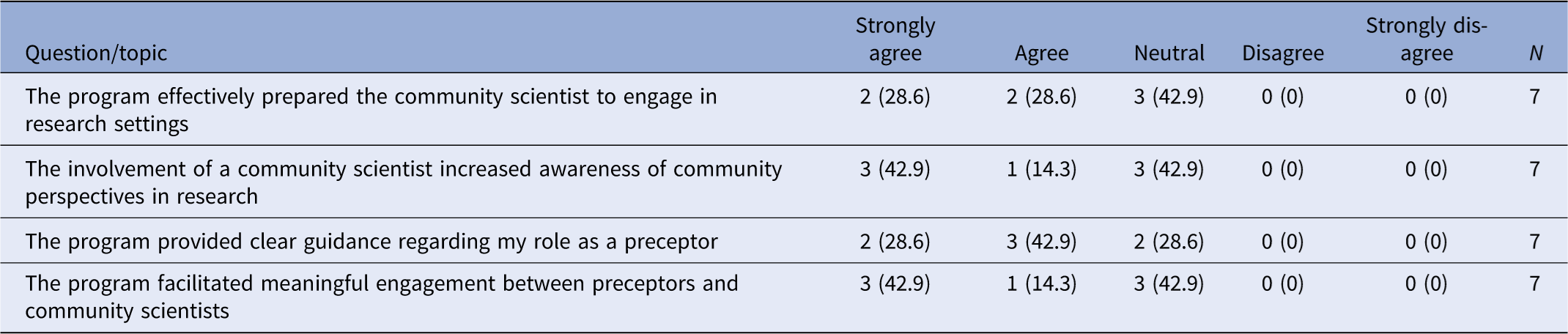
Seven preceptors completed evaluations of the experiential learning component (Table 6). Preceptors described the contributions of Community Scientists and noted increased awareness of community perspectives within their research teams. One preceptor shared:
It was great to have the community scientist bring their unique perspective… weekly meetings and presentations during lab meetings worked well.
Preceptor evaluation from experiential learning

Table 6. Long description
A table with four rows and six columns evaluating preceptor experiences with community scientists in research settings. The columns are labeled as follows: Question/topic, Strongly agree, Agree, Neutral, Disagree, Strongly disagree, and N. The rows are labeled with different questions or topics related to the program’s effectiveness, involvement of community scientists, guidance provided, and meaningful engagement. Each row contains values indicating the number and percentage of responses for each category. Row 1: The program effectively prepared the community scientist to engage in research settings. Values: Strongly agree 2 (28.6), Agree 2 (28.6), Neutral 3 (42.9), Disagree 0 (0), Strongly disagree 0 (0), N 7. Row 2: The involvement of a community scientist increased awareness of community perspectives in research. Values: Strongly agree 3 (42.9), Agree 1 (14.3), Neutral 3 (42.9), Disagree 0 (0), Strongly disagree 0 (0), N 7. Row 3: The program provided clear guidance regarding my role as a preceptor. Values: Strongly agree 2 (28.6), Agree 3 (42.9), Neutral 2 (28.6), Disagree 0 (0), Strongly disagree 0 (0), N 7. Row 4: The program facilitated meaningful engagement between preceptors and community scientists. Values: Strongly agree 3 (42.9), Agree 1 (14.3), Neutral 3 (42.9), Disagree 0 (0), Strongly disagree 0 (0), N 7.
Data reported as no. (%). Percentages may not total 100% due to rounding.
However, preceptors also identified opportunities for improvement, including clearer guidance on expectations, more structured orientation, additional support for translating complex scientific concepts, and extending the six-week engagement period. Several noted that integration increased toward the end of the assignment.
Across quantitative and qualitative measures, participants reported increases in research-related knowledge, confidence, and readiness to engage. The reported gains spanned all curriculum domains, including genomics, biobanking, and research ethics. The experiential learning outcomes reflected applied engagement between CSs and research teams.
Discussion
This evaluation found that the CS program was associated with increases in participant-reported familiarity, confidence, and readiness to engage as research partners. The largest gains were observed in genomics and biobanking, domains often unfamiliar to community members but essential for advancing representation in precision medicine and biorepository-based research [Reference Rosas, Rodriguez Espinosa, Montes Jimenez and King8,Reference Katapally10]. Increases in familiarity with research ethics and IRB processes further support informed participation and may help reduce power asymmetries that can limit meaningful engagement [Reference Israel, Schulz, Parker and Becker11]. These gains reflect what the CS program was designed to accomplish: building individual research literacy and institutional readiness as a foundation for partnership, not partnership itself. The CS model is best understood as one approach among several strategies for involving community members in research including CBPR, CABs, PFAC and accessible translation models such as Boot Camp Translation. Where CBPR emphasizes shared governance and co-production from the outset, the CS model creates structured entry points through which community members can develop the knowledge, confidence, and institutional access needed to participate more equitably in research over time. These approaches differ in their assumptions about power, partnership, and institutional responsibility, and in the contexts for which they are best suited. We argue that building this shared language and institutional infrastructure is one mechanism through which research institutions can begin to fulfill their own responsibilities for creating the conditions that genuine community engagement requires. As Boot Camp Translation and related models demonstrate, researchers too must adapt, meeting communities where they are, rather than expecting communities to navigate research culture unaided [Reference Norman, Bennett and Cowart5]. Institutions should select and combine approaches based on their specific community relationships, research goals, and capacity for sustained engagement, recognizing that no single model is inherently the right method, and that citizen science training and community engagement in the fuller sense may serve different but equally legitimate purposes.
Program evolution from a single-day training to an eight-week curriculum with experiential learning and asynchronous options demonstrates scalability and flexibility across institutional regions and community contexts. By explicitly linking training to readiness for advisory, protocol review, and study team roles, the program addresses a persistent gap in engagement science: the lack of structured institutional pathways that translate engagement intent into engagement capability [Reference Glasgow, Harden and Gaglio6,Reference Proctor, Silmere and Raghavan9]. Participant and preceptor feedback highlighted opportunities to improve experiential onboarding and to enhance long-term engagement pathways following program completion, feedback that points toward the deeper infrastructure investments that sustained community engagement ultimately requires.
Beyond individual outcomes, trained Community Scientists can strengthen institutional engagement infrastructure by improving the clarity and inclusivity of study materials, informing recruitment and dissemination strategies, and supporting more community-centered interpretation of findings. However, we wish to be transparent that these contributions, while meaningful, represent early steps along a continuum rather than the full realization of community engagement as a shared-power partnership. The Principles of Community Engagement remind us that trustworthiness, sustained relationships, and institutional accountability are foundational to genuine engagement [Reference Cohn, McCloskey and Berman2]. The CS program creates conditions that support movement toward that goal, and institutions that adopt this model should treat it as a beginning, not an endpoint, of their community engagement commitments.
The long-term trajectory of CS program graduates represents an important area for future evaluation, including whether trained CSs go on to participate as partners in longitudinal studies, how their contributions influence research design and dissemination, and how they experience sustained engagement over time. A number of graduates have already transitioned into active, compensated research partnerships based on interest and PI alignment, demonstrating the feasibility of this pathway. Opportunities for sustained research engagement were influenced by funding availability and study opportunities, highlighting the importance of continued institutional infrastructure and support. Future evaluation should prioritize longitudinal follow-up with graduates to assess the depth, durability, and impact of their engagement.
Limitations and challenges
Several implementation challenges and evaluation limitations warrant consideration. Early barriers related to institutional access limited participation, though these were mitigated over time through the development of volunteer access pathways. Limited capacity to place all trainees in experiential assignments due to funding constraints and study availability, and preceptor feedback identifying the need for clearer guidance and more structured orientation, further informed program refinements. Participant recruitment combined targeted community outreach with voluntary self-application, introducing the possibility of self-selection bias. Individuals who sought out the program may represent particularly motivated learners whose outcomes are not fully generalizable to broader community populations, and this should be considered when interpreting reported gains in familiarity and confidence. Preceptor perspectives were additionally limited in scope, with only seven survey responses and a single qualitative quote available for analysis; future evaluations should prioritize more structured and comprehensive qualitative data collection from preceptors to capture the breadth of their experiential component experiences.
Relatedly, knowledge and familiarity gains following structured didactic training in novel domains are an expected outcome of instruction. The pre–post survey design documents that learning occurred but cannot speak to the depth, durability, or transferability of that knowledge over time. Future evaluations should incorporate follow-up assessments and objective measures of learning alongside self-reported familiarity. From a measurement standpoint, low post survey response rates and differential pre- and post-training sample sizes limited individual-level longitudinal comparisons. Outcomes relied on self-reported measures subject to response and social desirability bias, and the absence of a comparison group precludes causal inference.
Retention barriers identified across cohorts included scheduling conflicts with work and family obligations, the time commitment required by the eight-week didactic curriculum, geographic distance from training sites for participants in rural and semi-rural communities, and limited flexibility in session timing for working adults. Facilitators of retention included financial compensation for participation, the relational investment of program staff in maintaining participant engagement between sessions, and participants’ strong intrinsic motivation to contribute to research affecting their communities. The introduction of asynchronous session options in the 2025 cohort was designed to address scheduling and geographic barriers to participation and represents a promising avenue for expanding program reach and improving retention.
Preceptors volunteered their time as part of an institutional commitment to community engagement. While this reflects genuine commitment to the program’s mission, reliance on volunteerism may create unequal burdens across faculty and staff, who may differ in access to protected time and flexibility in workload expectations. Future program iterations should consider whether formal recognition, protected time, or other institutional supports are needed to ensure sustainable and equitable preceptor participation.
Despite these constraints, the evaluation provides pragmatic insights into engagement readiness and capacity-building outcomes. Planned refinements including strengthened follow-up evaluation, enhanced preceptor training, expanded asynchronous learning options, and prioritization of placements are intended to improve program effectiveness, evaluative rigor going forward.
Conclusion
This study shows that the CS Training Program can be effectively implemented to strengthen community members’ familiarity with key research concepts, ethics, and processes, with gains observed across training domains. The program increased research literacy and readiness for partnership among diverse community members across three Mayo Clinic regions. Notably, it addressed critical gaps in genomics and biobanking, areas central to equitable participation in precision medicine and other research fields where underrepresented communities have been historically excluded. By building confidence, role clarity, and applied engagement skills, the program supports community capacity for equitable research partnerships. As participants become better prepared to contribute to study teams and advisory structures, institutions may benefit from more informed and inclusive community perspectives embedded within research processes. Despite implementation challenges, including technology access and placement constraints, findings support the program’s role as a scalable, experiential training model. Overall, the Community Scientist Program provides a pragmatic pathway to strengthen NCI CCSG- and CTSA-aligned community engagement and support community-relevant translation across research settings.
Author contributions
Nuwanthi Heendeniya: Data curation, Formal analysis, Investigation, Methodology, Project administration, Writing – original draft, Writing – review & editing; Gladys Asiedu: Formal analysis, Investigation, Methodology, Project administration, Validation, Visualization, Writing – original draft, Writing – review & editing; Sagar Dugani: Formal analysis, Funding acquisition, Project administration, Validation, Visualization, Writing – original draft, Writing – review & editing; Manisha Salinas: Data curation, Formal analysis, Investigation, Methodology, Writing – review & editing; Hanh Higginbotham: Data curation, Investigation, Project administration, Writing – review & editing; Noreen Stephenson: Data curation, Investigation, Writing – review & editing; Monica L. Albertie: Data curation, Investigation, Project administration, Writing – review & editing; Farhia Omar: Data curation, Investigation, Writing – review & editing; Adeline Abbenyi: Data curation, Investigation, Writing – review & editing; Doug Murrell: Project administration, Writing – review & editing; Mark Wieland: Conceptualization, Funding acquisition, Resources, Supervision, Validation, Visualization, Writing – review & editing; Folakemi Odedina: Conceptualization, Data curation, Funding acquisition, Investigation, Resources, Supervision, Validation, Visualization, Writing – review & editing.
Funding statement
This work was supported by the National Cancer Institute (P30 CA015083), Mayo Clinic Center for Clinical and Translational Science (UL1 TR02377), iCCaRE Consortium by Department of Defense under Award Numbers W81XWH-22-1-0968 and HT94252411101, and Mayo Clinic. S.B.D. was supported by the National Institutes of Health/National Institute on Minority Health and Health Disparities (NIH K23 MD016230). The funders had no role in study design, data analysis and interpretation; in writing of the manuscript; and in the decision to submit the manuscript for publication. The findings and conclusions do not necessarily represent the views of the funders.
Competing interests
None of the authors reported any competing interests or conflicts of interest.




 Open access

