Introduction
With the advancement of technology and the development of the market, continuous product improvement is necessary to adapt to the fierce market competition and dynamic user requirements. The exploration of product improvement provides enterprises with a strategic direction for next-generation products and accelerates the speed of product renewal (Qi et al., Reference Qi, Zhang, Jeon and Zhou2016). Product improvement refers to improving certain features and attributes of existing products to meet new application scenarios and achieve better user satisfaction (Sun et al., Reference Sun, Guo, Shao and Rong2020). The essence of product improvement is identifying product features that need to be improved and constructing solutions to improve these features based on existing products (Li et al., Reference Li, Zhang, Li and Yu2021). In user-related research, the goal of product improvement is to improve usability and user experience (UX) (Voet et al., Reference Voet, Altenhof, Ellerich, Schmitt and Linke2019). More companies increasingly recognize positive UX as an important product strategy to achieve higher user acceptance and satisfaction (Lin and Cheng, Reference Lin and Cheng2017). If certain product attributes cause users to generate a negative UX, that is, bad or unsatisfactory perceptions and reactions by users when using or expecting to use the product, then these attributes need to be improved first. Thus, UX has become one of the most important drivers of product improvement. However, the designer's understanding of the design process and methods of UX-driven product improvement is ambiguous, especially in the conceptual design stage. Specifically, attribute identification, process reasoning, and scheme modification remain difficult for the designer. Thus, it is necessary to establish a logical framework and tools to support product improvement at the conceptual design stage.
Conceptual design is an early stage of the product development process, which highly determines the success of the final products (He and Feng, Reference He and Feng2013). It is a creative, complicated, and difficult problem-solving process that aims to generate solutions that satisfy design requirements (Zheng et al., Reference Zheng, Feng, Tan and Zhang2015). At this stage, a set of critical technical activities needs to be implemented, including the analysis of user requirements, the transformation of customer requirements into design functions, the development of new concepts, and the generation of conceptual schemes for products (Li et al., Reference Li, Li, Wang and Liu2010b). Many previous studies have established several tools to support the conceptual design of new products, involving requirements analysis, function-structure mapping, knowledge reasoning, and concept evaluation (Chen et al., Reference Chen, Liu and Xie2012, Reference Chen, Hu and Chen2019a; Guo et al., Reference Guo, Xue, Yu and Shen2018; Jing et al., Reference Jing, Yao, Gao, Li, Peng and Jiang2021). The product that needs to be improved already has a mature combination of some functions and structures. These already existing original features, including attributes, functions, and structures, can have a dramatic impact on the design process. The user's response to these original features, including user satisfaction and attention, directly affects the UX. In this paper, these product-derived and user-derived factors are defined as improvement constraints, which influence the design activities of product improvement. However, when improvement constraints need to be considered in design activities, the traditional tools that are mainly used in new product design lack targeted goals and sufficient efficiency.
Although there is no clear definition of UX, it encompasses the usability and emotion of a product, reflecting all aspects of user interaction with the product (Berni and Borgianni, Reference Berni and Borgianni2021). The user's online reviews of products provide a wide and authentic source of UX information (Yang et al., Reference Yang, Liu, Liang and Tang2019). Previous studies have shown that the user information obtained from online reviews is more reliable and effective than traditional user surveys (Chris et al., Reference Chris, Anindya and Batia2008; Jing et al., Reference Jing, Yu and Lin2015; Hye-Sun et al., Reference Hye-Sun, Ho-Bin and Jong-Suk2016; Chen et al., Reference Chen, Ota, Wang and He2019b). Although some scholars have worked to extract UX information from online reviews, further study on how to relate discrete UX information to specific product attributes to find to-be-improved product attributes is needed. Furthermore, conceptual design is a knowledge-intensive solution process (Yu et al., Reference Yu, Zhao and Zhao2022). It is an effective way to improve design efficiency by pushing appropriate knowledge to designers in key steps of the design process (Wang et al., Reference Wang, Tian, Wu and Liu2016). Many methods of knowledge modeling, matching, and reasoning have been proposed to assist designers in applying knowledge at the conceptual design stage. Connecting knowledge with decomposed functions to construct a unified knowledge representation model for conceptual design would help improve the reusability of functional knowledge (FK) (Li et al., Reference Li, Hu and Peng2010a). Independent and decoupled FK units are obtained by decomposing FK, which can be integrated with each other, and they are defined as discrete knowledge in this paper. Knowledge configuration is a reuse-based knowledge application process that determines how knowledge is handled in the design process to generate design solutions (Peng et al., Reference Peng, Li, Wang, Song and Qin2020). The purpose of knowledge configuration is to combine some discrete knowledge into a conceptual scheme according to certain rules. However, previous studies have rarely studied the application of knowledge from the perspective of product improvement design. Among them, how to match, filter, and configure knowledge under the influence of improvement constraints remains challenging. Therefore, two key issues need to be addressed in UX-driven product improvement: (a) how to acquire and analyze product-related UX information to identify the product attributes that need to be improved and (b) how to efficiently use knowledge to make rapid improvements for existing products.
To deal with these problems, this study proposes a knowledge-enabled approach for product improvement that integrates online review processing, knowledge pushing, and knowledge configuration. The requirements of this paper mainly include the following aspects: (1) Providing a framework for the implementation of UX-driven product improvement in the conceptual design phase. (2) A method for UX analysis based on user review data is needed to identify the product attributes with negative UX that need improvement. (3) A knowledge reasoning model and knowledge configuration method considering improvement constraints are required to enable rapid modification of product attributes. The study is organized as follows: A review of related studies is presented in the Section “Literature review”. A conceptual design framework and specific methods to support product improvement are presented in the Section “Framework and methodology to support product improvement”. A case study of the application of the proposed framework and methodology in an improvement design process for the agricultural sprayer is described in the Section “Case study”. Finally, the discussion and conclusion are presented in the Sections “Discussion” and “Conclusion”, respectively.
Literature review
This study focuses on generating product improvement solutions through problem identification and feature modification at the conceptual design phase. The literature review is divided into three parts. An overview of product improvement is presented first, as this work seeks to contribute to this area. Since the proposed method is intended to be used to identify product attributes with negative UX to improve from online user reviews, the existing online review-based UX analysis methods are reviewed. Finally, because the traditional knowledge-based concept solution approach is adapted and complemented in this study to support design improvement, a review of the knowledge-based conceptual design is provided.
Overview of product improvement
Product improvement refers to the process of revising, modifying, or improving an existing product (Lamb et al., Reference Lamb, Hair and McDaniel2012). In order to respond to the changes in customer requirements and enhance market competitiveness, product improvement has become the most frequent product development project initiated by enterprises. To illustrate the significance and influencing factors of product improvement, several studies have explored product improvement strategies in product development from a business management perspective. Product improvement provides enterprises with the following advantages: (1) retaining existing customers and attracting potential customers; (2) accelerating product innovation; and (3) closely related to performance, business growth, and survival (Iyer and Soberman, Reference Iyer and Soberman2000). Some studies have explored the driving factors for product improvement, such as enterprises’ knowledge management capabilities (Kiessling et al., Reference Kiessling, Richey, Meng and Dabic2009). The magnitude of product improvement, the pace of product improvement, the quality level, and the consumer response are key issues that enterprises should consider when formulating product improvement strategies (Sivakumar and Feng, Reference Sivakumar and Feng2019). From the perspective of product realization, improvement may involve changing a product's design, materials, manufacturing process, or packaging. Among them, design is the most important and effective stage to achieve product improvement. For product design improvement, two key questions need to be discussed: how to identify improvement opportunities and how to implement design improvement.
Identifying product improvement opportunities has been considered the first and most critical task for product improvement (Van Kleef et al., Reference Van Kleef, Van Trijp and Luning2005). According to the source of improvement opportunities, the relevant literature can be divided into two categories: user-oriented improvement opportunities and product-oriented improvement opportunities. The user-oriented improvement opportunity identification is based on the analysis of user satisfaction and preference. Many scholars have conducted related studies. To deal with the limitations of product planning studies in the difficulty of identifying latent product features and the insufficient consideration of opportunity potential analysis of the identified features, Jeong et al. (Reference Jeong, Yoon and Lee2019) proposed an opportunity algorithm based on topic modeling and sentiment analysis to identify product improvement opportunities from social media data. Zhu et al. (Reference Zhu, Qi, Hu and Huang2021) used an ontology-based fine-grained sentiment analysis method to obtain user preferences and transformed them into multi-levels for the automatic establishment of opportunity landscapes and house of quality table for improvement. Wang et al. (Reference Wang, Zhang, Zhao, Lu and Peng2020) established a review-driven measurement model of customer preference, considering the inconsistencies between the numerical product ratings and the textual product reviews, for measuring customer preferences with regard to product features. This method combines the importance and performance of product features to support improvement strategies. The product-oriented improvement opportunity identification is based on the analysis of the performance and quality of the product itself. Voet et al. (Reference Voet, Altenhof, Ellerich, Schmitt and Linke2019) proposed a framework for the capture and analysis of product usage data to drive product improvement. The most relevant data on product use and human-product interaction were captured automatically, and an improvement would result from capturing the deviation from the intended use or planned performance. Ma et al. (Reference Ma, Chu, Lyu and Xue2017) proposed an approach to use product usage data for the assessment of product performance degradation and identification of the to-be-modified design parameters. This research work provided opportunities to improve product design to reduce product functional performance degradation. Relich et al. (Reference Relich, Gola and Jasiulewicz-Kaczmarek2022) proposed an approach to support R&D specialists in identifying opportunities for changes in product design toward reducing energy consumption in product life cycle stages regarding product usage and its manufacturing. These studies have proved the effectiveness of feedback data from users and products in identifying opportunities for improvement. This study is based on this understanding to further investigate UX-driven product improvement. Corresponding methods are still needed to capture user feedback on the experience of product attributes.
In the design process, some design methods such as redesign and iterative design can be used to implement product improvement. The method of redesign refers to the redesign of existing products to create brand new products (Smith et al., Reference Smith, Smith and Shen2012). It mainly originated with the idea that some existing similar products could be used as the basis for the new design (Zhan-Shan et al., Reference Zhan-Shan, Kou, Cheng and Wang2006). Redesign is an approach that involves modifying some structures in existing products and redesigning them into a new structure that can be used for the development of other new products. However, when continuous improvement of an existing product is required, the redesign method performs poorly. The method of iterative design refers to the process of dividing a product update process into multiple iterations to update the products through multiple rounds of improvement (Dou et al., Reference Dou, Zhang and Nan2016; Yang et al., Reference Yang, Wu, Tan, Yu, Zhou, Tao and Song2021). When the current design solution cannot meet existing design requirements, the design scheme needs to be iterated in one design cycle (Smith and Eppinger, Reference Smith and Eppinger1997). Iterative design is generally a repeated process in a design cycle, which would inevitably increase design time and costs. While redesign and iterative design can enable some modifications and updates, they are difficult to use for rapid, efficient continuous improvement due to limitations in objectives, objects, and methods. Hence, targeted design methods are required to standardize the design improvement process and provide effective guidance for design improvement.
The presented literature review has shown that product improvement at the design stage remains challenging due to the absence of some key methodologies, including the identification of to-be-improved product attributes and the generation of improved solutions. Therefore, it is necessary to propose a general framework and methodology for implementing product improvement in the design phase, from identifying improvement opportunities to building improved design solutions.
UX analysis based on online reviews
Most previous studies used surveys, questionnaires, and experimental studies to obtain, measure, and evaluate UX for analysis by creating different scenarios in which users interact with products (Sheng and Teo, Reference Sheng and Teo2012; Kosmadoudi et al., Reference Kosmadoudi, Lim, Ritchie, Louchart, Liu and Sung2013; Park et al., Reference Park, Han, Kim, Oh and Moon2013; Law et al., Reference Law, van Schaik and Roto2014; Rodda et al., Reference Rodda, Ranscombe and Kuys2022). These methods not only require a lot of upfront preparation but also yield limited customer data. Research has shown that online customer reviews have become an important source of data to obtain user affective needs and preferences (Zhu and Zhang, Reference Zhu and Zhang2010; Wang et al., Reference Wang, Yu and Wei2012; Liu et al., Reference Liu, Jin, Ji, Harding and Fung2013; Jin et al., Reference Jin, Liu, Ji and Kwong2019). Analyzing UX information from online reviews can compensate for the shortcomings of traditional methods (Yang et al., Reference Yang, Liu, Liang and Tang2019). Jiao and Zhou have systematically studied the influence of affective and cognitive factors in UX implementation (Zhou et al., Reference Zhou, Xu and Jiao2011, Reference Zhou, Ji and Jiao2014; Jiao et al., Reference Jiao, Zhou and Chu2017). According to their studies, the affective need was an important factor in UX analysis. Therefore, it is feasible to explore UX from the perspective of affective satisfaction based on online reviews, including user preferences, emotions, and attitudes.
Many scholars have studied methods to extract customer preferences and satisfaction from online reviews based on sentiment analysis. Rai (Reference Rai2012) divided online customer reviews into multiple categories and then assessed customer responses to product attributes to propose a new approach based on text mining online customer reviews to supplement traditional methods of need and preference analysis. Since effect of sentiment on the performance of online reviews remains unexplored, Salehan and Kim (Reference Salehan and Kim2016) proposed a sentiment mining approach for big data analytics to deal with the challenges introduced by the volume, variety, velocity, and veracity of online consumer reviews. To identify representative yet comparative sentimental sentences with specific product features from product online reviews, Jin et al. (Reference Jin, Ji and Gu2016) proposed a framework for competitor analysis based on online reviews to help designers analyze design requirements, which selected pairs of opinionated representative yet comparative sentences with specific product features from reviews of competitive products. To compute, assess, and interpret customer attitudes toward a brand in brand equity assessment, Pournarakis et al. (Reference Pournarakis, Sotiropoulos and Giaglis2017) developed a requirement computing model that combined topic modeling, data clustering, and sentiment analysis to perceive the most influential needs topics from customer reviews on social media. Zhou et al. (Reference Zhou, Jianxin Jiao and Linsey2015) presented a latent customer needs elicitation method based on sentiment analysis of online reviews and case analogical reasoning. In their subsequent study (Zhou et al., Reference Zhou, Jiao, Yang and Lei2017), they proposed a sentiment analysis method to mine customer preference from online reviews that is based on predicting sentence sentiments of product features with a hybrid combination of a list of affective lexicons and rough set-based decision rules and decomposition trees. Based on extracting the time series data of customer preferences from online customer reviews of products, Jiang et al. (Reference Jiang, Kwong, Okudan Kremer and Park2019) proposed a new methodology for dynamic modeling of customer preferences based on online customer reviews, including opinion mining from online customer reviews and dynamic modeling of customer preferences using a dynamic evolving neural-fuzzy inference system approach. The above studies have shown that sentiment analysis based on online reviews is an effective and widely used method to obtain UX information. However, many user reviews describe an overall evaluation of the product, and it is difficult to focus the UX information on specific product attributes. For product improvement, this information is inefficient and weakly usable. Thus, the connection of UX information obtained from online reviews and specific product attributes needs to be further strengthened.
In recent years, some scholars have combined the study of online reviews with product improvement. Qi et al. (Reference Qi, Zhang, Jeon and Zhou2016) and Li et al. (Reference Li, Zhang, Li and Yu2021) have proposed methods to mine user preferences from online reviews and combine the results with KANO models to measure and analyze the impact of product attributes on customer satisfaction. These methods enable the qualitative classification of product attributes based on user preferences to help develop improvement strategies. Zhang et al. (Reference Zhang, Chu and Xue2019) proposed an online review-based approach to identify to-be-improved product features, which created a feature selection model to identify the target features from all candidate features, considering engineering cost, redesign lead time, and technical risk. This method enables further filtering and sorting of product attributes obtained from online reviews to prioritize improvements. Sun et al. (Reference Sun, Guo, Shao and Rong2020) proposed a method for dynamically mining the opinions and sentiments of both consumers and manufacturers from online reviews to analyze the changing behavior of product attributes over time and improve product design. This method focuses on the dynamic characteristics of product attributes over an uninterrupted time to develop improvement strategies.
These methods can provide support for the identification of product attributes that need to be improved. Due to the limited time, cost, and resources, not all product attributes obtained from online reviews should be improved in practice. The product attributes that have a greater impact on negative UX need to be identified from them for improvement. However, few existing studies have focused on this goal, and more efforts are needed to realize it. A UX-based approach that enables the identification of product attributes to improve is required. Moreover, the improvement in the existing studies mainly focuses on proposing general improvement strategies for product attributes, and there is a lack of studies on improving the specific design features of these product attributes. The connection between the product attributes to be improved and the subsequent design process needs to be strengthened. This study proposes an improvement degree evaluation method to transform the results of online review processing so as to identify the product attributes to improve. And a structured framework is used to establish the connection between the UX analysis based on online reviews and the design process.
Knowledge-based conceptual design
Conceptual design is a process of continuous evolution from rough to fine, from fuzzy to clear, and from abstract to concrete (Yuan et al., Reference Yuan, Liu, Sun, Cao and Qamar2016). Many empirical studies have shown that the early stages of product development are in fact iterative and uncertain, and different design tasks and product types will add different degrees of uncertainty to the design process. Conceptual design, especially for complex products, usually involves interdisciplinary and multidisciplinary knowledge (Sobolewski, Reference Sobolewski2017). Under an uncertain situation, designers must employ their creative capabilities to find and apply proper knowledge to their design problems (Yang et al., Reference Yang, Quan and Zeng2022). Knowledge support has been an effective tool in the conceptual design process to assist designers in solving design problems and generating design concepts. The research for knowledge-based product conceptual design mainly focuses on knowledge requirement definition, knowledge representation and modeling, knowledge matching and retrieval, and knowledge configuration. Zhang et al. (Reference Zhang, Zhao, Wang, Chen and Guo2018) proposed a knowledge push approach based on quality-function-knowledge deployment. The quality house for knowledge requirements (KRs) connected knowledge with design activities to help designers track the required knowledge. However, because this approach is oriented toward the whole life cycle of product design, the knowledge requirement definition is difficult to focus on specific product features. To improve the efficiency and usability of knowledge acquisition, Wang et al. (Reference Wang, Tian, Wu and Liu2016) proposed a knowledge push system based on modeling the design intent and interests of designers. The knowledge push service was realized by modeling designers’ personalized KRs and selecting knowledge matching algorithms. The method fully considers the human factor in the knowledge requirement definition but lacks the consideration of product-related factors. To address the lack of effective formal representation of product behavior knowledge in ontology-based knowledge modeling, Chen et al. (Reference Chen, Zhang and Yang2013) introduced the bond graph theory to express product behavior knowledge to realize the unity of dynamic behavior and static behavior, and constructed an ontology model of product design knowledge. Xu et al. (Reference Xu, Houssin, Bernard and Caillaud2013) proposed a systemic model of knowledge that was characterized by knowledge content and context from the perspective of systems thinking. The knowledge model can holistically exploit multiple dimensions of knowledge and fully utilize them to improve the capability of innovation in design and the performance of companies. Bandini and Sartori (Reference Bandini and Sartori2010) proposed a computational framework to support experts in the design and manufacturing of high-quality products. The basis of this method was knowledge ontology, which had high requirements for the standardized expression of knowledge. In order to model design cases as knowledge to be reused, Romero Bejarano et al. (Reference Romero Bejarano, Coudert, Vareilles, Geneste, Aldanondo and Abeille2014) presented a knowledge model to realize the case-based reasoning (CBR) processes for system design. However, the direct link between these ontology-based or case-based knowledge modeling approaches and the design function and structure needs to be strengthened. To solve the problem that the expected design knowledge cannot be retrieved properly, Hu et al. (Reference Hu, Ma, Feng and Peng2017) presented a combined approach to support the creative conceptual design process, which can realize the support of cross-domain and cross-disciplinary knowledge in conceptual design. In order to find the most relevant knowledge for decision-makers to make decisions about a given problem in new product development, Zhang et al. (Reference Zhang, Zhou, Lu and Chang2017) proposed a knowledge reuse method based on graphs to support knowledge-driven decision making, and the proposed approach was able to achieve effective reuse of knowledge using knowledge maps and knowledge navigation. Based on a semantic topic knowledge graph, Huang et al. (Reference Huang, Jiang, He, Liu, Song and Liu2015) proposed a semantic-based visual wiki system integrated with a core visualized search module for lesson-learned knowledge reuse in product design. The aim of these knowledge matching methods was to find as much available knowledge as possible. However, the obtained knowledge required further filtering and selection. Li et al. (Reference Li, Li, Li and Chen2019) proposed an extended CBR method with a two-stage case retrieval for product design. The former retrieval stage was aimed at retrieving the most similar product case for design knowledge reuse, and the latter one was aimed at providing designers with available function units from different case types for creative problem-solving by design knowledge transfer. Luo et al. (Reference Luo, Sarica and Wood2021) built a knowledge network based on all patent data and all fields of technologies in the IPC and used knowledge distance as the key variable to guide the search and retrieval of design stimuli for inferences across technology fields and combination- or analogy-based design ideation. Considering the carbon emission constraints of knowledge, Guo et al. (Reference Guo, Zhao, Hu, Li, Liu, Wang and Zhang2021b) proposed a smart knowledge deployment method for the conceptual design of low-carbon products, which can generate low-carbon conceptual schemes by matching and configuring low-carbon knowledge. However, this knowledge configuration was specific to the carbon emission problem of the conceptual solution. For other different design problems, the knowledge configuration method needs to be improved.
The above studies have suggested some key methods for the use of knowledge in conceptual design. However, few studies have developed knowledge-based approaches specifically from the perspective of supporting product improvement. Since the existing methods in knowledge requirement definition, knowledge modeling, and knowledge matching lack consideration of to-be-improved product features, the effectiveness and usability of knowledge pushing for product improvement need to be improved. In addition, the existing knowledge configuration methods are implemented by combining all available FK and generating a new structure. However, product improvement is a modification of existing structures. How to realize the configuration of knowledge and existing structures need further research. Thus, to support the conceptual design process for product improvement, some additional factors need to be taken into account in the knowledge-enabled methods. Factors that bring changes to the knowledge-enabled method due to improvements should be focused on. These factors are derived from existing features in the to-be-improved products, both those that need to be improved and those that do not need to be improved. Knowledge pushing can be optimized by introducing product features into KRs, knowledge modeling, and knowledge matching. And through associating knowledge configuration with improvement goals (IGs), it is possible to establish knowledge configuration methods for product improvement.
Framework and methodology to support product improvement
Establishing a general framework is a common research method to support conceptual design. In our previous studies, some frameworks used for product design have been developed. These framework tools can provide implementation specifications for conceptual design in different scenarios and provide guidance for designers to conduct the corresponding design activities. To help designers track, acquire, and apply knowledge throughout the product innovation design lifecycle, a knowledge push framework was created (Zhang et al., Reference Zhang, Zhao, Wang, Chen and Guo2018). A conceptual design framework was created to address the impact of uncertain environments and potential issues (Guo et al., Reference Guo, Liu, Zhao, Wang and Chen2021a). A framework was created to support the conceptual design of low-carbon products, addressing the generation, ranking, and optimization of low-carbon concepts (Guo et al., Reference Guo, Zhao, Hu, Li, Liu, Wang and Zhang2021b). However, these frameworks are mostly used for the design of new products and cannot be fully applied to the design of improvements to existing products. Within these frameworks, a multi-step overall design process, the key methods for each step, the flow of data or information, and the influencing factors are the key elements. For conceptual design in different scenarios, these key elements that make up a framework vary. When considering the impact that improvements impose on the design process, the corresponding elements need to be further extended. In this study, the influencing factors to be considered are clarified by analyzing the characteristics of product improvement. The design steps are sorted out based on the design process theory, and the input and output information of each step is clarified. The methods are established by improving the existing attribute identification methods and knowledge application methods. A conceptual design framework for product improvement is developed by integrating these elements.
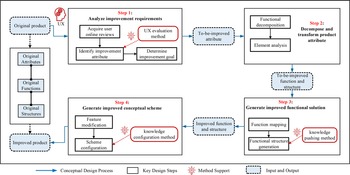
The constructed framework is shown in Figure 1. The original product and UX are taken as initial input, which introduces corresponding improvement constraints. The original attributes, original functions, and original structures of the original product are considered in scope. The improved product that is obtained through a series of design activities is the final output of the framework. In this framework, a logical conceptual design process and corresponding support methods are key tools, which are described in detail in subsequent subsections. This framework can enhance the capability of achieving user satisfaction through UX-based attribute identification. The framework increases the acceptability of improvements and reduces iterations of the improvement process under the guidance of knowledge. This framework intends to help designers identify product attributes that cause negative UX from the perspective of user groups and then establish effective improved solutions to optimize the functions and structures of the original product at the conceptual design phase, thereby increasing user satisfaction. It provides an implementation specification for UX-driven product improvement at the conceptual design stage through defining the basic steps of the solving process and the application of data and knowledge-based methods at critical stages.
The conceptual design framework for product improvement.

Some concepts in this framework need to be defined. Design elements (DEs) are defined as the basic entity units constituting conceptual products, which can be obtained by product decomposition and correspond to certain product features (BORG et al., Reference Borg, Yan and Juster1999; Rehman and Yan, Reference Rehman and Yan2003, Reference Rehman and Yan2011). For instance, the conceptual scheme of one mobile phone consists of many DEs, just like the screen, battery, and microphone, which respectively realize the functions of “display”, “supply power”, and “input voice”. Generally, knowledge is associated with decomposed sub-functions to create knowledge units, which are defined as FK. It expresses various design parameters that fulfill functional requirements (FRs) (Hu et al., Reference Hu, Ma, Feng and Peng2017). The FKs in the knowledge base are based on past design cases, design specifications, or other design resources.
The conceptual design process for product improvement
Specifically, the logical conceptual design process in the framework includes four steps, as follows:
Step 1: Analyze the improvement requirements. Due to the large number, mixed content, and free form of online reviews, it is difficult for designers to directly capture useful information from the online reviews for the original product. An automated framework can help designers process online user reviews and analyze improvement requirements. The purpose of this step is to determine which product attributes need to be improved. This step is entirely automated. The designer only needs to enter the collected user review data, and the tool automatically performs the improvement requirements analysis. Through obtaining and processing online reviews of the original product from users, the product attributes related to UX are analyzed. Then, through a decision-making process, the product attributes that produce negative UX can be identified for improvement. On the sales website of a cellphone, for example, user reviews on attributes such as the battery, camera, appearance, and phone operation can be obtained. When a certain attribute receives many bad reviews from a certain number of users, this attribute that causes negative UX should be considered for improvement. To support these automated design activities in this step, a decision-making algorithm based on UX evaluation is applied.
Step 2: Decompose and transform to-be-improved product attributes. This step intents to identify the functional models and structural elements in the original product that are relevant to the to-be-improved attributes. This step requires designer input, which is achieved by functional decomposition and element analysis. The designer performs functional decomposition and design element analysis to correlate functions and elements of the attributes to be improved. For example, if the screen of a smartphone needs to be improved, the functions associated with the screen can be decomposed into display, interact, and protect. In the smartphone, a set of structural elements, including outer glass, a touch module, and an LCD module, are used to implement the screen attribute.
Step 3: Generate improved functional solutions. The purpose of this step is to create a solution for the functions to improve. This step is partly automatic and partly requires designer input. The designer analyzes the functions and enters KRs, and the tool automatically performs knowledge pushing to help the designer build functional solutions. Through mapping the function to structure, new structural elements are searched to realize the to-be-improved functions. A knowledge pushing method is used to automatically recommend knowledge for the designer that meets the FRs. Based on the knowledge, improved functional structures are generated. For example, the designer retrieves which structures can realize the function “display” from the knowledge base.
Step 4: Generate an improved conceptual scheme (ICS). The purpose of this step is to integrate the improved functional structure into the original product to achieve the modification, reconfiguration, and optimization of product attributes. This step requires designer input. The designer inputs improved function and structure to perform feature modification and scheme configuration. An ICS is generated. A knowledge configuration method is used to help the designer. This step requires consideration of the types of configuration operations, such as addition, deletion, and replacement, as well as constraints on structural elements, such as compatibility.
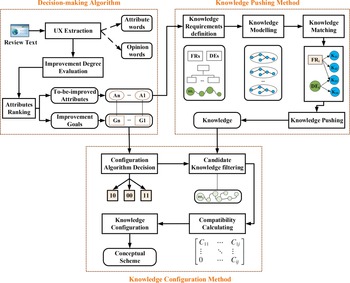
In addition, the three supporting methods that are used in the design process form a systematic knowledge-enabled approach for UX-driven product improvement, as shown in Figure 2. The implementation logic of the approach can be expressed as follows:
 $$\eqalign{&{ {ADM}}( {OR\to {\rm UX}\to ( {PA{\rm \boxplus }IG} ) } ) \to {{KPM}}( {PA\to KR\to FK} ) \cr & \quad \to{ {KCM}}( {( {FK{\rm \boxplus }IG} ) \to CDE\to ICS} ), }$$
Where ADM represents the decision-making algorithm. Through review processing, online reviews (ORs) are transformed into UX information and then into to-be-improved product attributes (PAs) and improvement goals (IGs). The symbol  ${\rm \boxplus }$ indicates a coordinating relation, like “and”. KPM represents the knowledge pushing method. PAs are transformed into KRs, which are expressed by DEs and FRs, and FKs are pushed through knowledge modeling and matching. KCM represents the knowledge configuration method. Combining the IGs and FKs, the best candidate design elements (CDEs) are selected from the recommended FKs and configured with the original product to generate an ICS.
The knowledge-enabled method used in the framework.

Decision-making algorithm for to-be-improved attributes
The purpose of the decision-making algorithm is to identify product attributes that need to be improved according to UX. First, samples of product attributes need to be extracted from online reviews. A review extraction process is adopted to extract product attribute words and opinion words of UX from online reviews. Then, an improvement degree evaluation algorithm is established to evaluate the improvement priority of each attribute. Finally, considering the actual capabilities of the enterprise, the product attributes in urgent need of improvement and the corresponding IGs are determined from the candidate attributes.
Extracting product attributes from online reviews
The input of the review extraction process is a set of user review data obtained from online channels, and the output is a set of standardized product-related attribute words and UX-related opinion words. To implement this process, six steps are involved: (1) pre-processing, (2) part-of-speech tagging, (3) validity analysis, (4) feature extraction, (5) feature pruning, and (6) feature clustering.
Through pre-processing, noise such as special characters, stop words, and punctuation marks from the original data are removed, and the review text is segmented. Part-of-speech tagging is applied to tag the words in the segmented text as nouns, verbs, adjectives, or adverbs. In this study, nouns are considered attribute words, which describe product attributes and features, whereas adjectives are considered opinion words, which express user emotions. Validity analysis aims to find valid reviews that are relevant to product features and can express user opinions from all reviews. If a review is judged valid, its content must include both attribute words to express certain product attributes and opinion words to express some user opinions. Feature extraction is used to extract possible attribute words and opinion words from valid review data. A semi-supervised extraction algorithm based on bootstrapping (Mykowiecka and Górecki, Reference Mykowiecka and Górecki2016) is utilized to extract attribute words from online reviews. An extraction method developed by Hu and Liu (Reference Hu and Liu2004) is used to extract opinion words. The adjectives closest to or adjacent to the attribute words in the comments were searched as candidate opinion words. Feature pruning is used to remove incorrect or redundant attribute words, such as some non-nominal attribute words or attribute words that are not related to product features. Since several different attribute words may describe the same product attributes, it is necessary to perform feature clustering to cluster these synonymous attribute words into the same group and then use a standard attribute word to represent the group of attributes. A K-means clustering method based on semantic similarity is used to realize feature clustering. Through the above steps, a set of attribute words and related opinion words are extracted from online reviews.
Improvement degree evaluation
After extracting valid product attributes from online reviews, it is necessary to identify which attributes need to be improved. To determine the candidate product attributes to be improved, an evaluation method of improvement degree based on sentiment analysis is established in this study. The satisfactions and concerns of users about product attributes need to be considered in the evaluation process.
Attribute satisfaction reflects the user's acceptance of the product attributes. Based on the semantic emotional tendency and sentiment scores of the opinion words corresponding to the extracted attribute words, user satisfaction for the attribute can be evaluated. The affective lexicon ontology (Li et al., Reference Li, Liu and Lin2017) and Snow-NLP (a sentiment analysis tool) are used to calculate the probability e and affective expression intensity W of each user review expressing positive sentiments.
The positive affective probability of the j-th comment in the i-th product attribute is set as e ij, which has a value range of [0, 1]. In order to express the user's affective tendency and degree more directly and accurately, the positive affective probability e ij of the comment is converted to a sentiment score E ij, which has a value range of [−1, 1]. In this way, positive and negative values can be used to indicate positive and negative affective tendencies, respectively. The larger the absolute value, the stronger the affective degree. Thus, the sentiment score directly expresses the user satisfaction and acceptance with the product attributes. The conversion formula is shown below:
 $$E_{ij} = ( {e_{ij}-0.5} ) \times 2.$$
In order to obtain the user's satisfaction with the i-th product attribute, the sentiment score of all users’ comments on the product attribute is calculated, denoted as R i. As there are words in the reviews that express the intensity of the user's sentiment, such as “very”, “extremely”, “general”, and “may”, the sentiment score needs to be weighted. The sentiment weight of the j-th user comment of the i-th product attribute can be recorded as W ij. In the affective lexicon ontology, the level of affective intensity is divided into five levels, which have the values [1, 3, 5, 7, 9]. Therefore, the calculation method of the sentiment score R i of all reviews of the i-th product attribute is as shown in the formula (3):
 $$R_i = \mathop \sum \limits_{\,j = 1}^{N_i} \displaystyle{{E_{ij} \times W_{ij}} \over {9N_i}},$$
where N i is the number of reviews in the group of i-th product attribute. E ij is the sentiment score of the j-th comment in the i-th product attribute.
The attribute concern reflects the market importance of the product attributes. In general, if a user describes a product attribute in online reviews, it indicates that the user is concerned about the product attribute. Therefore, in order to indicate the user's attention to the i-th product attribute, the number of user comments N i in which the product attribute appears is divided by the total number of valid comments n, denoted as C i.
 $$C_i = {{N_i} \over n}.$$
The decision variable of the candidate improved attribute is defined as:
 $$ \eqalign{x_i = \left\{{\matrix{ {1, } & {{\rm if}\,R_i < {R_0\;{\rm and}\;C_i} > C_0}, \hfill \cr {0, } & \hskip-5.9pc {{\rm if}\,{\rm not}}, } } \right.}$$
where x i = 1 denotes that the attribute is selected as a candidate. x i = 0 denotes that the attribute is not selected as a candidate. R 0 and C 0 indicate the thresholds of satisfaction and attention, respectively, which are determined by designers considering improvement constrains. In this study, the mean value is used as the threshold. Where m represents the number of the extracted product attributes.
 $$R_0 = \displaystyle{1 \over m}\mathop \sum \limits_{i = 1}^m R_i,$$
 $$C_0 = \displaystyle{1 \over m}\mathop \sum \limits_{i = 1}^m C_i.$$
Due to the limited resources of the enterprise, the improvement is mainly based on the urgent improvement requirements, which have a greater improvement degree. The improvement degree M i for candidate attributes is calculated as follows:
 $$M_i = \displaystyle{{( {R_0-R_i} ) \times ( {C_i-C_0} ) } \over {R_0 \times C_0}}.$$
Therefore, product attributes with greater attention and lower satisfaction have higher improvement priorities. By the constructed evaluation system, the urgent improvement degree of the candidate product attributes is ranked. Then, considering the capabilities of the enterprises, such as resource, cost, market, and environment, the product attributes that ultimately need to be improved are selected from the candidate attributes according to the degree of priority for improvement. For each to-be-improved attribute, improvement targets are identified based on the analysis of negative opinion words.
Knowledge pushing method
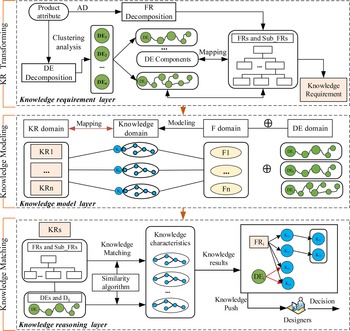
Useful knowledge can provide great help for designers to solve problems in generating functional solutions. The purpose of the knowledge pushing is to improve the efficiency of knowledge acquisition and the usability of design knowledge. Knowledge push can understand the KRs of the designer and then push the proper knowledge to designers at the proper time through knowledge matching and filtering (Wang et al., Reference Wang, Tian, Wu and Liu2016). In product improvement, the impact of improvement constraints needs to be taken into account in the knowledge push. The conventional KRs, knowledge modeling, and knowledge matching need to be optimized to improve the effectiveness of knowledge pushing. To organize and implement these knowledge activities, a structured smart knowledge reasoning model for knowledge push in product improvement is proposed in this paper, as shown in Figure 3.
The smart knowledge reasoning model for product improvement design.

The input of the knowledge reasoning model is a product attribute from the set of to-be-improved product attributes, and the output is the FK related to the attribute. This knowledge enables designers to reason and make decisions in the function solution phase of product improvement design. The smart knowledge reasoning model consists of three layers: the knowledge requirement layer, the knowledge model layer, and the knowledge reasoning layer. Through a series of operations, including knowledge requirement transformation, knowledge modeling, and knowledge matching, knowledge pushing for product improvement design can be realized.
In the knowledge requirement layer, the product attributes are transformed into KRs. KRs explain which knowledge is needed by designers in specific design activities. It is the premise of realizing accurate knowledge reasoning. In product improvement design, KRs depend on the to-be-improved product attributes. Combined with the conceptual design process, the to-be-improved product attributes are transformed into KRs based on FR and DE decomposition.
Clustering analysis and axiomatic design (AD) theory are used to implement DE decomposition and FR decomposition. At first, according to the corresponding relationship between design elements and product features, the DEs related to the to-be-improved product attributes PA i are decomposed from the current product to form a set, which is represented as D i = {DE 1, DE 2, …, DE n}. After decomposition based on AD, the independent sub-FRs related to PA i is obtained. Through clustering analysis, the DEs that represent the solution of the same sub-FRs are clustered into a discrete design element component D ij. The design element component has the following relationship:
 $$\left\{{\matrix{ {D_{i1}\cap D_{i2}\cap \cdots \cap D_{im} = \emptyset }, \cr {D_{i1}\cup D_{i2}\cup \cdots \cup D_{im} = D_i}, \cr {D_{ij} = \psi ( {D_i, \;s\_FR_j} ) }, } } \right.$$
where D ij is a subset of D i.  ${ s}\_{ F}{ R}_{ j}$ represents the sub-FRs realized by D ij. The function ψ(x, y) is clustering rule, which means that the design elements corresponding to
 ${ s}\_{ F}{ R}_{ j}$ in the set D i are clustered into a group.
To improve the convergence and accuracy of knowledge reasoning, a structured expression based on FRs and design elements is used to define KRs, KR = (FR, DE). The knowledge requirement KR i related to product attribute PA i is represented as:
 $$KR_i = \bigcup_{\,j = 1, 2, \ldots } {KR_{ij} = \bigcup_{\,j = 1, 2, \ldots } {( {s\_FR_j, \;D_{ij}} ) } }. $$
In the knowledge model layer, FK is associated with FRs and design elements through knowledge modeling. In the knowledge model, the mapping between knowledge and KRs is realized by constructing the relation between the knowledge domain, the function domain, and the design element domain. In this study, a knowledge representation model based on function and design element is established, as follows:
 $$\left\{{\matrix{ {K_m = F_m\oplus D_m}, \cr {F_m = F( v ) \otimes C_f}, \cr {D_m = D( n ) \otimes C_d}, } } \right.$$
where the functional knowledge K m is a standardized representation of the design element component D m that can realize function F m. The expression of function F m adopts the method of semantic functional predicate F(v) and semantic constraints C f. The design element component D m is represented by semantic elemental nouns D(n) and semantic constraints C d. The semantic constraints are supplementary descriptions of the scope, object, or mode of action of a functional predicate or elemental nouns. Then, the knowledge is stored in a database through uniformly encoding the function F m and design elements D m.
In the knowledge reasoning layer, the knowledge that meets KRs is pushed to designers through knowledge matching to aid functional solution in product improvement design. The knowledge is matched by calculating the similarity between the KRs and knowledge characteristics. Then, constraint conditions should be imposed on the knowledge matching process to filter knowledge and improve the availability and convergence of knowledge for product improvement design. The knowledge after matching and filtering is pushed to designers.
In this study, the similarity in knowledge matching is calculated based on cosine similarity algorithm (Zhu et al., Reference Zhu, Wu, Xiong and Xia2011). The similarity calculation formula of n-dimensional actual vector  $\overrightarrow {X_n}$ and n-dimensional standard vector
 $\vec{X}$ is as follows:
 $$Sim( {\overrightarrow {X_n} {\rm \;}, \;{\rm \;}\vec{X}} ) = \displaystyle{{\overrightarrow {X_n} \cdot \vec{X}} \over {\overrightarrow {\Vert {X_n} \Vert } \Vert {\vec{X}} \Vert }} = { = } \displaystyle{{\mathop \sum \nolimits_1^n X_n\overline {X_n} } \over {\sqrt {\mathop \sum \nolimits_1^n X_n^2 } \times \sqrt {\mathop \sum \nolimits_1^n {\overline {X_n} }^2} }}.$$
Therefore, the similarity between the i-th knowledge requirement KR i and certain knowledge K j to be matched is calculated as follows:
 $$Sim( {KR_i, \;K_j} ) = \left\{{\matrix{ {Sim_f( {F_i, \;K_j( F ) } ) = \displaystyle{{\mathop \sum \nolimits_1^n ( {V{( {F_i} ) }_m \times V{( {K_j( F ) } ) }_m} ) } \over {\sqrt {\mathop \sum \nolimits_1^n {( {V{( {F_i} ) }_m} ) }^2} \times \sqrt {\mathop \sum \nolimits_1^n {( {V{( {K_j( F ) } ) }_m} ) }^2} }}}, \cr {Sim_d( {D_i, \;K_j( D ) } ) = \displaystyle{{\mathop \sum \nolimits_1^n ( {V{( {D_i} ) }_m \times V{( {K_j( D ) } ) }_m} ) } \over {\sqrt {\mathop \sum \nolimits_1^n {( {V{( {D_i} ) }_m} ) }^2} \times \sqrt {\mathop \sum \nolimits_1^n {( {V{( {K_j( D ) } ) }_m} ) }^2} }}} , } } \right.$$
where Sim f and Sim d respectively represent the similarity of function and design element. F i and D i respectively represent the function and the design element in KR i. K j(F) and K j(D) respectively represent the function and the design element in K j. V is the code for function and design element in database.
The restriction given to the knowledge matching algorithm by the authors is defined as follows. If a product attribute needs to be improved, the design elements in the current functional solution for the attribute need to be redesigned. In the knowledge reasoning process, if the design elements in certain FK are similar to those in the current functional solution, the knowledge is redundant and unhelpful for the functional solution in product improvement design and needs to be filtered. Therefore, the authors define the following constraints for knowledge matching:
 $$x_f = \left\{{\matrix{ {1,} \hfill & {Sim_f > S_{\,f0}}, \hfill \cr {0,} \hfill & {Sim_f < S_{\,f0}}, } } \right.$$
 $$x_d = \left\{{\matrix{ {1,} \hfill & {Sim_d < S_{d0}}, \hfill \cr {0,} \hfill & {Sim_d > S_{d0}}, } } \right.$$
where x f and x d respectively represent the constraint condition of function matching and the constraint condition of element matching. When the value is 1, indicating that the knowledge is matched. S f0 and S d0 are the thresholds of functional similarity Sim f and element similarity Sim d, which are determined by designers according to the actual situation. The meaning of the constraints is that the knowledge whose function similarity is greater than the threshold value and whose element similarity is less than the threshold value should be pushed. If K i represents the knowledge items in the database, the set k of the finally pushed knowledge is as follows:
 $$k = \bigcup\nolimits_{i = 1}^n {K_i{\rm \ast }x_f\,{\rm \ast }x_d}. $$
Knowledge configuration method
In this study, the generation of an ICS is implemented by configuring FK into the to-be-improved product. The FK that is matched by knowledge reasoning has met the FRs of product improvement design, but realizing the configuration and usage of design elements required a key method. Therefore, we propose a knowledge configuration method for the generation of an ICS.
The implementation of product improvement design is to modify and redesign some features of the existing scheme and get the new scheme. The IGs can be divided into three types, including the removal of existing features, the replacement of existing features, and the introduction of new features. An operation identifier (OI) for the IGs to determine the operation methods of knowledge configuration is defined. The code of OI can be 00, 01, and 11, indicating that the knowledge configuration has three operation modes, including removing design elements from the solution of existing FRs, replacing the elements of the solution of existing FRs, and adding the elements of the solution of new FRs. The knowledge is configured using the following algorithm:
 $$f( {CS, \;FK} ) = \left\{{\matrix{ {CS{\ominus }cDe\oplus kDe, } \hfill & {OI = 10}, \hfill \cr {CS\oplus kDe, } \hfill & {OI = 11}, \hfill \cr {CS{ \ominus }cDe, } \hfill & {OI = 00}, } } \right.$$
where f is the configuration method. CS stands for the current scheme for product, and FK is the matched functional knowledge. The variables cDe and kDe respectively represent the design elements in CS and FK.  ${\rm \ominus }$ and
 ${\oplus}$ are the operators for configuration and represent removal and addition.
In order to avoid conflicts in knowledge configuration, the compatibility between different FKs and the compatibility between FKs and the elements in the product that do not need to be improved need to be considered. It is necessary to ensure the feasibility of the knowledge configuration by testing compatibility constraints. A triangular symmetric matrix can be used to express the compatibility constraints between FKs (Guo et al., Reference Guo, Zhao, Hu, Li, Liu, Wang and Zhang2021b). Meanwhile, a diagonal matrix can be used to express the compatibility constraints between FKs and the elements in the product that do not need to be improved.
 $$[ {COMP} ] _{FK_i-FK_j} = \left[{\matrix{ {C_{11}} & \cdots & {C_{1j}} \cr \vdots & \ddots & \vdots \cr {C_{\,j1}} & \cdots & {C_{\,jj}} \cr } } \right], \;\;\; C_{ij} = \left\{{\matrix{ 1, \hfill & {{\rm if\;}FK_i\;{\rm and}\;FK_j\;{\rm are}\,{\rm compatible}}, \hfill \cr 0, \hfill & \hskip-8.1pc {{\rm if}\,{\rm not}}, } } \right.$$
 $$[ {COMP} ] _{FK_i-DE_j} = \left[{\matrix{ {C_{11}} & \cdots & 0 \cr \vdots & \ddots & \vdots \cr 0 & \cdots & {C_{\,jj}} \cr } } \right], \;\; C_{\,jj} = \left\{{\matrix{ 1, \hfill & {{\rm if}\,FK_i\,{\rm and}\,DE_j\,{\rm are}\,{\rm compatible}}, \hfill \cr {0,} \hfill & \hskip-7.8pc{{\rm if\;}{\rm not},}} } \right.$$
where  $[ {COMP} ] _{FK_i-FK_j}$ is the compatibility constraint between different FKs, and
 $[ {COMP} ] _{FK_i-DE_j}$ is the compatibility constraint between FKs and the elements DE j in the product that do not need to be improved. Only when the ranks of the two matrices meet
 $R( {{[ {COMP} ] }_{FK_i-FK_j}} ) = n\,{\rm and}\,R( {{[ {COMP} ] }_{FK_i-DE_j}} ) = n$, the knowledge can be configured successfully. Then an ICS for the product can be generated after configuring the FKs matched by each KR.
Case study
Case introduction
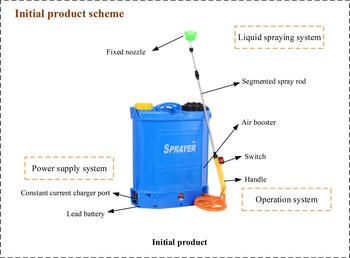
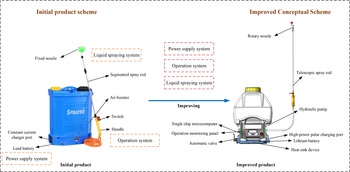
To verify the feasibility of the proposed framework and methods, an improvement design process for the agricultural sprayer is taken as a case study. The agricultural sprayer is an important tool for the scientific use of pesticides and spraying agricultural liquids, which is widely used in current agricultural production. An electric agricultural sprayer product of a certain agricultural equipment company is selected as an example to analyze. The current initial product is shown in Figure 4. The product is a typical agricultural sprayer, which has been widely sold on the market for many years and used by many users. However, there are so many similar products on the market that it lacks competitiveness and needs innovation. With the development of modern agriculture toward intelligence and automation, several new functional features and technical requirements are required by the user, so it is necessary to continuously improve the products to meet the market and agricultural technology. But the customers of agricultural sprayers have a large gap in the degree of specialization, and the user groups are scattered, which makes it difficult for designers to obtain user feedback directly, resulting in a long improvement cycle for the sprayers. Therefore, effective methods need to be used to support the improvement of agricultural sprayers. The authors aimed to improve current agricultural sprayers to develop a new conceptual product that meets new requirements and market environment based on the proposed framework and methods.
The existing product of certain agricultural sprayer.

Attribute identification based on online reviews processing
In order to obtain a reliable UX with the existing agricultural sprayer, a large amount of online user review data needs to be obtained and analyzed. A requirements analysis based on online review processing is used to determine which attributes of the current product need to be improved.
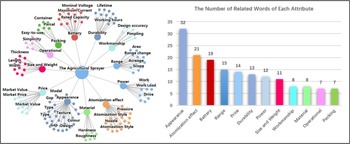
Using the Python programming language, a crawler program or script is written that can capture data on the Internet according to certain rules. In this study, the user evaluation page of a shopping website is used as the source of data. According to the web page parsing, the corresponding parameters of the crawler script are set to realize the crawler application. Using this method, user review data about this agricultural sprayer on major shopping sites can be obtained, then stored as a CSV file in plain text form. Through the proposed product attribute extraction process, a set of important attributes of the agricultural sprayer is obtained, including 12 standard attribute words. The map of the detailed attributes and the number of related words for each attribute word are shown in Figure 5.
The standard attribute words and the number of related words of each attribute word.

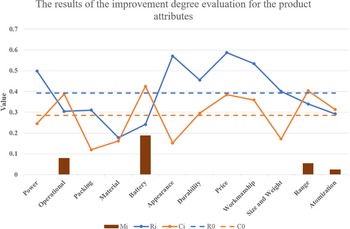
Based on the constructed improvement degree evaluation method, the degree of urgent improvement of agricultural sprayer attributes is evaluated. Using formulas (2)–(4) to calculate the satisfactions R i and concerns C i of users for the extracted product attributes. Then the candidate attributes that need to be improved are identified through the defined decision variable x i, and the improvement degree M i is calculated based on R i and C i using formulas (5)–(8). Table 1 shows the results of the improvement degree evaluation. In it, the 12 important attributes of the product are presented, as well as the values of user satisfaction R i and concern C i for these attributes. The thresholds for satisfaction and concern are calculated as R 0 = 0.3930, C 0 = 0.2851. The values of the decision variables for the four attributes, including “Operational”, “Battery”, “Range”, and “Atomization” are 1. These four attributes are selected as candidates. The improvement degrees of these four candidate attributes are 0.0803, 0.1897, 0.0556, and 0.0251, respectively. Based on the results, a distribution diagram of these values is plotted, as Figure 6.
The results of the improvement degree evaluation for the attributes of the agricultural sprayer

A distribution diagram of the improvement degree evaluation results.

According to the results, the attributes “Operational”, “Battery”, “Range”, and “Atomization” are determined as candidates that need to be improved. The degree of urgent improvement is ranked as “Battery, Operational, Range, Atomization”. Considering the time, cost, resources, and environment elements of the enterprise, “Battery, Operational, Range” are determined as the attributes that ultimately need to be improved. Taking the attribute “Battery” as an example, the IGs are determined by analyzing the keywords and opinions of the negative reviews, as shown in Table 2.
An example of the to-be-improved attribute and improvement goals

The basic improvement requirements of the agricultural sprayer are shown in Table 3.
The improvement requirements of the agricultural sprayer

Functional solving based on knowledge pushing
To achieve the improvement requirements shown in Table 3, it is necessary to conduct a functional decomposition and solution of the to-be-improved product attributes based on smart knowledge reasoning.
First, design elements related to the product attributes to be improved are decomposed from the current scheme of the product through element decomposition, as shown in Table 4. Then, through AD, the improvement requirements are decomposed into multiple sub-FRs, and the existing design elements are clustered according to the FRs.
The results of the elements decomposition of the agricultural sprayer product

Among them, the attribute PA 1 is used as an example to perform the functional decomposition and element clustering. The results are shown in Table 5.
The results of the functional decomposition and elements clustering of PA 1

Next, based on Eq. (10), the knowledge requirement for the improvement design of PA 1 is determined.  $KR_1 = \bigcup\nolimits_{j = 1, 2, 3}$
 $ {KR_{1j} = { {( {f_{11}, \;D_{11}} ) , \;( {f_{12}, \;D_{12}} ) , \;( {f_{13}, \;\;0} ) } } }$.
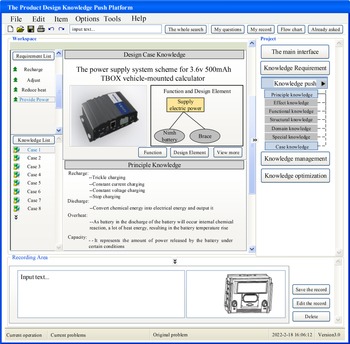
To help designers use knowledge for functional solving, a knowledge push system is developed. The system has realized the mapping between defined KRs and FKs through knowledge modeling and matching. Figure 7 shows one interface of the system. A design scheme for a power supply system is pushed to designers as design case knowledge. A sketch of the scheme, the functions implemented, and the design elements of the structure are presented in the interface. In addition, some principle knowledge associated with the scheme, explaining the scientific principles involved in the scheme, is also presented in the interface. Using the similarity algorithm in Eqs (13)–(16), the knowledge matched to KRs is filtered and pushed to designers. For example, if the knowledge requirement KR 1 of the to-be-improved attribute PA 1 is entered into the system, some matched knowledge that meet the similarity is output. The result of knowledge reasoning and pushing is shown in Figure 8. The KR is defined as (supply electricity, lead battery). By calculating the functional similarity and elemental similarity, the matched knowledge includes “lead battery”, “lead-acid battery”, “lithium battery”, “Ni-MH battery”, etc. Based on the validation of constraint conditions x f and x d, the knowledge “lead battery” that does not satisfy the constraint conditions is filtered. The final pushed knowledges are “lead-acid battery”, “lithium battery”, and “Ni-MH battery”.
An interface of the knowledge push system.

An example of smart knowledge reasoning and pushing.

Improved scheme generation based on knowledge configuration
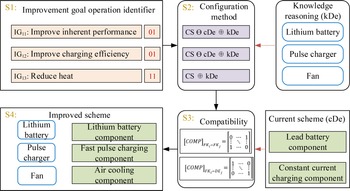
In this case, the to-be-improved product attribute PA 1 “battery” is taken as an example to implement the knowledge configuration. As shown in Figure 9, this knowledge configuration process consists of four steps. Step 1: Analyzing the improvement goal operation identifier. Step 2: Selecting the configuration method. Step 3: Judging the compatibility. Step 4: Generating an improved scheme.
The process of knowledge configuration for PA 1.

S1: Analyzing the IGs of the attribute in Table 2 and defining the coding of the OI for each goal. For example, the OI of improvement goal IG 11 and IG 12 are encoded as 01, representing the solution of f 11 and f 12 requires to be replaced. And the OI of the improvement goal IG 13 is encoded as 11, representing a new FR f 13 needs to be added.
S2: Using Eq. (17) to determine the knowledge configuration algorithm according to OI. For IG 11, the knowledge is configured as  $\;CS{\rm \ominus }cDe\oplus kDe$. Where cDe = D 11 = {lead battery}, kDe = {lithium battery body}. For IG 12, the knowledge is configured as
 $\;CS{\rm \ominus }cDe\oplus kDe$. Where cDe = D 12 = {Constant current charger}, kDe = {Pulse charger}. And the knowledge for IG 13 is configured as
 $CS\oplus kDe$. Where kDe = {Fan, air channel}.
S3: Then, Eqs (18) and (19) should be used to determine whether compatibility is satisfied.
 $$[ {COMP} ] _{FK_1-FK_3} = \left[{\matrix{ 0 & 1 & 1 \cr 1 & 0 & 1 \cr 1 & 1 & 0 \cr } } \right], \;\;R = 3,$$
 $$[ {COMP} ] _{FK_i-DE_j} = \left[{\matrix{ 1 & \cdots & 0 \cr \vdots & \ddots & \vdots \cr 0 & \cdots & 1 \cr } } \right], \;\;R = n.$$
The matrices indicate that the knowledge meets the compatibility constraints and that the knowledge configuration scheme is feasible.
S4: The scheme for the attribute PA 1 “Battery” has been improved in the following ways: A new lithium battery component, which is lighter and has a longer working life, is designed to replace the initial lead battery component. And a higher-power fast pulse charging component is designed to replace the initial constant current charging component to reduce charging time without harming the battery. A heat sink subsystem using air cooling component is designed and integrated into the battery system to reduce the serious heating phenomenon when the battery is charged and used.
Similarly, the scheme for to-be-improved attributes PA 2 and PA 3 are improved based on knowledge configuration. In summary, the proposed conceptual design process for product improvement based on online reviews and knowledge is used to design an improved agricultural sprayer product. The final conceptual scheme is shown in Figure 10. In the final conceptual scheme, the power supply system is improved to optimize the performance parameters, including endurance time, capacity, weight, charging efficiency, and operating temperature of the product attribute “battery”. An improved operation system (including an automatic valve, a single chip microcomputer, an operation monitoring panel, and a sensor) is designed to optimize the product attribute “operational”. Moreover, an improved liquid spraying system (including a telescopic spray rod, throttle valve, hydraulic pump, and rotary nozzle) is designed to optimize the performance parameters such as spraying diameter range and maximum spray angle of the product attribute “range”.
The improved conceptual scheme for the agricultural sprayer product.

Discussion
To reveal the unique characteristics of the newly developed framework and method, a comparison needs to be performed. The proposed approach is compared with other tools used in traditional conceptual design (QFD, KANO) and some related works reviewed in the Section “Literature review”, including data-based methods (Jeong et al., Reference Jeong, Yoon and Lee2019; Zhang et al., Reference Zhang, Chu and Xue2019; Wang et al., Reference Wang, Zhang, Zhao, Lu and Peng2020) and knowledge-based methods (Hu et al., Reference Hu, Ma, Feng and Peng2017; Zhang et al., Reference Zhang, Zhou, Lu and Chang2017). The purpose of this comparison is to summarize the typical characteristics of each method when used for product improvement, as shown in Table 6.
Comparison with other approaches used in conceptual design and product improvement

Based on the above comparison, it has the following differences: (1) The proposed method is a comprehensive analysis method that includes both qualitative and quantitative analysis. (2) The proposed method has a broader scope of application and can support multiple activities of conceptual design for product improvement. (3) The proposed method uses an objective reasoning mode based on online review data and knowledge. The method can directly output improved schemes. (4) The proposed method considers more influencing factors. There are both user-derived and product-derived factors. Therefore, the proposed approach is a more objective, applicable, and comprehensive method when used for product improvement.
The contributions of this work are discussed in detail. Firstly, this study is helpful to establish implementation specifications for product improvement design. Product improvement is a non-standardized process based on existing products, which has a lot of constraints. The proposed framework limits the design process by defining key design steps and supporting methods to reduce the design deviations caused by uncertain constraints. In practice, the proposed framework may not be applicable to product improvement in all scenarios, but it is believed that it can still provide inspiration for the implementation of product improvement in other scenarios. Secondly, this study establishes a data and knowledge support mechanism for product improvement. The proposed approach integrates online review data and knowledge into the entire process of product improvement design to support the decision-making process for design activities. By establishing the mapping between online reviews, product attributes, KRs, knowledge, and solutions, data and knowledge are transformed and transferred along with the design process, forming the design information flow of product improvement. Although this paper only presents the application of user online reviews of UX, other data such as user usage data and maintenance and repair data also satisfy this mechanism. Lastly, this study also provides important implications for divergent thinking in the process of improvement scheme generation. Different from creating a completely new conceptual solution, the purpose of product improvement is to create a partially modified solution. The generation of solutions for product improvement is a subjective design activity aimed at a specific product, and the designer's thinking needs to break through the limitations of the current product. Knowledge offers more possibilities for improvement. In order to facilitate the modification of the current scheme, the concept of design elements has been introduced, and the solution is abstracted as a combination of design elements. Product feature modification is implemented by manipulating the design elements of the product attributes that need to be improved.
However, it should be acknowledged that the proposed framework for product improvement is still a conceptual one that is based on our understanding of online requirements analysis and knowledge support. In practice, the limitations of user profiles should be considered. The proposed method cannot distinguish between main user reviews and other reviews, which may ignore key customer feedback for product improvement. To solve this problem, a user weight system can be constructed to classify online reviews based on different market segments. Scheme generation is a highly subjective design activity. To improve the feasibility and operability of the knowledge configuration scheme, a decision algorithm needs to be used to predict the performance of knowledge in the product to be improved in order to select the optimal knowledge. The proposed knowledge configuration method only considers compatibility constraints without considering more specific constraints in product improvement, such as cost, time, performance, or sustainability. More efforts are needed to further improve the knowledge configuration method in the subsequent research. For example, a deep learning model can be used to predict the performance of knowledge configuration.
Conclusion
Product improvement plays an important role in meeting the dynamic requirements of users and adapting to fast market changes. To deal with the limitations of the traditional tools for UX-driven attribute identification and improvement-oriented knowledge application, this paper proposes a knowledge-enabled approach for UX-driven product improvement at the conceptual design stage. First, a conceptual design framework for product improvement is presented. By defining key steps and specific tools, the framework provides specifications and guidance for designers to implement product improvement. This can increase the acceptability of improvements, reduce iterations, and enhance user satisfaction. Then, a logical conceptual design process supported by data and knowledge for UX-driven product improvement is proposed. The design process is implemented through several steps, including analyzing the improvement requirements, decomposing and transforming the to-be-improved product attributes, generating improved functional solutions, and generating ICSs. Next, three core components of the knowledge-enabled approach are proposed to support the design activities in the corresponding design steps. Based on online review analysis, more reliable UX information can be obtained to identify the product attributes that most affect the UX for improvement. Through knowledge pushing and configuration, designers are able to quickly build improved functional solutions and configure them into the initial product to realize improvement. Finally, to verify the feasibility of the framework and approach, a case study of the improvement design of an agricultural sprayer is presented.
With the continuous development of big data application technology and social media, the expression of the UX may take various online forms, including videos, images, expressions, etc. The proposed method has room for improvement in dealing with diverse forms of UX. Looking forward, in a typical design process of knowledge support, we expect more comparative studies to take this forward in exploring to what extent the proposed knowledge-based approach can help designers in different product improvement activities.
Data availability statement
The authors confirm that the data supporting the findings of this study are available within the article.
Funding statement
This research was partially supported by the National Natural Science Foundation of China (52175241) and project from the Sichuan Science and Technology Programs (2022YFQ0114, 2022ZDZX0037).
Competing interests
No potential conflict of interest was reported by the authors.
Jun Li, is currently a PhD student in school of Mechanical Engineering, Sichuan University. Before that he studied in Nanchang University in Mechanical Engineering and obtained his bachelor degree in 2017. His research interests include Product innovative design, Conceptual design, and their applications in engineering.
Xin Guo, is currently a research fellow in school of Mechanical Engineering, Sichuan University. He received his PhD degree in Mechanical Engineering from Sichuan University in 2017. From 2019 to 2020, he was a visiting academic at Cardiff University. He is mainly engaged in the research of Product innovation design, Artificial intelligence technology assisted product design, Knowledge aided design and system.
Kai Zhang, is currently an associate research fellow in school of Mechanical Engineering, Sichuan University. He received his PhD degree in Mechanical Engineering from Sichuan University in 2018. His research interests are Knowledge engineering, Knowledge-aided design, Highend equipment research and development. His recent research was supported by grant from the National Natural Science Foundation of China.
Wu Zhao, is an academic and technical leader in Sichuan Province, China. He is currently a professor in school of Mechanical Engineering, Sichuan University. He received his PhD degree in Mechanical Engineering from Sichuan University in 2006. His research interests are Product innovation design, Intelligent manufacturing, Computer-aided design.