Introduction
The coronavirus disease 2019 (COVID-19) pandemic has led to unprecedented restrictions throughout the U.S. to mitigate disease spread, that has resulted in a profound economic and social crisis affecting the public's mental health. In this context, those who are transitioning to adulthood may be particularly affected as pandemic-specific barriers to seeking career-related aspirations and sampling adult-related life experiences could trigger frustration and feelings of helplessness as they face an uncertain future, which ultimately may have a corrosive effect on their emotional wellbeing. Early in the pandemic, mostly cross-sectional studies point to a dramatic increase in mental health problems during COVID-19 in the general population (Alzueta et al., Reference Alzueta, Perrin, Baker, Caffarra, Ramos-Usuga, Yuksel and Arango-Lasprilla2021), with the risk for depression being higher for younger ages (Varma, Junge, Meaklim, & Jackson, Reference Varma, Junge, Meaklim and Jackson2020) and young women (Mazza et al., Reference Mazza, Ricci, Biondi, Colasanti, Ferracuti, Napoli and Roma2020). There is, however, a dearth of longitudinal studies that track changes in depressive symptoms of emerging adults before and during COVID to identify pre-existing modifiable risk factors.
A known modifiable risk factor for depression is sleep disturbance, with reduced quantity of sleep increasing the risk for major depression three-fold in youth (Roberts & Duong, Reference Roberts and Duong2014). Sleep disturbances more often precede depression than the reverse, supporting sleep as a modifiable target to reduce risk (Blake, Trinder, & Allen, Reference Blake, Trinder and Allen2018). Further, shorter sleep duration is associated with a 55% increased risk of mood dysregulation (Short, Booth, Omar, Ostlundh, & Arora, Reference Short, Booth, Omar, Ostlundh and Arora2020). Cross-sectional data have shown sleep health has worsened during the COVID-19 pandemic in the general population, especially in young women, and was associated with higher levels of depression (Yuksel et al., Reference Yuksel, McKee, Perrin, Alzueta, Caffarra, Ramos-Usuga and Baker2021). Heavy alcohol use is also closely linked with depression, with shared risk factors and the potential for alcohol to be used to relieve negative feelings but also for alcohol problems to predispose people to depression (Marmorstein, Reference Marmorstein2009) and disturbed sleep (Koob & Colrain, Reference Koob and Colrain2020). Emerging evidence points to associations between alcohol use and depressive symptoms in adults during the pandemic (Neill et al., Reference Neill, Meyer, Toh, van Rheenen, Phillipou, Tan and Rossell2020); however, longitudinal studies have yet to examine whether pre-existing sleep problems or alcohol use increase the risk for depression during the pandemic, particularly in emerging adults, who are at increased vulnerability to both mood and alcohol use disorders (Galaif, Sussman, Newcomb, & Locke, Reference Galaif, Sussman, Newcomb and Locke2007).
The present study leveraged the National Consortium on Alcohol and NeuroDevelopment in Adolescence (NCANDA) study of 525 adolescents and young adults who now are in the age range of emerging adults (age range: 17–29 years when the pandemic started), and who have been followed for up to 7 years across adolescence, before the pandemic, and at two-time points during the pandemic. The NCANDA sample is large, demographically diverse, and well-characterized (Brown et al., Reference Brown, Brumback, Tomlinson, Cummins, Thompson, Nagel and Tapert2015). The sample includes no/low to moderate-to-heavy drinkers and provides assessments of sleep and alcohol use behavior. The current study examined whether the presence of self-reported depressive symptomatology changes from before to during the COVID-19 pandemic, and whether modifiable behaviors, such as sleep and alcohol use, could predict the extent of change in depressive symptoms.
Method
Participants and procedures
Measures were the annually administered questionnaires for self-reported depressive symptoms, sleep habits, and alcohol use of the NCANDA cohort, which comprises 831 participants (ages 12–21 years at baseline) recruited between 2013 and 2014 across five U.S. collection sites: University of California San Diego (UCSD), Duke University, Oregon Health & Science University (OHSU), University of Pittsburgh, and SRI International. Efforts were made in each location to collect a community sample reflective of the local racial/ethnic distribution of their area with equal sex proportions across the age range. Participants were recruited through public notices, targeted catchment-area calling, and announcements distributed to student populations at local schools and colleges. Detailed information about recruitment, demographics and procedures for the NCANDA study can be found in (Brown et al., Reference Brown, Brumback, Tomlinson, Cummins, Thompson, Nagel and Tapert2015). The majority of the sample (83%) had a history of limited or no alcohol use at baseline and a smaller portion (17%) exceeded drinking thresholds [Table 1 in (Brown et al., Reference Brown, Brumback, Tomlinson, Cummins, Thompson, Nagel and Tapert2015)]. Adolescents endorsing risk factors for alcohol use (e.g. early alcohol experience, family history of alcohol/other drug problems) were strategically oversampled. All sites administered the same protocol in which participants had baseline and annual follow-up visits. Follow-up visits for the NCANDA sample, therefore, were distributed across each calendar year. Informed consent was provided by adult participants and by parent/legal guardians for minor participants, who also gave written assent. The Institutional Review Boards of each site approved the study. For the current analysis, any data collected before March 1, 2020 were considered for pre-COVID assessments. This cutoff date was chosen because shelter-in-place orders began to be issued across the U.S. in March 2020.
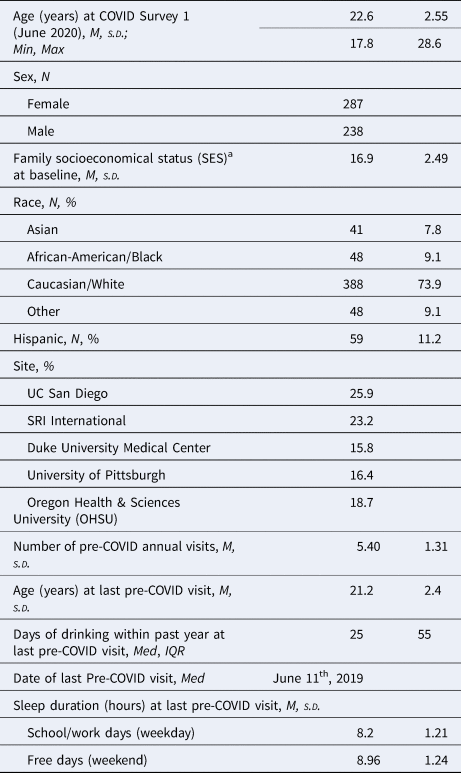
Two online surveys were distributed to participants in 2020 to determine the effects of the COVID-19 pandemic (23 June–10 July: COVID Survey 1; 7–24 December: COVID Survey 2). Data here are taken from 525 emerging adults (ages 17.8–28.6 years at COVID Survey 1; 287 women and 238 men), who completed at least one pre-COVID annual visit (median date of the last visit was 11 June 2019) and both COVID surveys. Participants included in this analysis were more likely to be female (Chi-square test, p = 0.01), less likely to be African American (Chi-squared test, p = 0.015), and tended to have lower, albeit not significantly, family socioeconomical status (t-test, p = 0.06) than those not included (n = 306). We used parental years of education as an indicator of family socioeconomical status, given that higher levels of education are often associated with better economic outcomes and more social resources (American Psychological Association, 2007; Daly, Duncan, McDonough, & Williams, Reference Daly, Duncan, McDonough and Williams2002). Table 1 summarizes the demographic characteristics of the sample and the analysis is based on the public data release NCANDA_PUBLIC_7Y_COVID_REDCAP_V01 (Pohl et al., Reference Pohl, Sullivan, Podhajsky, Baker, Brown, Clark and Pfefferbaum2021).
Demographics of 525 participants from the NCANDA cohort included in the analysis

IQR, Interquartile range; M, mean; s.d., standard deviation; Med, median (for non-Gaussian distributions).
a Highest number of years of education of either parent.
Measures
Depressive symptoms: The CES-D-10 is a shortened, validated version of the 20-item CES-D (Radloff, Reference Radloff1991). It assesses depressive symptoms in the past week using 10 items, with responses ranging from ‘rarely or none of the time’ (score of 0) to ‘all of the time’ (score of 3). Total scores range from 0 to 30, with higher scores indicating the presence of more depressive symptomatology, and a score above 10 identifies individuals at risk for clinical depression (Andresen, Malmgren, Carter, & Patrick, Reference Andresen, Malmgren, Carter and Patrick1994). The CES-D-10 has good psychometrical properties (Björgvinsson, Kertz, Bigda-Peyton, McCoy, & Aderka, Reference Björgvinsson, Kertz, Bigda-Peyton, McCoy and Aderka2013; Mohebbi et al., Reference Mohebbi, Nguyen, McNeil, Woods, Nelson, Shah and Berk2018). While it measures both state and trait depression (Spielberger, Ritterband, Reheiser, & Brunner, Reference Spielberger, Ritterband, Reheiser and Brunner2003), the CES-D assesses ‘current’ level of symptoms, having sensitivity to change; for example, test−retest changes have been found before and after a stressful life event (Smarr & Keefer, Reference Smarr and Keefer2011).
Pre-COVID measures of alcohol use and sleep duration: At the last pre-COVID visit, NCANDA recorded self-reported alcohol use frequency in the past year, from the Customary Drinking and Drug-use Record (Brown et al., Reference Brown, Myers, Lippke, Tapert, Stewart and Vik1998). Specifically, the following question was asked: ‘During the past year, how many days did you have a drink containing alcohol?’ Alcohol use frequency has high sensitivity and specificity in identifying problem drinking in adolescents as assessed with the Diagnostic and Statistical Manual, Fourth Edition for alcohol use disorder symptoms and alcohol dependence (Chung et al., Reference Chung, Smith, Donovan, Windle, Faden, Chen and Martin2012), and performs better than questions about quantity of alcohol consumed per occasion and heavy episodic drinking (Chung et al., Reference Chung, Smith, Donovan, Windle, Faden, Chen and Martin2012). Participants also completed a self-reported measure about sleep habits (Hasler et al., Reference Hasler, Franzen, de Zambotti, Prouty, Brown, Tapert and Clark2017), including sleep duration, calculated as the difference between bedtime and rise-time separately for school or work days (usually weekdays) and school/work free-days (e.g. weekends).
Data analysis
Identifying COVID-19 effect
The significance of the difference in the number of participants at risk of depression between the last pre-COVID visit and the first COVID survey was tested via McNemar's χ2 Test (two-tailed p < 0.05). To explore whether pre-existing depression risk influenced COVID-19 depression levels, the change in CES-D-10 scores from the closest pre-COVID visit to COVID survey 1 was tested separately for the at-risk depression group (pre-COVID, CES-D-10 scores >10) and the low-risk group (pre-COVID, CES-D-10 scores ⩽10) using one-sample t tests. Lastly, the change of CES-D-10 between the multiple Pre-COVID visits and two COVID surveys and its interaction with age, and sex were quantified by a ‘Trajectory Analysis’ and an analysis focusing on the ‘Change in Average CES-D-10’, which are described next.
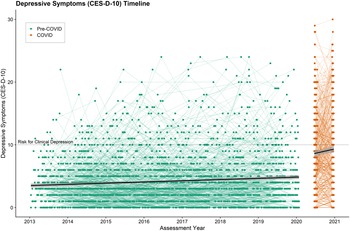
Trajectory Analysis: As the CES-D-10 scores approximately followed a Poisson distribution (Fig. 1), a Poisson mixed-effect model with a log link function (Dobson, Reference Dobson1990) tested the impact of the COVID-19 pandemic on the trajectory of CES-D-10 scores over the last 8 years. Participants were weighted by the inverse of the sampling probability from the whole cohort with respect to sex and race (Robins, Rotnitzky, & Zhao, Reference Robins, Rotnitzky and Zhao1994). Fixed-effect covariates of CES-D-10 were age (at each visit), sex, age-by-sex, site, family socioeconomical status, and race. The UCSD site was used as the reference for the site variable, and the Caucasian/white race was the reference for a race (Table 2). Each participant had a random effect of intercept. The effect of COVID-19 was tested in a stepwise manner (Efroymson, Reference Efroymson1960). The base model (no COVID interaction) incorporated two binary fixed-effect variables related to COVID-19, the first (variable name: COVID) testing whether CES-D-10 scores of the two COVID surveys were significantly different from the trajectory of pre-COVID visits; the second (variable name: Survey 2) testing whether there was a significant additive effect from COVID survey 2 compared to survey 1. As such, pre-COVID visits were encoded as (0, 0), COVID survey 1 as (1, 0), and COVID survey 2 as (1, 1). Next, interaction terms of age-by-COVID and sex-by-COVID were added to the model (two-way interactions). A final model, with the three-way interaction between age, sex, and COVID was also included. Each fixed effect related to COVID was considered significant if two-tailed p < 0.05 for the corresponding coefficient. The relationship between covariates and COVID variables are illustrated in Supplement Fig. S1 (Westreich & Greenland, Reference Westreich and Greenland2013).
Trajectories of depressive symptoms (scores on the Center for Epidemiological Studies Depression Scale, CES-D-10) over years leading up to the COVID-19 pandemic (2020) and at two points during COVID-19 (June and December 2020) for 525 emerging adults participating in NCANDA since 2013. CES-D-10 was, on average, 3.95 points higher during, compared to before, the COVID-19 pandemic.

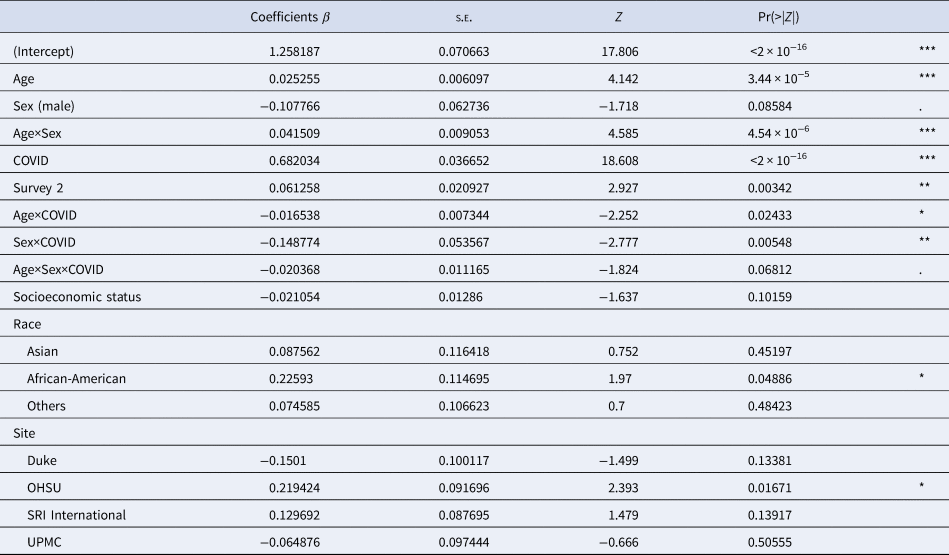
Results of the Poisson mixed-effect model testing for the effect of the COVID pandemic and its interaction with age and sex (three-way interaction) in 525 NCANDA participants

Note: . = p ⩽ 0.1; * = p ⩽ 0.05; ** = p ⩽ 0.01; *** = p ⩽ 0.001. The model used a log link function to regress from age, sex, COVID Surveys and their interactions with covariates as site, socioeconomical status, and race. COVID Survey 2 was also included in the model to examine any change in CES-D-10 at COVID Survey 2 relative to COVID Survey 1. The fixed effect R 2 was 0.203.
Change in Average CES-D-10: The difference between the average CES-D-10 over the Pre-COVID visits and the average CES-D-10 over the two COVID surveys for each subject was computed. A general linear model (GLM) regressed from this change, age, sex, site, socioeconomical status, race, the time interval between the average age at the Pre-COVID visits and the average age at the COVID surveys. Effects of the covariates other than age and sex were regressed out from the CES-D-10 change measure. The 525 participants were then divided into four groups (younger females, younger males, older females, and older males) based on sex and the median age at COVID Survey 1 (22.5 years). Each pairwise group comparison in the CES-D-10 change was examined by two-sample t tests with a significance level of two-tailed p < 0.05.
Alcohol and sleep in relation with depressive symptoms
To investigate how pre-COVID risk factors impact depressive symptoms during COVID-19, a GLM predicted change in CES-D-10 from the closest pre-COVID visit to COVID Survey 1 from alcohol use frequency (n = 421) and sleep duration (n = 471) measured in the closest pre-COVID visit. Covariates included age, sex, socioeconomical status, site, race, and the time interval between the last pre-COVID visit and COVID Survey 1. Correlations were considered significant if two-tailed p < 0.05. Lastly, this GLM was repeated by using alcohol and sleep variables measured in the visit in 2018 to predict the change of CES-D-10 from 2018 to 2019.
Results
Figure 1 shows the longitudinal trajectories of depressive symptom scores before March 2020 (i.e. pre-COVID) and during COVID-19 (June, December 2020). Supplementary Fig. S2 summarizes the distribution of the scores within half-year intervals. Significantly increasing (χ2 = 88.41, p < 0.0001) was the number of participants scoring above the clinical cut-off for depression risk (Andresen et al., Reference Andresen, Malmgren, Carter and Patrick1994) from the last pre-COVID visit (11%) to the first COVID survey (33%) (Supplementary Fig. S3). Participants with pre-pandemic low risk for depression (CES-D-10 ⩽10, n = 465) reported a significant increase (t 464 = 19.19, p < 0.0001) in depression scores during the pandemic (Supplementary Fig. S4). The pre-pandemic high-risk group (CES-D-10 >10, n = 60) continued to show high risk during the pandemic as the corresponding change was insignificant (t 59 = 0.17, p = 0.87).
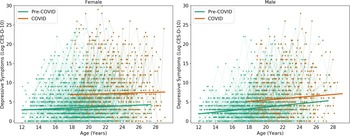
According to the base Poisson mixed-effect model, the CES-D-10 score of the two COVID surveys significantly increased (ZCOVID = 22.547, p < 0.0001, Supplementary Table S1) compared with the trajectory of pre-COVID visits after adjusting for the covariates. The increase in CES-D-10 from Survey 1 to Survey 2 was also significant (Z survey-2 = 2.391, p = 0.017, Supplementary Table S1) but with a smaller effect size (β survey-2 = 0.05, Supplementary Table S1). Incorporating the two-way interactions in the model (Supplementary Table S2) showed that the COVID-related increase was dependent on age and sex, with a larger increase in younger (Z age×COVID = −4.546, p < 0.0001), female (Z sex×COVID = −4.374, p < 0.0001) participants. Finally, adding the three-way interaction term (Table 2) indicated a trend-level larger increase in younger women (Z age×sex×COVID = −1.824, p = 0.0681, Fig. 2). In addition to the trajectory analysis, an analysis on the average pre-COVID CES-D-10 scores and average COVID CES-D-10 scores confirmed that the increase in CES-D-10 scores during the pandemic was greater for younger women than older women or younger and older men (Supplementary Fig. S5).
Trajectories of depressive symptoms shown separately for female (left) and male (right) participants for pre-COVID and COVID assessments with respect to age. There was a trend-level sex-by-age-COVID interaction, with younger women having more depressive symptoms during the COVID-19 pandemic.

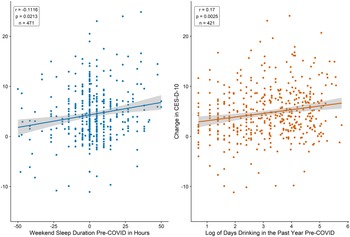
As shown in Fig. 3, greater alcohol use frequency (r 419 = 0.17, p = 0.003) and shorter sleep duration on free days (r 469 = −0.11, p = 0.02) pre-COVID predicted a larger increase in CES-D-10 during COVID-19. Finally, these two factors measured in the visit in 2018 did not predict the change of CES-D-10 from 2018 to 2019.
Sleep duration (hours on free days, like weekends) (left) and alcohol use frequency (natural logarithm of days over the year, right) reported on the last visit before COVID-19 predicted a greater increase in depressive symptoms from the last pre-COVID visit to the first COVID visit. Covariates were regressed out from change in CES-D-10.

Discussion
This longitudinal study leveraged a well-characterized cohort of emerging adults in the U.S. to identify changes in depressive symptoms during the COVID-19 pandemic relative to several years before the pandemic. Present findings provide novel longitudinal evidence for a dramatic increase in depressive symptoms and a tripling in the number of individuals at risk for clinical depression during the pandemic, with younger women being particularly at risk. Critically, the level of depression reported in June 2020 was sustained in December 2020. Further discovery revealed with prospective assessment was the significant role of pre-pandemic drinking and sleep behavior in predicting elevated depressive symptomatology. Results point toward an urgent need for interventions to help emerging adults, particularly young women, cope with COVID-19-related stressors to prevent the development of a depressive disorder in this vulnerable age group.
The present results are consistent with early cross-sectional studies reporting that younger individuals are more vulnerable to the psychological impact of the COVID-19 pandemic (Alzueta et al., Reference Alzueta, Perrin, Baker, Caffarra, Ramos-Usuga, Yuksel and Arango-Lasprilla2021; Moghanibashi-Mansourieh, Reference Moghanibashi-Mansourieh2020; Qiu et al., Reference Qiu, Shen, Zhao, Wang, Xie and Xu2020; Stanton et al., Reference Stanton, To, Khalesi, Williams, Alley, Thwaite and Vandelanotte2020) (see Xiong et al., Reference Xiong, Lipsitz, Nasri, Lui, Gill, Phan and McIntyre2020 for a review). The heightened vulnerability to depression in emerging adults has been attributed to several factors, including use of less effective coping strategies comparing with older age groups (Yeung & Fung, Reference Yeung and Fung2007), and the complex conjuncture of financial or education uncertainty, workload responsibilities, and greater exposure to the media for emerging adults during the pandemic (Ahmed et al., Reference Ahmed, Ahmed, Aibao, Hanbin, Siyu and Ahmad2020; Liu, Zhang, Wong, Hyun, & Hahm, Reference Liu, Zhang, Wong, Hyun and Hahm2020).
Similar to the present findings, albeit in mostly younger age groups, studies of adolescents in Australia (Magson et al., Reference Magson, Freeman, Rapee, Richardson, Oar and Fardouly2021) and the U.S. (Gotlib et al., Reference Gotlib, Borchers, Chahal, Gifuni, Teresi and Ho2020) presented longitudinal evidence for an increase in depressive symptoms during compared with before COVID-19, with girls being more vulnerable (Gotlib et al., Reference Gotlib, Borchers, Chahal, Gifuni, Teresi and Ho2020; Magson et al., Reference Magson, Freeman, Rapee, Richardson, Oar and Fardouly2021). Also, a longitudinal study of adolescents and young adults living in Long Island, New York, found that only female participants had increased depressive symptoms compared to pre-pandemic levels (Hawes, Szenczy, Klein, Hajcak, & Nelson, Reference Hawes, Szenczy, Klein, Hajcak and Nelson2021).
It was well known before the pandemic, that depression is more prevalent in women than in men (Andrade et al., Reference Andrade, Caraveo-Anduaga, Berglund, Bijl, De Graaf, Vollebergh and Wittchen2003; Baxter et al., Reference Baxter, Scott, Ferrari, Norman, Vos and Whiteford2014), with this sex difference emerging during mid-puberty and persisting into adulthood (Hankin et al., Reference Hankin, Abramson, Moffitt, Silva, McGee and Angell1998; Schraedley, Gotlib, & Hayward, Reference Schraedley, Gotlib and Hayward1999). Women are also more likely than men to develop depressive symptoms after stress or trauma exposure (Tolin & Foa, Reference Tolin and Foa2006). Reasons behind the vulnerability of women to depression are complex and involve an interplay of (neuro)biological factors and gender-specific personal and environmental (e.g. stress exposure) factors (Kuehner, Reference Kuehner2017). The sex difference in increased depressive symptoms shown here suggests that the vulnerability of women to depression is further exacerbated in the pandemic. Using this unique longitudinal dataset, the current study was also able to show that individuals at high risk for depression before the pandemic, continued to show elevated levels during the pandemic, possibly reflecting a ceiling effect.
Beyond sex, this study found alcohol drinking before the pandemic to be a risk factor, with higher use frequency pre-COVID predicting a greater increase in depressive symptoms during the pandemic. This finding comports with pre-COVID studies (Boden & Fergusson, Reference Boden and Fergusson2011; Marmorstein, Reference Marmorstein2009), including a meta-analysis of 17 adolescent studies (Cairns, Yap, Pilkington, & Jorm, Reference Cairns, Yap, Pilkington and Jorm2014) reporting greater exposure to alcohol being linked to increased risk of depression. Critically, some evidence suggests the association between alcohol and depression is stronger in females than males, indicating a greater susceptibility of women to the negative effects of alcohol use on mental health (Jeong, Joo, Hahn, Kim, & Kim, Reference Jeong, Joo, Hahn, Kim and Kim2019). Another risk factor identified by the current study was short sleep duration before the pandemic, which predicted a greater increase in depressive symptoms during the pandemic. These results support a growing body of work showing sleep is a modifiable target that protects against the development of depression (Blake et al., Reference Blake, Trinder and Allen2018; Cairns et al., Reference Cairns, Yap, Pilkington and Jorm2014) and suggest that obtaining sufficient sleep might militate the deleterious effect of the pandemic on mental health. In contrast to our findings about pre-pandemic alcohol use frequency and shorter sleep predicting depression during the pandemic, alcohol use frequency and sleep duration in one pre-pandemic year (2018) did not predict depressive symptoms in the next pre-pandemic year (2019). Possibly, shorter sleep duration and heavier alcohol use are vulnerability factors for the effect of stressors, such as the pandemic, on mood. Alternatively, their predictive effects may only be evident when there is a substantial change in depressive symptoms, such as occurred during the pandemic.
The relatively modest magnitude of pre-COVID-19 alcohol use and short sleep duration predicting increased depressive symptoms during COVID-19 suggests that principal contributors to excess depressive symptoms were likely COVID-19 pandemic-related stresses themselves. The elevated depressive symptom level during the pandemic was sustained and even showed an upward trend in December 2020. Other studies, mostly in Europe, showed that depressive symptoms were maintained or even decreased (Bendau et al., Reference Bendau, Kunas, Wyka, Petzold, Plag, Asselmann and Ströhle2021; Fancourt, Steptoe, & Bu, Reference Fancourt, Steptoe and Bu2021), yet suicidal ideation, especially among young adults, increased over time (O'Connor et al., Reference O'Connor, Wetherall, Cleare, McClelland, Melson, Niedzwiedz and Robb2020). These concerning data might be attributed to the presence of some risk factors (e.g. alcohol consumption) in combination with social isolation and loneliness in a time in which community services were severely restrained (Gunnell et al., Reference Gunnell, Appleby, Arensman, Hawton, John, Kapur and Pirkis2020).
The strength of this study is its longitudinal nature, with a well-characterized cohort of young individuals followed across 8 years including 2020 – a period when the U.S. was profoundly disrupted by the COVID-19 pandemic. Another strength is that the NCANDA sample is geographically distributed across five different sites in the U.S. Considering that counties where participants lived, were under different restriction orders during the COVID-19 pandemic, the geographic diversity of the NCANDA sample contributes to the generalizability of the study findings. However, there are also some potential limitations to consider. NCANDA participants are predominantly Caucasian and of high socioeconomic status, which limits the generalizability of our findings. Also, the sample was originally designed to disentangle the relationship between alcohol use and neurodevelopmental changes, and therefore individuals at higher risk for alcohol use problems are overrepresented, which could affect generalizability. On the other hand, due to its design, alcohol use was well characterized in the sample throughout the study, enabling an examination of the relationship between pre-COVID alcohol use and depressive symptoms during the pandemic. This study investigated depressive symptoms during the pandemic; continued longitudinal assessment for formal psychiatric diagnosis is required to test whether the identified depressive symptoms result in a major depressive disorder.
Overall, findings from this study using longitudinal data over multiple pre-pandemic years show the pandemic has tripled the risk for depression in emerging adults. Critically, subthreshold depression at a younger age is a risk factor for mental health problems in later life (Fergusson, Horwood, Ridder, & Beautrais, Reference Fergusson, Horwood, Ridder and Beautrais2005), such that the sustained corrosive effects of the pandemic might lead to the development of future psychiatric disorders in some individuals and have alarming implications for the social and emotional functioning of an entire generation. However, the prolonged effect of the COVID-19 pandemic on mental health in the U.S. remains to be determined, with possible variation related to regional differences in the pandemic's chronicity. Designing effective mental health promotion strategies is crucial to promote opportunities for help and early detection, especially for young women, and could consider sleep and alcohol use as modifiable targets for early psychosocial interventions that may prevent the exacerbation of depressive symptoms during and beyond this time of crisis.
Supplementary material
The supplementary material for this article can be found at https://doi.org/10.1017/S0033291721004062.
Acknowledgements
We thank everyone involved in this longitudinal project, especially all the participants for their contribution to science during these years.
Financial support
This study was supported by the National Consortium on Alcohol and Neurodevelopment in Adolescence (NCANDA) project by means of research grants from the National Institute on Alcohol Abuse and Alcoholism AA021697, AA021695, AA021692, AA021696, AA021681, AA021690, and AA021691, and a supplement to study COVID-19 effects (AA021696-07S1, FCB). The research was also supported by the Stanford HAI AWS Cloud Credit (PI: KMP). The content is solely the responsibility of the authors and does not necessarily represent the official views the National Institutes of Health.
Conflict of interest
The authors declared no conflict of interest related to the current work.
Ethical standards
The authors assert that all procedures contributing to this work comply with the ethical standards of the relevant national and institutional committees on human experimentation and with the Helsinki Declaration of 1975, as revised in 2008.