Introduction
On February 6, 2023, 2 devastating earthquakes with magnitudes of 7.7 Mw and 7.6 Mw occurred in Kahramanmaraş city and 10 provinces around it in Turkey. Musculoskeletal problems such as bone fractures, soft tissue damage, peripheral artery and nerve injuries, compartment syndrome, and amputation are observed in these patients. According to the latest official data, the disaster resulted in at least 45,968 deaths, 108,368 injuries, and 241,577 damaged buildings. 1 , Reference Uluöz and Gökmen 2
Functional disability is frequently encountered after natural disasters. Complaints in the musculoskeletal system are commonly experienced with or without musculoskeletal injury.Reference Yabe, Hagiwara and Sekiguchi 3 Post-disaster housing problems and post-traumatic stress-related sleep disorders are also associated with musculoskeletal complaints.Reference Yabe, Hagiwara and Sekiguchi 4 It is necessary to identify earthquake-related musculoskeletal problems. After a disaster, previously existing musculoskeletal complaints may increase, and new complaints may also arise. This situation may negatively affect the person’s recreational, community, and professional activities.Reference Jinnouchi, Ohira and Kakihana 5 , Reference Hagiwara, Yabe and Sekiguchi 6
Triage, treatment, management, and clinical follow-up of the injured are challenging tasks. After earthquakes, superficial injuries, fractures, open wounds due to high-energy trauma, compression-related compartment syndrome, crush injuries, and crush syndrome are frequently encountered, and patients are often exposed to multiple trauma.Reference Kulakoğlu, Uzunay and Pota 7 Patients with physical injuries after the earthquake apply to the Physical Medicine and Rehabilitation (PMR) clinic for orthopedic or neurological rehabilitation after overcoming their acute problems. In these patients, we see disabilities and functional inadequacies due to spinal cord damage, peripheral nerve damage, fractures, soft tissue damage in the extremities, crush injuries, and amputation at different sites. Some of these patients undergo surgical orthopedic procedures (fasciotomy, amputation surgery, tendon and soft tissue repair, fracture fixation).Reference Uz, Çetin and Kodik 8 Each patient is handled differently.
In disasters such as the Kahramamaraş earthquake, which affected a wide geography and large population, unfortunately, a significant portion of the patients could only reach the hospital at the end of this critical 8-10 hour period. Both the destruction and damage of health facilities in the cities most affected by the earthquake and the disruption of first aid services in this disaster environment play a role in delaying the recovery of individuals from the rubble.Reference Ergen, Kaya and Yılmaz 9
In this study, we determined the medical conditions of our patients who suffered musculoskeletal injuries in the earthquake, examined their treatment options and processes, and examined the clinical follow-up data of the patients in the long term. The aim was to document sociodemographic and clinical data of patients with musculoskeletal injuries who applied to the PMR clinic after the earthquake clinic after the Kahramanmaraş earthquake, to share experiences, and thus contribute to preparation for subsequent disasters. Many critical difficulties were encountered after the earthquake. Potential strategies need to be developed to improve disaster management practices and existing situations. For this reason, all kinds of experience contribute.Reference Tolon, Yazgan, Ural and Goss 10 , Reference Kocyigit 11
Patients and Methods
The study was designed as retrospective, cross-sectional, and analytic. Sociodemographic and clinical data of patients with musculoskeletal injuries, male or female, adult or child, who applied to the PMR outpatient clinic after the February 6 earthquake were recorded. Patients’ age, gender, duration of stay in the debris, site of injury (cranial, upper or lower extremity), soft tissue damage, fracture, peripheral nerve injury, amputation, surgical procedures performed, orthosis, prosthesis, assistive device used, fasciotomy, systemic complications such as pneumothorax, deep vein thrombosis, accompanying renal failure, soft tissue infection were recorded.
Criteria for Inclusion in the Study
-
• Having suffered a musculoskeletal injury in the earthquake
-
• Being a male or female earthquake victim in all age groups
-
• Volunteer
Exclusion Criteria from the Study
-
• Having any physical disability or trauma history before the earthquake
-
• History of cranial injury or cerebrovascular disease that will cause cognitive and psychiatric impairment in the earthquake
-
• Not wanting to participate in the study
Statistical Analysis
Statistical analyses were performed using the Statistical Package for the Social Sciences (SPSS) 20.0 (SPSS Inc., Chicago, IL, USA) program. As a result of the power analysis considering the type 1 error as 0.05, the power of the test as 0.80, and the effect size as 0.5, the minimum sample size was calculated as 210. Simple random sampling was used in the study. Normal distributions were made using the Kolmogorov-Smirnov test and histogram graphs. Numerical (continuous) variables were shown as mean and standard deviation or median (minimum-maximum), depending on whether they conformed to normal distribution or not. Categorical variables were presented as numbers and percentages. Data was created by examining the patient’s age, gender, duration of stay in the debris, injury levels (soft tissue injury, fracture, amputation, and compartment syndrome), and the number of patients with surgical procedures (fasciotomy, amputation, tendon, and soft tissue transfer). For categorical variables, a comparison was made with the chi-square test. Student t-test or Mann-Whitney U test was used for the comparison of 2 groups. More than 2 groups were compared using ANOVA and post hoc tests. Here, we used Tukey instead of Bonferroni, after an ANOVA test to compare all group differences. A significance level of P <0.05 was considered for all hypotheses.
Results
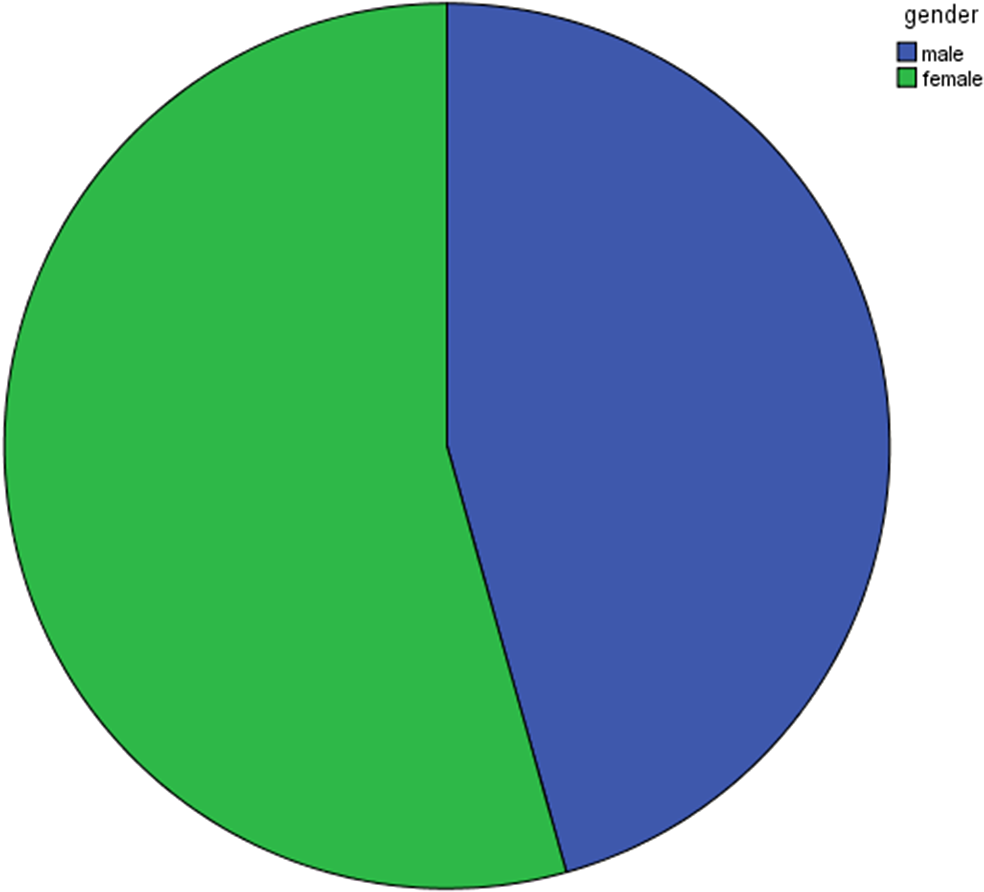
A total of N = 230 earthquake victims, 105 (45.7%) males and 125 (54.3%) females, aged between 1 and 79, were included in our study (Figure 1). The median time they stayed in the debris was 36 hours (0-248 hours) (Figure 2).
Gender distribution of survivors.

Histogram of duration under debris.

Regarding injury location, the lower extremity was primarily affected with N = 125 (54.3%). The number of amputated patients was N = 29 (12.6%), and the most common location was transfemoral amputation with N = 14 (6.1%) patients. The number of fractures was N = 130 (56.5%), and the most common fracture site was the lower extremity in N = 66 (28.7%) patients. N = 162 (70.4%) of the patients had soft tissue damage. There was peripheral nerve injury in N = 76 (33%) of the earthquake victims; the most frequently damaged nerve was the peroneal nerve in N = 36 (15.7%) patients. A vertebral fracture was present in N = 9 (3.9%) patients, and the most frequently fractured vertebra was the lumbar vertebra in 11 (4.8%) patients. Rib fracture N = 9 (3.9%), pneumothorax N = 9 (3.9%), head trauma N = 6 (2.6%), multiple trauma N = 52 (22.6%), fasciotomy N = 54 (23.5%), dialysis N = 12 (5.2%), tendon transfer surgery N = 19 (8.3%), soft tissue reconstruction N = 48 (20.9%), history of infection N = 18 (7.8%), and history of deep vein thrombosis N = 12 (% 5.2) were present. The sociodemographic and clinical characteristics of the patients are summarized in Table 1.
Sociodemographic and clinical characteristics of earthquake victims

* Most commonly seen.
N = 67 (29.1%) of the earthquake victims used orthosis, and polyethylene ankle foot orthosis (PAFO) and ankle foot orthosis (AFO) were the most commonly used orthosis types, with N = 43 (18.7%). The number of patients using a prosthesis was N = 6 (2.6%), and the most commonly used prosthesis type was above-knee prosthesis in N = 4 (1.7%) patients. Walking assistive devices were used in N = 29 (12.6%) patients, and wheelchair use was most common in N = 13 (5.7%) (Table 2).
Orthoses, prostheses, and walking assistive devices use

AFO: ankle foot orthosis; H-KAFO: hip-knee ankle foot orthosis; PAFO: polyethylene ankle foot orthosis.
* Most commonly seen.
All parameters were similar for both genders. In the correlation analysis, age was correlated with fracture (rho = –0.223; P = 0.001), amputation (rho = 0.139; P = 0.036), peripheral nerve damage (rho = 0.211; P = 0.001), head trauma (rho = –0.141; P = 0.033), multi-trauma (rho = –0.142; P = 0.0.31), and orthosis use (rho = 0.205; P = 0.02) (Figure 3a-d).
A, Boxplot of peripheral nerve injury according to age. B, Boxplot of amputation according to age. C, Boxplot of multiple trauma according to age. D, Boxplot of fracture according to age.

Duration of stay in the debris was positively correlated with soft tissue damage (rho = 0.139; P = 0.036). Amputation was correlated with fracture (rho = 0.227; P = 0.001), soft tissue damage (rho = 0.131; P = 0.047), history of infection (rho = 0.277; P <0.001), orthosis use (rho = –0.157; P = 0.017), prosthesis use (rho = 0.431; P <0.001), and walking assistive device (rho = 0.211; P = 0.001). History of infection was correlated with soft tissue damage (rho = 0.139; P = 0.035), multiple trauma (rho = 0.153; P = 0.02), fasciotomy (rho = 0.231; P <0.001), dialysis (rho = 0.222; P = 0.001), tendon transfer surgery (rho = 0.207; P = 0.002), fracture surgery (rho = 0.249; P <0.001), prosthesis use (rho = 0.153; P = 0.02), and assistive device use (rho = 0.230; P <0.001) (Figure 4 a,b).
A, Boxplot of infection according to fasciotomy. B, Boxplot of infection according to multiple trauma.

History of pneumothorax was correlated with fracture (rho = 0.177; P = 0.007), peripheral nerve injury (rho = –0.142; P = 0.032), rib fracture (rho = 0.239; P <0.001), head trauma (rho = 0.653; P <0.001), and trauma history (rho = 0.159; P = 0.016).
When we evaluated the groups according to age ranges (1-11 years; 12-17 years; 18-30 years; 31-60 years; >60 years) (one-way ANOVA test), a significant difference was observed among the groups in terms of amputation (P = 0.032) (1-11 years), peripheral nerve injury ( P = 0.05) (18-30 years), and orthosis use (P = 0.006) (18-30 years).
Discussion
Turkey is situated in a region with extensive seismic fault lines and has experienced numerous devastating earthquakes throughout its history. Most post-earthquake injuries occur due to objects falling on people, crushing injuries caused by falling directly under the debris, and disruptions during rescue and transfer from the debris. Many cities, especially Pazarcık and Elbistan districts, centered in Kahramanmaraş, were affected by the earthquake, and hospitals were also destroyed. There were disruptions in access to health care. Many volunteer health personnel from within and outside the country came to the earthquake area and provided support. Field hospitals were established in places where existing hospital buildings were inadequate.Reference Vaishya, Agarwal, Vijay, Hussaini and Singh 12
We encountered a wide range of patient profiles that were accompanied by different problems and were exposed to physical injury, with or without being trapped under the rubble. Coordination goals should include clearly defining these patient profiles, planning in the acute period, utilizing existing resources, and rapidly identifying patients who will undergo surgery.
Our study group consisted mostly of middle-aged male and female earthquake victims. There were earthquake victims who stayed in the debris for a long time, and there were also earthquake victims who did not stay. Injuries, fractures, and amputations mostly occurred in patients with lower extremity localization. A high rate of soft tissue injury was accompanied by peripheral nerve damage at a rate of one-third. Again, the most commonly affected nerve was the peroneal nerve in the lower extremity. This may be due to direct injury to the peroneal nerve or ischemic neuronal damage due to compartment syndrome. The fact that the patients in our study had lower extremity complaints can be explained by the fact that it causes more functional disability and that an action that affects daily life, such as walking, causes more complaints in people. One-fifth had vertebral fractures, most commonly at the lumbar level. In particular, the immediate transfer of people with acute polytrauma to relevant health institutions within the first 20 hours is important for the prognosis and survival of patients.Reference Kiani, Qazi, Khan and Iqbal 13 Life-threatening injuries such as rib fractures, pneumothorax, and hemothorax due to blunt chest trauma may occur in those trapped under debris in an earthquake.Reference Ozel, Tatliparmak and Cetinkaya 14 While multiple trauma and fractures are more common in older individuals, the fact that amputation and peripheral nerve injury occur more in the younger age group may be due to age-related physiological changes in circulation, nutrition, and musculoskeletal systems. Additionally, the decision of the surgeon experienced in amputation may be related to the difference in the age group. Children affected by the earthquake are included in a special group called “earthquake orphans.”Reference Terzi and Dundar 15 In addition, women, people with physical/psychiatric disabilities, and older people should also be included in special groups and given priority. In our study, it was seen that gender did not cause any differences in the parameters.
We encounter patients who underwent fasciotomy after compartment syndrome in the subacute period and may develop acute renal failure and wound infection. It is also an expected result that infection rates are high in patients with soft tissue damage, multiple trauma, dialysis, fracture surgery, tendon transfer surgery, and fasciotomy. Disruption of skin and bone integrity or multiple organ damage predisposes to infection. As expected, the frequency of pneumothorax was higher in patients with multiple trauma, head trauma, and rib fractures. As can be seen, the parameters that negatively affect the clinical situation of earthquake victims appear together. Such accompanying complications are associated with worse long-term outcomes in patients.Reference Akgun, Emet and Sibar 16 Abrasions and necrotic wounds due to crushing are common in earthquakes. Antiseptics, debridement, and negative pressure wound therapy are the most commonly applied wound care methods.Reference Ulusoy, Kılınç and Oruç 17 Successful orthopedic surgeries in line with the principles of correct fixation of fractures, fasciotomy, and amputation are vital for such devastating earthquakes.Reference Akkaya, Öktem and Tolunay 18 Mortality rates, especially due to sepsis, are high after fasciotomy.Reference Yalın and Gölgelioğlu 19 In cases where soft tissue damage is widespread, open fractures, patients undergoing fasciotomy due to crush syndrome, and multiple organ failure, skin, and systemic infection complications may develop and increase the morbidity of patients. In addition, soft tissue damage close to the joint and deep vein thrombosis also cause serious limitations in joint movement.
We prescribe orthoses, prostheses, and assistive devices to ensure the independent mobilization of these patients. Orthosis use was more common in the middle-aged group. While one-third of the patients use orthoses or assistive devices, the lower rate of prosthesis use compared to amputee patients shows that they have difficulty obtaining a prosthesis.
It is important to determine a team leader after the earthquake and ensure coordination from a single center, to keep a good recording system, and to include technicians, secretaries, and auxiliary personnel in the team, as well as health care professionals such as physicians and nurses.Reference Koca and Topak 20 Özdemir et al.Reference Özdemir, Karlıdağ and Bingöl 21 emphasize that the communication and organization strategy with the social media triage system established by orthopedic surgeons after the Kahramanmaraş earthquake reduced the delay in treatment and possible side effects. The specialist’s experience, fasciotomy decision, and time are effective in saving the extremity. To save the extremity, the risk of late fasciotomy and crush syndrome development should be carefully evaluated.Reference Bingol, Karlidag and Keskin 22 , Reference Kundakci, Mirioglu and Tekin 23 Failure to perform fasciotomy at the right time or failure of patients to receive adequate treatment may cause peripheral nerve damage (peroneal palsy) and loss of strength due to nerve ischemia in the future. Compartment or crush syndrome may often develop in these patients. It is known that nerve degeneration is more common in people who stay under debris for a long time. It has been reported in the literature that neuropraxia and axonomethesis are more common in the electrophysiological findings of these patients, and that signs of regeneration are observed during follow-ups with a good prognosis.Reference Ahrari, Zangiabadi, Asadi and Sarafi Nejad 24 -Reference Kapisiz, Kaya and Eryılmaz 28
Rhabdomyolysis is a detailed muscle dissolution with leakage of muscle cell contents, myoglobin, and sarcoplasmic proteins. Electrolytes are incorporated into extracellular fluids and components. It can be seen in compartment syndrome and is one of the causes of acute kidney failure. In our study, a small number of our patients had a history of dialysis. It was positively correlated with infection, which can be explained by the high infection risk in severe body traumas that will cause compartment syndrome.Reference Stanley, Chippa and Aeddula 29
The 2010 Haiti earthquake, which caused 230,000 deaths and thousands of injuries, resulted in the collapse of hospitals and a complete lack of access to health care. We have learned the lesson that in the first 48 hours of a devastating earthquake like the Haiti earthquake, many factors such as international aid, planning, communication between governments/hospitals, coordination, and determining the experienced team (with a leader) and material needs (such as hemodialysis materials, electrical generator, tetanus vaccine, and antibiotics) play a major role in reducing damage and loss of life in the early stages.Reference Oliveira 30 , Reference Lorich, Jeffcoat, MacIntyre, Chan and Helfet 31 Pre-disaster planning program is essential. Apart from geographical and cultural differences between countries, there are also differences in the technological infrastructure of health and transportation services. Every country should have a standard preparation protocol and revise this protocol by experiences worldwide.
The difficulties we experience in the rehabilitation processes are the fact that patients are followed up from different centers and apply to our center at different time periods. We have had patients who developed joint contractures or experienced permanent peripheral nerve motor loss because they were not intervened on in time. We aimed to increase their functional levels as much as possible during the rehabilitation process. Our patient population was heterogeneous both in age and musculoskeletal damage. In this way, we had the opportunity to evaluate and manage patients in a different clinical spectrum.
Study Limitations
The strengths of our study are that we have a compatible unit that is located at the center of the earthquake and becomes active in the 2nd month after the earthquake, and that we have experience with a wide range of patient spectrums. The limitations of our study include the fact that we collected data some time after the earthquake because we were at the center of the earthquake, and the difficulty of homogenization patients treated in different centers. Because of the limitations related to sample selection, geographic, cultural, and institutional (technology, staff, treatment approaches) differences, the results may not be representative of large populations.
Conclusions
We have to face earthquake disasters that affect large-scale masses, such as the February 6 Kahramanmaraş earthquake, in the future as well as in the past. It will be of great benefit to learn from our current experiences and make our plans based on our clinical experiences. For this reason, it will be guiding to clearly define the patient profile who applied to our PMR Clinic in the post-earthquake period and to determine the complications and needs that may occur. Determining rehabilitation needs and goals will help “to respond better to future earthquakes,” “to have better access to walking assistive devices, prostheses, and orthosis mainly for lower limbs and train peripheral nerve injury rehabilitation,” and “to increase the functional capacity of individuals and minimize their disabilities.”
Data availability statement
The data that support the findings of this study are available from the corresponding author upon reasonable request.
Author contribution
Idea and writing: FS, TTK; design, sources, analysis and/or interpretation, and literature review: TTK, FS; supervision and critical review: EB; data collection and/or processing: FS, ÖS.
This paper is derived from Fırat Sakınmaz’s thesis.
Funding statement
The authors received no financial support for the research and/or authorship of this article.
Competing interests
The authors declared no conflicts of interest with respect to the authorship and/or publication of this article.
Ethics standard
The study complied with the principles of the International Declaration of Helsinki, and ethical approval was obtained from Kahramanmaraş Sütçü İmam University Clinical Research Ethics Committee (date: November 21, 2023, protocol no: 113). After obtaining ethics committee approval, the same researcher recorded the data with the voluntary consent of the patients followed in our clinic, including the parents of pediatric patients. The identifiable data and the privacy of the participants were protected during the study. A written informed consent form was taken from the participants.
Consent for publication
Not applicable.