In 2011–2012, the Veterans Affairs Pittsburgh Healthcare System (VAPHS), a tertiary-care system situated on 3 campuses in Pittsburgh, Pennsylvania, experienced an outbreak of nosocomial Legionnaires’ disease due to Legionella pneumophila serogroup 1 among 22 veterans, which resulted in 6 deaths.Reference Demirjian, Lucas and Garrison 1 In November 2012, an outbreak investigation was initiated. Extensive surveillance of the VAPHS water system included matched pairs of water samples and swabs, which were cultured for Legionella. After genetic comparison of patient and environmental Legionella strains confirmed an outbreak, remediation measures including hyperchlorination of the water system and engineering improvements were instituted. Nosocomial cases have not occurred since November 2012.Reference Decker, Harris and Muder 2 The VAPHS infection prevention service continued to culture paired water samples and swabs from hospital water fixtures through September 2013. This program afforded an opportunity to compare the sensitivity of water and swab cultures for Legionella. Indeed, the relative sensitivity of water samples and swabs is an ongoing issue of uncertainty. 3 , 4
METHODS
Matched swab and one-liter water samples collected sequentially from a single fixture (pairs) were obtained during environmental surveillance. Data were analyzed retrospectively to compare water and swab culture qualitative positivity. McNemar’s test was used to determine significance (defined as P<.05).
Polyurethane foam swabs (Becton Dickinson Diagnostics, Franklin Lakes, NJ) were moistened with water from the target fixture, inserted, and scrubbed vigorously for 10 seconds. Thereafter, swabs were placed in a 0.2 M KCl wash, spun, and allowed to sit for 3 minutes; a 100-μL volume was plated on selective and nonselective buffered charcoal yeast extract agar (Remel, San Diego, CA). First-draw water cultures were obtained immediately after swab cultures. Samples were transported to the laboratory and processed within 24 hours or refrigerated. Water cultures were filtered using a sterile funnel containing a 0.2 µm filter (Fisher Scientific, Waltham, MA). The filter was placed in a sterile 50 mL centrifuge tube with 5 mL of sterile water, and vortexed for 1 minute; the recovered water was plated. Sodium thiosulfate (0.1N) was added at collection to neutralize chlorine. Fluorescent microscopy and a Legionella latex test (Fisher Scientific) were used to identify Legionella. A culture was considered positive if any Legionella was isolated. A pair was considered positive if either culture was positive.
The study period extended from November 2012 through September 2013. Prior to November 2012, 100-mL water samples were collected rather than 1-L samples. Swab cultures for routine surveillance were discontinued in September 2013. Quantitation was not reported because remediation is instigated for any detected quantity of Legionella, according to VAPHS protocol.
RESULTS
Results for the Entire Study Period
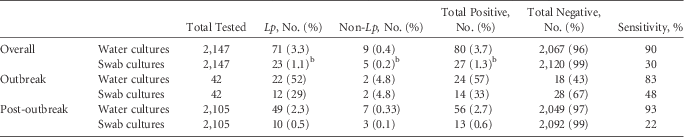
Overall, 2,147 matched pairs (4,294 total Legionella cultures) of swab and water samples were obtained (Table 1). Cultures were positive for Legionella using at least 1 method in 89 pairs of samples (4.1%). Furthermore, 80 water cultures (3.7%) and 27 swab cultures (1.3%) were positive (P<.00001). The sensitivity of water and swab cultures was 89.9% (80 of 89 water sample cultures) and 30.3% (27 of 89 swab cultures), respectively. If cultures were performed on swabs only, 62 of 89 sites (69.7%) identified as positive would have been missed; 9 of 89 positive sites (10.1%) would have been missed if cultures were performed on water samples only.
Legionella Positivity of Matched Water and Swab CulturesFootnote a

NOTE. Lp, Legionella pneumophila; non-Lp, non-pneumophila Legionella species.
a The positivity and sensitivity of water and swab cultures for Lp and non-Lp is shown overall and for the outbreak and post-outbreak periods.
b One swab was positive for both Lp and non-Lp.
Water cultures revealed Legionella pneumophila serogroup 1 in 48 samples (2.2%), L. pneumophila serogroups 2–14 in 23 samples (1.1%), and non-pneumophila Legionella species in 9 samples (0.4%). Swab cultures were positive for L. pneumophila serogroup 1 in 20 samples (0.9%), for L. pneumophila serogroups 2–14 in 3 samples (0.1%), and for non-pneumophila species in 5 samples (0.2%); 1 swab culture revealed both L. pneumophila and non-pneumophila Legionella. Water samples were superior to swabs for detecting both L. pneumophila serogroup 1 and serogroups 2–14 (P=.0005 and <.00001, respectively). There were no significant differences in the detection of non-pneumophila Legionella (P=.40).
In 4 pairs of samples, >1 type of Legionella was recovered. In 3 instances, water and swab cultures were positive for L. pneumophila serogroup 1 and non-pneumophila Legionella, respectively. In another instance, both water and swab cultures were positive for L. pneumophila serogroup 1 and the swab was also positive for non-pneumophila Legionella.
Results During and Following the Nosocomial Outbreak
In total, 42 pairs of water and swab samples were collected during the outbreak investigation in November 2012. Cultures were positive for Legionella by at least 1 method in 29 (69.0%) pairs. Moreover, 24 water cultures (57.1%) and 14 swab cultures (33.3%) were positive (P=.04). The sensitivity of water and swab cultures was 83% (24 of 29 water sample cultures) and 48% (14 of 29 swab cultures), respectively. Water and swab cultures revealed L. pneumophila serogroup 1 in 22 water samples (52.4%) and 12 swab samples (28.6%), respectively (P=.03). Furthermore, 2 water cultures and 2 swab cultures (4.8% each) were positive for non-pneumophila Legionella.
Following the outbreak, 2,105 matched pairs of samples were collected. Cultures were positive by at least 1 method in 60 pairs (2.9%), and 56 water cultures (2.7%) and 13 swab cultures (0.6%) were positive (P<.00001). The sensitivities of water and swab cultures were 93.3% (56 of 60) and 21.7% (13 of 60), respectively. Water cultures revealed Legionella pneumophila serogroup 1 in 26 samples (1.2%); L. pneumophila serogroups 2–14 in 23 samples (1.1%); and nonpneumophila Legionella species in 7 samples (0.3%). Swab cultures were positive for L. pneumophila serogroup 1 in 8 samples (0.4%), L. pneumophila serogroups 2–14 in 3 samples (1.4%), and non-pneumophila species in 3 samples (0.1%); 1 swab culture grew both L. pneumophila and non-pneumophila Legionella during this period.
DISCUSSION
Legionella colonize natural and manmade water works.Reference Wright, Ruseska, Athar, Corbett and Costerton 5 Hospital water systems have been implicated in numerous outbreaks of Legionnaires’ disease. The role of water-system surveillance in preventing nosocomial legionellosis is controversial. Some guidelines recommend routine surveillance, while others recommend targeted surveillance in response to a healthcare-associated case. Moreover, the optimal method of routine and case-based environmental surveillance for Legionella is unresolved. Both water and swab cultures have been recommended for the investigation of possible healthcare-associated cases. 3 , 4
This study marks the largest investigation of matched water and swab cultures for Legionella surveillance reported to date. Our data demonstrate that water cultures were markedly superior to concurrently collected swab cultures in detecting Legionella overall, and L. pneumophila serogroup 1 and serogroups 2–14 in particular. The superiority of water cultures was apparent during an outbreak, and in its aftermath. Our findings support those from several smaller studies, in which water cultures demonstrated superior sensitivity.Reference Hicks 6 – Reference Koziol-Montewka, Magrys and Stojek 8 In contrast, another study found that the quantitative yield of Legionella from swabs was greater than water cultures, although qualitative results were not reported.Reference Ta, Stout, Yu and Wagener 9 It is theoretically possible that prior swabbing improved the recovery of Legionella from water cultures in this study due to disruption of biofilms. However, an earlier study did not report a difference in sensitivity of water cultures collected before or after swabs.Reference Ta, Stout, Yu and Wagener 9 Pittsburgh is an endemic area for Legionella, which may have impacted our results.
Balancing testing sensitivity and judicious resource allocation is a crucial consideration when implementing routine water system testing for Legionella. Given the greater sensitivity, relative ease of collection, and avoidance of fixture disassembly, we recommend water cultures alone as the preferred method of surveillance for environmental Legionella. Based on our data, swab cultures were discontinued for routine surveillance at VAPHS. The combination of water and swab cultures provided a modest increase in absolute sensitivity, but the same increase might be achieved by collecting additional water samples.
ACKNOWLEDGMENTS
Financial support: No financial support was provided relevant to this article.
Potential conflicts of interest: All authors report no conflicts of interest relevant to this article.