INTRODUCTION
Schistosomiasis is still a major public health problem in the developing world, especially the tropical and subtropical regions. It ranks second only to malaria among parasitic diseases with regard to the number of people infected and those at risk of infection (Chitsulo et al. Reference Chitsulo, Engels, Montresor and Savioli2000). Applying the principles of DALYs led to rank schistosomiasis 78th in the list of DALYs for the world (King, Reference King2007). However a meta-analysis of disability-ranked outcomes in endemic schistosomiasis proved that the disability weight assigned to schistosomiasis is 2–15% in contrast to the World Health Organization estimate of 0·5% (King et al. Reference King, Dickman and Tisch2005).
At present, the main objective of schistosomiasis control is to reduce or eliminate morbidity or at least serious disease (WHO, 1985). The main tool for morbidity control is praziquantel (pzq) chemotherapy. This was encouraged by the marked reduction in its price in the last decades. Furthermore, pzq is a safe drug which can be delivered at the most peripheral levels of drug-delivery by non-medical personnel (Fenwick et al. Reference Fenwick, Savioli, Engels, Bergquist and Todd2003).
Unfortunately, a number of reports from endemic areas suggest that resistance or tolerance to pzq might exist in Schistosoma mansoni. In Egypt, it was reported that 1·6% of infected individuals, living in some villages in the Nile Delta, were not cured after 3 doses of pzq (Ismail et al. Reference Ismail, Metwally, Farghaly, Bruce, Tao and Benett1996). Furthermore, in Senegal, very low cure rates (18–34%) were obtained after administration of pzq to infected individuals in a recently established very intense focus of Ndombo (Gryseels et al. Reference Gryseels, Stelma, Talla, Van Dam, Polman, Sow, Diaw and Sturrock1994; Stelma et al. Reference Stelma, Talla, Sow, Kongs, Niang, Polman, Deelder and Gryseels1994). Several explanations were postulated (Gryseels et al. Reference Gryseels, Mbaye, De Vlas, Stelma, Guisse, Van Lieshout, Faye, Diop, Ly, Tchuem-Tchuente, Engels and Polman2001; Danso-Appiah and De Vlas, Reference Danso-Appiah and De Vlas2002). First, lack of acquired immunity in populations recently exposed to S. mansoni in view of the observation that pzq action is immune dependent (Brindley and Sher, Reference Brindley and Sher1987). Second, survival and maturation of the immature stages that escaped pzq which is effective against mature S. mansoni worms only (Sabah et al. Reference Sabah, Fletcher, Webbe and Doenhof1986). Third, development of tolerant or resistant S. mansoni strains.
Praziquantel was the cornerstone of the National Schistosomiasis Control Project (NSCP) implemented in the Nile Delta governorates in Egypt. In the context of the evaluation of the impact of the project in Kafr El Sheikh (KES) Governorate which is one of the Nile Delta governorates, low pzq cure rates were observed (Barakat, unpublished data). As KES governorate is characterized by high endemicity and transmission of S. mansoni infections (Barakat et al. Reference Barakat, Farghaly, El-Masry, El-Sayed, Husein and Miller1995), this study was designed to test the hypothesis that a low pzq cure rate in Egypt is attributed to the possibility that many individuals may harbour significant numbers of immature schistosome worms at the time of treatment. As pzq is ineffective against immature worms, younger worms might have escaped the administered pzq and matured later, producing ova which could account for the ova discharged in stools early after treatment (Renganathan and Cioli, Reference Renganathan and Cioli1998).
In this study the protocol involving administration of 2 doses of pzq separated by 4 weeks (which was suggested by an EC concerted action) was applied (Renganathan and Cioli, Reference Renganathan and Cioli1998) with the objective that the second dose would kill immature worms that had escaped the effect of the first dose. Furthermore, cure assessment was done 4 weeks post-treatment in order not to allow time for new infections that occurred after the first treatment to mature and produce ova before cure assessment.
MATERIALS AND METHODS
The study sample included 1583 children attending El Rouse primary school which is located in El Rouse village, Kafr El Sheikh Governorate, Nile Delta, Egypt. The village is situated 1 km from the Rosetta branch of the River Nile (Geographical coordinates: 31°23′N and 30°27′E). The inhabitants of the village depend on public taps in addition to canal water for their water supply but they lack sanitary sewage disposal. Most of the inhabitants are farmers; the main crops are rice and vegetables. Schistosoma mansoni is highly endemic in this area (Barakat et al. Reference Barakat, Farghaly, El-Masry, El-Sayed, Husein and Miller1995). El Rouse School was selected based on the high prevalence of S. mansoni infection among children attending it (Barakat, unpublished data).
All children enrolled in the school were included in the study. Consent and assent forms were obtained from all children and their parents who agreed to participate in the study. The protocol of the study was reviewed and approved by the ethical committee of the High Institute of Public Health, Alexandria University, Egypt.
Parasitological examination
Diagnosis of S. mansoni infection and parasitological cure assessment were based on examination of 2 Kato slides (41·7 mg) (Peters et al. Reference Peters, El Alamy, Warren and Mahmoud1980) prepared from 1 stool sample collected from each child at base line, 4 weeks after the first and second pzq treatments.
Treatment
Praziquantel was administered twice with a 4-week interval. The drug was given orally at a dose of 40 mg/kg body weight after breakfast.
Data analysis
Data was analysed using SPSS version 13 package. Chi square and Student's t-test were used to compare prevalence, intensity of infection, cure rate and egg reduction rate after 1 and 2 pzq treatments. P<0·05 was considered significant.
RESULTS
Operational results and study compliance
The study covered all children attending El Rouse Primary School (1583, 904 males and 679 females). All children were invited to participate in the study after explaining to them and their parents the details of the study and obtaining consent forms from the parents. From the 1583 children enrolled in the school, 1504 gave stool samples at base line, 1476 received the first pzq treatment, 1521 gave the second stool sample which was collected 4 weeks after the first treatment and 1494 children received the second pzq treatment which was given 4 weeks after the first dose of pzq. At the end of the study, 1506 children offered a third stool sample 4 weeks after the second pzq treatment. Only 1351 children participated in the 5 events (they received 2 pzq treatments and offered 3 stool samples).
Parasitological results
At base line, 588 (43·5%) children were infected with S. mansoni with a geometric mean egg count (GMEC) of 62·15 eggs per gramme (epg). The remaining 763 children were classified as negative because S. mansoni ova could not be detected in their stools after examination of 2 Kato slides from the single stool sample collected at baseline. Although these children received both the first and second pzq treatments, S. mansoni infection was diagnosed in 19 of them (16 light and 3 moderate). Consequently, all children were removed from the dataset and cure rate was calculated for the 588 children who were positive at baseline.
Cure rate and egg reduction rate
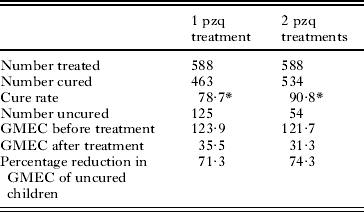
Parasitological cure rate based on disappearance of S. mansoni ova from 2 Kato slides prepared from 1 stool sample collected 4 weeks after receiving the first pzq treatment was 78·8%. When a second dose of pzq was offered to the children 4 weeks after the first treatment, cure rate increased to 90·8% (Table 1).
Cure rate and percentage reduction in geometric mean egg count of primary school children, children who were cured or uncured after receiving 1 and 2 pzq treatments
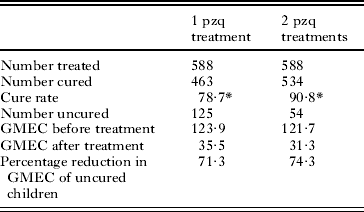
* Chi2=33·2, P=0·00.
From 463 children who were considered negative after the first treatment, 25 were positive for S. mansoni ova 28 days after receiving the second pzq treatment (22 with light infection and 3 with moderate infection).
Unlike the cure rate, the percentage reduction in the GMEC of the uncured children did not change significantly whether they received 1 or 2 pzq treatments. After the first treatment the uncured children showed 71·3% reduction in their GMEC when compared to pre-treatment intensity of infection, while after receiving 2 pzq treatments the reduction slightly increased to 77·2%.
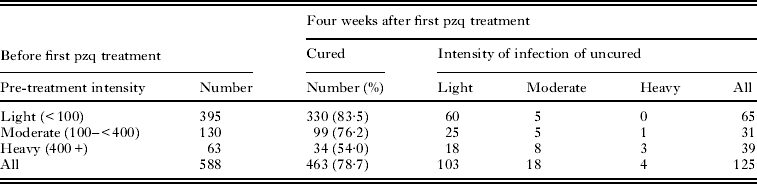
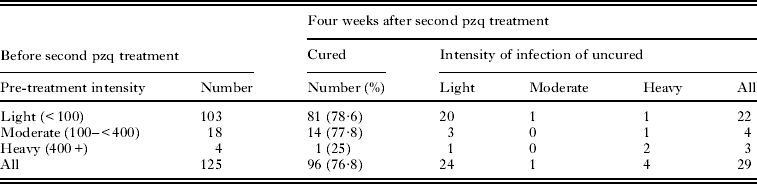
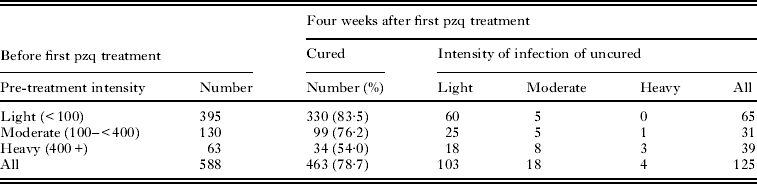
Tables 2 and 3 show the effect of each of the first and second pzq treatments alone on pre-treatment infection intensity. It is clear that cure rate was associated with infection intensity prior to receiving treatment. Also cure rates were very similar after the first and second treatments for both light and moderate intensity groups. Most uncured children fell in the light intensity category (103 out of 125 after the first treatment and 24 out of 29 after the second treatment).
Effect of first pzq treatment in relation to pre-treatment intensity of infection among primary school children
Effect of second pzq treatment in relation to pre-treatment intensity of infection among primary school children
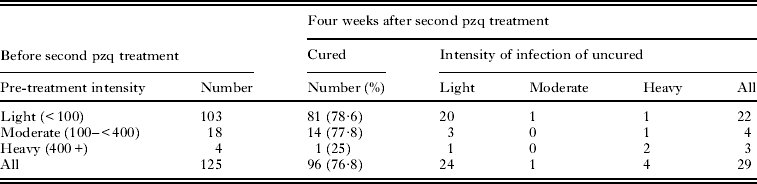
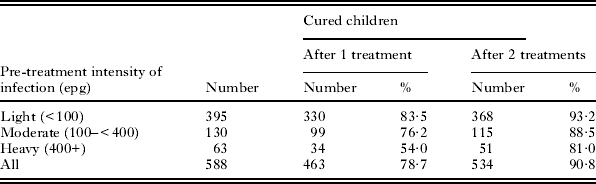
The intensity of infection before receiving pzq had a great influence on the outcome of the treatment (Table 4). Eighty-three percent of children with low S. mansoni intensity (less than 100 epg) were cured after receiving 1 pzq dose, while 76·2% of children with moderate intensity (100–<400 epg) were cured. But cure rate decreased significantly to reach 54·0% among children with heavy S. mansoni infection (400 and more epg).
Cure rate of 1 and 2 pzq treatments in relation to pre-treatment intensity of infection among primary school children
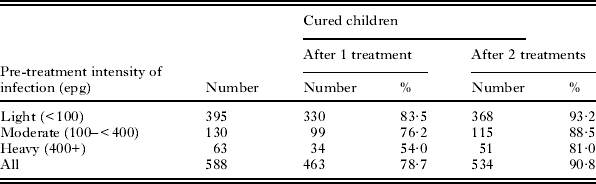
When 2 pzq treatments were offered to children, there was a significant increase in the cure rate in all categories of pre-treatment intensity of infection. However, this increase was much more evident in the group with heavy S. mansoni infection. The net cure rate after receiving 2 pzq treatments was highest among children with low intensity (93·2%) followed by that of moderate intensity (88·5%) and the lowest cure rate (81%) was obtained among the group with heavy intensity of S. mansoni infection.
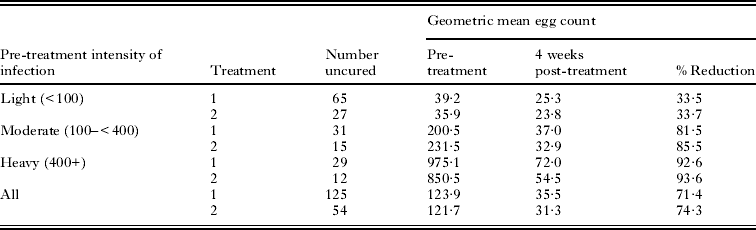
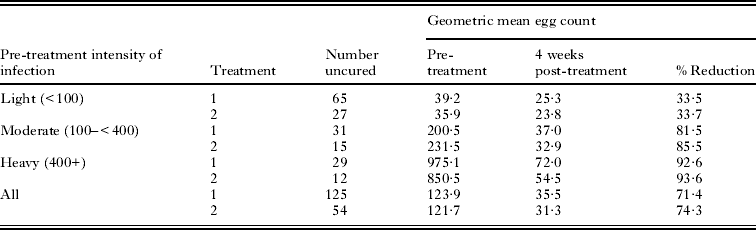
On the other hand, although the number of pzq treatments had no effect on the percentage reduction in GMEC of uncured children, the level of the pre-treatment intensity of infection had a significant effect on the reduction among uncured children regardless the number of pzq treatments received. The lowest percentage reduction in GMEC was observed in the group with light infection followed by that in the group of moderate infection to reach its maximum among the children with heavy pre-treatment intensity (Table 5).
Percentage reduction in geometric mean egg count of children uncured after receiving 1 and 2 pzq treatments according to pre-treatment intensity of infection
DISCUSSION
In the present study, cure rate obtained after 1 pzq treatment (78·7%) is within the range of pzq cure rates of 60–90% reported in different epidemiological settings (Davis et al. Reference Davis, Joidan, Webbe and Sturrock1993; Kumar and Gryseels, Reference Kumar and Gryseels1994). However, a very low cure rate (54%) was observed among children with a heavy intensity of S. mansoni infection. Although our results are based on examination of 2 Kato slides prepared from a single stool sample collected 28 days after pzq administration which might lead to overestimation, the cure rate obtained was not as high as that observed in other studies which reported a higher apparent parasitological cure rate when it was calculated on the basis of a single reading before and after the administration of 1 dose of pzq (88% by Utzinger et al. Reference Utzinger, N'Goran, N'Dri, Lengler and Tanner2000 and 87% by Raso et al. Reference Raso, N'Goran, Totay, Luginbuhe, Adjoua, Tian-Bi, Bogoch, Vounatsou, Tanner and Utzinger2004). After offering a second pzq treatment 4 weeks after the first dose, the cure rate increased significantly to reach 90·8% (Chi2=33·2, P=0·0). The fact that children were still passing S. mansoni ova 28 days after the first treatment cannot be attributed to new infections that might have occurred after pzq administration. In our study, the follow up was done 28 days after treatment while the developmental period for S. mansoni cerariae from skin penetration to oviposition takes about 31 days (Clegg, Reference Clegg1965) which is longer than our evaluation period. On the other hand, as the study area is an area of high transmission (Barakat et al. Reference Barakat, Farghaly, El-Masry, El-Sayed, Husein and Miller1995), it is very likely that the children harbour S. mansoni worms at different stages of maturation at the time of treatment. As pzq is effective against mature worms only (Xiao et al. Reference Xiao, Catto and Webester1985; Sabah et al. Reference Sabah, Fletcher, Webbe and Doenhof1986), immature worms would have escaped the effect of the drug and would have had enough time to mature and lay eggs which will be discharged in the follow-up sample. The second pzq treatment which was offered to children 28 days after the first would have killed those worms which matured after the first dose. Thus it will be responsible for disappearance of S. mansoni ova from the stool samples collected 28 days later for evaluation of the second treatment leading to the reported significant increase in cure rate. The same finding was reported in other studies (Utzinger et al. Reference Utzinger, N'Goran, N'Dri, Lengler and Tanner2000; Danso-Appiah and De Vlas, Reference Danso-Appiah and De Vlas2002). Furthermore, if we compare cure rates after the administration of 1 pzq dose (whether the first or second treatment), we will observe that both are almost equal (78·7% and 76·8% after the first and second treatment respectively). This excludes that the increase in cure rate achieved after 2 pzq treatments was due to a greater efficacy of the second dose and confirms the explanation that the second treatment killed immature S. mansoni worms which escaped the effect of the first dose.
In the present study, the proportion of pre-patent infection could be estimated to range from 5·4 to 7·2% (before the first treatment 763 children were negative and 28 days later infection was detected in 55 children (7·2%), before the second pzq treatment 463 children were negative, 25 (5·4%) of them became positive 28 days after pzq administration). These figures are close to those reported by other researchers (4–10%) (Utzinger et al. Reference Utzinger, N'Goran, N'Dri, Lengler and Tanner2000).
Contrary to the effect on cure rate, the percentage reduction in geometric mean egg count among uncured children after receiving 1 pzq treatment (71·3%) was lower than recorded in other studies that usually report more than 90% (Gryseels et al. Reference Gryseels, Nkulikyinka and Coosemans1987; Davis et al. Reference Davis, Joidan, Webbe and Sturrock1993; Kumar and Gryseels, Reference Kumar and Gryseels1994; Engels et al. Reference Engels, Sinzinkayo and Gryseels1996). Moreover, when a second pzq treatment was offered to the children, the increase in egg reduction rate was negligible (74·3%).
The present study demonstrates clearly the association between cure rate and infection intensity prior to pzq administration. Cure rates were significantly higher among children with light S. mansoni infections and decreased by the increase in intensity of infection. After the first pzq treatment, only 54% of children with heavy S. mansoni infection were cured followed by 76·2% of the group with moderate infection and the highest rate (83·5%) was among the light infection group (Chi2=16·5, P=0·00). The same trend was observed after the second treatment for the group which was still passing S. mansoni ova after the first treatment. The same finding was reported for S. mansoni infections in several previous studies (Picquet et al. Reference Picquet, Vercruysse, Shaw, Diop and Ly1998; Berhe et al. Reference Berhe, Gunderson, Abebe, Birrie, Medhin and Gemetchu1999; Van Lieshout et al. Reference Van Lieshout, Stelma, Guisse, Falcao Ferreira, Polman, Van Dam, Diakhte, Sow, Deelder and Gryseels1999; Utzinger et al. Reference Utzinger, N'Goran, N'Dri, Lengler and Tanner2000; Raso et al. Reference Raso, N'Goran, Totay, Luginbuhe, Adjoua, Tian-Bi, Bogoch, Vounatsou, Tanner and Utzinger2004). Also a higher cure rate – although not significant – was observed among individuals with light S. haematobium infection (Midzi et al. Reference Midzi, Sangweme, Zinyowera, Mapingure, Brouwer, Kumar, Mutapi, Woelk and Mduzola2008).
When the percentage reduction of egg count among children who were uncured after receiving the first pzq treatment is studied in relation to pre-treatment intensity of infection, we can observe a significant association (Chi2=35·2, P=0·00). Contrary to the cure rate, the lowest reduction in egg count was recorded among children with low intensity of infection prior to pzq administration while the maximum reduction was achieved by the group with heavy S. mansoni intensity. The same trend was found after the administration of 2 pzq treatments, there was significant association between the percentage egg reduction and intensity of S. mansoni infection prior to receiving the two treatments. Contrary to our findings (Utzinger et al. Reference Utzinger, N'Goran, N'Dri, Lengler and Tanner2000) could not find any association between the percentage reduction of egg counts after the administration of pzq and the infection intensity prior to treatment (Utzinger et al. Reference Utzinger, N'Goran, N'Dri, Lengler and Tanner2000).
Although our results are calculated based on examination of 2×41·7 mg Kato slides prepared from a single stool sample which might lead to overestimation of parasitological cure rates obtained due to undetected light infections, this could be compensated for by the fact that the same principle was applied in all parasitological examinations used for estimation of baseline prevalence and all follow-up examinations. Furthermore, the aim of our study was to compare cure rates after 1 and 2 pzq treatments and applying the same technique may compensate for this point. Also in most pzq field studies, cure rates have been determined on the basis of 1 or 2 Kato slides from only 1 stool sample (Polderman et al. Reference Polderman, Gryseels and De Caluwe1988; Simonen et al. Reference Simonen, Nega and Furu1990; Picquet et al. Reference Picquet, Vercruysse, Shaw, Diop and Ly1998; Gryseels et al. Reference Gryseels, Mbaye, De Vlas, Stelma, Guisse, Van Lieshout, Faye, Diop, Ly, Tchuem-Tchuente, Engels and Polman2001). However, it is highly recommended to carry out further studies in Egypt using more sensitive methods for assessment of pzq cure rate in view of the detection of some tolerant S. mansoni strains in the Nile Delta (Ismail et al. Reference Ismail, Metwally, Farghaly, Bruce, Tao and Benett1996), in addition to the distribution of huge amounts of pzq in Egypt in the last decades (Fenwick et al. Reference Fenwick, Savioli, Engels, Bergquist and Todd2003).
Finally, our results could confirm that the low cure rates obtained in a high S. mansoni transmission area could be attributed, even partially, to the possibility that many individuals may harbour significant numbers of immature schistosome worms at the time of pzq treatment. As pzq is ineffective against immature worms (Xiao et al. Reference Xiao, Catto and Webester1985; Sabah et al. Reference Sabah, Fletcher, Webbe and Doenhof1986), younger worms might have escaped the administered pzq, maturing later and producing ova to be discharged in the stools early after treatment (Renganathan and Cioli, Reference Renganathan and Cioli1998). However, we could not exclude the possibility of the presence of tolerant S. mansoni strains in view of the previous reports from the Nile Delta (Ismail et al. Reference Ismail, Botros, Metwally, William, Farghaly, Tao, Day and Bennett1999; Botros et al. Reference Botros, Sayed, Amer, El Ghannam, Bennett and Day2005).
In view of the obtained results, it is recommended that a second dose of pzq is given 4 weeks after the first dose. As this is neither operationally feasible nor cost effective for a national control programme (Midzi et al. Reference Midzi, Sangweme, Zinyowera, Mapingure, Brouwer, Kumar, Mutapi, Woelk and Mduzola2008), combination therapy has to be considered . The partner drugs should have different mechanisms of action and/ or target different developmental stages of the parasite (Utzinger et al. Reference Utzinger, Keiser, Shuhua, Tanner and Singer2003).