There is an emerging consensus among policy leaders and researchers in the United States that building resilient communities requires a departure from traditional approaches to more partnered approaches that bring together government and community-based organizations (CBOs).Reference Chandra, Acosta, Stern, Uscher-Pines and Williams 1 – Reference Plough, Fielding and Chandra 5 However, there is limited empirical evidence to support the beliefs that underscore this consensus. This research contributes to the evidence and explores ways to advance partnered approaches that can improve a community’s resilience in the aftermath of a disaster.
Two US strategies guide public health response and recovery from disasters: the National Health Security Strategy and the National Disaster Recovery Framework. These strategies emphasize the importance of engaging CBOs, 6 , 7 but they offer limited guidance about the specific roles and responsibilities for CBOs, how these roles and responsibilities vary across phases of the disaster, how CBOs should coordinate with one another and with government, how CBOs should be engaged prior to a disaster (eg, memorandums of understanding or agreement [MOUs/MOAs]), and how to address financing for the critical services CBOs provide. This limited guidance reflects the field’s lack of understanding about how CBO-CBO and CBO-government partnerships contribute to disaster resilience and which components of the relationship confer value.
Several studies have examined the importance of partnerships during non-disaster times. A retrospective study of 9/11 suggested that well-connected networks between government and the public and private sectors could play an important role in effective response and recovery.Reference Kapacu 3 A 2012 survey of preparedness coordinators for local health departments (LHDs) also found that strong CBO-LHD relationships were associated with LHDs’ ability to strengthen community engagement in public health emergency preparedness.Reference Schoch-Spana, Selck and Goldberg 8 In addition, public health partnership benefits in non-disaster times are well established: namely, that organizations with greater ties that are more centrally located in organizational networks in healthcare, public health, and social services typically deliver services more effectively than less connected organizations do.Reference Mays and Scutchfield 9 , Reference Mays, Smith, Ingram, Racster, Lamberth and Lovely 10
In contrast, no research to date has examined how existing or new partnerships develop and change after a disaster (during response and immediate recovery) or what partnership factors influence recovery in the longer term. An empirical study of partnerships during and after a disaster would not only support the growing consensus on which several federal policies are based but also extend prior research and promote understanding about the role these partnerships play in disaster recovery. In particular, more information is needed to describe these partnerships (who participates, when are they formed, are they maintained after a disaster, what role should LHDs play in these partnerships), explore how they support recovery, and examine whether the structure or durability of the partnerships is associated with differential community recovery. Without clear policies or guidelines on how partnerships should operate, many communities affected by disaster establish a committee or coalition (often called long-term recovery committees or LTRCs) to guide decisions about how to allocate scarce resources and address unmet needs in long-term recovery.Reference Street 11 The goal of these LTRCs is to help families become self-sufficient after a disaster. While several articles identify LTRCs as critical to maintaining and supporting partnerships for recovery,Reference Craddock, Walsh, Strauss-Riggs and Schor 12 , Reference Gajewski, Bell, Lein and Angel 13 there is no research demonstrating whether LTRCs make a difference during recovery.
This information would be invaluable to policymakers looking to refine the aforementioned national strategies and to LHDs and emergency planners trying to engage CBOs in their disaster planning. For example, Public Health Emergency Preparedness cooperative agreements are a critical source of funding that are awarded to 62 state, regional, and metropolitan public health departments. The agreements emphasize engaging with CBOs that can help mitigate health risks and integrating them into a jurisdiction’s emergency plans with defined community roles and responsibilities. 14 However, there are no established processes for how LHDs should engage CBOs to meet this funding requirement. For example, should an LHD act as a convener to bring together CBOs, or should it lead the whole community planning process that includes CBOs, as LHDs in New York, San Francisco, and Seattle have done? 15 – 17 More information and guidance is needed to ensure health departments have the capacities and capabilities to fully realize this funding requirement.
One opportunity for further study came with Hurricane Sandy. In October 2012, Sandy exposed New York City’s vulnerabilities with a record-breaking storm surge, extensive flooding, loss of life, and widespread damage. The devastating circumstances and large-scale engagement of CBOs provided an opportunity to examine how CBOs contribute to improved disaster recovery. During the storm, the city’s Department of Health and Mental Hygiene, Office of Emergency Preparedness and Response (DOHMH) Community Resilience and Recovery Planning Committee (C2RP), and its broader network of partners provided vulnerable populations with essential services, including supporting special needs medical shelters and restoration centers, and providing physical and mental healthcare. C2RP and its partners (referred to as CBOs throughout) are still involved in recovery efforts.
This study focuses on how the partnerships of the local public health department and this broad array of health, medical, and social services CBOs contributed to response and recovery up to 2 years after the storm. Specifically, this study describes the types of services provided by the CBOs in these partnerships in support of the response and recovery efforts; examines the structure and durability of CBO-CBO and CBO-DOHMH partnerships over 2 years of response and recovery efforts; and assesses whether the structure of partnerships in specific New York boroughs varies by the extent of storm damage. The study also assesses whether the structure or durability of these CBO partnerships or the strength of their relationship with DOHMH is associated with differential community recovery impacts. We hypothesize that organizations operating in the areas most strongly impacted by the storm might be more likely to form new ties, and that tie formation will be more intense in the month following the storm. We also hypothesize that CBOs that are more connected (ie, those with higher degree centrality scores) to either other CBOs or to DOHMH will report more recovery impacts.
Methods
Data Collection
We conducted an online survey at 2 points in time: 1 year (wave 1) and 2 years (wave 2) after Hurricane Sandy. The wave 1 survey asked participants to report on the services they were offering before Hurricane Sandy. Both waves 1 and 2 asked participants to reflect back on their recovery activities and partnerships over the past year. The data from both waves were combined into a single analytic database set reflecting the routine services and partnerships before Hurricane Sandy and recovery-specific services and partnerships starting with the initial response to Hurricane Sandy until 2 years after the storm.
The online survey took ~15-30 minutes to complete. Respondents were e-mailed an initial invitation followed by several reminders that alternated between e-mails and phone calls. Recipients provided electronic consent. This study was reviewed and approved by the Institutional Review Boards of the RAND Corporation, UCLA, and DOHMH.
Participants
A total of 292 organizations participated in wave 1 (42% response rate) and 262 organizations participated in wave 2 (48% response rate). Among the participants in one or both waves 18 were 369 CBO representatives (executive directors, presidents/CEOs, medical directors, nurse managers, and social workers) who participated in the C2RP or were part of C2RP’s Advanced Warning SystemFootnote a (a 41% response rate across both waves). We asked organizations to respond to the survey only once per wave, so if multiple individuals’ viewpoints were needed, they came together to complete the survey.
Fewer organizations were in the wave 2 sample because we removed non-functional e-mails and organizations that went out of business between waves 1 and 2. Response rates were higher than the reported average for web-based surveysReference Cook, Heath and Thompson 19 (a 2000 meta-analysis found an average response rate of 40%). In our descriptive tables, we do not weight to account for moderate differences in survey response rates across organization types (Cramér’s V=0.24). However, many of our models include baseline characteristics (such as rates of tie formation) that we expect to account for relevant differences between organizations in different sectors.
Measures
The study was conducted using the following measurements to assess the impact of CBO partnerships on recovery services.
Organizational Characteristics
We asked organizations to select the services they provided prior to Hurricane Sandy, which boroughs they served, and whether providing disaster recovery services was part of their primary mission.
Type(s) of Recovery Services
We asked organizations to report what disaster recovery services they have provided since Hurricane Sandy, which was their organization’s most important disaster recovery service, the number of months or years they have been involved in disaster recovery work, and whether they will continue to provide the same level of services over the next 12 months.
Partnership Structure and Durability
We assessed the structure of CBO-CBO and CBO-DOHMH partnerships using 2 validated instruments: PARTNER and the Assessment for Disaster Engagement with Partners Tool.Reference Varda, Chandra, Stern and Lurie 20 – 23 Organizations could report on up to 25 close partnerships, which were defined as partnering to plan, rebuild, offer joint services, or serve as a primary referral/information source. For each partner, organizations were asked to describe why they partnered (measured on a continuum from sharing information to joint service delivery) and how frequently they communicated. To capture the LHD’s role, we asked whether respondents had partnered with DOHMH on any recovery activities (eg, coordinating training or education on disaster recovery), what types of benefits (if any) organizations received as a result of their work with DOHMH (eg, more input on emergency plans), and to what extent a strong partnership with DOHMH is needed to promote recovery in their community (not at all to very much). We also asked respondents whether their organization was part of a formal recovery partnership such as a long-term recovery committee, unmet needs committee, or recovery coalition; the extent to which participation in a formal recovery partnership contributed to their ability to impact recovery (not at all to a great deal), and what benefits they received as a result of their participation in the formal recovery partnership (eg, improved access to information on recovery services). To understand factors that may influence partnership structure and durability, respondents were also asked about the barriers (eg, lack of time) and facilitators (eg, history of collaboration) to partnerships during disaster recovery and the resources needed to improve future partnerships (eg, funding, guidance on where resources for partnership are available).
Storm Damage
To identify the extent to which the 5 boroughs were impacted by Hurricane Sandy, we used the percent of households exposed to the storm surge, as reported in the FEMA Modeling Task Force-Hurricane Sandy Impact Analysis. 24
Impact on Recovery
We assessed respondents’ perceptions of the ways in which the recovery services that they and their partners provided impacted their community. Respondents could select one or more impacts from a pre-established list (eg, identified needs of affected residents, provided medical care to residents, supported residents emotionally or financially, provided education on or physically assisted with mold or resources for mold cleanup, helped rebuild damaged houses or infrastructure, shared recovery information with residents, shared community information with recovery services contractors) and write in additional impacts.
Analysis
The following sections explain how we estimated the various outcomes for the partnerships.
Organizational Characteristics
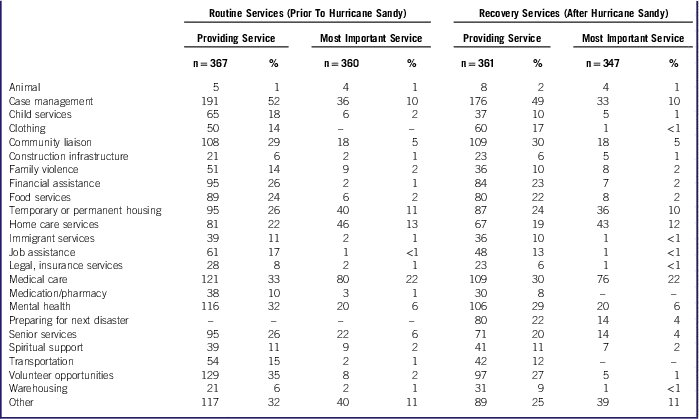
Thirty-nine percent of CBOs reported serving all 5 New York boroughs, while 11% said they provided services in Staten Island, 12% in Manhattan, 13% in Queens, 17% in the Bronx, and 18% in Brooklyn.Footnote b Participating CBOs represented healthcare (22%), social service (22%), cultural and faith-based (18%), emergency management (10%), business (9%), aging (6%), housing and shelter (5%), mental/behavioral health (3%), and education and childcare sectors (3%). These sectors align with the 11 community sectors that the Centers for Disease Control and Prevention defines in its public health preparedness capabilities community recovery performance measure. 25 Prior to Hurricane Sandy, organizations were providing an array of services, most commonly case management and volunteer services and organizations identified medical care, home care, and housing services as their most important non-disaster services (Table 1).
Routine and Recovery Services Provided by Community-Based Organizations

Note: Organizations could indicate they were providing more than 1 service so these numbers do not add up to 100%.
Type(s) of Recovery Services
To calculate organizational contributions to disaster recovery, we calculated frequencies for type of service reported by each organization at 3 time periods: during disaster response efforts (ie, first month after Hurricane Sandy), during immediate disaster recovery efforts (ie, 2-6 months after Hurricane Sandy), or during long-term disaster recovery efforts (ie, 7 months after Hurricane Sandy and beyond). For each time period, we also calculated the percent of services that would be maintained over the next 12 months.
Partnership Structure and Durability
To examine the structure of recovery partnerships, we assessed the number of organizational ties (ie, when one organization reports having a partnership with another organization) and how those varied over the recovery time. First, we assessed the change over time in those ties by using a count model to determine if the mean number of ties, density of ties, and the breadth of ties changed from period to period (this includes new and maintained ties). We used basic descriptive analysis for the types and location of services provided by the respondents.
To examine whether ties that might be attributed to storm response or recovery were more or less durable than ties that were formed before the storm, we first modeled the intensity of tie formation in the month following the storm compared with 2-6 months after it. We used a Poisson regression that employed an offset term so that the model estimates the rates of tie formation. Using a similar Poisson regression, we then estimated the durability of organizational ties formed (ie, whether organizational ties were maintained over time) in the immediate aftermath versus ties formed in other periods.
Influence of Storm Damage on Partnerships
To determine whether organizations operating in areas most strongly impacted by the storm were more likely to form new ties, we used Poisson regression to model the number of new ties formed as a function of storm damage. We measured storm damage as either the mean or the maximum damage across the borough(s) where each CBO operated. In sensitivity analyses, we also controlled for the number of ties that existed prior to the storm. The pre-existing ties were included in the model both as a raw count and logged. To avoid dropping observations with no pre-existing ties, we added 0.5 to the number of ties in the logged version.
Impacts on Recovery
We assessed whether more connected organizations (ie, those with higher degree centrality scores) have more types of impact by modeling the number of impacts claimed (including “other”) via a quasibinomial logistic model that allows for over- or under-dispersion as opposed to a standard binomial model that assumes independence between elections within each organization. We noted that having more types of impact does not necessarily imply having a greater impact, since we do not have any measures of the intensity/scope of the impact. The same type of model is used to assess the associations between number of impacts and involvement in a long-term recovery committee.
Results
The findings revealed the following about the type of recovery services each partnership provided, the structure and durability of partnerships, the influence of storm damage on partnerships, and the impact on recovery.
Type of Recovery Services
Organizations provided a variety of services during disaster recovery (Table 1), most commonly case management, medical care, and community liaison services. Similar to non-disaster times, organizations indicated that medical care, home care, and housing services were their most important recovery services. Before the storm, on average, respondents reported providing 4.0 types of services. After the storm, this dropped slightly to 3.8 types. Across the pre- and post-storm periods, respondents reported 5.3 types of services on average. The majority (66%) of respondents said they would provide the same level of services for the next 12 months.
When asked why they responded, 63% reported that responding to disasters is part of their emergency plan; 24% reported that they provided services because their target population was severely affected by the storm; and just 7% reported that disaster recovery services were part of their primary mission. We found no association between an organization reporting that it plans to provide the same level of services over the 12 months following the storm and whether disaster recovery is part of its primary mission (χ2 P=0.79). Sixty-four percent of organizations with disaster recovery in their mission planned to continue providing the same level of services, compared with a similar 69% of organizations without disaster recovery in their mission. We also assessed whether organizations provided a consistent set of services or whether services varied by disaster phase, and found that just 27% of respondents provided the same services before and after the storm.
Partnership Structure and Durability
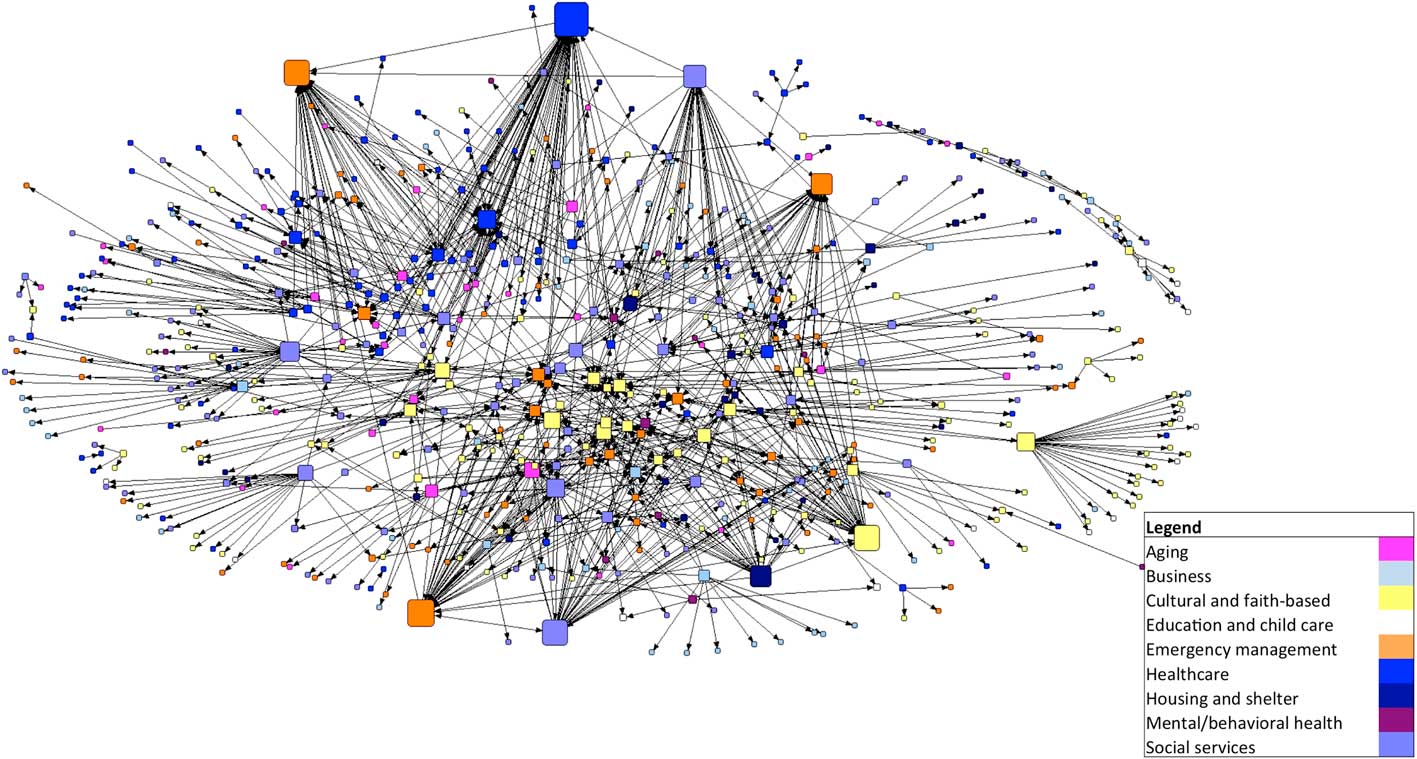
Of the 369 organizations participating in the survey, 169 reported a combined 788 ties with other organizations. As shown in Figure 1, organizations from the healthcare, emergency management, and cultural and faith-based sectors were the most central to the network, and they acted as bridges connecting large numbers of organizations from within their respective sectors. Organizations from these sectors appear in Figure 1 as the largest nodes and have the greatest numbers of ties to other organizations. Organizations most commonly worked together as part of a larger partnership to rebuild their community (29%), and 6% of these tied organizations communicated on a daily basis.
Recovery Network of Community-Based Organizations.

In our data, we found that the intensity of tie formation immediately after the storm was relatively high: 128 ties were reportedly formed in the month after the storm, compared with 533 ties that existed before the storm, or 186 that formed in the 2-6 months after the storm. Our analysis comparing the rates of tie formation (using a Poisson regression with an offset term to account for different lengths of time and random effects for responding organization), we found that the rate of tie formation in the first month was significantly higher than in months 2-6 (P<0.0001). It is not possible to quantify the rate of tie formation in the pre-storm period and the most recent period since there is no fixed interval over which the ties could have been formed.
However, we also found that the ties made during the storm response were less durable (Table 2). Just 34% of ties formed in the first month were still regularly active, compared to 60%–67% of ties formed in other periods. A logistic regression model with random effects for the reporting CBO found that ties formed in the month after the storm were less likely to remain active than those formed before the storm (P<0.0001). This is also the case for ties formed in months 2-6 (P=0.008).
Ties Formed at Each Time Period and the Extent to Which Ties Formed Were Maintained

Note: A tie is defined as a partnership between 2 organizations.
*Analysis comparing tie durability at these time points with pre-storm tie durability found significant differences P<0.05.
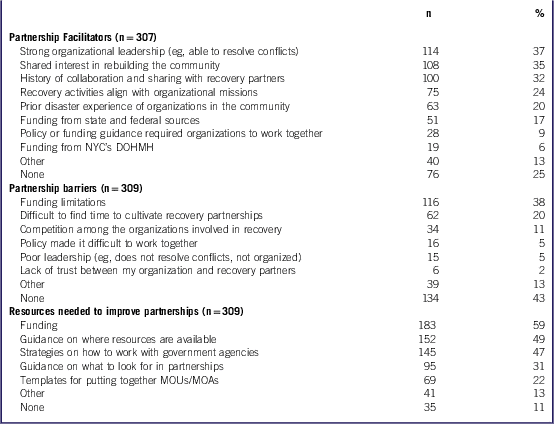
The most widely endorsed partnership facilitators were strong organizational leadership (eg, able to resolve conflicts), a history of collaboration among partners and shared interest in rebuilding the community. Interestingly, funding was among the least endorsed facilitators, but organizations endorsed funding as the greatest barrier to building partnerships, along with difficulty in finding time to cultivate recovery partnerships. Although many organizations indicated that there were no barriers to building recovery partnerships, funding was identified as the most needed resource (Table 3).
Facilitators, Barriers, and Resources Needed to Improve Recovery Partnerships

Abbreviations: DOHMH, Department of Health and Mental Hygiene, Office of Emergency Preparedness and Response; MOUs/MOAs, memorandums of understanding or agreement.
Influence of Storm Damage on Partnerships
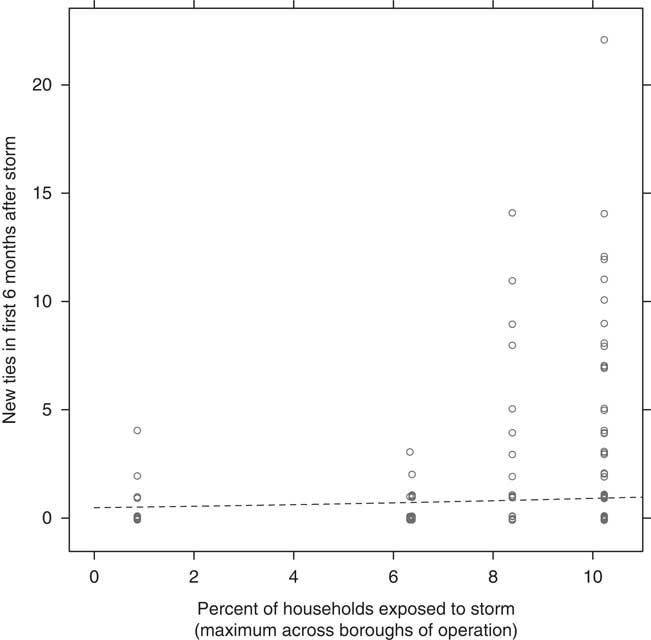
We analyzed rates of tie formation as a function of the severity of storm damage in the boroughs in which CBOs operated and found evidence that CBOs operating in the most-affected boroughs had a higher rate of tie formation than those working only in less impacted areas. In our primary model—which described the number of new ties formed in the 6 months following the storm as a function of the maximum damage measure in the boroughs where CBOs provided services (Figure 2)—we estimated that the log number of new ties increased by 0.065 (P=0.027) for each percent in our disaster damage scale; this corresponds to an incidence rate ratio (IRR) of 1.07. The estimate and statistical significance of this association is stronger when specifying damage in the model as a mean (rather than maximum) across boroughs. The estimate is nearly unchanged when we control for the logarithm of the reported number of pre-storm ties (IRR=1.07; P=0.037).
New Ties Reported in First 6 Months of Recovery, As a Function of the Percent of Households Exposed to Storm Damage, Taken as a Maximum Across Boroughs Where Each Organization Operates. Note: Counts are jittered to reduce overplotting.

Impact on Recovery
We found a strong, positive association between the organization’s number of connections and the number of types of impact that an organization and its partners could achieve. In our model, we estimated the log odds of each type of impact to be 0.074 higher for each additional degree (P<0.00001). In terms of the fitted values, we estimated that an organization with zero connections would be expected to have 1.7 types of impact, an organization with 5 connections would be expected to have 2.3 types of impact, and an organization with 10 connections would be expected to have 3.2 types of impact.
In a similar investigation, we were not able to detect a difference in the number of impact types for CBOs that worked with DOHMH, but we did find that CBOs that take part in a long-term recovery committee reported more types of impact (5.1 types versus 1.8 for an organization that is not part of such a committee, P<0.00001). When asked about the importance of key relationships to promoting community recovery, 35% reported that a relationship with DOHMH would not contribute to their ability to impact recovery, which corresponded with their self-reported data. However, 40% reported that membership in a long-term recovery committee would not contribute to their ability to impact recovery. Our analysis found this did not correspond with their self-reported data.
Discussion
The research shows that CBOs working as part of larger partnerships with DOHMH or long-term recovery committees provided a number of critical services to support public health post-disaster including health, home care, housing, mental health, and social services among others, despite the fact that disaster recovery was not part of many organizations’ missions. Many services that CBOs provided during recovery persisted well beyond the initial disaster response and short-term recovery. In addition, the investment of CBOs in disaster recovery is long term: Many CBOs were providing services 2 years after the storm and the majority were planning to continue in the coming year.
The critical role of CBOs (even those without a specific disaster focus) during disaster response and recovery over the longer-term underscores the importance of helping a broad array of CBOs with both continuity of operations planning (COOP) and recovery planning prior to disaster. Having these organizational-level plans in place could ensure that these CBOs are able to maintain their financial viability while providing the critical immediate and sustained services needed for a community to rebound after a disaster or emergency.
The Assistant Secretary for Preparedness and Response’s Technical Resources, Assistance Center, and Information Exchange (TRACIE) houses resources for healthcare organizations and other CBOs to engage in COOP and recovery planning. 23 Future studies may want to assess which components of pre-disaster COOP and recovery planning are most effective in helping CBOs better leverage their resources post-disaster for recovery and whether CBOs have the capacity and capabilities to take advantage of TRACIE and other available planning resources. Given the critical role of these CBOs, particularly in delivering medical care (in and out of the home), health departments should take a more active role in supporting or enhancing CBOs COOP and recovery planning efforts through training and technical assistance.
Past research has suggested that standing agreements be pre-established with CBOs to provide services during disaster response and recovery.Reference Glik, Eisenman and Donatello 21 The intent is to clearly identify roles and responsibilities for CBOs and diminish the lags in financial reimbursement that can challenge CBOs’ financial viability. However, this study found that during recovery, CBOs expanded the scope of their services beyond the core services they offer during non-disaster times to meet the needs of the community. Health departments and emergency planners need to recognize and allow for this flexibility in their planning and preparedness exercises. Additionally, policies such as the Stafford Act that govern recovery financing need to be amended to allow for flexible MOAs and MOUs between health departments, emergency management, and CBOs for key direct services.
Our findings also suggested that ties made during a disaster response are less durable, which underscores the importance of getting these partnerships in place early through pre-established, yet flexible, agreements. Similarly, the National Health Security Strategy and National Disaster Recovery Framework need accompanying implementation guidance for LHDs and emergency planners about how best to pre-identify key CBO partners given their emergent roles (ie, many CBOs provided recovery services despite not having disaster in their mission because their community was in need) and agility to adjust their service scope (ie, many CBOs provided outside their non-disaster scope of work). Future studies should also explore whether tie formation and dissolution patterns identified in this study are consistent across disasters and why the dissolution occurs, since it was unclear from the present study whether ties dissolved because not all relationships needed to be maintained or because they were too burdensome to CBOs.
CBOs that were more connected to other CBOs reported greater impacts on their community, as did CBOs that were part of a long-term recovery committee. CBO networks may be integral when CBOs exceed their resources (or cannot disperse resources efficiently) and need to rely on their network to share some of the burden. Although this analysis says nothing about the quality or amount of services, it does suggest that more connected organizations tend to be able to connect clients to a greater range of services. This finding underscores the importance of establishing strong CBO networks prior to a disaster and of having a well-coordinated long-term recovery committee (or similar structure for CBO coordination post-disaster). The National Disaster Recovery Framework acknowledges the long-term recovery group as one type of coordinating structure, and in 2016 the National Voluntary Organizations Active in Disaster released a nuts-and-bolts guide for how to establish a long-term recovery group. More research is needed to inform the current guidance and continue to enhance this important partnership structure and maintain its durability throughout long-term recovery. There were a handful of key CBOs that acted as bridges to many other CBOs (ie, largest nodes in Figure 1). These bridging organizations should be identified and targeted by LHDs and emergency planners for inclusion in their planning efforts and as a potential communication conduit to their network.
More than a third of CBO respondents did not perceive either their relationship with a long-term recovery committee or their relationship with the DOHMH as critical to promoting community recovery. More research is needed to better understand why these gaps exist and what can be done to better communicate the importance of these partnerships. While partnership with DOHMH was not associated with greater reported community recovery impacts, DOHMH did serve an important role in bringing these organizations together, even loosely through their Advanced Warning System and C2RP. Further examining the role of government, and health departments in particular, as a connector or convener promoting CBOs partnerships could be important, as organizations with more connections reported greater recovery impacts.
Conclusions
This study begins to quantify the important contributions that CBO partnerships make to disaster recovery operations—a critical step to informing a whole community approach to disasters. Formal policies to support integrating CBOs into the National Health Security Strategy and the National Disaster Recover Framework are emerging. However, they have several weaknesses: these policies are limited to a listing of types of partner organizations and possible roles, offer limited guidance on how CBOs should coordinate with one another and with government prior to and during the longer-term recovery phases of a disaster (eg, MOAs), and are not informed by empirical research demonstrating how CBOs roles and responsibilities vary across phases of the disaster. As shown in this study, CBOs are flexible in their scope of services, emergent based on community needs, invested in addressing long-term needs, and becoming more formalized through models such as the long-term recovery committee. Understanding the dynamic and emergent nature of these partnerships and their contributions, and recognizing the long-term recovery committee as a promising partnership model, are important to informing implementation and updates to these policies.
Acknowledgment
We would like to acknowledge the Assistant Secretary of Preparedness and Response at the US Department of Health and Human Services for funding to support the study.