Introduction
Malignant, benign and hormonal disease of the thyroid is common, affecting up to 11 per cent of the general population in Western society.Reference Canaris, Manowitz, Mayor and Ridgway1 Subsequently, thyroidectomy is one of the commonest and safest operations in general surgery. There are many indications for total or subtotal thyroidectomy, including multinodular goitre, compressive symptoms, malignancy, Graves’ disease and retrosternal extension.
Despite the frequency of the operation, thyroid surgery remains technically demanding, with a prominent side-effect profile. Post-operative haematoma is a potentially life-threatening complication because of the risk of upper airway compromise. Advances in operative technique and haemostatic devices have aimed to reduce operative time, cost and the risk of such complications. Following these advancements, the incidence of post-thyroidectomy haematoma has decreased to around 0–6.5 per cent in larger series.Reference Godballe, Madsen, Pedersen, Sorensen, Pedersen and Frisch2–Reference Promberger, Ott, Kober, Koppitsch, Seemann and Freissmuth12 Few risk factors have been identified for post-operative bleeding in recent literature.
Over the last decade, there has been an emphasis on performing ‘same-day’ or ‘out-patient’ thyroidectomy in order to reduce costs associated with this procedure.Reference Snyder, Hamid, Roberson, Rai, Bossen and Luh13, Reference Inabnet, Shifrin, Ahmed and Sinha14 Among other factors, the risk of post-operative bleeding has limited the widespread acceptance of out-patient thyroidectomy.Reference Leyre, Desurmont, Lacoste, Odasso, Bouche and Beaulieu10
The current study aimed to report the current rates of post-operative haematoma following thyroidectomy in a metropolitan teaching hospital, and to identify potential risk factors for the development of such a complication. The identification of risk factors may assist in identifying ‘high-risk’ patients who are unsuitable for out-patient thyroidectomy.
Materials and methods
Study methodology
Institutional ethics approval was obtained. Patients undergoing thyroid surgery at our institution between January 2007 and March 2012 were included in the study. The study was performed at a metropolitan teaching hospital in Melbourne, Australia. The operative procedures were performed by consultants and senior surgical trainees; operative techniques varied according to surgeon preference. The patient base of the surgical unit represents a low socio-economic and culturally diverse community, with a high rate of medical co-morbidities.
Patients undergoing subtotal or total thyroidectomy with or without neck dissection were included in the study. Patients were excluded if surgery did not include resection of thyroid tissue, including isolated parathyroidectomy.
Data were collected retrospectively from medical records. Patient demographics, including age, gender, body mass index (BMI), co-morbidities and current anticoagulation therapy, were documented. Pre-operative laboratory results, including thyroid-stimulating hormone (TSH) level, platelet count and international normalised ratio, were collected as appropriate. Surgical technique was determined from operative reports; data documented included operative time, operator experience, extent of resection (partial, unilateral, bilateral and lymph node dissection), haemostasis technique and use of Surgicel® (haemostatic agent). The primary operator was determined by reviewing the documentation on the operative report. Pathological outcome data included thyroid specimen weight and histopathology.
Post-operative blood pressure, drain output, haematoma and re-operation details were noted. Post-operative bleeding was defined as: bleeding at the surgical site in the post-operative period, as confirmed by radiological imaging; or bleeding that required either emergency evacuation of haematoma because of airway compromise or a return to the operating theatre. A post-operative hypertensive period was considered significant if a single value of 180 mmHg or greater was measured within the first 4 hours post-operatively. Blood pressure was measured post-operatively as per the hospital protocol: every 5 minutes for the first 30 minutes, then every 10 minutes until arrival onto the surgical ward, and hourly thereafter.
Surgical technique
Surgical techniques and protocols were performed in keeping with current literature. Pre-operatively, patients were instructed to cease antiplatelet therapy, including aspirin or clopidogrel, 7–10 days prior to surgery. Patients on anti-thrombotic agents, such as warfarin, were covered with therapeutic doses of low-molecular-weight heparin from 7 days pre-operatively. Low-molecular-weight heparin agents were withheld 12 hours pre-operatively and recommenced 12 hours post-operatively.
Thyroidectomy was performed under general anaesthetic. A midline vertical incision exposed the strap muscles, which were separated and retracted laterally. Mobilisation of the appropriate hemi-thyroid or total thyroid was performed. Identification and preservation of the recurrent laryngeal nerves and parathyroid glands was performed routinely.
Ligation and haemostasis techniques varied between operating surgeons. These included ligation clips, sutures, or haemostatic devices such as Ligasure (Valleylab, Boulder, Colorado, USA) or the Harmonic scalpel (Ethicon, Cincinnati, Ohio, USA). Valsalva or Trendelenburg manoeuvres were used selectively, depending on individual surgeon preference. Surgicel and post-operative drains were used selectively upon clinical discretion.
Statistical analysis
Data were collated using Excel 2003 spreadsheet software (Microsoft, Redmond, Washington, USA). Statistical analysis was completed using SPSS statistical software, version 20 (SPSS, Chicago, Illinois, USA). All parametric data were expressed as means and standard deviations (SDs), and non-parametric data were expressed as medians and interquartile ranges unless otherwise specified. Continuous variables, including age, BMI, TSH level, international normalised ratio, operative time and drain output, were tested for distribution. Age and BMI were deemed parametric, while TSH, international normalised ratio, operative time and drain output were deemed to be non-parametric. The Mann–Whitney U test was used for comparing continuous variables. Univariate and multivariate analyses were used to determine risk factors for post-operative complications. Two-sided p < 0.05 was considered statistically significant.
Results
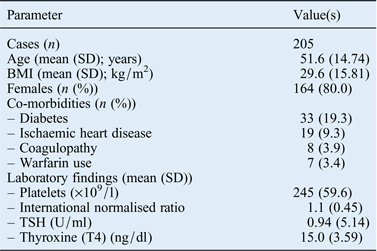
In all, 206 cases were identified for analysis over the specified study period. One patient was excluded as surgery consisted of isolated laryngectomy for laryngeal malignancy. Thus, data for 205 thyroidectomies performed on 184 patients between January 2007 and March 2012 were included for analysis. Mean patient age was 51.6 years (SD = 14.74), 147 cases (80 per cent) were female and mean BMI was 29.3 kg/m2 (SD = 15.81). Patient demographics, relevant co-morbidities and pre-operative laboratory findings are summarised in Table I.
Patient demographics, co-morbidities and pre-operative findings

SD = standard deviation; BMI = body mass index; TSH = thyroid-stimulating hormone
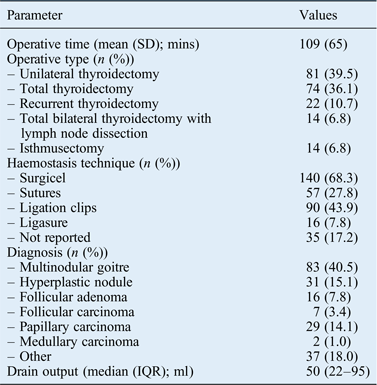
Median operative time was 109 minutes (interquartile range, 70–125 minutes). Total thyroidectomy, including completion thyroidectomy, was performed in 74 of the 205 cases (36.1 per cent). The remainder of procedures included unilateral thyroidectomy, total thyroidectomy with lymph node dissection, isthmusectomy, and thyroid nodule removal. Intra-operatively, laryngeal nerves were identified routinely, and nerve stimulation was performed in 31 cases (15.1 per cent). With respect to haemostasis, operators utilised: ligation clips (90 cases, 43.9 per cent), Ligasure (16 cases, 7.8 per cent) and sutures (57 cases, 27.8 per cent). Surgicel was used in 140 cases (68.3 per cent).
On pathological assessment, the most common diagnosis was multinodular goitre (83 cases, 40.5 per cent), followed by Hürthle cell adenoma (31 cases, 15.1 per cent), follicular adenoma (16 cases, 7.8 per cent) and Hashimoto's thyroiditis (16 cases, 7.8 per cent). Operative details and pathological diagnoses are outlined in Table II.
Operative details and pathological diagnoses
SD = standard deviation; mins = minutes; IQR = interquartile range
Post-operative bleeding occurred in nine patients (4.4 per cent), six of whom required further invasive intervention. All returns to the operating theatre occurred within 6 hours post-operatively. The source of bleeding was identified in all cases, with bleeding deep to the strap muscles identified in five cases. One additional patient underwent needle aspiration in the ward setting and no further intervention was required. The remaining two patients were diagnosed with post-operative wound hematoma on the basis of ultrasonographic evidence. These patients were managed conservatively given the location of the haematoma (isolated superficial to the infrahyoid muscle) or the low volume of the haematoma.
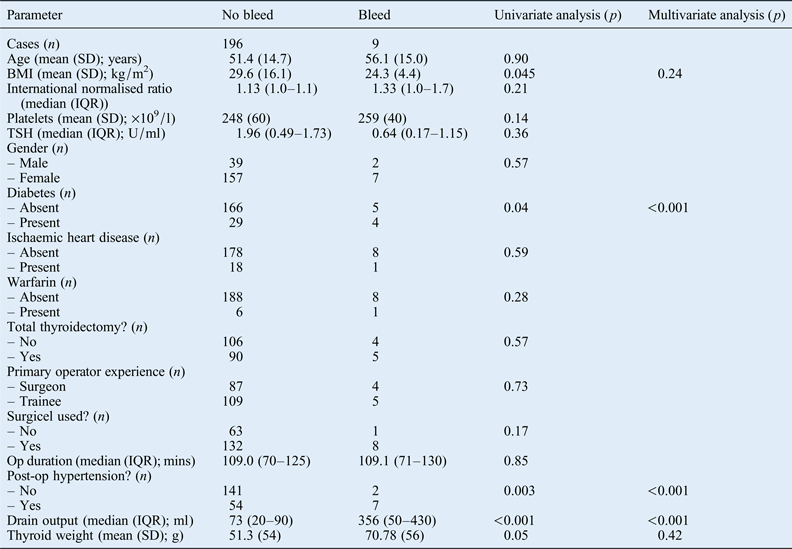
Univariate analysis identified the following factors as being predictive of post-operative bleeding: BMI, co-morbid diabetes, thyroid specimen weight, post-operative drain output and post-operative hypertension episodes (Table III). However, on multivariate analysis, only presence of diabetes, post-operative drain output and post-operative hypertension remained statistically significant (p < 0.001).
Identified risk factors for post-operative bleeding
SD = standard deviation; BMI = body mass index; IQR = interquartile range; TSH = thyroid-stimulating hormone; op = operation; mins = minutes
Discussion
Thyroidectomy is one of the most commonly performed surgical procedures in modern general surgery. Despite increased safety over the last few decades, several post-operative complications may occur, including hypoparathyroidism and recurrent laryngeal nerve palsy.Reference Lang, Yih and Lo15–Reference Chan, Lang and Lo17 Among these, post-operative haemorrhage presents as a medical emergency because of the risk of major airway compromise. The current study examined this complication in a contemporary series of patients who underwent thyroidectomy in a metropolitan teaching hospital in Australia. Our study findings suggest that post-operative bleeding remains an infrequent early complication, and that diabetes, greater post-operative drain output and post-operative hypertension increase this risk.
The highly vascular nature of the thyroid gland means that meticulous haemostasis is crucial in the prevention of this significant complication. Developments in surgical techniques and additions to equipment have been introduced with the aim of reducing this adverse event. New technologies employ ultrasonic coagulation (Harmonic scalpel; Ethicon) or bipolar energy (Ligasure; Valleylab), the use of which is currently common practice during thyroidectomy. These technologies have been extensively studied, and have been shown to reduce operating time and operating costs.Reference Lang, Ng, Lau, Cowling and Wong18–Reference Parker, Krupa, Esler, Vujovic and Bennett20 Given the relative infrequency of complications, all studies to date that have examined the risk of post-thyroidectomy haematoma using the various devices have been underpowered.Reference Canaris, Manowitz, Mayor and Ridgway1, Reference Ozlem, Ozdogan, Gurer, Gomceli and Aydin8, Reference Chang, O'Neill, Suliburk, Sidhu, Delbridge and Sywak21 Other developments to intra-operative procedures assist in the identification of bleeding vessels, such as a Trendelenburg tilt or a 30-second Valsalva manoeuvre.Reference Moumoulidis, Martinez Del Pero, Brennan and Jani22
In the era of these advances, recent literature suggests an incidence of post-operative haematoma ranging from 0 to 6.5 per cent;Reference Godballe, Madsen, Pedersen, Sorensen, Pedersen and Frisch2–Reference Promberger, Ott, Kober, Koppitsch, Seemann and Freissmuth12 however, in larger series these rates are much lower, at 0.3–1.2 per cent. Several local series have published data on rates of haematoma in Australian populations, with rates ranging between 0.9 and 3.5 per cent.Reference Vasica, O'Neill, Sidhu, Sywak, Reeve and Delbridge23–Reference Serpell and Phan25 However, the definition of post-operative haemorrhage lacked consistency. Several papers (with a similar sample size to our study) defined post-operative bleeding as an unplanned return to the operating theatre for evacuation of haematoma, which is comparable to the current study. The current study represents contemporary rates of haematoma in a metropolitan teaching centre, where the level of operator experience is variable.
Despite declines in the rate of haematoma, renewed interest in the literature examining this complication has been observed in the context of safety of out-patient or same-day thyroidectomy.Reference Snyder, Hamid, Roberson, Rai, Bossen and Luh13 Recent series have illustrated the potential role of out-patient thyroidectomy, particularly in the USA.Reference Snyder, Hamid, Roberson, Rai, Bossen and Luh13, Reference Inabnet, Shifrin, Ahmed and Sinha14 It is recognised that other conditions which occur in the post-operative period, such as urinary retention or hypocalcaemia, may favour a longer post-operative period of monitoring. Fortunately, these complications are not typically life-threatening, and may be limited by the administration of appropriate supplementation. Given the potential sequelae, post-operative bleeding is one of the limiting factors that preclude early discharge.
Bleeding generally presents within 6 hours post-operatively;Reference Burkey, van Heerden, Thompson, Grant, Schleck and Farley9, Reference Promberger, Ott, Kober, Koppitsch, Seemann and Freissmuth12, Reference Lang, Yih and Lo15 thus, proponents of out-patient or same-day thyroidectomy recommend monitoring for 6 hours post-operatively prior to discharge. Such reports are consistent with the findings of the current study, with all episodes of haemorrhage occurring within 6 hours post-operatively. Conversely, Schwartz et al. proposed that increasing the duration of minimum post-operative monitoring time from 6 to 24 hours would save 94 haematoma-related deaths per 100 000.Reference Schwartz, Clark, Ituarte and Lo Gerfo26 Lang et al. reported high levels of potential haematoma-related mortality during this period, of 194 deaths per 100 000.Reference Lang, Yih and Lo15 The aforementioned studies proposed the selective use of out-patient thyroidectomy in low-risk cases to prevent haematoma-related deaths.
Investigations attempting to identify clear risk factors for post-operative bleeding and resulting ‘high-risk’ thyroidectomy are sparse. Previous studies have identified older age, male gender and thyroid malignancy as potential risk factors.Reference Godballe, Madsen, Pedersen, Sorensen, Pedersen and Frisch2, Reference Bergenfelz, Jansson, Kristoffersson, Martensson, Reihner and Wallin3, Reference Rosato, Avenia, Bernante, De Palma, Gulino and Nasi5, Reference Burkey, van Heerden, Thompson, Grant, Schleck and Farley9, Reference Leyre, Desurmont, Lacoste, Odasso, Bouche and Beaulieu10, Reference Promberger, Ott, Kober, Koppitsch, Seemann and Freissmuth12, Reference Zambudio, Rodriguez, Riquelme, Soria, Canteras and Parrilla27, Reference Rosenbaum, Haridas and McHenry28 Operator experience has not been consistently shown to decrease complications rates.Reference Emre, Cakmak, Tascilar, Ucan, Irkorucu and Karakaya29, Reference Sosa, Mehta, Wang, Boudourakis and Roman30 Furthermore, previous studies have reported identical post-operative bleeding rates for consultants and trainees.Reference Sosa, Mehta, Wang, Boudourakis and Roman30–Reference Martin, Delbridge, Martin, Poole, Crummer and Reeve32 These findings are reflected in the current study. Lang et al. reported an increased risk of bleeding following thyroidectomy for larger nodules, postulating a causation of both a larger dissection of raw surfaces and a larger volume of potential dead space.Reference Lang, Yih and Lo15 Promberger et al. illustrated an increased risk in patients undergoing total thyroidectomy compared to unilateral thyroidectomy.Reference Promberger, Ott, Kober, Koppitsch, Seemann and Freissmuth12 This finding has been inconclusive in previous literature,Reference Rosato, Avenia, Bernante, De Palma, Gulino and Nasi5, Reference Agarwal and Mishra33, Reference Flynn, Lyons, Tarter and Ragsdale34 and was not a significant risk factor in the current study.
On multivariate analysis, a single episode of hypertension in the early post-operative period was a significant risk factor for post-operative bleeding. Similar findings have been reported sporadically in the literature. Morton et al. reported an increased risk of bleeding with hypertension, defined as systolic blood pressure greater than 150 mmHg in the pre- or post-operative period.Reference Morton, Mak, Moss, Ahmad and Sevao35 Similarly, excessive coughing or vomiting on reversal of anaesthesia has been identified as a risk.Reference Matory and Spiro36, Reference Harding, Sebag, Sierra, Palazzo and Henry37 These changes, along with excessive pain, have been postulated to transiently increase systemic blood pressure. Conversely, Burkey et al. did not identify post-operative blood pressure as a risk factor for bleeding.Reference Burkey, van Heerden, Thompson, Grant, Schleck and Farley9 However, these findings are not directly comparable: Burkey et al. used a threshold of 170 mmHg systolic blood pressure, whereas the current study used a threshold of 180 mmHg.
Diabetes was also shown to be associated with an increased bleeding risk in the current study. Few previous studies have specifically evaluated the link between post-operative haematoma and diabetes, which makes comparison difficult. An impaired inflammatory response may contribute negatively to vasoconstriction and clot formation, which are important in early haemostasis. Additionally, the presence of diabetes may increase thyroid growth and vascularity, thus contributing to more difficult and extensive dissections. However, thyroid weight was not evaluated specifically in diabetic patients and was not found to be significant on multivariate analysis. Further investigation into the relationship between diabetes and pre-operative control of the disease with haematoma rates after thyroid surgery may be warranted.
• Post-operative haematoma precludes the widespread use of out-patient thyroidectomy
• Post-thyroidectomy bleeding is a significant, life-threatening complication
• Contemporary literature on risk factors for post-operative haemorrhage is sparse
• Loco-regional rates of post-thyroidectomy haematoma are 0.9–3.5 per cent, equivalent to our low-volume teaching hospital rate of 4.4 per cent
• The study results indicate that post-operative hypertension increases the post-operative bleeding risk
• Meticulous blood pressure control may reduce haemorrhage risk
There are several limitations to the current study. The study was subject to the limitations inherent to retrospective data collection. The current study involved a small cohort, and increased patient numbers would be beneficial. Accurate extraction of operative data (such as primary surgeon, operative techniques and post-operative variables) was reliant on meticulous documentation. Further, surgical technique and the instrumentation utilised varied with surgeon preference, which makes comparison of these variables difficult. However, such variability in operator experience and the techniques utilised provides a database that may be directly applicable to major metropolitan teaching hospitals globally. The retrospective nature of the study means that post-operative hypertension cannot be definitively confirmed as a risk factor for bleeding; further research into this issue is required.
Conclusion
The current study, conducted in a metropolitan teaching hospital, illustrates that post-operative bleeding rates remain a relatively infrequent complication. Despite this, the dire consequences of post-operative bleeding limit the widespread adoption of out-patient thyroidectomy. Co-morbid diabetes, post-operative hypertension and high post-operative drain output were identified as independent risk factors on multivariate analysis. As such, we recommend the use of post-operative drains and prudent control of blood pressure in the early post-operative period.