Introduction
In many developing countries, corruption stymies growth and undermines public goods provision. Yet while some corruption scandals yield widespread protests, in other cases there is little visible outrage from citizens. Interventions that aim to increase citizens’ demands for accountability by providing information on government performance – including corruption – have had little success (Dunning et al. Reference Dunning, Grossman, Humphreys, Hyde, McIntosh and Nellis2019). This suggests the need to better understand how citizens evaluate corruption: what determines when a corruption scandal is viewed as sufficiently serious or severe that citizens are willing to vote, protest, or take other actions to punish the officials involved?
Early work on corruption focused on explaining the perceived frequency of corruption (Olken Reference Olken2009) or overall levels of corruption across countries (Fisman and Miguel Reference Fisman and Miguel2007; Serra Reference Serra2006). More recent work suggests that citizens may not care about corruption if leaders are otherwise effective, or if corruption creates positive externalities for citizens (Cheeseman Reference Cheeseman2015; Fernández-Vázquez, Barberá, and Rivero Reference Fernández-Vázquez, Barberá and Rivero2016). However, with the exception of Truex (Reference Truex2011), there is little work on which forms of corruption citizens might view as more or less deserving of punishment.
This paper uses a forced-choice conjoint survey experiment, conducted in Uganda, to provide new evidence on what drives perceived severity of one common form of corruption: embezzlement. In the experiment, respondents are shown pairs of hypothetical government officials accused of embezzling government funds; they rate the severity of each official’s offense and decide which individual they would most like to see punished. Each official has five randomly varied attributes concerning his role in government (elected or appointed, and part of national or local government), the source of stolen funds (taxes or windfalls), and the spending implications of the theft (the budget sector affected, and how stolen funds were spent). For most of the attributes, previous theory generates competing predictions regarding how each attribute will affect severity perceptions.
I find that revenue source and the spending implications of theft are most important in shaping perceptions of severity. Theft of tax funds (rather than aid or intergovernmental transfers) is viewed especially severely, as is theft of funds from public goods such as health care. Citizens view theft more severely when the corrupt official spends the money on himself, rather than recirculating funds through patronage or clientelism. The official’s role in government – including whether he is elected and the level of government he serves – is less important. The results suggest that interventions to increase citizen engagement may be more effective if they focus on sectors or funding types that citizens care most about. They also suggest that politicians have incentives to strategically allocate corruption to sectors that citizens care less about, or to use patronage or clientelism to reduce citizen anger at corruption.
Theory
Citizens may anticipate either economic or psychological benefits from punishing corruption. Economic benefits include lower corruption in future periods, either by incentivizing honest behavior or by replacing corrupt officials with honest ones. Economic benefits will be lower if citizens themselves benefit from corruption and its side effects, or if they believe that the corrupt official is more likely to implement preferred policies than a potential replacement (Anduiza, Gallego, and Muñoz Reference Anduiza, Gallego and Muñoz2013; Fernández-Vázquez, Barberá, and Rivero Reference Fernández-Vázquez, Barberá and Rivero2016). Psychological benefits have been documented in many settings; punishment has been shown to relieve negative emotions generated by norms violations (Fehr and Gachter Reference Fehr and Gachter2000). In general, we should therefore expect citizens to be more willing to punish corruption when it has a stronger negative effect on their personal well-being, and when it violates citizens’ norms about appropriate behavior.
Recent work suggests that citizens evaluate government performance not in absolute terms but relative to expectations, and that increasing expectations increases willingness to punish poor performance (Gottlieb Reference Gottlieb2016). If citizens have high expectations of an official – for example, if they believe that he is honest or will provide public goods efficiently – then a corruption scandal will violate those expectations. This, in turn, can increase dissatisfaction with performance, leading to higher willingness to punish. If, in contrast, a citizen has low expectations and views corruption as inevitable, a corruption scandal simply confirms their expectations and may not lead citizens to punish leader behavior. This is in line with work in psychology that willingness to engage in costly punishments is increasing in the size of perceived norms violations (Fehr and Schmidt Reference Fehr and Schmidt1999) – such a violation creates stronger negative emotions, effectively increasing the psychological (expressive) benefits of punishing that wrongdoing. Thus, on average, we should also expect citizens to be more willing to punish corruption involving types of officials of whom they have high expectations, as it can increase the expressive benefits of punishment.
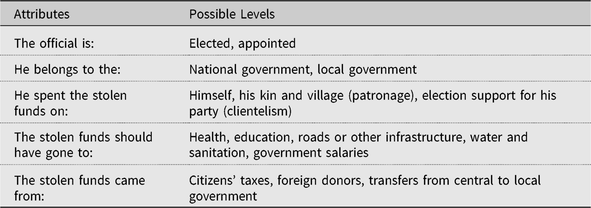
To choose the attributes for the conjoint experiment, I considered the information that citizens typically have access to during a corruption scandal. These include the corrupt official’s position in government, the source of stolen funds, and the spending implications of the theft. Another potential attribute would be the amount of funds stolen; I omitted this due to concerns that it could overwhelm the rest of the attributes. The rest of this section develops these information sources into the five attributes that were included in the conjoint experiment, discussing how each might affect perceived corruption severity. Table 1 describes all attributes and levels included in the experiment.
Attributes and Levels for Conjoint Survey Experiment

Position in government
Two pieces of information that could influence perceived corruption severity are whether the official is an elected politician or a bureaucrat, and whether she is part of central or local government.
Elected versus appointed officials
Responsibility for budgeting and spending is often split between elected officials and appointed bureaucrats, both of whom can steal government funds.Footnote 1 While elections increase citizens’ ability to remove a corrupt leader, it is less clear whether elections should also affect severity perceptions. If campaigns increase citizens’ expectations of politicians, elected officials may be viewed more severely when they are found to be dishonest; this is in line with work arguing that campaign promises can set expectations (Aragonès, Postlewaite, and Palfrey Reference Aragonès, Postlewaite and Palfrey2007). However, in low-income democracies like Uganda bureaucrats may have more de facto power than poorly trained politicians (Raffler Reference Raffler2016); this might lead citizens to expect more from bureaucrats and thus be more upset when they steal. There are therefore not only reasons citizens might view corrupt elected officials more severely, but also reasons to expect attributes of low-capacity democracies to attenuate these effects.
Local versus national officials
In a decentralized system like Uganda, both central and local government officials are responsible for providing public goods and services. Theories that decentralization can improve accountability, in part because local spending is often highly visible, suggest that citizens may be more willing to punish local malfeasance (Fisman and Gatti Reference Fisman and Gatti2000; Shah, Thompson, and Zou Reference Shah, Thompson and Zou2004). However, national budgets are typically much larger than local budgets, and central government officials are often higher capacity than their local counterparts – both of these characteristics could raise expectations and make citizens view central government corruption more severely. This is line with arguments that decentralization can actually increase corruption in low-capacity states (see, e.g., Treisman Reference Treisman2007). It is thus an empirical question which of these factors will prevail.
Source of stolen funds
Beyond a corrupt official’s role in government, citizens may have information about the original source of stolen funds. Both subnational and national governments in low-income countries like Uganda are typically funded by a mix of domestic taxes and foreign aid.Footnote 2 Local governments may also receive significant central transfers; these can be embezzled by national officials before disbursement or by local officials following disbursement.
Theories of taxation and accountability suggest that taxed citizens will be more likely to hold government officials accountable (Martin Reference Martin2016; Paler Reference Paler2013), implying that theft of tax funds should be viewed more severely than theft of aid funds. Perceptions of corruption involving central transfers will depend on whether they are viewed as more like aid or taxes. If citizens believe that transfers are mostly tax-based, their theft will be viewed more severely than if they are perceived as mostly donor funds. However, the nature of central transfers may obscure their origin, making them appear to be windfalls (Gervasoni Reference Gervasoni2010; Oates Reference Oates1999; Tanzi Reference Tanzi, Bruno and Pleskovic1996).
Spending implications
Embezzlement has two spending implications: it lowers expenditures in the sector from which funds were stolen, but increases the funds available to the corrupt official.
Budget allocations
Corruption scandals are often framed by the media in terms of the budget sector from which funds were stolen. One natural distinction is between money allocated to public goods and money allocated to administrative salaries. In developing countries like Uganda, bureaucratic payrolls are often bloated and contain ghost workers; stealing funds from this sector may therefore be seen as having few negative consequences. In contrast, theft from public goods may be viewed severely by those who rely on those services. However, to the extent that revenues are fungible, a purely rational citizen will not consider the sector of allocation, but rather consider how money could best have been spent. It is therefore unclear whether budget sector should affect corruption severity. The experiment considers five possible sectors: administrative salaries, health care, education, water and sanitation, and infrastructure like roads and electricity.
How stolen funds were spent
Finally, how a corrupt official spends embezzled funds may impact perceived corruption severity. Officials can steal funds for personal gain, to provide patronage to kin or village networks, or to finance campaign spending for themselves or their party, typically through clientelism. Patronage and clientelism are unique in that they benefit citizens as well as officials; this effectively lowers the economic benefits to stopping corruption, which may reduce punishment as shown by Fernández-Vázquez, Barberá, and Rivero (Reference Fernández-Vázquez, Barberá and Rivero2016). Previous work also suggests that citizens may prefer clientelist transfers to programmatic politics (Wantchekon Reference Wantchekon2003), or may view patronage and clientelism as a legitimate form of distribution (Cheeseman Reference Cheeseman2015) or even a core function of the state (Ekeh Reference Ekeh1975). Alternatively, if citizens view clientelism and patronage as providing few benefits and undermining the state or democracy in the long run, spending the money on oneself could be viewed as the least bad outcome. Thus, the theoretical predictions are unclear.
Methodology
The discussion above suggested five attributes that could affect corruption severity; there are few clear predictions regarding how each will affect corruption perceptions. This paper uses a forced-choice conjoint experiment, conducted in Uganda, to test these competing predictions and to compare the relative strength of each attribute in determining citizens’ perceptions of corruption severity. Uganda has seen several large-scale embezzlement scandals in recent years, yet citizens’ accountability demands are uneven at best. It is also a country where corruption and accountability are frequently studied, in part because Uganda is near the median for sub-Sarahan Africa on many economic and political variables.
Uganda is also a good empirical case because all profiles generated in the conjoint experiment are feasible. Control over revenues and service provision is split between local and national officials, and between bureaucrats and politicians. While local politicians do not always have direct budgetary control, they can and do embezzle funds by colluding with contractors or bureaucrats. Bureaucrats do not directly rely on electoral clientelism, but may still embezzle funds to help their patrons in the political wing, thus securing their own future power and status. Both national and local governments rely on (and can steal) taxes and aid money. Central transfers are often stolen by national-level officials before they are transferred to local governments; money that does reach districts can also be stolen there. Both patronage and electoral clientelism are common in Uganda. This means that many types of officials have access to a range of types of funding, which they can then misuse in different ways.
The survey was run on a sample of 778 respondents in 8 districts in central and eastern Uganda in November 2013. The sample focused on three groups: motorcycle taxi drivers, shopkeepers, and vendors in agricultural markets. These groups have high collective action capacity and are frequently involved in protests. They are also wealthier and more politically engaged than average Ugandans: their incomes are at least 25% higher than the country average, they are 5 percentage points more likely to vote, and men and women are more likely to be literate by 6 and 25 percentage points, respectively (Afrobarometer Data 2015; UBOS 2017).Footnote 3 This makes their views on corruption especially salient for Ugandan politicians and reduces concerns that their views over corruption and punishment are cheap talk: they understand the costs and benefits of political engagement. The online appendix provides additional detail on the sample and sampling strategy.
All respondents completed a set of background questions and then the conjoint experiment. In the experiment, enumerators first read a statement explaining that the Ugandan government is working to fight corruption but has limited resources to prosecute wrongdoing. They then presented respondents with four different pairs of hypothetical government officials, each of whom was accused of stealing government funds. I chose to focus on two outcome measures that closely mapped onto the theoretical framework: willingness to punish and perceived severity. For each pair of corrupt officials, respondents were first asked to choose which individual they would rather see prosecuted and punished for his behavior. They were then asked to rank the severity of each official’s corruption on a 5-point severity scale.Footnote 4 I expect that respondents will be more likely to select an official for punishment and rank them more highly, as perceived corruption severity increases.Footnote 5
Each official had the five attributes outlined above; the value each took was independently and randomly assigned from the levels in Table 1.Footnote 6 To aid comprehension, enumerators used printed icons representing each attribute-level – see online appendix for examples.
Results
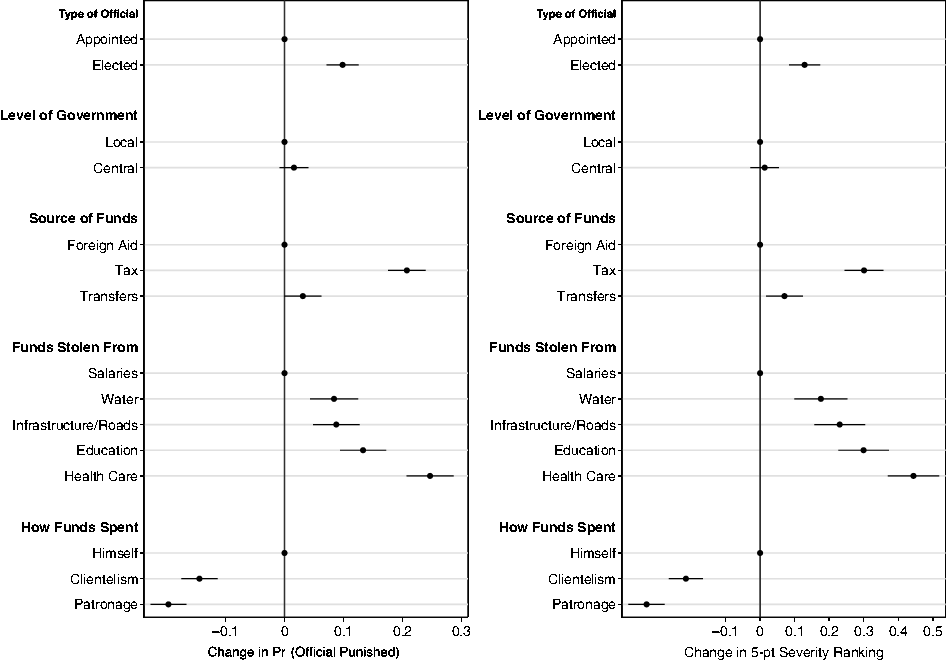
Figure 1 presents the results of the conjoint experiment. The left-hand side of the figure shows the result of an ordinary least squares (OLS) model in which an indicator for whether a profile was chosen for punishment was regressed on a set of dummies for each attribute-level, plus enumerator and town fixed effects. The unit of analysis is a single official within a profile pair. For each attribute, one level was selected as the baseline and omitted from the regression; these are represented by a dot at the zero mark. For each other attribute-level, the dot depicts the estimated marginal effect of the attribute-level on the probability a profile was selected for punishment; lines show 95% confidence intervals and standard errors are clustered by individual. The right-hand side of the figure reports the analysis for the 5-point severity ranking. See online appendix for regression tables.
Results of Conjoint Analysis. OLS Regression with Town and Enumerator Fixed Effects, SE clustered by individual.

As discussed above, there were few clear predictions regarding how each attribute should affect perceived severity. The results demonstrate that, while a corrupt official’s role in government has some impact on perceived corruption severity, the details of the corrupt act play the dominant role in shaping citizens’ corruption perceptions. Role in government does affect severity: elected officials were 9.8 percentage points more likely to be chosen for punishment than appointed officials (p = 0.000), consistent with arguments that elections increase accountability pressures from citizens. However, the magnitude of the effect is relatively small compared to other attributes. There were no significant differences in whether corruption by local or national officials is seen as more severe. Focus group discussions (see online appendix) suggest that citizens simply disagree about whether corruption by national or local officials is worse, creating a null effect on average.
The source of stolen funds has a much larger impact on corruption severity. Stealing taxes instead of aid increases the probability of punishment by 20.8 percentage points; the difference between taxes and central transfers is 17.7 percentage points. This supports the argument that taxation increases accountability pressures. It also suggests that central transfers are seen as unearned revenues, despite their large tax component.
The spending implications of theft are also a critical determinant of perceived severity. For budget sector, the main result is that officials who stole administrative salaries were on average 13.8 percentage points less likely to be punished than those who stole from any of the four sectors that produced public goods. This suggests that citizens are most likely to punish corruption that has serious implications for their own well-being. However, there is also significant variation within sectors. Theft of health care funds was 24.7 percentage points more likely to be punished than theft of salaries, compared to an 8.3 percentage point difference between theft of salaries and theft of water and sanitation funds. The results for this attribute are the most likely to vary across contexts – for example, citizens in countries with good health care systems may not prioritize health care in the same way as Ugandans, whose health system is notoriously troubled. However, the results do still suggest two generalizable findings. First, citizens do not appear to account for fungibility when they see corruption in a particular sector. Second, there is substantial variation in how citizens prioritize different sectors, and attempts to reduce corruption should take this into account.
Finally, officials who spent stolen funds on themselves were significantly more likely to be punished than those who spent the funds on clientelism or patronage. This suggests that outright theft is viewed very differently from diverting funds in a way that still channels at least some benefits to the community, even if patronage and clientelism have negative externalities for the state. Notably, clientelism is viewed as slightly worse than patronage. Focus group discussions (see online appendix) suggest that this is driven at least in part by some citizens’ concerns regarding clientelism’s long-term effects on government, although other citizens appear to view clientelism as an opportunity for economic gains. However, patronage and clientelism are viewed as severe in absolute terms: the average profile in which money was spent on clientelism (patronage) is ranked as 3.92 (4.04), corresponding to “very serious” on the 5-point scale; spending money on oneself was ranked 4.25 on average.
The right side of Figure 1 shows the results from a similar analysis in which the 5-point severity ranking is the dependent variable. The results are remarkably consistent across the two dependent variables: there are no differences in statistical significance or the relative size of the coefficients on different attribute-levels. This helps to confirm that corruption severity is linked to citizens’ desire to punish different officials, and the forced-choice results are not being driven by strategic considerations, for example, which types of officials would be easiest to punish.
A benefit of conjoint analysis is the ability to compare the relative importance of each attribute on citizens’ decisions. The results reveal that the corrupt official’s role in government matters less than the details of the crime. On average, an elected official from the central government was selected for punishment 55.8% of the time, barely more than by chance. In contrast, the probability of punishment was 75.4% for an official who stole tax funds that were allocated to health care, 61.3% for an official who spent stolen funds on himself, and 82% for an official who stole tax funds allocated to health care and spent them on himself. Respondents appear to view corruption as especially severe when it has larger economic consequences for citizens, for example, when officials divert funds from critical public goods or fail to use their gains to help others.
Robustness and additional results
Additional analysis in the online appendix shows that these results are robust to whether an official was part of the first, second, third, or fourth profile pair, whether an official was first or second within a pair, and using probit (for the binary outcome) or ordered probit (for the severity ranking). Additional survey evidence (see online appendix) shows that severity rankings in the conjoint experiment correlate with the perceived severity of a general corruption scandal, and with self-reported willingness to engage in different forms of political action, suggesting a correlation between demand for punishment in the conjoint experiment and reported willingness to engage in other forms of political action.
Another concern might be that the factors tested in the conjoint analysis interact in unexpected ways – for example, the difference between elected and appointed officials might be more (or less) pronounced at the national level relative to the local level. The online appendix reports the results of a fully saturated interaction model and finds little evidence for this; while 7 of the 39 interaction coefficients are significant at the 10% level or higher, they do not follow a discernible pattern.
Finally, the online appendix tests whether treatment effects differ across key subroups, including occupation, gender, age, income, and urbanization. If citizens have heterogeneous corruption perceptions, it will be harder for politicians to focus on prosecuting the forms of corruption that most citizens care most about. While some coefficients are significantly different for some subgroups, the differences are rarely robust or substantively significant; the most consistent result is that wealthier, more educated respondents care more strongly about theft from health care or infrastructure. Political variables are stronger predictors of corruption perceptions. Those who believe that the last elections were free and fair care more about corruption by elected officials, and care more strongly about theft of citizens’ taxes and central transfers, relative to donor funds. These citizens also show less concern with patronage and vote-buying.
Discussion
An enduring puzzle in political economy is when citizens will punish corruption by government officials. This paper argues that variation in perceived corruption severity drives willingness to punish and provides new evidence on the factors that affect corruption severity. Corruption is seen as more deserving of punishment when it affects valued public goods, when theft involves taxes rather than windfalls, and when citizens do not expect to benefit from the stolen funds through patronage or clientelism. The role of the corrupt official in government has a smaller impact on perceived severity.
While many of the findings presented here should travel to other low-income countries, there may be cross-national variation in the types of corruption that are viewed as most severe, especially for the degree to which different sectors are prioritized. However, the main implications of this paper remain. Interventions that attempt to increase citizens’ demands on government may be most effective when they target sectors or types of officials that citizens care most about, and resource-constrained governments who wish to improve citizens’ perceptions of government legitimacy may wish to focus public anti-corruption efforts on sectors that citizens value most – such as theft from tax funds, health care spending, or corruption by elected officials. These results may also be able to explain and predict patterns of corruption and misuse of funds within a government; politicians may adjust behavior to maximize corruption in areas that citizens care least about.
Future work is needed to test the extent to which there is variation both within and across countries in the factors that affect severity perceptions. Additional work is also needed to explore other attributes that might affect severity, such as the amount stolen, and to test whether citizens differentiate between officials, such as Members of Parliament or ministry officials, when more specific information is given. Future work is also needed to explore the extent to which corruption perceptions affect citizens’ willingness to engage in costly political actions.
Supplementary Material
To view supplementary material for this article, please visit https://doi.org/10.1017/XPS.2019.33