Introduction
Anxiety and depression are common mental health problems with substantial changes in their levels and prevalence during childhood and adolescence (Costello et al. Reference Costello, Egger and Angold2005; Angold & Costello, Reference Angold and Costello2006). Both clinical disorders and subclinical symptoms of anxiety and depression in childhood and adolescence are associated with concurrent and long-term psychosocial impairment and service use (Angold et al. Reference Angold, Costello, Farmer, Burns and Erkanli1999). In non-Western countries such as China, despite lower prevalence and levels, facing rapid and dramatic social changes (e.g. economic and education reform, changes in family structure) in the past decades, the prevalence and levels of child and adolescent anxiety and depression are also increasingly becoming a major public health concern (Liu et al. Reference Liu, Ma, Kurita and Tang1999; Tepper et al. Reference Tepper, Liu, Guo, Zhai, Liu and Li2008; Xin et al. Reference Xin, Zhang and Liu2010). For instance, one meta-analysis reported that, from 1992 to 2005, anxiety symptom scores of Chinese adolescents increased at least 0.7 standard deviations (Xin et al. Reference Xin, Zhang and Liu2010).
Twin and family studies have supported both genetic and environmental etiologies of child and adolescent anxiety and depression (Rice et al. Reference Rice, Harold and Thapar2002b ; Gregory & Eley, Reference Gregory and Eley2007; Franic et al. Reference Franic, Middeldorp, Dolan, Ligthart and Boomsma2010). A meta-analysis reported 48 and 44% additive genetic (sum of effects of alleles at different loci that affect a phenotype), 12 and 14% shared environmental (non-genetic factors shared by family members making twins more similar), 40 and 42% non-shared environmental (unique environmental influences making twins different from each other, as well as measurement error) influences on anxiety and depression, respectively (Burt, Reference Burt2009). While previous studies generally revealed no qualitative sex difference (different genetic and/or environmental factors influence a phenotype between males and females) (Franic et al. Reference Franic, Middeldorp, Dolan, Ligthart and Boomsma2010), findings on quantitative sex differences (the same genetic and environmental factors influence a phenotype, but to a different degree, between males and females) are mixed. Some studies found no quantitative sex difference on trait anxiety (Legrand et al. Reference Legrand, McGue and Iacono1999; Lau et al. Reference Lau, Eley and Stevenson2006; Garcia et al. Reference Garcia, Tully, Tarantino, South, Iacono and McGue2013), depression (Scourfield et al. Reference Scourfield, Rice, Thapar, Harold, Martin and McGuffin2003; Lau & Eley, Reference Lau and Eley2006), or anxious/depressed symptoms (Bartels et al. Reference Bartels, van den Oord, Hudziak, Rietveld, van Beijsterveldt and Boomsma2004; Boomsma et al. Reference Boomsma, van Beijsterveldt and Hudziak2005; Lamb et al. Reference Lamb, Middeldorp, van Beijsterveldt, Bartels, van der Aa, Polderman and Boomsma2010; Zavos et al. Reference Zavos, Rijsdijk and Eley2012). Some studies found higher heritability in boys and higher shared environmental influences in girls on trait anxiety and depression (Eley & Stevenson, Reference Eley and Stevenson1999; Rice et al. Reference Rice, Harold and Thapar2002a ), while others have suggested higher shared environmental influences in boys on anxiety and depression (Eaves et al. Reference Eaves, Silberg, Meyer, Maes, Simonoff, Pickles, Rutter, Reynolds, Heath, Truett, Neale, Erikson, Loeber and Hewitt1997; Topolski et al. Reference Topolski, Hewitt, Eaves, Silberg, Meyer, Rutter, Pickles and Simonoff1997) and higher heritability in girls on anxious/depressed symptoms (Bartels et al. Reference Bartels, van de Aa, van Beijsterveldt, Middeldorp and Boomsma2011) and anxiety (Topolski et al. Reference Topolski, Hewitt, Eaves, Meyer, Silberg, Simonoff and Rutter1999).
Meta-analyses have shown that shared environmental influences on anxiety and depression increased through childhood and decreased during adolescence (Burt, Reference Burt2009), and heritability increased from adolescence to young adulthood (Bergen et al. Reference Bergen, Gardner and Kendler2007). However, some studies reported no age differences (Eley & Stevenson, Reference Eley and Stevenson1999; Legrand et al. Reference Legrand, McGue and Iacono1999; Lau et al. Reference Lau, Eley and Stevenson2006), and others reported decreasing heritability and increasing shared environmental influences from childhood to mid-adolescence (Gjone et al. Reference Gjone, Stevenson, Sundet and Eilertsen1996; Topolski et al. Reference Topolski, Hewitt, Eaves, Silberg, Meyer, Rutter, Pickles and Simonoff1997, Reference Topolski, Hewitt, Eaves, Meyer, Silberg, Simonoff and Rutter1999; O'Connor et al. Reference O'Connor, Neiderhiser, Reiss, Hetherington and Plomin1998; Van der Valk et al. Reference Van der Valk, van den Oord, Verhulst and Boomsma2003). Most previous studies that have examined age differences, however, were cross-sectional in nature. Longitudinal studies can be informative concerning the etiology of child and adolescent anxiety and depression regarding developmental changes of genetic and environmental influences (Gregory & Eley, Reference Gregory and Eley2007; Franic et al. Reference Franic, Middeldorp, Dolan, Ligthart and Boomsma2010). Particularly, longitudinal studies can investigate genetic and environmental contributions to phenotypic continuity and reveal their developmentally dynamic patterns. For example, genetic innovation is demonstrated when new genetic factors emerge later in development; genetic attenuation is evident when earlier genetic factors explain less variance in later phenotypes (Kendler et al. Reference Kendler, Gardner and Lichtenstein2008).
Several longitudinal studies have examined twin and sibling samples of Western countries. Using a large Dutch twin sample, Van der Valk et al. (Reference Van der Valk, van den Oord, Verhulst and Boomsma2003), Bartels et al. (Reference Bartels, van den Oord, Hudziak, Rietveld, van Beijsterveldt and Boomsma2004) and Boomsma et al. (Reference Boomsma, van Beijsterveldt and Hudziak2005) found that genetic and shared environmental factors explained most of the stability, while non-shared environmental factors were largely age-specific, on parent-reported internalizing problems from 3 to 12 years old. Following the same sample, however, Lamb et al. (Reference Lamb, Middeldorp, van Beijsterveldt, Bartels, van der Aa, Polderman and Boomsma2010) and Nivard et al. (Reference Nivard, Dolan, Kendler, Kan, Willemsen, van Beijsterveldt, Lindauer, van Beek, Geels, Bartels, Middeldorp and Boomsma2015) reported that heritability increased and shared environmental influences decreased to negligible after age 12 years, and genetic factors explained most of the phenotypic stability. O'Connor et al. (Reference O'Connor, Neiderhiser, Reiss, Hetherington and Plomin1998) reported similar results on parent- and self-reported depression of 10–18 years in a US sample over a 3-year period, showing evidence for genetic attenuation but no innovation. However, Garcia et al. (Reference Garcia, Tully, Tarantino, South, Iacono and McGue2013) reported developmentally stable genes on self-reported trait anxiety in US twins from 14 to 21 years. Lau & Eley (Reference Lau and Eley2006) reported both genetic continuity and innovation on self-reported depressive symptoms in a large UK adolescent twin and sibling sample. Kendler et al. (Reference Kendler, Gardner and Lichtenstein2008) reported strong genetic (72–89%) but no shared environmental influences using both parent- and self-reported anxious/depressed symptoms in a large Swedish sample from 8–9 to 19–20 years, demonstrating both genetic innovation and attenuation. Similar results were also reported by Scourfield et al. (Reference Scourfield, Rice, Thapar, Harold, Martin and McGuffin2003) for parent-reported depressive symptoms in a group of 5- to 17-year-old UK twins over a 3-year period and by Zavos et al. (Reference Zavos, Rijsdijk and Eley2012) on self-reported depression and anxiety at 15 and 17 years in a large UK sample. Taken together, these findings seem to suggest that genetic factors explain a large proportion of the stability; however, new genetic factors emerge over time, while largely time-specific non-shared environmental factors mostly contribute to the change of child and adolescent anxiety and depression. Shared environmental factors, when present, also partly explain stability.
Although these findings have been quite informative regarding the etiology of child and adolescent anxiety and depression, their generalization to non-Western societies such as China remains an open question. To our knowledge, there are four twin studies that have investigated etiology and/or sex differences in child and adolescent (9–19 years old) anxiety and depression using Chinese samples, all cross-sectional. Unger et al. (Reference Unger, Lessov-Schlaggar, Pang, Guo, Ning, Gallaher, Lee, Cao, Conti and Johnson2011) reported modest to negligible genetic (10 and 0%), substantial shared (37 and 39%) and non-shared (53 and 62%) environmental influences on self-reported anxiety and depression without sex differences. Kuo et al. (Reference Kuo, Lin, Yang, Soong and Chen2004) reported higher genetic (58 v. 19%) but lower shared environmental influences (3 v. 58%) in girls than in boys on parent-reported anxious/depressed symptoms. Chen et al. (Reference Chen, Li, Natsuaki, Leve and Harold2014) reported 50% heritability and modest shared environmental influences (5–18%) on both self- and parent-reported depression without sex differences. However, none of these studies examined age differences. Chen et al. (Reference Chen, Yu, Li and Zhang2015) reported higher genetic influences (56 v. 47%) in girls than in boys on self-reported anxiety, but negligible shared environmental influences in both sexes (7 and 0%). However, heritability was higher in boys (72 v. 55%) and shared environmental influences (18%) were significant in girls using parent reports. Higher heritability was found in the older group (13–18 years) than the younger group (9–12 years) on parent reports. These findings seem to suggest moderate heritability for anxiety and depression in Chinese children and adolescents, while their inconsistencies may be partly due to different measurements, assessed outcomes (anxiety and depression separately or combined), raters (self- or parent-reports) and different zygosity-by-sex composition in the samples.
To our best knowledge, no study to date has examined changes in genetic and environmental influences on child and adolescent anxiety and depression in a non-Western society using a longitudinal design. The primary goal of this study was to investigate developmental changes in the magnitudes of genetic and environmental influences on self-reported anxiety and depressive symptoms from late childhood to mid-adolescence using a Chinese twin sample. There were two secondary goals of this study: (1) to examine genetic and environmental correlations over time and their contributions to the continuity of anxiety and depression from late childhood to mid-adolescence; and (2) to examine sex differences in genetic and environmental influences.
Method
Participants and procedure
Participants in the study were members of the Qingdao Twin Registry (QTR; Pang et al. Reference Pang, Ning, Unger, Johnson, Wang, Guo, Cao and Lee2006; Duan et al. Reference Duan, Ning, Zhang, Wang, Zhang, Tan, Tian and Pang2012), which is part of the Chinese National Twin Registry. Twins were recruited to join the QTR through medical records, schools and media outreach campaigns. The QTR includes approximately 74% of all twins living in Qingdao as of 2005 (Pang et al. Reference Pang, Ning, Unger, Johnson, Wang, Guo, Cao and Lee2006). More details on recruitment and survey procedures were described elsewhere (Duan et al. Reference Duan, Ning, Zhang, Wang, Zhang, Tan, Tian and Pang2012). Zygosity was determined by DNA testing using 16 short tandem repeat markers in blood samples, with a ⩾0.996 probability of correctly identifying monozygosity (Duan et al. Reference Duan, Ning, Zhang, Wang, Zhang, Tan, Tian and Pang2012). The current sample comprised a subset of the adolescent twin cohort who were first contacted and asked to take part in a multi-wave study of health and behavior in 2006 and followed up 3 years later in 2009 with a high retention rate (95%; Duan et al. Reference Duan, Ning, Zhang, Wang, Zhang, Tan, Tian and Pang2012). The current sample comprises 356 pairs of twins 10–12 years old in 2006 (mean = 10.88 years, s.d. = 0.77, males = 49%, 99% Han ethnicity), with 91 monozygotic (MZ) female twin pairs (MZF), 86 MZ male twin pairs (MZM), 50 dizygotic (DZ) female twin pairs (DZF), 48 DZ male twin pairs (DZM) and 81 DZ opposite-sex twin pairs (DOS). Informed consent was obtained and all procedures were approved from the university institutional review board.
Measures
Depression
Depression was measured with the 20-item Center for Epidemiological Studies Depression Scale (Radloff, Reference Radloff1977), previously validated in Chinese (Cheung & Bagley, Reference Cheung and Bagley1998; Yen et al. Reference Yen, Robins and Lin2000). Participants rated each item on their past-week depressive symptoms (e.g. think about how you felt during the past 7 days. On how many of those days did you feel depressed?) on a four-point scale (0 = less than 1 day; 1 = 1–2 days; 2 = 3–4 days; 3 = 5–7 days). A total score was created by summing all items. Cronbach's α was 0.83 and 0.85, respectively, at the two time points.
Anxiety
Anxiety was measured with the 20-item Zung Anxiety Scale (Zung, Reference Zung1971), previously validated in Chinese (Wang, Reference Wang1984). Participants rated each item (e.g. I feel more nervous and anxious than usual) on a four-point scale (0 = rarely or infrequently; 1 = occasionally; 2 = often; 3 = almost always). A total score was created by summing all items. Cronbach's α was 0.76 and 0.81, respectively, at the two time points.
Statistical analyses
Genetic twin analyses make use of the difference in genetic relatedness between MZ twins, who share all of their segregating genes, and DZ twins, who share half of their segregating genes on average. In a univariate model, the total phenotypic variance is divided into three independent components: additive genetic factors (A) that represent the sum of effects of alleles at different loci that affect a phenotype, shared environmental factors (C) that represent non-genetic factors shared by family members making twins more similar to each other, and non-shared environmental factors (E) that represent unique environmental influences making twins different from each other, as well as measurement error.
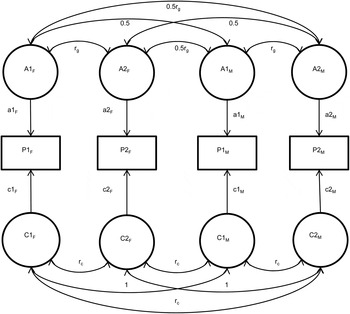
A correlated factors model was fitted for the multivariate genetic analyses, where each variable was influenced by a separate genetic factor. Correlations between genetic factors indicate the level of similarity between genetic components on the variable at different time points. A similar structure was also specified for shared and non-shared environment factors. The proportion of phenotypic correlation between late childhood and mid-adolescence for anxiety and depression, respectively, due to common genetic, shared and non-shared environmental factors was computed by multiplying standardized paths on each variable and their correlation and then divided by the overall phenotypic correlation (see Fig. 1). A series of multivariate sex-limitation models was fitted to the five sex–zygosity groups to test for qualitative and quantitative sex differences (Neale et al. Reference Neale, Roysamb and Jacobson2006). Preliminary analyses revealed no qualitative or quantitative sex differences. Therefore, only results from the final most parsimonious models were presented. Full details of multivariate sex-limitation model fit indices are available in online Supplementary Table S1.
A correlated factors scalar sex limitation model for a pair of dizygotic opposite-sex twins with quantitative sex different paths (e.g. a1F, a1M) but the same correlations across time (r c and r g). Only additive genetic factors (A), shared environmental factors (C) and phenotypes (P) are shown. Number (1, 2) refers to time and subscript (F, M) refers to the sex of the twin (female or male). Cross-time phenotypic correlation (r) due to C is calculated as c1F × r c × c2F/r. The same applies to A and E (non-shared environmental factors).

All twin analyses were done using the OpenMx package (Boker et al. Reference Boker, Neale, Maes, Wilde, Spiegel, Brick, Spies, Estabrook, Kenny, Bates, Mehta and Fox2011) with raw data maximum likelihood estimation to handle missing data. Goodness-of-fit of models were assessed with minus twice the log likelihood (−2LL). The difference of –2LL between a full model and a nested reduced model that contains fewer parameters was assessed by χ2 tests, with its degree of freedom equal to the difference in the number of parameters estimated in the two models. A non-significant χ2 test suggests the reduced model is a more parsimonious model. Akaike's information criterion was also computed, with lower values suggesting better fit.
Results
Descriptive statistics and correlations
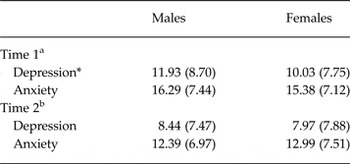
Table 1 presents the descriptive statistics of anxiety and depression in raw scores by sex. Randomly selecting one twin per pair, there was no sex difference in the levels of anxiety at time 1 (t 351 = −0.70, p = 0.49, d = 0.08). Girls had slightly lower levels of depression than boys at time 1 with a small effect size (t 351 = −2.01, p = 0.05, d = −0.22). There was no sex difference at time 2 in the levels of anxiety (t 274 = 0.302, p = 0.76, d = 0.04) or depression (t 274 = −0.23, p = 0.82, d = 0.03). The levels of anxiety and depression both decreased over time (t 272 = 6.41 and 5.35, p's < 0.001, d = 0.39 and 0.32, respectively). Square root transformation was applied to anxiety and depression to adjust for positive skewness. As is standard practice in twin analyses, the residuals after regressing on age and sex were used in the following genetic analyses (McGue & Bouchard, Reference McGue and Bouchard1984).
Descriptive statistics by sex

Data are given as mean (standard deviation).
a Mean age = 10.9 years.
b Mean age = 13.9 years.
* Significant sex difference (p = 0.05).
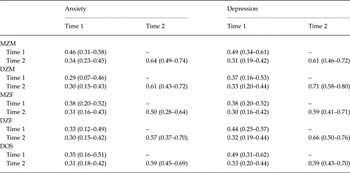
The twin correlations (cross-twin and cross-time) for each sex-by-zygosity group are shown in Table 2. The correlation patterns of opposite-sex DZ twins were very similar to those of same-sex DZ twins, suggesting no qualitative sex differences. The correlation patterns between MZ and DZ twins were also generally similar across sex, suggesting no quantitative sex differences. At time 1, for both anxiety and depression, the correlations of MZ twins were generally higher than those of DZ twins but less than twice those of DZ twins, suggesting additive genetic, shared environmental and non-shared environmental influences. This pattern changed at time 2, so that the correlations of MZ and DZ twins were more similar, indicating decreasing genetic influences. At time 2, some DZ correlations were higher than those of MZ (e.g. 0.71 for DZM and 0.61 for MZM for depression). However, they were not significantly different from each other because their 95% confidence intervals (CIs) overlapped, which suggests no genetic influences because MZ twins were not much more similar than DZ twins were to each other. Similarly, the MZ:DZ ratio of the cross-twin cross-time correlations were very close to 1:1, indicating that shared environmental effects are most probably responsible for the cross-time phenotypic correlations for anxiety and depression (r = 0.42 and 0.41, respectively).
Twin correlations (within- and cross-time) by sex and zygosity groups
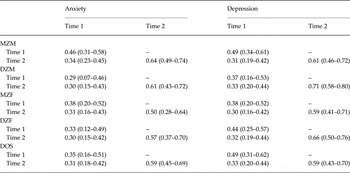
Data are given as correlation (95% confidence interval).
MZM, Monozygotic males; DZM, dizygotic males; MZF, monozygotic females; DZF, dizygotic females; DOS, dizygotic opposite-sex twins; on-diagonal, within-time correlations; off-diagonal, cross-time correlations.
Genetic model-fitting analyses
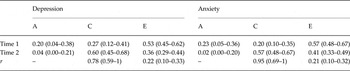
For both anxiety and depression, the homogeneity ACE model provided the best fit to the data. Constraining genetic and environmental factor correlations and all paths to be equal across sex did not significantly decrease the model fit (see online Supplementary Table S1) (χ2 9 = 5.55 and 5.21, p = 0.78 and 0.82, respectively). Shown in Table 3, at time 1, anxiety and depression were both explained by additive genetic (23 and 20%), shared environmental (20 and 27%) and non-shared environmental (57 and 53%) influences. At time 2, additive genetic influences for anxiety and depression both decreased substantially and were not significantly different from 0 (2 and 4%). Shared environmental influences increased substantially and were comparable between anxiety and depression (57 and 60%). Non-shared environmental influences decreased slightly (41 and 36%).
Parameter estimates a
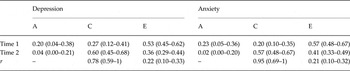
Data are given as estimate (95% confidence interval).
A, Additive genetic factors; C, shared environmental factors; E, non-shared environmental factors.
a Genetic correlation non-significant and fixed at 0.
The cross-time genetic correlations were not significantly different from 0 and subsequently fixed at 0. The correlations of shared environmental factors over a 3-year period were significant for both anxiety (r c = 0.95, 95% CI 0.69–1) and depression (r c = 0.78, 95% CI 0.59–1). The correlations of non-shared environmental factors for both anxiety (r e = 0.21, 95% CI 0.10–0.32) and depression (r e = 0.22, 95% CI 0.10–0.33) were modest but significant. Shared environment explained most of the continuity of anxiety and depression (75 and 77%).
Discussion
Most previous twin studies on genetic and environmental etiologies of child and adolescent anxiety and depression have focused on samples from Western societies. The few existing studies that have examined non-Western samples provided mixed results on estimated genetic and environmental influences, as well as sex differences. All these studies were cross-sectional and therefore were not able to examine changes in genetic and environmental influences in development. This study investigated developmental changes in genetic and environmental influences on self-reported anxiety and depression from late childhood to mid-adolescence in a Chinese twin sample using a longitudinal design, as well as genetic and environmental contributions to the continuity of anxiety and depression and sex differences.
Consistent with the few previous Chinese studies using twin samples (Kuo et al. Reference Kuo, Lin, Yang, Soong and Chen2004; Unger et al. Reference Unger, Lessov-Schlaggar, Pang, Guo, Ning, Gallaher, Lee, Cao, Conti and Johnson2011; Chen et al. Reference Chen, Li, Natsuaki, Leve and Harold2014, Reference Chen, Yu, Li and Zhang2015) and community samples (e.g. Liu et al. Reference Liu, Ma, Kurita and Tang1999; Tepper et al. Reference Tepper, Liu, Guo, Zhai, Liu and Li2008; Xin et al. Reference Xin, Zhang and Liu2010), no or minimal sex differences in the levels of anxiety and depression were found in the current sample during late childhood and adolescence. This result differs from the findings of some Western studies that showed females having more depressive/anxious symptoms than males starting in early to mid-adolescence (e.g. 12 years onwards; Nivard et al. Reference Nivard, Dolan, Kendler, Kan, Willemsen, van Beijsterveldt, Lindauer, van Beek, Geels, Bartels, Middeldorp and Boomsma2015). More studies following Chinese community samples from childhood to adolescence with robust assessment instruments are needed to further establish sex (and possibly cross-cultural) differences in prevalence and levels of depression and anxiety symptoms during this development period. Consistent with findings using Western samples (Franic et al. Reference Franic, Middeldorp, Dolan, Ligthart and Boomsma2010), no qualitative sex differences were found. As reported in the majority of previous studies (Legrand et al. Reference Legrand, McGue and Iacono1999; Scourfield et al. Reference Scourfield, Rice, Thapar, Harold, Martin and McGuffin2003; Bartels et al. Reference Bartels, van den Oord, Hudziak, Rietveld, van Beijsterveldt and Boomsma2004; Boomsma et al. Reference Boomsma, van Beijsterveldt and Hudziak2005; Lau & Eley, Reference Lau and Eley2006; Lau et al. Reference Lau, Eley and Stevenson2006; Lamb et al. Reference Lamb, Middeldorp, van Beijsterveldt, Bartels, van der Aa, Polderman and Boomsma2010; Zavos et al. Reference Zavos, Rijsdijk and Eley2012; Garcia et al. Reference Garcia, Tully, Tarantino, South, Iacono and McGue2013) and in a meta-analysis (Burt, Reference Burt2009), no quantitative sex differences were found in this study either, suggesting that boys and girls in the sample are generally influenced by the same genetic and environmental factors to the same degree, as reported similarly in two studies using Chinese samples (Unger et al. Reference Unger, Lessov-Schlaggar, Pang, Guo, Ning, Gallaher, Lee, Cao, Conti and Johnson2011; Chen et al. Reference Chen, Li, Natsuaki, Leve and Harold2014). However, given the wide CIs that overlapped between MZ and DZ twins in males and females, respectively, correlations suggested that the significant genetic influences in anxiety in late childhood (10–12 years) were mainly driven by males. Therefore, if first constraining correlations between MZ and DZ twins to be equal, respectively, in males and females, an alternative conclusion could be drawn that in late childhood, both genetic and shared environmental influences on anxiety would be significant in males, whereas shared environment would explain most familial resemblance for anxiety in females and for depression in both groups. Given that the other two Chinese twin studies reported sex differences in opposite directions using parent reports (Kuo et al. Reference Kuo, Lin, Yang, Soong and Chen2004; Chen et al. Reference Chen, Yu, Li and Zhang2015), as well as the small sample size in this study, more studies using non-Western samples are needed to better understand sex differences in the etiology of anxiety and depression during childhood and adolescence.
The current findings suggest that both anxiety and depression were heritable in Chinese children. The heritability estimates in late childhood (23 and 20%) were lower than those reported in a meta-analysis using Western samples (Burt, Reference Burt2009) and two Chinese studies (50% in Chen et al. Reference Chen, Li, Natsuaki, Leve and Harold2014; 47–72% in Chen et al. Reference Chen, Yu, Li and Zhang2015), but were consistent with some Western studies (31% in Lau et al. Reference Lau, Eley and Stevenson2006; 15% at 14 years in Garcia et al. Reference Garcia, Tully, Tarantino, South, Iacono and McGue2013), and the other two Chinese studies (19% for boys in Kuo et al. Reference Kuo, Lin, Yang, Soong and Chen2004; 10% in Unger et al. Reference Unger, Lessov-Schlaggar, Pang, Guo, Ning, Gallaher, Lee, Cao, Conti and Johnson2011). However, because Kuo et al. (Reference Kuo, Lin, Yang, Soong and Chen2004), Unger et al. (Reference Unger, Lessov-Schlaggar, Pang, Guo, Ning, Gallaher, Lee, Cao, Conti and Johnson2011) and Chen et al. (Reference Chen, Li, Natsuaki, Leve and Harold2014) all included samples with wide age ranges and did not examine age differences, cautions should be taken when comparing with these results.
From late childhood and early adolescence (10–12 years) to mid-adolescence (13–15 years), contrary to most previous Western studies demonstrating an increase in heritability during adolescence (Bergen et al. Reference Bergen, Gardner and Kendler2007), the heritability for both anxiety and depression decreased in our sample. However, this has also been found in some Western studies (74 to 31% from 8–9 years to 14–15 years in Gjone et al. Reference Gjone, Stevenson, Sundet and Eilertsen1996; 15 to 1% from 8–10 years to 14–16 years in Topolski et al. Reference Topolski, Hewitt, Eaves, Silberg, Meyer, Rutter, Pickles and Simonoff1997; 56 to 36% in 10–18 years in O'Connor et al. Reference O'Connor, Neiderhiser, Reiss, Hetherington and Plomin1998; 43 to 25% for 8- to 16-year-old girls in Topolski et al. Reference Topolski, Hewitt, Eaves, Meyer, Silberg, Simonoff and Rutter1999). The decrease in heritability was accompanied by an increase in shared environmental influences. This pattern of results has also been reported in some Western studies from 0–5 years to 6–10 years in a meta-analysis (Burt, Reference Burt2009), in longitudinal studies from 3 to 7 years old (Van der Valk et al. Reference Van der Valk, van den Oord, Verhulst and Boomsma2003), and from 7 to 12 years old (Boomsma et al. Reference Boomsma, van Beijsterveldt and Hudziak2005), and from late childhood to adolescence (Gjone et al. Reference Gjone, Stevenson, Sundet and Eilertsen1996; Topolski et al. Reference Topolski, Hewitt, Eaves, Silberg, Meyer, Rutter, Pickles and Simonoff1997, Reference Topolski, Hewitt, Eaves, Meyer, Silberg, Simonoff and Rutter1999). One possible explanation of this finding may be the fact that the transition from late childhood to mid-adolescence for most Chinese children is typically accompanied by the transition from primary school to middle or secondary school. Although school transition also occurs around the same time in Western populations, this transition in China usually results in dramatic changes in settings and organizations of schools and classrooms, networks and compositions of classmates and friends, a more structured curriculum, and early academic stress, which could influence Chinese children's anxiety and depressive symptom levels (Chen et al. Reference Chen, Cen, Li and He2005; Chen, Reference Chen and Bond2010; Chen & Chen, Reference Chen, Chen, Silbereisen and Chen2010). Therefore, the influences of shared environmental experiences (e.g. parental monitoring and warmth) on child and adolescent internalizing symptoms could be amplified during this particular transition period.
Because shared environmental influences could reflect the effects of shared family environment as well as the effects of the community and neighborhoods in which families are embedded, the substantial and increased shared environmental influences suggest that socialization experiences of Chinese children both outside and inside the home become increasingly important during this developmental period. This could be particularly relevant for child psychosocial development in the non-Western Chinese society, which also has a collectivistic culture. Compared with the individualistic cultures in most Western societies, family relationships are more emphasized and valued in the Chinese collectivistic culture, and different parenting styles are practised (Chen & French, Reference Chen and French2008; Chen, Reference Chen and Bond2010, Reference Chen2012). This finding suggests that school-based and family-focused interventions against adolescent anxiety and depression might be more effective in Chinese society than individual therapies as commonly used in Western countries. Findings from other studies using Chinese samples suggest that the pronounced effect of shared environmental influences during adolescence are not limited to internalizing but also to externalizing problems (Kuo et al. Reference Kuo, Lin, Yang, Soong and Chen2004) and deviant peer affiliation (Li et al. Reference Li, Chen, Li and Deater-Deckard2015). Therefore, more studies using non-Western samples are needed to replicate the current findings and to further investigate similarities and differences in genetic and environmental influences on internalizing and externalizing problems during childhood and the transition to adolescence.
The findings on the developmental changes of heritability reveal developmentally dynamic genomes. Similar to some previous studies that have reported decreased heritability for anxiety and depression (O'Connor et al. Reference O'Connor, Neiderhiser, Reiss, Hetherington and Plomin1998; Zavos et al. Reference Zavos, Rijsdijk and Eley2012), the finding of decreasing heritability suggests genetic attenuation. However, different from these studies where heritability estimates were still significant at follow-up, genetic influences in mid-adolescence in the current sample were not significant anymore. As opposed to the dynamic pattern of genetic factors, shared environmental factors showed high correlations and explained most of the stability for anxiety and depression, as reported in some previous studies (Scourfield et al. Reference Scourfield, Rice, Thapar, Harold, Martin and McGuffin2003; Van der Valk et al. Reference Van der Valk, van den Oord, Verhulst and Boomsma2003; Bartels et al. Reference Bartels, van den Oord, Hudziak, Rietveld, van Beijsterveldt and Boomsma2004). The finding suggests that shared environmental influences are stable and long term (Burt, Reference Burt2009), as opposed to non-shared environmental influences that are largely time-specific (O'Connor et al. Reference O'Connor, Neiderhiser, Reiss, Hetherington and Plomin1998; Van der Valk et al. Reference Van der Valk, van den Oord, Verhulst and Boomsma2003).
Limitations
Despite the strength of following a cohort of Chinese twins from late childhood to mid-adolescence, the current study has a few limitations. First, the power of the study is limited by the relatively small sample size. Therefore, the findings are better regarded as a first step to investigate developmental changes in genetic and environmental influences on child and adolescent anxiety and depression in the Chinese population. Future studies using larger non-Western samples are needed to replicate the findings. Second, anxiety and depression were all self-reported. Studies have shown that parent reports and self-reports can produce different results (Franic et al. Reference Franic, Middeldorp, Dolan, Ligthart and Boomsma2010; Chen et al. Reference Chen, Li, Natsuaki, Leve and Harold2014, Reference Chen, Yu, Li and Zhang2015). Future studies can benefit from a multi-informant approach to capture unique information from different raters on child and adolescent anxiety and depression (Kendler et al. Reference Kendler, Gardner and Lichtenstein2008; Chen et al. Reference Chen, Yu, Li and Zhang2015). Relatedly, the anxiety and depressive symptoms were measured with scales that may be more suitable for adults based on the past week's experience. Different measurements may partly explain the inconsistent findings with previous Western and Chinese studies. Future studies should consider measurement scales more sensitive to children and adolescents (e.g. Children's Depression Inventory). Third, this study measured symptoms of general anxiety and depression rather than clinically diagnosed disorder or subtypes of disorder, which have been shown to have different developmental patterns of genetic influences (Waszczuk et al. Reference Waszczuk, Zavos, Gregory and Eley2014, Reference Waszczuk, Zavos, Gregory and Eley2016). Therefore, the findings may not generalize to clinical disorders or symptoms. Fourth, this study did not examine the associations between anxiety and depressive symptoms over time. Future studies could adopt cross-lagged model to examine longitudinal associations between anxiety and depression (e.g. Zavos et al. Reference Zavos, Rijsdijk and Eley2012). We did not examine the effects of any specific genes or measured environmental experience either. Future studies could consider the influences of specific genes using polygenic risk scores (e.g. Peyrot et al. Reference Peyrot, Milaneschi, Abdellaoui, Sullivan, Hottenga, Boomsma and Penninx2014) and environmental measures (e.g. negative life events, Lau et al. Reference Lau, Gregory, Goldwin, Pine and Eley2007; maternal control, Eley et al. Reference Eley, Napolitano, Lau and Gregory2010), as well as their interplay, on anxiety and depression, especially in non-Western samples followed longitudinally (e.g. harsh parenting; Li et al. Reference Li, Chen, Li and Deater-Deckard2015).
Conclusions
The current study found that, contrary to most Western studies, heritability decreased while shared environmental influences increased from late childhood to mid-adolescence on Chinese child and adolescent anxiety and depression. Shared environmental factors played a major role in the continuity of anxiety and depression while non-shared environmental factors were largely time-specific. This increase in shared environmental influences with age might be specific to Chinese populations during the transition to adolescence that is accompanied with dramatic environmental changes, and highlights the importance of shared family and neighborhood experience that could influence child psychopathology in China. Future longitudinal research in other non-Western samples is necessary to confirm the current finding.
Supplementary material
For supplementary material accompanying this paper visit http://dx.doi.org/10.1017/S0033291716000313
Acknowledgements
J.-B.P. is supported by a European Commission Marie Curie Intra-European Fellowship (no. 330699). R.J.M. is supported by a LEEF BC Leadership Chair, an Establishment Award from the Child & Family Research Institute, and an award from the Canadian Foundation for innovation.
Declaration of Interest
None.