Introduction
Seed zinc (Zn) content in food crops such as rice and wheat can have critical impact on the nutrition of the human population who depends on these grains for their staple, especially those with low income and those with limited access to costly Zn-rich food (Nestel et al., Reference Nestel, Bouis, Meenaskshi and Pfeiffer2006). Zn deficiency has serious adverse effects on human health and development in infants and children through impaired physical and mental growth (e.g. Keen and Gershwin, Reference Keen and Gershwin1990; Black, Reference Black1998; Ho et al., Reference Ho, Courtemanche and Ames2003). Considerable variation exists in seed Zn concentration among rice genotypes (Welch and Graham, Reference Welch and Graham2002; Saenchai et al., Reference Saenchai, Prom-u-thai, Jamjod, Dell and Rerkasem2012), but seed Zn of some rice genotypes may differ significantly when grown in different soils (Graham et al., Reference Graham, Senadhira, Beebe, Iglesias and Monasterio1999). The same rice variety grown on a soil with a high Zn supply could produce seed with up to twice as high Zn concentration of the rice grown on soil with low Zn supply (Phattarakul et al., Reference Phattarakul, Rerkasem, Li, Wu, Zou, Ram, Sohu, Kang, Surek, Kalayci, Yazici, Zhang and Cakmak2012). In soils where Zn is limited, rice genotypes with a high seed Zn content that can better survive and persist should also be beneficial to those dependent on them for staple.
Local Thai rice varieties or landraces are recognized by the typical appearance of their plant and grain and unique key agronomic traits that describe their performance in the field or eating quality or both. In plants, adaptation is defined as genetic changes in populations that describe their evolutionary response (Lambers et al., Reference Lambers, Chapins and Pons1998). Under conditions of stress, such adaptation would be possible only where variation in the relevant traits enables the best fitted genotypes to be selected for. Analyses of functional traits as well as simple sequence repeat markers have demonstrated the possibility of evolutionary adaptation in local Thai rice germplasm (Pintasen et al., Reference Pintasen, Prom-u-thai, Jamjod, Yimyam and Rerkasem2007; Pusadee et al., Reference Pusadee, Jamjod, Chiang, Rerkasem and Schaal2009; Oupkaew et al., Reference Oupkaew, Pusadee, Sirabanchongkran, Rerkasem, Jamjod and Rerkasem2011). Most of the world's rice crop is grown as wetland crop, in which the soil is submerged under 10–20 cm of water for most of the growing season. Upland rice, the main staple crop for small farmers in many parts of tropical Asia (George et al., Reference George, Magbanua, Roder, Van Keer, Trébuil and Reom2001), is grown in well-drained soil, often on slopes. In Thailand and in other parts of Asia, upland rice is traditionally grown in a system of shifting cultivation or ‘slash-and-burn’, in which the vegetation is cut down, left to dry in the sun and then burned. Soil fertility is improved as nutrients stored in the biomass are released by burning, soil acidity neutralized or made more alkaline by the ash (Zinke et al., Reference Zinke, Sabhasri, Kunstadter, Kunstadter, Chapman and Sabhasri1978; Yimyam et al., Reference Yimyam, Rerkasem and Rerkasem2003). In ash pockets, the rice seed sown may encounter Zn deficiency more extremely than might be expected from a rise of one-half to one unit of pH of the bulk soil by burning. In such conditions, high seed Zn could be advantageous, especially during early establishment. This study examined variation in seed Zn in a local upland rice germplasm that may affect adaptation in a system of slash-and-burn in which a high seed Zn concentration may be advantageous, and also benefits eaters of the rice.
Materials and methods
Seed samples of five local rice varieties, namely Pa Ai Khupe (PA), Bue Bang (BB), Bue Gua (BG), Bue Mue Tabong (BM) and Bue Polo (BP), were obtained from farmers in Huai Tee Cha (19°78′ N, 93°84′ E; altitude 900 m), Sob Moei District, Mae Hong Son Province, about 250 km southwest of Chiang Mai (Fig. 1(a)). There were four seed lots each from different farmers of PA and BM, five seed lots of BG and BP, and two seed lots of BB. The village field from which the rice seeds were produced was on a clay loam to loam soil. Soil fertility characteristics determined on ten replicated samples to 30 cm depth included pH (1:1, soil:water), organic matter (Walkley and Black), total nitrogen (Kjeldahl), available phosphorus (Bray II), extractable potassium and Diethylenetriaminepentaacetic acid (DTPA)-extracted Zn. The seed Zn content was determined on seed without husk.
(a) Location of different seed lots from farmers in Huai Tee Cha, Sob Moei District, Mae Hong Son province, Thailand; (b) three levels of DTZ staining intensity of unpolished rice grain (upper: 1, least intense; 3, moderately intense; 5, most intense) compared with standards (lower: RD21, 19 mg Zn/kg and Nam Roo, 31 mg Zn/kg); and (c) relationship between Zn in unpolished grain of rice from farmers' seed lots of four rice varieties ( ) and DTZ index with low (RD21) and high (Nam Roo) Zn checks (
 ). Each point is the mean of three replicates, and the significance of linear regression was done by the analysis of variance.

Experiment 1: Detecting variation in seed Zn with dithizone staining
The Zn content was determined in individual 20 seeds of 15 seed lots in four local rice varieties (four of PA and BG, two of BB and five of BP) by dithizone (DTZ) staining (Ozturk et al., Reference Ozturk, Yazici, Yucel, Torun, Cekic, Bagci, Ozkan, Braun, Sayers and Cakmak2006), and in the bulk seed of each of the seed lots in triplicates using an atomic absorption spectrophotometer (Allan, Reference Allan1961). After the husk was removed by hand, the rice seed was soaked for 3 h in Distilled De-Ionized water (DDI) water, cut into half lengthwise through the embryo using a Teflon-coated razor blade to avoid contamination during separation (Prom-u-thai et al., Reference Prom-u-thai, Dell, Thompson and Rerkasem2003), then placed in freshly prepared DTZ (500 mg 1,5-diphenyl thiocarbazone (Merck) in 1 l of AR grade methanol) (Prom-u-thai et al., Reference Prom-u-thai, Rerkasem, Yazici, Cakmak and Huang2010). Samples were rinsed thoroughly in DDI water and blotted dry. The intensity of the red colour staining of the endosperm on the internal surface of the cut grain was rated at three levels: 1, least intense; 3, moderately intense; 5, most intense, compared with low (RD21) and high (Nam Roo) Zn standards, under an Olympus DP12 optical microscope (Tokyo, Japan) (Fig. 1(b)). The weighted-average staining for each seed lot, the DTZ index, was computed by the formula:
 $$\begin{eqnarray} DTZ\,index = \sum [1 p (1) + 3 p (3) + 5 p (5)], \end{eqnarray}$$
where p(1), p(2), p(3) = proportion of seed with 1, 3 and 5 DTZ staining, respectively. For example, if the proportion of the seed with 1, 3 and 5 DTZ staining is 11/20, 9/20 and 0/20, respectively, then
 $$\begin{eqnarray} DTZ\,index = \sum [1 p (1) + 3 p (3) + 5 p (5)], \end{eqnarray}$$
To determine Zn in the bulk seed lots, subsamples of the seed without husk (containing 40–50 seeds) were dried at 70°C for 72 h, and dry-ashed in a muffle furnace at 535°C for 8 h, the ash dissolved in 1:1 HCl, and Zn is determined with an atomic absorption spectrophotometer (Allan, Reference Allan1961).
Experiment 2: Variation in seed Zn within and among seed lots
Ten single-seed descent genotypes were produced from four farmers' seed lots each from PA and BM, five seed lots each from BG and BP and two seed lots each from BB. The genotypes were grown together in wetland (water level kept at 10–15 cm above the soil surface until 3 weeks before harvest) and upland (irrigated and allowed to drain) conditions on a sandy loam soil at Chiang Mai University (CMU), Thailand. Plants were grown at 0.25 × 0.25 m spacing, in single 5-m rows for each genotype. Soil pH, available P and DTPA extract Zn of the soil were determined as for the field soil. The crops were fertilized with 68 kg N, 25 kg P and 25 kg K/ha. The two standard low and high Zn varieties (RD21 and Nam Roo) were included in the planting for comparison. After determination of seed yield at maturity, subsamples of seed without husk were analysed in triplicate for Zn as in Experiment 1.
Results
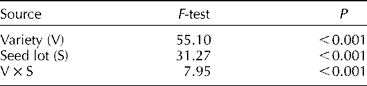
The soil at Huai Tee Cha where the farmers' seed was produced was acidic with only 0.4 mg DTPA-extractable Zn/kg and 2.9 mg available P/kg compared with 1.5 mg DTPA-extractable Zn/kg and 59 mg available P/kg in the soil in the experimental field at CMU (Table 1). The seed Zn of upland rice from the farmers' field, ranged from 16 to 28 mg Zn/kg, with a significant difference among varieties, seed lots and their interaction (Tables 2 and 3). The range of within-variety variations in seed Zn of the upland rice from farmers' field was especially large in PA and BP, with 16–18% coefficient of variation (CV).
Soil fertility characteristics of the field at Tee Cha village that provided the farmers' upland rice seed and at CMU for evaluation of progeny lines

nd, not determined.
* Values are means of ten replications.
Analysis of variance in the seed without husk of five local upland rice varieties in different seed lots from farmers' seed store

Zn concentration in the seed without husk of five local upland rice varieties in different seed lots from farmers' seed store

Different small letters indicate significant differences (P≤ 0.05; Duncan's multiple range test).
The intensity of DTZ staining clearly differentiated between the low and high Zn standards, RD21 with 19 mg Zn/kg and Nam Roo with 31 mg Zn/kg (Fig. 1(b)). This qualitative measure of seed Zn concentration was made quantitative by the weighted-average staining for each seed lot, the DTZ index, which was closely associated with Zn concentration by chemical analysis that averaged the Zn content over 40–50 seeds (Fig. 1(c)).
Variation in seed Zn content within each of the farmers' seed lots was indicated by variation in the intensity of DTZ staining (Fig. 2(a)). Individuals in the majority of seed lots showed DTZ staining intensity that ranged from least intense of RD21 (1), to most intense of Nam Roo (5) and intermediate between the two extremes (3).
(a) Distribution of individual seeds (20 seeds per sample) from different seed lots of four local rice varieties of an upland crop with low (RD21, 19 mg Zn/kg) and high (Nam Roo with 31 mg Zn/kg) Zn standards, by DTZ staining intensity in three classes (1 = least intense,  ; 3 = moderately intense,
 ; 5 = most intense,
 ); and (b) distribution of single-seed descent genotypes from different seed lots of five local rice varieties by the Zn concentration of their unpolished grain in five classes (mg Zn/kg: < 20,
 ;21–25,
 ; 26–30,
 ; 31–35,
 ; >35,
 ).

The variation in seed Zn content within seed lots indicated by DTZ staining of individual seeds was confirmed by the seed Zn determined chemically from their single-seed descent genotypes grown as an upland and wetland crop at CMU, with 10% or higher CV of the seed Zn in half of the seed lots (Table 4) and frequency distribution of the genotypes by their seed Zn covering three or more classes of Zn concentration in two-thirds of the seed lots of upland crop (Fig. 2(b)). This high level of variation in seed Zn was found in all of the upland rice varieties examined. When grown together in the same field, almost all of the single-seed descent genotypes developed from the farmers' upland rice germplasm had a higher concentration of seed Zn than RD21, the low Zn standard, while two-thirds of the genotypes had as high as or higher seed Zn than Nam Roo, the high Zn standard. In spite of the variation, the seed Zn of single-seed descent genotypes developed from each seed lot was closely associated with the seed Zn of the original seed lot from farmers' field (Fig. 3(a)). The seed Zn of the genotypes grown as a wetland crop was also closely associated with their seed Zn when grown as an upland crop (Fig. 3(b)). The variation in seed Zn in this germplasm did not appear to have resulted from dilution effects, and the association between seed Zn and seed yield was very weak for both upland (R 2= 0.04) and wetland (R 2= 0.05) grown seed (Fig. 3(c)).
Zn concentration in the seed without husk (mean, coefficient of variation and range) of individual plants grown as an upland and wetland crop at CMU from different seed lots of five local rice varieties

Relationship (a) between seed Zn of upland rice seed lots from farmers' field and of single-seed descent genotypes developed from farmers' seed lots (mean ± SD) grown as an upland crop in experimental field at CMU, and (b) between seed Zn of the genotypes grown as wetland and upland crops at CMU; (c) relationship between seed Zn and seed yield of single-seed descent genotypes of upland rice grown as upland ( , R
2 = 0.04) and wetland (
 , R
2 = 0.05) crops at CMU. Significance of linear regression was done by the analysis of variance.

Discussion
In spite of the low soil Zn of only 0.4 mg DTPA-extractable Zn/kg, most of the rice produced and consumed in this village was rich in Zn than common varieties produced in the lowlands for urban consumers, which were grown on soils with a much higher available Zn. Unpolished grain of rice from China, India and Thailand produced from popular modern varieties of each country on soils with 2.1–5.5 mg DTPA-extractable Zn/kg had only 21 ± 3 mg Zn/kg (Phattarakul et al., Reference Phattarakul, Rerkasem, Li, Wu, Zou, Ram, Sohu, Kang, Surek, Kalayci, Yazici, Zhang and Cakmak2012). The same study also showed that a high yielding Thai rice variety CNT1 produced grain with only 10 mg Zn/kg on a soil with 0.5 mg DTPA-Zn, while the grain contained 20 mg Zn/kg when grown on a soil with 2.1 mg DTPA-Zn.
Staining Zn with DTZ has been effectively used to rank wheat genotypes by their seed Zn concentration as well as to study the localization of Zn in different tissues of wheat seed (Ozturk et al., Reference Ozturk, Yazici, Yucel, Torun, Cekic, Bagci, Ozkan, Braun, Sayers and Cakmak2006). The very high Zn concentration in the rice embryo, shown to range from 119 to 254 mg Zn/kg and up to 17 times that of the endosperm (Saenchai et al., Reference Saenchai, Prom-u-thai, Jamjod, Dell and Rerkasem2012), was highlighted by its most intense staining in this study. The Zn content by chemical analysis was positively correlated with the weighted-average staining for each seed lot. The DTZ staining indicated the variation in individual seeds within seed lots and these were confirmed by the seed Zn determined chemically from their single-seed descent genotypes grown as an upland crop at CMU. Similar variation among individual seeds within seed lots including those with completely uniform appearance was seen in seed Fe with Perl's Prussian blue staining, confirmed with chemical analysis (Pintasen et al., Reference Pintasen, Prom-u-thai, Jamjod, Yimyam and Rerkasem2007).
Zinc requirement of germinating seed and early seedling growth may be met externally by Zn in the soil or applied directly to the seed (Slaton et al., Reference Slaton, Wilson, Ntamatungiro, Norman and Boothe2001; Prom-u-thai et al., Reference Prom-u-thai, Rerkasem, Yazici and Cakmak2012; Boonchuay et al., Reference Boonchuay, Cakmak, Rerkasem and Prom-u-thai2013) as well as internally from the Zn stored within the seed (Rengel and Graham, Reference Rengel and Graham1995; Cakmak, Reference Cakmak2008). The ability to accumulate Zn in the seed at very high concentration (Cakmak et al., Reference Cakmak, Ozkan, Braun, Welch and Romheld2000, Reference Cakmak, Torun, Millet, Feldman, Fahima, Korol, Nevo, Braun and Őzkan2004) would have been a key adaptation trait where the external Zn supply is limited, for example, in the wild and primitive wheat grown within the centre of diversity of wheat with extremely low Zn in the soil such as the Central Anatolia Region of Turkey (Cakmak et al., Reference Cakmak, Yilmaz, Kalayci, Ekiz, Torun, Erenoğlu and Braun1996). The molecular basis of rice explained that OsZIP4 was induced and expressed under Zn deficient in the root apical meristem and vascular bundles (Ishimaru et al., Reference Ishimaru, Masuda, Suzuki, Bashir, Takahashi, Nakanishi, Mori and Nishizawa2007). The evolutionary adaptation of rice variety with high seed Zn thus involves this mechanism. In the system of slash-and-burn cropping, the seed of upland rice is sown into the ash-covered soil in which there will be extremely alkaline pockets. The availability of Zn in the soil is depressed by alkalinity (Marschner, Reference Marschner and Robson1993), thus external Zn supply for early growth and establishment of the upland rice would be limiting, especially in soils already very low in available Zn. The adaptation advantage in such an environment would be with those genotypes that can accumulate more Zn in their seed. We have shown here how this was indeed the case with a local rice germplasm developed under slash-and-burn on a low Zn soil (0.4 mg DTPA-extractable Zn/kg), with two-thirds of the genotypes having seed Zn as high as or higher than the high Zn standard Nam Roo when grown on a soil where Zn was less limited (1.5 mg DTPA-extractable Zn/kg). The high Zn standard Nam Roo was in fact developed from a local upland rice variety of the same name from Nam Roo, a highland Lisu village (BRRD, 2014) some 130 km north of Chiang Mai. The stability ranking of seed Zn among rice varieties was shown from the positive relationship between Tee Cha village and CMU, even though the difference in seed Zn of the same variety was observed between the two locations. This suggested that environmental condition plays an important effect on seed Zn in rice such as growing location.
Local crop varieties or landraces are recognized for their potential to adapt to local conditions and changing farming practices and environments (Frankel et al., Reference Frankel, Brown and Burdon1995; McCouch, Reference McCouch2004). Adaptation of plants to stress is an evolutionary process (Lambers et al., Reference Lambers, Chapins and Pons1998). Continuing evolution of domesticated species is a central tenet of in situ or on-farm conservation (e.g. Brown, Reference Brown and Brush1999; Brush, Reference Brush and Brush1999), recognized by the Conference on Biological Diversity (United Nations, 1992). Such evolutionary adaptation to specific stresses is, however, only possible when there is variation in the key traits to enable the most fit in the population to be selected for. Molecular diversity in rice has been demonstrated in numerous studies, including those that focus on diversity within populations and varieties (e.g. Saini et al., Reference Saini, Jain, Jain and Jain2004; Zhu et al., Reference Zhu, Wang, Zhu and Lu2004; Pusadee et al., Reference Pusadee, Jamjod, Chiang, Rerkasem and Schaal2009; Choudhury et al., Reference Choudhury, Khan and Dayanandan2013). There are, however, few studies of within-population diversity in functional traits. The high value of CV within seed lot of the same variety from each farmer's field could be explained by (Ceccarelli and Grando, Reference Ceccarelli, Grando and Brush1999; Rerkasem, Reference Rerkasem2008). The first is due to the variation among individuals growing and completing their life cycle in the same field. This could be explained by the basis conscious and unconscious on-farm selection that have resulted in agronomically important adaptation and tolerance to stress. Farmer's selection is greatly aided by conspicuous variations among individuals. Selection for glutinous or non-glutinous rice, preferred staple of different ethnic groups, is made by their readily distinguishable waxy (opaque) and non-waxy (translucent) endosperm type. From a gall midge-resistant glutinous local variety, gall midge-resistant non-glutinous rice has been developed by farmers who prefer non-glutinous rice for staple, living at higher elevations where the gall midge is emerging as a new threat (Oupkaew et al., Reference Oupkaew, Pusadee, Sirabanchongkran, Rerkasem, Jamjod and Rerkasem2011; Chaksan, Reference Chaksan2013).
The prevalence of rice genotypes with high seed Zn in this local upland rice germplasm indicated that a high concentration of Zn in the seed was a key adaptation trait for rice in a slash-and-burn system on a low Zn soil, which also benefitted the people who grow and eat this rice. Variation in seed Zn among individuals in each seed lot suggested a continuing process of evolutionary adaptation, and also highlighted the need to focus on individuals in the population when evaluating such germplasm for potentially useful traits that would not be detectable by precise quantitative assessment of the phenotype like the chemical Zn analysis that averages over 40–50 individuals.
Acknowledgements
The first author is a recipient of a Royal Golden Jubilee PhD scholarship. The authors thank farmers of Huai Tee Cha for generously sharing their rice seed, and acknowledge financial support for this research from National Research University Programme of Thailand's Commission on Higher Education, Thailand Research Fund for the mid-career researcher (RSA5580056) and HarvestZinc Consortium.