In 2001, Gunnar and Vazquez wrote a seminal paper describing “hypocortisolism” in children, a paradoxical suppression of the hypothalamic–pituitary–adrenal axis (HPA axis) in which low cortisol levels, the final product of the HPA axis, were observed (Gunnar & Vazquez, Reference Gunnar and Vazquez2001). Whereas exposure to stress is expected to relate to elevated cortisol levels, exposure to toxic or chronic environmental risk is thought to predict hypocortisolism, and in turn predicts poorer mental health outcomes such as externalizing problems (Shirtcliff, Granger, Booth, & Johnson, Reference Shirtcliff, Granger, Booth and Johnson2005). Hypocortisolism is often explained within allostatic load theory (McEwen, Reference McEwen2004a, Reference McEwen2004b). Allostatic load theory is relevant to a broad range of physiological regulatory capacities, and posits that an individual's attempt to adapt to current environmental stressors may yield long-term consequences for physical and mental health. When applied to the HPA axis, the theory would suggest that over time, after a prolonged series of elevated cortisol responses stemming from living in a chronically stressful environment, the HPA axis may downregulate, producing hypo- or lower levels of cortisol.
Attempts to understand precisely what types of environmental stressors or what dosage of stress (i.e., acute vs. chronic) predict the elevated or blunted cortisol levels have led to sophisticated theories that describe the complex relation between environment and physiological reactive/regulatory systems. Two such theories are biological sensitivity to context (BSC; Boyce & Ellis, Reference Boyce and Ellis2005) and the adaptive calibration model (ACM; Del Giudice, Ellis, & Shirtcliff, Reference Del Giudice, Ellis and Shirtcliff2011). Both models are rooted in evolutionary theory and represent physiological reactivity as a complex nonlinear function of exposure to environmental stress or adversity. Significant interactions of physiological reactivity in the context of environmental stress predicting negative outcomes provide some empirical support to both theories (Bush, Obradović, Adler, & Boyce, Reference Bush, Obradović, Adler and Boyce2011; Essex, Armstrong, Burk, Goldsmith, & Boyce, Reference Essex, Armstrong, Burk, Goldsmith and Boyce2011).
The above-cited theories predict that children's physiological profiles would change to adapt to repeated exposures to environmental stress. Although the dimension of time is not explicitly represented in BSC or ACM theories, it is nonetheless implicit in the theories based on the principal of adaptation. Given that profiles of highly elevated cortisol levels (hyper-) and very low cortisol levels (hypo-) are both considered adaptations that represent potentially dysregulated forms of HPA-axis functioning (Blair et al., Reference Blair, Granger, Kivlighan, Mills-Koonce, Willoughby and Greenberg2008), it is possible that these manifestations of elevated and low patterns could change over time or even reflect an adaptation to the same level of risk exposure at different points in time. Unfortunately, the time duration or interval it would take for patterns of elevated HPA-axis functioning to change to blunted HPA-axis patterns is unknown. Furthermore, it is likely that the timeframe in which the HPA-axis registers chronic stress is a function of the intensity and chronicity of the stressor, as well as the developmental period (Ruttle et al., Reference Ruttle, Shirtcliff, Serbin, Ben-Dat Fisher, Stack and Schwartzman2011). The current study aims to uncover how profiles of HPA-axis activity, specifically diurnal cortisol morning level and slope, change or remain stable during the preschool period, and whether environmental stressors of low income and cumulative risk account for profile differences. To determine whether fluctuation in diurnal cortisol morning level and slope may signal a pattern or adaptation to the environment, it is important to know what we would expect in a normative sample. Therefore, we review what is known about the stability of diurnal cortisol morning levels and slope in the preschool period. Then, we review the literature on how low income and cumulative risk relate to children's HPA-axis functioning.
Stability of HPA Axis During the Preschool Period
The HPA axis follows a circadian rhythm, which is referred to as the diurnal cortisol pattern, evidenced in normative samples (Turner-Cobb, Rixon, & Jessop, Reference Turner-Cobb, Rixon and Jessop2008). Cortisol levels generally peak 20–30 min after time of awakening, decrease to half by midafternoon, and reach the lowest levels by midnight. However, this rhythmic pattern has been largely examined in adult and animal samples, leaving little information beyond day-to-day variations of the developmental course and stability of cortisol rhythms in young children (Rotenberg, McGrath, Roy-Gagnon, & Tu, Reference Rotenberg, McGrath, Roy-Gagnon and Tu2012). Few studies have obtained repeated assessments of cortisol, and those that have included a variety of measures (i.e., Bush et al., Reference Bush, Obradović, Adler and Boyce2011) and assessment intervals (i.e., Rotenberg et al., Reference Rotenberg, McGrath, Roy-Gagnon and Tu2012), making it difficult to compare across studies. There are few normative studies specifically examining the stability of diurnal cortisol morning level and slope patterns in children (Shirtcliff et al., Reference Shirtcliff, Allison, Armstrong, Slattery, Kalin and Essex2012), with fewer that examine diurnal cortisol during the preschool period. However, those that do typically examined environmental factors that predict differences in levels, such as school transitions (Turner-Cobb et al., Reference Turner-Cobb, Rixon and Jessop2008). Furthermore, few studies have measured diurnal cortisol in yearlong time intervals during preschool. Exceptions include two studies that examined stability and variability in cortisol levels attributable to cumulative risk and caregiving contexts, respectively (Laurent, Gilliam, Bruce, & Fisher, Reference Laurent, Gilliam, Bruce and Fisher2014; Laurent et al., Reference Laurent, Neiderhiser, Natsuaki, Shaw, Fisher and Reiss2013). In Laurent et al. (Reference Laurent, Neiderhiser, Natsuaki, Shaw, Fisher and Reiss2013), it was found that morning and evening cortisol levels were stable from ages 4.5 to 6, and that variability in levels from one time to the next was predicted by environmental stress. As acknowledged by these study authors, two sampling time points did not permit the examination of how environmental risk may be associated with fluctuations in HPA-axis functioning over time. In Laurent et al. (Reference Laurent, Gilliam, Bruce and Fisher2014), which obtained 29 samples of a.m. and p.m. cortisol over 6+ years, children in foster care had lower and more variable cortisol levels than did children in a treatment-enhanced foster care program or community comparisons (Laurent et al., Reference Laurent, Gilliam, Bruce and Fisher2014). These findings call to the necessity of examining both stability and variability of cortisol levels as predicted by contexts of risk. Therefore, the present study adds to the information on the influence of environmental stress on the stability and variability of cortisol morning level and diurnal slope within the preschool period, utilizing four repeated assessments obtained at 9-month intervals.
Low Income, Cumulative Risk, and Preschoolers' Diurnal Cortisol
Lower socioeconomic (SES) status represents a form of chronic stress. As such, it is not too surprising that lower SES has been shown to relate more often to blunted diurnal patterns (Dowd, Simanek, & Aiello, Reference Dowd, Simanek and Aiello2009). Furthermore, low-income backgrounds are often indicative of an environment fraught with other forms of stressors. Studies of children's experiences of multiple environmental risk factors have shown a dose-dependent relation with child adjustment outcomes, with increases in the number of risk factors being associated with increased levels of problems (Appleyard, Egeland, van Dulmen, & Sroufe, Reference Appleyard, Egeland, van Dulmen and Sroufe2005). Cumulative risk, which captures the number of risk factors, is a conceptual model and tool for characterizing multiple-risk environments and is a robust predictor of negative health outcomes, including higher rates of obesity and poorer psychosocial outcomes in children (Evans & English, Reference Evans and English2002; Larson, Russ, Crall, & Halfon, Reference Larson, Russ, Crall and Halfon2008; Suglia, Duarte, Chambers, & Boynton-Jarrett, Reference Suglia, Duarte, Chambers and Boynton-Jarrett2012). Only two studies have examined whether cumulative risk affects diurnal cortisol levels during the preschool period. In one study, increases in cumulative risk from 4.5 to 6 years were related to higher morning cortisol among early school-age children, with children's concurrent experiences of cumulative risk at age 6 relating to lower evening levels (Laurent et al., Reference Laurent, Neiderhiser, Natsuaki, Shaw, Fisher and Reiss2013). In another longitudinal study, cumulative risk measured from infancy through childhood did not predict 13-year-olds' overnight urinary cortisol levels, after poverty status was taken into account (Evans & Kim, Reference Evans and Kim2007). Although the findings may be due to methodological differences between the studies, the differences in the relation between environmental adversity and cortisol levels may hint at the potential of a nonlinear relation between cumulative risk and cortisol, which has been noted in adolescence (Gustafsson, Anckarsäter, Lichtenstein, Nelson, & Gustafsson, Reference Gustafsson, Anckarsäter, Lichtenstein, Nelson and Gustafsson2010). Consistent with BSC or ACM, children in either highly protective or high-risk environments may display more reactive profiles, reflecting heightened sensitivity to environmental circumstance. Due to this heightened sensitivity, children from these environments may exhibit greater variability or fluctuation in diurnal cortisol over time given environmental changes when compared to children in moderate risk environments.
Because there is no gold standard for what factors comprise measures of cumulative risk (Evans, Li, & Sepanski Whipple, Reference Evans, Li and Sepanski Whipple2013), the association between cumulative risk and child cortisol may also depend on whether low income is included in the cumulative risk score or examined separately. In a study of 4- to 7-year-olds whose families had stayed in an emergency shelter, cumulative socioeconomic risk, which included a composite of six risk factors pertaining to socioeconomic status, was not related to morning cortisol levels or cortisol reactivity. In this same study, more negative life events, which emphasized family stress, was significantly related to higher morning cortisol and greater reactivity to assessment tasks (Cutuli, Wiik, Herbers, Gunnar, & Masten, Reference Cutuli, Wiik, Herbers, Gunnar and Masten2010). These findings could reflect a potentially restricted range of SES, given that the sample was drawn from an emergency shelter, or the findings could suggest that family risk factors, as opposed to socioeconomic risk, impacted young children's HPA-axis functioning. However, this has not been tested using a cumulative risk framework and with a sample representing the full range of income. Given that the one study that has examined the associations of income and cumulative risk with cortisol found a mediated pathway model in which cumulative risk explained the relation between income and HPA-axis functioning (see Evans & Kim, Reference Evans and Kim2007), the present study examined the associations of cortisol morning level and diurnal slope with income, separately from cumulative risk.
Latent Profile Analysis (LPA) Provides an Approach to Examining Cortisol Levels Across Time
LPA (Muthen & Muthen, Reference Muthen and Muthen2006) is a person-oriented statistical method that is applied in the current study to identify profiles of cortisol morning level and diurnal slope across four time points. LPA is a type of latent class analysis that models heterogeneity within a sample by identifying subgroups, or profiles, of membership within a larger sample (Flaherty & Kiff, Reference Flaherty, Kiff, Cooper, Camic, Long, Panter, Rindskopf and Sher2012). By classifying individuals based on patterns of levels of cortisol across the preschool period, LPA allows for the examination of the characteristics of children exhibiting consistently low, high, or varying cortisol levels. Further, profiles can then be examined in relation to other variables, including income and cumulative risk, allowing tests of exogenous predictors of profile status. Latent profile analysis models homogenous subgroups and assigns a probability of group membership for each individual. In practice, individuals are commonly examined within the group to which they most probabilistically belong (Flaherty & Kiff, Reference Flaherty, Kiff, Cooper, Camic, Long, Panter, Rindskopf and Sher2012). This flexible modeling approach allows for the identification of several profiles representing consistency or variability in levels of HPA-axis responding. Thus, in this study, LPA provided the opportunity to (a) examine subtypes of cortisol patterns within a normative sample of preschoolers, and (b) test a priori hypotheses regarding the effect of risk on patterns of cortisol function.
LPA was selected over other statistical approaches such as a latent growth curve model or general growth mixture modeling. These longitudinal approaches would have had the benefit of incorporating time and repeated measurement into the models; however, they were theoretically and statistically problematic for other reasons. General growth mixture modeling employs an inferential test of various growth trajectories (Jung & Wickrama, Reference Jung and Wickrama2008). This assumes that the phenomenon of interest develops or may follow a meaningful trajectory. Given how little is known regarding the normative pattern of cortisol across several years early in development, it may be premature to assume that cortisol levels exhibit a meaningful trajectory. Therefore, the present study uses an LPA to describe cortisol levels over time. A second concern with using general growth mixture modeling was related to the goal of identifying the possible presence of fluctuating profiles over time. To test this, an inferential test would require the modeling of a quartic term (high, low, high, low) for which five time points would be required.
Study Aims
This study sought to elucidate the relations of HPA-axis functioning to income and cumulative risk. LPA was used to model the patterning of HPA-axis functioning at four time points to characterize the stability or variation in diurnal cortisol morning level and slope over time. By examining these relations, this study may clarify whether the linear and curvilinear relation of income and cumulative risk are associated with lower (hypo-), elevated (hyper-), or fluctuating patterns of cortisol levels in the preschool period. The specific aims of this study were to:
-
1. Determine stability of cortisol morning level and diurnal slope measured at four, 9-month intervals, beginning when children were 36 months.
-
2. Use latent profile analyses to identify distinct cortisol morning level and diurnal slope profiles. Based on the literature, which finds both lower and higher cortisol values related to risk exposure, we hypothesized that four morning level profiles would emerge: children who exhibited average morning level at each time point; children whose values were consistently higher at each time point compared to other children; children whose values were consistently lower at each time point compared to other children; and children whose values fluctuated from higher to lower than average (or vice versa) across assessments. Similarly, for the diurnal slope profiles, we hypothesized four profiles would emerge: children who exhibited average slope (calculated by average a.m. minus p.m. levels); children who exhibited high slope (suggesting a.m. cortisol levels higher than p.m. levels); children who exhibited a flat slope (indicating similar a.m. and p.m. levels); children who exhibit a fluctuating cortisol slope between the 9-month intervals.
-
3. Examine linear relations of income and cumulative risk as potential correlates of the cortisol profiles. Because low income and cumulative risk represent chronic or pervasive exposure to risk, we hypothesized that lower income and higher cumulative risk would be associated with profile patterns that were consistently lower/flat or that fluctuated across time. Furthermore, we explored the possibility that there would be curvilinear relations of income and cumulative risk to cortisol profiles, such that a higher quadratic term (indicating low and high income and cumulative risk) would be associated with profile patterns that were consistently higher/flat or lower/flat or that fluctuated across time.
Method
Participants
Participants were 306 mothers and their 36- to 40-month-old children (at Time 1; M = 37, SD = 0.84 months) recruited from various sources, including a university-hospital birth register, daycares, preschools, health clinics, and charitable agencies. Families at these sites received information forms about the study and could indicate their interest in participating in the study on the forms. Recruitment sites received an honorarium of $100 when 90% or more of their families returned forms, regardless of the number of families indicating interest in participating. If a site returned 75% or 50% of the forms, the site received $75 or $50, respectively.
Families were recruited to represent the full range of income, with a roughly equal number of families across socioeconomic levels. The 2009/2010 Federal HHS Poverty Guidelines, which is an income-to-needs ratio based on the number of people in the home, was used to describe the income levels represented in the sample. The distribution included 29% of the sample at or near poverty (N = 90 at or below 150% of the federal poverty threshold), 28% lower income (N = 84 between 150% poverty and the local median income of $58K), 25% middle to upper middle income (N = 77 between the median income and $100K), and 18% affluent (N = 54 above $100K). To participate, families were required to have reasonable proficiency in English to comprehend the assessment and consent procedures, and children diagnosed with a developmental disability were excluded. Participants included 50% girls. The racial and ethnic composition of the sample of children included 64% European American, 10% Latino or Hispanic, 9% African American, 3% Asian American, 2% Native or American Indian, and 12% multiple racial and ethnic backgrounds or other. Mothers' educational distribution included 3% mothers with some high school attainment, 6% high school graduates, 34% with some college, technical school or professional school, 30% college graduates, and 27% with postgraduate education. Eighty-one percent of mothers were married or had long-time partners, 12% were never married, 7% were separated, divorced, or widowed, and were single heads of household.
Procedures
Families were assessed in offices on a university campus. They were assessed when children were 36–40, 45–49, 54–58, and 63–67 months. With approval by the Human Subjects Institutional Review Board, both active parental consent and child assent were secured prior to data collection. As part of the larger study, children completed neuropsychological and behavioral measures, while mothers completed questionnaire measures in a separate room. Families received $70 for their first assessment and compensation increased by $20 for each of the three subsequent assessments.
Across all four time points, mothers were trained in the collection of child cortisol and were given a home-collection kit and instructions to collect the saliva samples at home. Specifically, mothers were instructed to collect their child's saliva 30 min after the child woke in the morning and 30 min prior to bedtime, for 3 consecutive days. Mothers were to place a sorbette (Salimetrics, LLC, State College, PA) under the child's tongue for 1 min and then place the sorbettes into a prelabeled swab storage tube. Mothers repeated this process with another sorbette to ensure adequate saliva volume. A staff member called families on the first night to ensure proper collection and answer questions. A reminder call was placed on the third evening to prompt mothers to return the packets via the mail. Mailing saliva has been shown not to influence saliva collection (Clements & Parker, Reference Clements and Parker1998) and this method has been successfully used in childhood samples (Bruce, Davis, & Gunnar, Reference Bruce, Davis and Gunnar2002). Parents were paid an additional $30 for all cortisol packets returned. Families were invited to collect cortisol regardless of their ability to attend the laboratory visit at that time point.
Measures
Cortisol
Saliva samples were sent to the university's Biobehavioral Behavioral and Nursing Systems laboratory for processing, where they were stored at –70 °C until extraction. In order to test for the presence of salivary cortisol, 25 μl of saliva from each sample was transferred into each of two wells, producing duplicate samples for each assay; sample values were then averaged. The concentration of cortisol in each sample was extrapolated from a standard curve generated in each test plate and the results were averaged in order to give an adjusted result. Samples were assayed using the High-Sensitivity Cortisol Salivary Enzyme Immunoassay Kit provided by Salimetrics LLC (State College, PA). The sensitivity of this kit ranges from 0.005 to 2.5 μg/dl. All samples from the same subject for each set of saliva were included in the same assay batch to minimize interassay within-subject variability. Each time point was assayed after all cortisol had been collected. At Time 1, the intraassay cortisol value (CV) was 3.98% and the interassay CV was 2.78%; Time 2 intraassay CV = 3.82% and interassay CV = 4.9%; Time 3 intraassay CV = 3.35% and interassay CV = 4.15%; Time 4 intraassay CV = 3.73% and interassay CV = 4.0%, all acceptable values.
Assay results that were over 2.0 μg/dl were deemed biologically implausible, and the values were not used, consistent with methods used in other studies (Ashman, Dawson, Panagiotides, Yamada, & Wilkinson, Reference Ashman, Dawson, Panagiotides, Yamada and Wilkinson2002). Values in samples that had been collected 90 min after wake-up or prior to bedtime were also discarded. Within each time point, the associations of raw morning and evening values were examined to determine if it was appropriate to average across days, as has been done in other studies to create a more reliable measure (Bruce, Fisher, Pears, & Levine, Reference Bruce, Fisher, Pears and Levine2009). For morning levels within a time point, cortisol values were all significantly correlated, with an average r = .35 (.14–.48, all ps < .05). For evening levels, all but two associations were significant, with an average r = .26 (.08–.56). As such, at each time point, cortisol levels refer to the average across the 3 days of sampling.
Average morning collection times ranged between 8 a.m. to 8:12 a.m. across Time 1–Time 4. Average latencies to collect these morning samples ranged from 27 to 40 min after awakening across Time 1–Time 4. Average evening collection times were 8:19 p.m. to 8:27 p.m. across Time 1–Time 4. On average, these samples were collected between 31 and 49 min before bed across Time 1–Time 4. Only one case was fully discarded because all cortisol values were over 2.0 ug/dl. As is common with cortisol data, values were positively skewed, and log transformations were applied to average morning variables. All data used in analyses were conducted with log-transformed values. The raw values for average morning level and diurnal slope are provide in a later section. Diurnal slope was calculated as the difference between average morning and average evening.
This study was able to maintain a higher cortisol collection rate compared to other preschool samples in which parents also collected morning and evening values at home (Dougherty, Klein, Olino, Dyson, & Rose, Reference Dougherty, Klein, Olino, Dyson and Rose2009). As a conservative estimate of missing cortisol data, we computed missing data for any family not returning a cortisol sample, even if the family did not attend their laboratory visit. For 306 families, at Time 1, 33 families (10.78%) did not return any samples, at Time 2, 42 (13.73%) families did not return samples, at Time 3, 38 (12.42%) families did not return samples, and at Time 4, 47 (15.36%) families did not return samples. Nineteen families did not return any usable samples at any of the four time points, thus resulting in usable cortisol values for 287 preschoolers. We created a “missing cortisol” variable and then compared children with cortisol samples to children missing cortisol samples on measures of family income and cumulative risk to examine whether children missing cortisol were from lower income or higher risk backgrounds. Children missing cortisol demonstrated higher cumulative risk scores (M = 1.56, SD = 1.02) compared to children not missing cortisol (M = 0.86, SD = 0.78), t (304) = 2.93, p = .008, although the association between missing cortisol and cumulative risk (r = –.21, p < .01) was significant, it is below the threshold deemed to introduce bias (Collins, Schafer, & Kam, Reference Collins, Schafer and Kam2001). Finally, missingness was not related to family income.
Use of steroid medications or inhaler, health, and food intake have been shown to affect cortisol levels. Mothers completed a daily questionnaire regarding children's wake and bed times, sampling times, and their children's health, medication use, and eating times on sampling days. Variables indicating the time of sampling and the latency from children's wake time to morning collection and from evening collection to bedtime were calculated from mother's reports. The questionnaires were reviewed to ensure compliance. In addition, mothers were given a phone call on the first evening of collection to review the collection procedures and answer any questions. Mothers were reminded to avoid sampling when their children were using steroid-based medications or were ill. Mothers were mailed additional materials if they accidently sampled when the child was ill.
Cumulative risk
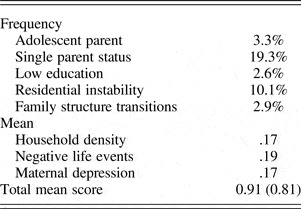
Cumulative risk included eight factors: adolescent parent, single parent status, low education, residential instability, family structure transitions, household density, negative life events, family conflict, and maternal depression. A total family adversity score was the sum of all of the component factors. Dichotomous scores were scored 0 = not present, 1 = present. Continuous scores were converted into proportions of the total possible score so that they ranged from 0 to 1, and thus, were weighted equally with the dichotomous variables. Percentages of those with at-risk levels, proportion scores, and the total cumulative risk scores are reported in Table 1.
Descriptive frequencies for individual risk factors, cumulative risk total, and correlations among cumulative risk

Mothers reported their age at the time of the study child's birth, and were considered an adolescent parent if they were 19 years or younger when the child was born. At each visit, mothers reported on their marital status, and families were identified as single-parent families if the mother indicated she was never married, currently widowed, separated, or divorced, or living for less than 1 year with a live-in partner. Mothers reported on their educational attainment. Risk was indicated by mothers' not graduating from high school. Residential instability was indicated by the family changing households three or more times in the previous 3 years. Family structure transitions were indicated by mothers reporting being divorced in the child's lifetime. Household density was calculated as the number of individuals living in the family home divided by the total number of rooms in the family home. The score was converted to a proportion of the highest score in the sample across all time points.
Negative life events
Negative life events were assessed with parent report on the General Life Events Schedule for Children (Sandler, Ramirez, & Reynolds, Reference Sandler, Ramirez and Reynolds1986), previously shown to have significant associations with child adjustment (Lengua & Long, Reference Lengua and Long2002). The 29 events include a range of moderate to major negative events, including changing schools, death of a family member or friend, parental arrest, or loss of friends or pets. Parents reported the occurrence of events within the previous 9 months, and total scores were the number of events that occurred. The total score was converted into a proportion of the possible 29 events.
Parents reported on their own depressive symptoms over the previous month using the 20-item Center for Epidemiological Studies Depression Scale (Radloff, Reference Radloff1977), a widely used self-report scale designed to measure depressive symptoms in the general population. Participants indicate whether each symptom was present on a scale of 0 (rarely or never) to 3 (most of the time), and the items were summed for a total score, with higher scores indicating higher levels of depression. Internal consistency was 0.88. The total score was converted into a proportion of the total possible score of 60.
Results
Analytic plan
Prior to testing our specific aims, we examined whether cortisol collection compliance variables were associated with morning and diurnal values and examined preliminary correlations between morning and diurnal slope levels with cumulative risk and income across 27 months. Next, in line with our study aims, we examined the stability of cortisol morning level and diurnal slope patterns across four time points. To address the second aim, we used a latent profile analysis to identify cortisol morning level and diurnal slope profiles across four time points in order to determine whether there were the hypothesized profiles of children with consistently higher levels, lower levels, or fluctuating levels across the four time points. The probabilities associated with profile membership were then correlated with income, cumulative risk, and individual risk factors across the four time points.
Cortisol collection protocol compliance
Mothers' reports on saliva collection time, the latency from children's wake time to morning collection time, and the latency from evening collection time and bed time were examined as potential covariates of the diurnal cortisol values. Collection time for a.m. and p.m. sampling and collection latencies were averaged across the 3 days of saliva sampling within each time point. The four average sampling times and latencies at each time point (a.m. collection time, p.m. collection time, a.m. latency to collect, p.m. latency to collect) were then correlated with average cortisol morning and diurnal slope from the corresponding time point. There were few significant associations. Time 1 morning cortisol levels were modestly associated with Time 1 later a.m. collection time (r = –.17, p =.005) and longer a.m. latency to collect (r = –.14, p = .039). In addition, Time 3 diurnal slope was correlated with Time 3 p.m. latency to collect (r = –.18, p = .005). Given the few and modest associations among collection times and cortisol levels, bias introduced due to collection times was deemed to be minimal.Footnote 1
In addition, health, medication, and food ingestion were examined in relation to cortisol values. Overall, there were fewer significant correlations than would be expected by chance, with no systematic pattern and modest magnitudes. Therefore, no cortisol collection compliance variables were included as covariates.
Preliminary analyses
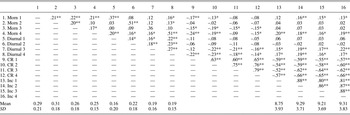
Income and cumulative risk were highly stable across time, thus supporting our aim of only examining Time 1 income and cumulative risk with the profiles (Table 2). Lower income was related to lower morning cortisol only at Time 4 and flatter diurnal slope at Times 3 and 4. Higher cumulative risk was significantly related to lower morning cortisol levels at Times 1, 3, and 4 and with flatter diurnal slope levels at Times 3 and 4.
Correlations, means, and standard deviation of log transformed morning and diurnal cortisol levels, cumulative risk scores, and income from Times 1 to 4
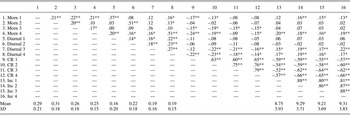
Note: Morn 1–4, Morning cortisol values for Times 1–3; CR 1–4, cumulative risk for Times 1–4; Inc 1–4, income for Times 1–4.
Aim 1: Examine the stability of cortisol morning level and diurnal slope
The first aim of this study was to examine stability of cortisol morning level and diurnal slope across four assessments each separated by 9 months during the preschool period. Morning level and diurnal slope values for Time 1–4 are reported in Table 2. Correlations among morning level values ranged from r = .17 to .22 (all ps < .05). Correlations among diurnal slope values ranged from r = .14 to .27 (all ps < .05). This suggests that there is modest rank-order stability in morning level and diurnal slope values.
Aim 2: Identify latent cortisol morning level and diurnal slope profiles
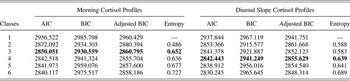
To test the second aim, we used latent profile analysis. Beginning with a one-class model, classes were iteratively added until the addition of a class did not improve model fit (Table 3). Full information maximum likelihood estimation was used to account for missing data when there were data available on at least one cortisol measure. Information criterion statistics were used to determine class number including the Bayesian information criterion (BIC; Schwarz, Reference Schwarz1978), adjusted Bayesian information criterion (adjusted BIC; Sclove, Reference Sclove1987), and Akaike information criterion (Akaike, Reference Akaike, Petrov and Czak1973). Both BIC (Magidson & Vermunt, Reference Magidson, Vermunt and Kaplan2004) and adjusted BIC (Yang, Reference Yang2006) have been found to be accurate statistics in different simulation studies. Entropy is reported as further evidence for our profile selection with values approaching 1.00 indicating greater distinction between classes (Celeux & Soromenho, Reference Celeux and Soromenho1996).
Latent profile analysis for morning and diurnal levels information criteria statistics
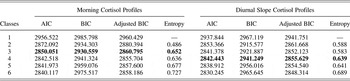
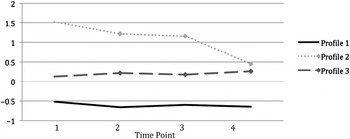
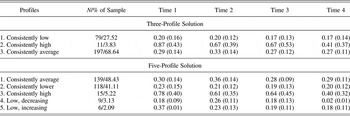
For morning cortisol levels, a three-profile solution was best supported. The results of the LPA or morning levels are presented in Figure 1, which displays the deviation of the class mean from the overall sample for cortisol morning level. The profiles and nontransformed means for the solution for morning level are presented in Table 4. Children with a high probability of membership in Profile 1 (27.52%) exhibited lower than average morning cortisol levels across all four time points (consistently lower). Children with a high probability of membership in Profile 2 (3.83%) exhibited very high morning cortisol levels at Time 1 that, although decreasing over time, were always higher than the sample mean (consistently higher). Finally, children with a high probability of membership in Profile 3 (68.64%) exhibited average morning cortisol levels across all four time points (consistently average).
Profiles of morning cortisol levels over time for the three-profile solution.

Means (standard deviations) of cortisol values (nontransformed values) associated with three-profile morning solution and a five-profile morning solution across Times 1–4
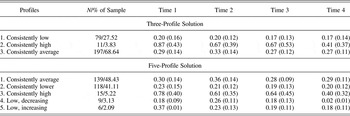
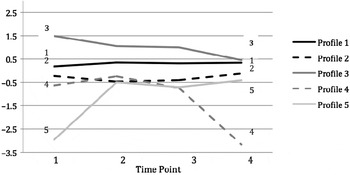
A major aim of this study was to potentially identify fluctuating cortisol levels over time. However, it was possible that few children demonstrated such a profile and those who did would fall into the average group if their levels fluctuated around the sample average across time. Therefore, we explored whether adding classes to the LPA model would identify fluctuating profiles. The addition of another profile resulted in a pattern that essentially differentiated the consistently average group into children whose cortisol levels were just below average across all time points (37.97%) or just above average across all time points (53.31%). Because adding an additional profile did not result in identifying a fluctuating profile, one more profile was added. The addition of a fifth profile resulted in the identification of two fluctuating profiles. Descriptive information on the five-profile solution for cortisol morning level is presented in Table 4 and in Figure 2. The associations of Profiles 4 (lower, decreasing) and 5 (lower, increasing) of the five-profile morning solution with income and cumulative risk are examined below (Figure 3).
Profiles of morning cortisol levels over time for the five-profile solution.

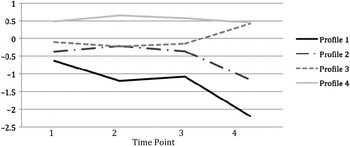
Profiles of diurnal cortisol slopes over time for the four-profile solution.

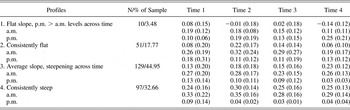
The LPA of diurnal slope resulted in four profiles with nontransformed slope values that are provided in Figure 3 and Table 5. It should be noted that a flat slope indicates that the a.m. and p.m. cortisol levels were similar, but does not reveal whether children with flat slopes have high, average, or low a.m. and p.m. levels. Therefore, in Table 5, the a.m. and p.m. nontransformed cortisol values are recorded underneath the slope value to characterize the values that comprise the diurnal slope calculation. Children with high probability of membership in Profile 1 (3.48%) exhibited lower (flatter) than average diurnal slope values (flat slope, p.m. > a.m. levels across time). In this profile, the Time 4 diurnal slope was negative, because the morning levels from Time 3 to Time 4 decreased and the a.m. cortisol values from Time 3 to Time 4 increased. There was no evidence that children in this profile had flat slopes composed of high a.m. and high p.m. levels. Children with a high probability of membership in Profiles 2 (17.77%) and 3 (44.95%) exhibited slightly lower than average diurnal patterns, with these profiles mainly being distinguished by their diurnal values at Time 4. Children most likely in Profile 2 had more flat diurnal slope values at Time 4 (consistently flatter), whereas children most likely to be in Profile 3 had steeper diurnal slope values at Time 4 (lower average slope, steepening across time). That is, the diurnal slope values of children likely to be included in Profile 3 increased at Time 4. Finally, children with a high probability of membership in Profile 4 (32.66%) exhibited higher than average (steeper) diurnal slope values across time (consistently steep). Profile 4 had similar Time 4 diurnal slope values as children in Profile 3.
Means (standard deviations) of diurnal, a.m., and p.m. cortisol values (nontransformed values) associated with four-profile diurnal solution across Times 1–4

Note: A higher slope value indicates a steeper slope.
Aim 3: Relations of Time 1 income and cumulative risk with morning and diurnal profiles
Both higher and lower morning levels and blunted diurnal slopes are thought to indicate cortisol patterns potentially associated with risk. In addition, it is possible that fluctuating levels could also indicate exposure to risk. Because low income and cumulative risk tend to be indicators of pervasive and chronic risk, we hypothesized that they would be related to profiles of lower morning levels and blunted diurnal cortisol. We explored whether income and cumulative risk were also related to fluctuating levels. Prior to testing these hypotheses, we created quadratic income and cumulative risk scores at Time 1. Income and cumulative risk were mean centered and then squared. Lower values indicate children from average income and cumulative risk backgrounds. Higher quadratic values indicate children from either low or high income and cumulative risk backgrounds.
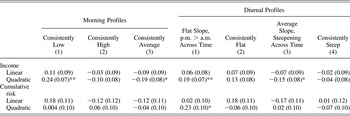
To accomplish Aim 3, we employed a total of seven multiple regression models to test whether there were direct or curvilinear relations of income and cumulative risk with profiles of cortisol morning level and diurnal slope (Table 6). Income, cumulative risk, and their quadratic terms were entered simultaneously in regressions predicting probabilities of profile inclusion.
Standardized regression coefficients and standard errors reported from multiple regression models of income and cumulative risk predicting morning and diurnal cortisol profiles

*p < .05. **p < .01.
Membership in morning Profile 1 (consistently lower) was predicted by the quadratic income term, suggesting that both high and low income predicted profile membership. In contrast, membership in morning Profile 3 (consistently average) was inversely related to the quadratic income term, suggesting that average income predicted consistently average cortisol levels over time. In regard to the diurnal profiles, membership in diurnal Profile 1 (flat slope, p.m. > a.m. levels across time) was predicted by the quadratic income and cumulative risk terms. Again, this suggests that both high and low income and cumulative risk predicted this profile membership. Finally, membership in Profile 3 (lower average slope, steepening across time) was inversely related to the quadratic income term. Thus, average income was related to diurnal slopes that increased in steepness.
Discussion
This study sought to identify patterns of HPA-axis functioning across the preschool period to determine whether patterns of elevated, lower, or fluctuating cortisol morning levels or diurnal slopes were associated with income and cumulative risk. LPA allowed the identification of homogenous subgroups, further elucidating (a) the patterning of cortisol levels across preschool in a normative sample, and (b) whether there was a pattern between low income and environmental risk predicting HPA-axis functioning. The majority of children in this sample exhibited stable patterns of morning cortisol levels and diurnal slopes across assessments, including morning or diurnal levels that represented average, lower, or higher cortisol levels. Our exploratory five-profile morning solution revealed that fluctuating profiles did emerge.
Developmental course of cortisol profiles
An important contribution of this study was our ability to examine the consistency of diurnal cortisol morning levels and slopes across the preschool period. The study measured cortisol at four time points separated by 9 months each, providing multiple observations within a period of rapid development. This study provides initial evidence regarding consistent morning levels and slopes across longer time intervals, elucidating the developmental course of diurnal cortisol within a community sample. The overall pattern of results suggests that over time, this sample was characterized by modest rank-order stability in children's levels, which is consistent with evidence from other studies that demonstrate modest stability (Laurent, Ablow, & Measelle, Reference Laurent, Ablow and Measelle2012).
In addition, the study design and sample characteristics provided the opportunity to examine specific patterns of preschool-age children's profiles of HPA-axis functioning including elevated, blunted, or fluctuating levels. Our expectation that the LPAs would identify a fluctuating profile stemmed partially from the allostatic load theory, which posits that after prolonged exposure to stress, individuals shift from hyperresponding to a downregulated response (McEwen, Reference McEwen1998a). The LPA results identified profiles that had elevated and blunted levels across time that may have resulted because of the high stability of income and cumulative risk (see Table 2). Without significant changes to family income or cumulative risk factors, it is not surprising that children's cortisol levels and slopes demonstrated stability. However, by expanding the number of profiles in an exploratory aim, we were able to identify a small percentage of children who exhibited fluctuating profiles. Specifically, two forms of fluctuating morning cortisol profiles included profiles that decreased from average to lower levels across time and those that increased from very low to average levels across time.
Income, cumulative risk, and HPA-axis functioning
In Aim 3, we examined the pattern of relations between income and cumulative risk with diurnal cortisol morning level and slope patterns. We explored whether there may be an association between a curvilinear pattern of environmental risk with morning and diurnal cortisol levels. We found that both lower and higher levels of income and cumulative risk were associated with lower morning levels and flatter diurnal slopes or even a slope pattern that inverts (higher p.m. than a.m. levels at Time 4) across time.
It is interesting to consider how the present findings may be interpreted within the BSC or ACM models. For instance, the observation that children within high- and low-risk environments were more likely to exhibit lower morning cortisol levels would be inconsistent with the BSC and ACM models. The BSC and ACM models would predict that these environments would be related to average to higher levels of cortisol reactivity/responsivity. However, it should be noted that the present study did not set out to explicitly test the BSC and ACM models, which typically examine how reactive physiological profiles (typically measured in a reactivity task) in the context of environmental risk predict behavioral outcomes. Rather, the present findings speak to the physiological outcomes associated with very low and very high environmental risk factors. Without behavioral indicators to corroborate the meaning of the cortisol levels observed, and by using basal and not reactivity measures of cortisol, it is difficult to know if the low morning or flattened diurnal patterns signify “reactive” HPA-axis patterns as described in the BSC and ACM models. Nonetheless, the findings are suggestive of two potential interpretations. There is evidence to suggest that children from low- and high-income backgrounds actually share certain risk factors, such as isolation from their parents (Luthar, Reference Luthar2003). Thus, this would suggest that traditionally low-risk environments as well as high-risk environments both confer risk factor for reactive HPA-axis functioning, such as lower morning levels or flattened diurnal slopes. Alternatively, the lower morning and flatter diurnal profiles may signify different patterns of HPA-axis functioning, as predicted by whether children associated with these profiles are from low- or high-income backgrounds. For instance, lower morning and flattened diurnal patterns could be indicative of allostatic load in children from low-income and environmentally risky backgrounds. In contrast, these same cortisol profiles could be signs of low physiological reactivity from children who experience little stress. Finally, it is possible to interpret lower morning and flattened slopes within models of chronic stress (Miller, Chen, & Zhou, Reference Miller, Chen and Zhou2007), in which the HPA axis downregulates. However, this interpretation would only apply to children in high-risk environments.
Finally, it is interesting to note that the pattern of relations of income and cumulative risk with the profiles was similar, even though their effects were tested simultaneously and represent independent effects. While many studies include low income as one of the factors accounted in a cumulative risk indicator, it is also important to examine the effect of income separately from cumulative risk (Evans & English, Reference Evans and English2002) because income may serve as a marker or proxy for the accumulation of environmental risk factors.
Strengths and limitations
Study strengths include a sample that utilized the full distribution of income, oversampling preschool-age children from poverty and low-income backgrounds, a comprehensive cumulative risk measure, and diurnal cortisol collection on 3 days per time period across four repeated assessments, occurring at 9-month intervals. Together, these strengths made this particular sample ideal to address gaps in the current literature regarding the stability of cortisol during the preschool period, as well as the risk factors that contribute to changes in HPA-axis functioning.
This study was also limited by several factors. The most rigorous studies on diurnal cortisol patterns use MEMS caps, which are used to monitor sampling times and adherence to collection protocols. Using MEMS caps would have strengthened evidence that flat diurnal slopes were not obtained because parents sampled both a.m. and p.m. at the same time. Although MEMs caps were not utilized in this study, we utilized other strategies to ensure that families adhered to protocol. These included training mothers on collection techniques, conducting trouble-shooting calls on intended days of collection, reviewing returned diary cards and collection tubes for improper collection, and emphasizing to mothers that incorrect sampling procedures should be reported without loss of benefit to them. Although several steps were taken to minimize the likelihood that noncompliance may partially explain the relation between environmental risks with profiles, it is impossible to entirely rule out this possibility. Another limitation of this study pertains to the challenge of interpreting flat diurnal slopes, because a score near zero, indicating nearly equivalent a.m. and p.m. levels, cannot represent the actual level of cortisol. This is problematic because low a.m. and low p.m. versus high a.m. and high p.m. have different relations with psychological outcomes, such as depression being related to higher a.m. levels in adolescents (Halligan, Herbert, Goodyer, & Murray, Reference Halligan, Herbert, Goodyer and Murray2004). To address this limitation, we provided descriptives (Table 5) to determine what the a.m. and p.m. values were that ultimately computed the diurnal slope score. The means and slopes for each diurnal cortisol profile provide evidence that flat slopes were driven by low a.m.–low p.m. levels. Despite these steps, it is possible that individuals with a flat, but high slope were included in other profiles, which prevents the present study from explicitly examining these potentially meaningful types of profiles.
Of many potential directions for future research that could stem from these findings, three are particularly crucial. First, although the present study focused on preschool-age cortisol levels across time, future work should examine children's intraindividual variability. It may be fruitful to consider variability within an individual at each time point in relation to their own mean level (as measured by Laurent et al., Reference Laurent, Ablow and Measelle2012; Shirtcliff et al., Reference Shirtcliff, Granger, Booth and Johnson2005) as opposed to variability or fluctuation between individuals, as most studies, including the present one, examine. Second, future research should explore family processes that may serve as mechanisms by which low income and cumulative risk “get under the skin.” Testing family processes allows us to further understand the mechanisms by which environment impacts physical and mental health outcomes. Furthermore, family processes, such as parenting, may be more variable than income and cumulative risk measures. A third future direction would be to test how these profiles related to the emergence of mental health symptoms in children. This last point is important because it would provide evidence that lower morning levels or flatter diurnal slopes represent HPA-axis dysregulation with implications for children's adjustment. Although we commonly view elevated or lowered cortisol levels as problematic, caution must be used when making this inference. Very few studies have examined all aspects of a comprehensive model in which environmental risk impacts neuroendocrine systems, which in turn has implications for children's adjustment outcomes. Tests of such a model are required to draw conclusions about whether certain levels or profiles of diurnal cortisol represent “maladaptive” HPA-axis functioning. Our field is far from understanding the long-term effects of what exhibiting certain cortisol profiles in preschool means for the future of any particular individual.
Overall, these results demonstrated that income and cumulative risk tend to be stable and that it is consistently associated with poorer HPA-axis responding, as indicated by fluctuating morning and diurnal slopes across time. Therefore, in addition to hyper- and hypocortisol profiles, fluctuating levels may also result from at-risk family environments. These results are consistent with the growing body of literature that demonstrates environmental risk is detrimental to children's HPA axis.