


INTRODUCTION
Social sciences scholarship has established over the last century that kinship-based institutions undermine state building. For instance, Weber ([1915] Reference Weber1951, 237) argues that the state needs to “shatter the fetters of the sib [the extended family].” Migdal (Reference Migdal1988, 269) maintains that strong states emerge only when massive dislocation severely weakens traditional kinship-based institutions. Fukuyama (Reference Fukuyama2011, 51) likewise contends that state building represents “a transition from kinship-based forms of organization to state-level organization.” Acemoglu and Robinson (Reference Acemoglu and Robinson2019, 18) consider communities with strong kinship-based institutions to be trapped in a “cage of norms,” which prevents the birth of a strong Leviathan. In the same vein, Henrich (Reference Henrich2020, 159–61) argues that the rise of so-called Western Educated Industrialized Rich Democratic (WEIRD) states can be traced back to the medieval era when the Catholic Church dissolved extended family networks.
However, kinship-based institutions have coexisted with centralized state institutions throughout human history. A group of Norman aristocrats, bound together by kinship ties, ruled medieval England (Bates Reference Bates2017, 26–7). In precolonial sub-Saharan Africa, kinship ties were prevalent in what Fortes and Evans-Pritchard (Reference Fortes and Evans-Pritchard1950, 5–7) call “centralized” kingdoms such as the Zulu, Ngwato, Bemba, Banyankole, and Kede. Imperial China, one of the world’s earliest bureaucratic states (Stasavage Reference Stasavage2020, 138–49), boasted strong lineage organizations (Perry Reference Perry1980, 60).
This article analyzes the conditions under which kinship-based institutions are compatible with state building. I argue that geographically dispersed kinship networks cross-cut local cleavages and incentivize elites to unite in pursuit of national, rather than sectarian, goals. Elites embedded in such dispersed networks can benefit from a strong central state, which generates scale economies in providing protection and justice throughout a large territory. Therefore, dispersed kinship networks transcend parochial interests to align the incentives of self-interested elites in favor of state building. It is thus the type, rather than the existence, of kinship-based institutions that matters for state building.
Systematic, individual-level data on elite views of critical state-building events are difficult to obtain. Most empirical evidence on state building comes from medieval or premodern Europe; I contribute to this literature by compiling data from imperial China. China accounts for a large share of the world’s population and economy and was a pioneer in state formation millennia ago (Hui Reference Hui2005). Its well-preserved historical records enable us to analyze politician-level behavior. Thus, the Chinese state constitutes a useful, yet understudied, alternative to the Eurocentric literature.
I compiled an original dataset that includes individual-level information on all the major politicians during what was arguably China’s most important state-building reform, which occurred during the Northern Song Dynasty (960–1127). China faced severe external threats from the nomads in the North during this time, which motivated the emperor to initiate a reform to strengthen the state’s fiscal and military capacities. However, politicians diverged on their attitudes toward the reform: some became state builders, whereas others formed the opposition. The emperor’s strategy to keep both camps in power to play them against each other allowed them to publicly express their policy preferences. I use archival materials, such as policy deliberations submitted to the emperor, to document the political allegiances of major central officials during this reform era.
Mapping elite kinship networks from a thousand years ago presents a formidable challenge. I use a novel archeological source: tomb epitaphs.Footnote 1 The tomb epitaphs included lengthy eulogies containing information on several generations of the deceased individual’s kin members. I geocoded every kin member’s hometown to construct an index that measures the geographic concentration of each politician’s kinship network. I used a variety of approaches to address missing data problems inherent in historical research, including multiple imputation and randomly assigning a value. My statistical tests demonstrate that politicians’ support for state building is positively correlated with the geographic span of their kinship networks. In other words, the more dispersed their extended family, the more likely politicians are to advocate a strong state.
This correlation is driven by what Hirschman (Reference Hirschman1958, 100) calls “forward linkage” effects. Forward linkages are created when investment in a particular activity encourages investment in subsequent activities. For instance, elites create such linkages when they build kinship networks, a form of patronage sharing and risk mitigation, to perpetuate their power and alleviate uncertainties. These networks can “lock” politicians into future state-building preferences even after the initial impetus to create the networks has passed. In imperial China, politicians’ kinship networks, often handed down from earlier generations, shaped how they weighed their family’s future interests vis-à-vis state interests.
Padgett and Ansell (Reference Padgett and Ansell1993, 1310) point out that to understand state building, one needs to “penetrate beneath the veneer of formal institutions and apparently clear goals, down to the relational substratum of people’s actual lives.” Social science research has long emphasized the influence of social networks (e.g., Putnam Reference Putnam1993) and “social embeddedness” (Granovetter Reference Granovetter1985) on elite behavior. Recent works demonstrate that network structures shape political incentives (Cruz, Labonne, and Querubin Reference Cruz, Labonne and Querubin2020; Naidu, Robinson, and Young Reference Naidu, Robinson and Young2021). To the best of my knowledge, this article is the first to introduce a theoretical argument supported by quantitative evidence linking the geography of elites’ kinship networks to their state-building preferences.
This article is related to the contribution of Jha (Reference Jha2015), which shows that overseas shareholding aligned the incentives of various elites during England’s Civil War (1642–1648) to cobble together a pro-reform coalition in favor of parliamentary supremacy. I focus instead on kinship networks, which were prevalent in premodern societies and remain prominent in many developing countries (Cruz, Labonne, and Querubin Reference Cruz, Labonne and Querubin2017; Mattingly Reference Mattingly2016; Tsai Reference Tsai2007; Xu and Yao Reference Xu and Yao2015). My approach “brings people back into the state” (Levi Reference Levi, Katznelson and Milner2002, 37) and introduces a novel rationale for explaining why politicians prefer different degrees of state strength.
Many previous studies assume that if politicians face common threats, they will act together to strengthen the state (Slater Reference Slater2010; Tilly Reference Tilly1992). However, I show, that politicians vary in their state-building preferences even when they face severe external threats. Thus, this study advances an emerging elite-centered literature on state building that includes Blaydes and Chaney (Reference Blaydes and Chaney2013), Soifer (Reference Soifer2015), Garfias (Reference Garfias2018), Beramendi, Dincecco, and Rogers (Reference Beramendi, Dincecco and Rogers2019), and Suryanarayan and White (Reference Suryanarayan and White2021). Although most of these studies emphasize elite competition, I focus on elite social relations. Therefore, I offer a nuanced view of the state–society perspective: although this approach tends to treat the state and society as separate competing entities (Acemoglu and Robinson Reference Acemoglu and Robinson2019; Migdal Reference Migdal1988; Shue Reference Shue1988), I show that whether social institutions strengthen the state depends on state–society linkages. Footnote 2
THE ARGUMENT
Kinship-based institutions came before the state and have been resilient throughout human history. Individuals of common descent banded together to reduce the costs of acting alone (Greif Reference Greif2006, 308). State–society scholars believe kinship-based institutions compete with the modern state to create “rules of the game” (Migdal Reference Migdal1988, 14). For example, extended families use a variety of sanctions and rewards to induce people to behave according to what Fukuyama (Reference Fukuyama2011, 49) calls “the tyranny of cousins” rather than to follow state rules.
I argue that kinship institutions, under certain conditions, incentivize elites to strengthen the state. An important distinction is whether members of extended families (and thus kinship networks) are geographically dispersed or concentrated.
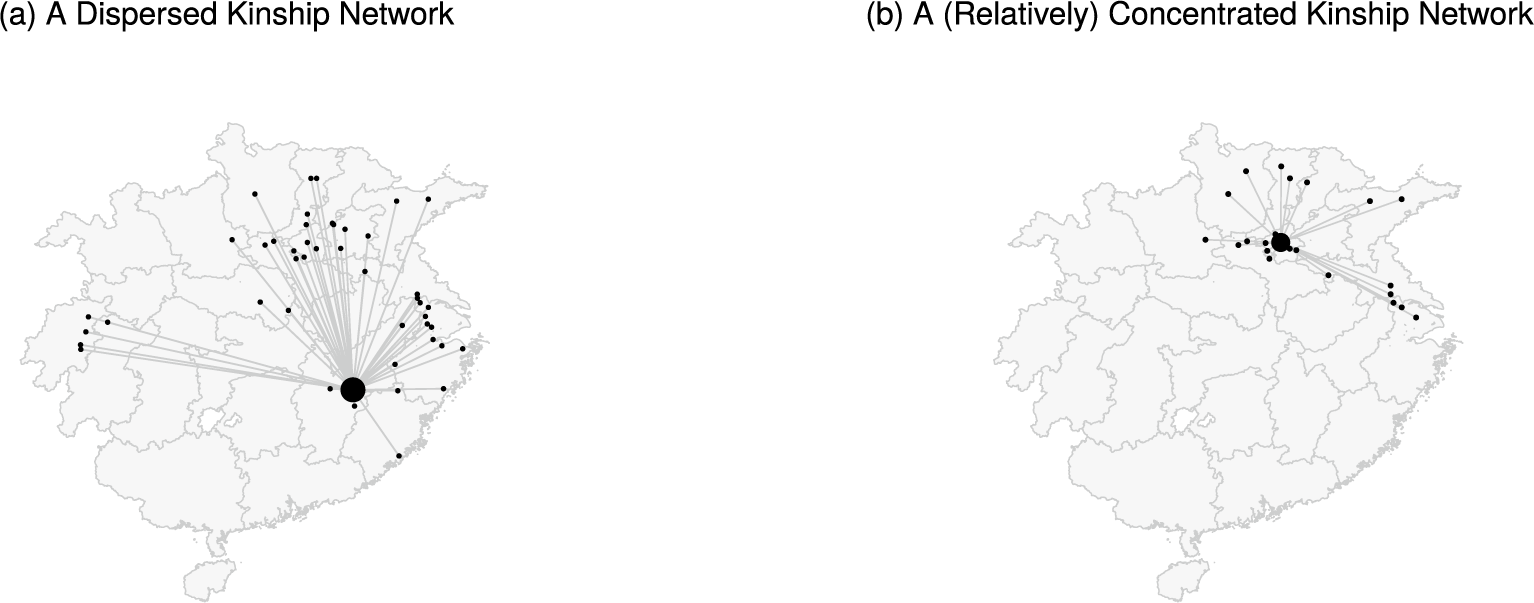
Compare the two kinship networks in Figure 1, which are drawn from real examples that I describe in more detail below. Panel (a) shows a dispersed network in which the elite, whom I refer to as the ego (denoted by the large circle in the figure), has kin (small dots) located all over the country. Panel (b) depicts a relatively concentrated network in which the ego has kin mostly located in nearby provinces.
Examples of Kinship Networks
Note: The large circles represent the locations of the egos, and the small dots show the locations of their kin. The lines represent kinship ties.

Elites form these kinship networks to mitigate costs and share risks.Footnote 3 These networks in turn create “forward linkages” that induce individuals to engage in activities to preserve them. I argue that the type of network they create (e.g., dispersed vs. concentrated) shapes elites’ preferences regarding state strength because some state-building outcomes are more beneficial than others to their kinship networks. In this way, the networks can shape elites’ preferences on new issues, such as state building, long after the initial impetus to create the networks has passed.
My argument starts with the assumption that elites are agents of their kinship groups; their objective is to influence government policies to provide the best services to their groups at the lowest possible cost. These services include defense against external and internal violence, insurance against uncertainties, and justice in dispute resolution (North Reference North1981, 23). Two governance structures, public-order institutions (such as the state) and private-order institutions (such as kinship organizations), are the leading alternatives for providing such services.Footnote 4
Elites embedded in dispersed kinship networks have a strong incentive to use the state to provide these types of services to their kinship groups. Two considerations drive elites’ choices. The first is economic: it is more efficient to rely on the central state to provide services because the state enjoys economies of scale and scope (Alesina and Wacziarg Reference Alesina and Wacziarg1998; Ferejohn and Rosenbluth Reference Ferejohn and Rosenbluth2010).Footnote 5 Where the central state is strong, it is much cheaper to cover an additional territory in which a connected kinship group is located than to rely on the group to provide its own security and justice.
The second consideration that motivates elites’ decisions is social. Kinship groups that are concentrated in a certain locality often care a lot about their local interests but little about national matters. For example, they oppose paying taxes to the central state because the state will deliver services to all parts of the country and these kinship groups would end up paying for services provided to others. Thus, these geographically defined kinship groups create regional cleavages that produce distributive conflicts. Nevertheless, if elites can connect multiple geographically dispersed kinship groups, this social network will cross-cut regional cleavages.Footnote 6 These cross-cutting cleavages incentivize elites to aggregate the interests of multiple localities and groups and scale them up to the national level. Therefore, dispersed kinship networks transcend parochial interests and foster a broad state-building coalition.
However, geographically concentrated networks reinforce existing regional cleavages. In this case, it is more efficient for members of local kinship groups to rely on private-order institutions for protection and justice because the marginal costs of funding kinship organizations to service a local area are relatively low compared with taxes paid to support the central state. Therefore, elites embedded in concentrated networks would oppose strengthening the central state because such policies would divert resources from kinship groups to the state and weaken their local power bases.
Elites embedded in dispersed versus concentrated networks follow patterns that are similar to those that Olson (Reference Olson1982, 48) describes as encompassing versus narrow interest groups. Elites in a dispersed network have encompassing interests because they represent multiple localities, whereas those in a concentrated network become a narrow interest group that represents a small number of areas.
Cross-pressures that arise from encompassing networks incentivize elites to form a coalition that pursues national rather than sectarian goals. Elites in this situation do not create private-order institutions because it is redundant for each kinship group to set up its own local defense and provide its own public goods. Therefore, elites embedded in dispersed networks prefer to strike a Hobbesian deal with the ruler to pay taxes in exchange for centralized protection.
Such a deal provides two credible commitments: (1) between the ruler and the elites and (2) between the elites and their kin. In the first, dispersed networks strengthen elites’ bargaining power vis-à-vis the ruler. The elites are embedded in a centralized social structure in which they can use their cross-cutting ties to mobilize social forces across regions. The ruler, facing a nationally connected elite, must commit to use the state to provide public goods rather than to prey on members of society.Footnote 7 Because elites embedded in geographically concentrated networks have only regional bases of power, they can mobilize some (regionally based) social groups to capture a region or threaten secession. But it is easier for the ruler to quell challenges that are concentrated in certain areas. Second, the central state, represented by the ruler, provides an institutional commitment device between the elites and their kin. Supporting state building allows the elites to credibly commit to protecting their kin because it is harder for the central state than for kinship institutions to exclude specific group members as beneficiaries from a distance.
The state and kinship networks in this refined notion of state–society relations complement rather than undermine each other. Politicians—that is, elites who represent the interests of their kin—build a strong state and use it to provide protection and justice for their kinship networks. The main insight is that elites’ incentives to support state building increase with the geographic size of their kinship networks. This generates a testable hypothesis:Footnote 8
Hypothesis 1: A politician’s support for state building increases with the geographic size of his or her kinship network, ceteris paribus.
HISTORICAL BACKGROUND
The Northern Song Dynasty faced existential threats from the Khitan and Tangut nomadic tribes in the North; war appeared to be imminent.Footnote 9 In 1065, the state spent more than 80% of its income on defense, which created the dynasty’s first financial deficit (Smith Reference Smith, Twitchett and Smith2009, 349). Due to a shortage of able-bodied men, aged and inexperienced soldiers were hired from the flotsam of the marketplace and were unfit for combat.
To address these external threats and the resulting deficit, in 1069 Emperor Shenzong introduced the New Policies. These policies, which were later known as the Wang Anshi Reform after the cabinet member who created them, established the goal of “enriching the nation and strengthening its military power” (Liang Reference Liang1908, 165). The New Policies were designed to expand the scope of state power to intensify state participation in the market economy in order to generate a surplus that the state could then extract to fulfill its fiscal and military needs (Deng Reference Deng1997, 48). The major reform policies included the following:Footnote 10
-
• Cadastral Surveys and Equitable Tax (方田均税法). This measure sought to equalize the tax burden across localities and landowners by instituting a series of cadastral surveys. Many localities and powerful families had historically underreported their landholdings to avoid taxes (Liu Reference Liu1959, 39). The surveys revealed 34.7 million additional acres of land—54% of the national total (Smith Reference Smith, Twitchett and Smith2009, 393). The discovery of this previously untaxed land shifted some of the tax burden away from politically powerless landowners to official families with large landholdings.
-
• Military Conscription (保甲法). Before the reform, the state relied on an inefficient and ineffective mercenary army. At the local level, villages formed a variety of voluntary defense organizations to foster security. Over time, some of these private associations became private armies controlled by local elites. The reform created a formal grassroots military organization (baojia) that all households were required to participate in. The emperor intended to eventually rotate baojia troops into the national army (Williamson Reference Williamson1935, 181). In 1075, a central bureaucratic agency started to exert control over the baojia. As of 1076, there were 6.9 million men on the baojia rosters, which represented almost half of the empire’s households (Smith Reference Smith, Twitchett and Smith2009, 414).
-
• Rural Credit (青苗法). This policy created a state-run rural credit system designed to break the private credit monopoly. Previously, rural landlords had a monopoly over agricultural credit and charged high interest rates (Deng Reference Deng1997, 88). The reformers used state-run granaries to buy grains when prices were low and to resell when prices rose or in times of natural disaster. They also converted the reserves into a liquid loan fund that was to be made in the spring and repaid in the summer and fall. The government also established rules to protect borrowers from unfair official manipulation. By supplanting landlords and private moneylenders as the principal source of rural credit, the state extracted the interest that previously enriched local elites and gave peasants access to low-interest loans (Williamson Reference Williamson1935, 142–3).
-
• Labor Service (募役法). This policy imposed a tax, called a “service assistance fee,” on all households with property that wanted to avoid government labor service (Deng Reference Deng1997, 88). Before the policy, every household was obliged to undertake government service, for example as office messengers, bookkeepers, granary laborers, or local police officers. Many families were exempt by law, such as officials and town dwellers, or by practice, such as powerful local families whose influence over government clerks gave them de facto immunity (Smith Reference Smith, Twitchett and Smith2009, 400). The reform required all households eligible for drafted service to pay a tax, graduated according to their assessed wealth.
These policies successfully increased the revenues of the Song government (Smith Reference Smith, Twitchett and Smith2009, 434). Government revenue constituted 17.5% of the Song economy in the late eleventh century, which was unparalleled elsewhere in the world (Guo Reference Guo2019; Stasavage Reference Stasavage2020, 160). The entire population was organized into baojia security units, which gave the state a relatively cheap conscription system that reversed the trend toward entrusting local elites with village-level security (Smith Reference Smith, Twitchett and Smith2009, 427; Williamson Reference Williamson1935, 197).
The reformers supported the policies because strengthening the state was aligned with their family interests. For example, the reform leader, Wang Anshi, wrote in a letter to the transportation officer Ma, “It is necessary that an individual who is desirous of increasing his family resources, should be dependent for so doing upon the particular state in which he resides. It is necessary also that he who wishes to increase the financial resources of his state should depend upon the empire in order to achieve his object” (Wang [1086] Reference Wang2017, 75: 22).
However, many politicians, opposed the reform. For example, Sima Guang, Su Xun, Su Zhe, and Zheng Xia insisted that the wealthy served as the pillars of local society and the providers of capital (land and credit) and security to the people and that the society and economy functioned best when they were least burdened by the state (Qi Reference Qi1987, 1163–8). As for who should provide security, the censor Wang Yansou maintained that the prereform system was built on a solid communal foundation in which “households on duty with propertied roots in the community” were kept afloat during their period of service by local elites who came to their aid with labor and material assistance. However, under the new reform measure, state employees replaced “well-established local families” (Li [1177] Reference Li1979, 364: 8703–6). For Wang Yansou, as for Sima Guang, Zhang Fangping, Liu Zhi, and Yang Hui, only local men with property in the region could be trusted (Sima [1086] Reference Sima1937, 49: 626–8; Li [1177] Reference Li1979, 224: 5444–6, 6787–91). In the same vein, the censor Deng Runpu charged that replacing private militias with baojia guardsmen had shattered a natural defense and surveillance network built on personal relationships, leaving local communities powerless (Li [1177] Reference Li1979, 279: 6834–5). They also contended that a stronger state threatened their family’s interests because the taxation associated with state strengthening increased their household expenses. Sima Guang made the point forcefully in a debate with Wang Anshi before the emperor: “The output of the world in money and goods is of a fixed and definite amount. If it is in the hands of the state then it is not in the hands of the people” (Sima [1086] Reference Sima1937, 42: 543–5). Fan Zhen similarly argued in a memorial to the emperor, “The policy of creating and maintaining a standing army … involves the people in heavier taxation and an increase of the burden of public services… . On the contrary, the policy of raising Private Militia or People’s Corps … tends to eliminate these evils… . Taxation is lighter, and the loyalty of the people remains staunch and true” (Li [1177] Reference Li1979, 179: 48).
To maintain the balance of power between the supporters and opponents of the reform, the emperor kept both camps in court to play factions of elites against each other (Liu Reference Liu1959, 60). As the personnel minister Zeng Gongliang advised the emperor, “it is important to have people of different opinions stirring each other up, so that no one will dare to do wrong” (Li [1177] Reference Li1979, 213: 5169). Although this might have empowered the monarch, it jeopardized the fate of the reform. After the retirement of the reform’s architect, Wang Anshi, and the emperor’s death in 1085, the antireform dowager empress took power and coalesced with the opposition to gradually abolish the New Policies (Deng Reference Deng1997, 254).
POLITICIANS WITH DISPERSED VERSUS CONCENTRATED NETWORKS
Consistent with prior historical research (Bossler Reference Bossler1998; Ebrey Reference Ebrey1993), in this section I show that the migration history of politicians’ families significantly affected the geographic span of their kinship networks.
Sample of Politicians
I used two main criteria to create my sample of observations.Footnote 11 First, I focus on the major politicians who had a say in the reform process, which I define as those who held positions in the national government at the vice-ministerial level or above.Footnote 12 Second, I limit my data collection to the reign of Emperor Shenzong (1067–1085)—the period in which the Wang Anshi Reform was proposed, implemented, and debated—which allows me to examine a sample of comparable contemporaries.
Using these criteria, I identify 137 major politicians from Li’s (Reference Li2003) list of Shenzong officials. These politicians include chief councilors, central secretariats, leaders of various ministries, and the emperor’s main advisors.Footnote 13 They were all male, Han Chinese, and from landowning elite families. They were, on average, 51 years old in 1067.Footnote 14 On average, they started their political careers in 1047—20 years before Shenzong came to power. Their average bureaucratic rank was ministerial.
Mapping Kinship Networks
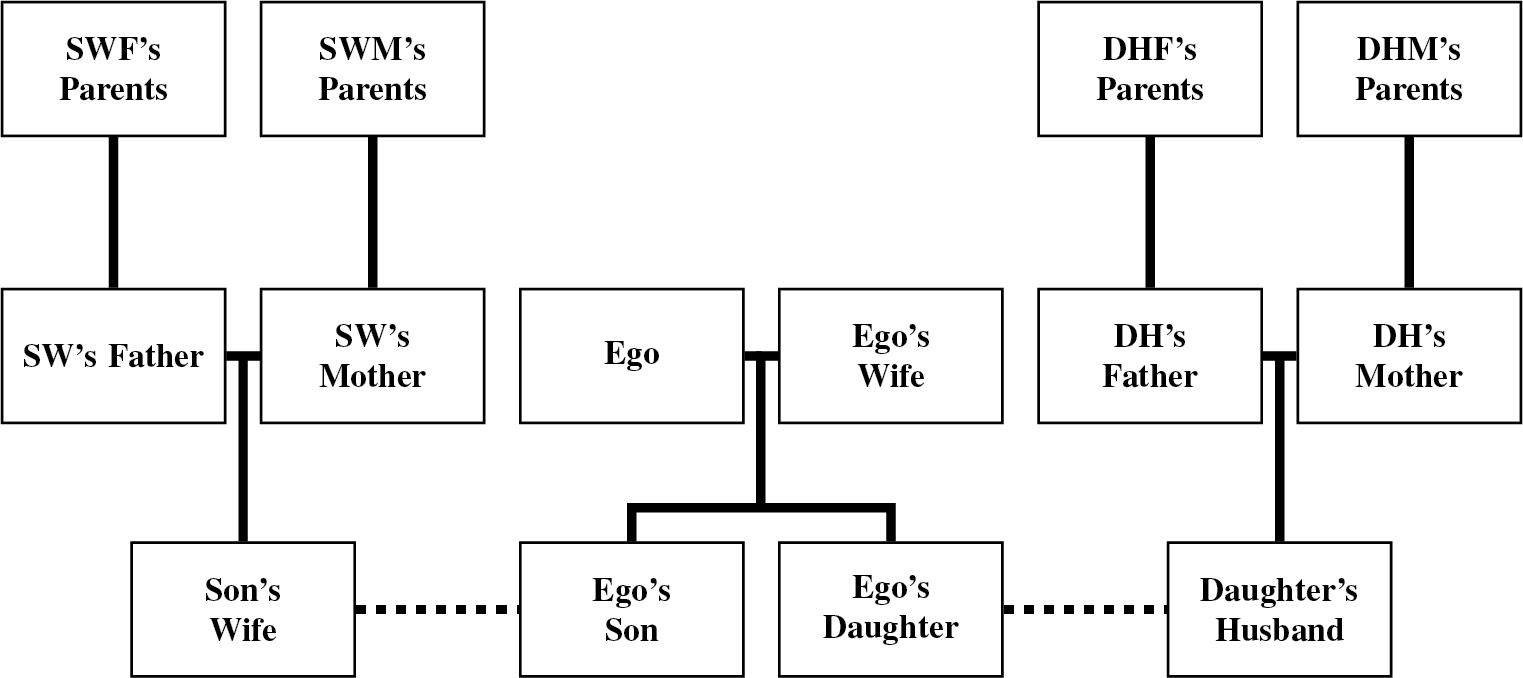
I construct a variable—Local concentration of kin—to measure the geographic concentration of each politician’s kinship network. Each network consists of two components—the politician’s nuclear family and all in-laws who were connected by marriage to his son(s) or daughter(s). Figure 2 presents an example of a kinship network. Including both blood and marriage ties in the kinship network follows from a reasonable assumption. Marriages in imperial China, especially among elites, were transactional and arranged to maximize power and mitigate risks. These marriage ties required effort and attention to garner favor, foster trust, and negotiate mutually beneficial action plans for specific political agendas that would likely expand family fortunes in the long term. Thus, marriage ties mattered as much, if not more, than blood ties.
Example of a Kinship Network
Note: SW = son’s wife; SWF = son’s wife’s father; SWM = son’s wife’s mother; DH = daughter’s husband; DHF = daughter’s husband’s father; DHM = daughter’s husband’s mother. Solid lines represent blood relations, and dashed lines denote marriage ties.

I focus on marriage ties built via son(s) or daughter(s) because these connections best represent politicians’ “forward linkages.” Song-era politicians made political alliances by intermarrying. According to Bossler (Reference Bossler1998, 78), “the majority of connections” between high-level politicians “consisted of marriages between their descendants, especially their children.” The politicians’ families arranged these marriages before the reform started. Given that males typically married and had their first child in their late teens during the Song era (Ebrey Reference Ebrey1993, 75), by the time the reform was introduced, the children of most politicians in the sample were already married. Engagements occurred even earlier, when children were infants or even before they were born (Ebrey Reference Ebrey1993, 63). Although the marriage ties were formed before the reform, after it started politicians calculated which state-building outcomes would best serve their kinship networks. As there is generally a lag between a policy’s implementation and its effects, politicians at time t calculated how their kin would benefit from the policies at time t + 1, which coincided with their children’s generation.Footnote 15
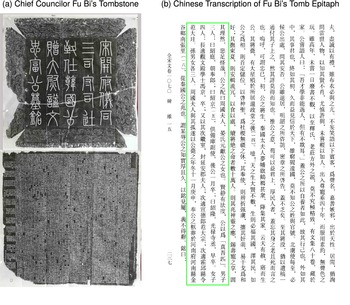
I use the detailed information provided on tomb epitaphs to map elite kinship networks. Tomb epitaphs in the Song period consisted of square slabs of limestone on which the biographies of the deceased were inscribed. Because the epitaphs were deemed a literary genre, the texts of hundreds of them survive in the collected works of Song-era writers and are included in The Complete Prose of Song (全宋文) edited by Zeng and Liu (Reference Zeng and Liu2006). The tomb inscriptions are rich with information of interest to historians (Tackett Reference Tackett2014, 13). They contain lengthy eulogistic passages, which almost always include the surnames of their wives and generally provide the names (and ranks, if applicable) of their sons and sons-in-law. These conventions—especially where more than one member of the network is eulogized—allow researchers to reconstruct descent lines and affinal connections over several generations (Bossler Reference Bossler1998, 11). Figure 3 shows the tomb epitaph of Fu Bi—a chief councilor under Shenzong.
Tomb Epitaph Example
English Translation: His excellency (Fu Bi) married the daughter of Yan Shu. She was virtuous, calm, and restrained. They had three sons: Fu Shaoting, Gentleman for Court Service; Fu Shaojing, Deputy Commissioner of Storehouse; Fu Shaolong, Aid in the Court of Imperial Entertainments. They had four daughters: the first married Feng Jing, Scholar in the Institute for the Extension of Literary Arts; after she died, the second daughter married Feng Jing; the third daughter married Fan Dazong, Court Gentleman for Instruction; the fourth daughter married Fan Dagui, County Magistrate of Huoqiu.

My research team first found all available tomb epitaphs of the major politicians from The Complete Prose of Song and manually identified each politician’s wife, son(s), daughter(s), and son(s)-in-law. We then searched in The Complete Prose of Song to determine whether the family members’ epitaphs were preserved. We used the snowball approach and consulted CBDB (2018) to collect information on 68 politicians’ kinship networks.Footnote 16 Due to cost limitations, we stopped after three generations—the politician’s parents’ generation, the politician’s generation, and the politician’s children’s generation. I controlled for the number of recorded kin in regressions to deal with the possibility that some politicians’ networks were better documented than others. For the remainder of the sample that has missing kinship information, I used listwise deletion in the main analysis and multiple imputation in the robustness checks.Footnote 17
The tomb epitaphs and CBDB (2018) also specified each individual’s hometown. I geocoded each kin member using CHGIS (2018), which provides the latitudes and longitudes of Song localities.
Recall Figure 1, which illustrates two real examples of kinship networks. Panel (a) shows that the relatives of the reform leader Wang Anshi were scattered all over the country, and Panel (b) indicates that those of Lü Gongzhu—an opposition leader—were located mostly in nearby provinces.
I then constructed an index using the “market potential” approach, which the economic geography literature employs to measure market localization (Harris Reference Harris1954). Local concentration of kin for politician i is defined as
 $ {\sum}_{k\in K}{\left(1+{distance}_{i,k}\right)}^{-1}, $
where distancei,k is the “as the crow flies” distance (in kilometers) from politician i to his kin k. The set K includes all kin members of i. The underlying logic is that this index of local concentration increases for politicians whose kin live closer to them. The index does not rely on administrative units, which are different sizes and often determined by time-variant, arbitrarily drawn borders.Footnote
18 I show in the robustness checks that my results do not depend on this measure: a weighted Herfindahl index—which relies on administrative units—obtained similar results.Footnote
19 I also obtained the same results by transforming the index using its inverse hyperbolic sine or square root,Footnote
20 weighting the index by the number of children a politician had,Footnote
21 giving different weights to different kin members, and considering the ruggedness of the terrain where the kinship network is located.
Dispersed versus Concentrated Networks
Chinese elites had a strong incentive to marry locally in the Song era. China began using civil service examinations to recruit bureaucrats during this time.Footnote 22 To screen out men who had a bad reputation, Song emperors asked prominent local elites to vouch for prospective candidates before they could sit the initial exam (Hartwell Reference Hartwell1982, 419). Therefore, the exam system created strong incentives for local landowning elites to contract marriage alliances with notable local neighbors (Hymes Reference Hymes1986, 103) and brought many locally marrying elites into the central government.Footnote 23
Song elites made local marriage alliances with families of at least roughly equal standing—marriages of “matching gates” in Chinese parlance (Bossler Reference Bossler1998, 82). As a family’s political status rose, however, affines of similar rank became rarer in the neighborhood, so the family had to look further afield to find an appropriate match.
Relatives’ migration provided opportunities to connect families of equal status in distant areas. Song politicians rotated among localities other than their hometowns (Smith Reference Smith, Twitchett and Smith2009, 357–8). Even after serving in the capital, many politicians retired in the provinces (See, e.g., Deng Reference Deng1997, 239). Several politicians spent a long time in a province far from home and made it their permanent residence (Ebrey Reference Ebrey1993, 66). Their marriage alliances with the local families enabled them to build local political networks, gain social support, and mitigate risks (Bossler Reference Bossler1998, 170). Bossler (Reference Bossler1998, 160) remarks that when a crisis occurred, nearby affinal relatives (those linked through marriage) may have been more able to help than remote agnates (those related by blood).
Therefore, I expect a politician’s family migration patterns to be associated with the geographic span of his kinship networks. I trace family migration patterns using information from the tomb epitaphs and CBDB (2018). I focus on the politician’s father, because he would have played an important role in matchmaking for his grandchildren (Ebrey Reference Ebrey1993, 69), which formed the politician’s kinship network. Father migration is the as the crow flies distance (in kilometers) from the father’s final residence to the grandfather’s hometown.
Table 1 shows the ordinary least squares (OLS) estimates of the correlation between Father migration and the politician’s Local concentration of kin. I restrict the sample to the 40 politicians included in the main analysis. If a politician’s father migrated great distances, the politician was more likely to have a dispersed kinship network. The results are stronger when the politician’s hometown prefecture fixed effects are included, which control for hometown-level covariates such as geography, history, and local culture.Footnote 24
OLS Estimates of the Correlation between Father Migration and Geography of Kinship Network

Note: This table reports the results for the 40 politicians included in the main analysis. The dependent variable is an index of the local concentration of kin (higher values indicate more localized networks). The variable of interest is the distance between the politician’s father’s final residence and the politician’s grandfather’s hometown (Father migration). All variables are standardized. Column (2) includes politicians’ hometown prefecture fixed effects. Robust standard errors clustered at the prefectural level are in parentheses. ***p < 0.01, **p < 0.05, and *p < 0.10.
KINSHIP NETWORK AND STATE-BUILDING PREFERENCES
In this section, I test the hypothesis that politicians’ support for state building is positively correlated with the geographic span of their kinship networks.
The Outcome Variable
The outcome variable—Support for reform—is a politician’s attitude toward the reform. I collected this information from three primary sources. The first is the The History of Song (宋史) edited by Toghtō ([1343] 1985), a biographical history of the Song Dynasty compiled by historians in the Yuan Dynasty (1279–1368). The second, The Extended Continuation to Comprehensive Mirror in Aid of Governance (续资治通鉴长编), edited by Li ([1177] Reference Li1979), is a chronological history of the Northern Song era compiled by historians in the Southern Song Dynasty (1127–1279). These books are the most authoritative sources of Song history, and both were written by relative contemporaries, based on official court records (Wilkinson Reference Wilkinson2000, 501). Yet it is possible that contemporaries might have had political and personal biases. For example, a Southern Song historian descended from a Northern Song politician might have had an incentive to embellish his ancestor’s account, depending on how the reform was perceived at the time. To overcome such potential biases, I triangulate this information with a third source, The Complete Prose of Song edited by Zeng and Liu (Reference Zeng and Liu2006). This source is a 360-volume, 100-million-word collection of Song-era writings compiled by Chinese literature researchers using literary criteria in the twenty-first century. Instead of summarizing and interpreting what the politicians said, as in Toghtō ([1343] 1985) and Li ([1177] Reference Li1979), Zeng and Liu (Reference Zeng and Liu2006) record all the writings, such as memorials to the emperor, in their original form.
My research team read these books and identified every mention involving at least one of the 137 major politicians. We then selected all their activities related to the Wang Anshi Reform, such as writing to the emperor or participating in public discussion, and manually coded every politician according to his attitude toward the reform. For example, a politician who wrote to the emperor to denounce the reform was considered an opponent, whereas one who championed it in court discussions was coded as a supporter.
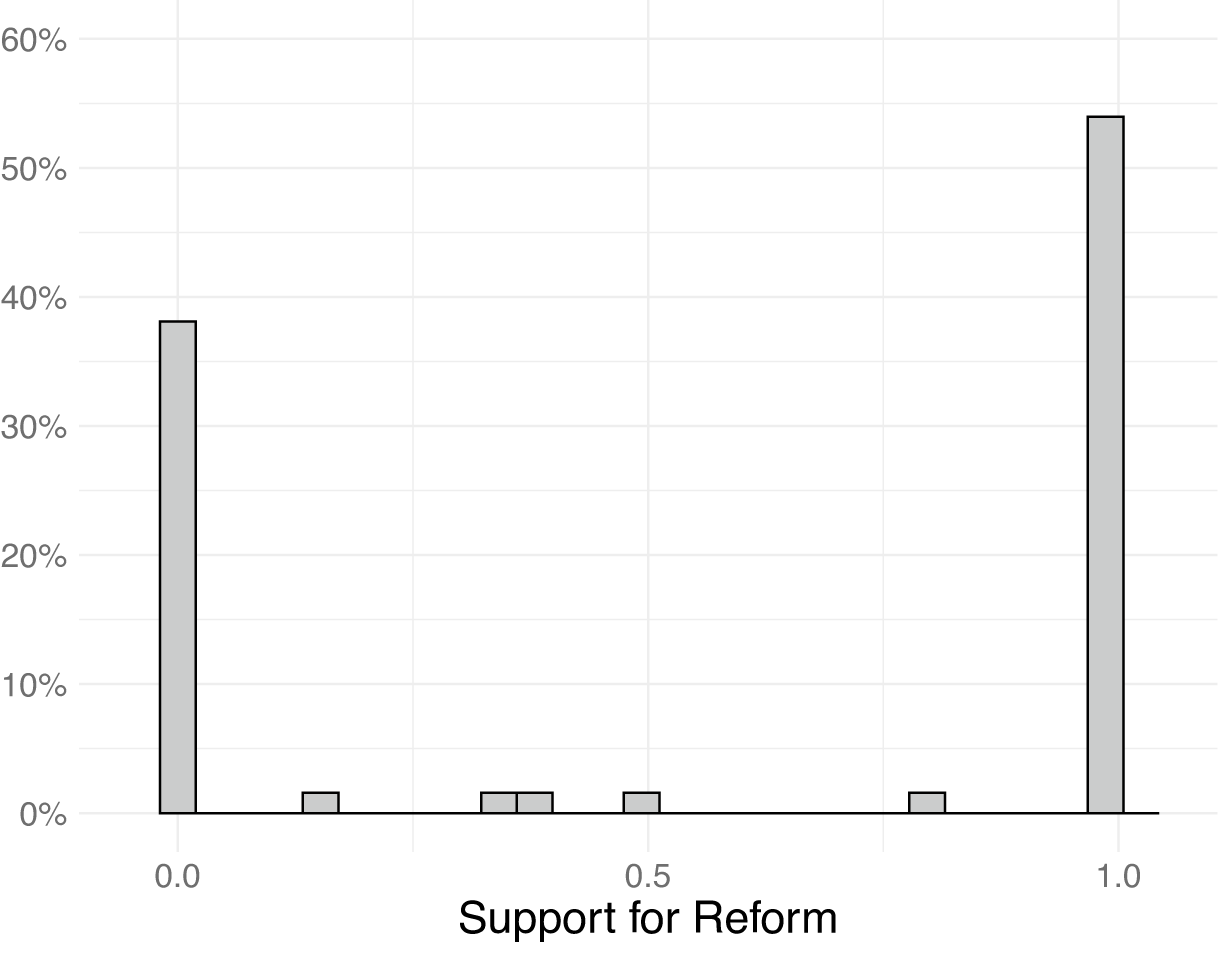
The politicians were polarized. As Figure 4 illustrates, of the 63 politicians who expressed an opinion about the reform, 34 (54%) consistently (across policies and over time) supported it (coded as 1), whereas 24 (38%) consistently opposed it (coded as 0).Footnote 25 The remaining five politicians supported some of the reform policies but opposed others; their scores are averaged across all policies in the main analysis.Footnote 26 I obtained the same results when rounding their scores up or down in a robustness check.Footnote 27
Major Politicians’ Attitudes toward the State-Building Reform
Note: The figure includes the 63 politicians who expressed an opinion about the reform (1 = support; 0 = oppose; noninteger = mean of mixed attitudes).

Over half of the politicians (74, or 54%) did not explicitly express an attitude toward the reform. Most of these (49) were in ceremonial positions, such as in the Ministry of Rites, which was in charge of religious rituals and court ceremonies. So, a simple explanation is that these 74 politicians were not in policy-relevant positions and thus did not exhibit any policy preferences. In the main analysis, I use listwise deletion, without making any assumptions about their implicit attitudes. In the robustness checks, I employ three alternative approaches to handle these politicians. First, I code them as neutral and create a trichotomous dependent variable—support (1), neutral (0), and oppose (-1).Footnote 28 Second, I restrict the sample to the subset of politicians who held policy-relevant positions (defined as generalist positions such as chief councilor and positions in the fiscal or military sectors, following Li [Reference Li2013, 16–7, 47–8, 62–70]).Footnote 29 Third, I randomly assign a value to these politicians by flipping a coin (i.e., drawing from the Bernoulli distribution).Footnote 30 All three of these approaches produce the same results.
Politicians’ career trajectories indicate that Emperor Shenzong tried to balance the two camps. The correlation coefficient between Support for reform and rank change under Shenzong, calculated by subtracting the rank of an official’s first position from that of his last, is quite small (0.066) and not statistically significant (p = 0.688). This suggests that the emperor treated supporters and opponents roughly equally in their career advancement. This partly eases concerns about selection bias in the sample, which might be nontrivial if Shenzong overwhelmingly promoted one group over the other.
Another concern is that a politician might take a particular stance on the reform as a political favor for a colleague of equal or higher rank with the expectation that the colleague would reciprocate in kind at a future date. To examine this possibility, I assess the correlations between politicians’ attitudes and their political ranks. Because the politicians expressed their attitudes at different points and their ranks changed during Shenzong’s reign, I use their average ranks (mean of the ranks of all positions) and find the correlations small and statistically insignificant.Footnote 31 In the regressions, I will also control for a politician’s rank to take into account power dynamics.
Results
I estimate the following benchmark OLS specification:
 $$ {\displaystyle \begin{array}{l} Support\ \ for\hskip0.22em {reform}_i\\ {}\hskip1em =\alpha +\beta Local\ \ concentration\ \ of\hskip0.22em {kin}_i+{\mu}_j+\mathbf{XB}+{\varepsilon}_j.\end{array}} $$
The dependent variable Support for reformi is a continuous variable that measures politician i’s degree of support for the reform. The variable of interest, Local concentration of kini, is an index that measures the geographic concentration of politician i’s kinship network. Hypothesis 1 predicts that β, the quantity of interest, will be negative. The parameter μj includes politicians’ hometown prefecture fixed effects. All standard errors are robust, clustered at the prefectural level j to account for any within-prefecture correlation in the error term. I standardize all variables to have a mean of zero and a standard deviation of one to facilitate interpretation.Footnote 32
Table 2 presents the estimates of the benchmark model. I use listwise deletion so that the estimates are based on the 40 politicians for whom I have full information on all the variables.Footnote 33 Column (1) shows the bivariate relationship between Local concentration of kin and Support for reform. Column (2) adds politicians’ hometown prefecture fixed effects. Column (3) includes additional control variables, which I discuss below.Footnote 34 Column (4) includes only the covariates selected through the “post-double-selection” method using least absolute shrinkage and selection operator (LASSO) regressions (Belloni, Chernozhukov, and Hansen Reference Belloni, Chernozhukov and Hansen2014).
OLS Estimates of the Correlation between Geography of Kinship Network and Support for Reform

Note: The unit of analysis is an individual politician. The variable of interest is an index that measures the local concentration of kin (higher values indicate more localized networks). All variables are standardized. Robust standard errors clustered at the prefectural level are in parentheses. ***p < 0.01, **p < 0.05, and *p < 0.10.
I consider eight alternative explanations. First, a politician’s individual characteristics, such as family wealth, might influence their calculations. For example, those from wealthier families had more resources to support kinship organizations and thus were less likely to support the state-building reform. Hometown characteristics such as geography, history, culture, and cropping patterns also affected politicians’ attitudes. For example, those from regions that were vulnerable to nomadic invasions or domestic rebellions might have had a stronger incentive to strengthen the state (Slater Reference Slater2010; Tilly Reference Tilly1992). Moreover, a redistributive logic would predict that politicians from regions with good-quality soil and high agricultural yields would be more likely to oppose state building because they must pay disproportionately more taxes because of higher incomes (Meltzer and Richard Reference Meltzer and Richard1981). There is, unfortunately, scarce data on politicians’ family wealth. However, there is a consensus among historians that Song-era high-ranking officials were a relatively homogenous group from wealthy landowning families (Liu Reference Liu1959, 16). To control for their hometown characteristics, I include prefecture fixed effects, which consider the features of each politician’s hometown at the prefectural level (the level at which Song government institutions (such as taxation and security) were clustered [Smith Reference Smith, Twitchett and Smith2009, 407]).Footnote 35
Second, recent work using social network analysis shows that the more central an actor is in a network, the more influence his or her actions have on the actions of others and the more likely he or she is to take action (Naidu, Robinson, and Young Reference Naidu, Robinson and Young2021). Appendix Figure A1-5 illustrates the network of the 137 politicians; edges indicate marriage ties.Footnote 36 I then control for each politician’s Betweenness centrality—a measure of a node’s influence over the flow of resources in a network (Padgett and Ansell Reference Padgett and Ansell1993, 1278). I use Degree centrality and Bonacich power as robustness checks and obtain the same results.Footnote 37
Third, one might suggest that it is the number of kin members or children, rather than their location, that matters. Holding geographic distribution constant, a coordination logic might predict that having a large number of relatives would increase the transaction costs of coordination at the local level, which could induce politicians to buy services from the state—a “focal point” (Schelling Reference Schelling1960, 57). Therefore, I control for the total number of kin (N of kin) and the total number of children (N of children). These covariates also deal with the problem that some politicians’ networks were better recorded than others’.Footnote 38
Fourth, the Song era was characterized by the rise of factional politics and divergent philosophical schools (Bol Reference Bol2008). To code each politician’s factional ties, I first identified the reform leaders; these were Wang Anshi, Lü Huiqing, and Cai Que.Footnote 39 I then follow historians’ work to define each politician as having a factional tie with a reform leader if at least one of the following conditions is met: (1) he was in an examiner–examinee relationship with a reform leader, (2) he passed the civil service exam in the same year as a reform leader, or (3) he was in the same philosophical school, as defined by Bol (Reference Bol2008, 61–5), as a reform leader.Footnote 40 The indicator Factional tie with reform leaders measures each politician’s relationship with the reform leaders.
Fifth, power dynamics might have influenced politicians’ expressed attitudes toward the reform. For example, a politician of lower rank might support or oppose the reform to exchange political favors with a colleague of higher rank. Works on modern authoritarian regimes show that politicians with a lower rank have a stronger incentive to conform to the leader’s agenda in order to signal loyalty (e.g., Kung and Chen Reference Kung and Chen2011). To account for this possibility, I control for a politician’s average rank throughout the Shenzong reign.Footnote 41
Sixth, politicians whose kin were more exposed to nomadic invasions or domestic rebellions might prefer a stronger state. To measure external threats to kin, I constructed an index using the “market potential” approach to measure their relatives’ exposure to all external war battles fought in the 50-year period prior to Shenzong’s reign. Kin centroid exposure to external wars is thus
 $ {\sum}_{w\in W}{\left(1+{distance}_{k_c,w}\right)}^{-1}, $
where
 $ {distance}_{k_c,w} $
is the as the crow flies distance (in kilometers) from the centroid of the kinship network kc to an external war battle w. The set W includes all external war battles fought between the Song and a non-Song regime, such as Xixia or Liao, from 1016 to 1065.Footnote
42 This index increases as external war battles moved closer to the centroid of the kinship network. Similarly, I construct an index Kin centroid exposure to mass rebellions:
 $ {\sum}_{r\in R}{\left(1+{distance}_{k_c,r}\right)}^{-1}, $
where
 $ {distance}_{k_c,r} $
denotes the distance from the centroid of the kinship network kc to a mass rebellion battle r. The set R includes all mass rebellion battles fought between the Song government and a mass rebel group (e.g., peasants, artisans) from 1016 to 1065.Footnote
43 This index increases as mass rebellion battles moved closer to the kinship network’s centroid.Footnote
44
Seventh, all my distance measures use as the crow flies distances, which do not consider terrain conditions. One might argue that a politician who has kin living in mountainous areas can depend on natural barriers for defense, thus relying less on the state. Therefore, I control for Ruggedness Index, which uses the grid-cell-level data provided by Nunn and Puga (Reference Nunn and Puga2012) to calculate the average terrain ruggedness index across all the grid cells covered by the politician’s kinship network.
Last, the politician’s family history is important. I control for Father exam to measure whether the politician’s father entered officialdom by taking the exam (as opposed to inheriting his position). This variable also proxies for the politician’s father’s political orientation because the Confucian exam should have shaped the father’s political views, which might in turn have influenced his strategies in shaping his son’s (i.e., the politician’s) kinship network. I also control for Father migration to measure how far the politician’s father migrated away from his original hometown. As demonstrated above, Father migration is strongly associated with how dispersed the politician’s network is. It is also the only covariate selected by LASSO.
In all specifications, there is a negative correlation between Local concentration of kin and Support for reform and the coefficient is statistically significant at the 0.10 level. The magnitude of the standardized coefficients ranges from -0.250 to -0.433, suggesting that a one-standard-deviation increase in Local concentration of kin is associated with a 25–43% decrease in the standard deviation of support for the reform.
These results are highly robust, as shown in a wide range of robustness checks (Appendix Section Robustness Checks). For example, the original measure of the independent variable makes the heroic assumption that every kin member matters equally to the politician. I relax this assumption in two ways. First, in a patriarchal society such as imperial China, a politician might attach more importance to the son’s side of the kinship network than to the daughter’s side because the son will inherit the family property (Ebrey Reference Ebrey1993, 235). Therefore, I assign each kin member on the daughter’s side a “matrilineal discount” so that they contribute less to the index than kin members on the son’s side.Footnote 45 Second, I discount a kin member depending on how distant he or she is from the politician based on the intuition that he would attach more importance to immediate family members, such as sons and daughters, than to remote relatives.Footnote 46 Both of these alternative measures produce similar results. I also try dropping one politician at a time to see whether one observation is driving the results and find that the results are largely stable.Footnote 47
Although I control for a long list of observables, the omission of unobservables might bias my estimates. Therefore, I conduct a formal sensitivity analysis, as proposed by Altonji, Elder, and Taber (Reference Altonji, Elder and Taber2005), to determine how much stronger selection on unobservables would have to be, relative to selection on observables, to completely explain away my result. Appendix Table A1-22 show ratios (based on Altonji, Elder, and Taber Reference Altonji, Elder and Taber2005) that range from 13.650 to 15.328. These ratios suggest that the marginal effect of unobservables would have to be at least 13 times as large as the marginal effect of observables to invalidate my findings. This far exceeds the benchmark value of three that was used in previous studies to identify selection on unobservables (e.g., Nunn and Wantchekon Reference Nunn and Wantchekon2011, 3238).
In summary, I find strong support for Hypothesis 1 that politicians’ support for state building is positively correlated with the geographic span of their kinship networks.
CONCLUSION
Previous scholarship views state building as a state–society competition in which the state gradually achieves predominance over social organizations. In this competition, extended kinship groups are the state’s major rivals. However, this notion of state–kinship competition, is largely based on the European experience of state development, where the medieval church’s prohibitions on endogamy, adoption, polygyny, concubinage, divorce, and remarriage undermined the strength of kinship groups (Henrich Reference Henrich2020, 159–61). Meanwhile, frequent and increasingly expensive wars created a comparative advantage for territorial states over smaller social units, such as manors, in mobilizing resources (Tilly Reference Tilly1992). The state ultimately replaced its social rivals and became a monopolist (Weber [1918] Reference Weber1946, 78).
Yet complex kinship institutions have dominated premodern societies outside Europe (e.g., Evans-Pritchard Reference Evans-Pritchard1940). The Chinese state bureaucratized more than a thousand years before European countries (Hui Reference Hui2005). In the eleventh century, the Chinese state (under the Song Dynasty) taxed over 15% of its economy—a level that England did not reach until the eighteenth century (Guo Reference Guo2019; Stasavage Reference Stasavage2020, 160). China achieved these state-building milestones while maintaining strong kinship institutions.
This article examines how kinship networks can align elite incentives in favor of state building. I show that geographically dispersed kinship networks cross-cut local cleavages, align elites’ family interests with state interests, and foster a state-building coalition. By examining one of China’s most important state-building reforms, I contribute to the previously Eurocentric literature by highlighting an alternative driving force of state development.
Decades of social science research have concluded that a strong state is important for promoting economic development (Dincecco Reference Dincecco2017; North Reference North1981), preventing political violence and civil war (Fearon and Laitin Reference Fearon and Laitin2003), and delivering basic goods and services (Rothstein Reference Rothstein2011). Fukuyama (Reference Fukuyama2004, 17) argues that state building should be at the top of the global agenda. However, many developing countries have failed to build a strong state because elites often have conflicting interests and cannot form a broad coalition to support state-building reforms (See, e.g., Geddes Reference Geddes1994).
Many of the policy interventions carried out by the international community, such as the World Bank and the International Monetary Fund, focus on strengthening state bureaucracies and building “Weberian” states (Evans and Rauch Reference Evans and Rauch1999). But the Chinese case emphasizes the importance of understanding how a country’s social structure affects its state-building trajectory. When elites are embedded in local social relations, they are more likely to rely on local, private organizations to provide services and protection and less likely to support a strong central state. The lesson is that state weakness is a social problem that cannot be resolved with a purely bureaucratic solution. State-building projects should thus extend beyond a narrow focus on reforming the bureaucracy to include efforts to make incentives related to the social structure compatible with a strong state.
SUPPLEMENTARY MATERIALS
To view supplementary material for this article, please visit http://doi.org/10.1017/S0003055421001490.
DATA AVAILABILITY STATEMENT
Research documentation and data that support the findings of this study are openly available at the American Political Science Review Dataverse: https://doi.org/10.7910/DVN/C1SWYV.
ACKNOWLEDGMENTS
I greatly thank Bob Bates, Matt Blackwell, Lisa Blaydes, Carles Boix, Peter Bol, Xun Cao, Erin Baggott Carter, Stephen Chaudoin, Iza Ding, Greg Distelhorst, John Ferejohn, Anna Grzymala-Busse, Yue Hou, Sarah Hummel, Guillermo Kreiman, Horacio Larreguy, Steve Levitsky, Xiao Ma, Melanie Manion, Dan Mattingly, Carl Müller-Crepon, Christopher Paik, Jen Pan, Liz Perry, Pia Raffler, Molly Roberts, Jon Rogowski, Frances Rosenbluth, Dan Smith, Hendrik Spruyt, David Stasavage, Yiqing Xu, Taisu Zhang, Congyi Zhou, Boliang Zhu, and Daniel Ziblatt. I am also grateful for the dialogue with seminar and conference participants at Harvard, Korea University, Northwestern, NYU, NYU in Abu Dhabi, Oxford, Penn State, Princeton, Stanford, UPenn, USC, UVA, Yale, and the Zoom in the China Webinar Series, as well as the APSR editors and four anonymous reviewers for their helpful feedback. I also thank Xiaohe Ma at the Harvard Yenching Library, Lex Berman at the China Historical GIS Project, and Hongsu Wang at the China Biographical Database for their guidance, as well as Yuqian Chen, Cheng Cheng, Ce Gao, Jialu Li, and Shiqi Ma for their research assistance. All remaining errors are my own.
CONFLICTS OF INTEREST
The author declares no ethical issues or conflicts of interest in this research.
ETHICAL STANDARDS
The author affirms this research did not involve human subjects.





Comments
No Comments have been published for this article.