


Background and introduction
Social anxiety is a common problem among people with schizophrenia and other psychotic illnesses, with recent studies showing that up 70% of people recovering from early psychosis have clinical levels of social anxiety symptoms, despite being regarded as having recovered from acute psychotic episodes (Fowler et al., Reference Fowler, Hodgekins, Painter, Reilly, Crane, Macmillan, Mugford, Croudace and Jones2009). Individuals with high social anxiety (without the presence of psychosis) show distinctive characteristics in their processing of emotional information, in particular they tend to be more likely to interpret emotionally ambiguous situations in a threatening way (interpretive bias) (e.g. Hirsch and Clarke, Reference Hirsch and Clarke2004). Cognitive Bias Modification for Interpretation (CBM-I) is a procedure that can be used to assist reduction in threat-related interpretation biases (Mathews and Mackintosh, Reference Mathews and Mackintosh2000). This involves repeated practice of positive interpretations of emotionally ambiguous social situations, using computer-based methodology. Evidence suggests that this repeated practice can induce a learned production rule in which positive or benign interpretations are selected when faced with emotional ambiguity. This reduction of the negative bias then has an impact on anxiety vulnerability in stressful situations (e.g. Hoppitt, Mathews, Yiend and Mackintosh, Reference Hoppitt, Mathews, Yiend and Mackintosh2010).
The aim of the current study was to pilot the use of CBM-I with eight service users who were recovering from psychosis but continued to experience clinically significant levels of social anxiety. We wanted to investigate the feasibility and acceptability of the CBM-I methodology within this population, as well as getting an initial indication of its efficacy as an intervention.
Method
Design
As this study was a preliminary study investigating the feasibility and acceptability of CBM-I a single case series was used. The data reported on in this paper were taken from a larger multiple baseline single case series. The larger study consisted of a baseline, intervention, debrief and follow-up. Initial data on the participants’ interpretation bias were collected in the baseline phase. All other data were collected in a single session of the intervention phase.
Participants
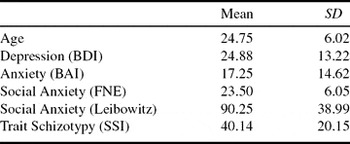
Participants were eight service users from within the Central Norfolk Early Intervention Team. They consisted of seven male and one female service user and ranged in age from 17 to 33 (M = 24.75, SD = 6.02).
Inclusion criteria
Participants were included if they had made a substantial recovery from their psychotic symptoms (based on clinical judgement by the participants’ multidisciplinary team) but were still experiencing clinically significant social anxiety as assessed by the SCID (First, Spitzer, Gibbon and Williams, Reference First, Spitzer, Gibbon and Williams2002).
Exclusion criteria
Participants were excluded if they were unable to read English to a degree that would enable them to complete the questionnaires and the computer based task. One participant was excluded due to severe dyslexia, which made it difficult for him to complete the computer based task.
Materials
Interpretive training (CBM-I) materials. Participants were presented with 100 training scenarios, each of three lines in length, and designed to stay emotionally ambiguous until the last word. The final word was presented as a word fragment, which always disambiguated the passage in a benign or positive way. Participants were required to read each scenario and form an image of the scenario to help them work out what the incomplete word was. A question was then presented to ensure that they had understood the scenario. Participants were presented with scenarios in sets of 10, with a break after each set. An example of a training item follows:
Looking out of your front window you see a group of children running along your road and throwing stones. One of them hits your window and you go out to talk to them. When they see you they turn to a p – - – g i s – (apologise)
Comprehension question:
Do you think that they are unfriendly to you? Answer: NO
Recognition task
The recognition test (based on that used by Mathews and Mackintosh, Reference Mathews and Mackintosh2000) was used to test for positive or negative bias. It contains two parts: the encoding phase followed by the recognition phase. In the encoding phase 10 emotionally ambiguous scenarios were presented. These scenarios were three lines in length and rather than the final word disambiguating the scenario (as in the training phase), the last word preserved the ambiguity of the scenario. Each scenario began with a title, for example:
The wedding reception: Your friend asks you to give a speech at her wedding reception. You prepare some remarks and when the time comes, get to your feet. As you speak, you notice that some people in the audience start to laugh.
Each scenario was followed by a comprehension question that did not have any emotional connotations, this was used to ensure that the material was read and understood (e.g. “Did you stand up to speak?” YES/NO).
Procedure
Participants took part in an initial assessment in which the presence of social anxiety was assessed using the SCID. In the following baseline session interpretive bias was assessed using the recognition task. One to three weeks later participants completed an intervention session. This session began with participants rating their mood on a visual analogue scale; they then completed 100 CBM-I training items, and then repeated the mood ratings. Participants then engaged, along with an assistant psychologist, in an activity that made them “somewhat” anxious. These activities involved going for a walk in a place where there were likely to be other people. The anxiety provoking activity was part of the larger single case series. The recognition task was then repeated. One week after the intervention session the participants were asked for qualitative feedback on the CBM-I training.
Results
Details of the descriptive and baseline scores for the participants are shown in Table 1.
Descriptive and baseline scores for participants

BDI: Beck Depression Inventory (Beck, Steer and Brown, Reference Beck, Steer and Brown1996).
BAI: Beck Anxiety Inventory (Beck and Steer, Reference Beck and Steer1987).
FNE: Fear of Negative Evaluation (Watson and Friend, Reference Watson and Friend1969).
Leibowitz Social Anxiety Scale (Leibowitz, Reference Leibowitz1987).
SSI: Schizotypy Symptom Inventory (Hodgekins, Reference Hodgekins2008).
Interpretive bias
Two bias scores for each participant (pre- and post-CBM-I) were calculated by subtracting the mean similarity rating for the negative targets from the mean similarity ratings for the positive targets. This gave each participant two scores (pre- and post-CBM-I) that could range from −3 to +3, with a negative score indicating a negative bias and a positive score indicating a positive bias. The greater the magnitude of the score from zero, the greater the degree of bias.
Complete sets of pre and post interpretive bias data were only available for 6 of the 8 participants. For one of the participants with missing data, mistakes had been made in the way that one of the paper versions of the recognition task had been completed, resulting in there being no possibility of scoring it. For the second participant with missing data there was insufficient time to complete the recognition task due to the computerized task taking longer than expected.
Three of the six participants displayed beneficial change in interpretive bias following CBM-I. Overall, the sample of participants appeared to show a mean change from a negative interpretive bias, to a positive interpretive bias (from M = −0.12, SD = 1.14 to M = +0.30, SD = 0.96).
Mood
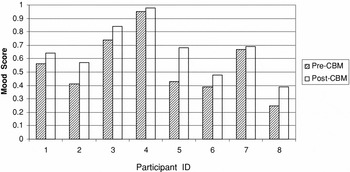
Participant mood was assessed using a series of visual analogue scales assessing depression, distress, tension and pessimism. The scale was from 0–1, with the anchors; depressed – happy, tense – relaxed, pessimistic – optimistic, distressed – not distressed. A mean mood score is then calculated based on the mean of all visual analogue scales completed with a higher score indicating better mood. All eight participants showed overall improvements in positive mood during the CBM session (see Figure 1). In the sample there was an overall increase in mood of 11% (from M = 0.55, SD = 0.23 to M = 0.66, SD = 0.19) which showed a medium effect size (d = 0.51).
Changes in mood pre and post-CBM (higher score indicates more positive mood)

Participant feedback
Due to the small amount of qualitative feedback gathered it was not possible to formally analyze the data. However, the feedback was explored by two members of the research team and general themes within the feedback were identified. The main themes that came out of the discussions concerned the short-lived nature of the benefits, the difficulty transferring learning to “the real world”, the boring lay-out and lack of interaction in the computer programme, and the unrealistic nature of some of the scenarios.
One positive comment made by a participant was “I thought differently because of the computer program” (participant 1) indicating that as well as providing positive benefits on the standardized measures some of the participants also experienced it as helpful. However, whilst reporting that it was helpful, a number of participants commented that the effects did not last very long e.g. “It made me think more positively, but this effect was only short-lived” (participant 3). Five of the participants explicitly reported insight into the potential benefits of this programme, although only three of them reported that they experienced any benefits themselves.
Areas in which participants reported that they felt CBM-I could be improved included making the screen more interesting and the task more interactive e.g. “It was just a white screen with black print – would be better if it was more interactive” (participant 2). Participants also reported that they found putting the learning from CBM-I into practice difficult: “I understood what the program was all about, but putting it into practice was harder than doing it on the computer” (participant 2). Additionally, some participants reported that they did not find the scenarios in the training very true to their lives e.g. “I did not find the scenarios that realistic” (participant 6).
Discussion
To summarize the results, all eight participants showed improvements in positive mood following the CBM-I. Three of the six participants who completed the recognition test displayed an improvement in positive interpretive bias following CBM-I.
This study provides provisional support for the potential of developing a CBM-I based therapeutic intervention for people recovering from psychosis; we have demonstrated that this process can be used in a manner that does not appear to cause stress and that there can be short term benefits for some people following a single session. The feedback from clients identified a number of areas in which CBM-I would need to be improved in order to be used effectively in clinical settings. It was noted in the feedback from participants that some individuals displayed a degree of insight into the benefits of the procedure and the application to the real-world. Research suggests that CBM-I might be aided by participants’ explicit knowledge of the purpose of the procedure (Salemink, van den Hout and Kindt, Reference Salemink, Van Den Hout and Kindt2007).
There are a number of limitations to this study. First, given that this was just a feasibility study with a small number of participants, it is not clear that the results would generalize to a wider population. Second, the recognition test used to assess the extent of people's bias was developed in relation to biases associated with non-psychotic anxiety. It is possible that this measure is less sensitive to biases in people with social anxiety who are recovering from psychosis. Finally, the insertion of the behavioural component before the final bias test complicates the interpretation of the results. It is possible that without the behavioural assessment an effect of CBM-I on bias would be even clearer. However, another possibility is that the behavioural component might itself have had an effect on bias.
This study provided preliminary evidence that computerized CBM-I interventions may be acceptable to people recovering from psychosis. Although this was a very small pilot study, there was no evidence that engaging in the CBM-I methodology had adverse consequences for this client group.




Comments
No Comments have been published for this article.