1. Introduction
Elinor Ostrom (1933–2012) was instrumental in developing a research agenda on the study of social–ecological systems and was an exemplar in conducting interdisciplinary multi-methods research. In this paper, we reflect on her contributions and our collaboration with her in our work on robustness of social–ecological systems (SESs).
Ostrom started her study of resource governance at a time when interest in environmental issues was rising in society in general, but when approaches to developing solutions were based on theoretical or ideological grounds rather than on empirical studies. Especially influential was the essay by Hardin (Reference Hardin1968) on the tragedy of the commons. Hardin lamented that when people share a common resource, the only way to avoid overharvesting is to institute governmental regulations or allow for privatization of the resource.
The essay of Hardin (a biologist) was supported by influential work by economists Gordon (Reference Gordon1954) and Scott (Reference Scott1955), and political scientist Olson (Reference Olson1965) and was rooted in rational choice theory. A key assumption was that actors made rational decisions based on selfish motives. The implications for policy were clear. Where practical, such as with some types of environmental pollution, top-down government regulation of firms was required. In other cases where monitoring and sanctioning is very costly, to avoid overharvesting of common-pool resources (CPRs) it is critical to establish private property rights or tax the use of the commons.
If Hardin and his colleagues are right, why are so many common-pool resources not overharvested? Ostrom (Reference Ostrom1965) observed in her dissertation work cases of farmers being institutional entrepreneurs in creating institutional arrangements to avoid overharvesting of aquifers. Her fieldwork showed that Hardin's thesis does not hold for all systems. Over the decade following the completion of her PhD thesis, she conducted research on policing and governance of metropolitan areas to test the functioning of polycentric governance systems. During that time, she began performing comparative analysis among metropolitan areas to identify attributes of institutional arrangements that lead to better performance. She observed a wide array of different types of rules and started to identify structure in the data by developing more careful and consistent definitions. This led in the 1980s to the beginnings of the Institutional Analysis and Development (IAD) Framework (Kiser and Ostrom, Reference Kiser, Ostrom and Ostrom1982; Ostrom, Reference Ostrom1986). The framework was built on well-defined components including the action situation, positions, outcomes, rules, etc. By providing a theoretical framework for the more systematic study of institutions, comparative analysis could better contribute to an accumulation of knowledge and theory development.
In the mid 1980s, she started to work on natural resources again. A group of scholars from different disciplines who had undertaken field studies during that period began to discover that the empirical evidence they were accumulating was not consistent with conventional theory (McCay and Acheson, Reference McCay and Acheson1987). They became concerned about the dominance of the conventional theory and the consequences of policies of privatization and nationalization that were becoming increasingly common in the management of natural resources. In order to understand the diversity of outcomes from individual case studies, there was a need for synthesis. This occurred, in part, through a series of meetings of the National Research Council starting in 1983. A large number of case studies were discovered that showed both successes and failures of self-organized governance by resource users. The resources included local fisheries, irrigation systems, pastures, and forests. In order to organize the case studies, this group started to draw on the IAD framework as a common language to compare the many case studies and develop a common database.
Since 1985, Elinor Ostrom and a group of students and faculty affiliated with the Workshop of Political Theory and Policy Analysis started to systematically code case studies resulting in over 80 detailed coded case studies of fisheries and irrigation systems (the data for these case studies are now freely available at seslibrary.asu.edu). In her 1990 book ‘Governing the Commons’, Ostrom provided an initial analysis of this meta-data (Ostrom, Reference Ostrom1990). Originally, the goal was to discover institutional arrangements that would lead to the best outcomes regarding the governance of common-pool resources. Despite her efforts to find such a golden rule, Ostrom was unsuccessful. Instead, she offered a number of ‘design principles’ as hypotheses of stylized facts observed in many case studies. These design principles included ‘well-defined boundaries’, ‘monitoring’, ‘conflict-resolution mechanisms’, and ‘graduated sanctioning’. These proposed design principles have held up the test of time (Cox et al., Reference Cox, Arnold and Villamayor Tomás2010).
Beginning the mid-1990s, Ostrom became more immersed with ecological concepts and worked more closely with ecologists. For example, she became part of the board of the Beijer Institute for Ecological Economics in Stockholm, Sweden, and became more involved with the Resilience Alliance, an international organization focused on the study of social–ecological systems. Although Ostrom (Reference Ostrom1990) identified attributes of commons governance that can explain successes and failures, the basic framework was static. Ecologists such as Holling (Reference Holling1973) emphasized the resilience of ecological systems, which refers to the capacity of ecosystems to absorb disturbances and recognize to retain similar dynamic functions. There was a clear need to connect the work of Ostrom on governance to the dynamics of ecological systems emphasized by Holling.
The rest of this paper deals with one effort in this direction on which we collaborated with Ostrom: the study of the robustness of social–ecological systems. We explain below how robustness differs from resilience. We illustrate the concept of robustness and the use of the robustness approach mainly with case studies of small-scale irrigation systems. In fact, we focus on small-scale irrigation systems because they function as our equivalent of the fruit fly in evolutionary biology to illustrate the robustness characteristics of social–ecological systems. All social–ecological systems consist of built infrastructure that connects actors to the ecology and connects the ecology to the social dynamics that play out among actors at different levels of organization. Small-scale irrigation systems exhibit a balance between the problem of providing hard public infrastructure such as canals and soft infrastructure (rules, norms, monitoring, and enforcement) needed to address the CPR problem associated with water distribution. Although other CPRs such as fisheries, forests, and rangelands also involve both these problems to some extent, they tend to be biased toward soft infrastructure and CPR problems. In some sense, forestry, fishery, and rangeland SESs are special cases of the more general SES represented by the small-scale irrigation system. Finally, there is a huge variety of present-day small-scale irrigation systems around the world as well as multiple examples from the past that we can draw on. As such, irrigation systems are ideal systems on which to test our concepts.
We will begin with a discussion of the early work of Ostrom on small-scale irrigation systems that, under the right conditions, can be exemplars of effective self-governance. We will then introduce our robustness framework and illustrate how it has led, and may lead to new theoretical insights. Finally, we discuss how theoretical questions that have emerged from the application of the robustness framework to case studies have led to recent laboratory and field experiments that have focused on the micro-foundations of decision making in irrigation that involve both provisioning and coordination dilemmas. By taking the reader through an example of the multi-method approach pioneered by Ostrom and developed further by Poteete et al. (Reference Poteete, Janssen and Ostrom2010), we illustrate the value of a multi-method approach for the study of social–ecological systems. Specifically, we show why the initial case-study-based research was rather limited for addressing questions related to robustness and the performance of SESs over time. We then illustrate the use of mathematical models and experiments to study underlying mechanisms that affect robustness in more depth. Finally, we discuss how moving back and forth between different methods has generated new insights into the original case-study research.
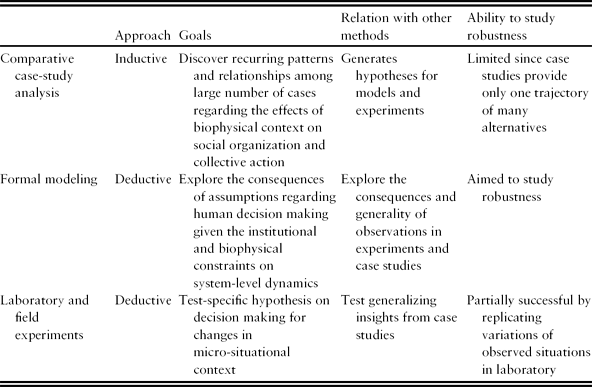
To close the introduction, we want to stress that we focus on our own research program, largely in collaboration with Elinor Ostrom, as an example of a multi-method approach. We do so largely in the interest of space and because we have intimate knowledge of how multiple methods were brought together in our research. There are many other scholars studying similar questions in a range of different case-study contexts using one or more of the methods we discuss here. We will draw on some of these case studies where appropriate but cannot do a proper comparison across these and the cases we have studied in our research. Such a comparison, certainly an area of very fruitful future research, is beyond the scope of this paper. Further, by focusing on our own experience we also hope to provide some practical lessons learned in actually trying to operationalize a multi-method approach. Although we use multiple methods, there are many methods we have not used, or have not discussed in this paper. We mainly focus on comparative case-study analysis, formal modeling and laboratory and field experiments. In Table 1, we provide a basic overview of the different methods we use and their relationships.
Overview of the methods used in this paper in relation to each other

The comparative case-study analysis we conduct is largely based on literature review and databases of coding forms detailing dozens of characteristics of the social and ecological components of the systems as well as some primary fieldwork (as in the Pumpa system described below). Such analysis may reveal patterns among the case studies and classes of case studies experiencing similar phenomena. Insights from the case studies can stimulate modeling and experiments. Those methods require more precise questions. Models enable us to systematically explore the consequences of assumptions of the theoretical framework on observed patterns. Deeper insights regarding the logic of the system dynamics can be extracted which may help us to better understand the qualitative insights from the case studies. Controlled experiments in the laboratory and field focus on testing specific behavioral questions, such as how changes in the micro-situational context (e.g. allowing costly punishment or not) affect outcomes in social dilemmas. The games participants play are purposely simplistic and artificial but enable us to test the same dilemma in different communities and, as such, may reveal some general tendencies of human decision making.
Each method has its pros and cons. In practice, we move back and forth between these methods during our projects. As such, each study we do is influenced by insights derived from the various methods. In the rest of the paper, we discuss some of our research activities in the context of such an iterative research program.
2. Small-scale irrigation systems and collective action (case-study analysis)
Irrigation systems have to solve at least two related collective action challenges to create, maintain, and use the infrastructure: (1) the provision of infrastructure necessary to use a resource (the ‘hard’ infrastructure of the physical irrigation system itself, and the ‘soft’ infrastructure of the governance structures necessary to maintain and use it) and (2) the asymmetric common-pool resource dilemma in which the relative positions of ‘head-enders’ and ‘tail-enders’ generate asymmetric access to the resource (Ostrom and Gardner, Reference Ostrom and Gardner1993). If actors behave as rational, selfish economic agents, it is to be expected that no contributions to the infrastructure are made. Even if the challenge of provision of infrastructure was solved, there remain incentives for users to over-appropriate from the resource it generates. This is especially likely in irrigation systems where asymmetry causes some users to have privileges over other users; the head-ender who has first access to water may not necessarily share with the tail-ender.
Note that in order to maintain the functioning and use of the infrastructure, irrigation communities have to solve the second-order collective action problems of monitoring and enforcement of rules to reduce freeriding on maintenance and water use (a component of soft infrastructure). Despite these challenges, there are many self-organized irrigation systems that exist and persist for very long periods (Hunt, Reference Hunt1988; Lansing, Reference Lansing1991; Ostrom, Reference Ostrom1992). The study of governance of irrigation systems is therefore an important topic in our understanding of governance of social–ecological systems in general.
Within the domain of irrigation systems, we focus on small-scale irrigation systems that typically have a long history of self-governance, not the larger-scale engineered irrigation systems that often do not lead to productive outcomes. In a recent study of irrigation in Asia, the authors note that the National Planning Commission of Nepal itself acknowledges how poorly (dismally, in fact) larger scale interventions-focused building and rebuilding canal systems have performed (Ostrom et al., Reference Ostrom, Lam and Pradhan2011). This experience in Nepal, one of the countries with the most intervention experiences, suggests that focusing only on physical infrastructure alone is not productive. Top-down management interventions have also met with limited success. Specifically, comparative studies (e.g. Lam, Reference Lam1998; Shivakoti and Ostrom, Reference Shivakoti and Ostrom2002) show that farmer-managed irrigation systems achieve higher performance than agency-managed irrigation systems. Performance is measured by the physical condition of the system – how well maintained the infrastructure is; the technical efficiency of the system – whether the water reaches the tail end of the system or not; and agricultural productivity – the cropping intensity achieved. This difference is remarkable since agency-managed irrigation systems typically have more modern infrastructure. However, agency-managed systems often were not developed with the need to clarify the water rights and management regime used by the farmers in mind. Hence, there was often a poor fit between the existing institutional arrangements and the provided physical infrastructure that was difficult to overcome.
Although small-scale irrigation systems might be perceived to be constructs from the past, they are still of critical importance for food security of a major part of the world's poorest people. In fact, nearly 90% of farms worldwide are less than 2 hectares (McIntyre et al., Reference McIntyre, Herren, Wakhungu and Watson2009), and a large proportion of these rely on irrigation which consumes an estimated 70% of global developed water supplies (Barker and Molle, Reference Barker and Molle2004) and produces 40% of global agricultural commodities from 17% of global cropped area (Wallingford, Reference Wallingford1997). It is likely that such small-scale farming systems will continue to provide the majority of food in developing countries for decades to come. Further, there is an emerging trend in many countries toward localizing some agricultural and food production (Lyson, Reference Lyson2004; Pretty, Reference Pretty1999). Such modern efforts may learn valuable lessons from the centuries of experience embodied in small-scale irrigation systems around the world.
Specifically, these small-scale irrigation systems have become exemplars of effective self-governance. Many are successful in addressing the challenges of governing shared resources over a long time and have been able to persist and adapt to perturbations and change (Ostrom, Reference Ostrom1990). Ostrom used a comparative case-study approach to understand the key features of SESs that enabled communities to solve the complex collective action problems associated with irrigation systems. Ostrom used the case studies as a cross-sectional data set – a static snapshot in time in which she could exploit differences across cases to see patterns. Extraction of these patterns eventually led to her Institutional Design Principles for successful self-governance mentioned in the introduction.Footnote 1 Although Ostrom focused mainly on institutional features associated with success, it is implicit in the IAD framework that the interaction between social, institutional, and biophysical factors is a critical determinant of success. Other scholars have followed up with additional case studies to explore the connection between institutional factors, community attributes, and biophysical factors in more detail. For example, Bastakoti and Shivakoti, (Reference Bastakoti and Shivakoti2012) compared several cases in Nepal to better understand how biophysical factors and the attributes of the community (beliefs and ideas) affect the development of new rules. Araral (Reference Araral2013) conducted a comparative analysis of the Zangjera, the Cagayan Valley, and the Ifugao Rice Terrace irrigation system in the Philippines to explore the effect of geography on institutional choice. He also looked at 1,958 irrigation associates in the Philippines and found that contextual variables such as proximity to markets and water scarcity affect capacity for collective action (Araral, Reference Araral2009). These studies provide interesting details regarding how communities solve the two general problems mentioned above and are suggestive of an important feature of successful small-scale irrigation systems: institutional arrangements and social structure become well tuned to local context. One subtle feature of local context is the disturbance regime they face – i.e. the variation in water supply, shocks to infrastructure, etc. It is likely that the past success of many irrigation systems may have involved becoming well tuned to particular disturbance regime.
Climate change is now exposing farming systems to disturbances at a pace not previously experienced in human history (Thornton et al., Reference Thornton, Jones, Alagarswamy and Andresen2009), fundamentally changing when, and how much water is available. In Pakistan, there is already a 10 to 15% decrease in precipitation in arid areas and rainfall, particularly during the summer monsoon, is expected to increase (IPCC, 2007). This means that at the beginning of the growing season, when farmers most need it, there will be less water availability, and when they need it least, there may be flash floods that destroy irrigation head works. In this sense, the disturbance regime to which these systems have become adapted will fundamentally change. Furthermore, globalization affects the incentives farmers face when choosing to invest immense effort in low-earning farming practices compared to alternatives in an increasingly urbanized world. Globalization also affects which crops, including more resource-intensive cash crops, are desired for production. As such, these systems are exposed by processes that can make the iconic examples of self-governance become vulnerable to new challenges. This raises the research question that occupies the remainder of this paper: are there analogues of the institutional design principles associated with successful collective action for the capacity of SESs to adapt to change? Addressing this question requires an extension of the IAD framework to move from a static, cross-sectional case-study analysis to a dynamic, longitudinal analysis. This leads to the development of the robustness framework discussed in the next section.
3. A robustness framework for social–ecological systems (linking the methods)
The authors met Elinor Ostrom at a workshop of the Resilience Alliance at the Royal Swedish Academy of Sciences in Stockholm, Sweden, in September 2000. The workshop was entitled ‘An overarching framework for modeling integrated ecological-institutional-economic systems’. This was the beginning of a long-term collaboration that focused on the robustness and governance of social–ecological systems.
Our original goal was to apply the concept of resilience to the governance of social–ecological systems. However, we found that resilience can be difficult to apply to systems in which some components are consciously designed. Resilience typically refers to endogenous processes within a given system of interest and does not address normative considerations associated with incentives and decisions that were central to our research interests. We felt that we needed a different set of concepts and tools.
Besides being involved with the Resilience Alliance, we were also involved with a series of workshops on robustness at the Santa Fe Institute, New Mexico, USA. At those workshops, physicists and engineers discussed their work on robust control, in which feedback systems are designed that make tradeoffs between performance and robustness (Csete and Doyle, Reference Csete and Doyle2002). Robustness does not come without costs. In fact, making a system more robust to expected disturbances can make the system vulnerable to unknown disturbances. Therefore, a system can be robust, yet fragile (Carlson and Doyle, Reference Carlson and Doyle2002). We found these to be important insights from control systems research, since our interest in irrigation systems confirmed this notion of shifting vulnerabilities despite efforts to improve robustness.
We favor the use of the robustness terminology for an institutional approach to the study of social–ecological systems. Although institutional arrangements might not always be crafted from a robustness perspective, they are a set of rules that are intentionally designed. Furthermore, actors need to make tradeoffs regarding which components of the system in which to invest.
In a social–ecological system, social and ecological components are continuously interacting (Figure 1). Anderies et al. (Reference Anderies, Janssen and Ostrom2004) distinguish four key interacting components: the resource, the resource users, public infrastructure providers, and public infrastructure. The framework was developed to address questions regarding common-pool resources and public goods. Thus, private infrastructures – e.g. private land, knowledge, machinery – are not made explicit. Rather, they are implicitly included in the characteristics of the resource users.
A conceptual model of a social–ecological system (based on Anderies et al., Reference Anderies, Janssen and Ostrom2004).
For small-scale irrigation systems, the common-pool resource is water. Resource users are farmers using water to produce crops. Public infrastructure providers are those members of a council who design and craft the institutional arrangements for governing the common-pool resource. In fact resource users often cope with operational rules, while public infrastructure providers often make decisions at the collective choice level. Note that ‘resource users’ and ‘public infrastructure providers’ refer to positions, not people. A single person can act (occupy the position of) both as a farmer and a water council member. Public infrastructure refers to the creation of built infrastructure such as head gates, dams, and canals, as well as the institutions and organizational structures that enable monitoring and sanctioning of rules in use and collective choice processes.
Figure 1 shows the interactions between the components. For an irrigation system, linkage 1 refers to the extraction of water from the irrigation system by the farmers for growing crops. The amount that farmers can extract depends on the public infrastructure (links 4 and 5). Often a local water council decides on the rules regarding when and who shall receive water, and in what amount (link 3). Such councils often have input from the farmers (link 2) and in many cases the council consists of representatives from the farmer community. The outcome of collective choice processes affects the state of the irrigation system (link 3) and the enforcement of the water allocation rules. The public infrastructure also affects the level of the resource available due to the quality and state of repair of the irrigation system (link 4). The flow of water available from the irrigation system is further affected by the public infrastructure due to flow dividers in the canal system and enforcement of water allocation rules (link 5). A critical link in the success of social–ecological systems is the co-production between resource users and official enforcement mechanisms (link 6). For example, self-monitoring and enforcement lower the costs of enforcement and increase the effectiveness of institutional arrangements.
Arrows 7 and 8 refer to external perturbations, such as changes in water supply, temperature, pest outbreaks (arrow 7), and changes in external regulations, crop prices, input prices, and political stability (arrow 8). In the study of robustness of social–ecological systems, we are interested in the design features of Figure 1, which increase the robustness of the social–ecological system. We find that link 2 is an especially critical connection since it affects the inclusion of local knowledge and acceptance of institutional arrangements designed by the public infrastructure providers. In the next section, we will illustrate with a specific example how the specific implementation of links 1, 4, and 5 also plays a critical role in the robustness of small-scale irrigation systems. In fact, in our example, for the social–ecological system to be well tuned to the complex disturbance regime it faces, a specific design of these links is needed. This is likely true in general.
The tuning of the social attributes to the biophysical constraints relates to the problem of fit of institutional arrangements and ecological dynamics (Folke et al. Reference Folke, Berkes, Colding and Svedin2007; Young, Reference Young2002). An appropriate fit requires institutional arrangements to take into account the scale and dynamics of the relevant ecological processes. For example, the Netherlands alone will not be able to reduce the pollution of the river Rhine, but a river basin approach has been successful (Myint, Reference Myint2012). The visibility of the farming plots in the Peruvian Andes made the use of water transparent to everyone and contributed to the success of sharing water in those irrigation systems (Trawick, Reference Trawick2001). Measuring the fit of institutions and ecology is a challenge, but some progress is made to develop quantitative metrics (Cox, Reference Cox2012; Ekstrom and Young, Reference Ekstrom and Young2009).
4. Robust control applied to traditional irrigation systems (case-study analysis and modeling)
The robustness framework can be used in many different ways. As a framework, it mainly identifies key system components and relationships between them that are important to studying the robustness characteristics of SESs. It has been used in many instances to provide a basis or comparative perspective for other more specific frameworks and approaches to understanding the capacity of SESs to adapt in dynamic contexts (e.g. Bodin et al., Reference Bodin, Crona and Ernstson2006; Duit and Galaz, Reference Duit and Galaz2008; Folke, Reference Folke2006; Folke et al., Reference Folke, Hahn, Olsson and Norberg2005; Gallopın, Reference Gallopın2006; Moser and Ekstrom, Reference Moser and Ekstrom2010; Paavola, Reference Paavola2007; Plummer and Armitage, Reference Plummer and Armitage2007; Rammel et al., Reference Rammel, Stagl and Wilfing2007) or for highlighting particular elements of a specific SES case study (e.g. Andrew et al., Reference Andrew, Béné, Hall, Allison, Heck and Ratner2007; Cinner et al., Reference Cinner, Marnane, McClanahan and Almany2006; Raymond et al., Reference Raymond, Bryan, MacDonald, Cast, Strathearn, Grandgirard and Kalivas2009). It has also been used to guide a comparative case study of the robustness of two Montane irrigation systems in Thailand (Shivakoti and Bastakoti, Reference Shivakoti and Bastakoti2006). These examples illustrate the use of the framework within a method (i.e. to guide comparative case-study analysis in the same sense as the IAD might be used). The robustness framework has been used to connect methods, e.g. to connect qualitative case-study information about specific cases to modeling efforts as a part of a multiple methods approach (Anderies, Reference Anderies2006; Cifdaloz et al., Reference Cifdaloz, Regmi, Anderies and Rodriguez2010). In these cases, the framework first helps organize information about the case for model development, then it is used to reflect the results of the modeling effort back in the case study through an iterative process. Given the focus of this paper, we illustrate the use of this framework in a multi-methods approach using the example of our analysis of the Pumpa irrigation system which focused on addressing the question of how local institutions impact the robustness of SESs to global change.
Cifdaloz et al. (Reference Cifdaloz, Regmi, Anderies and Rodriguez2010) apply the robustness framework to a traditional irrigation system, namely the Pumpa in eastern Chitwan in Nepal. The farmer-managed irrigation system was started in 1968 by migrants and serves 140 households who own 70 hectares of agricultural land. There are six irrigation sectors, each with 20–25 households, with varying water right seniority (the sectors were labeled from 1 to 6 with 1 being the highest seniority). Based on qualitative and quantitative data from fieldwork, a formal model was developed which consists of basic representations for water flows in the canals, the hydrological dynamics of water on fields, the connection between institutional arrangements and flow rates in canals, and the relationship between yield and water levels in each sector. The formal model allows us to apply concepts from robust control in engineering to analyze the performance and robustness properties of this small-scale irrigation system.
The farmers in the Pumpa system utilize a set of institutional arrangements that affect when to open and close gates to divert water for the fields. Farmers adapt institutional arrangements based on two factors: the flow rate of the Pumpa river, and the functioning of the headgate infrastructure. Given the water availability in the Pumpa during the year, the required water for rice crops over the growing season, and the capacity of the community to repair flood damage to headgate infrastructure, the formal model was used to assess the impact of water variability on rice yields – both in terms of overall amount and equity of distribution. The impact of different institutional arrangements governing water distribution used by the farmers could be assessed in terms of how they affected the robustness of the system.
Depending on conditions, farmers use one of four water governance regimes: open flow: all main flow controls are open and sectors can take water as they please; sequential: sector 1 has full access to all water in the system until its needs are met, then sector 2, etc.; 12-hour rotations: sector 1 receives water for 12 hours, then sector 2, etc.; 24-hour rotations: sector 1 receives water for 24 hours, then sector 2, etc. When water availability from the river is normal, the model predicts that the open flow and 12-hour rotations are best. They both result in the same yield but open flow requires less effort and, not surprisingly, is what the farmers actually do. However, if water availability is decreased by half, those strategies lead to a catastrophic drop in yield, and a sequential policy of delivering water leads to better results. And the actual local policy of switching from open flow to sequential matches model predictions of Cifdaloz et al. (Reference Cifdaloz, Regmi, Anderies and Rodriguez2010). Further analysis shows that robust control predicts what farmers actually do in response to changing environmental conditions. In fact, the authors note that this research illustrates an important linkage between formal modeling and case-study research. By virtue of their simplicity, stylized models often uncover the core drivers of the dynamics. In this case, the model suggested that 12- and 24-hour rotations should never be used. Yet, they were. This caused the research team to return to the case study to gather new data in order to understand model predictions. It turned out that 12- and 24-hour rotations are only used in very specific circumstances. When checked, the model predicted that 12- and 24-hour rotations would be best for these circumstances.
The strong agreement between what the model predicts farmers should do and what farmers actually do hints at the nature of the relationships among resource users, the resource, and public infrastructure in Figure 1. There is a tight connection between public infrastructure and the water resource. In fact, the institutional arrangement of a well-functioning irrigation system is highly optimized for the existing disturbance regimes. By highly optimized, we mean very finely tuned as, for example, the use of 12- and 24-hour rotations suggests. Changes in distribution of water during the year, for example due to climatic change, may have major performance consequences. For example, a shift in the timing of monsoons on the order of 3–4 weeks may be the most critical issue for the Pumpa system as it can reduce output by 50%. Given the rigidities such as those occurring in existing small-scale irrigation systems, investment directed at discovering new ways to use the resources, water and soil, which are consistent with existing institutions or which require institutional adjustments that are possible within the existing institutional context, would likely be more effective to increase food security compared to improving the performance of the physical infrastructure.
5. Understanding decision making in irrigation dilemmas (experiments)
The robustness analysis above illustrates that robustness of small-scale irrigation systems is largely dependent on decisions actors in the social–ecological system make given the biophysical constraints the community faces. The type of analysis discussed above is a system-level view: how well does the system perform given that actors make particular decisions? In real systems, while the biophysical constraints can be modeled reasonably well, the same cannot be said of human decisions. Above, it is assumed that actors follow the rotation rules perfectly. This is not the case in real systems. Thus, to fully understand the robustness of SESs, we must move the analysis from the system level to the individual level and try to understand how sensitive individual decisions are to a range of contextual variables. This is critical: even though a particular system of resources and public infrastructure combined with de jure institutions should be robust, it may be very sensitive to variation in human behavior that deviates from the de jure rules. In this section, we illustrate how we use laboratory and field experiments to improve our understanding of the decision making of individuals in irrigation dilemmas. Although such experiments are abstract, they can provide a micro-level foundation for developing a more formal theory of social–ecological systems.
Laboratory and field experiments have been used for decades to understand collective action in commons dilemmas (Poteete et al., Reference Poteete, Janssen and Ostrom2010). Experiments discussed below try to capture key features of irrigation systems in the experimental design, notably the asymmetry of access to the water resources. We first discuss experiments performed in the field with farmers in Thailand and Colombia (Janssen et al., Reference Anderies, Janssen, Lee and Wasserman2012), and then present results of laboratory experiments where the system experienced disturbances (Anderies et al. in press).
Janssen et al. (Reference Anderies, Janssen, Lee and Wasserman2012) present experiments of an irrigation game where participants have positions A, B, C, D, or E. The experimental design was motivated by case studies, i.e. the actual Pumpa system (and many like it) which has on the order of 5 sectors ordered upstream to downstream. Experiments are performed with pencil and paper, using tokens as the unit in which decisions are made. Decisions are made in private and tokens represent monetary value paid out in private at the end of the experiments. Participants earn one to two days of wage income for a 3-hour exercise, depending on the decisions they make.
Participants first have to make a decision regarding how much of the 10-token endowment they invest in the public infrastructure. A nonlinear production function is used to mimic the characteristics of a public good. The production function leads to a doubling of the tokens available for the group if everyone invests all their tokens. However, if only 20 tokens are invested, only 20 units of tokens are generated. Hence, at least three of the five participants need to invest in the infrastructure to benefit from the irrigation system.
In the second decision participants make, a certain amount from the common resource is collected. For example, if the common resource has the size of 75 tokens (tokens represent water in an irrigation system), how will this be distributed among the participants? A has the first choice to harvest water from the common resource. Then B has the next turn to harvest water from whatever amount was left by A, and so on. The location of the five players is randomly determined before the first round and remains fixed over the first set of 10 rounds of the game.
The experiment captures the dilemma of upstream participants who need the contribution of downstream participants to maintain the structure of their public infrastructure, which is crucial for the production of water in the game. However, the downstream participants can only obtain benefits from the shared water resource if upstream participants avoid the temptation to deplete the water resource and leave little water for downstream players.
If participants are selfish and rational, a game-theoretical analysis predicts that no participant will invest in the public infrastructure and all will keep their initial endowment for each of the 10 rounds of the experiment. In practice, however, participants invest on average five units in the public infrastructure. This investment level stays relatively stable, on average, over the rounds. Furthermore, the average contributions to the infrastructure are independent of the positions of the participants. There is substantial inequality of resource extractions among the participants in different positions. Participants in position A collect on average 18 tokens per round, while this drops to less than 3 tokens for position E. The difference in distributions of contributions to the public infrastructure and resource extraction suggests that a certain level of inequality of extraction is tolerated by the participants and that there may be some motivation behind contributions to the public infrastructure beyond individual gain.
In subsequent statistical analysis of the dynamics of the investments in public infrastructure and resource extraction reveals that the initial levels of investment correlate with the trust participants have in members of their village. The changes in investment levels are correlated to the level of inequality of extractions in the previous round. Hence, higher levels of inequality of resource extraction lead to a reduction of investments at the group level. As such, equality and trust are key factors in explaining the dynamics in the irrigation game.
In laboratory experiments, we use undergraduate students as our participants who have no experience with irrigation systems. However, laboratory experiments enable us to use computer-based experiments that can cope with more complexity than paper and pencil experiments. The experiments reported in Anderies et al. (in press) do again have five participants in positions A (= upstream) to E (= downstream). Participants are endowed with 10 tokens in each round that they can invest in the public infrastructure. In contrast to the paper and pencil game, the infrastructure does not completely disappear after each round, but is reduced by 25 tokens out of a maximum level of 100 tokens. Hence, the participants need to invest to maintain the infrastructure.
After investments are made, the participants have 50 seconds to grow a crop by opening and closing their gates. Even if the public infrastructure is in perfect condition, there will not be enough water for all participants to maximize crop output. As a group, the best outcome results if each participant extracts 60% of the level of water that would generate the optimal output at the individual level. At the beginning of each round before making decisions concerning investments and growing crops, participants can send text messages to one another in a chat room for 40 seconds. This allows the participants to coordinate and strategize on the decisions they make and the actions they take.
In Anderies et al., (in press), four scenarios are tested. Two scenarios include water supply variability. The default water level was 30 units per second, while in the moderate variability scenario the water supply in the river varies between 25 and 35 units per second with a mean of 30 over the 10 rounds, and in the high variability scenario, the water supply in the river varies between 20 and 40 units per second with a mean of 30 over the 10 rounds. Depending on the state of the public infrastructure, some proportion of those levels of water supply can be delivered to fields. Hence, participants may overinvest in the infrastructure if the water level in the river is low in a particular round. The water supply level is announced after the investment decisions are made. The last two scenarios address declines in infrastructure capacity (headgate washout due to a flood event). The default level of infrastructure decline is 25 units per round, but in the low variability scenario, this level is between 15 and 35 units with an average of 25 over the 10 rounds. In the high variability scenario, the level of infrastructure decline is 80 units for some rounds, and 10 units for others, again with an average of 25 over the 10 rounds.
The experiments we performed included a baseline scenario in the first 10 rounds without variation followed by 10 rounds played with one of the four scenarios of environmental variability. The results show that, like the field experiments, inequality of resource extraction among participants has a significant impact on the level of investments. In the rounds with variability, groups who experienced a high level of inequality of resource extraction when there was no variability have a significant reduction of performance. Hence, inequality during periods of stability reduces the level of collective action when there is a disturbance when more cooperation is needed. If this finding indicates a more general insight, it predicts that small-scale irrigation systems with the same biophysical structure and average level of production but with higher levels of inequality of wealth and resources will be less robust to environmental variation and will experience more challenges to adapt to climatic change. This hypothesis is momentarily being investigated in a new project with field experiment.
The different set of laboratory and field experiments shows that participants can self-govern irrigation systems, especially if they are allowed to communicate. We have seen many empirical examples, but replicating the qualitative patterns in controlled conditions suggests that there are general principles of human nature at play. Our experiments illustrate the importance of the distribution of contributions and extractions on the ability of groups to solve asymmetric commons dilemmas. Furthermore, we find that trust is a key explanatory variable in the success of the groups. As such, we find that controlled experiments complement and strengthen the insights derived from case studies.
6. Discussion
The natural resources that provide food and fiber for people around the world are predominantly managed at small scales. Most farms around the world are less than 2 hectares and are family managed. Shared infrastructure and governance are typically provided by local communities where the number of households are on the order of tens to hundreds. Top-down interventions in these systems have often failed. This begs the question: how will food and fiber production systems around the world cope with global change? Are these small-scale systems robust enough to cope with the climate change as well as the social and economic change they will face? How should governments invest to increase the adaptive capacity and robustness of these systems? How might such investments aimed at increasing robustness to a set of perceived risks introduce hidden fragilities? These are all important questions for global change policy.
The complexity and diversity of resource systems around the world and the range of uncertainty they face are beyond the capacity of central governments to manage. We should expect that local knowledge and the capacity for self-organization will be important for the management of natural resources. Small-scale irrigation systems are iconic exemplars of self-governance, and thus provide a model system for studying the broader challenges many resource systems face. The reason for this statement is the combination of social dynamics, biophysical context, ecological dynamics and build infrastructure, which can be found in many other social–ecological systems. Not in all, and therefore lessons from our studies do not lead to panaceas of the governance of all possible types of social–ecological systems. But the combination of the different components leads to relevant collective action problems such as provision and maintenance of infrastructure, coordination of appropriation, asymmetry of access, hierarchy of decision making, monitoring and enforcement challenges.
The comparative studies of Elinor Ostrom on long-lasting case studies of common-pool resources provided numerous examples of small-scale irrigation systems. Her work on these systems has generated many important insights regarding factors that contribute to successful self-governance. The extension of this work on governance to the dynamics of SESs discussed here highlights the subtle challenges to governance regimes experiencing novel change. Changes in the disturbance regimes due to climatic change and globalization make these small-scale irrigation systems vulnerable. In fact, basic principles from robust feedback control suggest that they might have become highly tuned to the disturbance regimes they faced in the past which makes them vulnerable to unexpected changes.
Our broad discussion of our research over the last 10 years highlights the importance of transdisciplinary work using different methods. We rely on ethnographic case study descriptions, comparative case-study analysis, formal mathematical modeling, and laboratory and field experiments to pursue our questions. Elinor Ostrom was not only an exemplar for transdisciplinary work but also in crossing methodological silos in order to advance her research. The research questions are central, and being open to new approaches may lead to new discoveries.
Our encounters with electrical engineers who are specialists in robust control have delivered to us a new perspective on governance of social–ecological systems. Within our community of resilience scholars, resilience was an endogenous attribute of a system, which could be disturbed by human activities. Engineers develop mechanical systems such as airplanes in which they must to design control systems to cope with known disturbances; they cannot rely on poorly defined notions of ‘adaptive capacity’ and ‘adaptive learning’ to cope with uncertainty and change. A critical lesson is that robustness comes at a cost and one has to make tradeoffs between system performance and robustness and between different vulnerabilities. Increasing robustness to one type of disturbance may increase vulnerability to others. Such a deliberation is of critical concern in the creation of institutional arrangements that aim to govern the sustainability of social–ecological systems. Hence, the design of institutional arrangements that fit the ecological dynamics depends on preferences and goals of the public infrastructure providers. Our study of the Pumpa irrigation system is an example of a successful small-scale irrigation system where the institutional arrangements fit the biophysical constraints. More systematic analysis of irrigation systems, with different degrees of performance, is needed to understand better the interaction of institutional arrangements and biophysical context.
At present, we lack a good understanding of how people make decisions in complex systems. As a result, we have start pursuing a research program focusing on laboratory and field experiments to enhance the micro-level theoretical foundations for the study of social–ecological systems. In contrast to typical experiments on the commons pursued by economists or psychologists, we include explicit ecological dynamics. The irrigation games show the critical role of trust and inequality. In periods of stability, the performance of irrigation systems may be similar, but our experiments indicate that inequality of earnings may reduce the adaptive capacity of the community to changes in the disturbance regime. This hypothesis is now being tested in a new series of experiments and fieldwork in various countries.
Small-scale irrigation systems serve as a fruit fly in the study of the dynamics of social–ecological systems. Their diversity (globally and deep time) and complexity provides numerous analogies to larger scale social–ecological systems. When we apply multiple methods to this rich range of cases, we can develop basic principles that govern the dynamics of social–ecological systems and their capacity to cope with change, much in the same way the fruit fly is used to understand basic principles of evolution. As such, our initial findings on the importance of robustness tradeoffs (from combining case-study analysis with dynamic modeling and robust control) and the role of trust and inequality (from human subject experiments) may provide lessons for governance of sustainability in general. A strong theme that emerges from all of our work is that in order to address our ability to cope with an increasing number of environmental challenges, we will also need to address increasing social and economic inequalities (Stiglitz, Reference Stiglitz2012).