Introduction
The United Nations and the World Health Organization (WHO) have made a clear statement that providing access to “palliative care is an ethical responsibility of health care systems, and that it is the ethical duty of healthcare professionals to alleviate pain and suffering, whether physical, psychosocial or spiritual, irrespective of whether the disease or condition can be cured, and that end-of-life care for individuals is among the critical components of palliative care” (World Health Organization, 2014). Sustainable Development Goals (SDG 3.c.) urge membership countries to “substantially increase health financing and the recruitment, development, training and retention of the health workforce” (Powell et al., Reference Powell, Mwangi-Powell and Radbruch2015). Until now, insufficient skills and capacities of healthcare workers remain a primary concern (Centeno et al., Reference Centeno, Garralda and Carrasco2017) limiting the access to palliative care services worldwide (Hawley, Reference Hawley2017). Enabling access to palliative care education needs to be addressed at multiple levels simultaneously (Elsner et al., Reference Elsner, Larkin and Lorenzl2017). The WHO Roadmap to palliative care proposes introducing three levels of palliative care education: basic for primary care clinicians, intermediate for secondary healthcare professionals, and tertiary for specialists (Callaway et al., Reference Callaway, Connor and Foley2018).
The United Nations and WHO expect member countries to integrate palliative care in the training of health workers and provide support to countries considered less resourceful (Rhee et al., Reference Rhee, Foley and Morrison2018). The WHO Regional Office for Europe and Paracelsus Medical Private University (PMU) in Salzburg have agreed to strengthen palliative care education of all healthcare professionals at the postgraduate level (http://whocc.pmu.ac.at/). The general aim of the collaboration is to develop a pan-European palliative care curriculum, which could be adapted to fit the national training requirements. PMU has committed to the promotion of educational work in the Eastern European and Central Asia regions to support healthcare professionals’ cooperation across all fields of responsibility (Elsner et al., Reference Elsner, Larkin and Lorenzl2017). The educational work at PMU is supported by the European Association for Palliative Care (EAPC), the work of the EAPC Palliative Care Education Reference Group in particular (Elsner et al., Reference Elsner, Centeno and Ellershaw2016).
The following paper reports on requirements for postgraduate palliative care education in European context derived from a survey of clinicians and educators involved in promoting and providing palliative care education in their regions. The paper aims at providing help and guidance for palliative care key players and experts responsible for health workforce training at local and national level.
Methods
A survey (the initial survey structure was designed by EPICC Strategic partners (www.epicc-project.eu) was specifically designed and tested to gather opinions and comments on the key elements of palliative care education for generalists at postgraduate level. The questionnaire comprised the following sections:
A. Demographics (multiple choice)
B. Definition of palliative care (open-ended)
C. Palliative care competencies (5-item scales)
D. Key learning goals for palliative care education (divided to knowledge, skills, attitudes, open-ended)
E. Teaching methods and strategies (open-ended)
F. The teacher's role in palliative care education (open-ended) and
G. Performance assessment (open-ended).
Clinicians and educators were invited to assess the palliative care competencies introduced by Gamondi et al. (Reference Gamondi, Larkin and Payne2013). Open questions provided the opportunity to choose between brief, focused answers or sharing a personal story of excellence and innovation in palliative care education.
The SoSci platform (https://www.soscisurvey.de/) was used to pretest and conduct the online survey. The first call for participation was introduced via the EAPC social media platform on 13 November 2018 (Blog Post, Facebook, LinkedIn and Twitter) and e-mails to palliative care champions, national palliative care organizations, and WHO collaborating centers in Europe. The survey, targeted at European palliative care experts, was accessible between 5 November 2017 and 31 January 2018.
The quantitative data were analyzed using IBM SPSS 24 Statistics Software. Descriptive statistics were used to deliver results regarding frequency distributions of the country of origin, working experience, professional background, and place of work of the included test takers. Furthermore, minimum, maximum, standard deviation, mean, range, and variance of the core competencies of palliative care were computed. Additionally, a t test for independent samples and a one-factor analysis of variance were conducted to discover possible differences in preference regarding the core competencies between professional groups, (working) experience-level, and work place.
Thematic analysis was used to identify, analyses and report themes within the textual data (Vaismoradi et al., Reference Vaismoradi, Turunen and Bondas2013). The analysis was data driven and was coded without trying to fit it into a preexisting coding frame. The analyses consisted of following steps: (1) the survey data were downloaded as an Excel document; (2) an Excel spreadsheet containing all individual responses was created per question; (3) one investigator generated the initial labels and categorized the themes; (4) categorized data were revisited for defining and naming the themes; and (5) the results were reported to demonstrate the semantic content as the collected data did not support any in-depth analysis.
Because the educational issues discussed in the survey are thematically interconnected, the themes are to be understood as categories with a considerable degree of overlap. This applies in particular to competencies that were divided into knowledge, skills, and attitudes in the survey. The results are presented as subthemes in the form of textual narrative synthesis (Lucas et al., Reference Lucas, Baird and Arai2007). This close to the original data method was selected to describe the broad scope of gathered evidence without preferring one topic to another, hence not quantifying, as the topics in palliative care are multifarious and largely dependent on local context and circumstances.
Ethical consent was not required for this study. Participants’ consent was obtained by virtue of completion. The data were gathered and maintained following the confidentiality principles.
Results
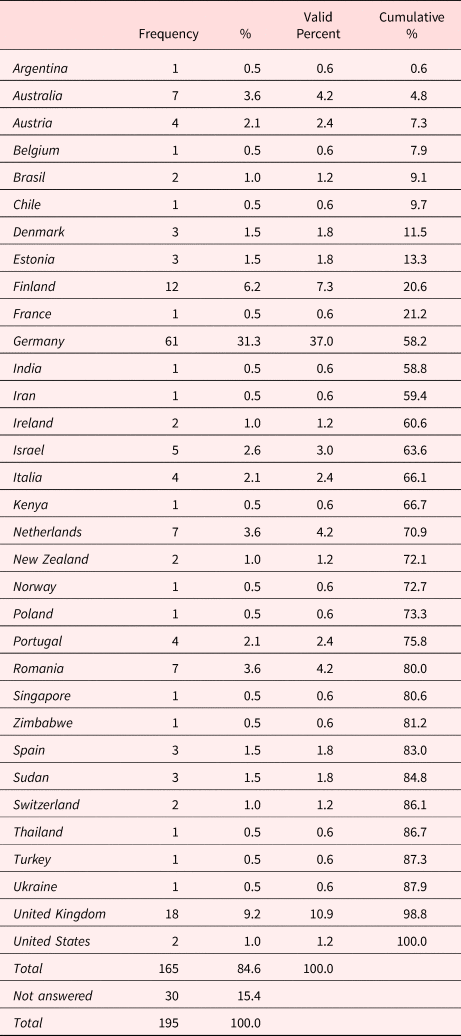
In total the survey received 893 klicks and 195 data sets were recorded, 82 of which were fully completed. Based on the overall data collected, the majority of answers were given by European palliative care experts (72.8%, n = 142). Because of the reach of the EAPC social media outlet, however, there were participants also from other parts of the world (11.8%, n = 23) and, in several cases, the country of origin was missing (15.4%, n = 30). The participating countries are listed in Table 1.
The participating countries

Participants’ professional background was recorded as nursing (35.4%, n = 69), medicine (29.2%, n = 57), researcher (4.1%, n = 8), chaplaincy (3.6%, n = 7), social worker (2.6%, n = 5), psychology (1.5%, n = 3), allied healthcare professional (1.5%, n = 3), and other (7.7%, n = 15); 14.4% (n = 28) did not answer. Place of work (multiple answers were allowed) was described as hospital (35.9%, n = 70), university (24.1%, n = 47), hospice (15.4%, n = 30), mobile care team (13.3%, n = 26), nursing home (3.6%, n = 7), and other (14.9%, n = 29), such as community-based nurse, private practice, prison, teaching facility other than university, or nongovernmental organization. A total of 45.1% (n = 88) of participants had >10 years of working experience, 21.5% (n = 42) had 5 to 10 years, and 16.4% (n = 32) had <5 years. A total of 1.5% (n = 3) chose the answer “other” and 15.4% (n = 30) didn't mention their working experience in palliative care setting.
Definition of palliative care
The majority of respondents agreed that the WHO definition (2002) is useful “to stimulate discussion and demonstrate principles and breadth of the topic” (C-379), albeit the definition might be too long, “especially for those who do not work in palliative care” (C-488). All in all, seven topics were brought out to be modified or added to the existing definition.
Education
Participants found that educating the general population and healthcare professionals about palliative care is crucial. Today, people do not want to know about the availability of palliation because of the lack of knowledge and misconceptions. A strong pledge for adding education to the current definition was made: “I miss the topic of education. In my opinion, it must be part of the definition. Palliative care without education gets lost. Education is necessary for developing quality” (C-329).
Assisting patients and caregivers
Several participants stressed the importance of companionship with patients and their families and putting the patient and family before the disease, but also educating and assisting patients and caregivers in prioritizing during the course of the disease. In every stage, respecting the preferences and choices of the unit of care was considered central, which calls for incorporating the understanding of compassion to palliative care education.
Hasten nor postpone death
In terms of palliative care outcomes (intends neither to hasten nor postpone death or affirms life), caution is needed in the educational setting because of regional differences. The prolongation of death through futile aggressive treatment was still the main concern for many respondents. One respondent noted: “Care professionals intend to postpone death, if there is any reasonable chance, and in line with my patients’ wishes” (C-462). Then again, in countries where physician-assisted death is accepted, professionals try to disconnect the goal of palliative care from the course of the illness and are arguing for good care during every stage of illness, even if cure is no longer possible. Hence, in educational setting, as one participant stated: “I sometimes mention that palliative care can have good effects on the process of the illness but I would never tell it in this way to patients” (C-858).
Multidimensional symptom management
Several comments were made about pain management. Participants felt that a more comprehensive description of all possible symptoms would be beneficial: “The phrase ‘pain and other symptoms’ brings the focus on pain and thus emphasizes physical symptoms.” It was suggested that this sentence could be replaced by: “aims to provide relief from all distressing symptoms: physical, psychological, social, and spiritual” (C-546) because problems in palliative care are often four-dimensional. Currently, the word “social” is underrepresented in the definition, which is a problem. Namely, it was reported that “patients are cared for in a social context including family and friends and they are an important part of the patient's support system whether they are in hospital, hospice, or at home” (C-517). Participants also mentioned the importance of acknowledging that sometimes pain control fails because there are no guarantees for success and that, at this point, it is crucial not to give up but provide support to the patient and family by one's presence.
Addressing anticipatory grief
Participants felt strongly about addressing anticipatory grief in palliative care education. Understanding grief is essential to avoid suicide attempts among patients. More generally, it would be vital to keep in mind the effect of grief on the caregivers’ health; hence, palliative care should extend after death, where necessary.
Life-limiting versus life-threatening illness
The answers indicated that the notion of a life-threatening illness should be discussed in educational setting: “this includes acute illness that is not typically seen as the subject of palliative care” (C-379). Several suggestions were made about replacing life-threatening illness with life-limiting illness.
Early integration
Respondents stated that early integration of palliative care means that healthcare professionals need to be ready to tell patients that “the life is running out” (C-458), but “having palliative care early postdiagnosis assists patients having the whole range of options explained and explored thoroughly and [there is] support for those decisions” (C-166). Palliation means “keeping/going along with the primary care team” (C-108). It was specified that “other specialities do not agree on the early referral to palliative care, and would delay as much as possible in referring a patient to a home care team or a mobile hospital team.” (C-734). One participant even complained: “I have often heard that we ‘steal’ the patients” (C-108), suggesting that many generalists resist incorporating palliative care into their practice.
Palliative care competencies
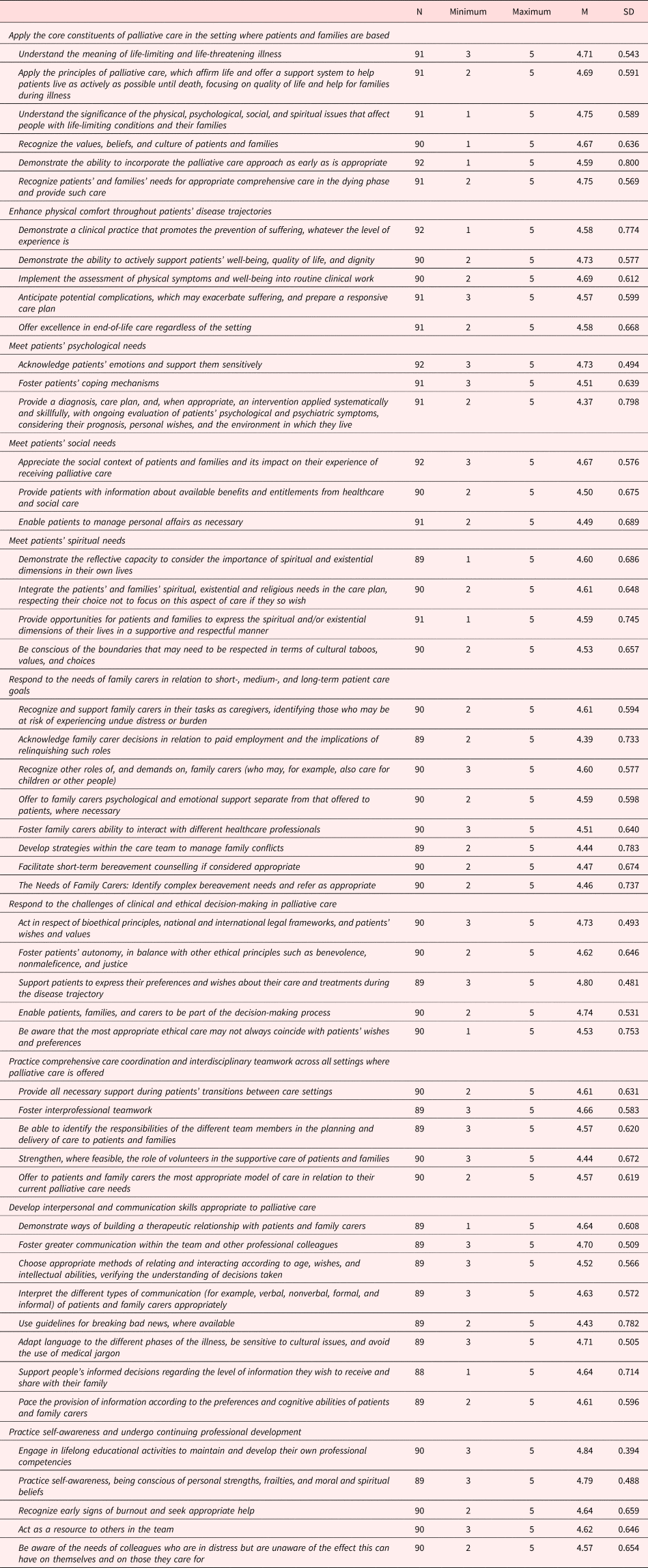
Tests to discover possible differences in preference regarding the core competencies of professional groups, (working) experience level, and workplace demonstrated no significant relationships. The descriptive analysis revealed a high agreement in palliative care competencies. The most significant finding in this context was that the detected maximum of all elements reached the highest possible score of 5. The overall results are indicated in Table 2.
Elements of palliative care education

Key learning goals for palliative care education: Knowledge
The thematic analysis revealed a wide range of learning goals. In terms of knowledge, eight subjects the generalists should be aware of were defined.
Multidimensionality of human beings
In terms of knowledge, the preamble for solid postgraduate education in palliative care is a personal maturity combined with the ability to see the bigger picture. Besides clinical competencies and universal clinical knowledge, a person trained in palliative care should have a basic knowledge of philosophy, be able to recognize different spiritual traditions and religions, understand the theory and principles of ethics, be aware of such concepts as human dignity, or the multidimensional nature of human beings. Healthcare professionals trained in palliative care should be able to recognize that, for patients and caregivers, psychosocial and spiritual aspects are mostly more important than medication. Furthermore, they should be aware about the understanding of illness and dying in different religions/spiritual backgrounds.
Accepting death
Personal maturity also reflects the ability to embrace knowledge that people die and that dying is mainly a social event with clinical implications. The ability to accept death as a natural process of life should be combined with understanding that a well-managed death is not a failure. In this regard, palliative care education should equip professionals with the ability to understand the disease trajectories, diagnose dying, and provide care for dying, which also includes awareness of what happens when someone has to say goodbye to life based on knowledge regarding grieving and bereavement.
Palliative care principles
In addition to the introduction of the WHO's definition of palliative care and palliative care principles, such as total pain, quality of life, the complexity of needs, and multidimensionality of suffering, the introductory part of any educational program should deliver the knowledge that palliative care is deeply engrained in values of humanity and thus follows the holistic care approach. To sustain the early integration of palliative care, it is essential to explain the differences and associated practice implications of the curative, disease-modifying and palliative approaches to care so that the healthcare professionals could learn when to start with palliative care, who is eligible for palliative care, when is palliative care indicated and what is good palliative care. For enabling good end-of-life care, the levels of palliative care provision should be explained following national and international standards, which means introducing policies, guidelines, and state of the art in terms of useful tools and instruments.
Assessment, control and management
In terms of knowledge, it is essential to identify key aspects of symptom assessment and management and to know how to combine the full range of therapeutic care to reduce or eliminate pain, breathlessness, and other concerns emerging in the early stages of the disease. Symptom management should not be only physical, but always also holistic. Healthcare professionals should understand that at the end of life, as one participant puts it, “less is more for most therapies and typically very simple and cheap mediums or ideas can be so helpful” (C-510). The awareness of the limitations of any treatment is equally important in the basic understanding of palliative symptom management and control.
Communication
The competence of communicating (read: the importance of talking to people), starting with communication theories and guidelines for breaking bad news and ending with active listening strategies, should inform healthcare professionals about how to assess and discuss the key strategies and challenges to define the goals of care in alignment with prognosis, treatment options, and patient's wishes.
Patient and caregiver support
In terms of patients’ and caregivers’ needs, healthcare professionals should be informed that every patient needs an individual treatment plan; hence, awareness of patient and family issues, such as family support and family support needs, should be integrated into the curricula. Healthcare professionals should learn to look for the patient's quality of life in every situation, respect patient's integrity and wishes, assess the sorrow [grief] of the patient and the family, and make a genuine effort to spend time with them.
Taking care of self
Self-care and self-reflection are essential parts of palliative care education. To be a clinician in palliative care, healthcare professionals should be equipped with knowledge of self-care, how to increase self-awareness, and why it is essential to reflect before taking any action. Working with one's own [spiritual] biography for increased self-awareness promotes the understanding of one's role as a professional in supporting the patient in all dimensions of palliative care and finding the way to provide this care in a personalized way that “fits” the innate human nature of the practitioner.
Shared decision-making
An equally relevant part of knowledge concerns decision-making as a result of transdisciplinary approach, communication, and planning. To draw a multidimensional, multidisciplinary action plan incorporating the goals of the patient, the importance of teamwork and the roles of the multidisciplinary team should be presented and explained. This also involves teaching about accessing specialist services and how to integrate these services into traditional care in preferred surroundings throughout terminal care and grief.
Key learning goals for palliative care education: Skills
Besides knowledge, the analysis revealed five skills: personal, communication, assessment and care planning, symptom management, and self-reflection as most relevant skills in palliative care education.
Personal skills
In terms of personal skills, the healthcare professional should exhibit traits of empathy, compassion, humanity, and humility. A content palliative care provider should perceive the ability to apply clear ethical principles, have good caring and clinical skills, and be both sensitive and hands on at the same time.
Communication skills
Every palliative care provider should be able to communicate effectively and sensitively with patients, families, carers, and colleagues regarding palliative and end-of-life issues, including breaking bad news, transition from the curative to palliative care approach, and discussing the goals of care (advance care planning). Good communication starts with the ability to be present and able to listen to the patients at the same time as building a relationship. The communication style should be respectful, creating an atmosphere of acceptance and trust. Furthermore, the professional should be able to comprehend the atmosphere in the patient's room and react to it adequately. Careful, nonjudgmental listening should help to explore how the four dimensions of palliative care play a role in the perceived discomfort. Good communication between different professions is equally relevant and should be encouraged, particularly in terms of shared decision-making and care planning.
Care planning based on needs assessment
Another important skill in palliative care regards drawing up the best care plan for the dying person and her or his loved ones. This begins with identifying when palliative care is needed; thereafter, all clinicians should be able to complete a comprehensive pain assessment, identify palliative care needs, and assess suffering to manage any physical, psychological, emotional or spiritual symptoms not only in adults, but also in children. In this context, interdisciplinary teamwork competencies need to be also addressed to learn when to refer to another discipline.
Symptom management skills
Healthcare professionals should understand how to manage pain and other complex symptoms. This involves practicing when to prescribe and how to use different drugs such as strong analgesics and specifically opioids, when to use oxygen and when not, understanding the (sometimes damaging) impact of nutrition and infusion at the end of life. And above all, practice providing high quality care to the imminently dying patient and their family, where staying with the patient, distress and discomfort management might prove to be most difficult.
Self-reflection skills
To be a skilled practitioner, one needs to have in place a well-developed emotional intelligence and effective self-management and -care strategies. In other words, being able to put things into perspective and respect own limits, being willing to reflect on own attitudes and experiences.
Key learning goals for palliative care education: Attitudes
Regarding attitudes, palliative care education may provide information for individual and professional growth; therefore, learners should comprehend the following.
Palliative care offers comfort
In terms of attitudes, healthcare professionals should be trained to grasp that palliative care is a human right that offers comfort based on patient's needs. Palliative care is not just about pain control; thus, it should be combined with cultural aspects and the depth and importance of a patient's spirituality. Professionals should learn that palliative care is not only for those considered terminally ill, because the centerpiece of palliative care is treating patients with advanced diseases and maintaining patients’ and caregivers’ quality of life, by recognizing when to refer to specialist palliative care.
Acceptance of nonideal outcomes
Respecting life and accepting death as part of life by acknowledging that everything that is born will die (thus, not everything can be cured), there will be outcomes that are less than ideal and that healthcare providers cannot save all patients. The most important part is to recognize when life-sustaining/prolonging treatment is futile and no longer in line with the patient's and family's wishes.
Assisting the patient and caregivers
Assisting the patient and his or her family begins with active listening and building relationships in the environment of approaching death. The healthcare professional should become a care advocate, addressing patient care needs where gaps exist whilst being simultaneously respectful of a diverse range of cultural and religious beliefs even if these differ from his or her own. Personal engagement and nonabandonment encourages and helps to maintain the dignity in every situation.
Acceptance of autonomy
Professionals should accept the patient's and family's autonomy in decision-making and make an effort to understand the patient's right to make personal choices in all matters. Accordingly, the care should be genuinely guided by the patient. Professionals should care that every patient is unique and has an inherent dignity and respect that his or her mood and attitudes or decisions may oscillate. Respecting dignity and autonomy means going with the needs of the patient not with guidelines. Furthermore, it means being open to different worldviews and cultures because, for example, the spirituality of the patient and family may differ from that of professional caregivers, but is nevertheless valid and valuable. A professional needs to make an effort to remain nonjudgmental because a patient-centered care approach focuses on the perception and wishes of the patient and loved ones.
Willingness to develop oneself as a helper
Healthcare professionals should demonstrate the willingness to develop oneself as a helper or an assistant by being open-minded and assessing, reassessing, and reviewing self and one's decisions. Being respectful to everybody takes honesty, humility, humor and empathy, compassion, dedication, and discretion. A professional must have a positive attitude to emphasize feelings; in other situations, staying calm and in control of own emotions might be equally beneficial. Patience and human approach make good palliative care not only professional, but also being able to say “I don't know but I will not abandon you” (C-164).
Value the roles of all interdisciplinary team members
A professional attitude in palliative care is adopted when people learn to share their responsibilities and understand that they cannot control everything: “I will offer my skills and resources, but I am not responsible for the patients' illness and suffering” (C-444). It means respecting the autonomy of patients, relatives, and other professionals. Recognizing that referral to palliative care does not mean a failure, is a priority. Palliative care is teamwork; thus, professionals should value the roles of all interdisciplinary team members. This should be demonstrated by shared decision-making as well as supporting and teaching colleagues.
Teaching methods and strategies
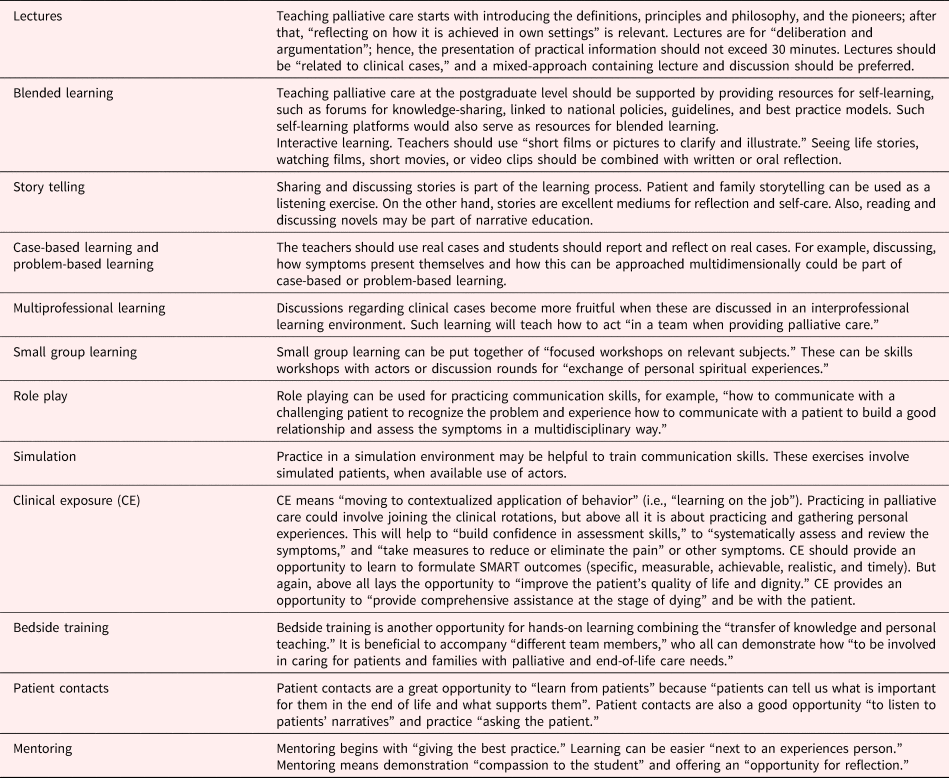
A great number of teaching methods was provided by respondents. The list of different methods is extended with participants’ comments to provide the opportunity to reassess and revise the existing approaches or gain ideas for selecting new ones. Teachers should bear in mind that “student-centered teaching is a CORE to patient- and carer- centered clinical care” (C-934) and it is essential to “talk about palliative care on all hospital departments” (C-510). A toolbox of various teaching methods is provided in Table 3.
Toolbox of teaching methods

Providing space for reflection should be seen as the most important part of teaching. The reflection may begin with a worksheet to reflect on your own thinking about death, or with a revision of past experiences to awaken the awareness about personal bias. Sometimes it might be important to let people express their own core attitudes toward existential issues or to share their experiences with total pain, dying, and death. Experiences of success and limitations professional caretakers see in their own job might be the key for learning success; therefore, talking about the experiences with patients and problems encountered or discussing the experiences with death as a professional caregiver should be maintained. Every lesson and exercise should provide an opportunity for reflecting and sharing. This can be arranged as an exchange with experienced staff, reflective writing session, or small group discussion. The participatory aspect is an essential part of learning; hence, inquiring students about their wishes, questions, or unmet needs is a must. Sharing personal experience and practice is important – telling students: “this is how I work” (C-546) and then discussing the approaches and efforts of the students to help them on their journey.
The teacher's role in palliative care education
The essential role of the teacher in the overall learning process became evident. The teacher should be respectful of where students are in terms of their learning but also personally, consider their cultural, religious, or spiritual beliefs. A good teacher should be able to run and manage the session, create awareness, and, if necessary, reduce student's anxiety. During teaching sessions, the role of the teacher should change in accordance with the learner's needs. All in all, a good teacher should aim for the following five competencies.
1. Organize the learning. Teacher should encourage deep learning through interactive engagement and reflective activities, stimulate critical thinking, and guide students to the source of knowledge. This means organizing the information presented, preparing the layout for the session and other teaching materials focusing on the goals of care, promoting multidisciplinary approach, demonstrating the appreciation of family and caregivers, and showing benefits of palliative care. The teacher should be able to deliver didactic content in a stimulating way using a variety of teaching methods, which means being familiar with interactive (online and web-based teaching procedures), triggering reflective learning opportunities and be able to design the pre- and posttests to assess learners’ readiness and the knowledge attained.
2. Knowing the field and state of the art. Besides having passed the train-the-trainer course, the teacher should have the necessary knowledge, competence, and experience in palliative care. This means having teamwork experience and understanding of the people's working environment. Expertise and up-to-date knowledge in the subject are essential. In some subjects, the teacher should also know which issues the group is trying to avoid. Generalist-level palliative care teaching “should concentrate on not expensive and not complicated care, and supporting basic palliative care level competencies in accordance with the curricular background of the topic regarded” (C-388).
3. Being ready to learn. A good teacher should be inspiring, encourage interaction, and help students to reflect by listening, questioning, and asking. The teacher should be attentive and respectful, allowing expression of feelings whilst confronting behavior relating to poor attitudes. In a classroom context, the teacher should be creative and open to impromptu changes, which may take place when a space for diversity is created. A good teacher is a teacher who is always open to learning from the student.
4. Teaching and leading by example. The teacher should be a coach, facilitator, critical friend, mediator, mentor, and role model throughout the learning process. This means having the flexibility to move between teaching, training, coaching, and mentoring as the learner advances. A good mentor is kind, lends support in accepting the uncertainty, provides emotional support, and guides the learning process by example.
5. Being real. The teacher should be authentic and warm-hearted, embodying and living the principles of palliative care. Besides being enthusiastic about the subject, a good teacher carries with him- or herself a certain amount of humility, passion, and modesty; has a good sense of humor; and is able to touch people emotionally.
Performance assessment
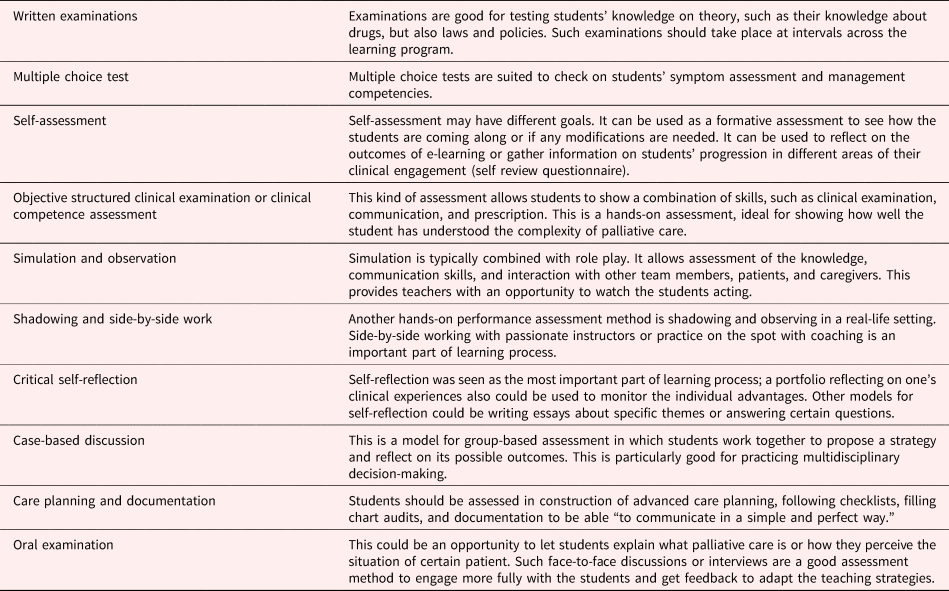
Participants admitted that performance assessment is a very difficult subject and therefore, before deciding on any assessment strategies, it should first be established where the learners are in their learning curve. At the postgraduate level, students should see the benefit of palliative care first and then make an effort to approach the service organizations, build personal and organizational networks, and, as a well-trained professional, look for possible resources and solutions at any situation. Different options for performance assessment are listed in Table 4.
Toolbox of performance assessment methods

Discussion
The aging populations are desperate for innovative and person-centered health solutions. By 2050, the share of the global population is projected to rise by 16%, with the segment ages 85+ and older growing the fastest (PRB, 2018). With the rapid rise nongovernmental organizations, chronic diseases, geriatric conditions, and multimorbidity have become an emerging priority for global health research. However, their implications on end-of-life care are still unclear and understudied (Bone et al., Reference Bone, Evans and Higginson2018). It has been estimated that because of the population shift, the deaths will become more complex. A recent simulation from England (PASCim) projected the rise in multimorbidity by 2035, where people are confronted with four and more diseases, of which two-thirds will be mental ill health, such as dementia, depression, or some other cognitive impairment (Kingston et al., Reference Kingston, Robinson and Booth2018). In the upcoming years, the ill health will be combined with severe social impairments, such as isolation and loneliness, and/or high economic burden resulting falling in poverty.
The recent WHO meeting in Tallinn (2018) for health ministers, policy makers in health and finance, patient organizations, and academic advisers in the European region agreed that health systems have been slow to innovate in many countries, but that it is important to strive for continuous improvement. The main takeaway from the meeting was to strive for innovations in healthcare for the benefit of the population (Lancet, 2018). Palliative care approach is a person-centered and innovative healthcare solution that benefits patients, their caregivers, and healthcare providers. The current lack of global indicators for palliative care development is a severe impediment to the inclusion of palliative care within global efforts toward universal health coverage (Centeno et al., Reference Centeno, Sitte and De Lima2018; Sleeman et al., Reference Sleeman, Leniz and Higginson2018), and thus, the provision of palliative care education is merely an initiative of pioneers (Noguera et al., Reference Noguera, Bolognesi and Garralda2018). The prognosis for the European region predicts a pressing need for development of transdisciplinary and multiprofessional palliative care services. This cannot be reached without investing in high-quality education (Rhee et al., Reference Rhee, Foley and Morrison2018, Walker et al., Reference Walker, Gibbins and Paes2017, Berendt et al., Reference Berendt, Steigleder and Van Oorschot2018).
It is a supreme time to bridge the specialist generalist gap in palliative care (Greenstreet, Reference Greenstreet2005) and make clear that (1) all healthcare professionals are responsible for providing palliative care and (2) palliative care must be integrated soon after diagnosing the life-threatening condition. The early integration of palliative care means that “patients undergo a systematic and integrated care process, meant to improve their life quality, which includes multidimensional assessment of their needs, recognition of their values and preferences for advance care planning purposes, treatments review, family care, and case management” (Gómez-Batiste et al., Reference Gómez-Batiste, Blay and Broggi2018). Healthcare professionals need to comprehend that early integration of palliative care is not “loss of care and curative options” nor “opting for cheaper solutions” (Gómez-Batiste et al., Reference Gómez-Batiste, Blay and Broggi2018), but is “an important component of integrated treatment for young and old throughout the life course” (WHO, 2014).
In this study, we asked clinicians and educators to comment on the WHO's definition of palliative care (2002) and its practicality when explaining what palliative care stands for. The participants agreed that the definition is useful, although possibly too long for generalists. Seven topics needing further elaboration were pointed out, as follows: education, assisting patients and caregivers, hastening nor postponing death, multidimensional symptom management, addressing anticipatory grief, life-limiting versus life-threatening illness, and early integration. These additions point out that as the field of palliative care is evolving, the definition might also need to be revised. To enhance the educational aspect of palliative care, it would be crucial to include education to the definition.
Furthermore, the study evaluated the EAPC core competencies (Gamondi et al., Reference Gamondi, Larkin and Payne2013) for the first time since these were published in 2013. The statistical analysis revealed an overall high agreement regarding the elements of palliative care education, which indicates that the core competencies introduced in EAPC's White Paper have been accepted as an essential part for palliative care education. Despite the high overall scores, some areas (i.e., recognizing the values, beliefs, and culture of patients and families; building a therapeutic relationship with patients and family carers; being aware that the most appropriate ethical care may not always coincide with patients’ wishes and preferences; or considering the importance of spiritual and existential dimensions in individual lives) were scored as irrelevant by several respondents. Therefore, we suggest that EAPC taskforces and reference groups carefully look at and, if necessary, revise these elements because this could help set better overall learning goals when planning future training.
Because the list of core competencies is not developed for generalists, this paper proposes four palliative care competencies relevant at generalist level for all healthcare providers.
1. Need to comprehend the palliative care philosophy
a. Knowledge: Multidimensionality of human-being; Accepting death; Palliative care principles.
b. Skills: Personal skills.
c. Attitudes: Palliative care offers comfort; Acceptance of nonideal outcomes.
2. Need the ability to demonstrate the complex symptom assessment and management competencies
a. Knowledge: Assessment, control, and management. Shared decision-making.
b. Skills: Symptom management skills.
c. Attitude: Assisting the patient and caregivers.
3. Need to be able to design care plans accordingly to patients’ and families’ wishes integrating multiprofessional and interdisciplinary approaches
a. Knowledge: Communication; Patient and caregiver support.
b. Skills: Care planning based on needs assessment.
c. Attitude: Acceptance of autonomy; Value the roles of all interdisciplinary team members.
4. Need to be able to listen and self-reflect
a. Knowledge: Taking care of self.
b. Skills: Communication skills; Self-reflection skills.
c. Attitude: Willingness to develop oneself as a helper.
Considering the amount of competencies medical, nursing, and allied professionals are expected to be trained in, we suggest integrating palliative care aspects into already existing curricula and performance assessments as much as possible. Themes surrounding death and dying, the importance of comprehensive symptom relief or accepting death as inevitable outcome, for example, should be introduced and discussed alongside with learning about applying appropriate decision-making models. The learning should also incorporate transdisciplinary approaches to demonstrate the value of multidisciplinary collaboration, one of the strengths of palliative care. At the same time, each healthcare provider should learn to listen to proposed care paths that respect patients’ and their caregivers’ values and needs (Densen, Reference Densen2011; Brighton & Bristowe, Reference Brighton and Bristowe2016; Brighton et al., Reference Brighton, Koffman and Hawkins2017). Listening and self-reflection are essential parts of this comprehensive practice.
According to the recent Palliative Care Roadmap “to facilitate the uptake of palliative care education and stress its importance, questions on palliative care should be included in undergraduate and postgraduate examinations that are required for certification and licensure” (Callaway et al., Reference Callaway, Connor and Foley2018). Respondents pointed out that performance assessment remains a very difficult subject and this area of palliative care education certainly needs further investigation. Until now, at a generalist level, the training goals are being met when (1) a healthcare professional acknowledges the benefit of integrating palliative care into healthcare services and (2) is ready to make an effort, look for resources, and build networks at organizational and personal levels. Hence, to design meaningful educational programs to meet the future challenges of healthcare systems, more research, innovation, creativity, and joint effort is needed.
Last, the extensive list of personal and professional qualities expected from a teacher underlined the need for leadership and train-the-trainer programs (Hauser et al., Reference Hauser, Preodor and Roman2015; Kang et al., Reference Kang, Yang and Chang2015; Widger et al., Reference Widger, Friedrichsdorf and Wolfe2016). The results revealed that a good teacher should organize the learning in a stimulating way; know the field; be ready to learn, teach, and lead by example; and be real. The teacher should be a coach, facilitator, critical friend, mediator, mentor, and role model throughout the learning process (Paal, Reference Paal2018). This means having the flexibility to move between teaching, training, coaching, and mentoring as the learner advances. Perhaps the greatest challenge for educators is creating safe learning environments because it the world is complex, and not only the patients, but also the practitioners are vulnerable, broken, and sometimes plain tired.
Limitations of the study
The idea of this survey was to evaluate the EAPC core competencies for the first time since they were published in 2013; therefore, part C of the survey was very long and not particularly user-friendly. As a result, some participants gave up at this point. Others commented that all competencies are equally important and thus there is no point evaluating those on a 5-item scale. The survey was designed for a multidisciplinary learning environment, which has proven most beneficial in palliative care education (Head et al., Reference Head, Schapmire and Hermann2014, Reference Head, Schapmire and Earnshaw2016; Kaasalainen et al., Reference Kaasalainen, Brazil and Kelley2014; Wittenberg-Lyles et al., Reference Wittenberg-Lyles, Goldsmith and Ferrell2014), and thus should be promoted at the postgraduate level. For some participants, this did not appear specific enough. The survey was designed so that participants could skip items, which led to missing data and inconsistencies in total numbers and percentages. This does not create any inconsistency in the presented results because descriptive statistics was used, indicating the percentages, total numbers, and missing per question. The survey was carried out in English, which was a barrier for many. When distributing the survey, we encouraged people to use their mother tongue; for example, some answers were given in German. The qualitative data were analyzed by one experienced researcher. The selected output method (narrative synthesis) was selected to give readers the possibility of comprehending the rich scope of the data this survey provided.
Conclusions
This paper contains a new and comprehensive list of competencies (knowledge, skills, and attitudes) essential for multidisciplinary palliative care education at the generalist level. It highlights the relevant teaching goals and provides best practice toolboxes containing practice-proven teaching and assessment methods. It demonstrates the importance of a teacher's role for assuring high-quality education in this still-developing field of person-centered healthcare systems. Comprehending that the work on introducing palliative care education is ongoing; we hope that the rich data presented in this paper helps to design locally and globally meaningful curricula.
Acknowledgments
The authors acknowledge all clinicians and educators who contributed to this survey. We equally thank EPICC Strategic partners (www.epicc-project.eu) who kindly permitted us to modify and use their initial survey for this study.